

NATIVE PLACE
INTRODUCTION
AREA AND PRODUCTION
CLIMATE
VARIETIES
LAND PREPERATION
SOWING TIME$METHOD
FERTILIZER @ IRRIGATION
PLANT PROTECTION
BREEDING METHOD
OBJECTIVES
CONTENTES
INTRODUCTION
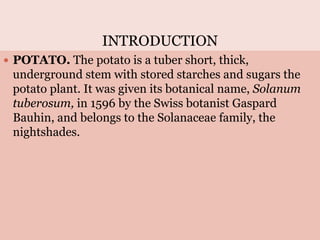
 POTATO. The potato is a tuber short, thick,
underground stem with stored starches and sugars the
potato plant. It was given its botanical name, Solanum
tuberosum, in 1596 by the Swiss botanist Gaspard
Bauhin, and belongs to the Solanaceae family, the
nightshades.
Native Place
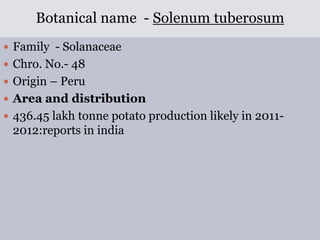
Botanical name - Solenum tuberosum
 Family - Solanaceae
 Chro. No.- 48
 Origin – Peru
 Area and distribution
 436.45 lakh tonne potato production likely in 2011-
2012:reports in india
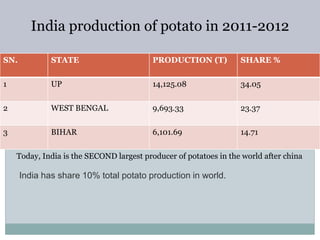
India production of potato in 2011-2012
SN. STATE PRODUCTION (T) SHARE %
1 UP 14,125.08 34.05
2 WEST BENGAL 9,693.33 23.37
3 BIHAR 6,101.69 14.71
Today, India is the SECOND largest producer of potatoes in the world after china
India has share 10% total potato production in world.
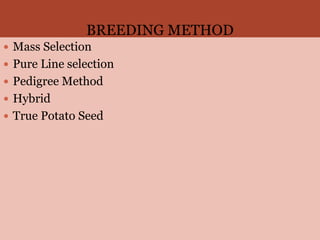
BREEDING METHOD
 Mass Selection
 Pure Line selection
 Pedigree Method
 Hybrid
 True Potato Seed
OBJECTIVES
 Higher tuber yield.
 Better keeping quality.
 Better resistance against disease and pests.
 Less sensitive to the environment.
 Resistant to heat drought frost and soil salinity.
 Better quality tubers.
Climate
 Potato is basically a temperate crop.
 Optimum temperature for potato growth ranges from 15
to 250C. Temperature below 210C favours tuberization.
 Soil:-
Potato is grown in all types of soils, but light, well-
drained sandy loam soils are best-suited
pH 5.5 - 6.0.
Land preparation
Potato field must be properly labelled with proper surface
drianage. Six or seven ploughings and planking are required to
make the soil loose, friable and porous.
Seed rate
In general, 15-20 q large whole tubers, 10-15 q medium-sized tubers, 8-
10 q small size tubers and 6-8 q cut tubers are required for 1 ha area.
Tubers should be medium-sized, 40-50 g in weight, 40-45 mm in
diameter and disease-free tubers should be preferred.
Source of seed obtain breeder’s or Foundation Seed from and
approved source.
All hand cut pieces should weigh
between 1 and 2 oz.
Hand-cut seed pieces.
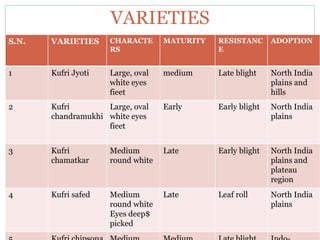
VARIETIES
S.N. VARIETIES CHARACTE
RS
MATURITY RESISTANC
E
ADOPTION
1 Kufri Jyoti Large, oval
white eyes
fieet
medium Late blight North India
plains and
hills
2 Kufri
chandramukhi
Large, oval
white eyes
fieet
Early Early blight North India
plains
3 Kufri
chamatkar
Medium
round white
Late Early blight North India
plains and
plateau
region
4 Kufri safed Medium
round white
Eyes deep$
picked
Late Leaf roll North India
plains
Sowing Time
Early- Sep.-First Weak Oct.
Mid- Oct.- First Weak Nov.
Late- Nov.-Mid Dec.
Isolation Distance
Foundation Seed -5 m.
Certified Seed - 5 m
Hybrid Seed - 50 m
Sowing method
 It is sown either on ridges or in flat beds.
Sowing on ridges gives higher yield. In
Maharashtra, Karnataka and some parts of
Uttar Pradesh flat bed sowing is also done.
Spacing between each row is kept 15-22 cm
while the spacing for ridges may vary from
45-60 to 75 cm row-to-row and 15-22 cm
from plant-to-plant according to variety and
time of sowing.
Fertilizers
 FYM 100-150Kg/hac.
 Nitrogen- 80-100Kg/hac.
 Phosphorus- 80-100Kg/hac.
Seed Treatment:-
Treated With 0.25% Areton Dipping for 5 minutes before
sowing.
FIRST IRRIGATION IS GIVEN AFTER THE
EMERGENCE. DEPENDING UPON THE TYPE OF
SOIL AND VARIETY , 5-10 IRRIGATIONS ARE
NEEDED.
IRRIGATION
Earthing - After 30-35 days of sowing
earthing are done
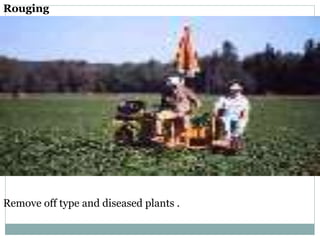
Rouging
Remove off type and diseased plants .
WEED CONTROL - AFTER 30-35 DAYS OF
SOWING , WEEDING DONE. SPRAYING 2 KG.
OF SIMEZINE PER HECTARE.
Plant Protection
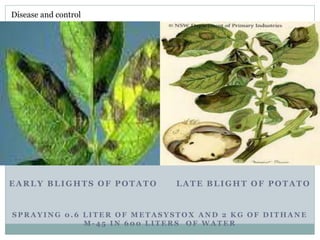
EARLY BLIGHTS OF POTATO LATE BLIGHT OF POTATO
S P R A Y I N G 0 . 6 L I T E R O F M E T A S Y S T O X A N D 2 K G O F D I T H A N E
M - 4 5 I N 6 0 0 L I T E R S O F W A T E R
Disease and control
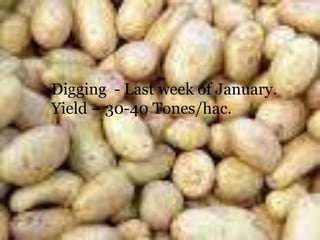
Digging - Last week of January.
Yield – 30-40 Tones/hac.
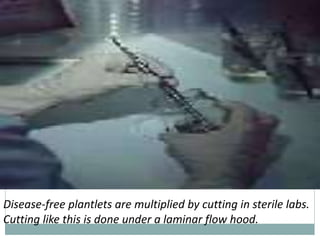
Disease-free plantlets are multiplied by cutting in sterile labs.
Cutting like this is done under a laminar flow hood.
Tissue-culture plantlets are propagated in
sterile rooms in on-farm laboratories.
Seed growers plant tissue-cultured plantlets in greenhouses to produce
nuclear tubers that will be planted in the he field the following year.
K . L . C H D H A A N D J . S . G R E W A L A D V A N C E I N H O R T I C U L T U R
V O L . 7 – P O T A T O . P . N . 3 5 - 4 9 M A L H O T R A P U B L . , N E W D E L H I .
S I N G H . C H H I D D A . , A N D E T A L . , 2 0 0 9 M O D E R A N T E C H N I Q U E S O F
R A I S I N G F I E L D C R O P ’ S S E C O N D E D I T I O N P . N . 5 0 1 - 5 1 8
O X F O R D A N D I B H P U B L I C A T I O N C O . P V T . L T D . N E W D E L H I
REFERENCE
seed production of potato

seed production of potato

  • 1.
    NATIVE PLACE INTRODUCTION AREA ANDPRODUCTION CLIMATE VARIETIES LAND PREPERATION SOWING TIME$METHOD FERTILIZER @ IRRIGATION PLANT PROTECTION BREEDING METHOD OBJECTIVES CONTENTES
  • 3.
    INTRODUCTION  POTATO. Thepotato is a tuber short, thick, underground stem with stored starches and sugars the potato plant. It was given its botanical name, Solanum tuberosum, in 1596 by the Swiss botanist Gaspard Bauhin, and belongs to the Solanaceae family, the nightshades.
  • 4.
  • 5.
    Botanical name -Solenum tuberosum  Family - Solanaceae  Chro. No.- 48  Origin – Peru  Area and distribution  436.45 lakh tonne potato production likely in 2011- 2012:reports in india
  • 6.
    India production ofpotato in 2011-2012 SN. STATE PRODUCTION (T) SHARE % 1 UP 14,125.08 34.05 2 WEST BENGAL 9,693.33 23.37 3 BIHAR 6,101.69 14.71 Today, India is the SECOND largest producer of potatoes in the world after china India has share 10% total potato production in world.
  • 7.
    BREEDING METHOD  MassSelection  Pure Line selection  Pedigree Method  Hybrid  True Potato Seed
  • 8.
    OBJECTIVES  Higher tuberyield.  Better keeping quality.  Better resistance against disease and pests.  Less sensitive to the environment.  Resistant to heat drought frost and soil salinity.  Better quality tubers.
  • 9.
    Climate  Potato isbasically a temperate crop.  Optimum temperature for potato growth ranges from 15 to 250C. Temperature below 210C favours tuberization.  Soil:- Potato is grown in all types of soils, but light, well- drained sandy loam soils are best-suited pH 5.5 - 6.0.
  • 10.
    Land preparation Potato fieldmust be properly labelled with proper surface drianage. Six or seven ploughings and planking are required to make the soil loose, friable and porous. Seed rate In general, 15-20 q large whole tubers, 10-15 q medium-sized tubers, 8- 10 q small size tubers and 6-8 q cut tubers are required for 1 ha area. Tubers should be medium-sized, 40-50 g in weight, 40-45 mm in diameter and disease-free tubers should be preferred. Source of seed obtain breeder’s or Foundation Seed from and approved source.
  • 11.
    All hand cutpieces should weigh between 1 and 2 oz. Hand-cut seed pieces.
  • 12.
    VARIETIES S.N. VARIETIES CHARACTE RS MATURITYRESISTANC E ADOPTION 1 Kufri Jyoti Large, oval white eyes fieet medium Late blight North India plains and hills 2 Kufri chandramukhi Large, oval white eyes fieet Early Early blight North India plains 3 Kufri chamatkar Medium round white Late Early blight North India plains and plateau region 4 Kufri safed Medium round white Eyes deep$ picked Late Leaf roll North India plains
  • 13.
    Sowing Time Early- Sep.-FirstWeak Oct. Mid- Oct.- First Weak Nov. Late- Nov.-Mid Dec. Isolation Distance Foundation Seed -5 m. Certified Seed - 5 m Hybrid Seed - 50 m
  • 14.
    Sowing method  Itis sown either on ridges or in flat beds. Sowing on ridges gives higher yield. In Maharashtra, Karnataka and some parts of Uttar Pradesh flat bed sowing is also done. Spacing between each row is kept 15-22 cm while the spacing for ridges may vary from 45-60 to 75 cm row-to-row and 15-22 cm from plant-to-plant according to variety and time of sowing.
  • 15.
    Fertilizers  FYM 100-150Kg/hac. Nitrogen- 80-100Kg/hac.  Phosphorus- 80-100Kg/hac. Seed Treatment:- Treated With 0.25% Areton Dipping for 5 minutes before sowing.
  • 16.
    FIRST IRRIGATION ISGIVEN AFTER THE EMERGENCE. DEPENDING UPON THE TYPE OF SOIL AND VARIETY , 5-10 IRRIGATIONS ARE NEEDED. IRRIGATION Earthing - After 30-35 days of sowing earthing are done
  • 17.
    Rouging Remove off typeand diseased plants .
  • 18.
    WEED CONTROL -AFTER 30-35 DAYS OF SOWING , WEEDING DONE. SPRAYING 2 KG. OF SIMEZINE PER HECTARE. Plant Protection
  • 19.
    EARLY BLIGHTS OFPOTATO LATE BLIGHT OF POTATO S P R A Y I N G 0 . 6 L I T E R O F M E T A S Y S T O X A N D 2 K G O F D I T H A N E M - 4 5 I N 6 0 0 L I T E R S O F W A T E R Disease and control
  • 20.
    Digging - Lastweek of January. Yield – 30-40 Tones/hac.
  • 21.
    Disease-free plantlets aremultiplied by cutting in sterile labs. Cutting like this is done under a laminar flow hood.
  • 22.
    Tissue-culture plantlets arepropagated in sterile rooms in on-farm laboratories.
  • 23.
    Seed growers planttissue-cultured plantlets in greenhouses to produce nuclear tubers that will be planted in the he field the following year.
  • 24.
    K . L. C H D H A A N D J . S . G R E W A L A D V A N C E I N H O R T I C U L T U R V O L . 7 – P O T A T O . P . N . 3 5 - 4 9 M A L H O T R A P U B L . , N E W D E L H I . S I N G H . C H H I D D A . , A N D E T A L . , 2 0 0 9 M O D E R A N T E C H N I Q U E S O F R A I S I N G F I E L D C R O P ’ S S E C O N D E D I T I O N P . N . 5 0 1 - 5 1 8 O X F O R D A N D I B H P U B L I C A T I O N C O . P V T . L T D . N E W D E L H I REFERENCE