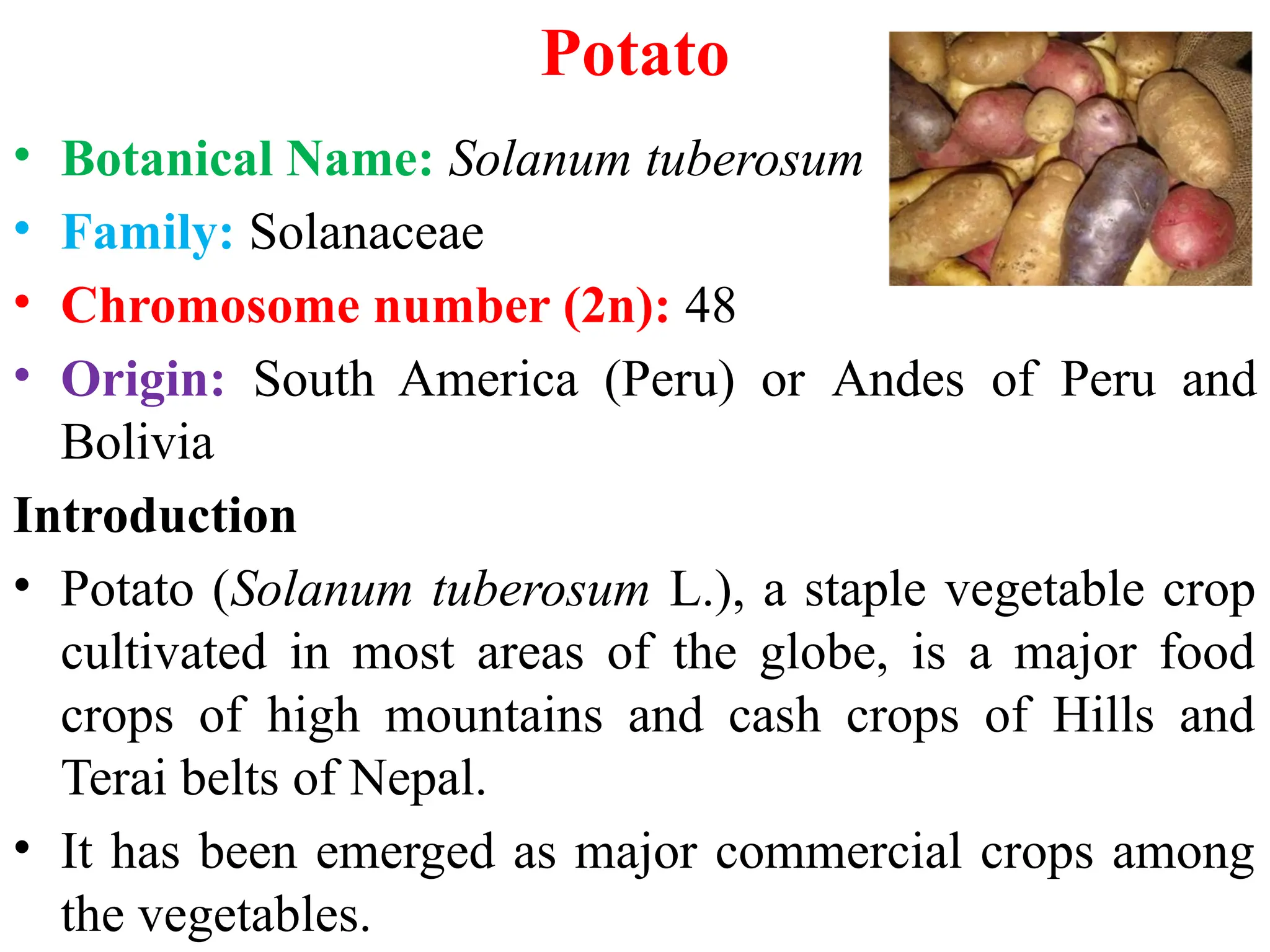
Potato
• Botanical Name:Solanum tuberosum
• Family: Solanaceae
• Chromosome number (2n): 48
• Origin: South America (Peru) or Andes of Peru and
Bolivia
Introduction
• Potato (Solanum tuberosum L.), a staple vegetable crop
cultivated in most areas of the globe, is a major food
crops of high mountains and cash crops of Hills and
Terai belts of Nepal.
• It has been emerged as major commercial crops among
the vegetables.
2.
Uses
• As astaple crop, it enhances the livelihood and
food security of poor farmers and is also a way out
of poverty.
• It is a nutritious food that contains carbohydrates
(17%), proteins (2%), adequate vitamins B and C
and high quality nutritional fiber.
• It is used as vegetable and in industries for
manufacturing starch, alcoholic beverages and other
processed products like French fries, chips etc.
• Edible part is tuber ( underground stems),also called
stolons)
3.
Distribution
• It ranksin first place among vegetables in
terms of area and production in the world.
• Staple food of almost half of the world
population and ranked fourth after rice,
maize and wheat.
• Cultivation is more popular in Europe and
Latin America than others parts of world
• China ranks first in terms of production
4.
Area and Production
•In Nepal, it is sixth most important crop in terms of area,
third in terms of production and second in terms of
productivity.
• This cash crop is popular crop in Nepal due to its wider
adoptability, high yield potential and high demand and
contributing about 6.57 and 2.17 percent respectively in
AGDP and GDP.
• It is grown in all 77 districts of Nepal and its production is
increasing rapidly in recent years due to quality researches,
effective dissemination and climatic diversity permits year
round cropping from terai (plains) to high hills (4400masl).
• Major potato growing districts: Kavre, Bara, Jhapa,
Solukhumbu, Illam, Khotang etc.
Botany:
• Annual herb
•Propagation by seeds tubers
(stolen)
• Stem are green, leaves are
compound with opposite leaflets
• Height ranges from one-two feet
depending upon variety
• Fruit type is berry, seeds are similar to the seed of
mustard
7.
Important varieties:
Janak dev,Kufri Jyoti, Khumal Laxmi Khumal
Seto-1, Khumal rato-4 for Mid and high hills
Kufri Sindhuri, Dejire,, Khumal Rato-2, Khumal
Rato-3, Kufri Bahar, Cardinal, IPY-8 for Terai
region
Local varieties:
Kathmandu Local: for Kathmandu Valley
Sarkari Seto: Eastern Hills
Jumli Local: Mid west hills
Tharu Local: Mid and west Terai
Syangdorge: Eastern Hills
Varieties
10.
Varietie
s
Varieties Recommend domainMaturity days
1. Cardinal Terai, valley
and midhills
90 – 120
2. NPI-106 Mid and high hills 100 -120
3. Kurfi Badhshah Terai 70 - 90
4. Tharu Local Mid and western terai 90 - 120
5. Kathmandu Local Kathmandu valley 100 - 110
6. CFM-69.1 Mid and high hills 110 - 120
7. GI-1124 Mid and high hills 100 - 120
8. Jumli Local Western terai 120
25.
Climate and soil
•Cool season crop, for germination 8 C ideal, 30-35 C
⁰ ⁰
for day, 20-25 C for night,
⁰ 18-20 C for tuber
⁰
formation.
• Well drained sandy loam soil, 5.0-7.0 pH,
Seed rate
• 2.5 tons/ha, 40 g seed size with 4 buds,
• Cutting also followed in big size keeping 2-3 eyes, 30-
40 g size
Sowing Time
• Terai= Sep-Oct
• Mid hills- Aug-Nov
• High hills- Dec-Feb
26.
Manure and fertilizer
•Potato is high dose nutrients demanding vegetables crops
• Fertilizers requirements depend upon soil type, soil fertility, crop
rotation, irrigation facilities etc
• 20-30 ton FYM/ha, 220:140:100 Kg NPK/ha (11:7:5Kg/Ropani),
90 kg CaO, 30 kg MgO.
• ½ N at basal, ½ at earthing up
Spacing and Planting
Spacing:
For edible potato:70 cm X 25cm
Seedling tuber Production from seed:25cmX4cm
Seed treated with 0.2 %Captan or Dithane M 45 for 20-30 minutes
Planting
Flatbed planting, planting on ridges , 30 cm height, 60 cm spacing
27.
Intercultural operations
1. Weedmanagement
• Weed reduce yield and quality by compete with crops
in nutrients, moisture, light and space
• Weed problems is severe when plant is small at early
stage
• Chemically weeds can be controlled by application of
Pendimethalin 0.5 kg/ha as pre planting weedicide and
Alachlor 1-1.5 kg/ha, Simazine 0.5 kg/ha as pre
emergence herbicides
28.
2. Earthing up
•The principle objective of earthing up is to keep
the soil loose, to check the weeds and to cover
the tuber with soil
• The 1st earthing up is done after 25 days of
planting.
• 2nd earthing up is done to cover tubers properly,
to prevent from greening (Solanin formation)
due to exposure of tubers to sunlight
29.
Harvesting
• Potato isharvested when plants turn yellow and dry.
• Harvesting is done both manually and mechanically.
• Before 7-10 days of harvesting plants are topped from
its base called dehaulming (Ham Pulling) to avoid
infection and for better storage life.
• Irrigation should be stopped before 10-15 days of
harvesting.
• After harvesting , potatoes are kept in heaps at a cool
place for 10-15 days for drying and curing.
Yield
20-35 ton/hectare under improved cultivation
30.
Post harvest handling
•After harvesting tubers are graded according
size(weight) eg. small(<25g), medium(25-50g),
large(51-75g) and extra large(>75g)
• Mechanical graders are also available now
days, after grading tubers are packed in gunny
bags
31.
Physiological Disorders
1. Greening
•Tubers turn green color when exposed to direct
sunlight.
• Solanin is slightly poisonous and is unfit for
human consumption.
Control:
• Earthing up should be done to avoid direct
exposure of tuber to the sunlight.
32.
2. Black orhollow heart
• It is the condition in which internal tissue of potato
breakdown and become dark grey or black when
stored at 35-45°C.
Causes:
• Low oxygen
• High carbon dioxide
• High temperature
Control:
• Proper ventilation in storage and transportation.
• Store tubers in cold storage at 2.2-3.3°C.
33.
Pre- Basic Seed(PBS)
• Pre-basic seed potatoes are disease free
potato minitubers produced by
transplanting pathogen free in vitro potato
plantlets under protected condition in
aphid-proof glasshouse and/or screen house.
35.
True Potato Seed(TPS)
• True potato seed (TPS) is the actual botanical seed
produced by sexual reproduction and is formed inside
the fruits/berries resembling tomatoes.
• True potato seed is occasionally formed after the potato has
finished flowering.
• True potato seed is a very effective and cheap source of
planting material
40.
Cultivation through truepotato seed is beneficial because:
Seed material as potato tubers required to cultivate 1.32 ha area is around
33 m q (seed rate 25 q/ha).
Quality seed production, certification and storage of such a huge quantity
is very difficult.
Transportation of such a huge material is also difficult and costly and can
be used as food material.
True seed is free from viruses and many other diseases as their
management is easy due to small area.
• Very less amount of seed is required per unit area(150-200 gm seed
per ha)
• TPS is resistant to certain disease
• TPS is virus free (meristematic tissue)
• Seed tuber from TPS can be utilized for many generations to produce
ware potato
• Save transportation cost of seed tuber
Cost of cultivation is also less.
41.
• Methods ofusing true potato seed
To raise seedlings and then transplanting
• Sowing of seed in nursery beds and then raising them for
obtaining small sized potato tubers which are used for cultivation
of the next crop. These seeds are sown in raised beds.
Problems associated with use of true potato seed
Seed is very small and weak as compared to tomato, brinjal etc.
• It is not grown very deep and also low application of fertilizers is
required.
• It very difficult to maintain optimum moisture conditions as it is
sown very near to the surface.
• Poor germination and unhealthy and weak nursery seedlings of
potato are creating problems to farmers.
• Therefore, farmers are not enthusiastic to take up this venture on
large scale cultivation.
42.
• Two methodshas been successfully employed to raise
crop using TPS seedling
1.Raising of crops from seeds
• Seeds are sown in nursery beds prepared by mixing FYM
and soil in the ratio of 1:1
• In plains sowing time October
• The seedling raised in nursery can either be transplanted
in the field to produce a ware / seed crop or alternatively
allowed to tuberiged in the nursery beds to produce small
seedling tubers which can be used for planting in next
year
• Seedling will be ready for transplanting in about 20- 25
days of germination
43.
2. Raising ofcrops from seedling tubers
• Small tubers are made in nursery beds and these are
used as seed tubers to raise the ware crop in next
season
• Dibbling 2-3 gm, TPS at 10 x 10 cm at depth 0.5-
0.1cm
• Germination takes place in 15 days
• Dehaulmimg 90-100 DAS
• Digging out tuber after 15-20 days
• The seed tuber are used as ware crop during
next year
44.
Seed plot technique
•The technique aims to produce disease free seed potato in
hills during the period of low aphid incidence.
• Narrow spacing 50x20 cm is maintain to produce greater
number small sized tubers
• In mid December, irrigation is checked, so that haulms wilt
and fall.
• Systemic pesticides are sprayed to control aphid population.
• When aphid population reaches threshold limit (20 aphid
per 100 leaves) haulms are cut.
• Tubers are allowed to mature in the soil for about 15 days
• The harvested crop is stored for planting in the following
autumn season.
45.
Seed Production
• Self-pollinated
•5 m isolation distance
• Agronomic practices same
• Harvested seed stored in air dry condition, 4-5 cm diameter, 40 g
seed selected
For TPS
100-150 g/ha
50-100 berries/plant and 150-200 seeds/berries
Seeds sown in nursery to produce seedling
1:1 FYM and soil
Soak seeds for 24 hrs
Night temperature 20°C
20-25 days after germination transplanted
46.
Diseases and InsectPests
A. Diseases
1.Alternaria blight
• Also known as early blight
• Caused by Alternaria solani
• Soil borne fungal pathogen that affect potato crops
Conditions
• Fungus survive on potato crops or other host debris or
directly in the soil as spores
• Mostly prevalent in warm and wet period
• Spread from rain splash or wind blown spores
• Lower leaves of crop pick up spores from soil
47.
Symptoms
Lesions on theleaves, appearance of concentric
rings
Earlier symptoms: black and brown spots on
lower leaves which then coalesce
As disease spread the leaf tissue die
Control
Cultural methods:
Long crop rotation
Weed management
Removing volunteers and alternate hosts such as
nightshade
Impact can be reduce by good crop
management, appropriate fertilizer applications
and irrigations
Figure: Alternaria blight
48.
2. Black dot
Caused by the fungus Colletotrichum
coccodes
One of the most problematic blemish
diseases of washed and pre-packed
potatoes
Conditions
Can be seed borne but commonly tuber
from contaminated soil
Store in warm humid conditions
Symptoms
Usually seen on stems, stolon and roots
Stem girdling and resulting in foliar wilt
Light brown to unblemished skin with
dots
Later dark brown patches may develop
Figure: Black dot in potato
49.
3. Black scurfand stem canker
Symptoms
Reddish brown necrotic patches
(canker) on roots, stems and stolons
Rolling of the upper leaves
Brown, slightly sunken lesions with
distinct edge develop on the stem
base and on stolons
Affected tuber can show growth
distortions and thicken brown skin
patches
Control
Long crop rotation
Avoid deep planting
Planting in warm, well drained seed
bed.
Figure: Black scurf and stem canker
50.
4.Late blight
• Causedby Phytophora infestans
• Major disease of terai
Conditions
• Minimum temperature is 10̊ C or above for two days
• Relative humidity more than 90% for at least 11 hours each day
Symptoms
• Foliar late blight- necrotic patch surrounded by a pale green ring on
upper surface
• Whitish spore bearing mould on lower surface which looks like fine
cotton wool develops around the lesions under moist conditions
• Stems lesions are elongated ,grey brown to black in colour.
52.
• Tuber infectionSymptoms:
• Darker brown sometimes purplish area on the tuber surface
• Irregular and sometime thread like rot developed
through tuber flesh
• Internal rot is radish brown rot which progress to the center of the tuber
• Late blight causes skin damage
Control
• Use resistant varieties like kufri Navtatal, CIP 392657.8, CIP
384321.15, CIP 392637.10, CIP 393280.57, CIP 393077.159 and
LBr40
• Infected plant part should be removed from the field
• Early symptom; spray mancozeb 75%WP, Dithane M-45 75% at
2.3gm per lit. water up to 7 days
• As disease spreads more; Spray Krilaxyl MZ 72 WP (Metalaxyl 8%
+Mancozeb 64%WP) @1.5gm/lit. water.
• Agrobat MZ: Acrobat used later in the season reduces late blight
spores.
53.
5.Common scab
• Causativeagent: Streptomyces scabies
Conditions
• Promoted by light free draining soils and dry
weather in June/July
• When rapid tuberisation takes place
• Symptoms
• Circular or angular lesions and may coalesces
into large irregular areas
• Severity can range from sparse colorless, corky
tentacles to dark brown, raised or pitted.
• Control
• Irrigation should be provided every 4 to 6 days for
3 to 4 weeks after tuber initiation
• Avoid increasing the PH of soil
• Plant clean seeds and maintain long rotations
Fig: Common scab
54.
Wart
Resistant Variety: Desiree
It is immune to potato wart and it
is resistant to skin spot.
The Désirée potato (sometimes
rendered Desirée or Desiree) is
a red-skinned main-crop
potato originally bred in the
Netherlands in 1962.
55.
Insects Pests andtheir Control
1. Aphids
• Aphids transmit a virus disease and cause
severe damage to the plant by sucking the juice
from leaves and young stems
• The plants may be stunted, with the leaves
tightly curled rolled when the attack is severe
• Aphids are controlled by spraying parathion or
malathion
56.
2. Leaf hoppers
•These insects are pale green and about one
fourth of a centimeter long
• They weaken the plants by sucking sap from
the leaves and stems
• The insects injects a toxin into the plant, and
in sever cases the leaves curl and upward and
turn yellow, finally becoming as hopperburn
• Can be controlled by using malathion / rogor
57.
3. Cut worms
•These insects damage young seedling by
cutting them at the vase near the soil
4. Colorado beetle
5. Potato Tuber Moth
(PTM)