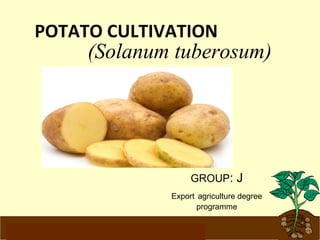
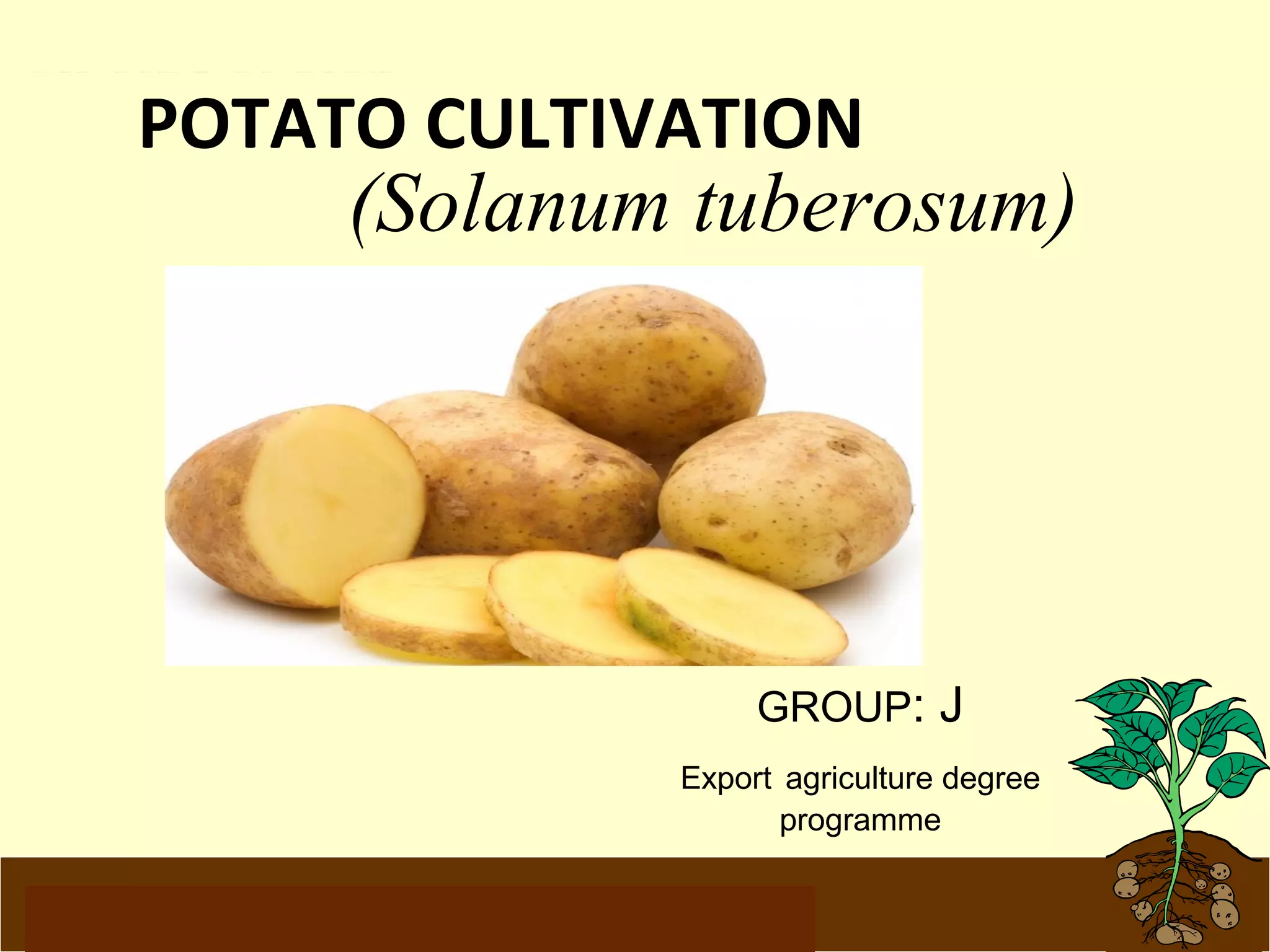
POTATO CULTIVATION 
(Solanum tuberosum) 
GROUP: J 
Export agriculture degree 
programme 
www.potatoesforschools.org.uk
Scientific classification 
www.potatoesforschools.org.uk
INTRODUCTION 
• Potatoes (Solanum tuberosum) are a 
member of the family Solanaceae 
• More than a billion people worldwide eat 
potato 
• The potato is the third most important 
food crop in the world after rice and 
wheat in terms of human consumption 
www.potatoesforschools.org.uk
• Introduced it to Sri Lanka in 1850's 
• At present, potato is extensively 
cultivated in the district of Nuwara Eliya 
in two major seasons, "Yala" and 
"Maha" 
• It also widely grown in Badulla District in 
paddy fields and high land during "Yala' 
and "Maha" seasons respectively 
www.potatoesforschools.org.uk
• Puttlam and Jaffna are the other 
two districts where the potato is 
grown in lesser extent 
ECOLOGICAL REQUIREMENTS 
• Annual rainfall is >2,500mm 
• Temperature ranges between 10- 
150C 
• Relative humidity of 80% 
www.potatoesforschools.org.uk
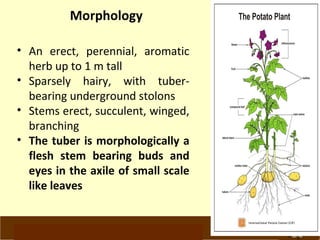
Morphology 
• An erect, perennial, aromatic 
herb up to 1 m tall 
• Sparsely hairy, with tuber-bearing 
underground stolons 
• Stems erect, succulent, winged, 
branching 
• The tuber is morphologically a 
flesh stem bearing buds and 
eyes in the axile of small scale 
like leaves 
www.potatoesforschools.org.uk
• Leaves: Divided into 3–5 pairs of leaflets 
• The leaves are compound and 
alternate, irregularly odd pinnate 
• Flowers: White to pink, purple or blue 
• The seeds are produced in a berry 
• Fruits: A succulent (but inedible), spherical, 
yellow-green to purple berry, up to 4 cm in 
diameter 
www.potatoesforschools.org.uk
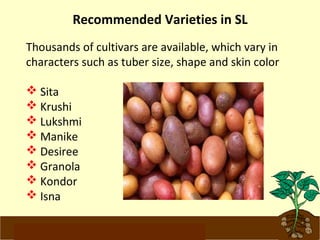
Recommended Varieties in SL 
Thousands of cultivars are available, which vary in 
characters such as tuber size, shape and skin color 
 Sita 
 Krushi 
 Lukshmi 
 Manike 
 Desiree 
 Granola 
 Kondor 
 Isna 
www.potatoesforschools.org.uk
Factors to consider when choosing a 
variety 
• The farmer needs to consider the following 
when choosing his variety 
• Consumer’s choice (Saleability) 
• Yield 
• Maturity 
• Disease resistance 
• Seed availability 
www.potatoesforschools.org.uk
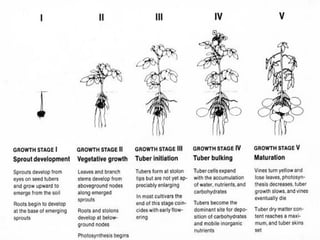
Growth Stages 
Growth Stage I: Sprout Development 
Growth Stage II: Vegetative Growth 
Growth Stage III: Tuber Set/Initiation 
Growth Stage IV: Tuber Bulking 
Growth Stage V: Maturation 
www.potatoesforschools.org.uk
Preparation of seedbed 
• Deep plough the soil to a depth of 22-25cm 
• All stones should then be removed 
• Stones can bruise potatoes (allowing infection) 
during harvesting and must be removed. 
• Stones can be removed by hand or a machine 
called a de-stoner 
• The soil is then cultivated into ridges, using a 
specialised machine 
www.potatoesforschools.org.uk
• A ridge is a raised area of soil into which the seed is 
sown 
• Ridges should be between 75 – 90 cm wide and 
15cm deep 
• Wide ridges lesson potatoes “greening”, lesson 
compaction and give greater yields 
• Ridges prevent the seed from water logging 
• Seeds are sown into the ridges at a depth of 10 cm 
below surface- 76cm apart 
www.potatoesforschools.org.uk
• The spacing of the seed in the ridges is governed by the 
size of the seed 
• As seed size increases the number of eyes / auxiliary 
buds per tuber increases 
• This protects the seed from excess sunlight 
• Seed should be sprouted before sowing as it speeds up 
growth, plant emergence and yields 
www.potatoesforschools.org.uk
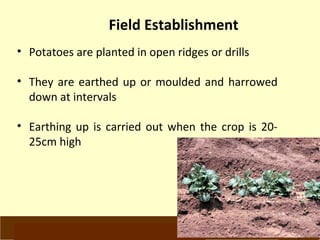
Field Establishment 
• Potatoes are planted in open ridges or drills 
• They are earthed up or moulded and harrowed 
down at intervals 
• Earthing up is carried out when the crop is 20- 
25cm high 
www.potatoesforschools.org.uk
• A ridger is used to deepen the furrows and widen 
the ridges 
• At the end of the growing season, the plant's 
leaves and stems die down to the soil level and its 
new tubers detach from their stolons 
• The tubers then serve as a nutrient store that 
allows the plant to survive the cold and later 
regrow and reproduce 
www.potatoesforschools.org.uk
Irrigation 
• Potatoes need frequent irrigation 
• The first irrigation should be given immediately 
after sowing 
• Thereafter at one week intervals 
• After tuber formation, the frequency of irrigation 
is decreased 
• Care must be taken while irrigating that the water 
does not reach fee top of the ridge 
• Irrigation should be stopped a few days before 
harvesting 
www.potatoesforschools.org.uk
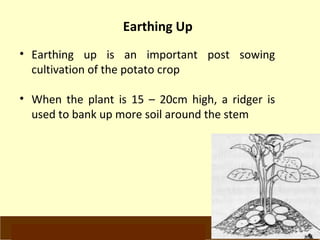
Earthing Up 
• Earthing up is an important post sowing 
cultivation of the potato crop 
• When the plant is 15 – 20cm high, a ridger is 
used to bank up more soil around the stem 
www.potatoesforschools.org.uk
• Earthing up prevents greening 
• Harrowing: kills all germinating annual weeds 
• This helps keep air in at the roots of the plants 
• When potato haulms meet across the drill, the 
weeds will be controlled 
www.potatoesforschools.org.uk
Earthing up is important because;: 
• It keeps the soil loose 
• Prevents greening of potatoes 
• Stops annual weeds from germinating 
• Can help to prevent disease (blight) 
• Can help to increase yield 
www.potatoesforschools.org.uk
Soil suitability 
• The ideal soil is a deep well-drained, medium 
heavy loam with as few stones as possible 
• High pH should be avoided 
• Optimum pH should be about pH 5 or 5.5 
• The soil must be frost free, so coastal areas 
are very suitable 
www.potatoesforschools.org.uk
Diseases 
• Potato blight – a fungal disease which 
can affect plants in humid weather 
• Blackleg – a bacterial disease which 
thrives in wet conditions 
• Gangrene – fungal 
• Common scab – bacterial disease which 
thrives in soils with high pH 
• Potato mosaic – viral disease spread by 
aphids 
www.potatoesforschools.org.uk
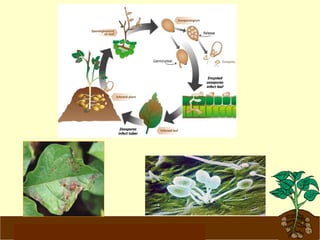
Potato Blight 
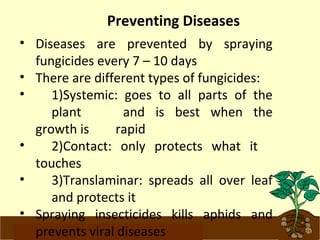
• Potato Blight or Phytophtora infestans is a 
fungal disease 
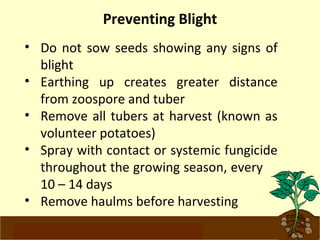
• Symptoms-browning and subsequent 
blackening of the leaves and rotting of the 
tubers 
• It causes premature death of haulms with 
resultant yield losses 
• This leads to infection and rotting during 
storage 
• The spread of potato blight is favoured by 
warm humid weather conditions 
www.potatoesforschools.org.uk
Preventing Blight 
• Do not sow seeds showing any signs of 
blight 
• Earthing up creates greater distance 
from zoospore and tuber 
• Remove all tubers at harvest (known as 
volunteer potatoes) 
• Spray with contact or systemic fungicide 
throughout the growing season, every 
10 – 14 days 
• Remove haulms before harvesting 
www.potatoesforschools.org.uk
Preventing Diseases 
• Diseases are prevented by spraying 
fungicides every 7 – 10 days 
• There are different types of fungicides: 
• 1)Systemic: goes to all parts of the 
plant and is best when the 
growth is rapid 
• 2)Contact: only protects what it 
touches 
• 3)Translaminar: spreads all over leaf 
and protects it 
• Spraying insecticides kills aphids and 
prevents viral diseases 
www.potatoesforschools.org.uk
Pests in potato cultivation 
The main pests of potatoes are: 
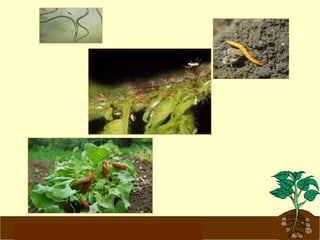
•Wireworms – can eat into tubers, common 
after grass, prevented using poison baits 
•Slugs – eat into tubers, high numbers during 
wet summers, killed using slug pellets 
•Aphids – eat plant and carry viral diseases, 
controlled using insecticides or ladybirds 
•Potato nematode and eelworms – eat into 
tubers, controlled by crop rotation 
www.potatoesforschools.org.uk
Weed Control 
• Crops are sprayed with a contact herbicide when one 
quarter of plants have appeared over the soil 
• A contact (residual) herbicide kills all plant tissue it 
comes in contact with 
• This allows for weeds to be controlled until “shading” 
occurs, which naturally prevents weeds 
• Shading refers to the time when plants meet across 
ridges 
• Earthing up also prevents weeds 

www.potatoesforschools.org.uk
Nutrition: Fertilizer 
Requirements 
• Soil should be tested before applying 
fertilizer to determine what is requirement 
and how 
• Typical Application Rates: 
• Nitrogen: 125 – 150 kg / ha 
• Phosphorous: 125 – 150 kg / ha 
• Potassium: 250 – 300 kg / ha 
• 10:10:20 or 7:6:17 Sulphate of Potash are 
ideal for potatoes 
• Fertilizer should be applied prior to sowing 
www.potatoesforschools.org.uk
• Fertilizer application must be balanced 
• Nitrogen increases yields but decreases dry 
matter 
• Avoid excess nitrogen as it gives higher yield 
but lowers eating quality and can lead to 
blight susceptibility 
• Phosphorous increases blight resistance and 
increases dry matter 
• Potassium increases tuber size 
www.potatoesforschools.org.uk
Harvesting 
• Potatoes are harvested from May/Early June on 
depending on variety and part of the country 
• Main crop potatoes are harvested in late 
September or October where tubers are fully-grown 
and mature 
www.potatoesforschools.org.uk
Storage 
Buildings which store the potatoes must be 
•leak proof 
•frost proof 
•Potatoes are also covered with a layer of straw to 
protect against frost 
•well ventilated to prevent sprouting and rotting. 
•large enough to allow easy access of tractors and 
trailers. 
•Temperature 4-6 0C 
www.potatoesforschools.org.uk
Food value and final use 
• Potatoes are a versatile, carbohydrate rich food 
highly popular worldwide and prepared and served 
in a variety of way 
• The potato is a moderate source of iron, and it has 
high vitamin C 
• It is a good source of vitamins B1, B3 and B6 and 
minerals such as potassium, phosphorus and 
magnesium. 
www.potatoesforschools.org.uk
VALUE ADDED PRODUCTS 
www.potatoesforschools.org.uk
Referrences 
• wikipedia.org/wiki/Potato 
• http://sikkimagrisnet.org/General/en/Potato.aspx 
www.potatoesforschools.org.uk
GROUP MEMBERS 
R.A.S.N Ranasinghe UWU/EAG/11/0031 
Watawana M. J. UWU/EAG/11/0036 
www.potatoesforschools.org.uk

Potato

  • 1.
    POTATO CULTIVATION (Solanumtuberosum) GROUP: J Export agriculture degree programme www.potatoesforschools.org.uk
  • 2.
  • 3.
    INTRODUCTION • Potatoes(Solanum tuberosum) are a member of the family Solanaceae • More than a billion people worldwide eat potato • The potato is the third most important food crop in the world after rice and wheat in terms of human consumption www.potatoesforschools.org.uk
  • 4.
    • Introduced itto Sri Lanka in 1850's • At present, potato is extensively cultivated in the district of Nuwara Eliya in two major seasons, "Yala" and "Maha" • It also widely grown in Badulla District in paddy fields and high land during "Yala' and "Maha" seasons respectively www.potatoesforschools.org.uk
  • 5.
    • Puttlam andJaffna are the other two districts where the potato is grown in lesser extent ECOLOGICAL REQUIREMENTS • Annual rainfall is >2,500mm • Temperature ranges between 10- 150C • Relative humidity of 80% www.potatoesforschools.org.uk
  • 6.
    Morphology • Anerect, perennial, aromatic herb up to 1 m tall • Sparsely hairy, with tuber-bearing underground stolons • Stems erect, succulent, winged, branching • The tuber is morphologically a flesh stem bearing buds and eyes in the axile of small scale like leaves www.potatoesforschools.org.uk
  • 7.
    • Leaves: Dividedinto 3–5 pairs of leaflets • The leaves are compound and alternate, irregularly odd pinnate • Flowers: White to pink, purple or blue • The seeds are produced in a berry • Fruits: A succulent (but inedible), spherical, yellow-green to purple berry, up to 4 cm in diameter www.potatoesforschools.org.uk
  • 8.
    Recommended Varieties inSL Thousands of cultivars are available, which vary in characters such as tuber size, shape and skin color  Sita  Krushi  Lukshmi  Manike  Desiree  Granola  Kondor  Isna www.potatoesforschools.org.uk
  • 9.
    Factors to considerwhen choosing a variety • The farmer needs to consider the following when choosing his variety • Consumer’s choice (Saleability) • Yield • Maturity • Disease resistance • Seed availability www.potatoesforschools.org.uk
  • 10.
    Growth Stages GrowthStage I: Sprout Development Growth Stage II: Vegetative Growth Growth Stage III: Tuber Set/Initiation Growth Stage IV: Tuber Bulking Growth Stage V: Maturation www.potatoesforschools.org.uk
  • 11.
  • 12.
    Preparation of seedbed • Deep plough the soil to a depth of 22-25cm • All stones should then be removed • Stones can bruise potatoes (allowing infection) during harvesting and must be removed. • Stones can be removed by hand or a machine called a de-stoner • The soil is then cultivated into ridges, using a specialised machine www.potatoesforschools.org.uk
  • 13.
    • A ridgeis a raised area of soil into which the seed is sown • Ridges should be between 75 – 90 cm wide and 15cm deep • Wide ridges lesson potatoes “greening”, lesson compaction and give greater yields • Ridges prevent the seed from water logging • Seeds are sown into the ridges at a depth of 10 cm below surface- 76cm apart www.potatoesforschools.org.uk
  • 14.
    • The spacingof the seed in the ridges is governed by the size of the seed • As seed size increases the number of eyes / auxiliary buds per tuber increases • This protects the seed from excess sunlight • Seed should be sprouted before sowing as it speeds up growth, plant emergence and yields www.potatoesforschools.org.uk
  • 15.
    Field Establishment •Potatoes are planted in open ridges or drills • They are earthed up or moulded and harrowed down at intervals • Earthing up is carried out when the crop is 20- 25cm high www.potatoesforschools.org.uk
  • 16.
    • A ridgeris used to deepen the furrows and widen the ridges • At the end of the growing season, the plant's leaves and stems die down to the soil level and its new tubers detach from their stolons • The tubers then serve as a nutrient store that allows the plant to survive the cold and later regrow and reproduce www.potatoesforschools.org.uk
  • 17.
    Irrigation • Potatoesneed frequent irrigation • The first irrigation should be given immediately after sowing • Thereafter at one week intervals • After tuber formation, the frequency of irrigation is decreased • Care must be taken while irrigating that the water does not reach fee top of the ridge • Irrigation should be stopped a few days before harvesting www.potatoesforschools.org.uk
  • 18.
    Earthing Up •Earthing up is an important post sowing cultivation of the potato crop • When the plant is 15 – 20cm high, a ridger is used to bank up more soil around the stem www.potatoesforschools.org.uk
  • 19.
    • Earthing upprevents greening • Harrowing: kills all germinating annual weeds • This helps keep air in at the roots of the plants • When potato haulms meet across the drill, the weeds will be controlled www.potatoesforschools.org.uk
  • 20.
    Earthing up isimportant because;: • It keeps the soil loose • Prevents greening of potatoes • Stops annual weeds from germinating • Can help to prevent disease (blight) • Can help to increase yield www.potatoesforschools.org.uk
  • 21.
    Soil suitability •The ideal soil is a deep well-drained, medium heavy loam with as few stones as possible • High pH should be avoided • Optimum pH should be about pH 5 or 5.5 • The soil must be frost free, so coastal areas are very suitable www.potatoesforschools.org.uk
  • 22.
    Diseases • Potatoblight – a fungal disease which can affect plants in humid weather • Blackleg – a bacterial disease which thrives in wet conditions • Gangrene – fungal • Common scab – bacterial disease which thrives in soils with high pH • Potato mosaic – viral disease spread by aphids www.potatoesforschools.org.uk
  • 23.
    Potato Blight •Potato Blight or Phytophtora infestans is a fungal disease • Symptoms-browning and subsequent blackening of the leaves and rotting of the tubers • It causes premature death of haulms with resultant yield losses • This leads to infection and rotting during storage • The spread of potato blight is favoured by warm humid weather conditions www.potatoesforschools.org.uk
  • 24.
  • 25.
    Preventing Blight •Do not sow seeds showing any signs of blight • Earthing up creates greater distance from zoospore and tuber • Remove all tubers at harvest (known as volunteer potatoes) • Spray with contact or systemic fungicide throughout the growing season, every 10 – 14 days • Remove haulms before harvesting www.potatoesforschools.org.uk
  • 26.
    Preventing Diseases •Diseases are prevented by spraying fungicides every 7 – 10 days • There are different types of fungicides: • 1)Systemic: goes to all parts of the plant and is best when the growth is rapid • 2)Contact: only protects what it touches • 3)Translaminar: spreads all over leaf and protects it • Spraying insecticides kills aphids and prevents viral diseases www.potatoesforschools.org.uk
  • 27.
    Pests in potatocultivation The main pests of potatoes are: •Wireworms – can eat into tubers, common after grass, prevented using poison baits •Slugs – eat into tubers, high numbers during wet summers, killed using slug pellets •Aphids – eat plant and carry viral diseases, controlled using insecticides or ladybirds •Potato nematode and eelworms – eat into tubers, controlled by crop rotation www.potatoesforschools.org.uk
  • 28.
  • 29.
    Weed Control •Crops are sprayed with a contact herbicide when one quarter of plants have appeared over the soil • A contact (residual) herbicide kills all plant tissue it comes in contact with • This allows for weeds to be controlled until “shading” occurs, which naturally prevents weeds • Shading refers to the time when plants meet across ridges • Earthing up also prevents weeds www.potatoesforschools.org.uk
  • 30.
    Nutrition: Fertilizer Requirements • Soil should be tested before applying fertilizer to determine what is requirement and how • Typical Application Rates: • Nitrogen: 125 – 150 kg / ha • Phosphorous: 125 – 150 kg / ha • Potassium: 250 – 300 kg / ha • 10:10:20 or 7:6:17 Sulphate of Potash are ideal for potatoes • Fertilizer should be applied prior to sowing www.potatoesforschools.org.uk
  • 31.
    • Fertilizer applicationmust be balanced • Nitrogen increases yields but decreases dry matter • Avoid excess nitrogen as it gives higher yield but lowers eating quality and can lead to blight susceptibility • Phosphorous increases blight resistance and increases dry matter • Potassium increases tuber size www.potatoesforschools.org.uk
  • 32.
    Harvesting • Potatoesare harvested from May/Early June on depending on variety and part of the country • Main crop potatoes are harvested in late September or October where tubers are fully-grown and mature www.potatoesforschools.org.uk
  • 33.
    Storage Buildings whichstore the potatoes must be •leak proof •frost proof •Potatoes are also covered with a layer of straw to protect against frost •well ventilated to prevent sprouting and rotting. •large enough to allow easy access of tractors and trailers. •Temperature 4-6 0C www.potatoesforschools.org.uk
  • 34.
    Food value andfinal use • Potatoes are a versatile, carbohydrate rich food highly popular worldwide and prepared and served in a variety of way • The potato is a moderate source of iron, and it has high vitamin C • It is a good source of vitamins B1, B3 and B6 and minerals such as potassium, phosphorus and magnesium. www.potatoesforschools.org.uk
  • 35.
    VALUE ADDED PRODUCTS www.potatoesforschools.org.uk
  • 36.
    Referrences • wikipedia.org/wiki/Potato • http://sikkimagrisnet.org/General/en/Potato.aspx www.potatoesforschools.org.uk
  • 37.
    GROUP MEMBERS R.A.S.NRanasinghe UWU/EAG/11/0031 Watawana M. J. UWU/EAG/11/0036 www.potatoesforschools.org.uk
  • 38.

Editor's Notes

  • #12 1.Sprouts develop from eyes on seed tubers and grow upward to emerge from soil,roots begin to develop at the base of emerging sprouts 2.Leaves and branch stems develop fro above ground nodes along emerged sprouts 3.Tubers from stolon tips,but not yet enlarging 4.Tuber cells expand with accumulation of water,nutrients,and carbohydrates 5.Vines turn yellow and loss leaves,ps.decreases.tuber growth slows and vine eventually die