PLANT BREEDING METHODS

SUBMITED BY,
M. THILAKAR,
LS1154
SECOND YEAR.
M.SC IN LIFE SCIENCES,
BHARATHIDASAN UNIVERSITY,
TIRUCHIRAPALLI.
Plant Breeding
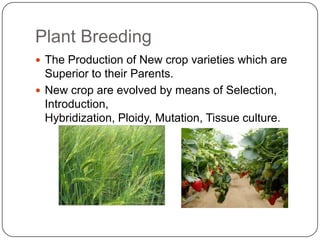
 The Production of New crop varieties which are
  Superior to their Parents.
 New crop are evolved by means of Selection,
  Introduction,
  Hybridization, Ploidy, Mutation, Tissue culture.
Popular scientists in Plant
breeding
M S SWANI NAATHAN   VENKATARAMANAN
Introduction of Plants
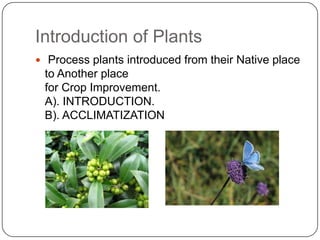
 Process plants introduced from their Native place
 to Another place
 for Crop Improvement.
 A). INTRODUCTION.
 B). ACCLIMATIZATION
A). INTRODUCTION
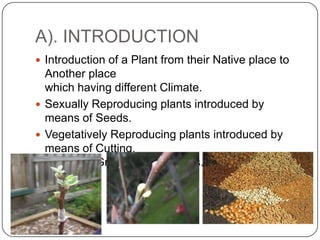
 Introduction of a Plant from their Native place to
  Another place
  which having different Climate.
 Sexually Reproducing plants introduced by
  means of Seeds.
 Vegetatively Reproducing plants introduced by
  means of Cutting,
  Layering, Graft, Bulb & Tubers.
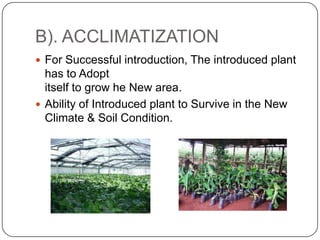
B). ACCLIMATIZATION
 For Successful introduction, The introduced plant
  has to Adopt
  itself to grow he New area.
 Ability of Introduced plant to Survive in the New
  Climate & Soil Condition.
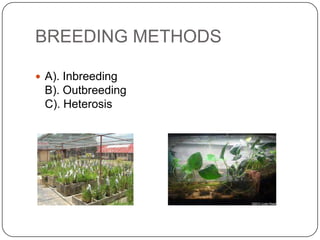
BREEDING METHODS

 A). Inbreeding
 B). Outbreeding
 C). Heterosis
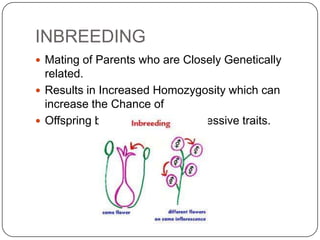
INBREEDING
 Mating of Parents who are Closely Genetically
  related.
 Results in Increased Homozygosity which can
  increase the Chance of
 Offspring being affected by Recessive traits.
METHOD OF INBREEDING
 Marriage between Brother and Sister is an Ideal
  Inbreeding.
 Royal Family of Egypt Cleopatra was famous for
  inbreeding between
  Brothers and Sisters.
 In Plants, It Occurs in the Form of Self Pollination.
RESULTS OF INBREEDING
 Reduced Fertility both in Litter size and in
 Sperm viability.
 Increased Genetic Disorders.
 Lower Birthrates
 Higher Infant Mortality
 Slower Growth rate.
 Loss of Immune System function.
MERITS & DEMERITS
MERITS OF                DEMERITS OF
INBREEDING               INBREEDING
 A) Increase of          A) Low yield
 Homozygotes,             B) Inbreeding
 B) Production of Pure    Depression
 lines.                   C) Appearance of
 C) Elimination of        Deleterious
 Deleterious              Characters.
 Recessive
 Characters.
 D) Production of
 Valuable Breeds.
OUTBREEDING
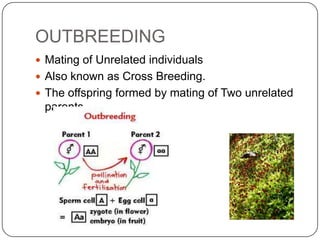
 Mating of Unrelated individuals
 Also known as Cross Breeding.
 The offspring formed by mating of Two unrelated
 parents.
TYPES OF OUTBREEDING
A) INTRASPECIFIC : Matting between Members
of Same Species.

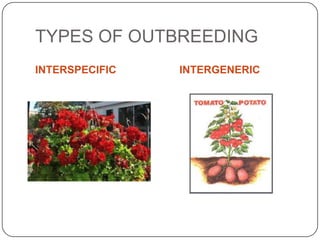
B) INTERSPECIFIC : Matting between Members
of Different Species.

C) INTERGENERIC :
Matting between the Members of Different
Genera.
TYPES OF OUTBREEDING
INTERSPECIFIC   INTERGENERIC
Examples of Outbreeding
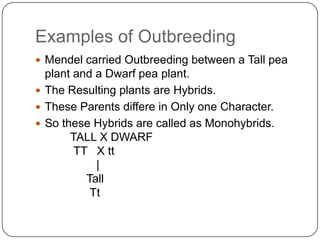
 Mendel carried Outbreeding between a Tall pea
  plant and a Dwarf pea plant.
 The Resulting plants are Hybrids.
 These Parents differe in Only one Character.
 So these Hybrids are called as Monohybrids.
       TALL X DWARF
        TT X tt
            |
          Tall
           Tt
RESULTS OF OUTBREEDING
A) Numerous varieties of better Yielding crop
plants.
B) Paddy hybrids produce more Grains.
C) Tall and Dwarf coconut hybrid yields more
number of Nuts
D) Caddish is a hybrid Between Cabbage and
Radish
E) Pomato is a hybrid between Potato and
Tomato.
HETEROSIS BREEDING
 The Increased growth vigour or yield of hybrids
  over the Parents is
  known as Heterosis or Hybrid vigour.
 Crop breeding to manifest heterosis is called
  Heterosis breeding.
 It brings out the Superiority in F1 individuals but
  the vigour tends to Decrease from F2 generation
  onwards.
HETEROSIS BREEDING
 Heterosis means Deviation of Offspring from the
  Actual Character of Parents.
 In Plants, Heterosis appears due to
  Developmental stimulation induced by the Union
  of Gametes coming from Two genetically
  complementing parents.
THEORIES OF HETEROSIS
 Two Popular Hypotheses to explain Heterosis in
 F1
 A) Dominance Hypothesis
 B) Over Dominance Hypothesis
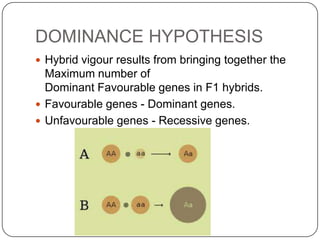
DOMINANCE HYPOTHESIS
 Hybrid vigour results from bringing together the
  Maximum number of
  Dominant Favourable genes in F1 hybrids.
 Favourable genes - Dominant genes.
 Unfavourable genes - Recessive genes.
EXAMPLE
 KKggPPnnRR and kkGGppNNrr are codes from
  Ear length.
      Parent-1              Parent-2
      KKggPPnnRR      x     kkGGppNNrr
  K+P+R= 15 cm x           k+p+r= 3 cm
  g+n = 2 cm          x     G+N= 10 cm
  Total = 17 cm            Total = 13 cm
 Each of
  Dominant genes = 5 cm
  Recessive genes = 1 cm
 F1 -> KkGgPpNnRr
  K+G+P+N+R = 25 cm
 So the Hybrid vigour results from bringing
  together the Maximum number of
  Dominant Favourable genes in F1 hybrids.
OVER DOMINANCE
HYPOTHESIS
 Hybrid vigour due to Superiority of Heterozygotes
  over the Homozygotes .
 Allelic Combinations are more vigour than single
  Allelic expression.
EXAMPLE
 A1, A2, A3, A4 are Alleles with Different functions
  A1 x A1                A2 x A2
     |                |
  A1A1                    A2A2
 So the A1A2, A1A3, A1A4 are more vigour than
  A1A1 and A2A2.
 Thus Hybrid vigour is due to Superiority of
  Heterozygotes over the Homozygotes is called
  Over Dominance.
METHOD FOR HETEROSIS
BREEDING
 Methodology of Heterosis breeding varies with
  Different crops.
 Depending on their nature of Pollination, Sexual
  incompatability and other reasons.
 This includes main three types
  1) Producing inbred lines.
  2) Testing of Combining ability of Inbred lines.
  3) Production of Hybrid seeds.
EFFECTS OF HYBRID VIGOUR
1. Roots of Carrot.
2. Leaf of Spinach and Lettuce.
3. Flowers in Cauliflower.
4. Fruits in Cucurbits, Brinjal. Peas, etc.
ADVANTAGE & DISADVANTAGE
ADVANTAGE                   DISADVANTAGE
1. In many crops, F1        1. Production cost is
   hybrids are Early in
   Maturity.                   High.
   EX : Cabbage, Onion,
   Tomato etc.              2. Fresh seeds is to be
2. They produce goods          Purchased every
   with Uniform size.          time to raise new
   Ex : Onion and
   Cabbage.                    crop.
3. They are resistance to   3. Sometimes F1
   Biotic and Abiotic
   stresses.                   hybrids are
   Ex : Cucumber, Tomato       Vulnerable to
   and Onion.
4. They are always high
                               disease.
   yielding varieties
Thank you….

Plant Breeding Methods

  • 1.
    PLANT BREEDING METHODS SUBMITEDBY, M. THILAKAR, LS1154 SECOND YEAR. M.SC IN LIFE SCIENCES, BHARATHIDASAN UNIVERSITY, TIRUCHIRAPALLI.
  • 2.
    Plant Breeding  TheProduction of New crop varieties which are Superior to their Parents.  New crop are evolved by means of Selection, Introduction, Hybridization, Ploidy, Mutation, Tissue culture.
  • 3.
    Popular scientists inPlant breeding M S SWANI NAATHAN VENKATARAMANAN
  • 4.
    Introduction of Plants Process plants introduced from their Native place to Another place for Crop Improvement. A). INTRODUCTION. B). ACCLIMATIZATION
  • 5.
    A). INTRODUCTION  Introductionof a Plant from their Native place to Another place which having different Climate.  Sexually Reproducing plants introduced by means of Seeds.  Vegetatively Reproducing plants introduced by means of Cutting, Layering, Graft, Bulb & Tubers.
  • 6.
    B). ACCLIMATIZATION  ForSuccessful introduction, The introduced plant has to Adopt itself to grow he New area.  Ability of Introduced plant to Survive in the New Climate & Soil Condition.
  • 7.
    BREEDING METHODS  A).Inbreeding B). Outbreeding C). Heterosis
  • 8.
    INBREEDING  Mating ofParents who are Closely Genetically related.  Results in Increased Homozygosity which can increase the Chance of  Offspring being affected by Recessive traits.
  • 9.
    METHOD OF INBREEDING Marriage between Brother and Sister is an Ideal Inbreeding.  Royal Family of Egypt Cleopatra was famous for inbreeding between Brothers and Sisters.  In Plants, It Occurs in the Form of Self Pollination.
  • 10.
    RESULTS OF INBREEDING Reduced Fertility both in Litter size and in  Sperm viability.  Increased Genetic Disorders.  Lower Birthrates  Higher Infant Mortality  Slower Growth rate.  Loss of Immune System function.
  • 11.
    MERITS & DEMERITS MERITSOF DEMERITS OF INBREEDING INBREEDING  A) Increase of  A) Low yield Homozygotes, B) Inbreeding B) Production of Pure Depression lines. C) Appearance of C) Elimination of Deleterious Deleterious Characters. Recessive Characters. D) Production of Valuable Breeds.
  • 12.
    OUTBREEDING  Mating ofUnrelated individuals  Also known as Cross Breeding.  The offspring formed by mating of Two unrelated parents.
  • 13.
    TYPES OF OUTBREEDING A)INTRASPECIFIC : Matting between Members of Same Species. B) INTERSPECIFIC : Matting between Members of Different Species. C) INTERGENERIC : Matting between the Members of Different Genera.
  • 14.
  • 15.
    Examples of Outbreeding Mendel carried Outbreeding between a Tall pea plant and a Dwarf pea plant.  The Resulting plants are Hybrids.  These Parents differe in Only one Character.  So these Hybrids are called as Monohybrids. TALL X DWARF TT X tt | Tall Tt
  • 16.
    RESULTS OF OUTBREEDING A)Numerous varieties of better Yielding crop plants. B) Paddy hybrids produce more Grains. C) Tall and Dwarf coconut hybrid yields more number of Nuts D) Caddish is a hybrid Between Cabbage and Radish E) Pomato is a hybrid between Potato and Tomato.
  • 17.
    HETEROSIS BREEDING  TheIncreased growth vigour or yield of hybrids over the Parents is known as Heterosis or Hybrid vigour.  Crop breeding to manifest heterosis is called Heterosis breeding.  It brings out the Superiority in F1 individuals but the vigour tends to Decrease from F2 generation onwards.
  • 18.
    HETEROSIS BREEDING  Heterosismeans Deviation of Offspring from the Actual Character of Parents.  In Plants, Heterosis appears due to Developmental stimulation induced by the Union of Gametes coming from Two genetically complementing parents.
  • 19.
    THEORIES OF HETEROSIS Two Popular Hypotheses to explain Heterosis in F1 A) Dominance Hypothesis B) Over Dominance Hypothesis
  • 20.
    DOMINANCE HYPOTHESIS  Hybridvigour results from bringing together the Maximum number of Dominant Favourable genes in F1 hybrids.  Favourable genes - Dominant genes.  Unfavourable genes - Recessive genes.
  • 21.
    EXAMPLE  KKggPPnnRR andkkGGppNNrr are codes from Ear length. Parent-1 Parent-2 KKggPPnnRR x kkGGppNNrr K+P+R= 15 cm x k+p+r= 3 cm g+n = 2 cm x G+N= 10 cm Total = 17 cm Total = 13 cm  Each of Dominant genes = 5 cm Recessive genes = 1 cm
  • 22.
     F1 ->KkGgPpNnRr K+G+P+N+R = 25 cm  So the Hybrid vigour results from bringing together the Maximum number of Dominant Favourable genes in F1 hybrids.
  • 23.
    OVER DOMINANCE HYPOTHESIS  Hybridvigour due to Superiority of Heterozygotes over the Homozygotes .  Allelic Combinations are more vigour than single Allelic expression.
  • 24.
    EXAMPLE  A1, A2,A3, A4 are Alleles with Different functions A1 x A1 A2 x A2 | | A1A1 A2A2  So the A1A2, A1A3, A1A4 are more vigour than A1A1 and A2A2.  Thus Hybrid vigour is due to Superiority of Heterozygotes over the Homozygotes is called Over Dominance.
  • 25.
    METHOD FOR HETEROSIS BREEDING Methodology of Heterosis breeding varies with Different crops.  Depending on their nature of Pollination, Sexual incompatability and other reasons.  This includes main three types 1) Producing inbred lines. 2) Testing of Combining ability of Inbred lines. 3) Production of Hybrid seeds.
  • 26.
    EFFECTS OF HYBRIDVIGOUR 1. Roots of Carrot. 2. Leaf of Spinach and Lettuce. 3. Flowers in Cauliflower. 4. Fruits in Cucurbits, Brinjal. Peas, etc.
  • 27.
    ADVANTAGE & DISADVANTAGE ADVANTAGE DISADVANTAGE 1. In many crops, F1 1. Production cost is hybrids are Early in Maturity. High. EX : Cabbage, Onion, Tomato etc. 2. Fresh seeds is to be 2. They produce goods Purchased every with Uniform size. time to raise new Ex : Onion and Cabbage. crop. 3. They are resistance to 3. Sometimes F1 Biotic and Abiotic stresses. hybrids are Ex : Cucumber, Tomato Vulnerable to and Onion. 4. They are always high disease. yielding varieties
  • 28.