DOCTORAL SEMINAR
ON
Research work done on grafting of
vegetable crops
SEMINAR INCHARGE
Dr. D. A. Sarnaik
Professor
Deptt. Deptt. Genetics and plant
breedig
Speaker
Dhaendra Dhanuka
Ph.D. Scholar
Deptt. Genetics and plant breedig
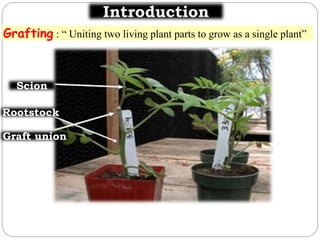
Grafting : “ Uniting two living plant parts to grow as a single plant”.
Introduction
Graft union
Rootstock
Scion
What is Grafting ??????
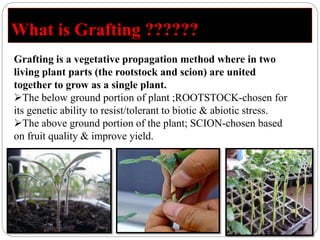
Grafting is a vegetative propagation method where in two
living plant parts (the rootstock and scion) are united
together to grow as a single plant.
The below ground portion of plant ;ROOTSTOCK-chosen for
its genetic ability to resist/tolerant to biotic & abiotic stress.
The above ground portion of the plant; SCION-chosen based
on fruit quality & improve yield.
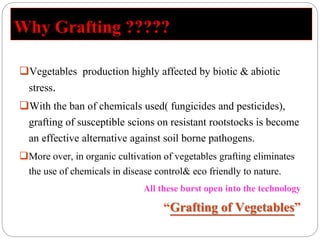
Why Grafting ?????
Vegetables production highly affected by biotic & abiotic
stress.
With the ban of chemicals used( fungicides and pesticides),
grafting of susceptible scions on resistant rootstocks is become
an effective alternative against soil borne pathogens.
More over, in organic cultivation of vegetables grafting eliminates
the use of chemicals in disease control& eco friendly to nature.
All these burst open into the technology
“Grafting of Vegetables”
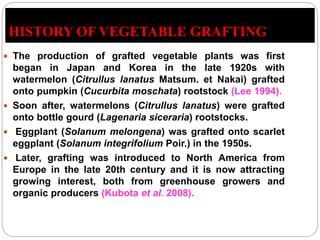
HISTORY OF VEGETABLE GRAFTING
 The production of grafted vegetable plants was first
began in Japan and Korea in the late 1920s with
watermelon (Citrullus lanatus Matsum. et Nakai) grafted
onto pumpkin (Cucurbita moschata) rootstock (Lee 1994).
 Soon after, watermelons (Citrullus lanatus) were grafted
onto bottle gourd (Lagenaria siceraria) rootstocks.
 Eggplant (Solanum melongena) was grafted onto scarlet
eggplant (Solanum integrifolium Poir.) in the 1950s.
 Later, grafting was introduced to North America from
Europe in the late 20th century and it is now attracting
growing interest, both from greenhouse growers and
organic producers (Kubota et al. 2008).
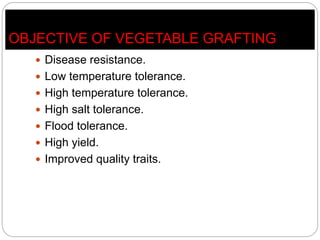
OBJECTIVE OF VEGETABLE GRAFTING
 Disease resistance.
 Low temperature tolerance.
 High temperature tolerance.
 High salt tolerance.
 Flood tolerance.
 High yield.
 Improved quality traits.
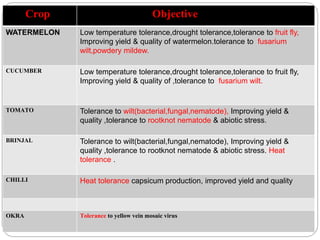
Crop Objective
WATERMELON Low temperature tolerance,drought tolerance,tolerance to fruit fly,
Improving yield & quality of watermelon.tolerance to fusarium
wilt,powdery mildew.
CUCUMBER Low temperature tolerance,drought tolerance,tolerance to fruit fly,
Improving yield & quality of ,tolerance to fusarium wilt.
TOMATO Tolerance to wilt(bacterial,fungal,nematode), Improving yield &
quality ,tolerance to rootknot nematode & abiotic stress.
BRINJAL Tolerance to wilt(bacterial,fungal,nematode), Improving yield &
quality ,tolerance to rootknot nematode & abiotic stress. Heat
tolerance .
CHILLI Heat tolerance capsicum production, improved yield and quality
OKRA Tolerance to yellow vein mosaic virus
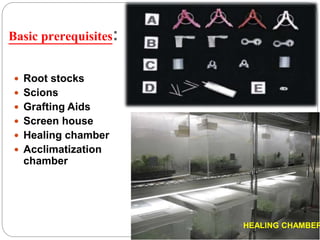
Basic prerequisites:
 Root stocks
 Scions
 Grafting Aids
 Screen house
 Healing chamber
 Acclimatization
chamber
HEALING CHAMBER
Methods of Grafting
1. Cleft Grafting
2. Tongue Approach/Approach Grafting
3. Hole Insertion/Top Insertion Grafting
4. One Cotyledon/Slant/Splice grafting
5.Tube Grafting
6. Pin Grafting
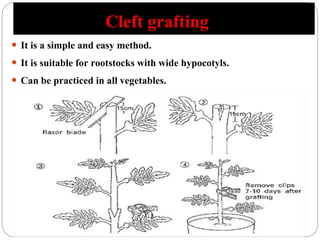
Cleft grafting
 It is a simple and easy method.
 It is suitable for rootstocks with wide hypocotyls.
 Can be practiced in all vegetables.
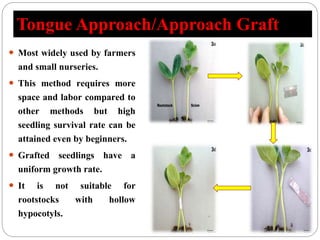
Tongue Approach/Approach Graft
 Most widely used by farmers
and small nurseries.
 This method requires more
space and labor compared to
other methods but high
seedling survival rate can be
attained even by beginners.
 Grafted seedlings have a
uniform growth rate.
 It is not suitable for
rootstocks with hollow
hypocotyls.
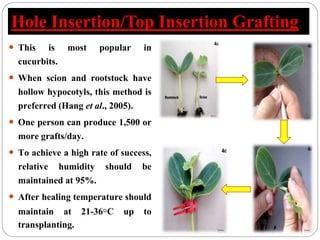
Hole Insertion/Top Insertion Grafting
 This is most popular in
cucurbits.
 When scion and rootstock have
hollow hypocotyls, this method is
preferred (Hang et al., 2005).
 One person can produce 1,500 or
more grafts/day.
 To achieve a high rate of success,
relative humidity should be
maintained at 95%.
 After healing temperature should
maintain at 21-36◦C up to
transplanting.
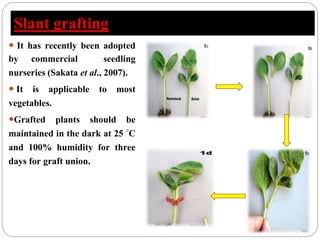
Slant grafting
 It has recently been adopted
by commercial seedling
nurseries (Sakata et al., 2007).
 It is applicable to most
vegetables.
Grafted plants should be
maintained in the dark at 25 ◦C
and 100% humidity for three
days for graft union.
Tube Grafting
 It is similar to slant grafting except that in this method root stock &
scion joined are held with an elastic tube instead of clips.
 It is more popular in tomato, brinjal.
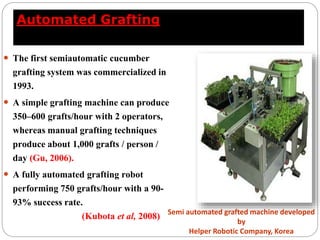
Automated Grafting
 The first semiautomatic cucumber
grafting system was commercialized in
1993.
 A simple grafting machine can produce
350–600 grafts/hour with 2 operators,
whereas manual grafting techniques
produce about 1,000 grafts / person /
day (Gu, 2006).
 A fully automated grafting robot
performing 750 grafts/hour with a 90-
93% success rate.
(Kubota et al, 2008) Semi automated grafted machine developed
by
Helper Robotic Company, Korea
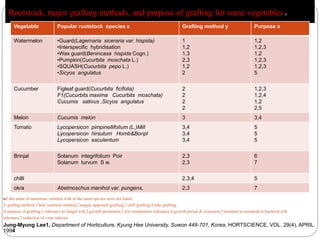
Rootstock, major grafting methods, and purpose of grafting for some vegetables.
Vegetable Popular rootstock species z Grafting method y Purpose x
Watermelon •Guard(Lagernaria siceraria var. hispida)
•Interspecific hybridisation
•Wax guard(Benincasa hispida Cogn.)
•Pumpkin(Cucurbita moschata L.)
•SQUASH(Cucurbita pepo L.)
•Sicyos angulatus
1
1,2
1,3
2,3
1,2
2
1,2
1,2,3
1,2
1,2,3
1,2,3
5
Cucumber Figleaf guard(Cucurbita ficifolia)
F1(Cucurbits maxima Cucurbits moschata)
Cucumis sativus ,Sicyos angulatus
2
2
2
2
1,2,3
1,2,4
1,2
2,5
Melon Cucumis melon 3 3,4
Tomato Lycopersicon pimpinellifolium (L.)Mill
Lycopersicon hirsutum Homb&Bonpl
Lycopersicon esculentum
3,4
3,4
3,4
5
5
5
Brinjal Solanum integrifolium Poir
Solanum turvum S w.
2,3
2,3
6
7
chilli 2,3,4 5
okra Abelmoschus manihot var. pungens, 2,3 7
nZ:the name of numerous varieties with in the same species were not listed.
Y:graftng method-1.hole insertion method,2.tongue approach grafting,3.cleft grafting,4.tube grafting.
X:purpose of grafting-1.tolerance to fungal wilt,2.growth promotion,3.low temperature tolerance,4.growth period & extension,5.resistant to nematode,6.bacterial wilt
tolerance,7.reduction of virus infectio
Jung-Myung Lee1, Department of Horticulture, Kyung Hee University, Suwon 449-701, Korea, HORTSCIENCE, VOL. 29(4), APRIL
1994
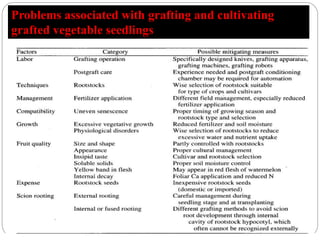
Problems associated with grafting and cultivating
grafted vegetable seedlings.
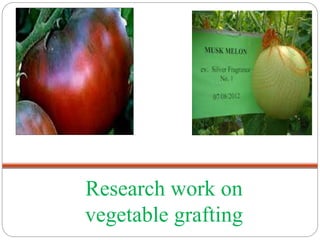
Research work on
vegetable grafting
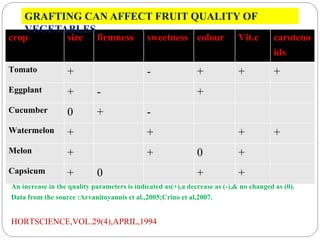
An increase in the quality parameters is indicated as(+),a decrease as (-),& no changed as (0).
Data from the source :Arvanitoyannis et al.,2005;Crino et al,2007.
HORTSCIENCE,VOL.29(4),APRIL,1994
crop size firmness sweetness colour Vit.c caroteno
ids
Tomato + - + + +
Eggplant + - +
Cucumber 0 + -
Watermelon + + + +
Melon + + 0 +
Capsicum + 0 + +
GRAFTING CAN AFFECT FRUIT QUALITY OF
VEGETABLES
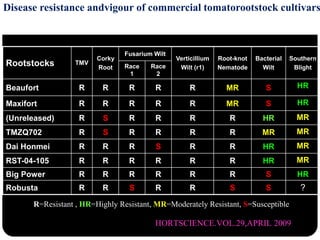
R=Resistant , HR=Highly Resistant, MR=Moderately Resistant, S=Susceptible
Disease resistance andvigour of commercial tomatorootstock cultivars
Rootstocks TMV
Corky
Root
Fusarium Wilt
Verticillium
Wilt (r1)
Root-knot
Nematode
Bacterial
Wilt
Southern
BlightRace
1
Race
2
Beaufort R R R R R MR S HR
Maxifort R R R R R MR S HR
(Unreleased) R S R R R R HR MR
TMZQ702 R S R R R R MR MR
Dai Honmei R R R S R R HR MR
RST-04-105 R R R R R R HR MR
Big Power R R R R R R S HR
Robusta R R S R R S S ?
HORTSCIENCE.VOL.29,APRIL 2009
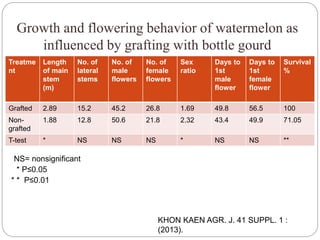
Growth and flowering behavior of watermelon as
influenced by grafting with bottle gourd
Treatme
nt
Length
of main
stem
(m)
No. of
lateral
stems
No. of
male
flowers
No. of
female
flowers
Sex
ratio
Days to
1st
male
flower
Days to
1st
female
flower
Survival
%
Grafted 2.89 15.2 45.2 26.8 1.69 49.8 56.5 100
Non-
grafted
1.88 12.8 50.6 21.8 2.32 43.4 49.9 71.05
T-test * NS NS NS * NS NS **
NS= nonsignificant
* P≤0.05
* * P≤0.01
KHON KAEN AGR. J. 41 SUPPL. 1 :
(2013).
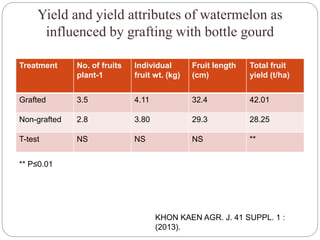
Yield and yield attributes of watermelon as
influenced by grafting with bottle gourd
Treatment No. of fruits
plant-1
Individual
fruit wt. (kg)
Fruit length
(cm)
Total fruit
yield (t/ha)
Grafted 3.5 4.11 32.4 42.01
Non-grafted 2.8 3.80 29.3 28.25
T-test NS NS NS **
** P≤0.01
KHON KAEN AGR. J. 41 SUPPL. 1 :
(2013).
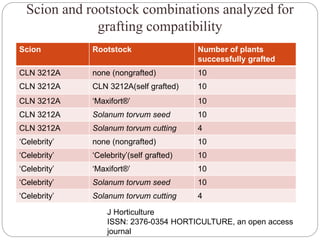
Scion and rootstock combinations analyzed for
grafting compatibility
Scion Rootstock Number of plants
successfully grafted
CLN 3212A none (nongrafted) 10
CLN 3212A CLN 3212A(self grafted) 10
CLN 3212A ‘Maxifort®’ 10
CLN 3212A Solanum torvum seed 10
CLN 3212A Solanum torvum cutting 4
‘Celebrity’ none (nongrafted) 10
‘Celebrity’ ‘Celebrity’(self grafted) 10
‘Celebrity’ ‘Maxifort®’ 10
‘Celebrity’ Solanum torvum seed 10
‘Celebrity’ Solanum torvum cutting 4
J Horticulture
ISSN: 2376-0354 HORTICULTURE, an open access
journal
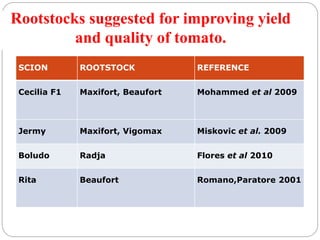
Rootstocks suggested for improving yield
and quality of tomato.
SCION ROOTSTOCK REFERENCE
Cecilia F1 Maxifort, Beaufort Mohammed et al 2009
Jermy Maxifort, Vigomax Miskovic et al. 2009
Boludo Radja Flores et al 2010
Rita Beaufort Romano,Paratore 2001
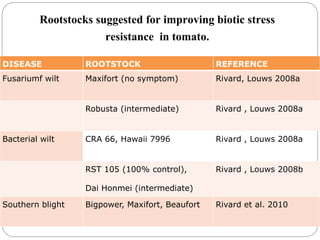
Rootstocks suggested for improving biotic stress
resistance in tomato.
DISEASE ROOTSTOCK REFERENCE
Fusariumf wilt Maxifort (no symptom) Rivard, Louws 2008a
Robusta (intermediate) Rivard , Louws 2008a
Bacterial wilt CRA 66, Hawaii 7996 Rivard , Louws 2008a
RST 105 (100% control),
Dai Honmei (intermediate)
Rivard , Louws 2008b
Southern blight Bigpower, Maxifort, Beaufort Rivard et al. 2010
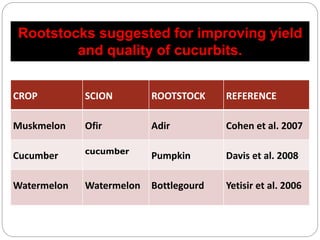
Rootstocks suggested for improving yield
and quality of cucurbits.
CROP SCION ROOTSTOCK REFERENCE
Muskmelon Ofir Adir Cohen et al. 2007
Cucumber cucumber
Pumpkin Davis et al. 2008
Watermelon Watermelon Bottlegourd Yetisir et al. 2006
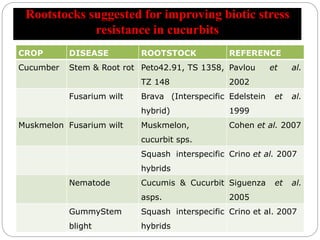
Rootstocks suggested for improving biotic stress
resistance in cucurbits
CROP DISEASE ROOTSTOCK REFERENCE
Cucumber Stem & Root rot Peto42.91, TS 1358,
TZ 148
Pavlou et al.
2002
Fusarium wilt Brava (Interspecific
hybrid)
Edelstein et al.
1999
Muskmelon Fusarium wilt Muskmelon,
cucurbit sps.
Cohen et al. 2007
Squash interspecific
hybrids
Crino et al. 2007
Nematode Cucumis & Cucurbit
asps.
Siguenza et al.
2005
GummyStem
blight
Squash interspecific
hybrids
Crino et al. 2007
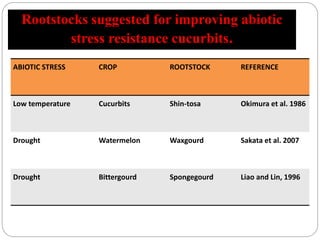
Rootstocks suggested for improving abiotic
stress resistance cucurbits.
ABIOTIC STRESS CROP ROOTSTOCK REFERENCE
Low temperature Cucurbits Shin-tosa Okimura et al. 1986
Drought Watermelon Waxgourd Sakata et al. 2007
Drought Bittergourd Spongegourd Liao and Lin, 1996
Country Watermelon Cucumber Melon Tomato Brinjal Pepper
Israel 70% - 5% 15% 5% -
Japan 93% 72% 30% 48% 65% 5%
Korea 98% 95% 95% 15% 2% 25%
Greece 100% 5-10% 40-50% 2-3%
Spain 98% - 3% 4500 ha - -
Morocco - - - 75% - -
Cyprea 80% 170 ha
Italy 30% - 5-6 million 1200 ha - -
France - 3% 1000 ha 2800 ha - -
Netherla
nd
- 5% - 50% - -
Turkey 30% 5% - 25% 10% -
Countries position of vegetable grafting in world
Source: Histil South Africa (PTY), 2007 cited by Yassin and Hussen [94]
Conclusion
Use of rootstocks can enhance whole plant biotic stress responses by
improving
-plant vigor through vigorous attainment of soil nutrients
-avoidance of soil pathogens
-tolerance of low soil temperatures, salinity, and wet soil conditions
-rootstock also affects scion growth, yield, and fruit quality.
Grafting of vegetables may be useful in the low-input, sustainable
horticulture of the future.
Grafting is rare in India due high initial cost and availability of facilities, but
with continued loss of quality disease free farmland vegetable grafting is an
attractive option.
Thank You…

Grafting in vegetable

  • 2.
    DOCTORAL SEMINAR ON Research workdone on grafting of vegetable crops SEMINAR INCHARGE Dr. D. A. Sarnaik Professor Deptt. Deptt. Genetics and plant breedig Speaker Dhaendra Dhanuka Ph.D. Scholar Deptt. Genetics and plant breedig
  • 3.
    Grafting : “Uniting two living plant parts to grow as a single plant”. Introduction Graft union Rootstock Scion
  • 4.
    What is Grafting?????? Grafting is a vegetative propagation method where in two living plant parts (the rootstock and scion) are united together to grow as a single plant. The below ground portion of plant ;ROOTSTOCK-chosen for its genetic ability to resist/tolerant to biotic & abiotic stress. The above ground portion of the plant; SCION-chosen based on fruit quality & improve yield.
  • 5.
    Why Grafting ????? Vegetablesproduction highly affected by biotic & abiotic stress. With the ban of chemicals used( fungicides and pesticides), grafting of susceptible scions on resistant rootstocks is become an effective alternative against soil borne pathogens. More over, in organic cultivation of vegetables grafting eliminates the use of chemicals in disease control& eco friendly to nature. All these burst open into the technology “Grafting of Vegetables”
  • 6.
    HISTORY OF VEGETABLEGRAFTING  The production of grafted vegetable plants was first began in Japan and Korea in the late 1920s with watermelon (Citrullus lanatus Matsum. et Nakai) grafted onto pumpkin (Cucurbita moschata) rootstock (Lee 1994).  Soon after, watermelons (Citrullus lanatus) were grafted onto bottle gourd (Lagenaria siceraria) rootstocks.  Eggplant (Solanum melongena) was grafted onto scarlet eggplant (Solanum integrifolium Poir.) in the 1950s.  Later, grafting was introduced to North America from Europe in the late 20th century and it is now attracting growing interest, both from greenhouse growers and organic producers (Kubota et al. 2008).
  • 7.
    OBJECTIVE OF VEGETABLEGRAFTING  Disease resistance.  Low temperature tolerance.  High temperature tolerance.  High salt tolerance.  Flood tolerance.  High yield.  Improved quality traits.
  • 8.
    Crop Objective WATERMELON Lowtemperature tolerance,drought tolerance,tolerance to fruit fly, Improving yield & quality of watermelon.tolerance to fusarium wilt,powdery mildew. CUCUMBER Low temperature tolerance,drought tolerance,tolerance to fruit fly, Improving yield & quality of ,tolerance to fusarium wilt. TOMATO Tolerance to wilt(bacterial,fungal,nematode), Improving yield & quality ,tolerance to rootknot nematode & abiotic stress. BRINJAL Tolerance to wilt(bacterial,fungal,nematode), Improving yield & quality ,tolerance to rootknot nematode & abiotic stress. Heat tolerance . CHILLI Heat tolerance capsicum production, improved yield and quality OKRA Tolerance to yellow vein mosaic virus
  • 9.
    Basic prerequisites:  Rootstocks  Scions  Grafting Aids  Screen house  Healing chamber  Acclimatization chamber HEALING CHAMBER
  • 10.
    Methods of Grafting 1.Cleft Grafting 2. Tongue Approach/Approach Grafting 3. Hole Insertion/Top Insertion Grafting 4. One Cotyledon/Slant/Splice grafting 5.Tube Grafting 6. Pin Grafting
  • 11.
    Cleft grafting  Itis a simple and easy method.  It is suitable for rootstocks with wide hypocotyls.  Can be practiced in all vegetables.
  • 12.
    Tongue Approach/Approach Graft Most widely used by farmers and small nurseries.  This method requires more space and labor compared to other methods but high seedling survival rate can be attained even by beginners.  Grafted seedlings have a uniform growth rate.  It is not suitable for rootstocks with hollow hypocotyls.
  • 13.
    Hole Insertion/Top InsertionGrafting  This is most popular in cucurbits.  When scion and rootstock have hollow hypocotyls, this method is preferred (Hang et al., 2005).  One person can produce 1,500 or more grafts/day.  To achieve a high rate of success, relative humidity should be maintained at 95%.  After healing temperature should maintain at 21-36◦C up to transplanting.
  • 14.
    Slant grafting  Ithas recently been adopted by commercial seedling nurseries (Sakata et al., 2007).  It is applicable to most vegetables. Grafted plants should be maintained in the dark at 25 ◦C and 100% humidity for three days for graft union.
  • 15.
    Tube Grafting  Itis similar to slant grafting except that in this method root stock & scion joined are held with an elastic tube instead of clips.  It is more popular in tomato, brinjal.
  • 16.
    Automated Grafting  Thefirst semiautomatic cucumber grafting system was commercialized in 1993.  A simple grafting machine can produce 350–600 grafts/hour with 2 operators, whereas manual grafting techniques produce about 1,000 grafts / person / day (Gu, 2006).  A fully automated grafting robot performing 750 grafts/hour with a 90- 93% success rate. (Kubota et al, 2008) Semi automated grafted machine developed by Helper Robotic Company, Korea
  • 17.
    Rootstock, major graftingmethods, and purpose of grafting for some vegetables. Vegetable Popular rootstock species z Grafting method y Purpose x Watermelon •Guard(Lagernaria siceraria var. hispida) •Interspecific hybridisation •Wax guard(Benincasa hispida Cogn.) •Pumpkin(Cucurbita moschata L.) •SQUASH(Cucurbita pepo L.) •Sicyos angulatus 1 1,2 1,3 2,3 1,2 2 1,2 1,2,3 1,2 1,2,3 1,2,3 5 Cucumber Figleaf guard(Cucurbita ficifolia) F1(Cucurbits maxima Cucurbits moschata) Cucumis sativus ,Sicyos angulatus 2 2 2 2 1,2,3 1,2,4 1,2 2,5 Melon Cucumis melon 3 3,4 Tomato Lycopersicon pimpinellifolium (L.)Mill Lycopersicon hirsutum Homb&Bonpl Lycopersicon esculentum 3,4 3,4 3,4 5 5 5 Brinjal Solanum integrifolium Poir Solanum turvum S w. 2,3 2,3 6 7 chilli 2,3,4 5 okra Abelmoschus manihot var. pungens, 2,3 7 nZ:the name of numerous varieties with in the same species were not listed. Y:graftng method-1.hole insertion method,2.tongue approach grafting,3.cleft grafting,4.tube grafting. X:purpose of grafting-1.tolerance to fungal wilt,2.growth promotion,3.low temperature tolerance,4.growth period & extension,5.resistant to nematode,6.bacterial wilt tolerance,7.reduction of virus infectio Jung-Myung Lee1, Department of Horticulture, Kyung Hee University, Suwon 449-701, Korea, HORTSCIENCE, VOL. 29(4), APRIL 1994
  • 18.
    Problems associated withgrafting and cultivating grafted vegetable seedlings.
  • 19.
  • 20.
    An increase inthe quality parameters is indicated as(+),a decrease as (-),& no changed as (0). Data from the source :Arvanitoyannis et al.,2005;Crino et al,2007. HORTSCIENCE,VOL.29(4),APRIL,1994 crop size firmness sweetness colour Vit.c caroteno ids Tomato + - + + + Eggplant + - + Cucumber 0 + - Watermelon + + + + Melon + + 0 + Capsicum + 0 + + GRAFTING CAN AFFECT FRUIT QUALITY OF VEGETABLES
  • 21.
    R=Resistant , HR=HighlyResistant, MR=Moderately Resistant, S=Susceptible Disease resistance andvigour of commercial tomatorootstock cultivars Rootstocks TMV Corky Root Fusarium Wilt Verticillium Wilt (r1) Root-knot Nematode Bacterial Wilt Southern BlightRace 1 Race 2 Beaufort R R R R R MR S HR Maxifort R R R R R MR S HR (Unreleased) R S R R R R HR MR TMZQ702 R S R R R R MR MR Dai Honmei R R R S R R HR MR RST-04-105 R R R R R R HR MR Big Power R R R R R R S HR Robusta R R S R R S S ? HORTSCIENCE.VOL.29,APRIL 2009
  • 22.
    Growth and floweringbehavior of watermelon as influenced by grafting with bottle gourd Treatme nt Length of main stem (m) No. of lateral stems No. of male flowers No. of female flowers Sex ratio Days to 1st male flower Days to 1st female flower Survival % Grafted 2.89 15.2 45.2 26.8 1.69 49.8 56.5 100 Non- grafted 1.88 12.8 50.6 21.8 2.32 43.4 49.9 71.05 T-test * NS NS NS * NS NS ** NS= nonsignificant * P≤0.05 * * P≤0.01 KHON KAEN AGR. J. 41 SUPPL. 1 : (2013).
  • 23.
    Yield and yieldattributes of watermelon as influenced by grafting with bottle gourd Treatment No. of fruits plant-1 Individual fruit wt. (kg) Fruit length (cm) Total fruit yield (t/ha) Grafted 3.5 4.11 32.4 42.01 Non-grafted 2.8 3.80 29.3 28.25 T-test NS NS NS ** ** P≤0.01 KHON KAEN AGR. J. 41 SUPPL. 1 : (2013).
  • 24.
    Scion and rootstockcombinations analyzed for grafting compatibility Scion Rootstock Number of plants successfully grafted CLN 3212A none (nongrafted) 10 CLN 3212A CLN 3212A(self grafted) 10 CLN 3212A ‘Maxifort®’ 10 CLN 3212A Solanum torvum seed 10 CLN 3212A Solanum torvum cutting 4 ‘Celebrity’ none (nongrafted) 10 ‘Celebrity’ ‘Celebrity’(self grafted) 10 ‘Celebrity’ ‘Maxifort®’ 10 ‘Celebrity’ Solanum torvum seed 10 ‘Celebrity’ Solanum torvum cutting 4 J Horticulture ISSN: 2376-0354 HORTICULTURE, an open access journal
  • 25.
    Rootstocks suggested forimproving yield and quality of tomato. SCION ROOTSTOCK REFERENCE Cecilia F1 Maxifort, Beaufort Mohammed et al 2009 Jermy Maxifort, Vigomax Miskovic et al. 2009 Boludo Radja Flores et al 2010 Rita Beaufort Romano,Paratore 2001
  • 26.
    Rootstocks suggested forimproving biotic stress resistance in tomato. DISEASE ROOTSTOCK REFERENCE Fusariumf wilt Maxifort (no symptom) Rivard, Louws 2008a Robusta (intermediate) Rivard , Louws 2008a Bacterial wilt CRA 66, Hawaii 7996 Rivard , Louws 2008a RST 105 (100% control), Dai Honmei (intermediate) Rivard , Louws 2008b Southern blight Bigpower, Maxifort, Beaufort Rivard et al. 2010
  • 27.
    Rootstocks suggested forimproving yield and quality of cucurbits. CROP SCION ROOTSTOCK REFERENCE Muskmelon Ofir Adir Cohen et al. 2007 Cucumber cucumber Pumpkin Davis et al. 2008 Watermelon Watermelon Bottlegourd Yetisir et al. 2006
  • 28.
    Rootstocks suggested forimproving biotic stress resistance in cucurbits CROP DISEASE ROOTSTOCK REFERENCE Cucumber Stem & Root rot Peto42.91, TS 1358, TZ 148 Pavlou et al. 2002 Fusarium wilt Brava (Interspecific hybrid) Edelstein et al. 1999 Muskmelon Fusarium wilt Muskmelon, cucurbit sps. Cohen et al. 2007 Squash interspecific hybrids Crino et al. 2007 Nematode Cucumis & Cucurbit asps. Siguenza et al. 2005 GummyStem blight Squash interspecific hybrids Crino et al. 2007
  • 29.
    Rootstocks suggested forimproving abiotic stress resistance cucurbits. ABIOTIC STRESS CROP ROOTSTOCK REFERENCE Low temperature Cucurbits Shin-tosa Okimura et al. 1986 Drought Watermelon Waxgourd Sakata et al. 2007 Drought Bittergourd Spongegourd Liao and Lin, 1996
  • 30.
    Country Watermelon CucumberMelon Tomato Brinjal Pepper Israel 70% - 5% 15% 5% - Japan 93% 72% 30% 48% 65% 5% Korea 98% 95% 95% 15% 2% 25% Greece 100% 5-10% 40-50% 2-3% Spain 98% - 3% 4500 ha - - Morocco - - - 75% - - Cyprea 80% 170 ha Italy 30% - 5-6 million 1200 ha - - France - 3% 1000 ha 2800 ha - - Netherla nd - 5% - 50% - - Turkey 30% 5% - 25% 10% - Countries position of vegetable grafting in world Source: Histil South Africa (PTY), 2007 cited by Yassin and Hussen [94]
  • 31.
    Conclusion Use of rootstockscan enhance whole plant biotic stress responses by improving -plant vigor through vigorous attainment of soil nutrients -avoidance of soil pathogens -tolerance of low soil temperatures, salinity, and wet soil conditions -rootstock also affects scion growth, yield, and fruit quality. Grafting of vegetables may be useful in the low-input, sustainable horticulture of the future. Grafting is rare in India due high initial cost and availability of facilities, but with continued loss of quality disease free farmland vegetable grafting is an attractive option.
  • 32.