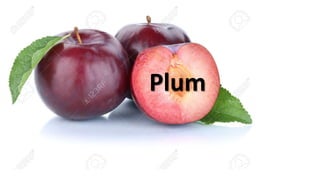
Plum
Taxonamy
• Kingdom: Plantae
• Order: Rosales
• Family: Rosaceae
• Subfamily: Maloideae or Spiraeoideae
• Genus: Prunus
• Subgenus: Prunus
• Section: Prunus (old world plum)
: Prunocerasus (new world plum)
2
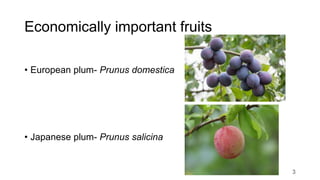
Economically important fruits
• European plum- Prunus domestica
• Japanese plum- Prunus salicina
3
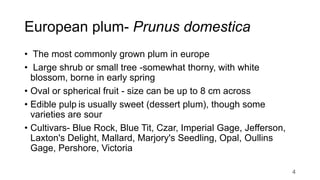
European plum- Prunus domestica
• The most commonly grown plum in europe
• Large shrub or small tree -somewhat thorny, with white
blossom, borne in early spring
• Oval or spherical fruit - size can be up to 8 cm across
• Edible pulp is usually sweet (dessert plum), though some
varieties are sour
• Cultivars- Blue Rock, Blue Tit, Czar, Imperial Gage, Jefferson,
Laxton's Delight, Mallard, Marjory's Seedling, Opal, Oullins
Gage, Pershore, Victoria
4
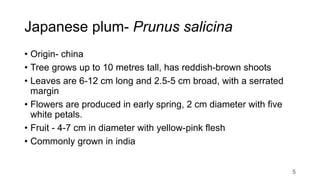
Japanese plum- Prunus salicina
• Origin- china
• Tree grows up to 10 metres tall, has reddish-brown shoots
• Leaves are 6-12 cm long and 2.5-5 cm broad, with a serrated
margin
• Flowers are produced in early spring, 2 cm diameter with five
white petals.
• Fruit - 4-7 cm in diameter with yellow-pink flesh
• Commonly grown in india
5
Cultivars
Early Mid-season Late
Highhills Sweet Early, Methley,
Kelsey
Starking Delicious,
Satsuma, Burbank,
Elephant Heart
Mariposa
Midhills Santa rosa, Beauty,
Early Red Beauty,
Transparent Cage
Frontier, Kanto 5 Mariposa, Tarrol, Red
Ace
Lowhills Alucha Purple, Titron
Himachal Pradesh
6
Contd…
Early Mid-season Late
Uttar Pradesh Jamuni, Titron, Settler,
Cloth of gold,
Ramgarh Maynard
Howe, Alubukhara
Sharbati, Zardalu,
Zardhalu Chittidar,
Burbank, Elephant
Heart, Satsuma, Black
chamba, Victoria
Late Yellow, Kanto 5,
Sweet Early, Santa
Rosa, Mariposa
Jammu and Kashmir Saharanpuri White,
Plum First Ramgarh,
Maynard Sharps,
Formosa, Maynard,
Bryanstones Ganze,
Burbank, Santa Rosa
Satsuma, Grand
Duke, Silver Wickson,
Beauty, Cloth of Gold,
Reine Claude Bavy,
Golden Gage
Panjab Satluj Purple Titron, Kala Amritsari,
Kataru Chak
Alubhukara
7
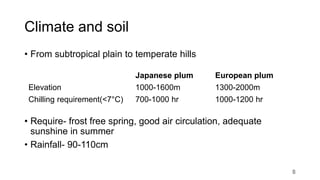
Climate and soil
• From subtropical plain to temperate hills
• Require- frost free spring, good air circulation, adequate
sunshine in summer
• Rainfall- 90-110cm
Japanese plum European plum
Elevation 1000-1600m 1300-2000m
Chilling requirement(<7°C) 700-1000 hr 1000-1200 hr
8
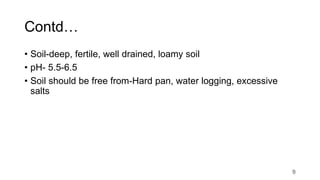
Contd…
• Soil-deep, fertile, well drained, loamy soil
• pH- 5.5-6.5
• Soil should be free from-Hard pan, water logging, excessive
salts
9
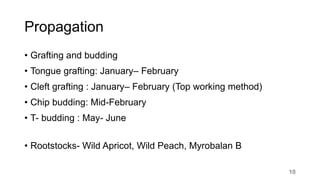
Propagation
• Grafting and budding
• Tongue grafting: January– February
• Cleft grafting : January– February (Top working method)
• Chip budding: Mid-February
• T- budding : May- June
• Rootstocks- Wild Apricot, Wild Peach, Myrobalan B
10
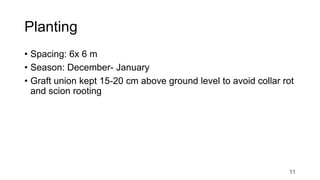
Planting
• Spacing: 6x 6 m
• Season: December- January
• Graft union kept 15-20 cm above ground level to avoid collar rot
and scion rooting
11
Training and pruning
• Open centre system
• First year
• Plant headed back at 60 cm
• 3-5 scaffold branches are retained-first: 30 cm above ground level,
remaining- 15cm spacing
• One- third portion of scaffold branch is removed
• Second year
• 2-3 secondary branches retained
• One-third to one-fourth portion of secondary branch is removed
• Third year
• Removal of unwanted, diseased, and interfering branches
12
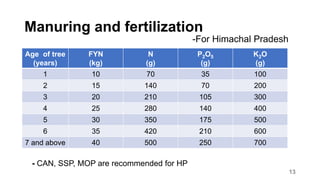
Manuring and fertilization
-For Himachal Pradesh
Age of tree
(years)
FYN
(kg)
N
(g)
P2O5
(g)
K2O
(g)
1 10 70 35 100
2 15 140 70 200
3 20 210 105 300
4 25 280 140 400
5 30 350 175 500
6 35 420 210 600
7 and above 40 500 250 700
- CAN, SSP, MOP are recommended for HP
13
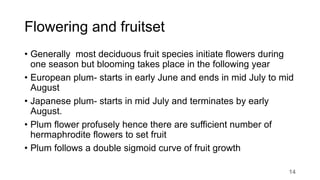
Flowering and fruitset
• Generally most deciduous fruit species initiate flowers during
one season but blooming takes place in the following year
• European plum- starts in early June and ends in mid July to mid
August
• Japanese plum- starts in mid July and terminates by early
August.
• Plum flower profusely hence there are sufficient number of
hermaphrodite flowers to set fruit
• Plum follows a double sigmoid curve of fruit growth
14
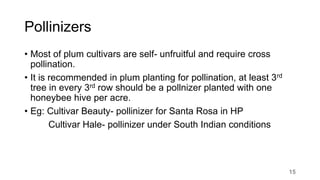
Pollinizers
• Most of plum cultivars are self- unfruitful and require cross
pollination.
• It is recommended in plum planting for pollination, at least 3rd
tree in every 3rd row should be a pollnizer planted with one
honeybee hive per acre.
• Eg: Cultivar Beauty- pollinizer for Santa Rosa in HP
Cultivar Hale- pollinizer under South Indian conditions
15
Growth regulators
• Fruit thinning- 200ppm Ethephon and 100ppm Carbaryl at full
bloom
• Improve fruit colour- 500ppm Ethephon a week before harvest
• Improve fruit size- 50ppm Triacontanol after pit hardening stage
16
Maturity indices
• Days from full bloom, firmness, TSS, change in colour
• Colour changes from green to yellow or red depending on
cultivar
variety Days from full bloom Firmness(kg) TSS(%)
Beauty 87±2 5.8±0.45 13±2
Santa Rosa 94±3 5.9±0.45 16±2
Alubukhara 102±2 5.7±0.45 12±1
Frontier 108±2 6.5±0.45 14±1
17
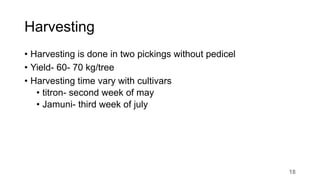
Harvesting
• Harvesting is done in two pickings without pedicel
• Yield- 60- 70 kg/tree
• Harvesting time vary with cultivars
• titron- second week of may
• Jamuni- third week of july
18
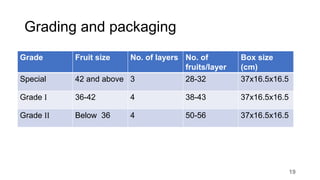
Grading and packaging
Grade Fruit size No. of layers No. of
fruits/layer
Box size
(cm)
Special 42 and above 3 28-32 37x16.5x16.5
Grade I 36-42 4 38-43 37x16.5x16.5
Grade II Below 36 4 50-56 37x16.5x16.5
19
Storage
• Plums are highly perishable
• 2-4 weeks at 0°C with 85-90% relative humidity
• Dipping in 4% calcium chloridenfor 2 minutes- store for 12 days
at room temperature
20
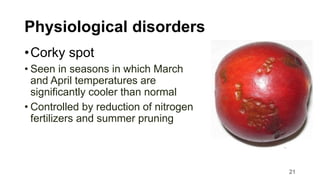
Physiological disorders
•Corky spot
• Seen in seasons in which March
and April temperatures are
significantly cooler than normal
• Controlled by reduction of nitrogen
fertilizers and summer pruning
21
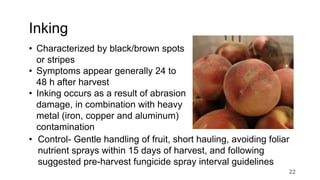
Inking
• Characterized by black/brown spots
or stripes
• Symptoms appear generally 24 to
48 h after harvest
• Inking occurs as a result of abrasion
damage, in combination with heavy
metal (iron, copper and aluminum)
contamination
• Control- Gentle handling of fruit, short hauling, avoiding foliar
nutrient sprays within 15 days of harvest, and following
suggested pre-harvest fungicide spray interval guidelines
22
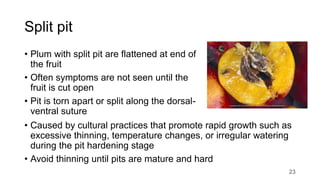
Split pit
• Plum with split pit are flattened at end of
the fruit
• Often symptoms are not seen until the
fruit is cut open
• Pit is torn apart or split along the dorsal-
ventral suture
• Caused by cultural practices that promote rapid growth such as
excessive thinning, temperature changes, or irregular watering
during the pit hardening stage
• Avoid thinning until pits are mature and hard
23
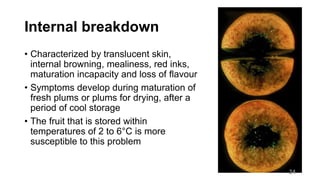
Internal breakdown
• Characterized by translucent skin,
internal browning, mealiness, red inks,
maturation incapacity and loss of flavour
• Symptoms develop during maturation of
fresh plums or plums for drying, after a
period of cool storage
• The fruit that is stored within
temperatures of 2 to 6°C is more
susceptible to this problem
24
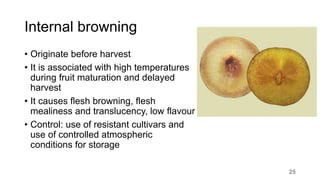
Internal browning
• Originate before harvest
• It is associated with high temperatures
during fruit maturation and delayed
harvest
• It causes flesh browning, flesh
mealiness and translucency, low flavour
• Control: use of resistant cultivars and
use of controlled atmospheric
conditions for storage
25
Diseases
• Brown rot
• Black knot
• Powdery mildew
• Stigmina blight
• Bacterial spot
• Bacterial canker
• Plum pox
26
Pests
• Plum weevil
• Defoliating beetiles
• Scale insects
• San Jose Scale
• Plum fruit moth
• Hairy caterpillars
• Leopard moth
27
28

Plum

  • 1.
  • 2.
    Taxonamy • Kingdom: Plantae •Order: Rosales • Family: Rosaceae • Subfamily: Maloideae or Spiraeoideae • Genus: Prunus • Subgenus: Prunus • Section: Prunus (old world plum) : Prunocerasus (new world plum) 2
  • 3.
    Economically important fruits •European plum- Prunus domestica • Japanese plum- Prunus salicina 3
  • 4.
    European plum- Prunusdomestica • The most commonly grown plum in europe • Large shrub or small tree -somewhat thorny, with white blossom, borne in early spring • Oval or spherical fruit - size can be up to 8 cm across • Edible pulp is usually sweet (dessert plum), though some varieties are sour • Cultivars- Blue Rock, Blue Tit, Czar, Imperial Gage, Jefferson, Laxton's Delight, Mallard, Marjory's Seedling, Opal, Oullins Gage, Pershore, Victoria 4
  • 5.
    Japanese plum- Prunussalicina • Origin- china • Tree grows up to 10 metres tall, has reddish-brown shoots • Leaves are 6-12 cm long and 2.5-5 cm broad, with a serrated margin • Flowers are produced in early spring, 2 cm diameter with five white petals. • Fruit - 4-7 cm in diameter with yellow-pink flesh • Commonly grown in india 5
  • 6.
    Cultivars Early Mid-season Late HighhillsSweet Early, Methley, Kelsey Starking Delicious, Satsuma, Burbank, Elephant Heart Mariposa Midhills Santa rosa, Beauty, Early Red Beauty, Transparent Cage Frontier, Kanto 5 Mariposa, Tarrol, Red Ace Lowhills Alucha Purple, Titron Himachal Pradesh 6
  • 7.
    Contd… Early Mid-season Late UttarPradesh Jamuni, Titron, Settler, Cloth of gold, Ramgarh Maynard Howe, Alubukhara Sharbati, Zardalu, Zardhalu Chittidar, Burbank, Elephant Heart, Satsuma, Black chamba, Victoria Late Yellow, Kanto 5, Sweet Early, Santa Rosa, Mariposa Jammu and Kashmir Saharanpuri White, Plum First Ramgarh, Maynard Sharps, Formosa, Maynard, Bryanstones Ganze, Burbank, Santa Rosa Satsuma, Grand Duke, Silver Wickson, Beauty, Cloth of Gold, Reine Claude Bavy, Golden Gage Panjab Satluj Purple Titron, Kala Amritsari, Kataru Chak Alubhukara 7
  • 8.
    Climate and soil •From subtropical plain to temperate hills • Require- frost free spring, good air circulation, adequate sunshine in summer • Rainfall- 90-110cm Japanese plum European plum Elevation 1000-1600m 1300-2000m Chilling requirement(<7°C) 700-1000 hr 1000-1200 hr 8
  • 9.
    Contd… • Soil-deep, fertile,well drained, loamy soil • pH- 5.5-6.5 • Soil should be free from-Hard pan, water logging, excessive salts 9
  • 10.
    Propagation • Grafting andbudding • Tongue grafting: January– February • Cleft grafting : January– February (Top working method) • Chip budding: Mid-February • T- budding : May- June • Rootstocks- Wild Apricot, Wild Peach, Myrobalan B 10
  • 11.
    Planting • Spacing: 6x6 m • Season: December- January • Graft union kept 15-20 cm above ground level to avoid collar rot and scion rooting 11
  • 12.
    Training and pruning •Open centre system • First year • Plant headed back at 60 cm • 3-5 scaffold branches are retained-first: 30 cm above ground level, remaining- 15cm spacing • One- third portion of scaffold branch is removed • Second year • 2-3 secondary branches retained • One-third to one-fourth portion of secondary branch is removed • Third year • Removal of unwanted, diseased, and interfering branches 12
  • 13.
    Manuring and fertilization -ForHimachal Pradesh Age of tree (years) FYN (kg) N (g) P2O5 (g) K2O (g) 1 10 70 35 100 2 15 140 70 200 3 20 210 105 300 4 25 280 140 400 5 30 350 175 500 6 35 420 210 600 7 and above 40 500 250 700 - CAN, SSP, MOP are recommended for HP 13
  • 14.
    Flowering and fruitset •Generally most deciduous fruit species initiate flowers during one season but blooming takes place in the following year • European plum- starts in early June and ends in mid July to mid August • Japanese plum- starts in mid July and terminates by early August. • Plum flower profusely hence there are sufficient number of hermaphrodite flowers to set fruit • Plum follows a double sigmoid curve of fruit growth 14
  • 15.
    Pollinizers • Most ofplum cultivars are self- unfruitful and require cross pollination. • It is recommended in plum planting for pollination, at least 3rd tree in every 3rd row should be a pollnizer planted with one honeybee hive per acre. • Eg: Cultivar Beauty- pollinizer for Santa Rosa in HP Cultivar Hale- pollinizer under South Indian conditions 15
  • 16.
    Growth regulators • Fruitthinning- 200ppm Ethephon and 100ppm Carbaryl at full bloom • Improve fruit colour- 500ppm Ethephon a week before harvest • Improve fruit size- 50ppm Triacontanol after pit hardening stage 16
  • 17.
    Maturity indices • Daysfrom full bloom, firmness, TSS, change in colour • Colour changes from green to yellow or red depending on cultivar variety Days from full bloom Firmness(kg) TSS(%) Beauty 87±2 5.8±0.45 13±2 Santa Rosa 94±3 5.9±0.45 16±2 Alubukhara 102±2 5.7±0.45 12±1 Frontier 108±2 6.5±0.45 14±1 17
  • 18.
    Harvesting • Harvesting isdone in two pickings without pedicel • Yield- 60- 70 kg/tree • Harvesting time vary with cultivars • titron- second week of may • Jamuni- third week of july 18
  • 19.
    Grading and packaging GradeFruit size No. of layers No. of fruits/layer Box size (cm) Special 42 and above 3 28-32 37x16.5x16.5 Grade I 36-42 4 38-43 37x16.5x16.5 Grade II Below 36 4 50-56 37x16.5x16.5 19
  • 20.
    Storage • Plums arehighly perishable • 2-4 weeks at 0°C with 85-90% relative humidity • Dipping in 4% calcium chloridenfor 2 minutes- store for 12 days at room temperature 20
  • 21.
    Physiological disorders •Corky spot •Seen in seasons in which March and April temperatures are significantly cooler than normal • Controlled by reduction of nitrogen fertilizers and summer pruning 21
  • 22.
    Inking • Characterized byblack/brown spots or stripes • Symptoms appear generally 24 to 48 h after harvest • Inking occurs as a result of abrasion damage, in combination with heavy metal (iron, copper and aluminum) contamination • Control- Gentle handling of fruit, short hauling, avoiding foliar nutrient sprays within 15 days of harvest, and following suggested pre-harvest fungicide spray interval guidelines 22
  • 23.
    Split pit • Plumwith split pit are flattened at end of the fruit • Often symptoms are not seen until the fruit is cut open • Pit is torn apart or split along the dorsal- ventral suture • Caused by cultural practices that promote rapid growth such as excessive thinning, temperature changes, or irregular watering during the pit hardening stage • Avoid thinning until pits are mature and hard 23
  • 24.
    Internal breakdown • Characterizedby translucent skin, internal browning, mealiness, red inks, maturation incapacity and loss of flavour • Symptoms develop during maturation of fresh plums or plums for drying, after a period of cool storage • The fruit that is stored within temperatures of 2 to 6°C is more susceptible to this problem 24
  • 25.
    Internal browning • Originatebefore harvest • It is associated with high temperatures during fruit maturation and delayed harvest • It causes flesh browning, flesh mealiness and translucency, low flavour • Control: use of resistant cultivars and use of controlled atmospheric conditions for storage 25
  • 26.
    Diseases • Brown rot •Black knot • Powdery mildew • Stigmina blight • Bacterial spot • Bacterial canker • Plum pox 26
  • 27.
    Pests • Plum weevil •Defoliating beetiles • Scale insects • San Jose Scale • Plum fruit moth • Hairy caterpillars • Leopard moth 27
  • 28.

Editor's Notes

  • #3 Sect. Armeniaca (apricots)
  • #15 Usually there is very heavy fruit set in plums. However, it is cultivar dependent. For example Kala Amritsar is heavy bearer but Alubokhara shy bearer.