
AN PERSENTATION ON FLOWER
VIVEK SINGH DEVA RAM
12MSSDCI020 12MSSDCI049
Dept of GPB &SST Allahabad school of agriculture
S.H.I.A.T.S. Allahabad (India )
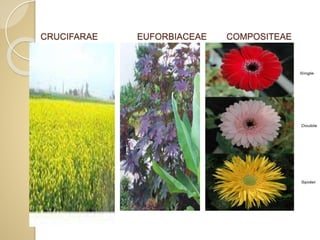
CRUCIFARAE EUFORBIACEAE COMPOSITEAE
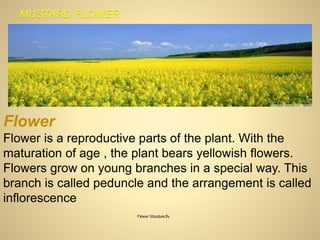
MUSTARD FLOWER
Flower
Flower is a reproductive parts of the plant. With the
maturation of age , the plant bears yellowish flowers.
Flowers grow on young branches in a special way. This
branch is called peduncle and the arrangement is called
inflorescence
Flower Structure.flv
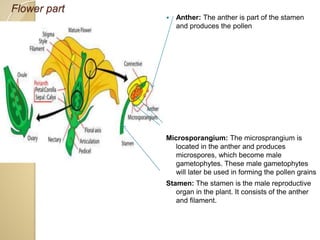
 Flower part
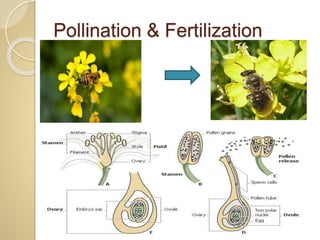
 Stigma: The stigma is the sticky surface
where pollen lands and is collected to
fertilize the ovules.
 Style: The style is part of the pistil and
holds the stigma above the ovary.
 Filament: The filament provides support
for the anther in the stamen
 Ovule: The ovules contain egg cells and
become the seeds after pollination.
 Ovary: The ovary houses the ovules and
will become the fruit after pollination
 Calyx: The whorl of sepals on the outside
of a flower is referred to as the calyx.
 Corolla: The whorl of petals is called the
corolla.
Flower part
 Anther: The anther is part of the stamen
and produces the pollen
Microsporangium: The microsprangium is
located in the anther and produces
microspores, which become male
gametophytes. These male gametophytes
will later be used in forming the pollen grains
Stamen: The stamen is the male reproductive
organ in the plant. It consists of the anther
and filament.
Cruciferae Flower structure
Actinomorphic
Bisexual
Calyx 2+2
Corolla 4
Androecium 2+4
Superior ovary 2
Pollination & Fertilization
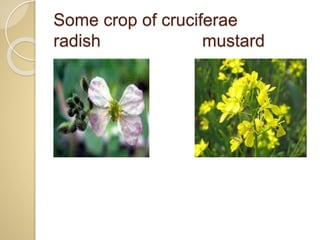
Some crop of cruciferae
radish mustard
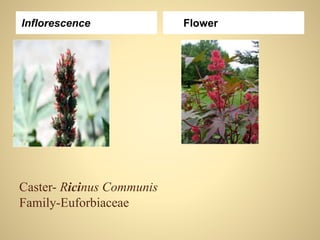
Caster- Ricinus Communis
Family-Euforbiaceae
Inflorescence Flower
Male Flower - Calyx membranous, splitting into 3-5 valvate
segments, stamens vary many filaments crowded, variously
connate or in branching clusters, anther cells distinct, distant, sub
globose, divergent, pistillode .
Female flowers Calyx spathaceous, caducous, ovary 3 celled,
styles short or long, spreading. Often very large, entire 2-fid or 3-
partite, feathery or papillose; cells 1 ovuled.
Male flowers Female flowers
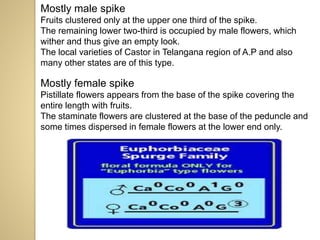
Mostly male spike
Fruits clustered only at the upper one third of the spike.
The remaining lower two-third is occupied by male flowers, which
wither and thus give an empty look.
The local varieties of Castor in Telangana region of A.P and also
many other states are of this type.
Mostly female spike
Pistillate flowers appears from the base of the spike covering the
entire length with fruits.
The staminate flowers are clustered at the base of the peduncle and
some times dispersed in female flowers at the lower end only.
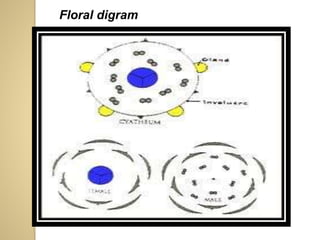
Floral digram
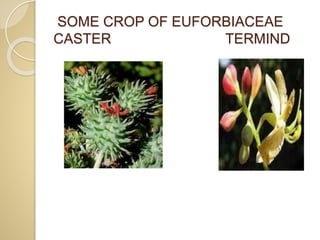
SOME CROP OF EUFORBIACEAE
CASTER TERMIND
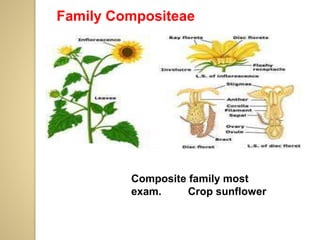
Composite family most
exam. Crop sunflower
Family Compositeae
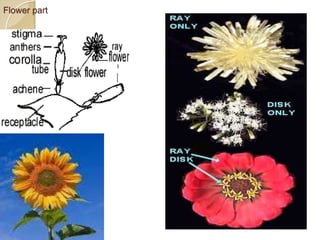
Flower part
Flower part
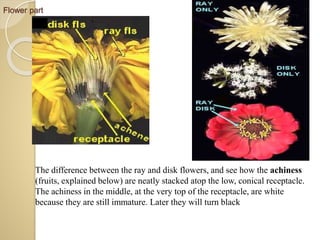
The difference between the ray and disk flowers, and see how the achiness
(fruits, explained below) are neatly stacked atop the low, conical receptacle.
The achiness in the middle, at the very top of the receptacle, are white
because they are still immature. Later they will turn black
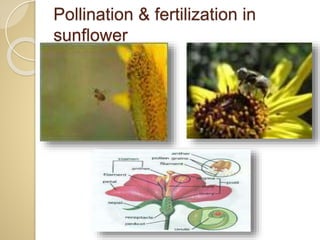
Pollination & fertilization in
sunflower
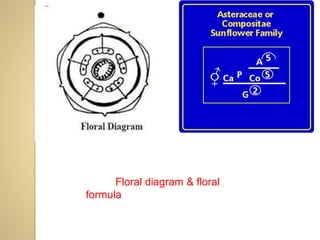
Floral diagram & floral
formula
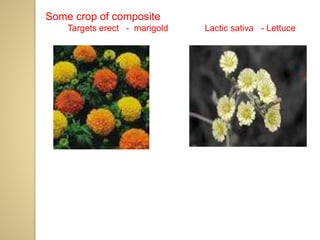
Some crop of composite
Targets erect - marigold Lactic sativa - Lettuce
Floral biology

Floral biology

  • 1.
    AN PERSENTATION ONFLOWER VIVEK SINGH DEVA RAM 12MSSDCI020 12MSSDCI049 Dept of GPB &SST Allahabad school of agriculture S.H.I.A.T.S. Allahabad (India )
  • 2.
  • 3.
    MUSTARD FLOWER Flower Flower isa reproductive parts of the plant. With the maturation of age , the plant bears yellowish flowers. Flowers grow on young branches in a special way. This branch is called peduncle and the arrangement is called inflorescence Flower Structure.flv
  • 4.
     Flower part Stigma: The stigma is the sticky surface where pollen lands and is collected to fertilize the ovules.  Style: The style is part of the pistil and holds the stigma above the ovary.  Filament: The filament provides support for the anther in the stamen  Ovule: The ovules contain egg cells and become the seeds after pollination.  Ovary: The ovary houses the ovules and will become the fruit after pollination  Calyx: The whorl of sepals on the outside of a flower is referred to as the calyx.  Corolla: The whorl of petals is called the corolla.
  • 5.
    Flower part  Anther:The anther is part of the stamen and produces the pollen Microsporangium: The microsprangium is located in the anther and produces microspores, which become male gametophytes. These male gametophytes will later be used in forming the pollen grains Stamen: The stamen is the male reproductive organ in the plant. It consists of the anther and filament.
  • 6.
    Cruciferae Flower structure Actinomorphic Bisexual Calyx2+2 Corolla 4 Androecium 2+4 Superior ovary 2
  • 7.
  • 8.
    Some crop ofcruciferae radish mustard
  • 9.
  • 10.
    Male Flower -Calyx membranous, splitting into 3-5 valvate segments, stamens vary many filaments crowded, variously connate or in branching clusters, anther cells distinct, distant, sub globose, divergent, pistillode . Female flowers Calyx spathaceous, caducous, ovary 3 celled, styles short or long, spreading. Often very large, entire 2-fid or 3- partite, feathery or papillose; cells 1 ovuled. Male flowers Female flowers
  • 11.
    Mostly male spike Fruitsclustered only at the upper one third of the spike. The remaining lower two-third is occupied by male flowers, which wither and thus give an empty look. The local varieties of Castor in Telangana region of A.P and also many other states are of this type. Mostly female spike Pistillate flowers appears from the base of the spike covering the entire length with fruits. The staminate flowers are clustered at the base of the peduncle and some times dispersed in female flowers at the lower end only.
  • 12.
  • 13.
    SOME CROP OFEUFORBIACEAE CASTER TERMIND
  • 14.
    Composite family most exam.Crop sunflower Family Compositeae
  • 15.
  • 16.
    Flower part The differencebetween the ray and disk flowers, and see how the achiness (fruits, explained below) are neatly stacked atop the low, conical receptacle. The achiness in the middle, at the very top of the receptacle, are white because they are still immature. Later they will turn black
  • 17.
  • 18.
    Floral diagram &floral formula
  • 19.
    Some crop ofcomposite Targets erect - marigold Lactic sativa - Lettuce