

1
COLLEGE OF HORTICULTURE, BAGALKOTE
5-Apr-21 2
Dept. of VSC
Presented By
Sanmathi Naik A T S
1ST Ph. D (Hort.)
Department of vegetable science
COH, Bagalkot
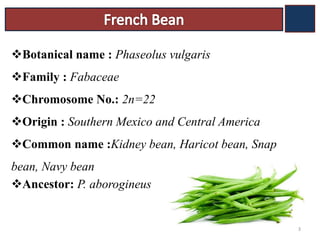
Botanical name : Phaseolus vulgaris
Family : Fabaceae
Chromosome No.: 2n=22
Origin : Southern Mexico and Central America
Common name :Kidney bean, Haricot bean, Snap
bean, Navy bean
Ancestor: P. aborogineus
3
4
Proginator/ Ancestor: Phaseolus aborogineus
Lima bean: Phaseolus lunatus
Scarlet runner bean/Runner bean: Phaseolus coccineus (Cross pollinated)
Tepary bean/Moth bean: Phaseolus acutifolius var. latifolius
Potato bean: Pachyrrhizus tuberosus
Thicket bean: Phaseolus polystachyus
Year bean: Phaseolus polyanthuss
Adzuki bean: Phaseolus lunatus
DIFFERENT SPECIES OF FRENCH BEAN
It is grown for the tender green beans and dry seeds.
The pods are slender, 10-25 cm long, straight or slightly curved with prominent
beak.
 Seeds are kidney shaped, elongated and white, red, purple or blackish in colour or
mottled.
The vegetable is in great demand in cities and is grown both commercially and in
home gardens.
Its major area is confined to hills, where it is grown for green pods.
Punjab, Jammu and Kashmir, Gujarat, Karnataka, Tamil Nadu, Uttar Pradesh and
Himachal Pradesh are the main states where it is being cultivated on large scale.
Dry grains are an excellent source of cheap protein and many varieties contain 22-
23% protein.
Hundred grams of edible fresh pods contain 91.4% water, 1.7% protein, 0.1% fat,
0.5% mineral matters, 4.5% carbohydrates, 50 mg Ca, 28 mg P and 1.7 mg Fe.
Its 100g dry seeds contain 9.6% water, 24.9% protein, 0.8% fat, 3.2% mineral
matters, 60.1% carbohydrates, 60 mg Ca, 433 mg P and 2.4mg Fe.
In India, it is mostly grown for fresh consumption, while in USA it is grown for
processing in large quantities.
Economic Benefits
5
French bean requires mild worm weather for good yield.
It is a day neutral crop except some few semi-pole varieties which are short day
types.
It is sensitive to frost and very high temperature. The optimum temperature
ranging between 15-25°C.
It is also sensitive to high temperature and high RH. The plants shed their
blossom or young pods in very hot or rainy weather.
It can be grown in variety of soils ranging from light sandy soils to clay soils but
it can withstand water logging.
The optimum soil pH is between 5.3 and 6.0.
High moisture content and high nitrogen caused delay in maturity.
Climate and soil
6
Season
There are two main growing seasons for French bean in the plains of India.
The first sowing is done during July-September and May even extended up to
September.
The second sowing is early spring that is between January to February.
In hilly regions seeds are sown on the month of March-May.
Cropping system
Being a leguminous crop, it fits well in any crop rotation.
Red kidney varieties are preferred to white seeds in heavy rainfall areas.
Such varieties also fit well in crop rotation with wheat.
It can also be grown as an intercrop in widely spread cucurbits till the main crop
begins to throw veins.
7
Land preparation
The soil should be ploughed, clods are broken and weeds are removed and brought to fine
tilth by shallow cultivation
Seed rate
The seed rate varies considerably depending on the variety, soil and climatic conditions.
The rate for bush varieties is 60-65 kg/ha while it is 25-30 kg/ha for pole varieties.
Inoculation of seed with rhizobium species facilitates quick nodulation on the roots, and
help in the fixation of atmospheric nitrogen.
Sowing
The seeds of bush beans are sown in rows 30-45 cm apart and 10-15 cm away from seed
to seed whereas pole beans are in the spacing’s of 60 cm to 100 cm between rows and plant
to plant 30cm. the depth of the sowing shall be 2 cm.
To avoid fungal infection, treat the seed with Rhizobium phaseoli @ 30 g/kg of seed.
8
Nutrition
Before sowing, at the time of ploughing apply FYM @ 25 t/ha. Although
French bean is a legume, it responds well to the application of nitrogen.
Application of 63 kg N, 100 kg P2O5 and 75 kg K2O ha is recommended.
Half of the N along with entire dose of P and K fertilizer should be applied at
the time of sowing.
Remaining half of N should be applied at the time of earthing up after 3rd
week of sowing.
Spraying micronutrients improves the quality besides increasing yield.
9
10
Irrigation
Prior to sowing the plots are irrigated and after 2-3 days when the soil is in moist
condition seeds are sown along the sides of the ridges.
Light irrigation is given after 2nd to 3rd day after sowing.
French bean is shallow rooted crop.
Water stress has marked influence on yield and quality of pods.
About 6-7 irrigations would be required at regular intervals.
Depending upon the atmospheric conditions, the amount of irrigation will be
decided.
The crop should be irrigated at an interval of one week. Excess water reduces
nodule formation and ultimately growth of plant.
Weed control
A pre sowing application of fluchloralin @ 2 l/ha checks the weed growth.
At least two hand weedings are required before earthing up.
Shallow cultivation during the early stages of crop is necessary to check the weeds and to
facilitate earthing up.
At the later stages of the crop growth, the weeds are kept under check due to the thick
canopy of the crop.
Staking
Staking is an important operation for pole beans.
The bamboo sticks or other wooden sticks or branches which are locally suitable can be
used for the support.
If the plants are grown in rows, single stick of about 2m length should be fixed near the
plant.
If the plants are grown in hills, the twigs and branches will give good support.
11
Use of growth regulators
Application of growth regulators improves the plant growth, flowering fruit set and pod
yield in French bean.
Plant regulators like PCPA @ 2ppm, L-naphthly acetamide or B-naphthal acetic acid at 5-
25ppm shown favourable effect on fruit set.
GA3 sprayed at 50-200 ppm proved effective in improving the crop growth.
Paclobutrazol at 150 ppm can be used for increasing yield and suppressing vegetative
growth of pole type varieties of French bean.
Harvesting and yield
The crop is ready for first harvest in about 45 days after sowing.
The green pods are to be picked when they are immature and fully grown but still tender.
As the harvest is delayed, the total yield increases but the quality falls rapidly due to over
maturity of pods, fiber development and rough surface.
The yield of tender pods varies from 8-10t/ha in bush varieties and 12-15 tons in pole
types. 12
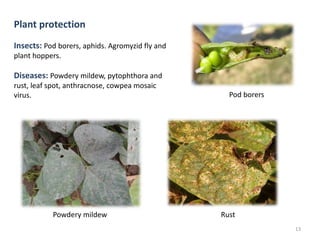
Plant protection
Insects: Pod borers, aphids. Agromyzid fly and
plant hoppers.
Diseases: Powdery mildew, pytophthora and
rust, leaf spot, anthracnose, cowpea mosaic
virus.
13
Pod borers
Powdery mildew Rust
14
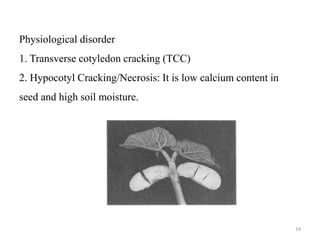
Physiological disorder
1. Transverse cotyledon cracking (TCC)
2. Hypocotyl Cracking/Necrosis: It is low calcium content in
seed and high soil moisture.
Maturity standards
The various maturity parameters like seed size, seed percentage, dry matter content
and distribution of pods according to sieve size are found to reliable maturity
standards.
Seed production
It is self pollinated crop.
Even then an isolation distance of 50 and 25 m should be maintained for Foundation
seed and certified seed respectively.
First rouging before pod set on the basis of foliage and flower characters, second at
the time of pod formation on the basis of pod characters.
Completely dried pods are harvested and kept in sunlight for drying.
Threshing and cleaning can be done by hand or thresher.
The average seed yield is about 15-20 q/ha.
15
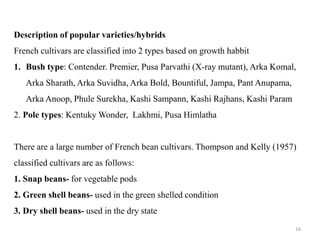
Description of popular varieties/hybrids
French cultivars are classified into 2 types based on growth habbit
1. Bush type: Contender. Premier, Pusa Parvathi (X-ray mutant), Arka Komal,
Arka Sharath, Arka Suvidha, Arka Bold, Bountiful, Jampa, Pant Anupama,
Arka Anoop, Phule Surekha, Kashi Sampann, Kashi Rajhans, Kashi Param
2. Pole types: Kentuky Wonder, Lakhmi, Pusa Himlatha
There are a large number of French bean cultivars. Thompson and Kelly (1957)
classified cultivars are as follows:
1. Snap beans- for vegetable pods
2. Green shell beans- used in the green shelled condition
3. Dry shell beans- used in the dry state
16
17
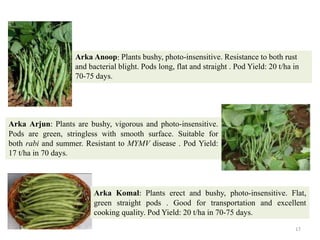
Arka Anoop: Plants bushy, photo-insensitive. Resistance to both rust
and bacterial blight. Pods long, flat and straight . Pod Yield: 20 t/ha in
70-75 days.
Arka Arjun: Plants are bushy, vigorous and photo-insensitive.
Pods are green, stringless with smooth surface. Suitable for
both rabi and summer. Resistant to MYMV disease . Pod Yield:
17 t/ha in 70 days.
Arka Komal: Plants erect and bushy, photo-insensitive. Flat,
green straight pods . Good for transportation and excellent
cooking quality. Pod Yield: 20 t/ha in 70-75 days.
18
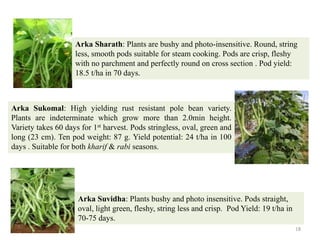
Arka Sharath: Plants are bushy and photo-insensitive. Round, string
less, smooth pods suitable for steam cooking. Pods are crisp, fleshy
with no parchment and perfectly round on cross section . Pod yield:
18.5 t/ha in 70 days.
Arka Sukomal: High yielding rust resistant pole bean variety.
Plants are indeterminate which grow more than 2.0min height.
Variety takes 60 days for 1st harvest. Pods stringless, oval, green and
long (23 cm). Ten pod weight: 87 g. Yield potential: 24 t/ha in 100
days . Suitable for both kharif & rabi seasons.
Arka Suvidha: Plants bushy and photo insensitive. Pods straight,
oval, light green, fleshy, string less and crisp. Pod Yield: 19 t/ha in
70-75 days.
19
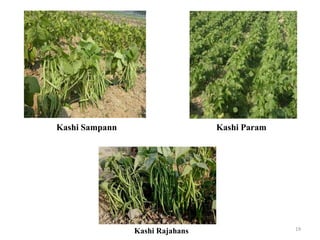
Kashi Sampann Kashi Param
Kashi Rajahans
20
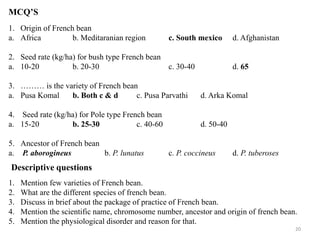
MCQ’S
1. Origin of French bean
a. Africa b. Meditaranian region c. South mexico d. Afghanistan
2. Seed rate (kg/ha) for bush type French bean
a. 10-20 b. 20-30 c. 30-40 d. 65
3. ……… is the variety of French bean
a. Pusa Komal b. Both c & d c. Pusa Parvathi d. Arka Komal
4. Seed rate (kg/ha) for Pole type French bean
a. 15-20 b. 25-30 c. 40-60 d. 50-40
5. Ancestor of French bean
a. P. aborogineus b. P. lunatus c. P. coccineus d. P. tuberoses
Descriptive questions
1. Mention few varieties of French bean.
2. What are the different species of french bean.
3. Discuss in brief about the package of practice of French bean.
4. Mention the scientific name, chromosome number, ancestor and origin of french bean.
5. Mention the physiological disorder and reason for that.

French bean

  • 1.
  • 2.
    COLLEGE OF HORTICULTURE,BAGALKOTE 5-Apr-21 2 Dept. of VSC Presented By Sanmathi Naik A T S 1ST Ph. D (Hort.) Department of vegetable science COH, Bagalkot
  • 3.
    Botanical name :Phaseolus vulgaris Family : Fabaceae Chromosome No.: 2n=22 Origin : Southern Mexico and Central America Common name :Kidney bean, Haricot bean, Snap bean, Navy bean Ancestor: P. aborogineus 3
  • 4.
    4 Proginator/ Ancestor: Phaseolusaborogineus Lima bean: Phaseolus lunatus Scarlet runner bean/Runner bean: Phaseolus coccineus (Cross pollinated) Tepary bean/Moth bean: Phaseolus acutifolius var. latifolius Potato bean: Pachyrrhizus tuberosus Thicket bean: Phaseolus polystachyus Year bean: Phaseolus polyanthuss Adzuki bean: Phaseolus lunatus DIFFERENT SPECIES OF FRENCH BEAN
  • 5.
    It is grownfor the tender green beans and dry seeds. The pods are slender, 10-25 cm long, straight or slightly curved with prominent beak.  Seeds are kidney shaped, elongated and white, red, purple or blackish in colour or mottled. The vegetable is in great demand in cities and is grown both commercially and in home gardens. Its major area is confined to hills, where it is grown for green pods. Punjab, Jammu and Kashmir, Gujarat, Karnataka, Tamil Nadu, Uttar Pradesh and Himachal Pradesh are the main states where it is being cultivated on large scale. Dry grains are an excellent source of cheap protein and many varieties contain 22- 23% protein. Hundred grams of edible fresh pods contain 91.4% water, 1.7% protein, 0.1% fat, 0.5% mineral matters, 4.5% carbohydrates, 50 mg Ca, 28 mg P and 1.7 mg Fe. Its 100g dry seeds contain 9.6% water, 24.9% protein, 0.8% fat, 3.2% mineral matters, 60.1% carbohydrates, 60 mg Ca, 433 mg P and 2.4mg Fe. In India, it is mostly grown for fresh consumption, while in USA it is grown for processing in large quantities. Economic Benefits 5
  • 6.
    French bean requiresmild worm weather for good yield. It is a day neutral crop except some few semi-pole varieties which are short day types. It is sensitive to frost and very high temperature. The optimum temperature ranging between 15-25°C. It is also sensitive to high temperature and high RH. The plants shed their blossom or young pods in very hot or rainy weather. It can be grown in variety of soils ranging from light sandy soils to clay soils but it can withstand water logging. The optimum soil pH is between 5.3 and 6.0. High moisture content and high nitrogen caused delay in maturity. Climate and soil 6
  • 7.
    Season There are twomain growing seasons for French bean in the plains of India. The first sowing is done during July-September and May even extended up to September. The second sowing is early spring that is between January to February. In hilly regions seeds are sown on the month of March-May. Cropping system Being a leguminous crop, it fits well in any crop rotation. Red kidney varieties are preferred to white seeds in heavy rainfall areas. Such varieties also fit well in crop rotation with wheat. It can also be grown as an intercrop in widely spread cucurbits till the main crop begins to throw veins. 7
  • 8.
    Land preparation The soilshould be ploughed, clods are broken and weeds are removed and brought to fine tilth by shallow cultivation Seed rate The seed rate varies considerably depending on the variety, soil and climatic conditions. The rate for bush varieties is 60-65 kg/ha while it is 25-30 kg/ha for pole varieties. Inoculation of seed with rhizobium species facilitates quick nodulation on the roots, and help in the fixation of atmospheric nitrogen. Sowing The seeds of bush beans are sown in rows 30-45 cm apart and 10-15 cm away from seed to seed whereas pole beans are in the spacing’s of 60 cm to 100 cm between rows and plant to plant 30cm. the depth of the sowing shall be 2 cm. To avoid fungal infection, treat the seed with Rhizobium phaseoli @ 30 g/kg of seed. 8
  • 9.
    Nutrition Before sowing, atthe time of ploughing apply FYM @ 25 t/ha. Although French bean is a legume, it responds well to the application of nitrogen. Application of 63 kg N, 100 kg P2O5 and 75 kg K2O ha is recommended. Half of the N along with entire dose of P and K fertilizer should be applied at the time of sowing. Remaining half of N should be applied at the time of earthing up after 3rd week of sowing. Spraying micronutrients improves the quality besides increasing yield. 9
  • 10.
    10 Irrigation Prior to sowingthe plots are irrigated and after 2-3 days when the soil is in moist condition seeds are sown along the sides of the ridges. Light irrigation is given after 2nd to 3rd day after sowing. French bean is shallow rooted crop. Water stress has marked influence on yield and quality of pods. About 6-7 irrigations would be required at regular intervals. Depending upon the atmospheric conditions, the amount of irrigation will be decided. The crop should be irrigated at an interval of one week. Excess water reduces nodule formation and ultimately growth of plant.
  • 11.
    Weed control A presowing application of fluchloralin @ 2 l/ha checks the weed growth. At least two hand weedings are required before earthing up. Shallow cultivation during the early stages of crop is necessary to check the weeds and to facilitate earthing up. At the later stages of the crop growth, the weeds are kept under check due to the thick canopy of the crop. Staking Staking is an important operation for pole beans. The bamboo sticks or other wooden sticks or branches which are locally suitable can be used for the support. If the plants are grown in rows, single stick of about 2m length should be fixed near the plant. If the plants are grown in hills, the twigs and branches will give good support. 11
  • 12.
    Use of growthregulators Application of growth regulators improves the plant growth, flowering fruit set and pod yield in French bean. Plant regulators like PCPA @ 2ppm, L-naphthly acetamide or B-naphthal acetic acid at 5- 25ppm shown favourable effect on fruit set. GA3 sprayed at 50-200 ppm proved effective in improving the crop growth. Paclobutrazol at 150 ppm can be used for increasing yield and suppressing vegetative growth of pole type varieties of French bean. Harvesting and yield The crop is ready for first harvest in about 45 days after sowing. The green pods are to be picked when they are immature and fully grown but still tender. As the harvest is delayed, the total yield increases but the quality falls rapidly due to over maturity of pods, fiber development and rough surface. The yield of tender pods varies from 8-10t/ha in bush varieties and 12-15 tons in pole types. 12
  • 13.
    Plant protection Insects: Podborers, aphids. Agromyzid fly and plant hoppers. Diseases: Powdery mildew, pytophthora and rust, leaf spot, anthracnose, cowpea mosaic virus. 13 Pod borers Powdery mildew Rust
  • 14.
    14 Physiological disorder 1. Transversecotyledon cracking (TCC) 2. Hypocotyl Cracking/Necrosis: It is low calcium content in seed and high soil moisture.
  • 15.
    Maturity standards The variousmaturity parameters like seed size, seed percentage, dry matter content and distribution of pods according to sieve size are found to reliable maturity standards. Seed production It is self pollinated crop. Even then an isolation distance of 50 and 25 m should be maintained for Foundation seed and certified seed respectively. First rouging before pod set on the basis of foliage and flower characters, second at the time of pod formation on the basis of pod characters. Completely dried pods are harvested and kept in sunlight for drying. Threshing and cleaning can be done by hand or thresher. The average seed yield is about 15-20 q/ha. 15
  • 16.
    Description of popularvarieties/hybrids French cultivars are classified into 2 types based on growth habbit 1. Bush type: Contender. Premier, Pusa Parvathi (X-ray mutant), Arka Komal, Arka Sharath, Arka Suvidha, Arka Bold, Bountiful, Jampa, Pant Anupama, Arka Anoop, Phule Surekha, Kashi Sampann, Kashi Rajhans, Kashi Param 2. Pole types: Kentuky Wonder, Lakhmi, Pusa Himlatha There are a large number of French bean cultivars. Thompson and Kelly (1957) classified cultivars are as follows: 1. Snap beans- for vegetable pods 2. Green shell beans- used in the green shelled condition 3. Dry shell beans- used in the dry state 16
  • 17.
    17 Arka Anoop: Plantsbushy, photo-insensitive. Resistance to both rust and bacterial blight. Pods long, flat and straight . Pod Yield: 20 t/ha in 70-75 days. Arka Arjun: Plants are bushy, vigorous and photo-insensitive. Pods are green, stringless with smooth surface. Suitable for both rabi and summer. Resistant to MYMV disease . Pod Yield: 17 t/ha in 70 days. Arka Komal: Plants erect and bushy, photo-insensitive. Flat, green straight pods . Good for transportation and excellent cooking quality. Pod Yield: 20 t/ha in 70-75 days.
  • 18.
    18 Arka Sharath: Plantsare bushy and photo-insensitive. Round, string less, smooth pods suitable for steam cooking. Pods are crisp, fleshy with no parchment and perfectly round on cross section . Pod yield: 18.5 t/ha in 70 days. Arka Sukomal: High yielding rust resistant pole bean variety. Plants are indeterminate which grow more than 2.0min height. Variety takes 60 days for 1st harvest. Pods stringless, oval, green and long (23 cm). Ten pod weight: 87 g. Yield potential: 24 t/ha in 100 days . Suitable for both kharif & rabi seasons. Arka Suvidha: Plants bushy and photo insensitive. Pods straight, oval, light green, fleshy, string less and crisp. Pod Yield: 19 t/ha in 70-75 days.
  • 19.
    19 Kashi Sampann KashiParam Kashi Rajahans
  • 20.
    20 MCQ’S 1. Origin ofFrench bean a. Africa b. Meditaranian region c. South mexico d. Afghanistan 2. Seed rate (kg/ha) for bush type French bean a. 10-20 b. 20-30 c. 30-40 d. 65 3. ……… is the variety of French bean a. Pusa Komal b. Both c & d c. Pusa Parvathi d. Arka Komal 4. Seed rate (kg/ha) for Pole type French bean a. 15-20 b. 25-30 c. 40-60 d. 50-40 5. Ancestor of French bean a. P. aborogineus b. P. lunatus c. P. coccineus d. P. tuberoses Descriptive questions 1. Mention few varieties of French bean. 2. What are the different species of french bean. 3. Discuss in brief about the package of practice of French bean. 4. Mention the scientific name, chromosome number, ancestor and origin of french bean. 5. Mention the physiological disorder and reason for that.