


DIALLALE SELECTIVEMATINGAPPROACH
Dev Hingra
Mail Id- mail2devhingra@gmail.com
RAJASTHAN COLLEGE OFAGRICULTURE
MPUAT,UDAIPUR (RAJASTHAN)
DIALLALE SELECTIVE MATING APPROACH
The concept of diallel selective mating system was
originally developed by jensen in 1970. jensen used this system
for genetic improvement of wheat. Now this system is used
for genetic improvement of various autogamous crops
especially small grain crops such as wheat, barley, rice, etc.
The system uses multiple parent input into a central gene
pool (population) which, through selective mating of individuals
is advanced through successive generations. Mass and
recurrent selection procedures are employed throughout on
both the plant and seed portions of each plant generation.
The system is designed to shift the attention of breeders
from the present operating concept of employing germplasm
sources discretely and sequentially in the formation of
numerous populations.
In contrast, the diallel and selective mating aspects of the
new system force the simultaneous insertion of multiple
genotypes into a few central populations.
Definition of DSM: A method of population improvement
of autogamous species that involves parental diallele series, F1
diallale series and selective mating series in the breeding
procedure.
Three basic functions of a breeding programme.
Firstly it allows the development of F2, F3, etc.
(selfing series) at every stage of the breeding
programme, which permits the isolation of
purelines for use of commercial varieties.
Secondly, it requires intermating among the selected
plants/lines in each stage; the progenies from
these intermatings form the basis for next stage
of the selfing series in the breeding programme.
VesiclesArbuscules
Thus the breeding programme progresses in two different
directions,
1. Vertically, through the selfing series leading to the
isolation of commercial varieties.
2. horizontally, through intermating among the selected
plants/lines ; this generates the recurrent selection series.
Thirdly, new germplasm may be introduced at any stage of the
programme by intermating it with some of the selected plants of
that stage. This permits the retension and or the creation of
large amount of variability for effective selection through the
several cycles.
In 1984, baker, concluded that the benefits of
intermating to break linkage groups while depend on
the fallowing:
Whether the gene of interest are linked in coupling
or repulsion phase.
The strength of the linkage.
The time required for intermating.
Breeding procedure
The breeding scheme is designed to serve both short term and long
term crop, each population being developed to full fill a specific
objective.
This scheme has not been widely used primarily due to the
difficulties in making the large number of crosses required in this
scheme. Jensen has suggested the genetic male sterility to
overcome this difficulty in the same way as in the recurrent
selection scheme discussed earlier. Further DSM Is much more
complicated then the simple pedigree method, with still is the
favourite breeding method for self pollinated crops.
The breeding procedure of DSM consists of three
major steps
1.parental diallel series,
2.F1 diallel series
3. selective mating series
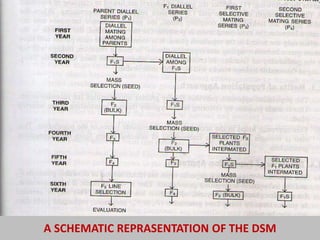
A SCHEMATIC REPRASENTATION OF THE DSM
2. F1 DIALLEL SERIES
The above F1 crosses are used in two ways (1) to produce F2
population and (2) to develop F1 diallel series. Mass selection is
practiced to advance the F2 population. The selected F1 crosses
are crossed in diallel fashion( upto 7 complete diallel and above 7
partial diallel). The F1 diallel series is also known as multiple
parent crosses because each cross involves 4 parents. The F1
diallel series is designated as P2.
The parental lines are selected keeping in view the breeding
objectives. The selected parent are crossed in a diallel fashion and
F1 seeds are obtained. If the number of parents is 7 or
less,complete diallel is used. When the number of parent is more
than 7, partial diallel cross is made. The parental diallel series is
designated as P1.
1.PARENTAL DIALLEL SERIES
3. SELECTIVE MATING SERIES
The F15 from the multiple crosses are selfed to produce
F2 population. The F2 population is used in two ways
(1) to produce F3 by mass selection, and
(2) to develop first selective mating series(P3) by
intermating selected F2 plants.
The F1 crosses developed by selective mating are used in
three ways. Some are selected for intermatinmg to form
the second selective mating series(P3) and others are
crossed with new parents(germplasm lines) not included in
the original diallel. This helps in broadening the genetic
base of breeding populations. Some plants are selfed to
produce F2 population. Many such cycles can be made to
achieve the desired breeding objective.
MERITS OF THE POPULATION
APPROACH1. The population approach provides far greater
oppurtunities for recombination. This is made
possible by restoring heterozygosity through
intermating of the selected plants.
2. This approach helps in the accumulation of
desirable genes in the population. This also is
brought about the intermating of selected plants
from the segregating generations.
3. DSM is very much useful in broadening the genetic
base populations by incorporation of multiple
parents(germplasm lines) in thebreeding
programme.
DEMERITS OF THE POPULATION
APPROACH
1. The success of this approach depends upon the
identification of desirable plants in F2 and
subsequent generation.
2. Another draw back of this approach is the
necessity for intermating the selected plants. This
may become a major limitation in some crops
because crossing in many self pollinated species is
difficult and time consuming.
3. The time taken to develop a new variety through
population approach would be always greater than
that by the pedigree method.
4. There is no convincing evidence for the benefits
from the population approach. It has been argued
that increased recombination may be detrimental as
it would break the desirable linkages.
Diallele selective mating system

Diallele selective mating system

  • 2.
    DIALLALE SELECTIVEMATINGAPPROACH Dev Hingra MailId- mail2devhingra@gmail.com RAJASTHAN COLLEGE OFAGRICULTURE MPUAT,UDAIPUR (RAJASTHAN)
  • 4.
    DIALLALE SELECTIVE MATINGAPPROACH The concept of diallel selective mating system was originally developed by jensen in 1970. jensen used this system for genetic improvement of wheat. Now this system is used for genetic improvement of various autogamous crops especially small grain crops such as wheat, barley, rice, etc. The system uses multiple parent input into a central gene pool (population) which, through selective mating of individuals is advanced through successive generations. Mass and recurrent selection procedures are employed throughout on both the plant and seed portions of each plant generation.
  • 5.
    The system isdesigned to shift the attention of breeders from the present operating concept of employing germplasm sources discretely and sequentially in the formation of numerous populations. In contrast, the diallel and selective mating aspects of the new system force the simultaneous insertion of multiple genotypes into a few central populations. Definition of DSM: A method of population improvement of autogamous species that involves parental diallele series, F1 diallale series and selective mating series in the breeding procedure.
  • 6.
    Three basic functionsof a breeding programme. Firstly it allows the development of F2, F3, etc. (selfing series) at every stage of the breeding programme, which permits the isolation of purelines for use of commercial varieties. Secondly, it requires intermating among the selected plants/lines in each stage; the progenies from these intermatings form the basis for next stage of the selfing series in the breeding programme.
  • 7.
    VesiclesArbuscules Thus the breedingprogramme progresses in two different directions, 1. Vertically, through the selfing series leading to the isolation of commercial varieties. 2. horizontally, through intermating among the selected plants/lines ; this generates the recurrent selection series. Thirdly, new germplasm may be introduced at any stage of the programme by intermating it with some of the selected plants of that stage. This permits the retension and or the creation of large amount of variability for effective selection through the several cycles.
  • 8.
    In 1984, baker,concluded that the benefits of intermating to break linkage groups while depend on the fallowing: Whether the gene of interest are linked in coupling or repulsion phase. The strength of the linkage. The time required for intermating.
  • 9.
    Breeding procedure The breedingscheme is designed to serve both short term and long term crop, each population being developed to full fill a specific objective. This scheme has not been widely used primarily due to the difficulties in making the large number of crosses required in this scheme. Jensen has suggested the genetic male sterility to overcome this difficulty in the same way as in the recurrent selection scheme discussed earlier. Further DSM Is much more complicated then the simple pedigree method, with still is the favourite breeding method for self pollinated crops. The breeding procedure of DSM consists of three major steps 1.parental diallel series, 2.F1 diallel series 3. selective mating series
  • 10.
  • 11.
    2. F1 DIALLELSERIES The above F1 crosses are used in two ways (1) to produce F2 population and (2) to develop F1 diallel series. Mass selection is practiced to advance the F2 population. The selected F1 crosses are crossed in diallel fashion( upto 7 complete diallel and above 7 partial diallel). The F1 diallel series is also known as multiple parent crosses because each cross involves 4 parents. The F1 diallel series is designated as P2. The parental lines are selected keeping in view the breeding objectives. The selected parent are crossed in a diallel fashion and F1 seeds are obtained. If the number of parents is 7 or less,complete diallel is used. When the number of parent is more than 7, partial diallel cross is made. The parental diallel series is designated as P1. 1.PARENTAL DIALLEL SERIES
  • 12.
    3. SELECTIVE MATINGSERIES The F15 from the multiple crosses are selfed to produce F2 population. The F2 population is used in two ways (1) to produce F3 by mass selection, and (2) to develop first selective mating series(P3) by intermating selected F2 plants. The F1 crosses developed by selective mating are used in three ways. Some are selected for intermatinmg to form the second selective mating series(P3) and others are crossed with new parents(germplasm lines) not included in the original diallel. This helps in broadening the genetic base of breeding populations. Some plants are selfed to produce F2 population. Many such cycles can be made to achieve the desired breeding objective.
  • 13.
    MERITS OF THEPOPULATION APPROACH1. The population approach provides far greater oppurtunities for recombination. This is made possible by restoring heterozygosity through intermating of the selected plants. 2. This approach helps in the accumulation of desirable genes in the population. This also is brought about the intermating of selected plants from the segregating generations. 3. DSM is very much useful in broadening the genetic base populations by incorporation of multiple parents(germplasm lines) in thebreeding programme.
  • 14.
    DEMERITS OF THEPOPULATION APPROACH 1. The success of this approach depends upon the identification of desirable plants in F2 and subsequent generation. 2. Another draw back of this approach is the necessity for intermating the selected plants. This may become a major limitation in some crops because crossing in many self pollinated species is difficult and time consuming.
  • 15.
    3. The timetaken to develop a new variety through population approach would be always greater than that by the pedigree method. 4. There is no convincing evidence for the benefits from the population approach. It has been argued that increased recombination may be detrimental as it would break the desirable linkages.