

SINGLE SEED DESCENT METHOD
SAM HIGGINBOTTOM INSTITUTE OF AGRICULTURE
TECHNOLOGY AND SCIENCES
ALLAHABAD-211007
Dev Hingra
Mail Id- mail2devhingra@gmail.com
SINGLE SEED DESCENT METHOD
This is the classic procedure of having a single seed from each
plant, bulking the individual seeds, and planting out the next
generation.
It is a method of inbreeding a segregating population that is
quite conducive to environments that are not typical.
Goulden (1941) proposed a similar system (without calling it
SSD) and it resulted from the interest of plant breeders to rapidly
inbreed populations before evaluating individual lines
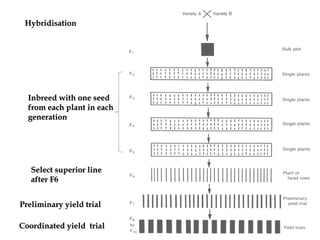
HybridisationHybridisation
Inbreed with one seedInbreed with one seed
from each plant in eachfrom each plant in each
generationgeneration
Select superior lineSelect superior line
after F6after F6
Preliminary yield trialPreliminary yield trial
Coordinated yield trialCoordinated yield trial
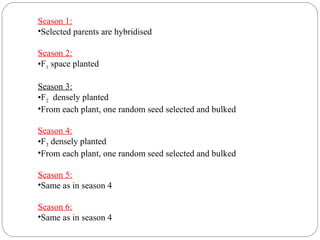
Season 1:
•Selected parents are hybridised
Season 2:
•F1 space planted
Season 3:
•F2 densely planted
•From each plant, one random seed selected and bulked
Season 4:
•F3 densely planted
•From each plant, one random seed selected and bulked
Season 5:
•Same as in season 4
Season 6:
•Same as in season 4
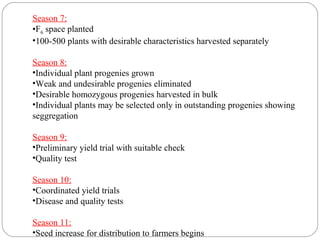
Season 7:
•F6 space planted
•100-500 plants with desirable characteristics harvested separately
Season 8:
•Individual plant progenies grown
•Weak and undesirable progenies eliminated
•Desirable homozygous progenies harvested in bulk
•Individual plants may be selected only in outstanding progenies showing
seggregation
Season 9:
•Preliminary yield trial with suitable check
•Quality test
Season 10:
•Coordinated yield trials
•Disease and quality tests
Season 11:
•Seed increase for distribution to farmers begins
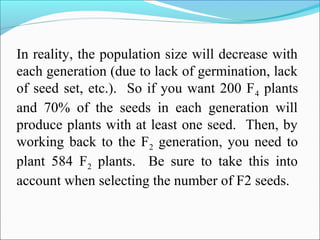
In reality, the population size will decrease with
each generation (due to lack of germination, lack
of seed set, etc.). So if you want 200 F4 plants
and 70% of the seeds in each generation will
produce plants with at least one seed. Then, by
working back to the F2 generation, you need to
plant 584 F2 plants. Be sure to take this into
account when selecting the number of F2 seeds.
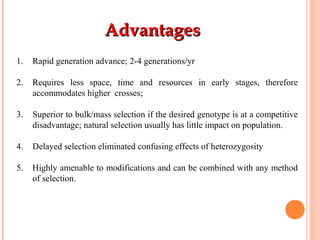
AdvantagesAdvantages
1. Rapid generation advance; 2-4 generations/yr
2. Requires less space, time and resources in early stages, therefore
accommodates higher crosses;
3. Superior to bulk/mass selection if the desired genotype is at a competitive
disadvantage; natural selection usually has little impact on population.
4. Delayed selection eliminated confusing effects of heterozygosity
5. Highly amenable to modifications and can be combined with any method
of selection.
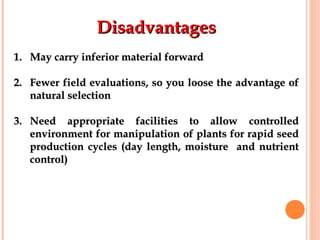
DisadvantagesDisadvantages
1.1. May carry inferior material forwardMay carry inferior material forward
2.2. Fewer field evaluations, so you loose the advantage ofFewer field evaluations, so you loose the advantage of
natural selectionnatural selection
3.3. Need appropriate facilities to allow controlledNeed appropriate facilities to allow controlled
environment for manipulation of plants for rapid seedenvironment for manipulation of plants for rapid seed
production cycles (day length, moisture and nutrientproduction cycles (day length, moisture and nutrient
control)control)
Thank You

Single seed descent method

  • 2.
    SINGLE SEED DESCENTMETHOD SAM HIGGINBOTTOM INSTITUTE OF AGRICULTURE TECHNOLOGY AND SCIENCES ALLAHABAD-211007 Dev Hingra Mail Id- mail2devhingra@gmail.com
  • 3.
    SINGLE SEED DESCENTMETHOD This is the classic procedure of having a single seed from each plant, bulking the individual seeds, and planting out the next generation. It is a method of inbreeding a segregating population that is quite conducive to environments that are not typical. Goulden (1941) proposed a similar system (without calling it SSD) and it resulted from the interest of plant breeders to rapidly inbreed populations before evaluating individual lines
  • 4.
    HybridisationHybridisation Inbreed with oneseedInbreed with one seed from each plant in eachfrom each plant in each generationgeneration Select superior lineSelect superior line after F6after F6 Preliminary yield trialPreliminary yield trial Coordinated yield trialCoordinated yield trial
  • 5.
    Season 1: •Selected parentsare hybridised Season 2: •F1 space planted Season 3: •F2 densely planted •From each plant, one random seed selected and bulked Season 4: •F3 densely planted •From each plant, one random seed selected and bulked Season 5: •Same as in season 4 Season 6: •Same as in season 4
  • 6.
    Season 7: •F6 spaceplanted •100-500 plants with desirable characteristics harvested separately Season 8: •Individual plant progenies grown •Weak and undesirable progenies eliminated •Desirable homozygous progenies harvested in bulk •Individual plants may be selected only in outstanding progenies showing seggregation Season 9: •Preliminary yield trial with suitable check •Quality test Season 10: •Coordinated yield trials •Disease and quality tests Season 11: •Seed increase for distribution to farmers begins
  • 7.
    In reality, thepopulation size will decrease with each generation (due to lack of germination, lack of seed set, etc.). So if you want 200 F4 plants and 70% of the seeds in each generation will produce plants with at least one seed. Then, by working back to the F2 generation, you need to plant 584 F2 plants. Be sure to take this into account when selecting the number of F2 seeds.
  • 8.
    AdvantagesAdvantages 1. Rapid generationadvance; 2-4 generations/yr 2. Requires less space, time and resources in early stages, therefore accommodates higher crosses; 3. Superior to bulk/mass selection if the desired genotype is at a competitive disadvantage; natural selection usually has little impact on population. 4. Delayed selection eliminated confusing effects of heterozygosity 5. Highly amenable to modifications and can be combined with any method of selection.
  • 9.
    DisadvantagesDisadvantages 1.1. May carryinferior material forwardMay carry inferior material forward 2.2. Fewer field evaluations, so you loose the advantage ofFewer field evaluations, so you loose the advantage of natural selectionnatural selection 3.3. Need appropriate facilities to allow controlledNeed appropriate facilities to allow controlled environment for manipulation of plants for rapid seedenvironment for manipulation of plants for rapid seed production cycles (day length, moisture and nutrientproduction cycles (day length, moisture and nutrient control)control)
  • 10.