

MALE STERILITY IN CROP PLANT AND THEIR
COMMERCIAL EXPLOITATION
DEPARTMENT OF GENETICS AND PLANT BREEDING
SAM HIGGINBOTTOM INSTITUTE OF AGRICULTURE,
TECHNOLOGY & SCIENCES
(DEEMED TO BE UNIVERSITY)
ALLAHABAD – 211007
Mail Id- mail2devhingra@gmail.com
Dev Hingra
INTRODUCTION
Male Sterility in Plants
Male sterility is characterised by nonfunctional pollen grains, if
and where produced, while female gametes function normally.
Features of Male Sterility
•Prevents self pollination, permits cross pollination.
•Leads to heterozygosity
•Female gametes function normally
•Assayed through staining techniques
•In nature, occur due to spontaneous mutations
•Can be induced artificially
Phenotypic Expression Of Male Sterility
•Absence of male sex organs.
•Lack of normal anther sac.
•Inability of the pollen to mature.
•Inability to develop normal pollen.
Types of Male Sterility
•Cytoplasmic male sterility (CMS) – governed by cytoplasmic
genes
•Genetic male sterility (GMS) – governed by nuclear genes
•Cytoplasmic-Genetic male sterility (CGMS) – governed by both
nuclear and cytoplasmic genes
•Transgenic male sterility – induced by the technique of genetic
engineering
•Chemical induced male sterility – induced by the use of chemical
Cytoplasmic Male Sterility
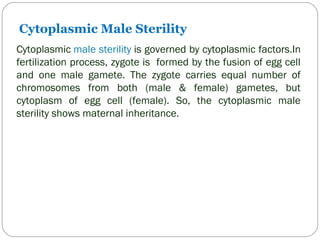
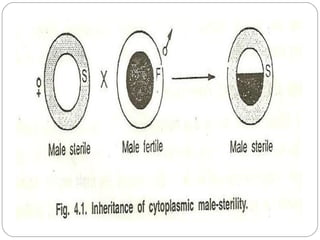
Cytoplasmic male sterility is governed by cytoplasmic factors.In
fertilization process, zygote is formed by the fusion of egg cell
and one male gamete. The zygote carries equal number of
chromosomes from both (male & female) gametes, but
cytoplasm of egg cell (female). So, the cytoplasmic male
sterility shows maternal inheritance.
Application of Cytoplasmic Male Sterility in Plant Breeding
It is applicable in production of hybrids in ornamental crops and
vegetatively propagated crops, overall, where grain or fruit is not
the economic product.
Examples – Observed in sugarcane,potato,forage crops.
Genetic Male Sterility
It is governed by nuclear genes, without any influence of
cytoplasm. Generally, this type of male sterility is due to
recessive allele,e.g.,Barley, Mustard, Pigeon pea, Paddy,
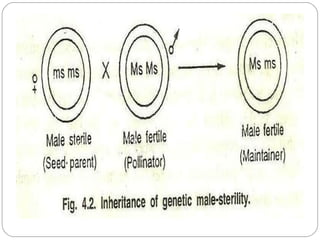
etc.In this system, seed parent (ms ms), maintainer (Ms ms)
and pollinator (Ms Ms) are used.
Application of Genetic Male Sterility in Plant Breeding
It is applicable in production of hybrids in both, vegetatively
propagated crops and crops important for fruit or seed yield.
Examples – Wheat, maize, barley, sorghum, lucerne, cotton,
sunflower, tomato and cucurbits.
Cytoplasmic-Genetic Male Sterility
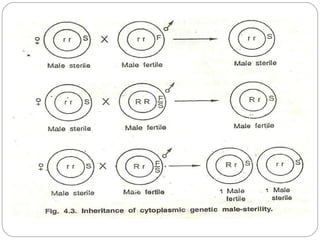
In this system, male sterility is expresed by homozygous recessive
gene in presence of sterility cytoplasm and fertility is restored by
dominant allele in presence of fertile as well as sterile cytoplasm. In
this system, a variety having sterile cytoplasm (S) and recessive
homozygous (rr) genes, is used as seed parent and is known as 'A'
line. In maintainer line ‘B‘, gene present are recessive (rr), but the
cytoplasm is male fertile (F), whereas, in restorer, dominant gene
(RR) are present, but the cytoplasm may be fertile or sterile.
Application of Cytoplasmic-Genetic Male Sterility in Plant
Breeding
It is used in commercial production of hybrid seeds in maize,
sorghum and bajara.
Examples – It is observed in maize, sorghum, bajara, sunflower,
rice and wheat.
Transgenic Male Sterility
When the male sterility is induced by the techniques of genetic
engineering, it is called as transgenic male sterility.
It is heritable and basically comes under genetic male sterility.
In this system, the two kinds of genes are involved.
One gene causes male sterility (integrated with genome of A line)
while the other suppresses it (in R line).
Chemical Induced Male Sterility
The chemical which induces male sterility artificially is called as
male gametocide. It is rapid method but the sterility is non-
heritable.
In this system A, B and R lines are not maintained. Some of the
male gametocides used are gibberellins (rice, maize), Sodium
Methyl Arsenate (rice) and Maleic hydrazide (wheat, onion).
References
Singh, B. D. 2005, Principles and Methods of Plant Breeding.
Singh, Phundan,2010, Essential of Plant Breeding.
Singh Tomar H. P. 2011, Seed Technology.
www.google.com
www.wikipedia.com
THANK YOU

Male sterility

  • 2.
    MALE STERILITY INCROP PLANT AND THEIR COMMERCIAL EXPLOITATION DEPARTMENT OF GENETICS AND PLANT BREEDING SAM HIGGINBOTTOM INSTITUTE OF AGRICULTURE, TECHNOLOGY & SCIENCES (DEEMED TO BE UNIVERSITY) ALLAHABAD – 211007 Mail Id- mail2devhingra@gmail.com Dev Hingra
  • 3.
    INTRODUCTION Male Sterility inPlants Male sterility is characterised by nonfunctional pollen grains, if and where produced, while female gametes function normally. Features of Male Sterility •Prevents self pollination, permits cross pollination. •Leads to heterozygosity •Female gametes function normally •Assayed through staining techniques •In nature, occur due to spontaneous mutations •Can be induced artificially
  • 4.
    Phenotypic Expression OfMale Sterility •Absence of male sex organs. •Lack of normal anther sac. •Inability of the pollen to mature. •Inability to develop normal pollen.
  • 5.
    Types of MaleSterility •Cytoplasmic male sterility (CMS) – governed by cytoplasmic genes •Genetic male sterility (GMS) – governed by nuclear genes •Cytoplasmic-Genetic male sterility (CGMS) – governed by both nuclear and cytoplasmic genes •Transgenic male sterility – induced by the technique of genetic engineering •Chemical induced male sterility – induced by the use of chemical
  • 6.
    Cytoplasmic Male Sterility Cytoplasmic malesterility is governed by cytoplasmic factors.In fertilization process, zygote is formed by the fusion of egg cell and one male gamete. The zygote carries equal number of chromosomes from both (male & female) gametes, but cytoplasm of egg cell (female). So, the cytoplasmic male sterility shows maternal inheritance.
  • 8.
    Application of CytoplasmicMale Sterility in Plant Breeding It is applicable in production of hybrids in ornamental crops and vegetatively propagated crops, overall, where grain or fruit is not the economic product. Examples – Observed in sugarcane,potato,forage crops.
  • 9.
    Genetic Male Sterility Itis governed by nuclear genes, without any influence of cytoplasm. Generally, this type of male sterility is due to recessive allele,e.g.,Barley, Mustard, Pigeon pea, Paddy, etc.In this system, seed parent (ms ms), maintainer (Ms ms) and pollinator (Ms Ms) are used.
  • 11.
    Application of GeneticMale Sterility in Plant Breeding It is applicable in production of hybrids in both, vegetatively propagated crops and crops important for fruit or seed yield. Examples – Wheat, maize, barley, sorghum, lucerne, cotton, sunflower, tomato and cucurbits.
  • 12.
    Cytoplasmic-Genetic Male Sterility Inthis system, male sterility is expresed by homozygous recessive gene in presence of sterility cytoplasm and fertility is restored by dominant allele in presence of fertile as well as sterile cytoplasm. In this system, a variety having sterile cytoplasm (S) and recessive homozygous (rr) genes, is used as seed parent and is known as 'A' line. In maintainer line ‘B‘, gene present are recessive (rr), but the cytoplasm is male fertile (F), whereas, in restorer, dominant gene (RR) are present, but the cytoplasm may be fertile or sterile.
  • 14.
    Application of Cytoplasmic-GeneticMale Sterility in Plant Breeding It is used in commercial production of hybrid seeds in maize, sorghum and bajara. Examples – It is observed in maize, sorghum, bajara, sunflower, rice and wheat.
  • 15.
    Transgenic Male Sterility Whenthe male sterility is induced by the techniques of genetic engineering, it is called as transgenic male sterility. It is heritable and basically comes under genetic male sterility. In this system, the two kinds of genes are involved. One gene causes male sterility (integrated with genome of A line) while the other suppresses it (in R line).
  • 16.
    Chemical Induced MaleSterility The chemical which induces male sterility artificially is called as male gametocide. It is rapid method but the sterility is non- heritable. In this system A, B and R lines are not maintained. Some of the male gametocides used are gibberellins (rice, maize), Sodium Methyl Arsenate (rice) and Maleic hydrazide (wheat, onion).
  • 17.
    References Singh, B. D.2005, Principles and Methods of Plant Breeding. Singh, Phundan,2010, Essential of Plant Breeding. Singh Tomar H. P. 2011, Seed Technology. www.google.com www.wikipedia.com
  • 18.