CROP
IMPROVEMENT
IN POTATO
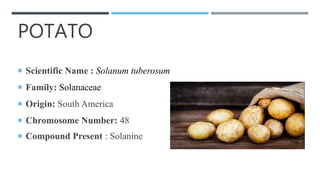
POTATO
 Scientific Name : Solanum tuberosum
 Family: Solanaceae
 Origin: South America
 Chromosome Number: 48
 Compound Present : Solanine
Field Preparation
Soil – pH – 4.8 to 5.4
- Fine Tilth
In hills provide an
inward slope in the
terraces
Drainage Channels
Ridges and Furrows
Seed Treatment &
Planting
Seed Treatment
Carbon disulphide
30 g/100 kg of
seeds
Seed rate - About
3000 – 3500 kg/ha
Planting
40 – 50 grams , 20
cm apart Season & Irrigation
Hills
Summer : March
– April
Autumn : August
– September
Irrigated : Januar
y – February
Plains
Planting is done during
October – November in
plains.
Irrigation – 10 Days
after planting – every
week
Fertilizer and
Fertigation
Fertigation
15 t/ha of FYM and 2
kg each
of Azospirillum and Ph
osphobacterium
Fertilizer
120:240:120 – NPK in 2
splits half as basal and
the balance for top
dressing on 30 days
after sowing
MgSO4 – 60kg/ha
Weed , Nematodes,
Pest and Disease
Control
Weeding
45 and 60th day
Pest Control
Nematodes -
Pseudomonas
fluorescens at 10 kg/ha
Pests -Methyl demeton
for aphids ,
Chlorpyriphos or
Quinalphos for cut
worms , Phorate for
white grub & etc.
Diseases – Mancozeb
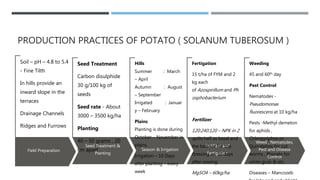
PRODUCTION PRACTICES OF POTATO ( SOLANUM TUBEROSUM )
CROP IMPROVEMENT IN POTATO
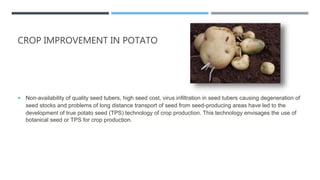
 Non-availability of quality seed tubers, high seed cost, virus infiltration in seed tubers causing degeneration of
seed stocks and problems of long distance transport of seed from seed-producing areas have led to the
development of true potato seed (TPS) technology of crop production. This technology envisages the use of
botanical seed or TPS for crop production.
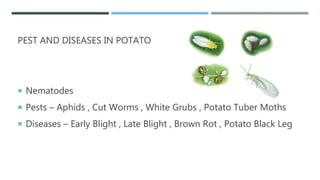
PEST AND DISEASES IN POTATO
 Nematodes
 Pests – Aphids , Cut Worms , White Grubs , Potato Tuber Moths
 Diseases – Early Blight , Late Blight , Brown Rot , Potato Black Leg
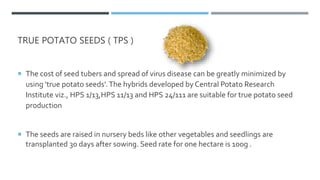
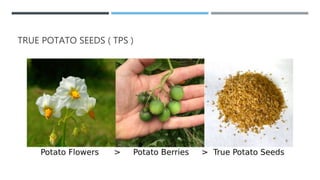
 The cost of seed tubers and spread of virus disease can be greatly minimized by
using 'true potato seeds’.The hybrids developed by Central Potato Research
Institute viz., HPS 1/13,HPS 11/13 and HPS 24/111 are suitable for true potato seed
production
 The seeds are raised in nursery beds like other vegetables and seedlings are
transplanted 30 days after sowing. Seed rate for one hectare is 100g .
TRUE POTATO SEEDS ( TPS )
CROP IMPROVEMENT IN POTATO
 International Potato Center, based in Lima, Peru holds an ISO- accredited
collection of potato germplasm.
 One wild potato spp. S.fendleri found in Texas is used in breeding for
resistant of nematode in cultivated potato.
 Hexaploid solanum demissum source of resistant to devastating late blight
diseases.
CHALLENGES TO IMPROVEMENT
 In addition to TPS and various other methods , proper agronomic practices
can reduce loss and increase yield .
 Timely availability of labor , machinery and chemical inputs is the major cause
of production loss in India
CHALLENGES TO IMPROVEMENT
 Potato seedbeds need to be fine, friable, non-compacted, free- draining and structurally
stable. Around 70% of the potato area in England is grown on soils with high risk of
structural degradation and, owing to the wide-scale adoption of de-stoning machinery,
degradation has increased.
 While soil type can vary considerably across fields, even in uniform-textured fields there
remains large variability in natural water content and bulk density at planting which will affect
the seedbed produced if cultivation takes place at a fixed depth. Reducing the depth of
cultivation slightly can often reduce compaction.
 The soil nitrogen supply (SNS) is likely to be modified greatly by timing and depth of
cultivations, soil water content and rooting activity.
POTATO FACTS
 In 1995, potato plants were taken into space with the space shuttle Columbia. This marked the first time any
food was ever grown in space.
 The heaviest potato weighs 4.98 kg (10 lb 14 oz) and was grown by Peter Glazebrook (UK). It was weighed
at the National Gardening Show.
 Potato is the fourth most eaten food in the world and French fries is the most sold potato based food
in the world
Thank You

Crop improvement in potato

  • 1.
  • 2.
    POTATO  Scientific Name: Solanum tuberosum  Family: Solanaceae  Origin: South America  Chromosome Number: 48  Compound Present : Solanine
  • 3.
    Field Preparation Soil –pH – 4.8 to 5.4 - Fine Tilth In hills provide an inward slope in the terraces Drainage Channels Ridges and Furrows Seed Treatment & Planting Seed Treatment Carbon disulphide 30 g/100 kg of seeds Seed rate - About 3000 – 3500 kg/ha Planting 40 – 50 grams , 20 cm apart Season & Irrigation Hills Summer : March – April Autumn : August – September Irrigated : Januar y – February Plains Planting is done during October – November in plains. Irrigation – 10 Days after planting – every week Fertilizer and Fertigation Fertigation 15 t/ha of FYM and 2 kg each of Azospirillum and Ph osphobacterium Fertilizer 120:240:120 – NPK in 2 splits half as basal and the balance for top dressing on 30 days after sowing MgSO4 – 60kg/ha Weed , Nematodes, Pest and Disease Control Weeding 45 and 60th day Pest Control Nematodes - Pseudomonas fluorescens at 10 kg/ha Pests -Methyl demeton for aphids , Chlorpyriphos or Quinalphos for cut worms , Phorate for white grub & etc. Diseases – Mancozeb PRODUCTION PRACTICES OF POTATO ( SOLANUM TUBEROSUM )
  • 4.
    CROP IMPROVEMENT INPOTATO  Non-availability of quality seed tubers, high seed cost, virus infiltration in seed tubers causing degeneration of seed stocks and problems of long distance transport of seed from seed-producing areas have led to the development of true potato seed (TPS) technology of crop production. This technology envisages the use of botanical seed or TPS for crop production.
  • 5.
    PEST AND DISEASESIN POTATO  Nematodes  Pests – Aphids , Cut Worms , White Grubs , Potato Tuber Moths  Diseases – Early Blight , Late Blight , Brown Rot , Potato Black Leg
  • 6.
     The costof seed tubers and spread of virus disease can be greatly minimized by using 'true potato seeds’.The hybrids developed by Central Potato Research Institute viz., HPS 1/13,HPS 11/13 and HPS 24/111 are suitable for true potato seed production  The seeds are raised in nursery beds like other vegetables and seedlings are transplanted 30 days after sowing. Seed rate for one hectare is 100g . TRUE POTATO SEEDS ( TPS )
  • 7.
  • 8.
    CROP IMPROVEMENT INPOTATO  International Potato Center, based in Lima, Peru holds an ISO- accredited collection of potato germplasm.  One wild potato spp. S.fendleri found in Texas is used in breeding for resistant of nematode in cultivated potato.  Hexaploid solanum demissum source of resistant to devastating late blight diseases.
  • 9.
    CHALLENGES TO IMPROVEMENT In addition to TPS and various other methods , proper agronomic practices can reduce loss and increase yield .  Timely availability of labor , machinery and chemical inputs is the major cause of production loss in India
  • 10.
    CHALLENGES TO IMPROVEMENT Potato seedbeds need to be fine, friable, non-compacted, free- draining and structurally stable. Around 70% of the potato area in England is grown on soils with high risk of structural degradation and, owing to the wide-scale adoption of de-stoning machinery, degradation has increased.  While soil type can vary considerably across fields, even in uniform-textured fields there remains large variability in natural water content and bulk density at planting which will affect the seedbed produced if cultivation takes place at a fixed depth. Reducing the depth of cultivation slightly can often reduce compaction.  The soil nitrogen supply (SNS) is likely to be modified greatly by timing and depth of cultivations, soil water content and rooting activity.
  • 11.
    POTATO FACTS  In1995, potato plants were taken into space with the space shuttle Columbia. This marked the first time any food was ever grown in space.  The heaviest potato weighs 4.98 kg (10 lb 14 oz) and was grown by Peter Glazebrook (UK). It was weighed at the National Gardening Show.  Potato is the fourth most eaten food in the world and French fries is the most sold potato based food in the world Thank You