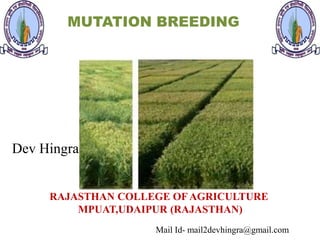
MUTATION BREEDING
Dev Hingra
Mail Id- mail2devhingra@gmail.com
RAJASTHAN COLLEGE OFAGRICULTURE
MPUAT,UDAIPUR (RAJASTHAN)
INTRODUCTION
Mutation refers to sudden heritable change in the phenotype of an
individual. In the molecular term, mutation is defined as the permanent
and relatively rare change in the number or sequence of nucleotide.In other
words, mutations arise due to change in DNA bases.
Mutation occurs in two ways :
(1) By alteration in nuclear DNA ( point mutations))
(2) By change in cytoplasmic DNA(cytoplasmic mutation))
The best example of useful cytoplasmic mutation is cytoplasm male sterility.
TYPES OF MUTATION
A. Spontaneous mutations : Mutation occur in natural
populations .
B. Induced mutations: Mutation may be artificially induced by
various mutagenic agents. Induced mutations are of two types:
1.Macro-mutations: Mutation with distinct morphological
changes in the phenotype.
2.Micro-mutations: Mutations with invisible phenotypic
changes.
MUTATION BREEDING
Inducing desirable mutations and exploiting them for crop
improvement. It is commonly used in self pollinated crops and
used to produce traits in crops such as larger seeds ,new
colour.
Mutagen : Physical or chemical agent which greatly
enhance the frequency of mutation
Types of mutagens:
A.Physical mutagens:
1.Ionising radiation:
(a)Particulate radiations: alpha-rays , beta-rays, fast neurons
and thermal neurons.
(b) Non-particulate radiations:x-rays,and gamma rays.
2.Non-ionising radiation: ultraviolet radiation.
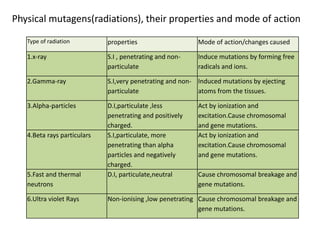
Type of radiation properties Mode of action/changes caused
1.x-ray S.I , penetrating and non-
particulate
Induce mutations by forming free
radicals and ions.
2.Gamma-ray S.I,very penetrating and non-
particulate
Induced mutations by ejecting
atoms from the tissues.
3.Alpha-particles D.I,particulate ,less
penetrating and positively
charged.
Act by ionization and
excitation.Cause chromosomal
and gene mutations.
4.Beta rays particulars S.I,particulate, more
penetrating than alpha
particles and negatively
charged.
Act by ionization and
excitation.Cause chromosomal
and gene mutations.
5.Fast and thermal
neutrons
D.I, particulate,neutral Cause chromosomal breakage and
gene mutations.
6.Ultra violet Rays Non-ionising ,low penetrating Cause chromosomal breakage and
gene mutations.
Physical mutagens(radiations), their properties and mode of action
B.Chemical mutagens:
1.Alkylating agents: EMS `(ethyl methane sulphonate),methyl
methane sulphonate (MMS),sulphur mustard,nitrogen mustard etc.
2.Acridine dyes: proflavin,acridine orange, acridine yellow and
ethidium bromide.
3.Base Analogues:5 Bromo Uracil,5-chlorouracil.
4.Other mutagens: Nitrous Acid, Sodium Azide.
l
M1FIRST YEAR
SECOND YEAR
THIRD YEAR
i) Treated seeds are space-planted
ii) Seeds from individual plants are
harvested separately
i) Individual plant progenies grown
ii) Seeds from all the plants of each
row containing or suspected to
contain the mutant allele harvested
separately.
llllllllllllll
llllllllllllll i)Individual plant progenies are
grown.
ii)Superior mutant lines harvested in
bulk if they are homogeneous.
ii)In heterogeneous progenies,
individual plants may be selected.
M2
M3
MUTATION BREEDING FOR OLIGOGENIC TRAITS
FOURTH YEAR M4 i)Preliminary yield trial with a
suitable check.
ii) Superior lines selected.
FIFTH –
SEVENTH
YEARS
M5-7
i)Replicated yield trial at several
locations.
ii) Outstanding line released as a
new variety.
EIGHT
YEAR M8
Seed multiplication for
distribution among farmers.
Fig: A generalised scheme for mutation breeding for oligogenic trait.
Use of viable and fertile mutant in rice
Rice is basically a self pollinating plant, however, the mutational
event may be much lower than the assured self pollinating rate.
Therefore in the M1 planting field (upper left light green
(variety ‘Reimei’) and lower right light green (variety
‘Norin-8’)) previously induced and increased light green and
fertile“chlorina” mutants were used to assure the line purity.
An example of M2 field planted with panicle to
row system. Indicator poles show some kind of
mutants were segregated in the family line.
Two early flowering mutants are shown here as
they segregated in panicle to row planting in a
M2 field.
Fertile twin grain mutant has two sets of pistils,
suggesting better external pollen reception. This
recessive mutation will not be expressed in the F1.
Flower of the twin grain mutant has two pistils, both are fertile, if condition allows.
These characters expressed in the maternal tissues may be screened in the M2 generation
field (in case of the “twin grains” flowers in M2 plants, and
seeds shown above are in M3 generatiòn).
In rice the flowering time of the day is not long, a few
hours in the morning. This open hull mutant keeps
open its flowers, or can not close. However, this
mutant has good seed fertility as shown in this picture.
APPLICATIONS IN CROP IMPROVEMENT
1.Development of improved varieties : In india ,improved
varieties have been developed through mutation breeding in
wheat ,rice,barley etc.Besides high yield , varieties with
better quality,earliness,dwarfness,disease resistance and low
toxin contents have been developed in various crop.
2.Induction of male sterility: GMS has been induced in durum
wheat and CMS induced in barley. Its reduces the cost of
hybrid seed production.
3.Creation of variability :Induced mutations have been used for
increasing the range of genetic variability in barley, wheat.
4.Improvement in Adaptation: Induced mutations play an
important role in improving adaptation of some crops.
ACHIEVEMENTS OF MUTATION BREEDING
1.In plant species, 2252 mutant varieted have been developed in
over the world.Of these 1585 have been released directly and
667 through the use of mutants in hybridization.
2.Out of 2252 mutant varieties ,1700 have been released in seed
propagated crops and 552 in vegetatively propagated species.
3.Among seed propagated species, the maximum mutant
varieties have been developed in rice (434),followed by barley
(269), and wheat (222).
4.Maximum varieties have been developed through radiations.
5.Among the chemical mutagenes,EMS resulted in the
development of maximum mutant varieties.
6.In india, 259 mutant varieties have been developed.
7.Maximum mutant varieties have been released in cereals
(1072).
Improved character Crops and mutant varieties
Higher yield Barley (DL 253), Pea (Hans), Groundnut
(Co 2, TG 17).
Short stature Barley (RDB 1),Rice (Prabhavati).
Earliness Rice (IIT 48,IIT 60,Indira,Padmini)
Stress resistance Salt tolerance in Rice (Mohan) and
water logging tolerance in jute (
Padma)
Bold seed size Groundnut (PB 1,PB 2,Vikram) and Rice
( Jagannath)
Improvement achieved in different characters through
mutation breeding in some crops in India :
1. Induced mutagenes is used for the induction of CMS.
Ethidium bromide (EB) has been used for induction of CMS
in barley.
2. Mutation breeding is a cheap and rapid method of
developing new varieties.
3. Mutation breeding is more effective for the improvement of
oligogenic characters.
4. Mutation breeding is the simple, quick and the best way
when a new character is to be induced.
DEMERITS OF MUTATION BREEDING
1.Most of the mutations are deleterious and undesirable.
2.Identification of micro-mutations, which are more useful to a
plant breeder is usually very difficult.
3.Mutation breeding has limited scope for the genetic
improvement of quantitative or polygenic characters.
MERITS OF MUTATION BREEDING
Conclusion
Today crop plants are different from the crop from which
they are originated i.e. it’s wild species. This change has
been brought by man through plant breeding. The
important achievement of plant breeding are :
Production of dwarf and semi dwarf cereal varieties in
wheat and rice
Development of hybrid and synthetic varieties in crops.
Plant Breeding has a very important role
to play in the future. It can be used as a
tool for intensive breeding of pulses and
oilseed crops, developing high yielding
varieties in vegetables and oilseed crops
and for the development of varieties
desirable for mechanical threshing and
cultivation
Mutation breeding

Mutation breeding

  • 1.
    MUTATION BREEDING Dev Hingra MailId- mail2devhingra@gmail.com RAJASTHAN COLLEGE OFAGRICULTURE MPUAT,UDAIPUR (RAJASTHAN)
  • 2.
    INTRODUCTION Mutation refers tosudden heritable change in the phenotype of an individual. In the molecular term, mutation is defined as the permanent and relatively rare change in the number or sequence of nucleotide.In other words, mutations arise due to change in DNA bases. Mutation occurs in two ways : (1) By alteration in nuclear DNA ( point mutations)) (2) By change in cytoplasmic DNA(cytoplasmic mutation)) The best example of useful cytoplasmic mutation is cytoplasm male sterility.
  • 3.
    TYPES OF MUTATION A.Spontaneous mutations : Mutation occur in natural populations . B. Induced mutations: Mutation may be artificially induced by various mutagenic agents. Induced mutations are of two types: 1.Macro-mutations: Mutation with distinct morphological changes in the phenotype. 2.Micro-mutations: Mutations with invisible phenotypic changes.
  • 4.
    MUTATION BREEDING Inducing desirablemutations and exploiting them for crop improvement. It is commonly used in self pollinated crops and used to produce traits in crops such as larger seeds ,new colour. Mutagen : Physical or chemical agent which greatly enhance the frequency of mutation Types of mutagens: A.Physical mutagens: 1.Ionising radiation: (a)Particulate radiations: alpha-rays , beta-rays, fast neurons and thermal neurons. (b) Non-particulate radiations:x-rays,and gamma rays. 2.Non-ionising radiation: ultraviolet radiation.
  • 5.
    Type of radiationproperties Mode of action/changes caused 1.x-ray S.I , penetrating and non- particulate Induce mutations by forming free radicals and ions. 2.Gamma-ray S.I,very penetrating and non- particulate Induced mutations by ejecting atoms from the tissues. 3.Alpha-particles D.I,particulate ,less penetrating and positively charged. Act by ionization and excitation.Cause chromosomal and gene mutations. 4.Beta rays particulars S.I,particulate, more penetrating than alpha particles and negatively charged. Act by ionization and excitation.Cause chromosomal and gene mutations. 5.Fast and thermal neutrons D.I, particulate,neutral Cause chromosomal breakage and gene mutations. 6.Ultra violet Rays Non-ionising ,low penetrating Cause chromosomal breakage and gene mutations. Physical mutagens(radiations), their properties and mode of action
  • 6.
    B.Chemical mutagens: 1.Alkylating agents:EMS `(ethyl methane sulphonate),methyl methane sulphonate (MMS),sulphur mustard,nitrogen mustard etc. 2.Acridine dyes: proflavin,acridine orange, acridine yellow and ethidium bromide. 3.Base Analogues:5 Bromo Uracil,5-chlorouracil. 4.Other mutagens: Nitrous Acid, Sodium Azide.
  • 7.
    l M1FIRST YEAR SECOND YEAR THIRDYEAR i) Treated seeds are space-planted ii) Seeds from individual plants are harvested separately i) Individual plant progenies grown ii) Seeds from all the plants of each row containing or suspected to contain the mutant allele harvested separately. llllllllllllll llllllllllllll i)Individual plant progenies are grown. ii)Superior mutant lines harvested in bulk if they are homogeneous. ii)In heterogeneous progenies, individual plants may be selected. M2 M3 MUTATION BREEDING FOR OLIGOGENIC TRAITS
  • 8.
    FOURTH YEAR M4i)Preliminary yield trial with a suitable check. ii) Superior lines selected. FIFTH – SEVENTH YEARS M5-7 i)Replicated yield trial at several locations. ii) Outstanding line released as a new variety. EIGHT YEAR M8 Seed multiplication for distribution among farmers. Fig: A generalised scheme for mutation breeding for oligogenic trait.
  • 9.
    Use of viableand fertile mutant in rice Rice is basically a self pollinating plant, however, the mutational event may be much lower than the assured self pollinating rate. Therefore in the M1 planting field (upper left light green (variety ‘Reimei’) and lower right light green (variety ‘Norin-8’)) previously induced and increased light green and fertile“chlorina” mutants were used to assure the line purity. An example of M2 field planted with panicle to row system. Indicator poles show some kind of mutants were segregated in the family line. Two early flowering mutants are shown here as they segregated in panicle to row planting in a M2 field.
  • 10.
    Fertile twin grainmutant has two sets of pistils, suggesting better external pollen reception. This recessive mutation will not be expressed in the F1. Flower of the twin grain mutant has two pistils, both are fertile, if condition allows. These characters expressed in the maternal tissues may be screened in the M2 generation field (in case of the “twin grains” flowers in M2 plants, and seeds shown above are in M3 generatiòn). In rice the flowering time of the day is not long, a few hours in the morning. This open hull mutant keeps open its flowers, or can not close. However, this mutant has good seed fertility as shown in this picture.
  • 11.
    APPLICATIONS IN CROPIMPROVEMENT 1.Development of improved varieties : In india ,improved varieties have been developed through mutation breeding in wheat ,rice,barley etc.Besides high yield , varieties with better quality,earliness,dwarfness,disease resistance and low toxin contents have been developed in various crop. 2.Induction of male sterility: GMS has been induced in durum wheat and CMS induced in barley. Its reduces the cost of hybrid seed production. 3.Creation of variability :Induced mutations have been used for increasing the range of genetic variability in barley, wheat. 4.Improvement in Adaptation: Induced mutations play an important role in improving adaptation of some crops.
  • 12.
    ACHIEVEMENTS OF MUTATIONBREEDING 1.In plant species, 2252 mutant varieted have been developed in over the world.Of these 1585 have been released directly and 667 through the use of mutants in hybridization. 2.Out of 2252 mutant varieties ,1700 have been released in seed propagated crops and 552 in vegetatively propagated species. 3.Among seed propagated species, the maximum mutant varieties have been developed in rice (434),followed by barley (269), and wheat (222). 4.Maximum varieties have been developed through radiations. 5.Among the chemical mutagenes,EMS resulted in the development of maximum mutant varieties. 6.In india, 259 mutant varieties have been developed. 7.Maximum mutant varieties have been released in cereals (1072).
  • 13.
    Improved character Cropsand mutant varieties Higher yield Barley (DL 253), Pea (Hans), Groundnut (Co 2, TG 17). Short stature Barley (RDB 1),Rice (Prabhavati). Earliness Rice (IIT 48,IIT 60,Indira,Padmini) Stress resistance Salt tolerance in Rice (Mohan) and water logging tolerance in jute ( Padma) Bold seed size Groundnut (PB 1,PB 2,Vikram) and Rice ( Jagannath) Improvement achieved in different characters through mutation breeding in some crops in India :
  • 14.
    1. Induced mutagenesis used for the induction of CMS. Ethidium bromide (EB) has been used for induction of CMS in barley. 2. Mutation breeding is a cheap and rapid method of developing new varieties. 3. Mutation breeding is more effective for the improvement of oligogenic characters. 4. Mutation breeding is the simple, quick and the best way when a new character is to be induced. DEMERITS OF MUTATION BREEDING 1.Most of the mutations are deleterious and undesirable. 2.Identification of micro-mutations, which are more useful to a plant breeder is usually very difficult. 3.Mutation breeding has limited scope for the genetic improvement of quantitative or polygenic characters. MERITS OF MUTATION BREEDING
  • 15.
    Conclusion Today crop plantsare different from the crop from which they are originated i.e. it’s wild species. This change has been brought by man through plant breeding. The important achievement of plant breeding are : Production of dwarf and semi dwarf cereal varieties in wheat and rice Development of hybrid and synthetic varieties in crops.
  • 16.
    Plant Breeding hasa very important role to play in the future. It can be used as a tool for intensive breeding of pulses and oilseed crops, developing high yielding varieties in vegetables and oilseed crops and for the development of varieties desirable for mechanical threshing and cultivation