WELCOME
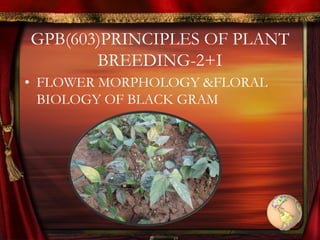
GPB(603)PRINCIPLES OF PLANT
BREEDING-2+I
• FLOWER MORPHOLOGY &FLORAL
BIOLOGY OF BLACK GRAM
Black gram is basically a warm season crop, but in India
it is grown in both summer and winter, up to 1800 m
altitude.
It is quite drought resistant but intolerant of frost and
prolonged cloudiness.
It is normally grown in areas with an average
temperature of 25–35°C and an annual rainfall of 600–
1000 mm.
In higher rainfall areas it may be grown in the dry season
on residual moisture. Heavier, well-drained soils such as
black-cotton soils with pH 6–7 are preferred, but black
gram is also grown on lighter soils.
• Black gram was most probably domesticated in India
from its wild ancestral type.
• At present black gram cultivation is of major
importance in India only, but it is also grown to some
extent throughout tropical Asia.
• In Pakistan, Bengladesh, India, it is growen as a
pulse crop
• It is grown in the United States and Australia mainly
as a fodder crop.
It would be worthwhile trying black gram on a much larger
scale in tropical Africa.
Because of its highly nutritious seeds and its wide
ecological applicability.
Germplasm diversity needs to be exploited to obtain
suitable cultivars for Africa.
Kingdom- plantae
Sub kingdom- Tracheobionta
Subclass- rosidae
Order- Fabales
Supper division- Spermatophyta
Division- Magnoliophyta
Class- Magnoliopsida
Family-fabaceae
Genus- vigna
Species- Vigna munggo
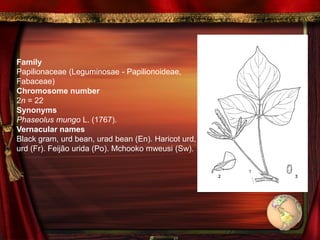
Family
Papilionaceae (Leguminosae - Papilionoideae,
Fabaceae)
Chromosome number
2n = 22
Synonyms
Phaseolus mungo L. (1767).
Vernacular names
Black gram, urd bean, urad bean (En). Haricot urd,
urd (Fr). Feijão urida (Po). Mchooko mweusi (Sw).
Three taxa are distinguished within Vigna
mungo:
– var. mungo, with large, black-seeded and early-
maturing cultivars.
– var. viridis Bose, with greenish dull or glossy seeds
and late-maturing cultivars.
– var. silvestris Lukoki, Maréchal & Otoul, the wild
type.
Genetic resources and breeding
About 2100 accessions of black gram are maintained by the
National Bureau of Plant Genetic Resources (NBPGR),
New Delhi, India, at its various research stations.
The USDA Southern Regional Plant Introduction Station,
Griffin, Georgia, United States, holds 300 accessions.
Asian Vegetable Research and Development Centre
(AVRDC) in Taiwan maintains a collection of 200
accessions.
cytology
Somatic chromosome number in urdbean is 2n=22
Avarge length of chromosome is 1.70 micron
Mejority of chromosome are metasentric in nature I.e. arm-ratio is
1.00-1.75
Fem chromosomes are reported to have secondery constriction
(gupta &sharm,1991
Vigna mungo is successfully crossed with
(1)Vigna sublobata
(2)Vigna trilobata
(3)Vigna umbellata
(4)Vigna angularis. But reciprocal cross is possible only through
embryo rescue technique (Gosal & Bajaja,1983)
morphology
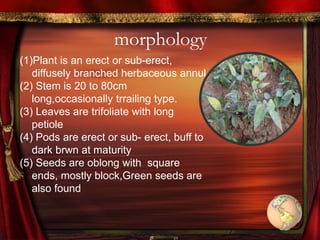
(1)Plant is an erect or sub-erect,
diffusely branched herbaceous annul
(2) Stem is 20 to 80cm
long,occasionally trrailing type.
(3) Leaves are trifoliate with long
petiole
(4) Pods are erect or sub- erect, buff to
dark brwn at maturity
(5) Seeds are oblong with square
ends, mostly block,Green seeds are
also found
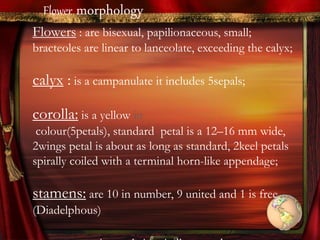
Flowers : are bisexual, papilionaceous, small;
bracteoles are linear to lanceolate, exceeding the calyx;
calyx : is a campanulate it includes 5sepals;
corolla: is a yellow in
colour(5petals), standard petal is a 12–16 mm wide,
2wings petal is about as long as standard, 2keel petals
spirally coiled with a terminal horn-like appendage;
stamens: are 10 in number, 9 united and 1 is free
(Diadelphous)
Flower morphology
Floral biology
•Flowers begin to open between 6 to 7 am
•Flower is continues for an hour
•Flower is remain open till noon & gradually close,being
completely closed by 2 to 4pm
•Pollination accure at bud stage
•Anthers dehisce between 9 pm to 3 am
•Petals wil shedin the folowing mornng
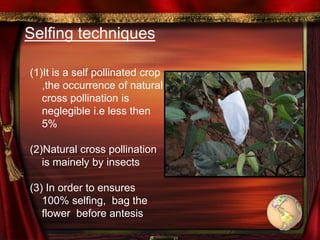
Selfing techniques
(1)It is a self pollinated crop
,the occurrence of natural
cross pollination is
neglegible i.e less then
5%
(2)Natural cross pollination
is mainely by insects
(3) In order to ensures
100% selfing, bag the
flower before antesis
BLACK GRAM IS A ESSENTIALLY A
SELF POLLINATED CROP.THERE
ARE TWO METHEDOS INVOLED IN
CROSSING OF BLACK GRAM
(1) EMASULATION
(2) POLLINATION
(1) Selection of flower bud
(2) Flower bud should held between fore and thumb finger
(3) Dissecting needle is inserted just under the standrd obliquel
y along the top of the bud
(4) The left side standard & left wing are pushed outward away
from the bud
(5) The left keel is removed in pieces
(6) Exposed anthers are removed
Pollination
Take out stamen from freshly opened flowers
Rubbed anthers againset the stigma of the emasculated bud
Pllination should be immediately after emasculation gives good
pod set
THANK YOU

Black gram

  • 1.
  • 2.
    GPB(603)PRINCIPLES OF PLANT BREEDING-2+I •FLOWER MORPHOLOGY &FLORAL BIOLOGY OF BLACK GRAM
  • 3.
    Black gram isbasically a warm season crop, but in India it is grown in both summer and winter, up to 1800 m altitude. It is quite drought resistant but intolerant of frost and prolonged cloudiness. It is normally grown in areas with an average temperature of 25–35°C and an annual rainfall of 600– 1000 mm. In higher rainfall areas it may be grown in the dry season on residual moisture. Heavier, well-drained soils such as black-cotton soils with pH 6–7 are preferred, but black gram is also grown on lighter soils.
  • 4.
    • Black gramwas most probably domesticated in India from its wild ancestral type. • At present black gram cultivation is of major importance in India only, but it is also grown to some extent throughout tropical Asia. • In Pakistan, Bengladesh, India, it is growen as a pulse crop • It is grown in the United States and Australia mainly as a fodder crop.
  • 5.
    It would beworthwhile trying black gram on a much larger scale in tropical Africa. Because of its highly nutritious seeds and its wide ecological applicability. Germplasm diversity needs to be exploited to obtain suitable cultivars for Africa.
  • 6.
    Kingdom- plantae Sub kingdom-Tracheobionta Subclass- rosidae Order- Fabales Supper division- Spermatophyta Division- Magnoliophyta Class- Magnoliopsida Family-fabaceae Genus- vigna Species- Vigna munggo
  • 7.
    Family Papilionaceae (Leguminosae -Papilionoideae, Fabaceae) Chromosome number 2n = 22 Synonyms Phaseolus mungo L. (1767). Vernacular names Black gram, urd bean, urad bean (En). Haricot urd, urd (Fr). Feijão urida (Po). Mchooko mweusi (Sw).
  • 8.
    Three taxa aredistinguished within Vigna mungo: – var. mungo, with large, black-seeded and early- maturing cultivars. – var. viridis Bose, with greenish dull or glossy seeds and late-maturing cultivars. – var. silvestris Lukoki, Maréchal & Otoul, the wild type.
  • 9.
    Genetic resources andbreeding About 2100 accessions of black gram are maintained by the National Bureau of Plant Genetic Resources (NBPGR), New Delhi, India, at its various research stations. The USDA Southern Regional Plant Introduction Station, Griffin, Georgia, United States, holds 300 accessions. Asian Vegetable Research and Development Centre (AVRDC) in Taiwan maintains a collection of 200 accessions.
  • 10.
    cytology Somatic chromosome numberin urdbean is 2n=22 Avarge length of chromosome is 1.70 micron Mejority of chromosome are metasentric in nature I.e. arm-ratio is 1.00-1.75 Fem chromosomes are reported to have secondery constriction (gupta &sharm,1991 Vigna mungo is successfully crossed with (1)Vigna sublobata (2)Vigna trilobata (3)Vigna umbellata (4)Vigna angularis. But reciprocal cross is possible only through embryo rescue technique (Gosal & Bajaja,1983)
  • 11.
    morphology (1)Plant is anerect or sub-erect, diffusely branched herbaceous annul (2) Stem is 20 to 80cm long,occasionally trrailing type. (3) Leaves are trifoliate with long petiole (4) Pods are erect or sub- erect, buff to dark brwn at maturity (5) Seeds are oblong with square ends, mostly block,Green seeds are also found
  • 12.
    Flowers : arebisexual, papilionaceous, small; bracteoles are linear to lanceolate, exceeding the calyx; calyx : is a campanulate it includes 5sepals; corolla: is a yellow in colour(5petals), standard petal is a 12–16 mm wide, 2wings petal is about as long as standard, 2keel petals spirally coiled with a terminal horn-like appendage; stamens: are 10 in number, 9 united and 1 is free (Diadelphous) Flower morphology
  • 13.
    Floral biology •Flowers beginto open between 6 to 7 am •Flower is continues for an hour •Flower is remain open till noon & gradually close,being completely closed by 2 to 4pm •Pollination accure at bud stage •Anthers dehisce between 9 pm to 3 am •Petals wil shedin the folowing mornng
  • 14.
    Selfing techniques (1)It isa self pollinated crop ,the occurrence of natural cross pollination is neglegible i.e less then 5% (2)Natural cross pollination is mainely by insects (3) In order to ensures 100% selfing, bag the flower before antesis
  • 15.
    BLACK GRAM ISA ESSENTIALLY A SELF POLLINATED CROP.THERE ARE TWO METHEDOS INVOLED IN CROSSING OF BLACK GRAM (1) EMASULATION (2) POLLINATION
  • 16.
    (1) Selection offlower bud (2) Flower bud should held between fore and thumb finger (3) Dissecting needle is inserted just under the standrd obliquel y along the top of the bud (4) The left side standard & left wing are pushed outward away from the bud (5) The left keel is removed in pieces (6) Exposed anthers are removed
  • 17.
    Pollination Take out stamenfrom freshly opened flowers Rubbed anthers againset the stigma of the emasculated bud Pllination should be immediately after emasculation gives good pod set
  • 18.