AONLA
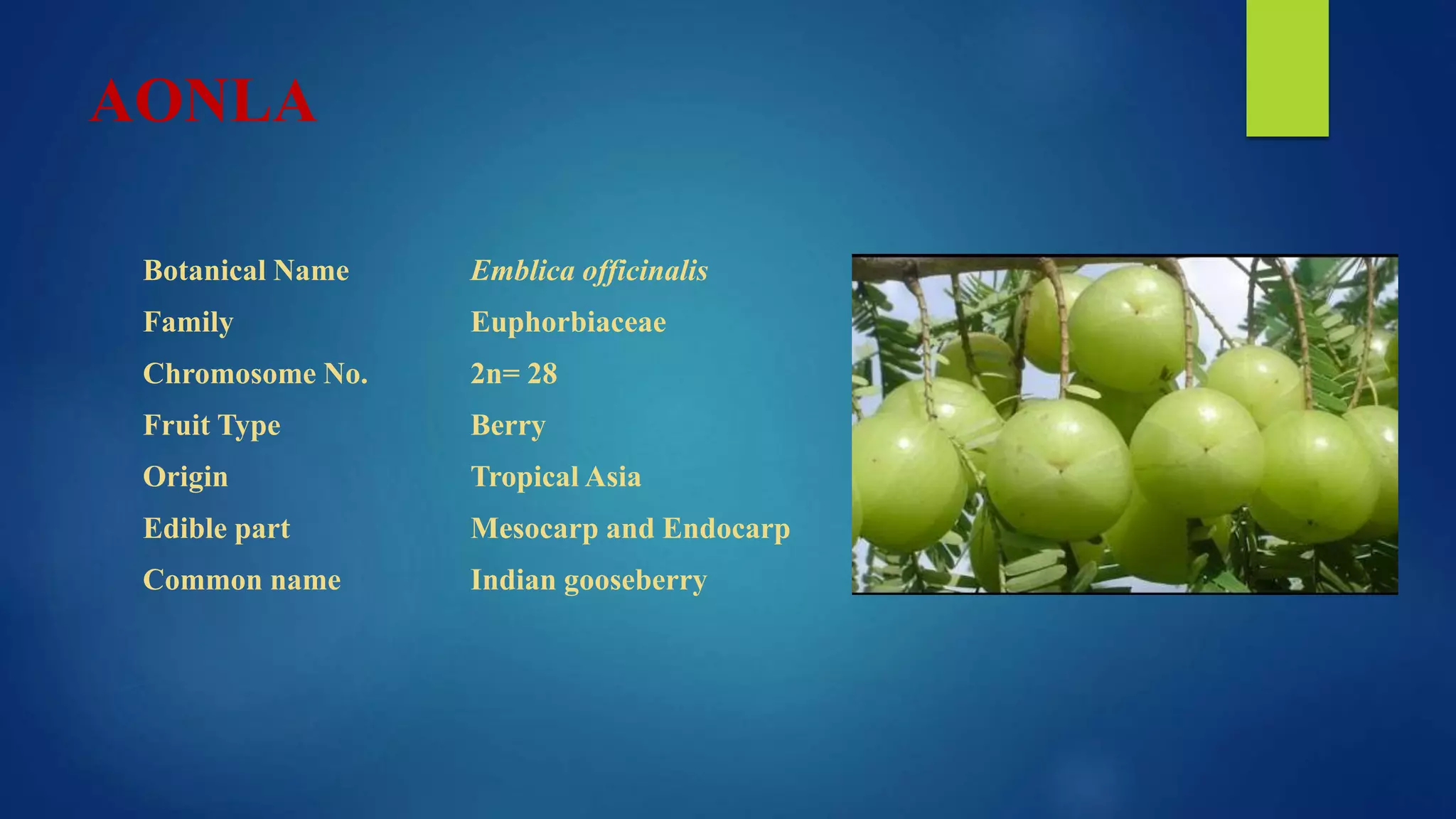
Botanical Name Emblica officinalis
Family Euphorbiaceae
Chromosome No. 2n= 28
Fruit Type Berry
Origin Tropical Asia
Edible part Mesocarp and Endocarp
Common name Indian gooseberry
 Amla is highly nutritive and popularly known as ‘Amrit phal’.
 It is wind pollinated as the pollen grains are light and are produced in abundance.
 It is very rich in vitamin C, pectin and minerals.
 Fruit is valued high among indigenous medicines in India.
 It is the main ingredients in Chawanprash.
 Amla has a great potential due to its high medicinal and nutritive values and more
productivity even on marginal lands.
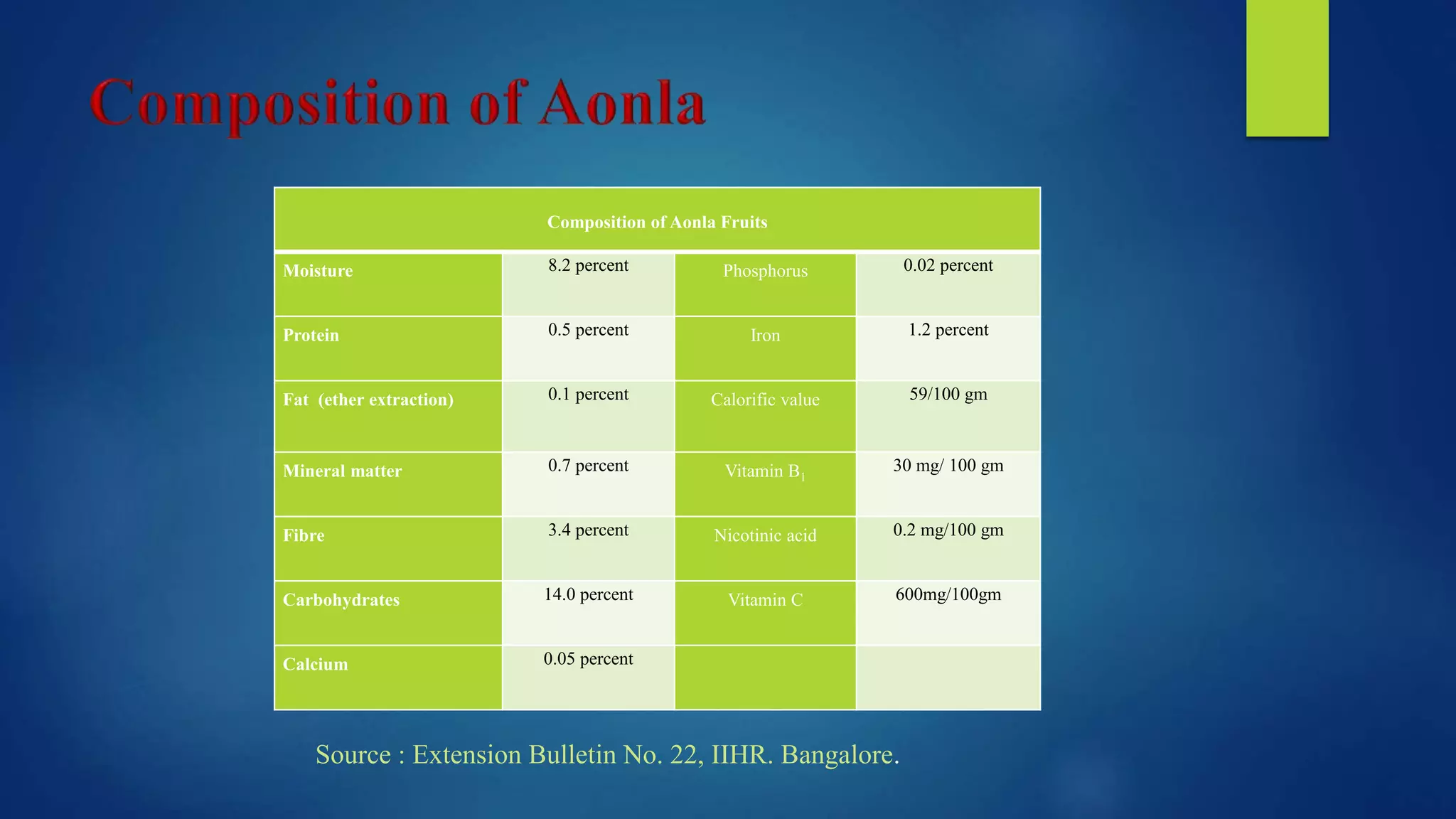
Composition of Aonla Fruits
Moisture 8.2 percent Phosphorus 0.02 percent
Protein 0.5 percent Iron 1.2 percent
Fat (ether extraction) 0.1 percent Calorific value 59/100 gm
Mineral matter 0.7 percent Vitamin B1
30 mg/ 100 gm
Fibre 3.4 percent Nicotinic acid 0.2 mg/100 gm
Carbohydrates 14.0 percent Vitamin C 600mg/100gm
Calcium 0.05 percent
Source : Extension Bulletin No. 22, IIHR. Bangalore.
Area and Production
 It is commercially cultivated in Varanasi, Agra and Kanpur area of Uttar Pradesh.
 In India it occupies an area of 93 thousand hectares with an annual production of
1075 thousand million tonnes.
 In Punjab it is being grown on 217 hectares only.
General uses
 Candy
 Powder
 Hair oil
 Juice
 Dried chips
 Murabha
Climatic and soil requirements
Climate
 Aonla is a subtropical fruit but its cultivation in tropical climate is quite successful.
 The tree is not much influenced either by hot wind or frost.
 The mature plants can tolerate freezing temperature as well as a temperature as high as
46 ºC.
 The young plants should be protected from hot wind (loo) during May-June and from
frost during winter, at least up to the age of ¾ years under North Indian conditions.
Soil
 Aonla can be grown in light as well as heavy soils except very sandy one.
 However, well-drained fertile loamy soil is the best.
 The plants have capacity for adaptation to dry regions and can also grow in
moderately alkaline soils.
 It is a potential crop for degraded lands and the marginal soils having soil pH of
6.0 to 9.5.
Varieties
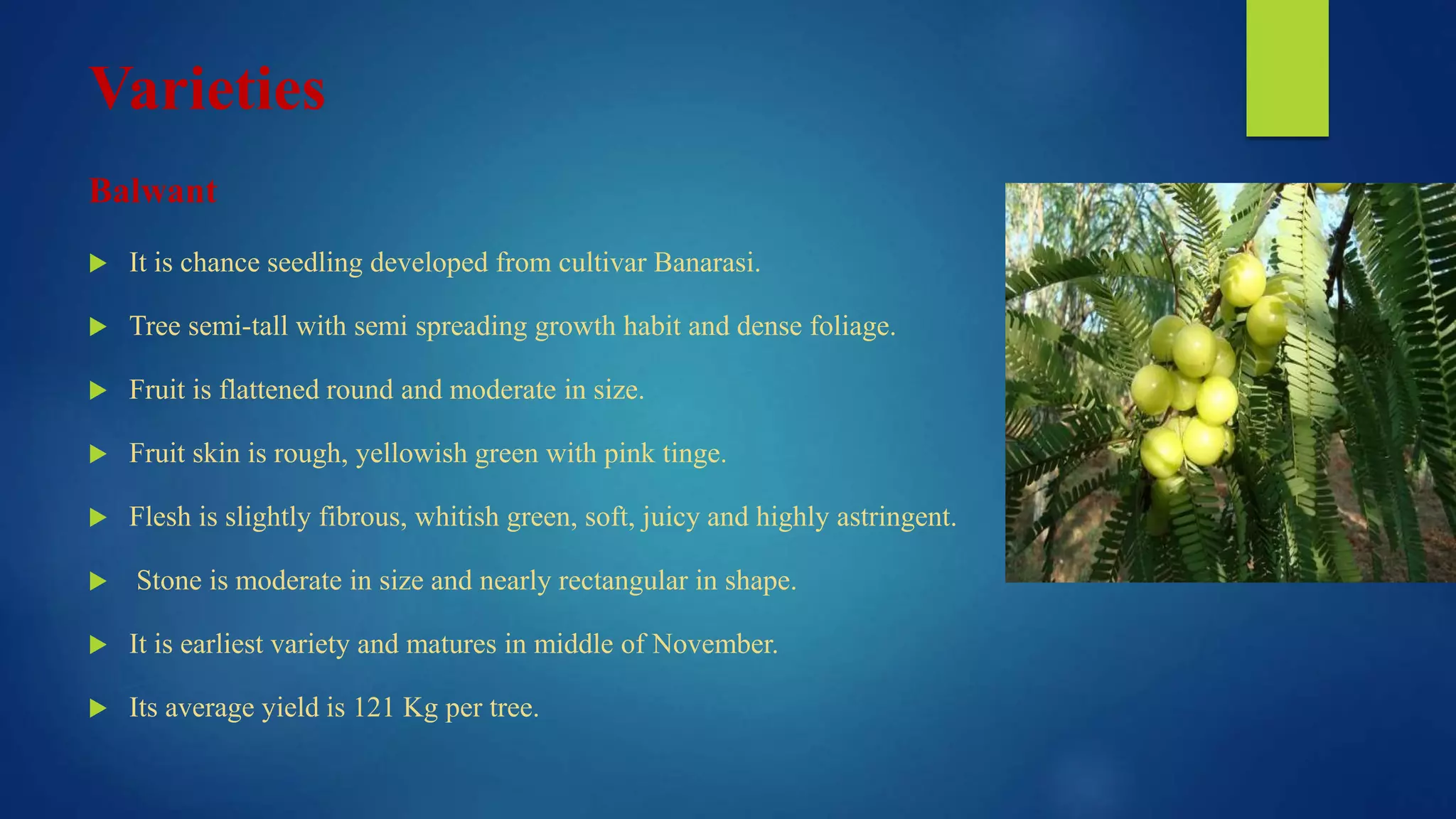
Balwant
 It is chance seedling developed from cultivar Banarasi.
 Tree semi-tall with semi spreading growth habit and dense foliage.
 Fruit is flattened round and moderate in size.
 Fruit skin is rough, yellowish green with pink tinge.
 Flesh is slightly fibrous, whitish green, soft, juicy and highly astringent.
 Stone is moderate in size and nearly rectangular in shape.
 It is earliest variety and matures in middle of November.
 Its average yield is 121 Kg per tree.
Neelum
 It is seedling selection from open pollinated strain of cultivar Francis.
 Tree is tall with semi-spreading growth habit and dense foliage.
 Fruit skin smooth, semi translucent and yellowish green.
 Flesh is almost fibreless and soft.
 Stone is medium in size and oval round in shape.
 It is a mid-season variety and matures in end November.
 Its average yield is 121 Kg per tree.
Kanchan
 It is a chance seedling from cultivar Chakaiya.
 Tree is tall with upright growth habit, sparse foliage.
 Fruit is flattened-oblong in shape and small to medium in size.
 Flesh is fibrous, hard and ideally suited for processing.
 Stoneis small and round.
 It is late in maturity and matures in mid-December.
 Its average yield is 111 Kg per tree.
Banarasi
 The fruits are large in size flattened oblong with smooth skin, yellowish with
characteristic three raised segments.
 On an average each fruit weighs 38g.
 Trees are having upright growth habit.
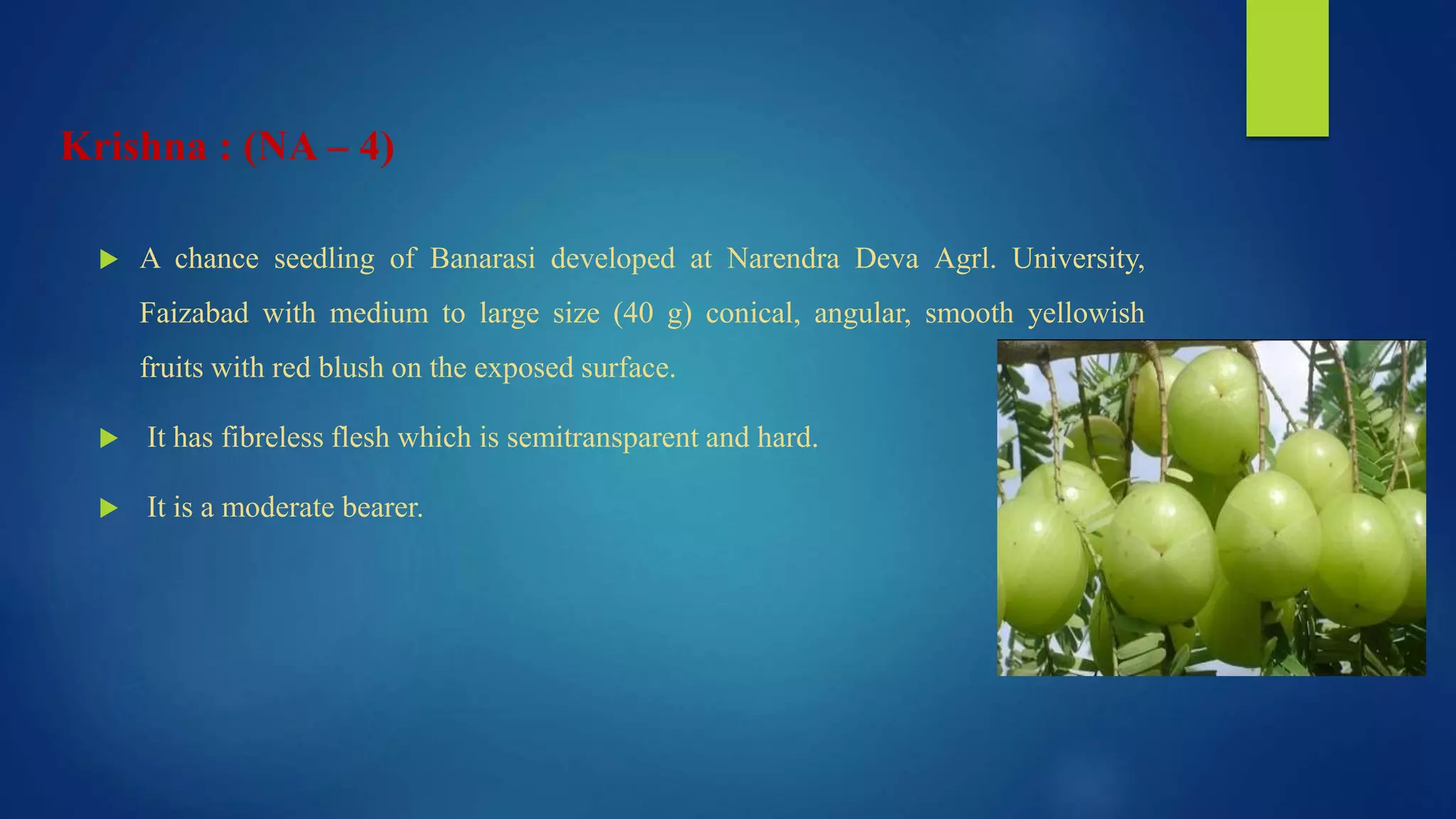
Krishna : (NA – 4)
 A chance seedling of Banarasi developed at Narendra Deva Agrl. University,
Faizabad with medium to large size (40 g) conical, angular, smooth yellowish
fruits with red blush on the exposed surface.
 It has fibreless flesh which is semitransparent and hard.
 It is a moderate bearer.
Propagation
Seed
 The aonla plants have long been raised from seeds but the plants do not come true-
to-type and produces small sized fruits, inferior in quality.
 Seedlings are raised from seeds and used as root stock.
Vegetative propagation
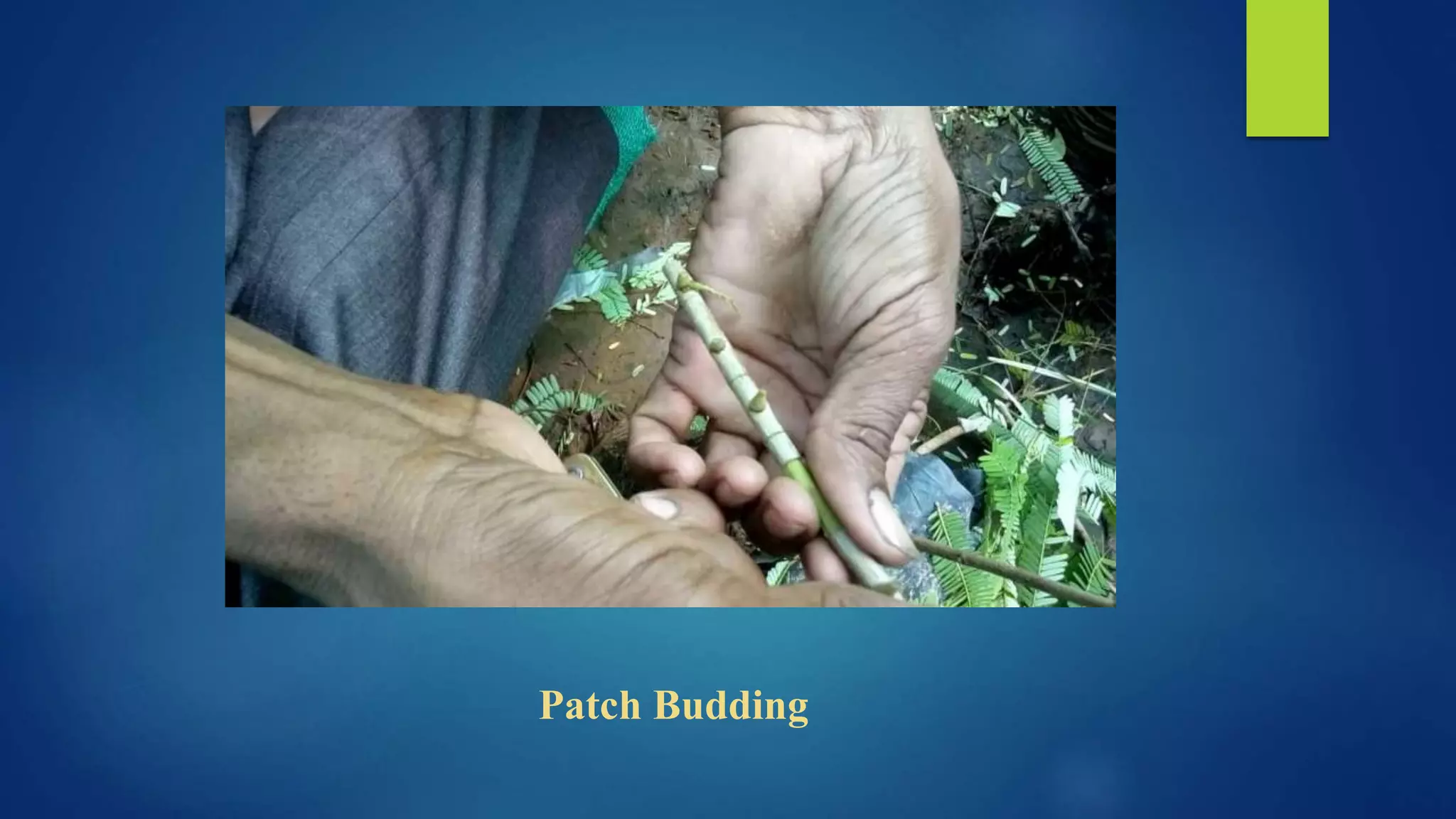
Shield budding or patch budding
 It is the commercial method of aonla propagation under North Indian conditions.
 It is propagated during June-September.
 Patch budding gave a success of 70-81.1 percent.
Patch Budding
Top working
 Older trees of inferior type can be rejuvenated and easily changed into superior
type by resorting top working.
 Inferior trees can be headed back to a height of 1*2 metres from the ground during
March and its stumps produced can be shield budded in early June with scions of
improved varieties.
 Frost damaged older aonla plants were also rejuvenated by T-budding
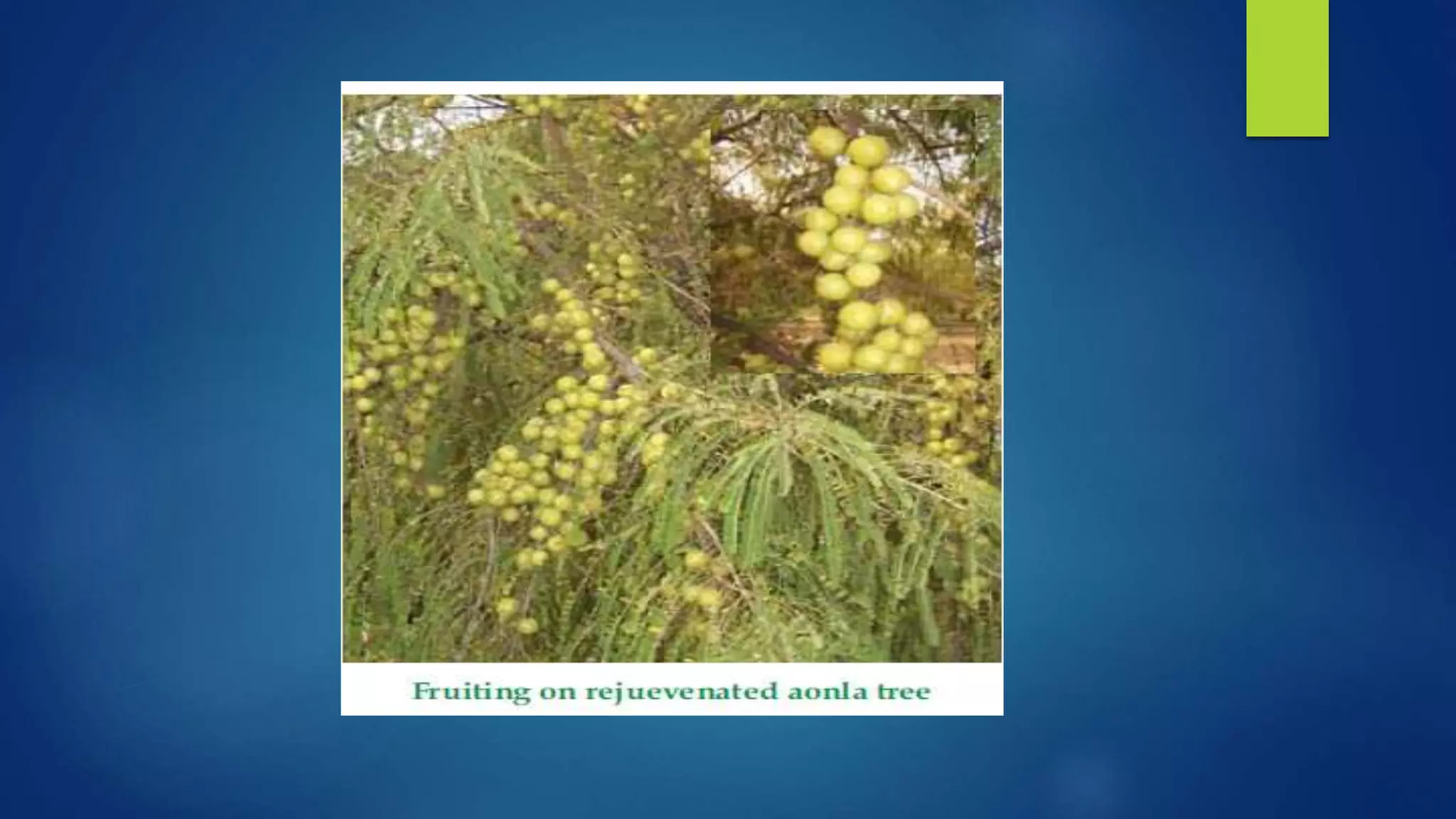
Aonla Rejuvenation
Planting
 After deep and thorough ploughing, pits of 1 cubic metre size can be dug at a
spacing of 7.5x7.5 m during February-March and August- September. and filled
up with 10-15 kg of well decomposed FYM.
 The budded plant or seedlings for in-situ budding.
 To get good yield, plants of atleast two varieties should be planted together g
(especially in dry areas) can be planted at the onset monsoon rains.
Training and Pruning
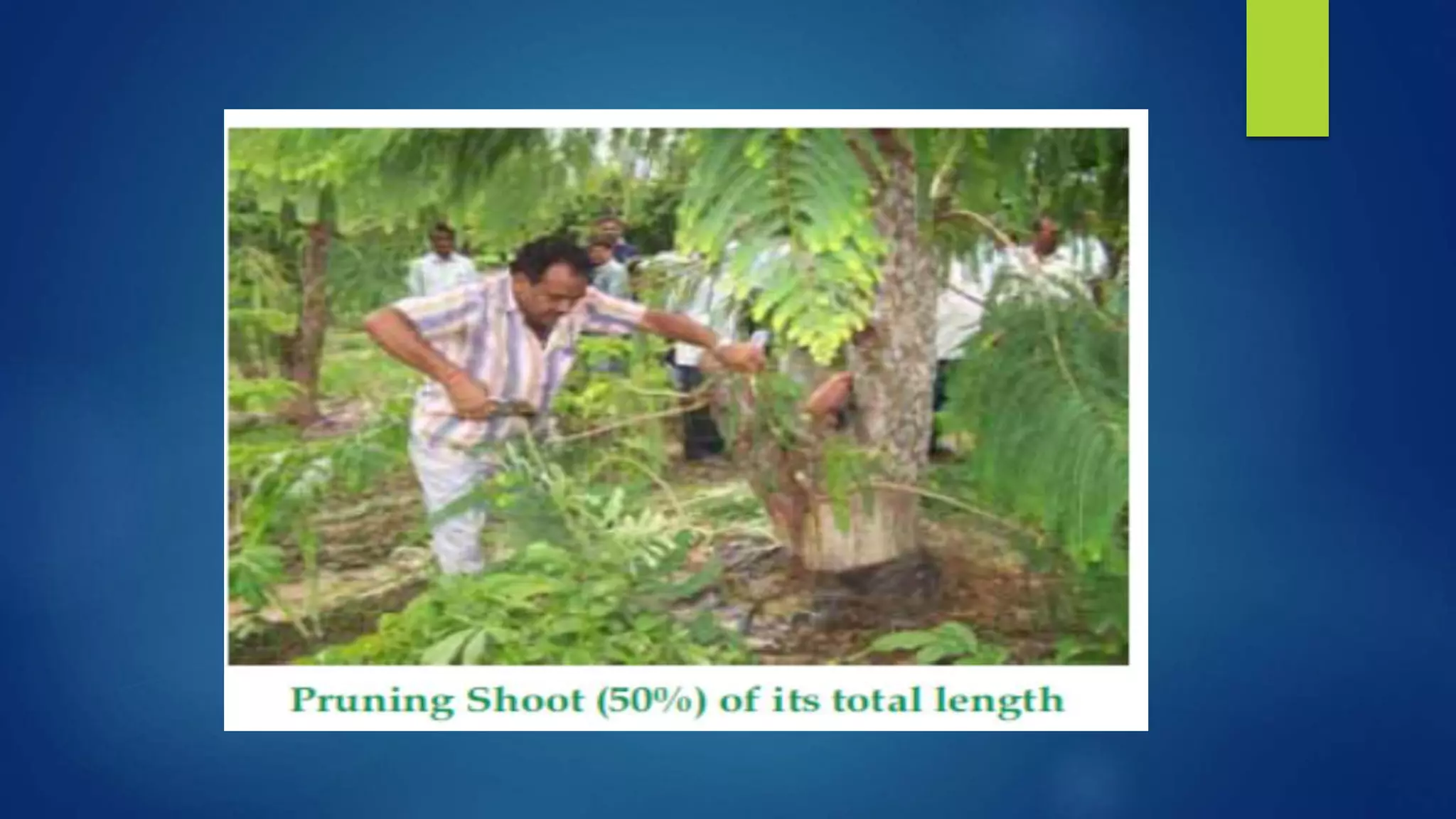
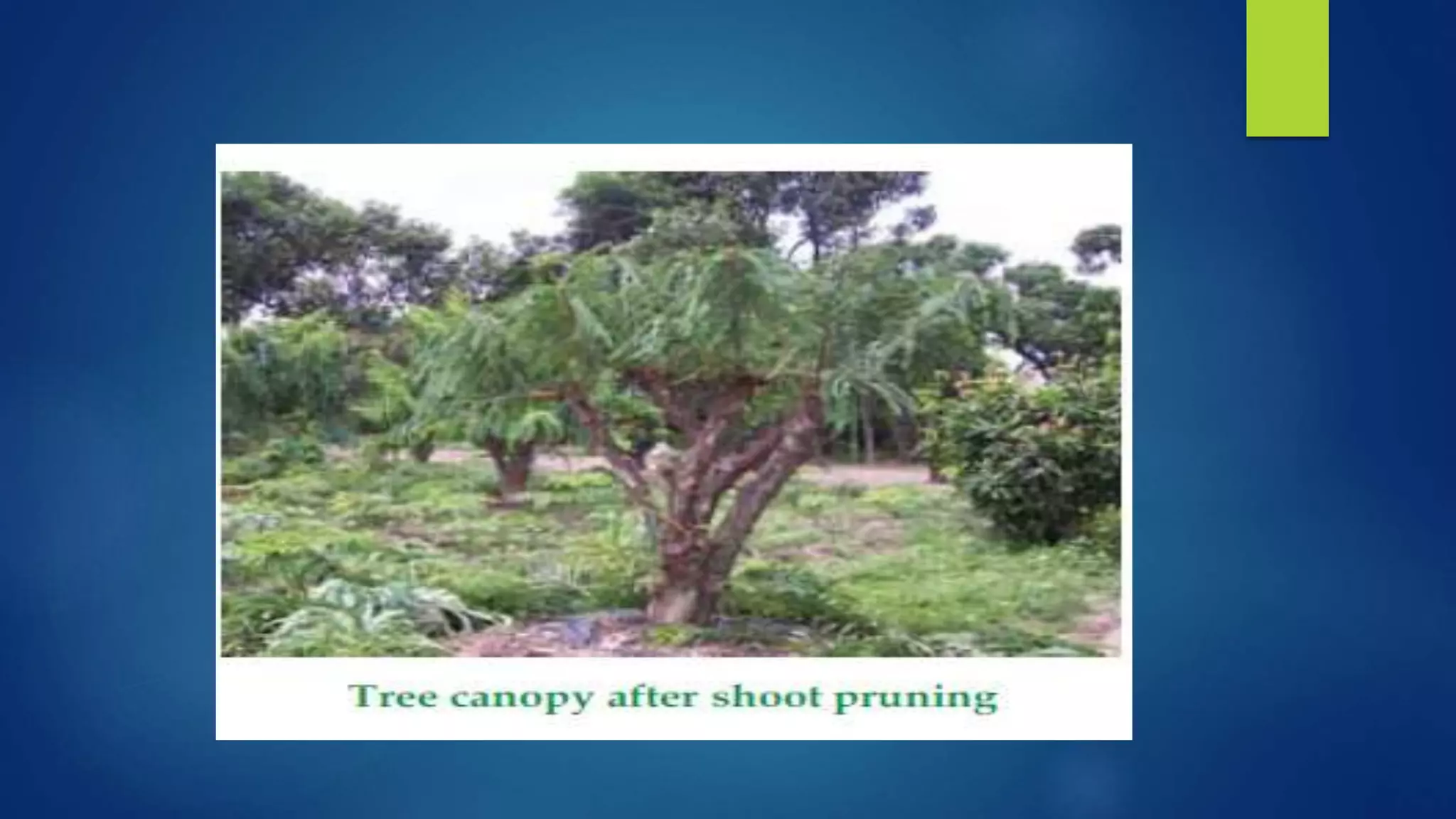
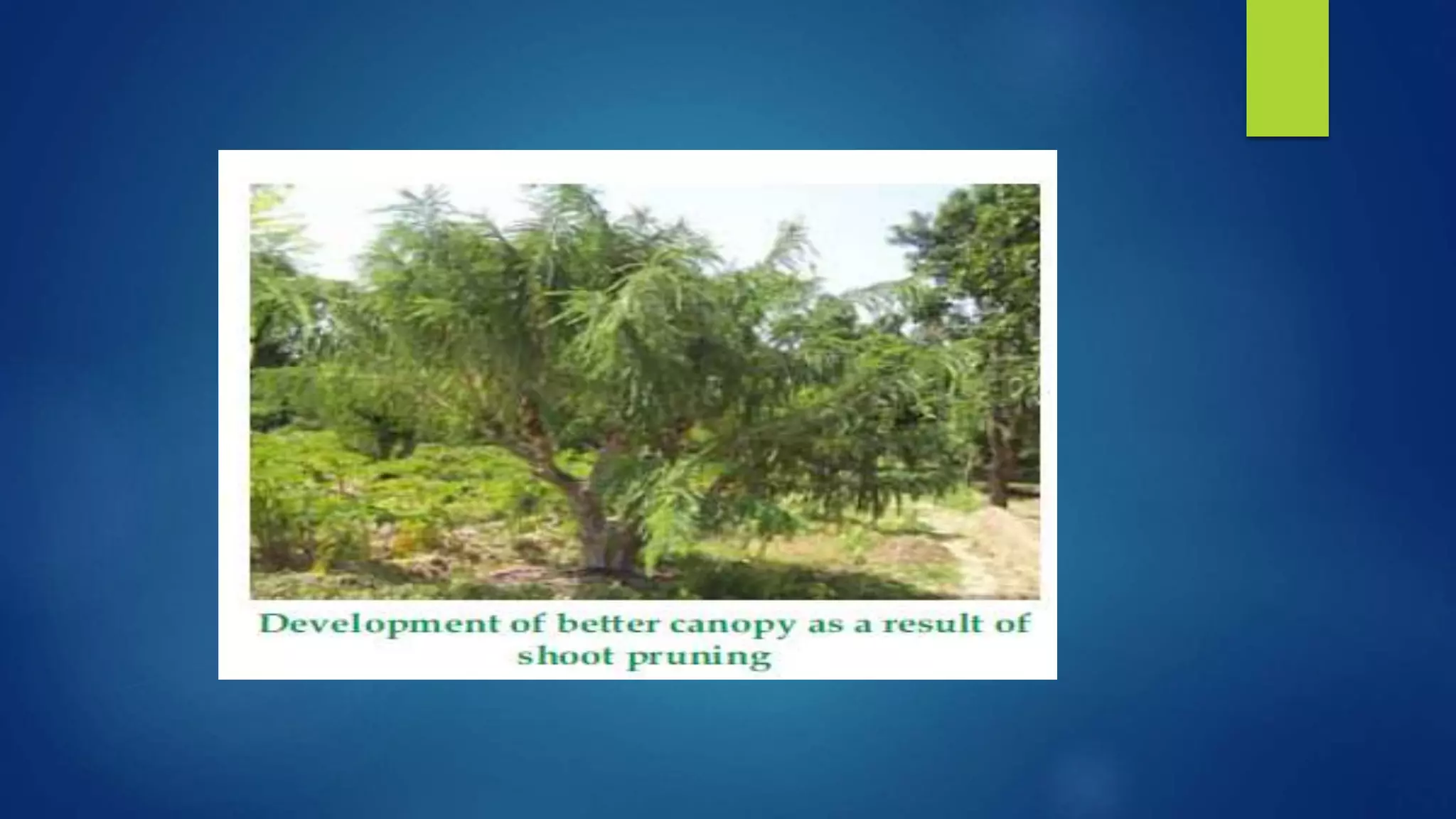
 The tree should be trained to single stem up to the height of 75 cm.
 Then select 4 to 6 well-spaced main branches in all directions around the trunk.
 When the crops started bearing early year after the harvest of fruits, dead,
diseased, weak and criss-cross branches should be pruned.
 The water sprouts and rootstock growth should be watched and periodically
removed.
Manures and Fertilizers
 Apply 15-20 Kg per plant farmyard manure to young plants and 30-40 Kg per tree
to mature plants during July.
 In addition, apply 50 g nitrogen (110 g Urea) to each one-year-old plant.
 Increase this dose of N by 50g each year up to 10 years and apply 500 g of
nitrogen (1100 g Urea) to mature plants thereafter.
Irrigation
 Young plantation shout be irrigated at 10-15 days intervals during summer.
 In bearing plantation, irrigation should be avoided during flowering.
 During early stages of establishment, the plants should be watered periodically
especially during summer.
 Fully mature trees are seldom watered.
 However, irrigation during April-June one in 15 days will help to encourage fruit
set and prevent fruit drop.
Intercroping
 Leguminous crops, viz., moong, cowpea, urid, etc., can be grown up to 8 years
when the plants usually remain in non-bearing stage and their root system and top
growth are not much developed.
Deficiency
Boron
Deficiency Symptoms
 Fruit necrosis which begins with the browning of inner most part of the
mesocarpic tissues at the time of endocarp hardening.
 This is extended towards the epicarp resulting into brownish black areas on the
fruit surfaces depending of the severity of the disorder, mesocarp of affected fruits
turns black from brown which later turns into corky and gummy pockets.
Correction Measure
 Spray of Borax 0.6% thrice at monthly intervals.
Boron Deficiency
Plant protection
1. Bark eating caterpillar- Indarbela tetraonis
Biology:
Eggs:
 350 on bark in May-June,
 Spherical eggs, usually singly, are laid in bark cracks.
 No. of generation : 1/year
Larva:
 Larval period 8-10 months till about 3rd week of April.
 The larval stage is for about 10 months.
 The larva is brown to black, shiny, sparsely hairy and measures 4.5-5.0 cm before pupation.
Pupa
 Pupation inside larval tunnel, pupal period is about 21-41 days.
Adult:
 Moth is creamy white with brown markings on the forewing. Moth longevity is 3
days.
Life cycle:
Damage symptoms:
 Make tunnels in the main trunk and branches
 Larvae construct loose irregular webbing of silken threads
 Deterioration of vitality, reduction in yield
Favourable conditions:
 Attacks in April at initiation of new growth after dormancy.
Bark eating caterpillar
Management
 Keep the orchards clean.
 Collect loose and damaged barks and destroy them.
 Kill larvae by inserting thin iron spike or wire into the hole.
 Spot application of 10 ml of Monocrotophos or fenthion or methyl parathion / 1 L
of water.
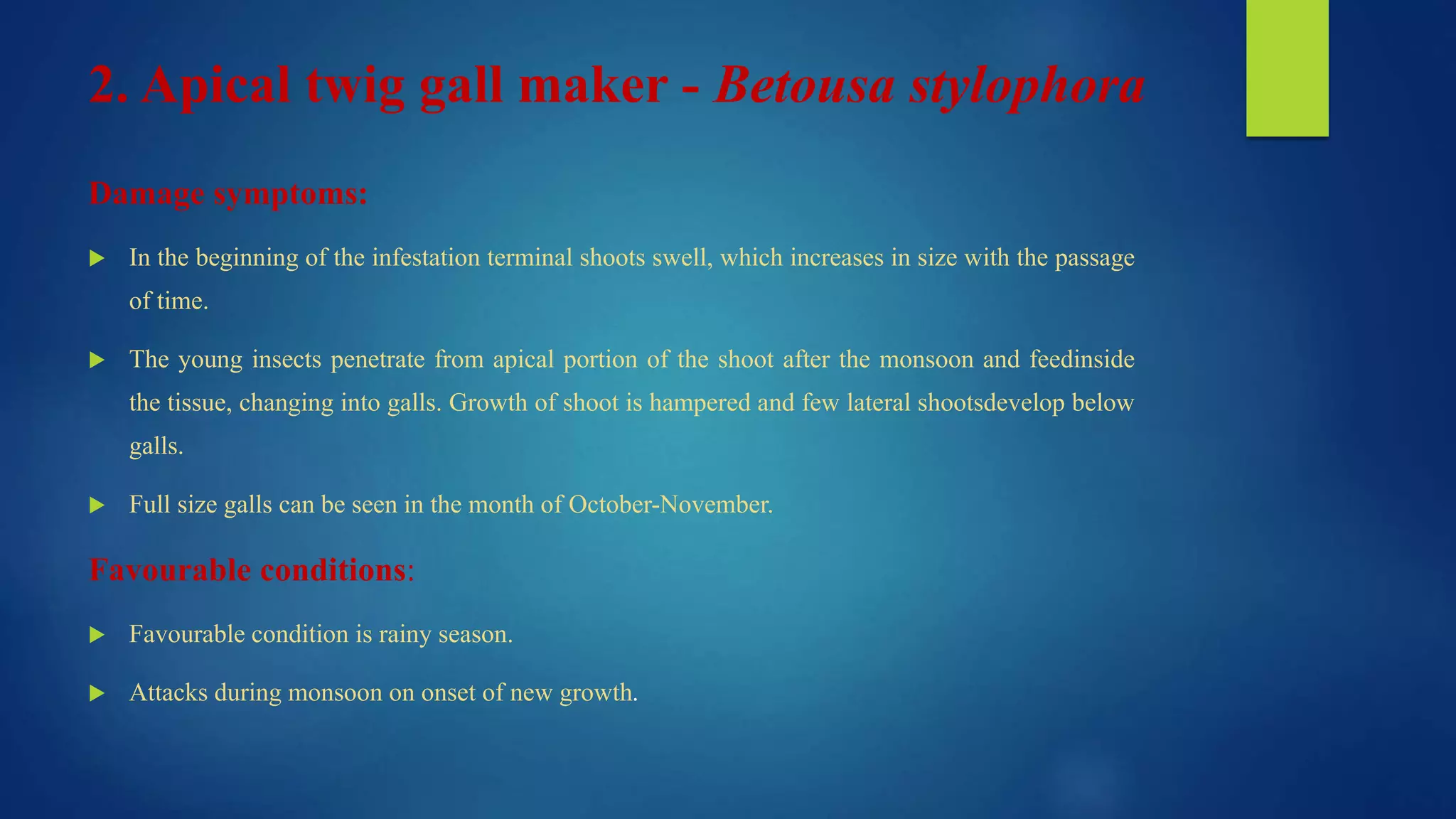
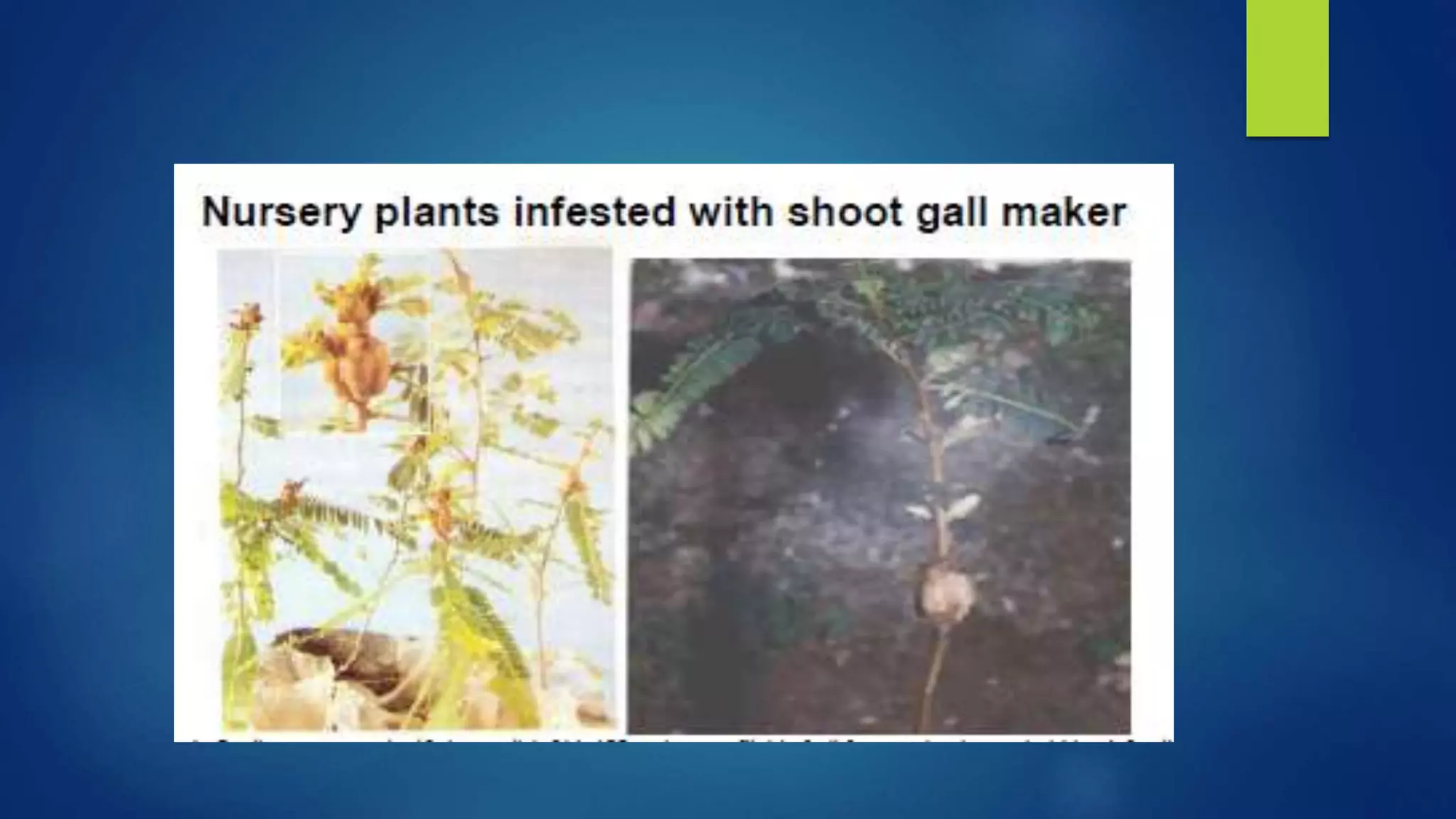
2. Apical twig gall maker - Betousa stylophora
Damage symptoms:
 In the beginning of the infestation terminal shoots swell, which increases in size with the passage
of time.
 The young insects penetrate from apical portion of the shoot after the monsoon and feedinside
the tissue, changing into galls. Growth of shoot is hampered and few lateral shootsdevelop below
galls.
 Full size galls can be seen in the month of October-November.
Favourable conditions:
 Favourable condition is rainy season.
 Attacks during monsoon on onset of new growth.
Management
Common mechanical practices:
 Collect and destroy disease infected and insect infested plant parts.
 Collect and destroy eggs and early stage larvae.
 Handpick the older larvae during early stages.
 Hand pick the gregarious caterpillars and cocoons which are found on stem/branches
and destroy them in kerosene mixed water.
 Use yellow sticky traps @ 4-5 trap/acre.
 Use light trap @ 1/acre and operate between 6 pm and 10 pm.
 Install pheromone traps @ 4-5/acre for monitoring adult moths activity (replace the
lures with fresh lures after every 2-3 weeks).
 Set up bonfire during evening hours at 7-8 pm.
3. Aphids - Setaphis bougainvilleae Theob.
Biology:
Eggs:
 Eggs hatch after one or two days.
 Young aphids, called nymphs.
Nymph:
 Oval or slightly elongated, reddish brown with six segmented antennae
Adult:
 Aphids reproduce in two ways: by laying eggs and laying live young, which birth process is depending on
environmental conditions and the availability of food.
 When food is plentiful, aphids give birth to live young. Populations develop quickly as this pest has many
young, a short life span and pre-adult insects can also give birth.
Favourable condition:
 The incidence of this pest is mainly seen from July to October with the peak
period in September.
Damage
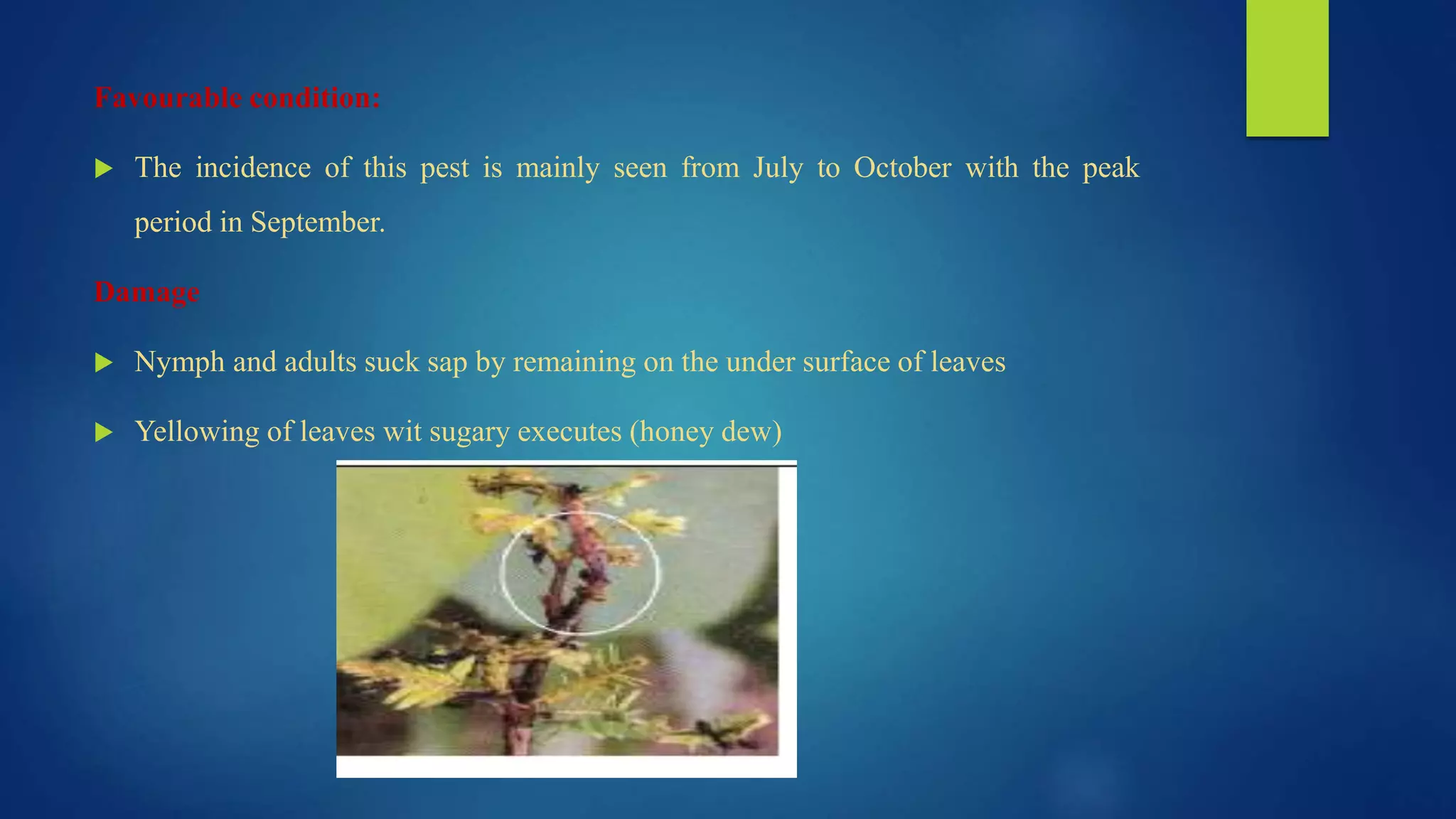
 Nymph and adults suck sap by remaining on the under surface of leaves
 Yellowing of leaves wit sugary executes (honey dew)
Life cycle
Natural enemies of aphids:
 Parasitoids: Aphidius colemani
 Predators: Dicyphus hesperus, Lacewing, Ladybird beetle.
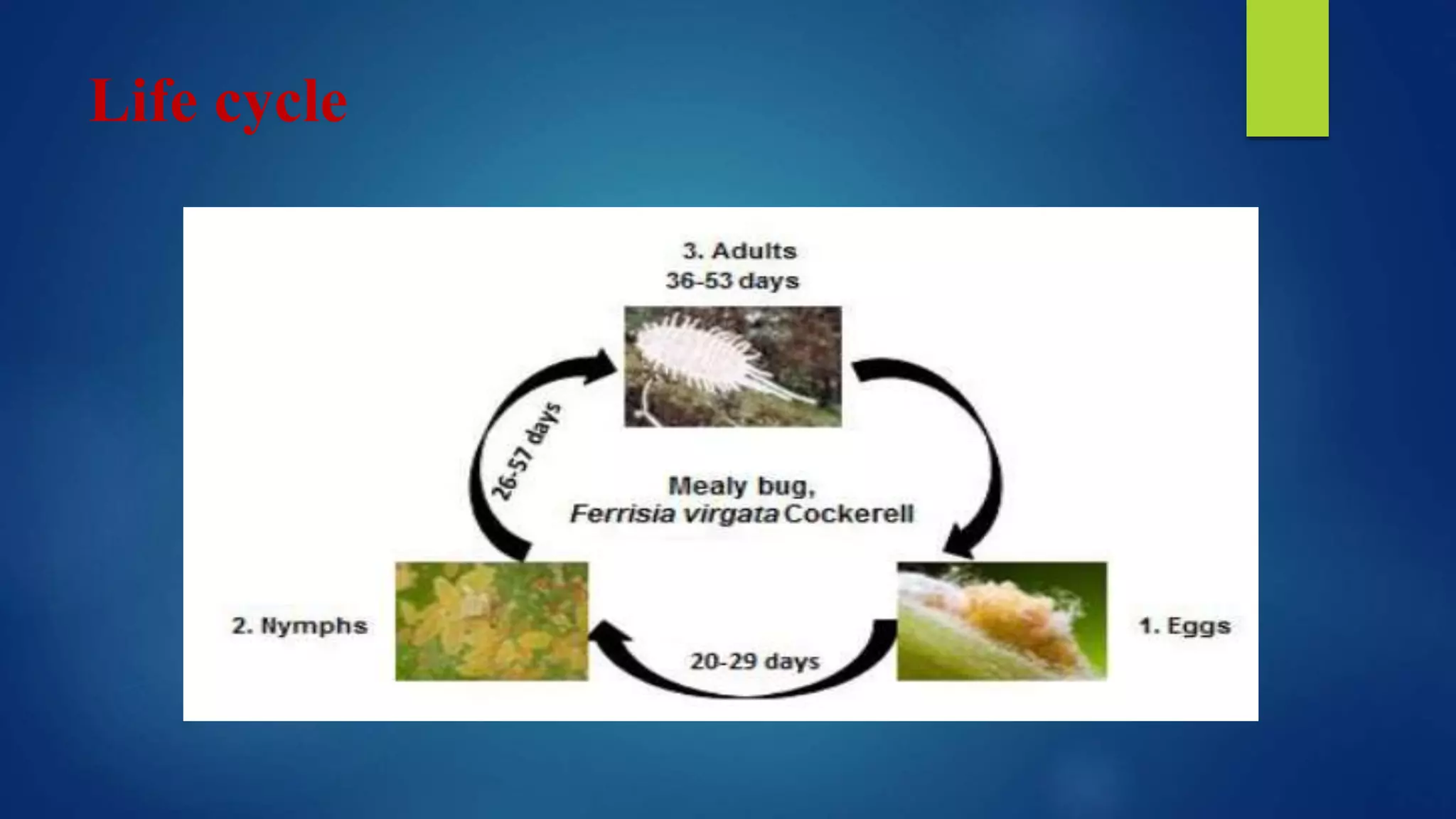
4. Mealy Bug – Ferrisia virgata
Biology:
Nymph:
 Yellowish to pale white.
Adult:
 Females apterous, long, slender covered with white waxy secretions. Incubation period 3 to 4
hours.
 Egg masses on leaves under female. The developmental period of nymph of male and female
varies from 31 to 57 and 26 - 47 days respectively.
 Longevity of male is 1-3 days and female is 36-53 days.
Favourable condition:
 Moist and warm conditions are most favourable.
Damage twig
 The nymphs were found sucking the cell sap from tender shoots or twigs,
 The infestation was at a very low level.
Control measure
 Generalized predators viz., spiders and mantid were observed feeding on this pest
on aonla trees.
Mealy Bug
Life cycle
5. Pomegranate/ Anar butterfly:
Biology:
Eggs:
 On calyx of flowers or on fruits, egg period is about 7-10 days.
Larva:
 Short, stout, dark brown with short hairs and whitish patches all over the body and 2 cm long.
 Larval period is about 18 to 47 days.
Pupa:
 Pupation inside the fruit or on fruit stalk, pupal period is about 7-34 days.
Adults:
 Medium sized, males are bluish violet while females are brownish violet with orange patch on
forewings.
Life cycle:
 1-2 months. No. of generation are 4 per year. Pest is active throughout the year.
Life Cycle
Favourable condition:
 Attack of this insect occurs during September-October, coinciding well with the
fruiting.
Damage symptoms:
 Caterpillars bore the fruits, feed on pulp and seeds.
 Damaged fruits subsequently get infected by bacteria resulting in rotting of fruits.
 Such rotten fruit gives offensive smell and fall down.
 The excreta of the larva around the entry holes are seen.
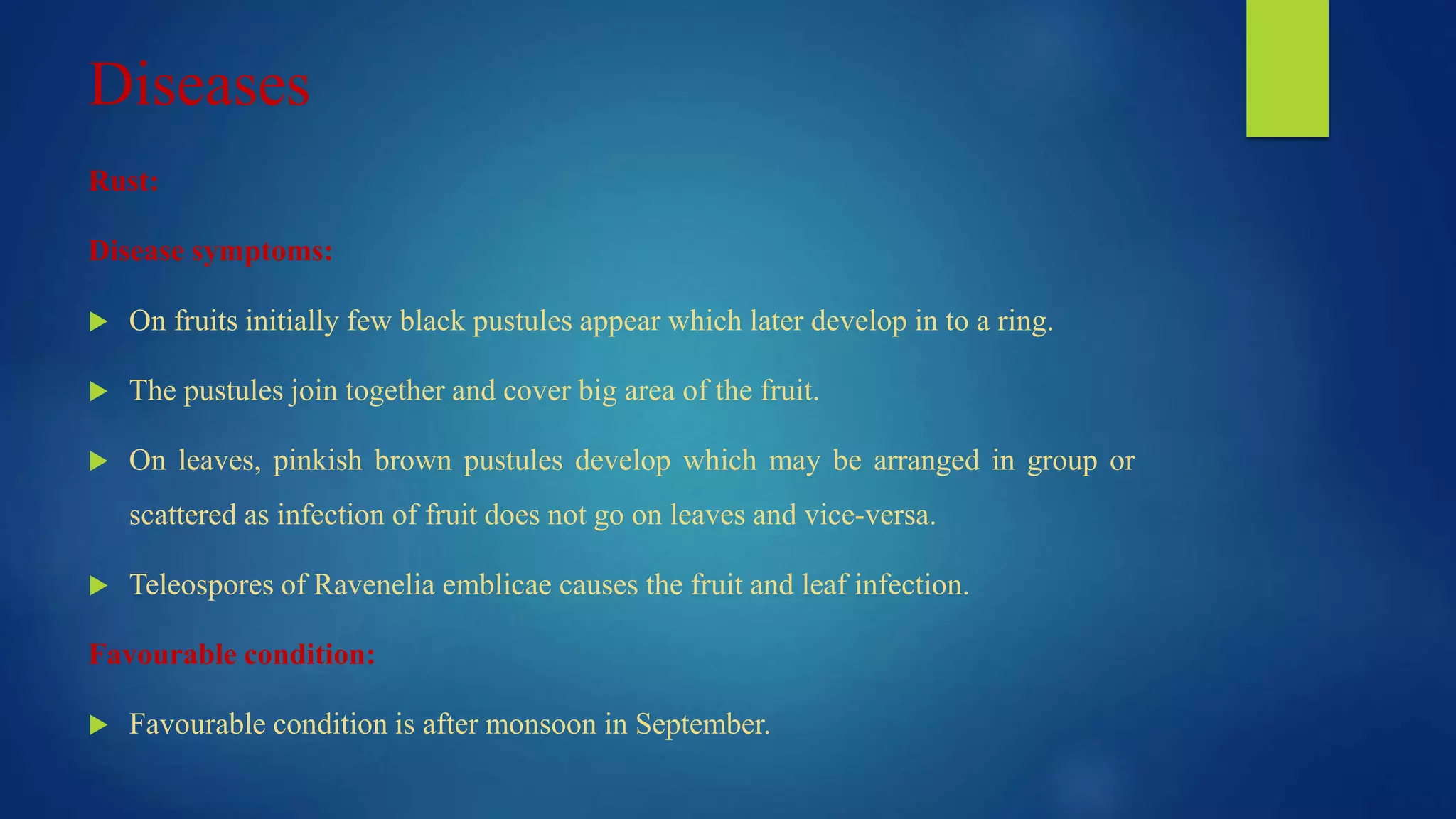
Diseases
Rust:
Disease symptoms:
 On fruits initially few black pustules appear which later develop in to a ring.
 The pustules join together and cover big area of the fruit.
 On leaves, pinkish brown pustules develop which may be arranged in group or
scattered as infection of fruit does not go on leaves and vice-versa.
 Teleospores of Ravenelia emblicae causes the fruit and leaf infection.
Favourable condition:
 Favourable condition is after monsoon in September.
Disease cycle
Management
Common cultural practices:
 Collect and destroy crop debris
 Provide irrigation at the critical stages of the crop
 Avoid water logging
 Avoid water stress during flowering stage
 Follow judicious use of fertilizers
 Enhance parasitic activity by avoiding chemical pesticide spray, when 1-2 larval
parasitoids are observed in the crops field.
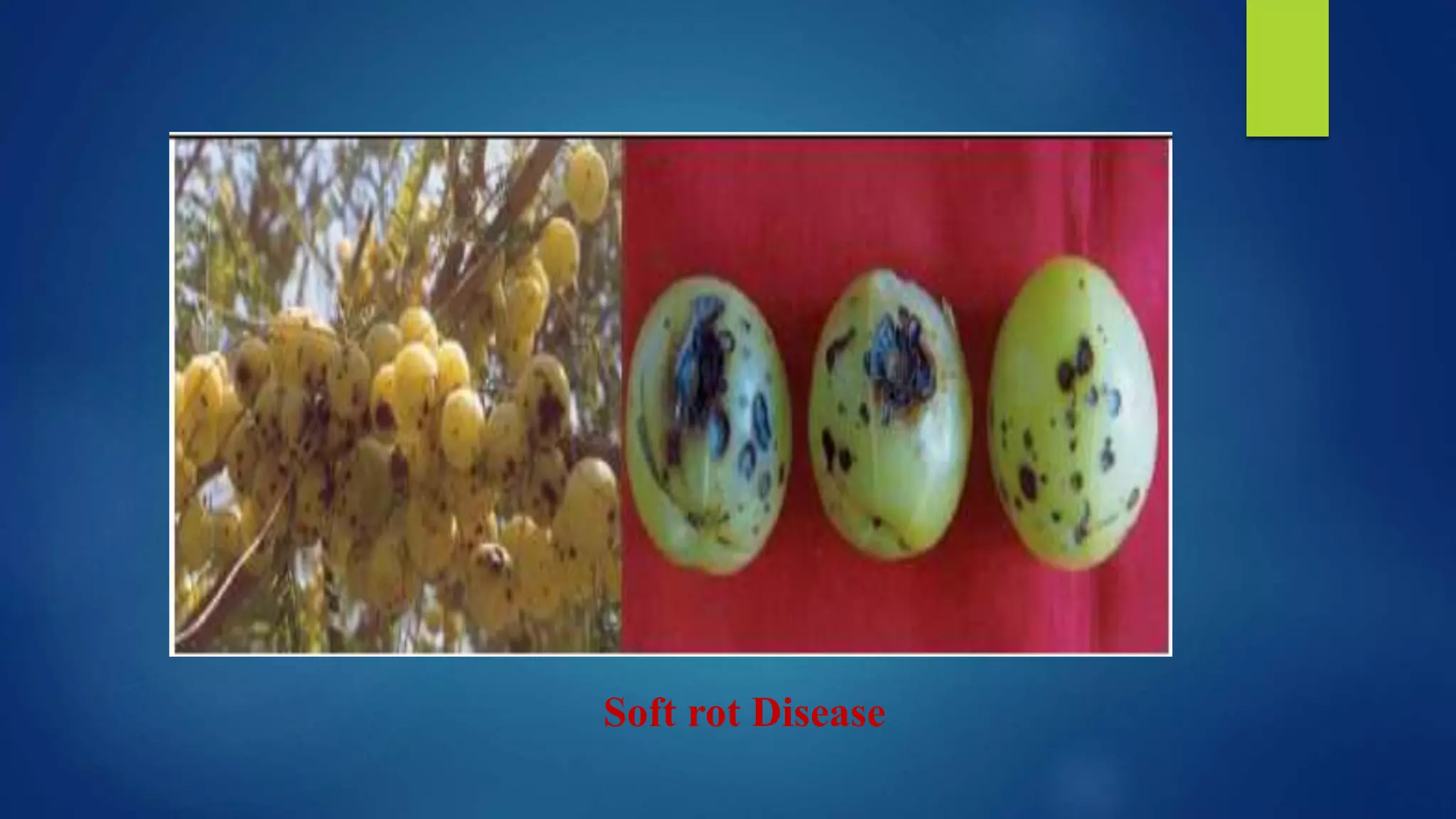
2. Soft rot
Disease symptoms:
 Smoke brown to black round lesions develop on fruits within 2-3 days of infection.
 The diseased parts later show olive brown discoloration with water soaked areas extending
toward both the ends of fruits forming an eye shaped appearance.
 Infected fruits become dark brown, crinkled with softening of underlining tissues and get
deformed.
 Fungus causes infection both in young and mature fruits, but mature fruits are found to be more
Susceptible.
Favourable conditions:
 Disease is favored by hot and wet weather. The optimum temperature for fungal growth is 29˚C
and it grows well up to 32˚C.
Disease cycle
Soft rot Disease
Management
Cultural control:
 Prune and destroy pruned cuttings and debris by burning, burying, or
ploughing them into the soil.
 Avoid injury to fruits.
Flowering, Pollination and Fruit-set
Flowering
 Flower bud differentiation of Banarasi aonla is in the first week of March.
 The development of male and female gametophyte was normal.
 The flowers commence opening from the last week of March and the blooming period lasts for 3 weeks.
 Male flowers appear in clusters in the axil of leaf all over the branchlet while female flowers on the
upper end of a few branchlets only.
 The maximum number of male flowers open between 6 and 7 p.m. and dehiscence of anthers occurs
soon or about 10-15 minutes after anthesis.
 The female flowers open in stages and it takes 72 hours to open completely and the stigma becomes
receptive on the third day of anthesis.
Pollination and fruit set
 It is wind pollinated as the pollen grains are light and are produced in abundance.
 Although actual fertilization could not be traced, zygote was observed within 24 to 36 hours
of pollination.
 There is no self-incompatibility in aonla and the cause of poor fruit-set may be due to a
high percentage of staminate flowers.
 An increase in fruit set under hand pollination indicates the need of pollinating agents for
better setting.
Flower and fruit drop
Flower and fruit drop are at three stages.
 The ‘first drop’ is heaviest as 70 per cent of the flowers drop off within three weeks of
flowering due to degeneration of the egg apparatus and lack of pollination.
 The ‘second drop' occurs from June to September due to lack of pollination and
fertilization.
 The ‘third drop’ consists of fruits of various stages beginning from third week of August
until October probably due to embryological and physiological factors.
Harvesting
 Fruit should be harvested at full maturity.
 Budded Amla plants start bearing after 4-5 years of age and the trees start
commercial yield at the age of 10 years.
 The average yield is about 150 kg/tree/year.
THANKS YOU
HAVE A NICE DAY

Cultivation of aonla.

  • 2.
    AONLA Botanical Name Emblicaofficinalis Family Euphorbiaceae Chromosome No. 2n= 28 Fruit Type Berry Origin Tropical Asia Edible part Mesocarp and Endocarp Common name Indian gooseberry
  • 3.
     Amla ishighly nutritive and popularly known as ‘Amrit phal’.  It is wind pollinated as the pollen grains are light and are produced in abundance.  It is very rich in vitamin C, pectin and minerals.  Fruit is valued high among indigenous medicines in India.  It is the main ingredients in Chawanprash.  Amla has a great potential due to its high medicinal and nutritive values and more productivity even on marginal lands.
  • 4.
    Composition of AonlaFruits Moisture 8.2 percent Phosphorus 0.02 percent Protein 0.5 percent Iron 1.2 percent Fat (ether extraction) 0.1 percent Calorific value 59/100 gm Mineral matter 0.7 percent Vitamin B1 30 mg/ 100 gm Fibre 3.4 percent Nicotinic acid 0.2 mg/100 gm Carbohydrates 14.0 percent Vitamin C 600mg/100gm Calcium 0.05 percent Source : Extension Bulletin No. 22, IIHR. Bangalore.
  • 5.
    Area and Production It is commercially cultivated in Varanasi, Agra and Kanpur area of Uttar Pradesh.  In India it occupies an area of 93 thousand hectares with an annual production of 1075 thousand million tonnes.  In Punjab it is being grown on 217 hectares only.
  • 6.
    General uses  Candy Powder  Hair oil  Juice  Dried chips  Murabha
  • 7.
    Climatic and soilrequirements Climate  Aonla is a subtropical fruit but its cultivation in tropical climate is quite successful.  The tree is not much influenced either by hot wind or frost.  The mature plants can tolerate freezing temperature as well as a temperature as high as 46 ºC.  The young plants should be protected from hot wind (loo) during May-June and from frost during winter, at least up to the age of ¾ years under North Indian conditions.
  • 8.
    Soil  Aonla canbe grown in light as well as heavy soils except very sandy one.  However, well-drained fertile loamy soil is the best.  The plants have capacity for adaptation to dry regions and can also grow in moderately alkaline soils.  It is a potential crop for degraded lands and the marginal soils having soil pH of 6.0 to 9.5.
  • 9.
    Varieties Balwant  It ischance seedling developed from cultivar Banarasi.  Tree semi-tall with semi spreading growth habit and dense foliage.  Fruit is flattened round and moderate in size.  Fruit skin is rough, yellowish green with pink tinge.  Flesh is slightly fibrous, whitish green, soft, juicy and highly astringent.  Stone is moderate in size and nearly rectangular in shape.  It is earliest variety and matures in middle of November.  Its average yield is 121 Kg per tree.
  • 10.
    Neelum  It isseedling selection from open pollinated strain of cultivar Francis.  Tree is tall with semi-spreading growth habit and dense foliage.  Fruit skin smooth, semi translucent and yellowish green.  Flesh is almost fibreless and soft.  Stone is medium in size and oval round in shape.  It is a mid-season variety and matures in end November.  Its average yield is 121 Kg per tree.
  • 11.
    Kanchan  It isa chance seedling from cultivar Chakaiya.  Tree is tall with upright growth habit, sparse foliage.  Fruit is flattened-oblong in shape and small to medium in size.  Flesh is fibrous, hard and ideally suited for processing.  Stoneis small and round.  It is late in maturity and matures in mid-December.  Its average yield is 111 Kg per tree.
  • 12.
    Banarasi  The fruitsare large in size flattened oblong with smooth skin, yellowish with characteristic three raised segments.  On an average each fruit weighs 38g.  Trees are having upright growth habit.
  • 13.
    Krishna : (NA– 4)  A chance seedling of Banarasi developed at Narendra Deva Agrl. University, Faizabad with medium to large size (40 g) conical, angular, smooth yellowish fruits with red blush on the exposed surface.  It has fibreless flesh which is semitransparent and hard.  It is a moderate bearer.
  • 14.
    Propagation Seed  The aonlaplants have long been raised from seeds but the plants do not come true- to-type and produces small sized fruits, inferior in quality.  Seedlings are raised from seeds and used as root stock.
  • 15.
    Vegetative propagation Shield buddingor patch budding  It is the commercial method of aonla propagation under North Indian conditions.  It is propagated during June-September.  Patch budding gave a success of 70-81.1 percent.
  • 16.
  • 17.
    Top working  Oldertrees of inferior type can be rejuvenated and easily changed into superior type by resorting top working.  Inferior trees can be headed back to a height of 1*2 metres from the ground during March and its stumps produced can be shield budded in early June with scions of improved varieties.  Frost damaged older aonla plants were also rejuvenated by T-budding
  • 18.
  • 28.
    Planting  After deepand thorough ploughing, pits of 1 cubic metre size can be dug at a spacing of 7.5x7.5 m during February-March and August- September. and filled up with 10-15 kg of well decomposed FYM.  The budded plant or seedlings for in-situ budding.  To get good yield, plants of atleast two varieties should be planted together g (especially in dry areas) can be planted at the onset monsoon rains.
  • 29.
    Training and Pruning The tree should be trained to single stem up to the height of 75 cm.  Then select 4 to 6 well-spaced main branches in all directions around the trunk.  When the crops started bearing early year after the harvest of fruits, dead, diseased, weak and criss-cross branches should be pruned.  The water sprouts and rootstock growth should be watched and periodically removed.
  • 30.
    Manures and Fertilizers Apply 15-20 Kg per plant farmyard manure to young plants and 30-40 Kg per tree to mature plants during July.  In addition, apply 50 g nitrogen (110 g Urea) to each one-year-old plant.  Increase this dose of N by 50g each year up to 10 years and apply 500 g of nitrogen (1100 g Urea) to mature plants thereafter.
  • 31.
    Irrigation  Young plantationshout be irrigated at 10-15 days intervals during summer.  In bearing plantation, irrigation should be avoided during flowering.  During early stages of establishment, the plants should be watered periodically especially during summer.  Fully mature trees are seldom watered.  However, irrigation during April-June one in 15 days will help to encourage fruit set and prevent fruit drop.
  • 32.
    Intercroping  Leguminous crops,viz., moong, cowpea, urid, etc., can be grown up to 8 years when the plants usually remain in non-bearing stage and their root system and top growth are not much developed.
  • 33.
    Deficiency Boron Deficiency Symptoms  Fruitnecrosis which begins with the browning of inner most part of the mesocarpic tissues at the time of endocarp hardening.  This is extended towards the epicarp resulting into brownish black areas on the fruit surfaces depending of the severity of the disorder, mesocarp of affected fruits turns black from brown which later turns into corky and gummy pockets. Correction Measure  Spray of Borax 0.6% thrice at monthly intervals.
  • 34.
  • 35.
    Plant protection 1. Barkeating caterpillar- Indarbela tetraonis Biology: Eggs:  350 on bark in May-June,  Spherical eggs, usually singly, are laid in bark cracks.  No. of generation : 1/year Larva:  Larval period 8-10 months till about 3rd week of April.  The larval stage is for about 10 months.  The larva is brown to black, shiny, sparsely hairy and measures 4.5-5.0 cm before pupation.
  • 36.
    Pupa  Pupation insidelarval tunnel, pupal period is about 21-41 days. Adult:  Moth is creamy white with brown markings on the forewing. Moth longevity is 3 days.
  • 37.
  • 38.
    Damage symptoms:  Maketunnels in the main trunk and branches  Larvae construct loose irregular webbing of silken threads  Deterioration of vitality, reduction in yield Favourable conditions:  Attacks in April at initiation of new growth after dormancy.
  • 39.
  • 40.
    Management  Keep theorchards clean.  Collect loose and damaged barks and destroy them.  Kill larvae by inserting thin iron spike or wire into the hole.  Spot application of 10 ml of Monocrotophos or fenthion or methyl parathion / 1 L of water.
  • 41.
    2. Apical twiggall maker - Betousa stylophora Damage symptoms:  In the beginning of the infestation terminal shoots swell, which increases in size with the passage of time.  The young insects penetrate from apical portion of the shoot after the monsoon and feedinside the tissue, changing into galls. Growth of shoot is hampered and few lateral shootsdevelop below galls.  Full size galls can be seen in the month of October-November. Favourable conditions:  Favourable condition is rainy season.  Attacks during monsoon on onset of new growth.
  • 43.
    Management Common mechanical practices: Collect and destroy disease infected and insect infested plant parts.  Collect and destroy eggs and early stage larvae.  Handpick the older larvae during early stages.  Hand pick the gregarious caterpillars and cocoons which are found on stem/branches and destroy them in kerosene mixed water.  Use yellow sticky traps @ 4-5 trap/acre.  Use light trap @ 1/acre and operate between 6 pm and 10 pm.  Install pheromone traps @ 4-5/acre for monitoring adult moths activity (replace the lures with fresh lures after every 2-3 weeks).  Set up bonfire during evening hours at 7-8 pm.
  • 44.
    3. Aphids -Setaphis bougainvilleae Theob. Biology: Eggs:  Eggs hatch after one or two days.  Young aphids, called nymphs. Nymph:  Oval or slightly elongated, reddish brown with six segmented antennae Adult:  Aphids reproduce in two ways: by laying eggs and laying live young, which birth process is depending on environmental conditions and the availability of food.  When food is plentiful, aphids give birth to live young. Populations develop quickly as this pest has many young, a short life span and pre-adult insects can also give birth.
  • 45.
    Favourable condition:  Theincidence of this pest is mainly seen from July to October with the peak period in September. Damage  Nymph and adults suck sap by remaining on the under surface of leaves  Yellowing of leaves wit sugary executes (honey dew)
  • 46.
  • 47.
    Natural enemies ofaphids:  Parasitoids: Aphidius colemani  Predators: Dicyphus hesperus, Lacewing, Ladybird beetle.
  • 48.
    4. Mealy Bug– Ferrisia virgata Biology: Nymph:  Yellowish to pale white. Adult:  Females apterous, long, slender covered with white waxy secretions. Incubation period 3 to 4 hours.  Egg masses on leaves under female. The developmental period of nymph of male and female varies from 31 to 57 and 26 - 47 days respectively.  Longevity of male is 1-3 days and female is 36-53 days. Favourable condition:  Moist and warm conditions are most favourable.
  • 49.
    Damage twig  Thenymphs were found sucking the cell sap from tender shoots or twigs,  The infestation was at a very low level. Control measure  Generalized predators viz., spiders and mantid were observed feeding on this pest on aonla trees.
  • 50.
  • 51.
  • 52.
    5. Pomegranate/ Anarbutterfly: Biology: Eggs:  On calyx of flowers or on fruits, egg period is about 7-10 days. Larva:  Short, stout, dark brown with short hairs and whitish patches all over the body and 2 cm long.  Larval period is about 18 to 47 days. Pupa:  Pupation inside the fruit or on fruit stalk, pupal period is about 7-34 days. Adults:  Medium sized, males are bluish violet while females are brownish violet with orange patch on forewings. Life cycle:  1-2 months. No. of generation are 4 per year. Pest is active throughout the year.
  • 53.
  • 54.
    Favourable condition:  Attackof this insect occurs during September-October, coinciding well with the fruiting. Damage symptoms:  Caterpillars bore the fruits, feed on pulp and seeds.  Damaged fruits subsequently get infected by bacteria resulting in rotting of fruits.  Such rotten fruit gives offensive smell and fall down.  The excreta of the larva around the entry holes are seen.
  • 56.
    Diseases Rust: Disease symptoms:  Onfruits initially few black pustules appear which later develop in to a ring.  The pustules join together and cover big area of the fruit.  On leaves, pinkish brown pustules develop which may be arranged in group or scattered as infection of fruit does not go on leaves and vice-versa.  Teleospores of Ravenelia emblicae causes the fruit and leaf infection. Favourable condition:  Favourable condition is after monsoon in September.
  • 58.
  • 59.
    Management Common cultural practices: Collect and destroy crop debris  Provide irrigation at the critical stages of the crop  Avoid water logging  Avoid water stress during flowering stage  Follow judicious use of fertilizers  Enhance parasitic activity by avoiding chemical pesticide spray, when 1-2 larval parasitoids are observed in the crops field.
  • 60.
    2. Soft rot Diseasesymptoms:  Smoke brown to black round lesions develop on fruits within 2-3 days of infection.  The diseased parts later show olive brown discoloration with water soaked areas extending toward both the ends of fruits forming an eye shaped appearance.  Infected fruits become dark brown, crinkled with softening of underlining tissues and get deformed.  Fungus causes infection both in young and mature fruits, but mature fruits are found to be more Susceptible. Favourable conditions:  Disease is favored by hot and wet weather. The optimum temperature for fungal growth is 29˚C and it grows well up to 32˚C.
  • 61.
  • 62.
  • 63.
    Management Cultural control:  Pruneand destroy pruned cuttings and debris by burning, burying, or ploughing them into the soil.  Avoid injury to fruits.
  • 64.
    Flowering, Pollination andFruit-set Flowering  Flower bud differentiation of Banarasi aonla is in the first week of March.  The development of male and female gametophyte was normal.  The flowers commence opening from the last week of March and the blooming period lasts for 3 weeks.  Male flowers appear in clusters in the axil of leaf all over the branchlet while female flowers on the upper end of a few branchlets only.  The maximum number of male flowers open between 6 and 7 p.m. and dehiscence of anthers occurs soon or about 10-15 minutes after anthesis.  The female flowers open in stages and it takes 72 hours to open completely and the stigma becomes receptive on the third day of anthesis.
  • 66.
    Pollination and fruitset  It is wind pollinated as the pollen grains are light and are produced in abundance.  Although actual fertilization could not be traced, zygote was observed within 24 to 36 hours of pollination.  There is no self-incompatibility in aonla and the cause of poor fruit-set may be due to a high percentage of staminate flowers.  An increase in fruit set under hand pollination indicates the need of pollinating agents for better setting.
  • 67.
    Flower and fruitdrop Flower and fruit drop are at three stages.  The ‘first drop’ is heaviest as 70 per cent of the flowers drop off within three weeks of flowering due to degeneration of the egg apparatus and lack of pollination.  The ‘second drop' occurs from June to September due to lack of pollination and fertilization.  The ‘third drop’ consists of fruits of various stages beginning from third week of August until October probably due to embryological and physiological factors.
  • 68.
    Harvesting  Fruit shouldbe harvested at full maturity.  Budded Amla plants start bearing after 4-5 years of age and the trees start commercial yield at the age of 10 years.  The average yield is about 150 kg/tree/year.
  • 69.