JYOTI
MHU2020H02M
M.Sc. Vegetable Science 1st year
Maharana Partap Horticultural University ,Karnal
5/13/2021 1
Content
5/13/2021 2
• Introduction
• Origin & Domestication
• Importance of cucumber
• Basic Information
• Taxonomy
• Cultivation scenario in Haryana
• Plant description and floral biology
• Anthesis and pollination
• Flower regulation and male/ female flowering
sequence
• Sex expression and genetics of sex
expression
• Breeding objective and breeding method
• Types of cucumber
• Selection of variety and types of cucumber
varities
• Important varieties
• Carotenoid rich varieties
• Climate , soil and field preperation
• Sowing time and seed rate
• Manure/Fertilizer and irrigation
• Intercultural operations
• Harvestion
• Post-harvesting, marketing and storage
• Hybrid seed production and seed extraction
• Disease and Insect- pest management
• Physiological disorders
Introduction
Cucumber
• Common name : Cucumber
• Hindi name : Khira
• Botanical name : Cucumis sativus L.
• Family : Cucurbitaceae
• Chromosome number: 2n=14
• Second most widely cultivated cucurbits after watermelon. The fruits are
consumed raw.
• Used as salad and for pickling. Tender leaves are also used as vegetables.
• In temperate countries it is extensively grown in glasshouse.
5/13/2021 3
Gherkin
• Common Name:- Maroon cucumber,
West Indian gherkin
• Scientific Name:-Cucumis sativus var.anguria
• Family : Cucurbitaceae
• Origin : Africa
• Herbaceous vine
• Fruits are ovoid to oblong, covered with long hairs over a surface of spines
or wart-like bumps. The inner flesh is pale to green.
• Primarily grown for its edible fruit, which are used in pickling, as
cooked vegetables.
• The flavor is similar to that of the common cucumber.
5/13/2021 4
5/13/2021 5
Leaves of gherkin Fruit of gherkin
Origin and Domestication
• The centre of origin for Cucumis species is likely Africa for the
wild species.
• According to decandolle (1886) cucumber is an indigeneous
vegetable to India.
• Progenitor of cucumber Cucumis hardwickii which is seen in the
foot hills of himalayas
• This species similar to cucumber except for smooth fruit surface
& extremely bitter flesh and falls within the range of variability
of cucumber.
• Burma is the secondary center of origin
• Now grown in tropical and subtropical climates.
5/13/2021 6
Importance of cucumber
• The fruit and seed posses cooling properties. The fruits as also
used as an astringent and antipyretic.
• The seed oil is used as an antipyretic .
• Fruits are good for people suffering from constipation,
jaundice and indigestion.
• Immature fruits of cucumber and gherkin are used as salad
and for pickling.
• Fruits contain 0.4% protein, 2.5% CHO, 1.5mg iron, 2mg
vitamin C / 100g fresh weight.
• Cucumber also a good source of dietry fiber, Ca, P, K, Na, Mg,
vitamin K, and water.
5/13/2021 7
Basic information
• Day neutral plant.
• Thermophilic crop.
• 1st sequenced vegetable crop.
• Gynoecious in cucumber is controlled by single dominant
gene(F/Acr).
• Prefers low temp. than watermelon.
• Economic sex ratio of cucumber is 15:1.
• Most common sex form : Monoecious
• Bitterness in cucumber : Cucurbitacins
• Induction of parthenocarpy in cucumber: Choloroflurenol
• Shows metaxenia effect i.e. Effect of pollen on fruit shape and other
fruit characteristics.
5/13/2021 8
Taxonomy
• Kingdom : Plantae
• Phylum : Spermatophyta
• Subphylum : Angiospermae
• Class : Dicotyledonae
• Order : Cucurbitales
• Family : Cucurbitaceae
• Genus : Cucumis
• Species : sativus (cucumber)
anguria (gherkin)
5/13/2021 9
Cultivation scenario in Haryana
• In Haryana, cucumber was grown all over the year in polyhouse.
• First crop of cucumber was planted in August and prolonged up
to November.
• Second crop was planted in December and prolonged up to
March.
• Third crop of cucumber was planted in April and prolonged up to
June.
• In open field condition cucumber was planted in February and
harvested up to April-May.
• Cropping intensity of cucumber was 300% in polyhouse
condition.
5/13/2021 10
Plant description
• Cucumber plant is a coarse, prostrate annual
creeping vine.
• Need supporting frames for growth.
• Large, prickly, hairy triangular leaves that form a
canopy over the fruit.
• Solitary yellow flowers which are mostly either male
or female. The female flowers are recognized by the
swollen ovary at the base, which will become the
edible fruit.
5/13/2021 11
Cucumber plant
5/13/2021 12
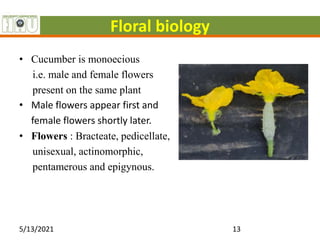
Floral biology
• Cucumber is monoecious
i.e. male and female flowers
present on the same plant
• Male flowers appear first and
female flowers shortly later.
• Flowers : Bracteate, pedicellate,
unisexual, actinomorphic,
pentamerous and epigynous.
5/13/2021 13
5/13/2021 14
Anthesis
• Opening of flower is called anthesis.
• Opening and closing of the male flowers are mainly
influenced by the sunrise and sunset, that is, by light
and the time of the day.
• Anther dehiscence between temperature ranges of
20.5- 21.5°C.
5/13/2021 15
• Pollen fertility : Up to noon
• By afternoon (2.00 PM) fertility is greatly reduced, and
negligible by evening.
• Stigma receptivity : for very short duration and pollination
should be carried out within 2 hours after anthesis.
• Rise in temperature causes early drying of stigmatic secretion.
• Different floral abnormalities like mixed inflorescence,
hermaphroditism, fusion, dimorphic female flowers, reduction
and increase in the floral parts were observed
5/13/2021 16
Pollination
• Pollination is a critical aspect of cucumber production.
• One or more pollen grains are needed per seed development.
• 10 - 20 bee visits are necessary per flower for proper fruit
shape and size.
• Therefore, it is important to bring hives into the field when
about 25% of the plants are beginning to flower.
• Insufficient seed development may result in fruit abortion,
misshapen, curved or short fruit, or poor fruit set.
5/13/2021 17
Flower regulation
• Production of female flowers is naturally promoted by the
short days, low temperatures and low light conditions.
• Flower femaleness can be promoted by applying plant growth
substances (PGRs) such as
NAA (a type of auxin)
Ethephone ( an ethylene promoter)
• If a purely female variety is grown, an appropriate pollinator
should be provided.
5/13/2021 18
• Male flowers is promoted by long days, high temperatures
and high light intensity.
• Male flowers also increases with high fruit load and with
stresses exerted on the plant also.
• Maleness can be promoted by applying PGRs such as
• Gibberelins
• Silver nitrate and
• AVG that act as ethylene suppressors.
5/13/2021 19
Male/female flowering sequence
• On a normal cucumber plant, the first 10 - 20 flowers
are male
• For every female flower, 10 - 20 male flowers are
produced.
• Flowering set progressively at the nodes.
• Developing fruit at the lower nodes may inhibit or
delay fruit at subsequent nodes.
• Size and shape of the cucumber fruits are related to
number of seeds produced.
5/13/2021 20
Sex Expression
• Cucumber sex phenotypes are mainly monoecious (staminate
and pistillate flowers) or gynoecious (pistillate flowers only),
• but androecious (staminate flowers only), hermaphroditic
(perfect flowers), andromonoecious(staminate and perfect
flowers), and trimonoecious (staminate, perfect, and pistillate
flowers) types also exist.
• Plants possessing pistillate and perfect flowers have also been
observed and used in hybrid production (El-Shawaf and Baker,
1981a).
5/13/2021 21
Genetics of sex expression
• These sex types are determined by three major loci (F, M, and A;
Shifriss, 1961; Galun,1961 and Kubicki, 1969).
• The F locus influences the degree of femaleness (FF > Ff >ff ),
while the M locus determines whether flowers are unisexual
(M_) or bisexual(mm).
• The A locus conditions increased male tendency if a plant is
homozygous recessive aa and ff.
• Interactions between these loci yield the basic sex types found
in cucumber.
• While this three-gene model describes the basic regulation of
sex types, a plant’s phenotype is also influenced by modifying
genes and environmental factors .
5/13/2021 22
Breeding objectives
• Reduced number of nodes to 1st female flower result in earliness.
• Bushy plant type.
• Short internodal length.
• Self staked habit.
• Bunching fruit habit by using pumpkin rootstock.
• Higher female:male sex ratio.
• More flesh thickness.
• Desirable flesh colour.
• Fruit shape as per local preference.
• Less or negligible cucurbitacin content.
• Uniformity of fruit.
• Less seediness.
• Resistance to biotic and abiotic stress.
5/13/2021 23
Breeding methods
 Major breeding methods for cucumber are:-
• Introduction
• Mass Selection
• Back cross Method
• Heterosis Breeding
• Interspecific Hybridisation
5/13/2021 24
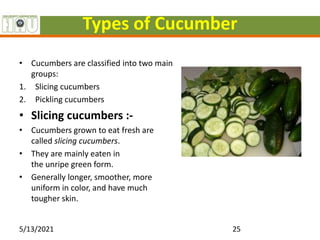
Types of Cucumber
• Cucumbers are classified into two main
groups:
1. Slicing cucumbers
2. Pickling cucumbers
• Slicing cucumbers :-
• Cucumbers grown to eat fresh are
called slicing cucumbers.
• They are mainly eaten in
the unripe green form.
• Generally longer, smoother, more
uniform in color, and have much
tougher skin.
5/13/2021 25
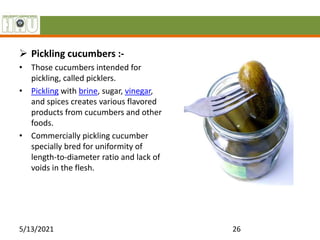
 Pickling cucumbers :-
• Those cucumbers intended for
pickling, called picklers.
• Pickling with brine, sugar, vinegar,
and spices creates various flavored
products from cucumbers and other
foods.
• Commercially pickling cucumber
specially bred for uniformity of
length-to-diameter ratio and lack of
voids in the flesh.
5/13/2021 26
Selection of Varieties
The main criteria in selecting the best cultivars are as follows:-
• Select the variety suitable to the season, good yielding and
suitable to the Green house production ( Parthinocarpic).
• Good overall productivity
• Plant growth habit and vigour
• Fruit quality i.e. length, diameter, shape, colour and
smoothness
• Fruit shelf life
• Disease resistance
• Insect resistance
5/13/2021 27
Type of Cucumber varieties
 On the bases of flowering habit:
1. Gynoecious:- Which produces only female flowers.
2. Pre-dominantly gynoecious :-Also bears some male flowers.
3. Monoecious:- Which produces both male and female flowers.
• The first two types produce fruits parthenocarpically ,whereas,
monoecious types require pollination.
 Monoecious Varieties: Monoecious varieties can be grown inside the
greenhouses, but pollination is required for fruit setting which are:
 Japnese Long Green
 Pusa Sanyog
 Priya
 Poinsett
 Malini Hybrid
5/13/2021 28
Gynoecious cucumber
• Most current hybrids are gynoecious.
• widely used because they are generally earlier and more
productive.
• 5% of the flowers are male in gynoecious hybrids.
• Hybrids are produced using a gynoecious inbreed as female parent
crossed with monoecious inbreed as male and honeybees as pollen
vectors.
• More resistant to disease and more prolific.
• 1st gynoecious F1 hybrid, Pusa Sanyog, developed in India in 1971.
• Two drawbacks –
Fruits are shorter than the ordinary varieties
 A higher temperature is required.
5/13/2021 29
Important varieties
• Pusa Seedless Cucumber-6
Year of release : 2015-16
First extra early (40-45 days for first fruit
harvest) improved variety of parthenocarpic
gynoecious cucumber suitable for cultivation
in protected condition.
• Pusa Sanyog
Breeding Method :Heterosis
Parentage : Japanese Gyn. Line x Green Long
Naples
Important Traits: Early maturing and high
yielding, fruits long, cylindrical and dark
green with yellow stripes, flesh crisp.
5/13/2021 30
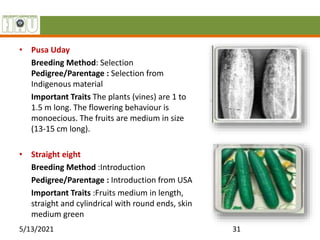
• Pusa Uday
Breeding Method: Selection
Pedigree/Parentage : Selection from
Indigenous material
Important Traits The plants (vines) are 1 to
1.5 m long. The flowering behaviour is
monoecious. The fruits are medium in size
(13-15 cm long).
• Straight eight
Breeding Method :Introduction
Pedigree/Parentage : Introduction from USA
Important Traits :Fruits medium in length,
straight and cylindrical with round ends, skin
medium green
5/13/2021 31
• Japanese Long Green
Breeding Method : Introduction
Important Traits : Plants are early, prolific
bearing, first picking starts in 45 days after
sowing. Fruits are yellowish green, 30-40 cm
long, whitish green with light green and
crisp flesh. This variety essentially requires
staking for straight fruits.
• Kalyanpur Green
Breeding Method : Selection
Important Traits : Fruits thick, green, tasty
while brown at maturity. This variety is
suitable for cultivation in rainy season. This
variety has yield potential of 100-125 q/ha
5/13/2021 32
• Phule Shubhangi (Sel 75-1-10)
Breeding Method : Pedigree Selection
Important Traits : Fruits green, colour of fruit remains after
storage, surface smooth with trichoms. Plants are tolerant to pod
borer, anthracnose, leaf spot and leaf under field condition. Fruits
are smooth and attractive green fruits with white strips at apical
end.
• Phule Priyanka
Breeding Method :Hybridization
Parentage : RHRB-5 x RHRBG4
Important Traits : Fruits dark green, highly prickled, 20 cm long,
suitable for rainy and summer seasons, tolerant to downey mildew,
average yield 282.7 q/ha
5/13/2021 33
• Pant Sankar Khira-1: The fruits are long about 20 cm, cylindrical
and green with light stripes. Vine length is about 120 cm. It
takes 50 days to first picking the yield potential is 200 qt/ha.
• Pant Khira-1: The fruits are long (20 cm), cylindrical with light
white stripes. The fruits attain first picking stage in 50-60 days.
Recommended seed rate is 4 kg/ha. The yield potential is150
q/ha.
• Pant Parthenocarpic khira-2: A parthenocarpic cucumber
variety. It is suitable for polyhouse cultivation. No. of female
flower per vine is 551. Average fruit wt. is 630 g and yield
potential is 2107 qt/ha.
5/13/2021 34
• Parthenocarpic khira-3: A parthenocarpic cucumber variety. It
is suitable for polyhouse cultivation. No. of female flower per
vine is 465. Average fruit weight is 415 g and yield potential is
1992 qt/ha.
• Himangni: Fruits are white in colour and resistant to bronzing,
suitable for kharif season, average yield 180 q/ha
• CO 1: Ripe fruits are bright yellow with greenish yellow
intermitant stripes. Average yield 25-28 t/ha.
5/13/2021 35
Greenhouse parthenocarpic varieties
 From Private Sector:-
• Dinamik,
• Kuk-9, Kuk-24, Kuk-29, Hilton,
• Amal, Mirna, Valleystar,
• Multistar, Kian, Isatis,
• Alpha best, Magic, Nariman
5/13/2021 36
Carotenoid rich varieties
• Orange-fleshed cucumber varieties are rich in carotenoid (pro-vitamin A).
• These varieties are consumed cooked or as chutney.
• They are called ‘Fanghma’ and ‘Hmazil’ in Mizoram and ‘Thabi’ in Manipur.
• The orange-fleshed varieties showed similar content of total sugars and
slightly higher content of ascorbic acid as the normal ones. However, the
carotenoid content varied with the stage of cucumber.
• At a stage when it is eaten as salad, the carotenoid content in orange-
fleshed varieties was 2-4 times greater than the normal variety. On further
maturity, however, orange cucumber may have 10-50 times more
carotenoid content than the white variety.
• Three varieties (IC420405, IC420422, and AZMC-1) from Mizoram and one
(KP-1291) from Manipur are yellow- orange coloured varieties.
5/13/2021 37
Climate
• Warm season crop.
• Maximum growth occurs at a day and night temperature of
about 28°C.
• Maximum fruit production is achieved with a night
temperature of 19- 20°C and a day temperature of 20-22°C.
• Minimum temperature should not be lower than 18⁰C because
it does not withstand frost.
• Prolonged temperature above 35⁰C should also be avoided as
fruit production and quality are affected at extremely higher
temperatures.
5/13/2021 38
Soil
• Cucumbers prefer light textured soils that are well drained
• High in organic matter
• pH- 6-6.8
• Adapted to a wide-range of soils, but will produce early in
sandy soils.
• Loam, silt loam and clay loam soils are best for getting higher
yield.
• Fairly tolerant to acid soils (down to pH 5.5).
• Greenhouse cucumbers generally grow quite well in a wide
range of soil pH (5.5-7.5), but a pH of 5.0-5.5 for organic soils
are generally accepted as optimum.
5/13/2021 39
Field Preparation
• Soil should be ploughed 3-4 times thoroughly.
• Well rotten compost or FYM is mixed at the
time of ploughing.
• Apply BHC @ lS-20kg/ ha to control termites
and cutworms in the soil at the time of land
preparation.
5/13/2021 40
Sowing Time & Seed rate
• Time of Sowing : Cucumber is cultivated both as summer
and rainy season crop.
–Summer crop: January to February
–Rainy season crop: June to July
• Seed rate : 3-5kg/ha (Cucumber)
800g/ha (Gherkin)
• Spacing :
–1.5 to 2.5m (row to row)
–60 to 90cm (plant to plant)
5/13/2021 41
Manure and Fertilizer
• Cucumber has a high nutrient requirement and
grows rapidly when supplied with sufficient
nutrients.
• Well rotten FYM @ 10-15 t/ha should be applied at
the time of land preparation.
• NPK @ 100:60:60 kg/ha should be applied at the
time of planting.
5/13/2021 42
Irrigation
• The summer crops require frequent irrigation at an interval of
4-5 days.
• Furrow irrigation is preferred.
• When overhead irrigation is used, it should be applied early in
the day to permit the vegetation to dry out prior to nightfall
and thereby minimize fruit rooting and foliar diseases.
• No need to give irrigation in rainy season crops.
• In greenhouse condition irrigation done by drip irrigation.
• Drip irrigation Inline lateral lines may be installed in the
middle of beds. Distance between two drippers - 30 cm and
its discharge rate is 2 L/hour. Diameter of riser is 16mm.
5/13/2021 43
Intercultural Operation
 Weeding: During early stage, the crop should be kept
weed free by giving shallow cultivation.
 Training and pruning
5/13/2021 44
• Staking: The plants should be
provided a suitable support
made of bamboo sticks
particularly in rainy season to
check against rotting of fruits.
• Staking in cucumber has
been found to be very
effective in getting maximum
yield and better quality of
fruits.
5/13/2021 45
Training
• Basic principle of training system is to uniformly
maximize the leaf interception of sunlight throughout the
house.
 Types of training:-
Single stem training (60 x 45 cm)
Umbrella system (60 x 60 cm)
V-system (60 x 60 cm) V system
5/13/2021 46
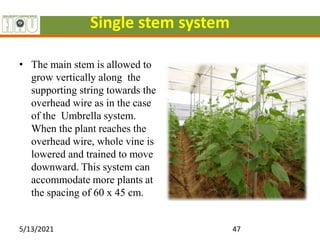
Single stem system
• The main stem is allowed to
grow vertically along the
supporting string towards the
overhead wire as in the case
of the Umbrella system.
When the plant reaches the
overhead wire, whole vine is
lowered and trained to move
downward. This system can
accommodate more plants at
the spacing of 60 x 45 cm.
5/13/2021 47
V system
• The main stem is allowed to
grow along the supporting
string and the growing point
is removed at the 6th leaf
stage (45-60cm plant
height).
• The two emerging lateral
branches are then trained into
a "V- shape" onto the
overhead wire. Other
practices were similar to the
Umbrella system.
5/13/2021 48
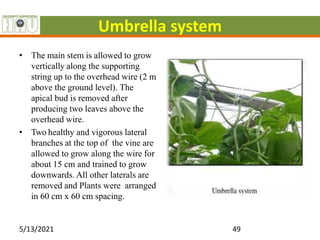
Umbrella system
• The main stem is allowed to grow
vertically along the supporting
string up to the overhead wire (2 m
above the ground level). The
apical bud is removed after
producing two leaves above the
overhead wire.
• Two healthy and vigorous lateral
branches at the top of the vine are
allowed to grow along the wire for
about 15 cm and trained to grow
downwards. All other laterals are
removed and Plants were arranged
in 60 cm x 60 cm spacing.
5/13/2021 49
Pruning
• Pruning improve fruit yield and quality
• As the plant grows up the string, remove all the lateral buds
up to the sixth node (a node being where a leaf joins the
stem).
• Pruning the lateral buds allows the plant to become large
enough to support continued healthy fruit development.
• In addition to the lateral buds, all the fruits should also be
removed up to this point.
5/13/2021 50
Harvesting
• Generally, both cucumber and gherkin are ready for first
harvesting in 35 to 40 days of planting depending upon climatic
conditions and crop management practices.
• Fruits keep on developing as the plants grow and reach
harvestable stage in 10-14 days after flower opening.
• Harvesting is done when fruits are more or less cylindrical and
well filled.
• Should be carried out in early morning or late evening.
• The harvested produce should immediately be moved to cool,
shaded and ventilated area.
5/13/2021 51
• As fruits are harvested manually, so these should be
clipped or snapped with a slight twist motion and
should not be pulled off the vines to minimize ‘pulled
ends’.
• Delay in harvesting causes the fruit to become unfit
for marketing.
• The average yield of cucumber is 120-150q/ha and
average yield of gherkin is 80-100q/ha.
5/13/2021 52
Post harvest , marketing and storage
• Processing product of cucumber is pickle using brine
solution.
• Damaged fruit, fruit fly attacked fruits should be
removed before sending to the market.
• Crook necked fruits have less acceptance in market.
• Cucumber do not stand long transport, so cucumber
have to be sold in nearby urban markets.
• Cucumbers should be packed in baskets and transported.
5/13/2021 53
• It is being highly perishable so the involvement of risk
and losses is more so cultivation is concentrated near
metropolitan cities.
• Some regions like Poona region of Maharashtra supply
cucumber to distant markets.
• Optimum storage temperature of cucumber fruits is -
10⁰C with 85% RH can be stored for 10-14 days.
• Chilling injury takes place below -10⁰C.
5/13/2021 54
Hybrid seed production
 There are different systems that have been proposed to
produce hybrid cucumber seed using a gynoecious line
(Robinson, 2000). They differ in the flower type of the line
used as pollen donor.
– Gynoecious x Monoecious hybrids
– Gynoecious x Gynoecious hybrids
– Gynoecious x Hermaphroditic hybrids
– Gynoecious x Andromonoecious hybrids.
• From these systems, Gynoecious x Monoecious hybrids are
most commonly used.
5/13/2021 55
Gynoecious x Monoecious hybrids
• The hybrids produced by the cross of a gynoecious and
monoecious line resulted in hybrid vigor and a high degree of
female sex expression, with uniform and concentrated fruit
formation, which was especially advantageous for mechanical
harvest .
• Gynoecious line used as female parent and monoecious line
used as male parent.
• Emasulation i.e. removal of male flower is not required in
gynoecious plant because of absence of male flower.
• Because of its tendency to produce mostly female flowers, seed
from this type of hybrid usually is blended with seed from a
monoecious cultivar added in a proportion of about 10%. This
practice improves pollination, which is required for fruit set.
5/13/2021 56
Seed extraction
• For maximum seed quality, cucumber fruits must reach full
maturity.
• This is signaled by a change in color from green to yellow and
by a withering of the fruit stalk.
• Seeds that separate easily from the flesh of a sliced cucumber
fruit are ready for harvest.
• Test weight of seed of cucumber is nearly 27-33g.
 Seed extraction is done by
• Natural fermentation
• Acid treatment.
5/13/2021 57
 Natural fermentation :- Fruits are first sliced and macerated
and the surrounding pulp, juice, and seeds allowed to ferment
for about 4 to 6 days under normal field conditions.
 Acid treatment :-Commercial hydrochloric acid (3 fluid
ounces) or sulfuric acid (1 fluid ounce) added to and stirred
with 11.3 kg (25 pounds) of the sliced, macerated fruit tissue.
After 15 to 30 minutes, water is added to the mixture and the
mature seeds sink to the bottom while the digested pulp
floats to the top.
• The seeds must be immediately washed to preserve seed
quality.
5/13/2021 58
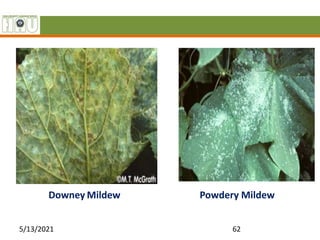
Disease management
Downy Mildew (Pseudoperonospora cubensis)
• Symptoms : Disease appears as irregular, numerous, small, yellow areas
surrounded by green tissues scattered all over the leaf lamina. It appears
just like in definite mosaic pattern particularly in cucumber. The yellow
areas are angular and bounded by veins.
 Management
• Crop should be grown with wide spacing in well-drained soil.
• Air movement and sunlight exposure helps in checking the disease
initiation and development.
• Use tolerant cucumber lines like Summer Prolific.
• Seed production should be preferably carried out in summer season
because summer crop is often free from disease.
• Spray of Mancozeb @ 0.25% at seven days interval .
5/13/2021 59
Powdery Mildew : (Sphaerotheca fuligena & Erysiphe
cichoracearum)
 Symptoms :
• Disease appears on all foliar part as white to dull white, powdery
growth.
• This white growth quickly covers most of the leaf surface and leads
to heavy reduction in photosynthesis area.
 Management :
• Controlled with benomyl, chlorothalonil, or dinocap (Karathane)
fungicide sprays.
• Apply the first spray as soon as the disease appears
• Latest chemicals:-Topase @1ml/1lit. Of water spray.
• Use tolerant varieties.
5/13/2021 60
Anthracnose : Colletotrichum lagenarium,
 Symptoms:-
• It is a destructive disease of cucurbits occurring during warm and
moist seasons
• All aboveground plant parts can be infected.
• Leaf lesions begin as water soaked and then become yellowish
circular spots
 Management:
• Choose anthracnose-resistant varieties if at all possible. Resistant
cucumber include Poinsett 76.
• Many pickling cucumbers are tolerant or resistant.
• Fungicides Among fungicides available are chlorothalonil (Bravo),
benomyl (Benlate), and mancozeb
5/13/2021 61
5/13/2021 62
Powdery Mildew
Downey Mildew
5/13/2021 63
Anthracnose
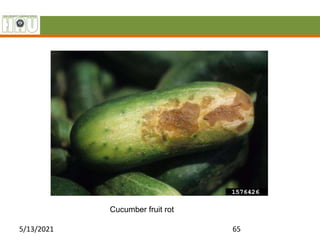
• Fruit Rot : (Phytophthora cinnamomi, Pythium, Rhizoctonia,
Phomopsis cucurbitae)
 Symptoms
• Disease is mostly observed on matured fruits as comparatively dry
rotting with characteristic pycnidia over it.
• Generally lower portion of fruits touching soil surface are affected
 Management
• Avoid soil contact of fruit by staking of plant.
• Provide proper drainage in the field.
• Green manuring followed by soil application of Trichoderma @ 5
kg/ha in soil is very effective in checking most of the fruit rotting.
• Collect affected fruits and burn them to reduce primary inoculum.
5/13/2021 64
5/13/2021 65
Cucumber fruit rot
Cucumber Mosaic Virus Disease and leaf distortion
disease:-
• CMV belongs to family Bromoviridae.
 Symptoms
• Generally alternate green and yellow patches with mottling
symptoms are observed.
• Sometimes leaves deform and curl downwards.
• Smalling and narrowing of the leaves is also observed in leaf
distortion virus.
• Plants become small and excessive branching, proliferation of
the leaves, twigs, petioles, bushy appearance of the plants are
observed.
5/13/2021 66
5/13/2021 67
 Management
• Destruction of diseased hosts and weeds.
• Virus free seeds must be used to check the seed
transmission.
• Initial rouging of the infected plants.
• Periodical spray of systemic insecticides up to flowering
stage to control vectors.
• Seed production should be preferably carried out in
summer season because summer crop is often free from
virus infection.
5/13/2021 68
Insect-pest of cucumber
 Fruit fly : Dacus ciliates , Dacus cucurbitae
• Serious pest of cucurbits.
• Maggots of this fly cause seviour damage
to young developing fruits.
• The adult fly lays egg below the skin of
the young ovaries.
• The egg hatch in to maggots which feed
inside the fruit and cause rotting.
• Control measures :
• The adult flies be controlled by using light
traps in the night and poision baits.
• Spraying with 0.2% carbaryl, and 0.05%
Malathion .
5/13/2021 69
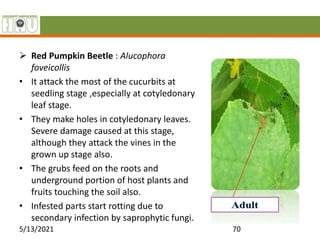
 Red Pumpkin Beetle : Alucophora
foveicollis
• It attack the most of the cucurbits at
seedling stage ,especially at cotyledonary
leaf stage.
• They make holes in cotyledonary leaves.
Severe damage caused at this stage,
although they attack the vines in the
grown up stage also.
• The grubs feed on the roots and
underground portion of host plants and
fruits touching the soil also.
• Infested parts start rotting due to
secondary infection by saprophytic fungi.
5/13/2021 70
 Management :
• As insects pupate in the soil, deep ploughing soon after the
crop exposes and kill grubs and pupae.
• Apply Furadan 3G (Granule ) 3-4 cm deep in soil near base
of germinated seedlings.
• Collect and destroy of beetles in early stage of infection.
• Spray Malathion @ 2 ml /liter of water for effective
control.
• Dusting with 5% Malathion @ 10kg/ha.
5/13/2021 71
Other pests are
• Serpentine Leaf Miner (Liriomyza trifolii Burgess)
• Red Spider Mite (Tetranychus neocaledonicus Andre)
• Thrips (Thrips palmi Karny)
• Root-knot Nematodes (Meloidogyne incognita)
5/13/2021 72
Physiological disorders
Bitterness
 Symptoms
• some time fruits of cucumber have bitter taste.
 Causes :
• This disorder is prevalent under cool weather at high elevations.
• Open pollination and excessive use of nitrogenous fertilizer
cause this disorder.
 Management :
• Judicious application of nitrogenous fertilizer and controlled self
pollination would help to reduce bitterness.
5/13/2021 73
Crooked fruit or crooking or curvature
 Symptoms
• This disorder is more serious in cucumbers
• Qualitative losses due to production of variously curved
fruit.
5/13/2021 74
 Causes
• Curved fruit are the result of imperfect pollination and
fertilization.
• High soil moisture ,poor nutrition and adverse temperature
favour the development of crooked-fruits.
 Management
• Optimum irrigation and nutrition scheduling may prove
helpful.
• Keep the crop free from insect pest.
5/13/2021 75
Frost or low temperature injury
 Symptoms
• Cucurbits are highly susceptible to low temperature or frost
injury.
• Freezing of cell sap results in rupture of the cell membrane.
 Control
• Applying irrigation, smoking in the field and spray of frost-
preventive chemical.
5/13/2021 76
Fruit splitting or cracking
 Symptoms
• The cracking is mostly vertical initiated from the basal part of the fruit.
• The slit is wide enough to expose seed and other internal tissues.
• Cracking makes the fruits prone to microbial infection and unfit for
consumption.
5/13/2021 77
 Cause of fruit spliting
• Heavy rainfall or Rain after a long period of water stress
causes fruits to splits.
• Calcium deficiency aggravates the disorder.
 Management
• Improving moisture conservation in soil will help reduce
cracking.
• If the crop is irrigated after a long stress , apply 2-3 light
irrigation instead of one heavy irrigation.
5/13/2021 78
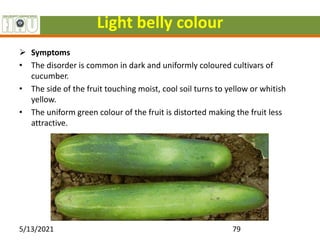
Light belly colour
 Symptoms
• The disorder is common in dark and uniformly coloured cultivars of
cucumber.
• The side of the fruit touching moist, cool soil turns to yellow or whitish
yellow.
• The uniform green colour of the fruit is distorted making the fruit less
attractive.
5/13/2021 79
 Causes of light belly colour
• Direct contract of the fruits with moisture , soil suppresses
development of normal fruit colour
• Delay in turning the fruits in field encourages this disorder.
 Management
• Use of plastic mulch can check contact of fruit with moiture
soil helping to avoid this disorder
• Use varieties less susceptical to this disorder.
• Turn the fruit in field from time to time.
• Do not delay harvesting of fruits
5/13/2021 80
Pillow disorder
 Symptoms:-
• An abnormal white styrofoam like porous textured
tissue is formed in the mesocarp of the fleshy
harvested fruits.
• Vascular tissue with some pillow areas may collapse
and become necrotic.
 Cause:-
• Calcium deficiency
5/13/2021 81
Misshapen fruits
 Symptoms
• This refers to formation of abnormal- shaped fruits with reduced market
value.
• Fruit may be bottle shaped, pitcher shaped, knobby, pointed at the
blossom end or excessively elongated.
5/13/2021 82
 Causes
• Environmental factor adversely affecting pollination and fertilization
results in misshapen fruits
• High plant population or dense plant canopy not providing
sufficient space to developing fruits forces abnormal growth of the
fruits
• Negligence in using growth hormones and herbicides also causes
distortion of the fruit.
• Management
• Keep the optimum plant population
• Maintain uniform soil moisture throughout the crop period.
• Carefully check the concentration , time of application and crop
sensitivity before using growth regulator or herbicide
5/13/2021 83
SYMBOL OF TRUST
5/13/2021 84

Cucumber

  • 1.
    JYOTI MHU2020H02M M.Sc. Vegetable Science1st year Maharana Partap Horticultural University ,Karnal 5/13/2021 1
  • 2.
    Content 5/13/2021 2 • Introduction •Origin & Domestication • Importance of cucumber • Basic Information • Taxonomy • Cultivation scenario in Haryana • Plant description and floral biology • Anthesis and pollination • Flower regulation and male/ female flowering sequence • Sex expression and genetics of sex expression • Breeding objective and breeding method • Types of cucumber • Selection of variety and types of cucumber varities • Important varieties • Carotenoid rich varieties • Climate , soil and field preperation • Sowing time and seed rate • Manure/Fertilizer and irrigation • Intercultural operations • Harvestion • Post-harvesting, marketing and storage • Hybrid seed production and seed extraction • Disease and Insect- pest management • Physiological disorders
  • 3.
    Introduction Cucumber • Common name: Cucumber • Hindi name : Khira • Botanical name : Cucumis sativus L. • Family : Cucurbitaceae • Chromosome number: 2n=14 • Second most widely cultivated cucurbits after watermelon. The fruits are consumed raw. • Used as salad and for pickling. Tender leaves are also used as vegetables. • In temperate countries it is extensively grown in glasshouse. 5/13/2021 3
  • 4.
    Gherkin • Common Name:-Maroon cucumber, West Indian gherkin • Scientific Name:-Cucumis sativus var.anguria • Family : Cucurbitaceae • Origin : Africa • Herbaceous vine • Fruits are ovoid to oblong, covered with long hairs over a surface of spines or wart-like bumps. The inner flesh is pale to green. • Primarily grown for its edible fruit, which are used in pickling, as cooked vegetables. • The flavor is similar to that of the common cucumber. 5/13/2021 4
  • 5.
    5/13/2021 5 Leaves ofgherkin Fruit of gherkin
  • 6.
    Origin and Domestication •The centre of origin for Cucumis species is likely Africa for the wild species. • According to decandolle (1886) cucumber is an indigeneous vegetable to India. • Progenitor of cucumber Cucumis hardwickii which is seen in the foot hills of himalayas • This species similar to cucumber except for smooth fruit surface & extremely bitter flesh and falls within the range of variability of cucumber. • Burma is the secondary center of origin • Now grown in tropical and subtropical climates. 5/13/2021 6
  • 7.
    Importance of cucumber •The fruit and seed posses cooling properties. The fruits as also used as an astringent and antipyretic. • The seed oil is used as an antipyretic . • Fruits are good for people suffering from constipation, jaundice and indigestion. • Immature fruits of cucumber and gherkin are used as salad and for pickling. • Fruits contain 0.4% protein, 2.5% CHO, 1.5mg iron, 2mg vitamin C / 100g fresh weight. • Cucumber also a good source of dietry fiber, Ca, P, K, Na, Mg, vitamin K, and water. 5/13/2021 7
  • 8.
    Basic information • Dayneutral plant. • Thermophilic crop. • 1st sequenced vegetable crop. • Gynoecious in cucumber is controlled by single dominant gene(F/Acr). • Prefers low temp. than watermelon. • Economic sex ratio of cucumber is 15:1. • Most common sex form : Monoecious • Bitterness in cucumber : Cucurbitacins • Induction of parthenocarpy in cucumber: Choloroflurenol • Shows metaxenia effect i.e. Effect of pollen on fruit shape and other fruit characteristics. 5/13/2021 8
  • 9.
    Taxonomy • Kingdom :Plantae • Phylum : Spermatophyta • Subphylum : Angiospermae • Class : Dicotyledonae • Order : Cucurbitales • Family : Cucurbitaceae • Genus : Cucumis • Species : sativus (cucumber) anguria (gherkin) 5/13/2021 9
  • 10.
    Cultivation scenario inHaryana • In Haryana, cucumber was grown all over the year in polyhouse. • First crop of cucumber was planted in August and prolonged up to November. • Second crop was planted in December and prolonged up to March. • Third crop of cucumber was planted in April and prolonged up to June. • In open field condition cucumber was planted in February and harvested up to April-May. • Cropping intensity of cucumber was 300% in polyhouse condition. 5/13/2021 10
  • 11.
    Plant description • Cucumberplant is a coarse, prostrate annual creeping vine. • Need supporting frames for growth. • Large, prickly, hairy triangular leaves that form a canopy over the fruit. • Solitary yellow flowers which are mostly either male or female. The female flowers are recognized by the swollen ovary at the base, which will become the edible fruit. 5/13/2021 11
  • 12.
  • 13.
    Floral biology • Cucumberis monoecious i.e. male and female flowers present on the same plant • Male flowers appear first and female flowers shortly later. • Flowers : Bracteate, pedicellate, unisexual, actinomorphic, pentamerous and epigynous. 5/13/2021 13
  • 14.
  • 15.
    Anthesis • Opening offlower is called anthesis. • Opening and closing of the male flowers are mainly influenced by the sunrise and sunset, that is, by light and the time of the day. • Anther dehiscence between temperature ranges of 20.5- 21.5°C. 5/13/2021 15
  • 16.
    • Pollen fertility: Up to noon • By afternoon (2.00 PM) fertility is greatly reduced, and negligible by evening. • Stigma receptivity : for very short duration and pollination should be carried out within 2 hours after anthesis. • Rise in temperature causes early drying of stigmatic secretion. • Different floral abnormalities like mixed inflorescence, hermaphroditism, fusion, dimorphic female flowers, reduction and increase in the floral parts were observed 5/13/2021 16
  • 17.
    Pollination • Pollination isa critical aspect of cucumber production. • One or more pollen grains are needed per seed development. • 10 - 20 bee visits are necessary per flower for proper fruit shape and size. • Therefore, it is important to bring hives into the field when about 25% of the plants are beginning to flower. • Insufficient seed development may result in fruit abortion, misshapen, curved or short fruit, or poor fruit set. 5/13/2021 17
  • 18.
    Flower regulation • Productionof female flowers is naturally promoted by the short days, low temperatures and low light conditions. • Flower femaleness can be promoted by applying plant growth substances (PGRs) such as NAA (a type of auxin) Ethephone ( an ethylene promoter) • If a purely female variety is grown, an appropriate pollinator should be provided. 5/13/2021 18
  • 19.
    • Male flowersis promoted by long days, high temperatures and high light intensity. • Male flowers also increases with high fruit load and with stresses exerted on the plant also. • Maleness can be promoted by applying PGRs such as • Gibberelins • Silver nitrate and • AVG that act as ethylene suppressors. 5/13/2021 19
  • 20.
    Male/female flowering sequence •On a normal cucumber plant, the first 10 - 20 flowers are male • For every female flower, 10 - 20 male flowers are produced. • Flowering set progressively at the nodes. • Developing fruit at the lower nodes may inhibit or delay fruit at subsequent nodes. • Size and shape of the cucumber fruits are related to number of seeds produced. 5/13/2021 20
  • 21.
    Sex Expression • Cucumbersex phenotypes are mainly monoecious (staminate and pistillate flowers) or gynoecious (pistillate flowers only), • but androecious (staminate flowers only), hermaphroditic (perfect flowers), andromonoecious(staminate and perfect flowers), and trimonoecious (staminate, perfect, and pistillate flowers) types also exist. • Plants possessing pistillate and perfect flowers have also been observed and used in hybrid production (El-Shawaf and Baker, 1981a). 5/13/2021 21
  • 22.
    Genetics of sexexpression • These sex types are determined by three major loci (F, M, and A; Shifriss, 1961; Galun,1961 and Kubicki, 1969). • The F locus influences the degree of femaleness (FF > Ff >ff ), while the M locus determines whether flowers are unisexual (M_) or bisexual(mm). • The A locus conditions increased male tendency if a plant is homozygous recessive aa and ff. • Interactions between these loci yield the basic sex types found in cucumber. • While this three-gene model describes the basic regulation of sex types, a plant’s phenotype is also influenced by modifying genes and environmental factors . 5/13/2021 22
  • 23.
    Breeding objectives • Reducednumber of nodes to 1st female flower result in earliness. • Bushy plant type. • Short internodal length. • Self staked habit. • Bunching fruit habit by using pumpkin rootstock. • Higher female:male sex ratio. • More flesh thickness. • Desirable flesh colour. • Fruit shape as per local preference. • Less or negligible cucurbitacin content. • Uniformity of fruit. • Less seediness. • Resistance to biotic and abiotic stress. 5/13/2021 23
  • 24.
    Breeding methods  Majorbreeding methods for cucumber are:- • Introduction • Mass Selection • Back cross Method • Heterosis Breeding • Interspecific Hybridisation 5/13/2021 24
  • 25.
    Types of Cucumber •Cucumbers are classified into two main groups: 1. Slicing cucumbers 2. Pickling cucumbers • Slicing cucumbers :- • Cucumbers grown to eat fresh are called slicing cucumbers. • They are mainly eaten in the unripe green form. • Generally longer, smoother, more uniform in color, and have much tougher skin. 5/13/2021 25
  • 26.
     Pickling cucumbers:- • Those cucumbers intended for pickling, called picklers. • Pickling with brine, sugar, vinegar, and spices creates various flavored products from cucumbers and other foods. • Commercially pickling cucumber specially bred for uniformity of length-to-diameter ratio and lack of voids in the flesh. 5/13/2021 26
  • 27.
    Selection of Varieties Themain criteria in selecting the best cultivars are as follows:- • Select the variety suitable to the season, good yielding and suitable to the Green house production ( Parthinocarpic). • Good overall productivity • Plant growth habit and vigour • Fruit quality i.e. length, diameter, shape, colour and smoothness • Fruit shelf life • Disease resistance • Insect resistance 5/13/2021 27
  • 28.
    Type of Cucumbervarieties  On the bases of flowering habit: 1. Gynoecious:- Which produces only female flowers. 2. Pre-dominantly gynoecious :-Also bears some male flowers. 3. Monoecious:- Which produces both male and female flowers. • The first two types produce fruits parthenocarpically ,whereas, monoecious types require pollination.  Monoecious Varieties: Monoecious varieties can be grown inside the greenhouses, but pollination is required for fruit setting which are:  Japnese Long Green  Pusa Sanyog  Priya  Poinsett  Malini Hybrid 5/13/2021 28
  • 29.
    Gynoecious cucumber • Mostcurrent hybrids are gynoecious. • widely used because they are generally earlier and more productive. • 5% of the flowers are male in gynoecious hybrids. • Hybrids are produced using a gynoecious inbreed as female parent crossed with monoecious inbreed as male and honeybees as pollen vectors. • More resistant to disease and more prolific. • 1st gynoecious F1 hybrid, Pusa Sanyog, developed in India in 1971. • Two drawbacks – Fruits are shorter than the ordinary varieties  A higher temperature is required. 5/13/2021 29
  • 30.
    Important varieties • PusaSeedless Cucumber-6 Year of release : 2015-16 First extra early (40-45 days for first fruit harvest) improved variety of parthenocarpic gynoecious cucumber suitable for cultivation in protected condition. • Pusa Sanyog Breeding Method :Heterosis Parentage : Japanese Gyn. Line x Green Long Naples Important Traits: Early maturing and high yielding, fruits long, cylindrical and dark green with yellow stripes, flesh crisp. 5/13/2021 30
  • 31.
    • Pusa Uday BreedingMethod: Selection Pedigree/Parentage : Selection from Indigenous material Important Traits The plants (vines) are 1 to 1.5 m long. The flowering behaviour is monoecious. The fruits are medium in size (13-15 cm long). • Straight eight Breeding Method :Introduction Pedigree/Parentage : Introduction from USA Important Traits :Fruits medium in length, straight and cylindrical with round ends, skin medium green 5/13/2021 31
  • 32.
    • Japanese LongGreen Breeding Method : Introduction Important Traits : Plants are early, prolific bearing, first picking starts in 45 days after sowing. Fruits are yellowish green, 30-40 cm long, whitish green with light green and crisp flesh. This variety essentially requires staking for straight fruits. • Kalyanpur Green Breeding Method : Selection Important Traits : Fruits thick, green, tasty while brown at maturity. This variety is suitable for cultivation in rainy season. This variety has yield potential of 100-125 q/ha 5/13/2021 32
  • 33.
    • Phule Shubhangi(Sel 75-1-10) Breeding Method : Pedigree Selection Important Traits : Fruits green, colour of fruit remains after storage, surface smooth with trichoms. Plants are tolerant to pod borer, anthracnose, leaf spot and leaf under field condition. Fruits are smooth and attractive green fruits with white strips at apical end. • Phule Priyanka Breeding Method :Hybridization Parentage : RHRB-5 x RHRBG4 Important Traits : Fruits dark green, highly prickled, 20 cm long, suitable for rainy and summer seasons, tolerant to downey mildew, average yield 282.7 q/ha 5/13/2021 33
  • 34.
    • Pant SankarKhira-1: The fruits are long about 20 cm, cylindrical and green with light stripes. Vine length is about 120 cm. It takes 50 days to first picking the yield potential is 200 qt/ha. • Pant Khira-1: The fruits are long (20 cm), cylindrical with light white stripes. The fruits attain first picking stage in 50-60 days. Recommended seed rate is 4 kg/ha. The yield potential is150 q/ha. • Pant Parthenocarpic khira-2: A parthenocarpic cucumber variety. It is suitable for polyhouse cultivation. No. of female flower per vine is 551. Average fruit wt. is 630 g and yield potential is 2107 qt/ha. 5/13/2021 34
  • 35.
    • Parthenocarpic khira-3:A parthenocarpic cucumber variety. It is suitable for polyhouse cultivation. No. of female flower per vine is 465. Average fruit weight is 415 g and yield potential is 1992 qt/ha. • Himangni: Fruits are white in colour and resistant to bronzing, suitable for kharif season, average yield 180 q/ha • CO 1: Ripe fruits are bright yellow with greenish yellow intermitant stripes. Average yield 25-28 t/ha. 5/13/2021 35
  • 36.
    Greenhouse parthenocarpic varieties From Private Sector:- • Dinamik, • Kuk-9, Kuk-24, Kuk-29, Hilton, • Amal, Mirna, Valleystar, • Multistar, Kian, Isatis, • Alpha best, Magic, Nariman 5/13/2021 36
  • 37.
    Carotenoid rich varieties •Orange-fleshed cucumber varieties are rich in carotenoid (pro-vitamin A). • These varieties are consumed cooked or as chutney. • They are called ‘Fanghma’ and ‘Hmazil’ in Mizoram and ‘Thabi’ in Manipur. • The orange-fleshed varieties showed similar content of total sugars and slightly higher content of ascorbic acid as the normal ones. However, the carotenoid content varied with the stage of cucumber. • At a stage when it is eaten as salad, the carotenoid content in orange- fleshed varieties was 2-4 times greater than the normal variety. On further maturity, however, orange cucumber may have 10-50 times more carotenoid content than the white variety. • Three varieties (IC420405, IC420422, and AZMC-1) from Mizoram and one (KP-1291) from Manipur are yellow- orange coloured varieties. 5/13/2021 37
  • 38.
    Climate • Warm seasoncrop. • Maximum growth occurs at a day and night temperature of about 28°C. • Maximum fruit production is achieved with a night temperature of 19- 20°C and a day temperature of 20-22°C. • Minimum temperature should not be lower than 18⁰C because it does not withstand frost. • Prolonged temperature above 35⁰C should also be avoided as fruit production and quality are affected at extremely higher temperatures. 5/13/2021 38
  • 39.
    Soil • Cucumbers preferlight textured soils that are well drained • High in organic matter • pH- 6-6.8 • Adapted to a wide-range of soils, but will produce early in sandy soils. • Loam, silt loam and clay loam soils are best for getting higher yield. • Fairly tolerant to acid soils (down to pH 5.5). • Greenhouse cucumbers generally grow quite well in a wide range of soil pH (5.5-7.5), but a pH of 5.0-5.5 for organic soils are generally accepted as optimum. 5/13/2021 39
  • 40.
    Field Preparation • Soilshould be ploughed 3-4 times thoroughly. • Well rotten compost or FYM is mixed at the time of ploughing. • Apply BHC @ lS-20kg/ ha to control termites and cutworms in the soil at the time of land preparation. 5/13/2021 40
  • 41.
    Sowing Time &Seed rate • Time of Sowing : Cucumber is cultivated both as summer and rainy season crop. –Summer crop: January to February –Rainy season crop: June to July • Seed rate : 3-5kg/ha (Cucumber) 800g/ha (Gherkin) • Spacing : –1.5 to 2.5m (row to row) –60 to 90cm (plant to plant) 5/13/2021 41
  • 42.
    Manure and Fertilizer •Cucumber has a high nutrient requirement and grows rapidly when supplied with sufficient nutrients. • Well rotten FYM @ 10-15 t/ha should be applied at the time of land preparation. • NPK @ 100:60:60 kg/ha should be applied at the time of planting. 5/13/2021 42
  • 43.
    Irrigation • The summercrops require frequent irrigation at an interval of 4-5 days. • Furrow irrigation is preferred. • When overhead irrigation is used, it should be applied early in the day to permit the vegetation to dry out prior to nightfall and thereby minimize fruit rooting and foliar diseases. • No need to give irrigation in rainy season crops. • In greenhouse condition irrigation done by drip irrigation. • Drip irrigation Inline lateral lines may be installed in the middle of beds. Distance between two drippers - 30 cm and its discharge rate is 2 L/hour. Diameter of riser is 16mm. 5/13/2021 43
  • 44.
    Intercultural Operation  Weeding:During early stage, the crop should be kept weed free by giving shallow cultivation.  Training and pruning 5/13/2021 44
  • 45.
    • Staking: Theplants should be provided a suitable support made of bamboo sticks particularly in rainy season to check against rotting of fruits. • Staking in cucumber has been found to be very effective in getting maximum yield and better quality of fruits. 5/13/2021 45
  • 46.
    Training • Basic principleof training system is to uniformly maximize the leaf interception of sunlight throughout the house.  Types of training:- Single stem training (60 x 45 cm) Umbrella system (60 x 60 cm) V-system (60 x 60 cm) V system 5/13/2021 46
  • 47.
    Single stem system •The main stem is allowed to grow vertically along the supporting string towards the overhead wire as in the case of the Umbrella system. When the plant reaches the overhead wire, whole vine is lowered and trained to move downward. This system can accommodate more plants at the spacing of 60 x 45 cm. 5/13/2021 47
  • 48.
    V system • Themain stem is allowed to grow along the supporting string and the growing point is removed at the 6th leaf stage (45-60cm plant height). • The two emerging lateral branches are then trained into a "V- shape" onto the overhead wire. Other practices were similar to the Umbrella system. 5/13/2021 48
  • 49.
    Umbrella system • Themain stem is allowed to grow vertically along the supporting string up to the overhead wire (2 m above the ground level). The apical bud is removed after producing two leaves above the overhead wire. • Two healthy and vigorous lateral branches at the top of the vine are allowed to grow along the wire for about 15 cm and trained to grow downwards. All other laterals are removed and Plants were arranged in 60 cm x 60 cm spacing. 5/13/2021 49
  • 50.
    Pruning • Pruning improvefruit yield and quality • As the plant grows up the string, remove all the lateral buds up to the sixth node (a node being where a leaf joins the stem). • Pruning the lateral buds allows the plant to become large enough to support continued healthy fruit development. • In addition to the lateral buds, all the fruits should also be removed up to this point. 5/13/2021 50
  • 51.
    Harvesting • Generally, bothcucumber and gherkin are ready for first harvesting in 35 to 40 days of planting depending upon climatic conditions and crop management practices. • Fruits keep on developing as the plants grow and reach harvestable stage in 10-14 days after flower opening. • Harvesting is done when fruits are more or less cylindrical and well filled. • Should be carried out in early morning or late evening. • The harvested produce should immediately be moved to cool, shaded and ventilated area. 5/13/2021 51
  • 52.
    • As fruitsare harvested manually, so these should be clipped or snapped with a slight twist motion and should not be pulled off the vines to minimize ‘pulled ends’. • Delay in harvesting causes the fruit to become unfit for marketing. • The average yield of cucumber is 120-150q/ha and average yield of gherkin is 80-100q/ha. 5/13/2021 52
  • 53.
    Post harvest ,marketing and storage • Processing product of cucumber is pickle using brine solution. • Damaged fruit, fruit fly attacked fruits should be removed before sending to the market. • Crook necked fruits have less acceptance in market. • Cucumber do not stand long transport, so cucumber have to be sold in nearby urban markets. • Cucumbers should be packed in baskets and transported. 5/13/2021 53
  • 54.
    • It isbeing highly perishable so the involvement of risk and losses is more so cultivation is concentrated near metropolitan cities. • Some regions like Poona region of Maharashtra supply cucumber to distant markets. • Optimum storage temperature of cucumber fruits is - 10⁰C with 85% RH can be stored for 10-14 days. • Chilling injury takes place below -10⁰C. 5/13/2021 54
  • 55.
    Hybrid seed production There are different systems that have been proposed to produce hybrid cucumber seed using a gynoecious line (Robinson, 2000). They differ in the flower type of the line used as pollen donor. – Gynoecious x Monoecious hybrids – Gynoecious x Gynoecious hybrids – Gynoecious x Hermaphroditic hybrids – Gynoecious x Andromonoecious hybrids. • From these systems, Gynoecious x Monoecious hybrids are most commonly used. 5/13/2021 55
  • 56.
    Gynoecious x Monoecioushybrids • The hybrids produced by the cross of a gynoecious and monoecious line resulted in hybrid vigor and a high degree of female sex expression, with uniform and concentrated fruit formation, which was especially advantageous for mechanical harvest . • Gynoecious line used as female parent and monoecious line used as male parent. • Emasulation i.e. removal of male flower is not required in gynoecious plant because of absence of male flower. • Because of its tendency to produce mostly female flowers, seed from this type of hybrid usually is blended with seed from a monoecious cultivar added in a proportion of about 10%. This practice improves pollination, which is required for fruit set. 5/13/2021 56
  • 57.
    Seed extraction • Formaximum seed quality, cucumber fruits must reach full maturity. • This is signaled by a change in color from green to yellow and by a withering of the fruit stalk. • Seeds that separate easily from the flesh of a sliced cucumber fruit are ready for harvest. • Test weight of seed of cucumber is nearly 27-33g.  Seed extraction is done by • Natural fermentation • Acid treatment. 5/13/2021 57
  • 58.
     Natural fermentation:- Fruits are first sliced and macerated and the surrounding pulp, juice, and seeds allowed to ferment for about 4 to 6 days under normal field conditions.  Acid treatment :-Commercial hydrochloric acid (3 fluid ounces) or sulfuric acid (1 fluid ounce) added to and stirred with 11.3 kg (25 pounds) of the sliced, macerated fruit tissue. After 15 to 30 minutes, water is added to the mixture and the mature seeds sink to the bottom while the digested pulp floats to the top. • The seeds must be immediately washed to preserve seed quality. 5/13/2021 58
  • 59.
    Disease management Downy Mildew(Pseudoperonospora cubensis) • Symptoms : Disease appears as irregular, numerous, small, yellow areas surrounded by green tissues scattered all over the leaf lamina. It appears just like in definite mosaic pattern particularly in cucumber. The yellow areas are angular and bounded by veins.  Management • Crop should be grown with wide spacing in well-drained soil. • Air movement and sunlight exposure helps in checking the disease initiation and development. • Use tolerant cucumber lines like Summer Prolific. • Seed production should be preferably carried out in summer season because summer crop is often free from disease. • Spray of Mancozeb @ 0.25% at seven days interval . 5/13/2021 59
  • 60.
    Powdery Mildew :(Sphaerotheca fuligena & Erysiphe cichoracearum)  Symptoms : • Disease appears on all foliar part as white to dull white, powdery growth. • This white growth quickly covers most of the leaf surface and leads to heavy reduction in photosynthesis area.  Management : • Controlled with benomyl, chlorothalonil, or dinocap (Karathane) fungicide sprays. • Apply the first spray as soon as the disease appears • Latest chemicals:-Topase @1ml/1lit. Of water spray. • Use tolerant varieties. 5/13/2021 60
  • 61.
    Anthracnose : Colletotrichumlagenarium,  Symptoms:- • It is a destructive disease of cucurbits occurring during warm and moist seasons • All aboveground plant parts can be infected. • Leaf lesions begin as water soaked and then become yellowish circular spots  Management: • Choose anthracnose-resistant varieties if at all possible. Resistant cucumber include Poinsett 76. • Many pickling cucumbers are tolerant or resistant. • Fungicides Among fungicides available are chlorothalonil (Bravo), benomyl (Benlate), and mancozeb 5/13/2021 61
  • 62.
  • 63.
  • 64.
    • Fruit Rot: (Phytophthora cinnamomi, Pythium, Rhizoctonia, Phomopsis cucurbitae)  Symptoms • Disease is mostly observed on matured fruits as comparatively dry rotting with characteristic pycnidia over it. • Generally lower portion of fruits touching soil surface are affected  Management • Avoid soil contact of fruit by staking of plant. • Provide proper drainage in the field. • Green manuring followed by soil application of Trichoderma @ 5 kg/ha in soil is very effective in checking most of the fruit rotting. • Collect affected fruits and burn them to reduce primary inoculum. 5/13/2021 64
  • 65.
  • 66.
    Cucumber Mosaic VirusDisease and leaf distortion disease:- • CMV belongs to family Bromoviridae.  Symptoms • Generally alternate green and yellow patches with mottling symptoms are observed. • Sometimes leaves deform and curl downwards. • Smalling and narrowing of the leaves is also observed in leaf distortion virus. • Plants become small and excessive branching, proliferation of the leaves, twigs, petioles, bushy appearance of the plants are observed. 5/13/2021 66
  • 67.
  • 68.
     Management • Destructionof diseased hosts and weeds. • Virus free seeds must be used to check the seed transmission. • Initial rouging of the infected plants. • Periodical spray of systemic insecticides up to flowering stage to control vectors. • Seed production should be preferably carried out in summer season because summer crop is often free from virus infection. 5/13/2021 68
  • 69.
    Insect-pest of cucumber Fruit fly : Dacus ciliates , Dacus cucurbitae • Serious pest of cucurbits. • Maggots of this fly cause seviour damage to young developing fruits. • The adult fly lays egg below the skin of the young ovaries. • The egg hatch in to maggots which feed inside the fruit and cause rotting. • Control measures : • The adult flies be controlled by using light traps in the night and poision baits. • Spraying with 0.2% carbaryl, and 0.05% Malathion . 5/13/2021 69
  • 70.
     Red PumpkinBeetle : Alucophora foveicollis • It attack the most of the cucurbits at seedling stage ,especially at cotyledonary leaf stage. • They make holes in cotyledonary leaves. Severe damage caused at this stage, although they attack the vines in the grown up stage also. • The grubs feed on the roots and underground portion of host plants and fruits touching the soil also. • Infested parts start rotting due to secondary infection by saprophytic fungi. 5/13/2021 70
  • 71.
     Management : •As insects pupate in the soil, deep ploughing soon after the crop exposes and kill grubs and pupae. • Apply Furadan 3G (Granule ) 3-4 cm deep in soil near base of germinated seedlings. • Collect and destroy of beetles in early stage of infection. • Spray Malathion @ 2 ml /liter of water for effective control. • Dusting with 5% Malathion @ 10kg/ha. 5/13/2021 71
  • 72.
    Other pests are •Serpentine Leaf Miner (Liriomyza trifolii Burgess) • Red Spider Mite (Tetranychus neocaledonicus Andre) • Thrips (Thrips palmi Karny) • Root-knot Nematodes (Meloidogyne incognita) 5/13/2021 72
  • 73.
    Physiological disorders Bitterness  Symptoms •some time fruits of cucumber have bitter taste.  Causes : • This disorder is prevalent under cool weather at high elevations. • Open pollination and excessive use of nitrogenous fertilizer cause this disorder.  Management : • Judicious application of nitrogenous fertilizer and controlled self pollination would help to reduce bitterness. 5/13/2021 73
  • 74.
    Crooked fruit orcrooking or curvature  Symptoms • This disorder is more serious in cucumbers • Qualitative losses due to production of variously curved fruit. 5/13/2021 74
  • 75.
     Causes • Curvedfruit are the result of imperfect pollination and fertilization. • High soil moisture ,poor nutrition and adverse temperature favour the development of crooked-fruits.  Management • Optimum irrigation and nutrition scheduling may prove helpful. • Keep the crop free from insect pest. 5/13/2021 75
  • 76.
    Frost or lowtemperature injury  Symptoms • Cucurbits are highly susceptible to low temperature or frost injury. • Freezing of cell sap results in rupture of the cell membrane.  Control • Applying irrigation, smoking in the field and spray of frost- preventive chemical. 5/13/2021 76
  • 77.
    Fruit splitting orcracking  Symptoms • The cracking is mostly vertical initiated from the basal part of the fruit. • The slit is wide enough to expose seed and other internal tissues. • Cracking makes the fruits prone to microbial infection and unfit for consumption. 5/13/2021 77
  • 78.
     Cause offruit spliting • Heavy rainfall or Rain after a long period of water stress causes fruits to splits. • Calcium deficiency aggravates the disorder.  Management • Improving moisture conservation in soil will help reduce cracking. • If the crop is irrigated after a long stress , apply 2-3 light irrigation instead of one heavy irrigation. 5/13/2021 78
  • 79.
    Light belly colour Symptoms • The disorder is common in dark and uniformly coloured cultivars of cucumber. • The side of the fruit touching moist, cool soil turns to yellow or whitish yellow. • The uniform green colour of the fruit is distorted making the fruit less attractive. 5/13/2021 79
  • 80.
     Causes oflight belly colour • Direct contract of the fruits with moisture , soil suppresses development of normal fruit colour • Delay in turning the fruits in field encourages this disorder.  Management • Use of plastic mulch can check contact of fruit with moiture soil helping to avoid this disorder • Use varieties less susceptical to this disorder. • Turn the fruit in field from time to time. • Do not delay harvesting of fruits 5/13/2021 80
  • 81.
    Pillow disorder  Symptoms:- •An abnormal white styrofoam like porous textured tissue is formed in the mesocarp of the fleshy harvested fruits. • Vascular tissue with some pillow areas may collapse and become necrotic.  Cause:- • Calcium deficiency 5/13/2021 81
  • 82.
    Misshapen fruits  Symptoms •This refers to formation of abnormal- shaped fruits with reduced market value. • Fruit may be bottle shaped, pitcher shaped, knobby, pointed at the blossom end or excessively elongated. 5/13/2021 82
  • 83.
     Causes • Environmentalfactor adversely affecting pollination and fertilization results in misshapen fruits • High plant population or dense plant canopy not providing sufficient space to developing fruits forces abnormal growth of the fruits • Negligence in using growth hormones and herbicides also causes distortion of the fruit. • Management • Keep the optimum plant population • Maintain uniform soil moisture throughout the crop period. • Carefully check the concentration , time of application and crop sensitivity before using growth regulator or herbicide 5/13/2021 83
  • 84.