Elementary Statistics
Chapter 5:
Discrete Probability
Distribution
5.3 Poisson Probability
Distribution
1
Chapter 5: Discrete Probability Distribution
5.1 Probability Distributions
5.2 Binomial Probability Distributions
5.3 Poisson Probability Distributions
2
Objectives:
• Construct a probability distribution for a random variable.
• Find the mean, variance, standard deviation, and expected value for a discrete
random variable.
• Find the exact probability for X successes in n trials of a binomial experiment.
• Find the mean, variance, and standard deviation for the variable of a binomial
distribution.
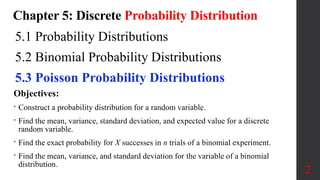
Key Concept: In this section, we introduce Poisson probability distributions, which are another category of
discrete probability distributions.
A Poisson probability distribution is a discrete probability distribution that applies to occurrences of some event
over a specified interval. The random variable x is the number of occurrences of the event in an interval. The
interval can be time, distance, area, volume, or some similar unit.
The probability of the event occurring x times over an interval is given by : 𝑃 𝑥 =
𝜇𝑥∙𝑒−𝜇
𝑥!
where e  2.71828, µ =
mean number of occurrences of the event in the intervals
Parameters: 𝜇 𝑎𝑛𝑑 𝜎 = 𝜇
Properties of the Poisson Probability Distribution
• A particular Poisson distribution is determined only by the mean, µ.
• A Poisson distribution has possible x values of 0, 1, 2, . . . with no upper limit.
Requirements:
1. The random variable x is the number of occurrences of an event in some interval.
2. The occurrences must be random.
3. The occurrences must be independent of each other.
4. The occurrences must be uniformly distributed over the interval being used.
5.3 Poisson Probability Distributions
3
TI Calculator:
Poisson Distribution
1. 2nd + VARS
2. Poissonpdf (
3. Enter: µ or 𝜆 , x
4. Enter or Paste
5. If using Poissoncdf (
6. Gives sum of the
probabilities from 0 to x.
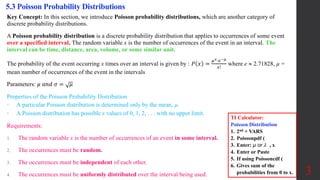
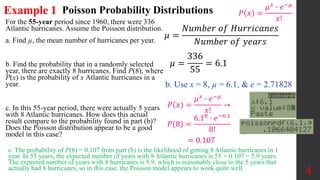
Example 1
For the 55-year period since 1960, there were 336
Atlantic hurricanes. Assume the Poisson distribution.
a. Find µ, the mean number of hurricanes per year.
b. Find the probability that in a randomly selected
year, there are exactly 8 hurricanes. Find P(8), where
P(x) is the probability of x Atlantic hurricanes in a
year.
c. In this 55-year period, there were actually 5 years
with 8 Atlantic hurricanes. How does this actual
result compare to the probability found in part (b)?
Does the Poisson distribution appear to be a good
model in this case?
4
Poisson Probability Distributions
𝜇 =
𝑁𝑢𝑚𝑏𝑒𝑟 𝑜𝑓 𝐻𝑢𝑟𝑟𝑖𝑐𝑎𝑛𝑒𝑠
𝑁𝑢𝑚𝑏𝑒𝑟 𝑜𝑓 𝑦𝑒𝑎𝑟𝑠
𝜇 =
336
55
= 6.1
= 0.107
b. Use x = 8, µ = 6.1, & e = 2.71828
c. The probability of P(8) = 0.107 from part (b) is the likelihood of getting 8 Atlantic hurricanes in 1
year. In 55 years, the expected number of years with 8 Atlantic hurricanes is 55 × 0.107 = 5.9 years.
The expected number of years with 8 hurricanes is 5.9, which is reasonably close to the 5 years that
actually had 8 hurricanes, so in this case, the Poisson model appears to work quite well.
𝑃 𝑥 =
𝜇𝑥
∙ 𝑒−𝜇
𝑥!
𝑃 𝑥 =
𝜇𝑥
∙ 𝑒−𝜇
𝑥!
→
𝑃(8) =
6.18 ∙ 𝑒−6.1
8!
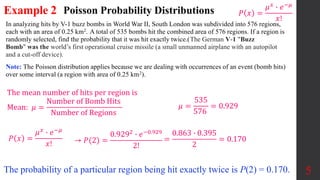
Example 2
In analyzing hits by V-1 buzz bombs in World War II, South London was subdivided into 576 regions,
each with an area of 0.25 km2. A total of 535 bombs hit the combined area of 576 regions. If a region is
randomly selected, find the probability that it was hit exactly twice.(The German V-1 "Buzz
Bomb" was the world’s first operational cruise missile (a small unmanned airplane with an autopilot
and a cut-off device).
Note: The Poisson distribution applies because we are dealing with occurrences of an event (bomb hits)
over some interval (a region with area of 0.25 km2).
5
Poisson Probability Distributions
The probability of a particular region being hit exactly twice is P(2) = 0.170.
The mean number of hits per region is
Mean: 𝜇 =
Number of Bomb Hits
Number of Regions
𝜇 =
535
576
= 0.929
𝑃 𝑥 =
𝜇𝑥
∙ 𝑒−𝜇
𝑥!
𝑃 𝑥 =
𝜇𝑥 ∙ 𝑒−𝜇
𝑥! → 𝑃(2) =
0.9292
∙ 𝑒−0.929
2!
=
0.863 ∙ 0.395
2
= 0.170
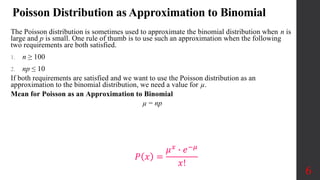
Poisson Distribution as Approximation to Binomial
The Poisson distribution is sometimes used to approximate the binomial distribution when n is
large and p is small. One rule of thumb is to use such an approximation when the following
two requirements are both satisfied.
1. n ≥ 100
2. np ≤ 10
If both requirements are satisfied and we want to use the Poisson distribution as an
approximation to the binomial distribution, we need a value for µ.
Mean for Poisson as an Approximation to Binomial
µ = np
6
𝑃 𝑥 =
𝜇𝑥 ∙ 𝑒−𝜇
𝑥!
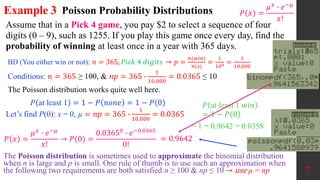
Example 3
Assume that in a Pick 4 game, you pay $2 to select a sequence of four
digits (0 – 9), such as 1255. If you play this game once every day, find the
probability of winning at least once in a year with 365 days.
7
Poisson Probability Distributions
𝑃 at least 1 = 1 − 𝑃 𝑛𝑜𝑛𝑒 = 1 − 𝑃 0
Let’s find P(0): x = 0, µ = 𝑛𝑝 = 365 ∙
1
10,000
= 0.0365
𝑃 at least 1 𝑤𝑖𝑛
= 1 − 𝑃 0
= 1 − 0.9642 = 0.0358
= 0.9642
The Poisson distribution is sometimes used to approximate the binomial distribution
when n is large and p is small. One rule of thumb is to use such an approximation when
the following two requirements are both satisfied.​​n ≥ 100 & ​np ≤ 10 → use µ = np
𝑃 𝑥 =
𝜇𝑥
∙ 𝑒−𝜇
𝑥!
𝑃 𝑥 =
𝜇𝑥 ∙ 𝑒−𝜇
𝑥!
→ 𝑃(0) =
0.03650 ∙ 𝑒−0.0365
0!
BD (You either win or not): 𝑛 = 365, 𝑃𝑖𝑐𝑘 4 𝑑𝑖𝑔𝑖𝑡𝑠 → 𝑝 =
𝑛(𝑤𝑖𝑛)
𝑛(𝑠)
=
1
104 =
1
10,000
Conditions: 𝑛 = 365 ≥ 100, & 𝑛𝑝 = 365 ∙
1
10,000
= 0.0365 ≤ 10
The Poisson distribution works quite well here.

Poisson Probability Distributions

  • 1.
    Elementary Statistics Chapter 5: DiscreteProbability Distribution 5.3 Poisson Probability Distribution 1
  • 2.
    Chapter 5: DiscreteProbability Distribution 5.1 Probability Distributions 5.2 Binomial Probability Distributions 5.3 Poisson Probability Distributions 2 Objectives: • Construct a probability distribution for a random variable. • Find the mean, variance, standard deviation, and expected value for a discrete random variable. • Find the exact probability for X successes in n trials of a binomial experiment. • Find the mean, variance, and standard deviation for the variable of a binomial distribution.
  • 3.
    Key Concept: Inthis section, we introduce Poisson probability distributions, which are another category of discrete probability distributions. A Poisson probability distribution is a discrete probability distribution that applies to occurrences of some event over a specified interval. The random variable x is the number of occurrences of the event in an interval. The interval can be time, distance, area, volume, or some similar unit. The probability of the event occurring x times over an interval is given by : 𝑃 𝑥 = 𝜇𝑥∙𝑒−𝜇 𝑥! where e  2.71828, µ = mean number of occurrences of the event in the intervals Parameters: 𝜇 𝑎𝑛𝑑 𝜎 = 𝜇 Properties of the Poisson Probability Distribution • A particular Poisson distribution is determined only by the mean, µ. • A Poisson distribution has possible x values of 0, 1, 2, . . . with no upper limit. Requirements: 1. The random variable x is the number of occurrences of an event in some interval. 2. The occurrences must be random. 3. The occurrences must be independent of each other. 4. The occurrences must be uniformly distributed over the interval being used. 5.3 Poisson Probability Distributions 3 TI Calculator: Poisson Distribution 1. 2nd + VARS 2. Poissonpdf ( 3. Enter: µ or 𝜆 , x 4. Enter or Paste 5. If using Poissoncdf ( 6. Gives sum of the probabilities from 0 to x.
  • 4.
    Example 1 For the55-year period since 1960, there were 336 Atlantic hurricanes. Assume the Poisson distribution. a. Find µ, the mean number of hurricanes per year. b. Find the probability that in a randomly selected year, there are exactly 8 hurricanes. Find P(8), where P(x) is the probability of x Atlantic hurricanes in a year. c. In this 55-year period, there were actually 5 years with 8 Atlantic hurricanes. How does this actual result compare to the probability found in part (b)? Does the Poisson distribution appear to be a good model in this case? 4 Poisson Probability Distributions 𝜇 = 𝑁𝑢𝑚𝑏𝑒𝑟 𝑜𝑓 𝐻𝑢𝑟𝑟𝑖𝑐𝑎𝑛𝑒𝑠 𝑁𝑢𝑚𝑏𝑒𝑟 𝑜𝑓 𝑦𝑒𝑎𝑟𝑠 𝜇 = 336 55 = 6.1 = 0.107 b. Use x = 8, µ = 6.1, & e = 2.71828 c. The probability of P(8) = 0.107 from part (b) is the likelihood of getting 8 Atlantic hurricanes in 1 year. In 55 years, the expected number of years with 8 Atlantic hurricanes is 55 × 0.107 = 5.9 years. The expected number of years with 8 hurricanes is 5.9, which is reasonably close to the 5 years that actually had 8 hurricanes, so in this case, the Poisson model appears to work quite well. 𝑃 𝑥 = 𝜇𝑥 ∙ 𝑒−𝜇 𝑥! 𝑃 𝑥 = 𝜇𝑥 ∙ 𝑒−𝜇 𝑥! → 𝑃(8) = 6.18 ∙ 𝑒−6.1 8!
  • 5.
    Example 2 In analyzinghits by V-1 buzz bombs in World War II, South London was subdivided into 576 regions, each with an area of 0.25 km2. A total of 535 bombs hit the combined area of 576 regions. If a region is randomly selected, find the probability that it was hit exactly twice.(The German V-1 "Buzz Bomb" was the world’s first operational cruise missile (a small unmanned airplane with an autopilot and a cut-off device). Note: The Poisson distribution applies because we are dealing with occurrences of an event (bomb hits) over some interval (a region with area of 0.25 km2). 5 Poisson Probability Distributions The probability of a particular region being hit exactly twice is P(2) = 0.170. The mean number of hits per region is Mean: 𝜇 = Number of Bomb Hits Number of Regions 𝜇 = 535 576 = 0.929 𝑃 𝑥 = 𝜇𝑥 ∙ 𝑒−𝜇 𝑥! 𝑃 𝑥 = 𝜇𝑥 ∙ 𝑒−𝜇 𝑥! → 𝑃(2) = 0.9292 ∙ 𝑒−0.929 2! = 0.863 ∙ 0.395 2 = 0.170
  • 6.
    Poisson Distribution asApproximation to Binomial The Poisson distribution is sometimes used to approximate the binomial distribution when n is large and p is small. One rule of thumb is to use such an approximation when the following two requirements are both satisfied. 1. n ≥ 100 2. np ≤ 10 If both requirements are satisfied and we want to use the Poisson distribution as an approximation to the binomial distribution, we need a value for µ. Mean for Poisson as an Approximation to Binomial µ = np 6 𝑃 𝑥 = 𝜇𝑥 ∙ 𝑒−𝜇 𝑥!
  • 7.
    Example 3 Assume thatin a Pick 4 game, you pay $2 to select a sequence of four digits (0 – 9), such as 1255. If you play this game once every day, find the probability of winning at least once in a year with 365 days. 7 Poisson Probability Distributions 𝑃 at least 1 = 1 − 𝑃 𝑛𝑜𝑛𝑒 = 1 − 𝑃 0 Let’s find P(0): x = 0, µ = 𝑛𝑝 = 365 ∙ 1 10,000 = 0.0365 𝑃 at least 1 𝑤𝑖𝑛 = 1 − 𝑃 0 = 1 − 0.9642 = 0.0358 = 0.9642 The Poisson distribution is sometimes used to approximate the binomial distribution when n is large and p is small. One rule of thumb is to use such an approximation when the following two requirements are both satisfied.​​n ≥ 100 & ​np ≤ 10 → use µ = np 𝑃 𝑥 = 𝜇𝑥 ∙ 𝑒−𝜇 𝑥! 𝑃 𝑥 = 𝜇𝑥 ∙ 𝑒−𝜇 𝑥! → 𝑃(0) = 0.03650 ∙ 𝑒−0.0365 0! BD (You either win or not): 𝑛 = 365, 𝑃𝑖𝑐𝑘 4 𝑑𝑖𝑔𝑖𝑡𝑠 → 𝑝 = 𝑛(𝑤𝑖𝑛) 𝑛(𝑠) = 1 104 = 1 10,000 Conditions: 𝑛 = 365 ≥ 100, & 𝑛𝑝 = 365 ∙ 1 10,000 = 0.0365 ≤ 10 The Poisson distribution works quite well here.