Elementary Statistics
Chapter 4:
Probability
4.4 Counting
1
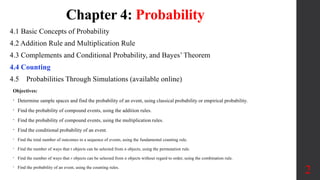
Chapter 4: Probability
4.1 Basic Concepts of Probability
4.2 Addition Rule and Multiplication Rule
4.3 Complements and Conditional Probability, and Bayes’ Theorem
4.4 Counting
4.5 Probabilities Through Simulations (available online)
2
Objectives:
• Determine sample spaces and find the probability of an event, using classical probability or empirical probability.
• Find the probability of compound events, using the addition rules.
• Find the probability of compound events, using the multiplication rules.
• Find the conditional probability of an event.
• Find the total number of outcomes in a sequence of events, using the fundamental counting rule.
• Find the number of ways that r objects can be selected from n objects, using the permutation rule.
• Find the number of ways that r objects can be selected from n objects without regard to order, using the combination rule.
• Find the probability of an event, using the counting rules.
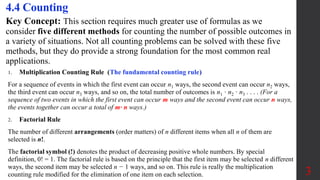
Key Concept: This section requires much greater use of formulas as we
consider five different methods for counting the number of possible outcomes in
a variety of situations. Not all counting problems can be solved with these five
methods, but they do provide a strong foundation for the most common real
applications.
3
4.4 Counting
1. Multiplication Counting Rule (The fundamental counting rule)
For a sequence of events in which the first event can occur n1 ways, the second event can occur n2 ways,
the third event can occur n3 ways, and so on, the total number of outcomes is n1 · n2 · n3 . . . . (For a
sequence of two events in which the first event can occur m ways and the second event can occur n ways,
the events together can occur a total of m∙ n ways.)
2. Factorial Rule
The number of different arrangements (order matters) of n different items when all n of them are
selected is n!.
The factorial symbol (!) denotes the product of decreasing positive whole numbers. By special
definition, 0! = 1. The factorial rule is based on the principle that the first item may be selected n different
ways, the second item may be selected n − 1 ways, and so on. This rule is really the multiplication
counting rule modified for the elimination of one item on each selection.
Example 1
A paint manufacturer is making different paint categories as follows:
Color: red, blue, white, black, green, brown, yellow
Type: latex, oil
Texture: flat, semi-gloss, high gloss
Use: outdoor, indoor
How many different kinds of paint can we make if we can select one color,
one type, one texture, and one use?
4
Multiplication Counting Rule
# of
colors
# of
types
# of
textures
# of
uses
= 84 different kinds of paint
= 7 ⋅ 2 ⋅ 3 ⋅ 2
Example 2
When making random guesses for
an unknown four-digit passcode,
each digit can be 0, 1. . . , 9.
a. What is the total number of
different possible passcodes?
b. Given that all of the guesses
have the same chance of being
correct, what is the probability of
guessing the correct passcode on
the first attempt?
5
Solution: 10 digits: 0, 1, …9
Total number of different possible
passcodes:
𝑃(𝐶) =
𝑛(𝑐)
𝑛(𝑠)
Multiplication Counting Rule
n1 · n2 · n3 · n4 = 10 · 10 · 10 · 10
Or 104
= 10,000
=
1
10,000
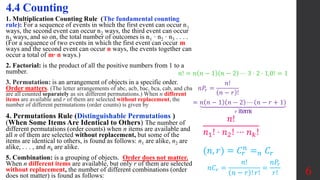
1. Multiplication Counting Rule (The fundamental counting
rule): For a sequence of events in which the first event can occur n1
ways, the second event can occur n2 ways, the third event can occur
n3 ways, and so on, the total number of outcomes is n1 · n2 · n3 . . . .
(For a sequence of two events in which the first event can occur m
ways and the second event can occur n ways, the events together can
occur a total of m∙ n ways.)
2. Factorial: is the product of all the positive numbers from 1 to a
number.
3. Permutation: is an arrangement of objects in a specific order.
Order matters. (The letter arrangements of abc, acb, bac, bca, cab, and cba
are all counted separately as six different permutations.) When n different
items are available and r of them are selected without replacement, the
number of different permutations (order counts) is given by
4. Permutations Rule (Distinguishable Permutations )
(When Some Items Are Identical to Others) The number of
different permutations (order counts) when n items are available and
all n of them are selected without replacement, but some of the
items are identical to others, is found as follows: n1 are alike, n2 are
alike, . . . , and nk are alike.
5. Combination: is a grouping of objects. Order does not matter.
When n different items are available, but only r of them are selected
without replacement, the number of different combinations (order
does not matter) is found as follows: 6
4.4 Counting
𝑛! = 𝑛 𝑛 − 1 𝑛 − 2 ⋅⋅⋅ 3 ⋅ 2 ⋅ 1,0! = 1
= 𝑛 𝑛 − 1 𝑛 − 2 ⋯ 𝑛 − 𝑟 + 1
𝑟 item
s
𝑛𝑃𝑟 =
𝑛!
𝑛 − 𝑟 !
𝑛𝐶𝑟 =
𝑛!
𝑛 − 𝑟 ! 𝑟!
=
𝑛𝑃𝑟
𝑟!
(𝑛, 𝑟) = 𝐶𝑟
𝑛 =𝑛 𝐶𝑟
𝑛!
𝑛1! ⋅ 𝑛2! ⋅⋅⋅ 𝑛𝑘!
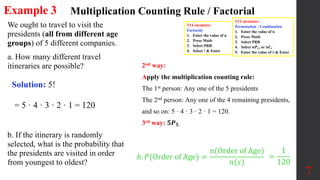
Example 3
We ought to travel to visit the
presidents (all from different age
groups) of 5 different companies.
a. How many different travel
itineraries are possible?
b. If the itinerary is randomly
selected, what is the probability that
the presidents are visited in order
from youngest to oldest?
7
Solution: 5!
𝑏. 𝑃(Order of Age) =
𝑛(Order of Age)
𝑛(𝑠)
Multiplication Counting Rule / Factorial
2nd way:
Apply the multiplication counting rule:
The 1st person: Any one of the 5 presidents
The 2nd person: Any one of the 4 remaining presidents,
and so on: 5 · 4 · 3 · 2 · 1 = 120.
3rd way: 𝟓𝑷𝟓
= 5 · 4 · 3 · 2 · 1 = 120
=
1
120
TI Calculator:
Factorial
1. Enter the value of n
2. Press Math
3. Select PRB
4. Select ! & Enter
TI Calculator:
Permutation / Combination
1. Enter the value of n
2. Press Math
3. Select PRB
4. Select 𝒏𝑷𝒓, or 𝒏𝑪𝒓
5. Enter the value of r & Enter
Example 4
A business owner has a choice of 5 locations in which to establish the
business. She decides to rank each location according to certain criteria,
such as price of the store and parking facilities.
8
first
choice
second
choice
third
choice
fourth
choice
fifth
choice
= 120
5 ⋅ 4 ⋅ 3 ⋅ 2 ⋅ 1
Using factorials: 5! = 120
Using permutations: 5P5 = 120
first
choice
second
choice
third
choice
5 ⋅ 4 ⋅ 3 = 60
Using permutations: 5P3 = 60
Multiplication Counting Rule / Factorial / Permutation
a. How many different ways can she rank the 5 locations?
b. If she wishes to rank only the top 3 of the 5 locations. How many
different ways can she rank them?
Example 5
A TV show has 7 ads to use on a program. If we select 1 for the opening, 1
for the middle, and 1 for the ending of the show, how many different ways
are possible?
9
Counting
Order matters: 7𝑃3 =
7!
7 − 3 !
=
7!
4!
=
7 ⋅ 6 ⋅ 5 ⋅ 4!
4!
= 210
𝑂𝑟: 7 ⋅ 6 ⋅ 5 = 210
𝑛𝑃𝑟 =
𝑛!
𝑛−𝑟 !
, 𝑛𝐶𝑟 =
𝑛!
𝑛−𝑟 !𝑟!
=
𝑛𝑃𝑟
𝑟!
Example 6
A department musical director will select 2 musical plays to present in a
year, one in the fall, and one the spring. There are 9 to pick from, how
many different possibilities are there?
10
Counting
Order matters:
9𝑃2 =
9!
7!
= 72 or9𝑃2 = 9 ⋅ 8
2
= 72
𝑂𝑟: 9 ⋅ 8 = 72
𝑛𝑃𝑟 =
𝑛!
𝑛−𝑟 !
, 𝑛𝐶𝑟 =
𝑛!
𝑛−𝑟 !𝑟!
=
𝑛𝑃𝑟
𝑟!
Example 7
An editor has 8 books to review, and he can only use 3 reviews in his
paper. How many different ways can the 3 reviews be selected?
11
Counting
Does order matter?
8𝐶3 =
8!
5! 3!
or8𝐶3 =
8𝑃3
3!
= 56
8𝐶3 =
=
8 ⋅ 7 ⋅ 6 ⋅ 5!
5! ⋅ 3 ⋅ 2 ⋅ 1
= 56
𝑛𝑃𝑟 =
𝑛!
𝑛−𝑟 !
, 𝑛𝐶𝑟 =
𝑛!
𝑛−𝑟 !𝑟!
=
𝑛𝑃𝑟
𝑟!
Example 8:
a. 3 women and 2 men
12
Does order
matter?
7𝐶3 ⋅5 𝐶2 =
Women: 7𝐶3, Men: 5𝐶2
35·10 = 350
Women: 7𝐶2, Men: 5𝐶3
21·10 = 210
12𝐶5 =
12!
5! 7! = 792
7𝐶2 ⋅5 𝐶3 =
In a club there are 7 women and 5 men. How many different possibilities
are there? A committee of 5 persons is to be chosen as follows:
=
7!
3! 4!
= 35, =
5!
2! 3!
= 10
=
7!
2! 5!
= 21,
5!
3! 2!
= 10
c. 5 persons
b. 2 women and 3 men
𝑛𝑃𝑟 =
𝑛!
𝑛−𝑟 !
, 𝑛𝐶𝑟 =
𝑛!
𝑛−𝑟 !𝑟!
=
𝑛𝑃𝑟
𝑟!
Example 9
A store has 6 TV Graphic magazines and 8 Newstime magazines on the counter.
If two customers purchased a magazine, find the probability that one of each
magazine was purchased.
13
TV Graphic: 1 magazine of the 6 magazines
Newstime: 1 magazine of the 8 magazines
Total: 2 magazines of the 14 magazines
6𝐶1 ⋅ 8 𝐶1
14𝐶2
=
6 ⋅ 8
91
=
48
91
𝑃(1 of each) =
𝑛(1of each)
𝑛(𝑠)
=
𝑛(1of each) =6 𝐶1 ⋅ 8𝐶
𝑛(𝑠) =14 𝐶2
𝑛𝑃𝑟 =
𝑛!
𝑛−𝑟 !
, 𝑛𝐶𝑟 =
𝑛!
𝑛−𝑟 !𝑟!
=
𝑛𝑃𝑟
𝑟!
Example 10
A combination lock consists of the 26 letters of the alphabet. If a 3-letter
combination is needed, find the probability that the combination will consist of
the letters ABC in that order. The same letter can be used more than once.
(Note: A combination lock is really a permutation lock.)
14
Counting
26·26·26, or 263 = 17,576 possible combinations.
Example: ABC in order create one combination.
𝑃 ABC =
𝑛 ABC
𝑛(𝑠)
=
1
17,576
Example 11
Trifecta: In a horse race, a trifecta bet
is won if we select the horses that finish
first and second and third in the correct
order. There are 19 horses in a race.
a. How many different trifecta bets are
possible?
b. If a bettor randomly selects three of
those horses for a trifecta bet, what is
the probability of winning?
c. Do all of the different possible
trifecta bets have the same chance of
winning? (Ignore “dead heats” in which
horses tie for a win.) 15
Solution: a. n = 19 horses, select r = 3
of them without replacement.
19𝑃3 =
19!
19 − 3 !
b. 1/5814
c. There are 5814 different possible
trifecta bets, but not all of them
have the same chance of winning,
because some horses tend to be
faster than others.
=
19 ⋅ 18 ⋅ 17 ⋅ 16!
16! = 5814
𝑛𝑃𝑟 =
𝑛!
𝑛−𝑟 !
, 𝑛𝐶𝑟 =
𝑛!
𝑛−𝑟 !𝑟!
=
𝑛𝑃𝑟
𝑟!
Example 12
When designing surveys, pollsters sometimes repeat a question
to see if a subject is thoughtlessly providing answers just to finish quickly. For
one particular survey with 10 questions, 2 of the questions are identical to each
other, and 3 other questions are also identical to each other. For this survey, how
many different arrangements are possible? Is it practical to survey enough
subjects so that every different possible arrangement is used?
16
Solution: n = 10 questions
with 2 that are identical to each other
and 3 others that are also identical to each other,
The remaining 5 are different.
=
10!
2! ⋅ 3! ⋅ 1! ⋅ 1! ⋅ 1! ⋅ 1! ⋅ 1!
= 302,400
Interpretation:
It is not practical to accommodate every possible permutation. For typical surveys and
according to previous data, the number of respondents is somewhere around 1000.
𝑛!
𝑛1! ⋅ 𝑛2! ⋅⋅⋅ 𝑛𝑘!
𝑛!
𝑛1! ⋅ 𝑛2! ⋅⋅⋅ 𝑛𝑘!
Example 13
In California’s Fantasy 5 lottery game, winning the
jackpot requires that you select 5 different numbers
from 1 to 39, and the same 5 numbers must be drawn in
the lottery. The winning numbers can be drawn in any
order, so order does not make a difference.
a. How many different lottery tickets are possible?
b. Find the probability of winning the jackpot when one
ticket is purchased.
17
Solution
n = 39, r = 5
Does order matter?
39𝐶5 =
39!
5! (39 − 5)!
=
39!
5! (34)!
= 575,757
𝑏. 𝑃(𝑤) =
𝑛(𝑤)
𝑛(𝑠)
=
1
575,757
𝑛𝑃𝑟 =
𝑛!
𝑛−𝑟 !
, 𝑛𝐶𝑟 =
𝑛!
𝑛−𝑟 !𝑟!
=
𝑛𝑃𝑟
𝑟!
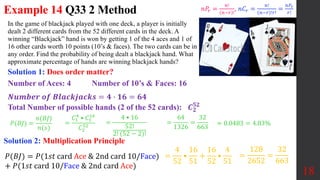
Example 14 Q33 2 Method
In the game of blackjack played with one​ deck, a player is initially
dealt 2 different cards from the 52 different cards in the deck. A
winning​ “Blackjack” hand is won by getting 1 of the 4 aces and 1 of
16 other cards worth 10 points (10’s & faces). The two cards can be in
any order. Find the probability of being dealt a blackjack hand. What
approximate percentage of hands are winning blackjack​ hands?
18
Solution 1: Does order matter?
𝑃(𝐵𝐽) =
𝑛(𝐵𝐽)
𝑛(𝑠)
=
64
1326
=
32
663
≈ 0.0483 = 4.83%
=
4 • 16
52!
2! (52 − 2)!
Number of Aces: 4 Number of 10’s & Faces: 16
𝑵𝒖𝒎𝒃𝒆𝒓 𝒐𝒇 𝑩𝒍𝒂𝒄𝒌𝒋𝒂𝒄𝒌𝒔 = 𝟒 ∙ 𝟏𝟔 = 𝟔𝟒
Total Number of possible hands (2 of the 52 cards): 𝑪𝟐
𝟓𝟐
=
𝐶1
4
• 𝐶1
16
𝐶2
52
𝑛𝑃𝑟 =
𝑛!
𝑛−𝑟 !
, 𝑛𝐶𝑟 =
𝑛!
𝑛−𝑟 !𝑟!
=
𝑛𝑃𝑟
𝑟!
Solution 2: Multiplication Principle
𝑃(𝐵𝐽) = 𝑃(1𝑠𝑡 card Ace & 2nd card 10/Face)
+ 𝑃(1𝑠𝑡 card 10/Face & 2nd card Ace)
=
128
2652
=
32
663
=
4
52
•
16
51
+
16
52
•
4
51
Example 15 (Time)
19
Counting
2 ∙ 263 + 2 ∙ 262 = 36,504 possiblities
𝑛𝑃𝑟 =
𝑛!
𝑛−𝑟 !
, 𝑛𝐶𝑟 =
𝑛!
𝑛−𝑟 !𝑟!
=
𝑛𝑃𝑟
𝑟!
10. The radio station call letters must begin with either k or w and must include either two or three
additional letters, how many different possibilities are​ there?.
As of this writing, the Powerball lottery is run in 44 states. Winning the jackpot requires that you select
the correct five different numbers between l and 69 and, in a separate drawing, you must also select the
correct single number between 1 and 26. Find the probability of winning the jackpot.
𝑃 𝑊 =
𝑛(𝑊)
𝑛(𝑠)
=
1
𝐶5
69
∙ 26
=
1
292,201,338
The International Morse code is a way of transmitting coded text by using sequences of on/ off tones. Each
character is 1 or 2 or 3 or 4 or 5 segments long, and each segment is either a dot or a dash. For example, the
letter G is transmitted as two dashes followed by a dot, as in --.. How many different characters are possible
with this scheme? Are there enough characters for the alphabet and numbers?
1 𝐶ℎ𝑎𝑟𝑎𝑐𝑡𝑒𝑟: 𝑑𝑎𝑠ℎ 𝑜𝑟 𝑑𝑜𝑡: 2 ways
2 𝐶ℎ𝑎𝑟𝑎𝑐𝑡𝑒𝑟𝑠: 1𝑠𝑡 𝐶ℎ𝑎𝑟𝑎𝑐𝑡𝑒𝑟 𝑑𝑎𝑠ℎ 𝑜𝑟 𝑑𝑜𝑡: 2 ways, & 1𝑠𝑡 𝐶ℎ𝑎𝑟𝑎𝑐𝑡𝑒𝑟 𝑑𝑎𝑠ℎ 𝑜𝑟 𝑑𝑜𝑡: 2 ways 𝑑 → 22
= 4
3 𝐶ℎ𝑎𝑟𝑎𝑐𝑡𝑒𝑟𝑠, → 23
= 8….
2 + 22 + 23 + 24 + 25 = 62 possiblities
𝑦𝑒, 𝑖𝑡′𝑠 𝑒𝑛𝑜𝑢𝑔ℎ: 62 > 26 𝐴𝑙𝑝ℎ𝑎𝑏𝑒𝑡 +
10 𝑑𝑖𝑔𝑖𝑡𝑠 = 36 characters
Example 16
20
𝑇𝑜𝑢𝑐ℎ 5 𝑓𝑖𝑛𝑔𝑢𝑟𝑒𝑠: 𝐶5
5
+ 𝑇𝑜𝑢𝑐ℎ 4 𝑓𝑖𝑛𝑔𝑢𝑟𝑒𝑠𝐶4
5
+ 𝑇𝑜𝑢𝑐ℎ 3 𝑓𝑖𝑛𝑔𝑢𝑟𝑒𝑠𝐶3
5
+
𝑇𝑜𝑢𝑐ℎ 2 𝑓𝑖𝑛𝑔𝑢𝑟𝑒𝑠𝐶2
5
= 1 + 5 + 10 + 10 = 26
𝑛𝑃𝑟 =
𝑛!
𝑛−𝑟 !
, 𝑛𝐶𝑟 =
𝑛!
𝑛−𝑟 !𝑟!
=
𝑛𝑃𝑟
𝑟!
Quicken Loans offered a prize of $1 billion to anyone who could correctly predict the winner of the NCAA
basketball tournament. After the “play-in” games, there are 64 teams in the tournament. a. How many games is
required to get 1 championship from the field of 64 teams? b. If you make random guesses for each game of the
tournament, find the probability of picking the winner in every game.
How many different ways can you touch two or more fingers to each other on one hand?
𝑎. 32 + 16 + 8 + 4 + 2 + 1 = 63, 𝑏.
1
2
63
=
1
9,223,372,036,854,775,808
Extremely unlikely
Example 17
21
𝑛𝑃𝑟 =
𝑛!
𝑛−𝑟 !
, 𝑛𝐶𝑟 =
𝑛!
𝑛−𝑟 !𝑟!
=
𝑛𝑃𝑟
𝑟!
A common computer programming rule is that names of variables must be between one and eight
characters long. The first character can be any of the 26​ letters, while successive characters can be any of
the 26 letters or any of the 10 digits. For​ example, allowable variable names include​ A, BB, and
M3477K. How many different variable names are​ possible? (Ignore the difference between uppercase
and lowercase​ letters.)
1- letter variable: 26 2 - character variable: 26x36 3 - character variable: 26 x 36 x 36 = 26 ∙ 362
4 - Character variable: = 26 ∙ 363 … 4 - Character variable: = 26 ∙ 367
Possible characters = sum of the above = 26(1 + 36 + 362 + ... + 367)
= 2,095,681,645,538 (about 2 trillion)

Counting

  • 1.
  • 2.
    Chapter 4: Probability 4.1Basic Concepts of Probability 4.2 Addition Rule and Multiplication Rule 4.3 Complements and Conditional Probability, and Bayes’ Theorem 4.4 Counting 4.5 Probabilities Through Simulations (available online) 2 Objectives: • Determine sample spaces and find the probability of an event, using classical probability or empirical probability. • Find the probability of compound events, using the addition rules. • Find the probability of compound events, using the multiplication rules. • Find the conditional probability of an event. • Find the total number of outcomes in a sequence of events, using the fundamental counting rule. • Find the number of ways that r objects can be selected from n objects, using the permutation rule. • Find the number of ways that r objects can be selected from n objects without regard to order, using the combination rule. • Find the probability of an event, using the counting rules.
  • 3.
    Key Concept: Thissection requires much greater use of formulas as we consider five different methods for counting the number of possible outcomes in a variety of situations. Not all counting problems can be solved with these five methods, but they do provide a strong foundation for the most common real applications. 3 4.4 Counting 1. Multiplication Counting Rule (The fundamental counting rule) For a sequence of events in which the first event can occur n1 ways, the second event can occur n2 ways, the third event can occur n3 ways, and so on, the total number of outcomes is n1 · n2 · n3 . . . . (For a sequence of two events in which the first event can occur m ways and the second event can occur n ways, the events together can occur a total of m∙ n ways.) 2. Factorial Rule The number of different arrangements (order matters) of n different items when all n of them are selected is n!. The factorial symbol (!) denotes the product of decreasing positive whole numbers. By special definition, 0! = 1. The factorial rule is based on the principle that the first item may be selected n different ways, the second item may be selected n − 1 ways, and so on. This rule is really the multiplication counting rule modified for the elimination of one item on each selection.
  • 4.
    Example 1 A paintmanufacturer is making different paint categories as follows: Color: red, blue, white, black, green, brown, yellow Type: latex, oil Texture: flat, semi-gloss, high gloss Use: outdoor, indoor How many different kinds of paint can we make if we can select one color, one type, one texture, and one use? 4 Multiplication Counting Rule # of colors # of types # of textures # of uses = 84 different kinds of paint = 7 ⋅ 2 ⋅ 3 ⋅ 2
  • 5.
    Example 2 When makingrandom guesses for an unknown four-digit passcode, each digit can be 0, 1. . . , 9. a. What is the total number of different possible passcodes? b. Given that all of the guesses have the same chance of being correct, what is the probability of guessing the correct passcode on the first attempt? 5 Solution: 10 digits: 0, 1, …9 Total number of different possible passcodes: 𝑃(𝐶) = 𝑛(𝑐) 𝑛(𝑠) Multiplication Counting Rule n1 · n2 · n3 · n4 = 10 · 10 · 10 · 10 Or 104 = 10,000 = 1 10,000
  • 6.
    1. Multiplication CountingRule (The fundamental counting rule): For a sequence of events in which the first event can occur n1 ways, the second event can occur n2 ways, the third event can occur n3 ways, and so on, the total number of outcomes is n1 · n2 · n3 . . . . (For a sequence of two events in which the first event can occur m ways and the second event can occur n ways, the events together can occur a total of m∙ n ways.) 2. Factorial: is the product of all the positive numbers from 1 to a number. 3. Permutation: is an arrangement of objects in a specific order. Order matters. (The letter arrangements of abc, acb, bac, bca, cab, and cba are all counted separately as six different permutations.) When n different items are available and r of them are selected without replacement, the number of different permutations (order counts) is given by 4. Permutations Rule (Distinguishable Permutations ) (When Some Items Are Identical to Others) The number of different permutations (order counts) when n items are available and all n of them are selected without replacement, but some of the items are identical to others, is found as follows: n1 are alike, n2 are alike, . . . , and nk are alike. 5. Combination: is a grouping of objects. Order does not matter. When n different items are available, but only r of them are selected without replacement, the number of different combinations (order does not matter) is found as follows: 6 4.4 Counting 𝑛! = 𝑛 𝑛 − 1 𝑛 − 2 ⋅⋅⋅ 3 ⋅ 2 ⋅ 1,0! = 1 = 𝑛 𝑛 − 1 𝑛 − 2 ⋯ 𝑛 − 𝑟 + 1 𝑟 item s 𝑛𝑃𝑟 = 𝑛! 𝑛 − 𝑟 ! 𝑛𝐶𝑟 = 𝑛! 𝑛 − 𝑟 ! 𝑟! = 𝑛𝑃𝑟 𝑟! (𝑛, 𝑟) = 𝐶𝑟 𝑛 =𝑛 𝐶𝑟 𝑛! 𝑛1! ⋅ 𝑛2! ⋅⋅⋅ 𝑛𝑘!
  • 7.
    Example 3 We oughtto travel to visit the presidents (all from different age groups) of 5 different companies. a. How many different travel itineraries are possible? b. If the itinerary is randomly selected, what is the probability that the presidents are visited in order from youngest to oldest? 7 Solution: 5! 𝑏. 𝑃(Order of Age) = 𝑛(Order of Age) 𝑛(𝑠) Multiplication Counting Rule / Factorial 2nd way: Apply the multiplication counting rule: The 1st person: Any one of the 5 presidents The 2nd person: Any one of the 4 remaining presidents, and so on: 5 · 4 · 3 · 2 · 1 = 120. 3rd way: 𝟓𝑷𝟓 = 5 · 4 · 3 · 2 · 1 = 120 = 1 120 TI Calculator: Factorial 1. Enter the value of n 2. Press Math 3. Select PRB 4. Select ! & Enter TI Calculator: Permutation / Combination 1. Enter the value of n 2. Press Math 3. Select PRB 4. Select 𝒏𝑷𝒓, or 𝒏𝑪𝒓 5. Enter the value of r & Enter
  • 8.
    Example 4 A businessowner has a choice of 5 locations in which to establish the business. She decides to rank each location according to certain criteria, such as price of the store and parking facilities. 8 first choice second choice third choice fourth choice fifth choice = 120 5 ⋅ 4 ⋅ 3 ⋅ 2 ⋅ 1 Using factorials: 5! = 120 Using permutations: 5P5 = 120 first choice second choice third choice 5 ⋅ 4 ⋅ 3 = 60 Using permutations: 5P3 = 60 Multiplication Counting Rule / Factorial / Permutation a. How many different ways can she rank the 5 locations? b. If she wishes to rank only the top 3 of the 5 locations. How many different ways can she rank them?
  • 9.
    Example 5 A TVshow has 7 ads to use on a program. If we select 1 for the opening, 1 for the middle, and 1 for the ending of the show, how many different ways are possible? 9 Counting Order matters: 7𝑃3 = 7! 7 − 3 ! = 7! 4! = 7 ⋅ 6 ⋅ 5 ⋅ 4! 4! = 210 𝑂𝑟: 7 ⋅ 6 ⋅ 5 = 210 𝑛𝑃𝑟 = 𝑛! 𝑛−𝑟 ! , 𝑛𝐶𝑟 = 𝑛! 𝑛−𝑟 !𝑟! = 𝑛𝑃𝑟 𝑟!
  • 10.
    Example 6 A departmentmusical director will select 2 musical plays to present in a year, one in the fall, and one the spring. There are 9 to pick from, how many different possibilities are there? 10 Counting Order matters: 9𝑃2 = 9! 7! = 72 or9𝑃2 = 9 ⋅ 8 2 = 72 𝑂𝑟: 9 ⋅ 8 = 72 𝑛𝑃𝑟 = 𝑛! 𝑛−𝑟 ! , 𝑛𝐶𝑟 = 𝑛! 𝑛−𝑟 !𝑟! = 𝑛𝑃𝑟 𝑟!
  • 11.
    Example 7 An editorhas 8 books to review, and he can only use 3 reviews in his paper. How many different ways can the 3 reviews be selected? 11 Counting Does order matter? 8𝐶3 = 8! 5! 3! or8𝐶3 = 8𝑃3 3! = 56 8𝐶3 = = 8 ⋅ 7 ⋅ 6 ⋅ 5! 5! ⋅ 3 ⋅ 2 ⋅ 1 = 56 𝑛𝑃𝑟 = 𝑛! 𝑛−𝑟 ! , 𝑛𝐶𝑟 = 𝑛! 𝑛−𝑟 !𝑟! = 𝑛𝑃𝑟 𝑟!
  • 12.
    Example 8: a. 3women and 2 men 12 Does order matter? 7𝐶3 ⋅5 𝐶2 = Women: 7𝐶3, Men: 5𝐶2 35·10 = 350 Women: 7𝐶2, Men: 5𝐶3 21·10 = 210 12𝐶5 = 12! 5! 7! = 792 7𝐶2 ⋅5 𝐶3 = In a club there are 7 women and 5 men. How many different possibilities are there? A committee of 5 persons is to be chosen as follows: = 7! 3! 4! = 35, = 5! 2! 3! = 10 = 7! 2! 5! = 21, 5! 3! 2! = 10 c. 5 persons b. 2 women and 3 men 𝑛𝑃𝑟 = 𝑛! 𝑛−𝑟 ! , 𝑛𝐶𝑟 = 𝑛! 𝑛−𝑟 !𝑟! = 𝑛𝑃𝑟 𝑟!
  • 13.
    Example 9 A storehas 6 TV Graphic magazines and 8 Newstime magazines on the counter. If two customers purchased a magazine, find the probability that one of each magazine was purchased. 13 TV Graphic: 1 magazine of the 6 magazines Newstime: 1 magazine of the 8 magazines Total: 2 magazines of the 14 magazines 6𝐶1 ⋅ 8 𝐶1 14𝐶2 = 6 ⋅ 8 91 = 48 91 𝑃(1 of each) = 𝑛(1of each) 𝑛(𝑠) = 𝑛(1of each) =6 𝐶1 ⋅ 8𝐶 𝑛(𝑠) =14 𝐶2 𝑛𝑃𝑟 = 𝑛! 𝑛−𝑟 ! , 𝑛𝐶𝑟 = 𝑛! 𝑛−𝑟 !𝑟! = 𝑛𝑃𝑟 𝑟!
  • 14.
    Example 10 A combinationlock consists of the 26 letters of the alphabet. If a 3-letter combination is needed, find the probability that the combination will consist of the letters ABC in that order. The same letter can be used more than once. (Note: A combination lock is really a permutation lock.) 14 Counting 26·26·26, or 263 = 17,576 possible combinations. Example: ABC in order create one combination. 𝑃 ABC = 𝑛 ABC 𝑛(𝑠) = 1 17,576
  • 15.
    Example 11 Trifecta: Ina horse race, a trifecta bet is won if we select the horses that finish first and second and third in the correct order. There are 19 horses in a race. a. How many different trifecta bets are possible? b. If a bettor randomly selects three of those horses for a trifecta bet, what is the probability of winning? c. Do all of the different possible trifecta bets have the same chance of winning? (Ignore “dead heats” in which horses tie for a win.) 15 Solution: a. n = 19 horses, select r = 3 of them without replacement. 19𝑃3 = 19! 19 − 3 ! b. 1/5814 c. There are 5814 different possible trifecta bets, but not all of them have the same chance of winning, because some horses tend to be faster than others. = 19 ⋅ 18 ⋅ 17 ⋅ 16! 16! = 5814 𝑛𝑃𝑟 = 𝑛! 𝑛−𝑟 ! , 𝑛𝐶𝑟 = 𝑛! 𝑛−𝑟 !𝑟! = 𝑛𝑃𝑟 𝑟!
  • 16.
    Example 12 When designingsurveys, pollsters sometimes repeat a question to see if a subject is thoughtlessly providing answers just to finish quickly. For one particular survey with 10 questions, 2 of the questions are identical to each other, and 3 other questions are also identical to each other. For this survey, how many different arrangements are possible? Is it practical to survey enough subjects so that every different possible arrangement is used? 16 Solution: n = 10 questions with 2 that are identical to each other and 3 others that are also identical to each other, The remaining 5 are different. = 10! 2! ⋅ 3! ⋅ 1! ⋅ 1! ⋅ 1! ⋅ 1! ⋅ 1! = 302,400 Interpretation: It is not practical to accommodate every possible permutation. For typical surveys and according to previous data, the number of respondents is somewhere around 1000. 𝑛! 𝑛1! ⋅ 𝑛2! ⋅⋅⋅ 𝑛𝑘! 𝑛! 𝑛1! ⋅ 𝑛2! ⋅⋅⋅ 𝑛𝑘!
  • 17.
    Example 13 In California’sFantasy 5 lottery game, winning the jackpot requires that you select 5 different numbers from 1 to 39, and the same 5 numbers must be drawn in the lottery. The winning numbers can be drawn in any order, so order does not make a difference. a. How many different lottery tickets are possible? b. Find the probability of winning the jackpot when one ticket is purchased. 17 Solution n = 39, r = 5 Does order matter? 39𝐶5 = 39! 5! (39 − 5)! = 39! 5! (34)! = 575,757 𝑏. 𝑃(𝑤) = 𝑛(𝑤) 𝑛(𝑠) = 1 575,757 𝑛𝑃𝑟 = 𝑛! 𝑛−𝑟 ! , 𝑛𝐶𝑟 = 𝑛! 𝑛−𝑟 !𝑟! = 𝑛𝑃𝑟 𝑟!
  • 18.
    Example 14 Q332 Method In the game of blackjack played with one​ deck, a player is initially dealt 2 different cards from the 52 different cards in the deck. A winning​ “Blackjack” hand is won by getting 1 of the 4 aces and 1 of 16 other cards worth 10 points (10’s & faces). The two cards can be in any order. Find the probability of being dealt a blackjack hand. What approximate percentage of hands are winning blackjack​ hands? 18 Solution 1: Does order matter? 𝑃(𝐵𝐽) = 𝑛(𝐵𝐽) 𝑛(𝑠) = 64 1326 = 32 663 ≈ 0.0483 = 4.83% = 4 • 16 52! 2! (52 − 2)! Number of Aces: 4 Number of 10’s & Faces: 16 𝑵𝒖𝒎𝒃𝒆𝒓 𝒐𝒇 𝑩𝒍𝒂𝒄𝒌𝒋𝒂𝒄𝒌𝒔 = 𝟒 ∙ 𝟏𝟔 = 𝟔𝟒 Total Number of possible hands (2 of the 52 cards): 𝑪𝟐 𝟓𝟐 = 𝐶1 4 • 𝐶1 16 𝐶2 52 𝑛𝑃𝑟 = 𝑛! 𝑛−𝑟 ! , 𝑛𝐶𝑟 = 𝑛! 𝑛−𝑟 !𝑟! = 𝑛𝑃𝑟 𝑟! Solution 2: Multiplication Principle 𝑃(𝐵𝐽) = 𝑃(1𝑠𝑡 card Ace & 2nd card 10/Face) + 𝑃(1𝑠𝑡 card 10/Face & 2nd card Ace) = 128 2652 = 32 663 = 4 52 • 16 51 + 16 52 • 4 51
  • 19.
    Example 15 (Time) 19 Counting 2∙ 263 + 2 ∙ 262 = 36,504 possiblities 𝑛𝑃𝑟 = 𝑛! 𝑛−𝑟 ! , 𝑛𝐶𝑟 = 𝑛! 𝑛−𝑟 !𝑟! = 𝑛𝑃𝑟 𝑟! 10. The radio station call letters must begin with either k or w and must include either two or three additional letters, how many different possibilities are​ there?. As of this writing, the Powerball lottery is run in 44 states. Winning the jackpot requires that you select the correct five different numbers between l and 69 and, in a separate drawing, you must also select the correct single number between 1 and 26. Find the probability of winning the jackpot. 𝑃 𝑊 = 𝑛(𝑊) 𝑛(𝑠) = 1 𝐶5 69 ∙ 26 = 1 292,201,338 The International Morse code is a way of transmitting coded text by using sequences of on/ off tones. Each character is 1 or 2 or 3 or 4 or 5 segments long, and each segment is either a dot or a dash. For example, the letter G is transmitted as two dashes followed by a dot, as in --.. How many different characters are possible with this scheme? Are there enough characters for the alphabet and numbers? 1 𝐶ℎ𝑎𝑟𝑎𝑐𝑡𝑒𝑟: 𝑑𝑎𝑠ℎ 𝑜𝑟 𝑑𝑜𝑡: 2 ways 2 𝐶ℎ𝑎𝑟𝑎𝑐𝑡𝑒𝑟𝑠: 1𝑠𝑡 𝐶ℎ𝑎𝑟𝑎𝑐𝑡𝑒𝑟 𝑑𝑎𝑠ℎ 𝑜𝑟 𝑑𝑜𝑡: 2 ways, & 1𝑠𝑡 𝐶ℎ𝑎𝑟𝑎𝑐𝑡𝑒𝑟 𝑑𝑎𝑠ℎ 𝑜𝑟 𝑑𝑜𝑡: 2 ways 𝑑 → 22 = 4 3 𝐶ℎ𝑎𝑟𝑎𝑐𝑡𝑒𝑟𝑠, → 23 = 8…. 2 + 22 + 23 + 24 + 25 = 62 possiblities 𝑦𝑒, 𝑖𝑡′𝑠 𝑒𝑛𝑜𝑢𝑔ℎ: 62 > 26 𝐴𝑙𝑝ℎ𝑎𝑏𝑒𝑡 + 10 𝑑𝑖𝑔𝑖𝑡𝑠 = 36 characters
  • 20.
    Example 16 20 𝑇𝑜𝑢𝑐ℎ 5𝑓𝑖𝑛𝑔𝑢𝑟𝑒𝑠: 𝐶5 5 + 𝑇𝑜𝑢𝑐ℎ 4 𝑓𝑖𝑛𝑔𝑢𝑟𝑒𝑠𝐶4 5 + 𝑇𝑜𝑢𝑐ℎ 3 𝑓𝑖𝑛𝑔𝑢𝑟𝑒𝑠𝐶3 5 + 𝑇𝑜𝑢𝑐ℎ 2 𝑓𝑖𝑛𝑔𝑢𝑟𝑒𝑠𝐶2 5 = 1 + 5 + 10 + 10 = 26 𝑛𝑃𝑟 = 𝑛! 𝑛−𝑟 ! , 𝑛𝐶𝑟 = 𝑛! 𝑛−𝑟 !𝑟! = 𝑛𝑃𝑟 𝑟! Quicken Loans offered a prize of $1 billion to anyone who could correctly predict the winner of the NCAA basketball tournament. After the “play-in” games, there are 64 teams in the tournament. a. How many games is required to get 1 championship from the field of 64 teams? b. If you make random guesses for each game of the tournament, find the probability of picking the winner in every game. How many different ways can you touch two or more fingers to each other on one hand? 𝑎. 32 + 16 + 8 + 4 + 2 + 1 = 63, 𝑏. 1 2 63 = 1 9,223,372,036,854,775,808 Extremely unlikely
  • 21.
    Example 17 21 𝑛𝑃𝑟 = 𝑛! 𝑛−𝑟! , 𝑛𝐶𝑟 = 𝑛! 𝑛−𝑟 !𝑟! = 𝑛𝑃𝑟 𝑟! A common computer programming rule is that names of variables must be between one and eight characters long. The first character can be any of the 26​ letters, while successive characters can be any of the 26 letters or any of the 10 digits. For​ example, allowable variable names include​ A, BB, and M3477K. How many different variable names are​ possible? (Ignore the difference between uppercase and lowercase​ letters.) 1- letter variable: 26 2 - character variable: 26x36 3 - character variable: 26 x 36 x 36 = 26 ∙ 362 4 - Character variable: = 26 ∙ 363 … 4 - Character variable: = 26 ∙ 367 Possible characters = sum of the above = 26(1 + 36 + 362 + ... + 367) = 2,095,681,645,538 (about 2 trillion)