WELCOME TO
OUR
PRESENTATION
1
Basic Concept of Probability
2
Topic:
Introduction
 Probability is the study of randomness
and uncertainty.
 In the early days, probability was
associated with games of chance
(gambling).
3
Simple Games Involving Probability
Game: A fair die is rolled. If the result is 2,
3, or 4, you win $1; if it is 5, you win $2;
but if it is 1 or 6, you lose $3.
Should we play this game?
4
Random Experiment
 a random experiment is a process whose outcome is
uncertain.
Examples:
 Tossing a coin once or several times
 Picking a card or cards from a deck
 Measuring temperature of patients
5
Events & Sample Spaces 6
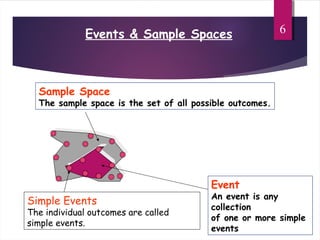
Sample Space
The sample space is the set of all possible outcomes.
Simple Events
The individual outcomes are called
simple events.
Event
An event is any
collection
of one or more simple
events
Example
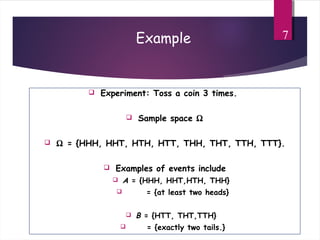
 Experiment: Toss a coin 3 times.
 Sample space Ω
 Ω = {HHH, HHT, HTH, HTT, THH, THT, TTH, TTT}.
 Examples of events include
 A = {HHH, HHT,HTH, THH}
 = {at least two heads}
 B = {HTT, THT,TTH}
 = {exactly two tails.}
7
Basic Concepts (from Set Theory)
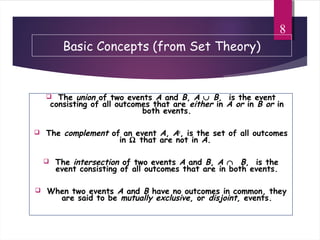
 The union of two events A and B, A ∪ B, is the event
consisting of all outcomes that are either in A or in B or in
both events.
 The complement of an event A, Ac
, is the set of all outcomes
in Ω that are not in A.
 The intersection of two events A and B, A ∩ B, is the
event consisting of all outcomes that are in both events.
 When two events A and B have no outcomes in common, they
are said to be mutually exclusive, or disjoint, events.
8
Example
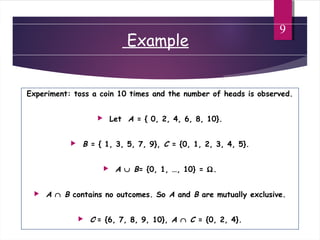
Experiment: toss a coin 10 times and the number of heads is observed.
 Let A = { 0, 2, 4, 6, 8, 10}.
 B = { 1, 3, 5, 7, 9}, C = {0, 1, 2, 3, 4, 5}.
 A ∪ B= {0, 1, …, 10} = Ω.
 A ∩ B contains no outcomes. So A and B are mutually exclusive.
 Cc
= {6, 7, 8, 9, 10}, A ∩ C = {0, 2, 4}.
9
Rules
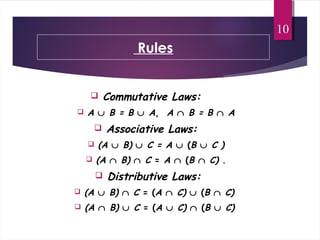
 Commutative Laws:
 A ∪ B = B ∪ A, A ∩ B = B ∩ A
 Associative Laws:
 (A ∪ B) ∪ C = A ∪ (B ∪ C )
 (A ∩ B) ∩ C = A ∩ (B ∩ C) .
 Distributive Laws:
 (A ∪ B) ∩ C = (A ∩ C) ∪ (B ∩ C)
 (A ∩ B) ∪ C = (A ∪ C) ∩ (B ∪ C)
10
Venn Diagram
Ω
11
A BA∩B
Probability
 A Probability is a number assigned to each subset (events)
of a sample space Ω.
 Probability distributions satisfy the following rules:
12
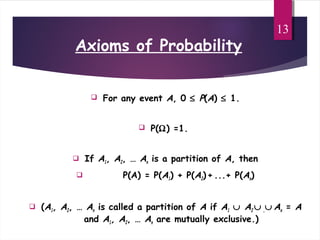
Axioms of Probability
 For any event A, 0 ≤ P(A) ≤ 1.
 P(Ω) =1.
 If A1, A2, … An is a partition of A, then
 P(A) = P(A1) + P(A2)+...+ P(An)
 (A1, A2, … An is called a partition of A if A1 ∪ A2 ∪ …∪ An = A
and A1, A2, … An are mutually exclusive.)
13
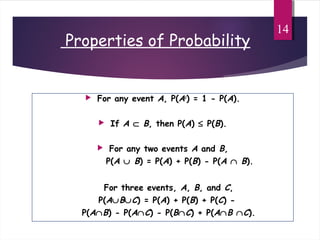
Properties of Probability
 For any event A, P(Ac
) = 1 - P(A).
 If A ⊂ B, then P(A) ≤ P(B).
 For any two events A and B,
P(A ∪ B) = P(A) + P(B) - P(A ∩ B).
For three events, A, B, and C,
P(A∪B∪C) = P(A) + P(B) + P(C) -
P(A∩B) - P(A∩C) - P(B∩C) + P(A∩B ∩C).
14
Example
 In a certain population, 10% of the people are rich, 5% are
famous, and 3% are both rich and famous. A person is
randomly selected from this population. What is the chance
that the person is
 not rich?
 rich but not famous?
 either rich or famous?
15
Here We Go Again: Not So Basic
Probability
16
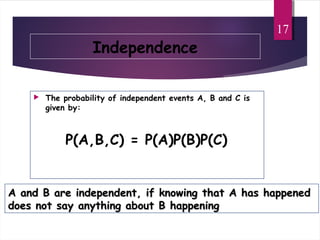
Independence
 The probability of independent events A, B and C is
given by:
P(A,B,C) = P(A)P(B)P(C)
17
A and B are independent, if knowing that A has happenedA and B are independent, if knowing that A has happened
does not say anything about B happeningdoes not say anything about B happening
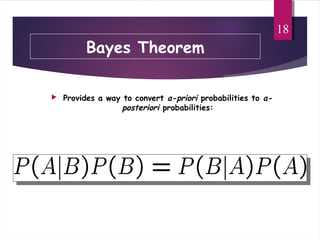
Bayes Theorem
 Provides a way to convert a-priori probabilities to a-
posteriori probabilities:
18
Conditional Probability
 One of the most useful concepts!
19
AA
BB
ΩΩ
THANK YOU ALL
20

Basic concept of probability

  • 1.
  • 2.
    Basic Concept ofProbability 2 Topic:
  • 3.
    Introduction  Probability isthe study of randomness and uncertainty.  In the early days, probability was associated with games of chance (gambling). 3
  • 4.
    Simple Games InvolvingProbability Game: A fair die is rolled. If the result is 2, 3, or 4, you win $1; if it is 5, you win $2; but if it is 1 or 6, you lose $3. Should we play this game? 4
  • 5.
    Random Experiment  arandom experiment is a process whose outcome is uncertain. Examples:  Tossing a coin once or several times  Picking a card or cards from a deck  Measuring temperature of patients 5
  • 6.
    Events & SampleSpaces 6 Sample Space The sample space is the set of all possible outcomes. Simple Events The individual outcomes are called simple events. Event An event is any collection of one or more simple events
  • 7.
    Example  Experiment: Tossa coin 3 times.  Sample space Ω  Ω = {HHH, HHT, HTH, HTT, THH, THT, TTH, TTT}.  Examples of events include  A = {HHH, HHT,HTH, THH}  = {at least two heads}  B = {HTT, THT,TTH}  = {exactly two tails.} 7
  • 8.
    Basic Concepts (fromSet Theory)  The union of two events A and B, A ∪ B, is the event consisting of all outcomes that are either in A or in B or in both events.  The complement of an event A, Ac , is the set of all outcomes in Ω that are not in A.  The intersection of two events A and B, A ∩ B, is the event consisting of all outcomes that are in both events.  When two events A and B have no outcomes in common, they are said to be mutually exclusive, or disjoint, events. 8
  • 9.
    Example Experiment: toss acoin 10 times and the number of heads is observed.  Let A = { 0, 2, 4, 6, 8, 10}.  B = { 1, 3, 5, 7, 9}, C = {0, 1, 2, 3, 4, 5}.  A ∪ B= {0, 1, …, 10} = Ω.  A ∩ B contains no outcomes. So A and B are mutually exclusive.  Cc = {6, 7, 8, 9, 10}, A ∩ C = {0, 2, 4}. 9
  • 10.
    Rules  Commutative Laws: A ∪ B = B ∪ A, A ∩ B = B ∩ A  Associative Laws:  (A ∪ B) ∪ C = A ∪ (B ∪ C )  (A ∩ B) ∩ C = A ∩ (B ∩ C) .  Distributive Laws:  (A ∪ B) ∩ C = (A ∩ C) ∪ (B ∩ C)  (A ∩ B) ∪ C = (A ∪ C) ∩ (B ∪ C) 10
  • 11.
  • 12.
    Probability  A Probabilityis a number assigned to each subset (events) of a sample space Ω.  Probability distributions satisfy the following rules: 12
  • 13.
    Axioms of Probability For any event A, 0 ≤ P(A) ≤ 1.  P(Ω) =1.  If A1, A2, … An is a partition of A, then  P(A) = P(A1) + P(A2)+...+ P(An)  (A1, A2, … An is called a partition of A if A1 ∪ A2 ∪ …∪ An = A and A1, A2, … An are mutually exclusive.) 13
  • 14.
    Properties of Probability For any event A, P(Ac ) = 1 - P(A).  If A ⊂ B, then P(A) ≤ P(B).  For any two events A and B, P(A ∪ B) = P(A) + P(B) - P(A ∩ B). For three events, A, B, and C, P(A∪B∪C) = P(A) + P(B) + P(C) - P(A∩B) - P(A∩C) - P(B∩C) + P(A∩B ∩C). 14
  • 15.
    Example  In acertain population, 10% of the people are rich, 5% are famous, and 3% are both rich and famous. A person is randomly selected from this population. What is the chance that the person is  not rich?  rich but not famous?  either rich or famous? 15
  • 16.
    Here We GoAgain: Not So Basic Probability 16
  • 17.
    Independence  The probabilityof independent events A, B and C is given by: P(A,B,C) = P(A)P(B)P(C) 17 A and B are independent, if knowing that A has happenedA and B are independent, if knowing that A has happened does not say anything about B happeningdoes not say anything about B happening
  • 18.
    Bayes Theorem  Providesa way to convert a-priori probabilities to a- posteriori probabilities: 18
  • 19.
    Conditional Probability  Oneof the most useful concepts! 19 AA BB ΩΩ
  • 20.

Editor's Notes