
NADEEM UDDIN
ASSOCIATE PROFESSOR
OF STATISTICS
BINOMIAL PROBABILITY
DISTRIBUTION
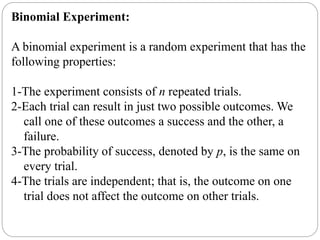
Binomial Experiment:
A binomial experiment is a random experiment that has the
following properties:
1-The experiment consists of n repeated trials.
2-Each trial can result in just two possible outcomes. We
call one of these outcomes a success and the other, a
failure.
3-The probability of success, denoted by p, is the same on
every trial.
4-The trials are independent; that is, the outcome on one
trial does not affect the outcome on other trials.
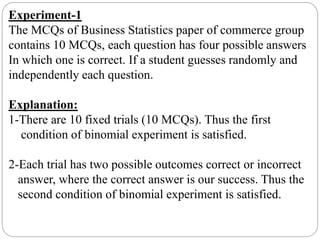
Experiment-1
The MCQs of Business Statistics paper of commerce group
contains 10 MCQs, each question has four possible answers
In which one is correct. If a student guesses randomly and
independently each question.
Explanation:
1-There are 10 fixed trials (10 MCQs). Thus the first
condition of binomial experiment is satisfied.
2-Each trial has two possible outcomes correct or incorrect
answer, where the correct answer is our success. Thus the
second condition of binomial experiment is satisfied.
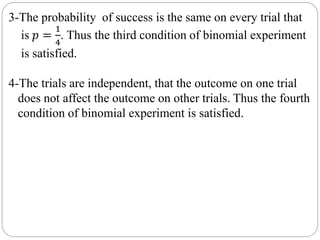
3-The probability of success is the same on every trial that
is 𝑝 =
1
4
. Thus the third condition of binomial experiment
is satisfied.
4-The trials are independent, that the outcome on one trial
does not affect the outcome on other trials. Thus the fourth
condition of binomial experiment is satisfied.
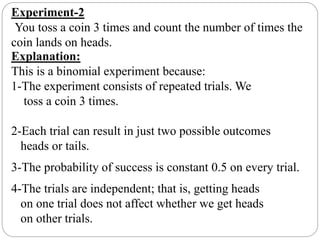
Experiment-2
You toss a coin 3 times and count the number of times the
coin lands on heads.
Explanation:
This is a binomial experiment because:
1-The experiment consists of repeated trials. We
toss a coin 3 times.
2-Each trial can result in just two possible outcomes
heads or tails.
3-The probability of success is constant 0.5 on every trial.
4-The trials are independent; that is, getting heads
on one trial does not affect whether we get heads
on other trials.
Binomial Random Variable:
A binomial random variable is the number of successes x in n
repeated trials of a binomial experiment. The binomial random can
assume n+1 integer value that is 0 to n.
Binomial Distribution:
The probability distribution of a binomial random variable is called
a binomial distribution .
Suppose we toss a coin 3 times and count the number of heads
(successes). The binomial random variable is the number of heads,
which can take on values of 0, 1, 2 or 3. The binomial distribution
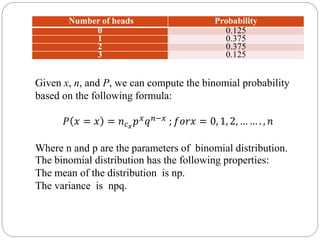
is presented below.
Given x, n, and P, we can compute the binomial probability
based on the following formula:
𝑃 𝑥 = 𝑥 = 𝑛 𝑐 𝑥
𝑝 𝑥 𝑞 𝑛−𝑥 ; 𝑓𝑜𝑟𝑥 = 0, 1, 2, … … . , 𝑛
Where n and p are the parameters of binomial distribution.
The binomial distribution has the following properties:
The mean of the distribution is np.
The variance is npq.
Number of heads Probability
0 0.125
1 0.375
2 0.375
3 0.125
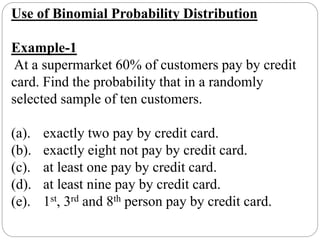
Use of Binomial Probability Distribution
Example-1
At a supermarket 60% of customers pay by credit
card. Find the probability that in a randomly
selected sample of ten customers.
(a). exactly two pay by credit card.
(b). exactly eight not pay by credit card.
(c). at least one pay by credit card.
(d). at least nine pay by credit card.
(e). 1st, 3rd and 8th person pay by credit card.
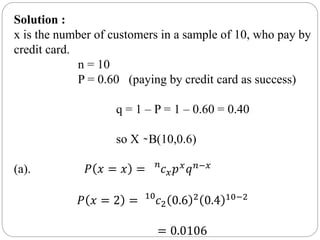
Solution :
x is the number of customers in a sample of 10, who pay by
credit card.
n = 10
P = 0.60 (paying by credit card as success)
q = 1 – P = 1 – 0.60 = 0.40
so X ̴ B(10,0.6)
(a). 𝑃 𝑥 = 𝑥 = 𝑛
𝑐 𝑥 𝑝 𝑥
𝑞 𝑛−𝑥
𝑃 𝑥 = 2 = 10
𝑐2 0.6 2
0.4 10−2
= 0.0106
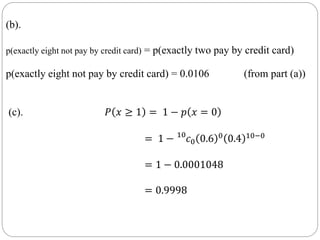
(b).
p(exactly eight not pay by credit card) = p(exactly two pay by credit card)
p(exactly eight not pay by credit card) = 0.0106 (from part (a))
(c). 𝑃 𝑥 ≥ 1 = 1 − 𝑝 𝑥 = 0
= 1 − 10
𝑐0 0.6 0 0.4 10−0
= 1 − 0.0001048
= 0.9998
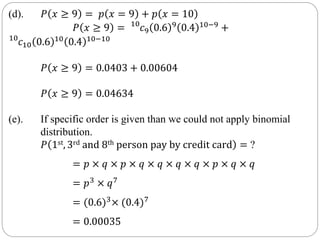
(d). 𝑃 𝑥 ≥ 9 = 𝑝 𝑥 = 9 + 𝑝 𝑥 = 10
𝑃 𝑥 ≥ 9 = 10
𝑐9 0.6 9
0.4 10−9
+
10
𝑐10 0.6 10 0.4 10−10
𝑃 𝑥 ≥ 9 = 0.0403 + 0.00604
𝑃 𝑥 ≥ 9 = 0.04634
(e). If specific order is given than we could not apply binomial
distribution.
𝑃 1st, 3rd and 8th person pay by credit card = ?
= 𝑝 × 𝑞 × 𝑝 × 𝑞 × 𝑞 × 𝑞 × 𝑞 × 𝑝 × 𝑞 × 𝑞
= 𝑝3 × 𝑞7
= (0.6)3
× (0.4)7
= 0.00035
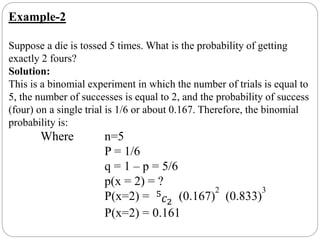
Example-2
Suppose a die is tossed 5 times. What is the probability of getting
exactly 2 fours?
Solution:
This is a binomial experiment in which the number of trials is equal to
5, the number of successes is equal to 2, and the probability of success
(four) on a single trial is 1/6 or about 0.167. Therefore, the binomial
probability is:
Where n=5
P = 1/6
q = 1 – p = 5/6
p(x = 2) = ?
P(x=2) = 5
𝑐2
(0.167)
2
(0.833)
3
P(x=2) = 0.161
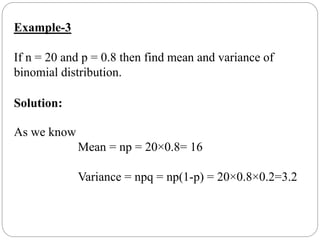
Example-3
If n = 20 and p = 0.8 then find mean and variance of
binomial distribution.
Solution:
As we know
Mean = np = 20×0.8= 16
Variance = npq = np(1-p) = 20×0.8×0.2=3.2
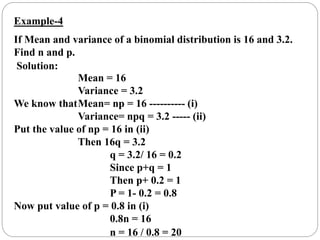
Example-4
If Mean and variance of a binomial distribution is 16 and 3.2.
Find n and p.
Solution:
Mean = 16
Variance = 3.2
We know thatMean= np = 16 ---------- (i)
Variance= npq = 3.2 ----- (ii)
Put the value of np = 16 in (ii)
Then 16q = 3.2
q = 3.2/ 16 = 0.2
Since p+q = 1
Then p+ 0.2 = 1
P = 1- 0.2 = 0.8
Now put value of p = 0.8 in (i)
0.8n = 16
n = 16 / 0.8 = 20

Binomial probability distribution

  • 1.
    NADEEM UDDIN ASSOCIATE PROFESSOR OFSTATISTICS BINOMIAL PROBABILITY DISTRIBUTION
  • 2.
    Binomial Experiment: A binomialexperiment is a random experiment that has the following properties: 1-The experiment consists of n repeated trials. 2-Each trial can result in just two possible outcomes. We call one of these outcomes a success and the other, a failure. 3-The probability of success, denoted by p, is the same on every trial. 4-The trials are independent; that is, the outcome on one trial does not affect the outcome on other trials.
  • 3.
    Experiment-1 The MCQs ofBusiness Statistics paper of commerce group contains 10 MCQs, each question has four possible answers In which one is correct. If a student guesses randomly and independently each question. Explanation: 1-There are 10 fixed trials (10 MCQs). Thus the first condition of binomial experiment is satisfied. 2-Each trial has two possible outcomes correct or incorrect answer, where the correct answer is our success. Thus the second condition of binomial experiment is satisfied.
  • 4.
    3-The probability ofsuccess is the same on every trial that is 𝑝 = 1 4 . Thus the third condition of binomial experiment is satisfied. 4-The trials are independent, that the outcome on one trial does not affect the outcome on other trials. Thus the fourth condition of binomial experiment is satisfied.
  • 5.
    Experiment-2 You toss acoin 3 times and count the number of times the coin lands on heads. Explanation: This is a binomial experiment because: 1-The experiment consists of repeated trials. We toss a coin 3 times. 2-Each trial can result in just two possible outcomes heads or tails. 3-The probability of success is constant 0.5 on every trial. 4-The trials are independent; that is, getting heads on one trial does not affect whether we get heads on other trials.
  • 6.
    Binomial Random Variable: Abinomial random variable is the number of successes x in n repeated trials of a binomial experiment. The binomial random can assume n+1 integer value that is 0 to n. Binomial Distribution: The probability distribution of a binomial random variable is called a binomial distribution . Suppose we toss a coin 3 times and count the number of heads (successes). The binomial random variable is the number of heads, which can take on values of 0, 1, 2 or 3. The binomial distribution is presented below.
  • 7.
    Given x, n,and P, we can compute the binomial probability based on the following formula: 𝑃 𝑥 = 𝑥 = 𝑛 𝑐 𝑥 𝑝 𝑥 𝑞 𝑛−𝑥 ; 𝑓𝑜𝑟𝑥 = 0, 1, 2, … … . , 𝑛 Where n and p are the parameters of binomial distribution. The binomial distribution has the following properties: The mean of the distribution is np. The variance is npq. Number of heads Probability 0 0.125 1 0.375 2 0.375 3 0.125
  • 8.
    Use of BinomialProbability Distribution Example-1 At a supermarket 60% of customers pay by credit card. Find the probability that in a randomly selected sample of ten customers. (a). exactly two pay by credit card. (b). exactly eight not pay by credit card. (c). at least one pay by credit card. (d). at least nine pay by credit card. (e). 1st, 3rd and 8th person pay by credit card.
  • 9.
    Solution : x isthe number of customers in a sample of 10, who pay by credit card. n = 10 P = 0.60 (paying by credit card as success) q = 1 – P = 1 – 0.60 = 0.40 so X ̴ B(10,0.6) (a). 𝑃 𝑥 = 𝑥 = 𝑛 𝑐 𝑥 𝑝 𝑥 𝑞 𝑛−𝑥 𝑃 𝑥 = 2 = 10 𝑐2 0.6 2 0.4 10−2 = 0.0106
  • 10.
    (b). p(exactly eight notpay by credit card) = p(exactly two pay by credit card) p(exactly eight not pay by credit card) = 0.0106 (from part (a)) (c). 𝑃 𝑥 ≥ 1 = 1 − 𝑝 𝑥 = 0 = 1 − 10 𝑐0 0.6 0 0.4 10−0 = 1 − 0.0001048 = 0.9998
  • 11.
    (d). 𝑃 𝑥≥ 9 = 𝑝 𝑥 = 9 + 𝑝 𝑥 = 10 𝑃 𝑥 ≥ 9 = 10 𝑐9 0.6 9 0.4 10−9 + 10 𝑐10 0.6 10 0.4 10−10 𝑃 𝑥 ≥ 9 = 0.0403 + 0.00604 𝑃 𝑥 ≥ 9 = 0.04634 (e). If specific order is given than we could not apply binomial distribution. 𝑃 1st, 3rd and 8th person pay by credit card = ? = 𝑝 × 𝑞 × 𝑝 × 𝑞 × 𝑞 × 𝑞 × 𝑞 × 𝑝 × 𝑞 × 𝑞 = 𝑝3 × 𝑞7 = (0.6)3 × (0.4)7 = 0.00035
  • 12.
    Example-2 Suppose a dieis tossed 5 times. What is the probability of getting exactly 2 fours? Solution: This is a binomial experiment in which the number of trials is equal to 5, the number of successes is equal to 2, and the probability of success (four) on a single trial is 1/6 or about 0.167. Therefore, the binomial probability is: Where n=5 P = 1/6 q = 1 – p = 5/6 p(x = 2) = ? P(x=2) = 5 𝑐2 (0.167) 2 (0.833) 3 P(x=2) = 0.161
  • 13.
    Example-3 If n =20 and p = 0.8 then find mean and variance of binomial distribution. Solution: As we know Mean = np = 20×0.8= 16 Variance = npq = np(1-p) = 20×0.8×0.2=3.2
  • 14.
    Example-4 If Mean andvariance of a binomial distribution is 16 and 3.2. Find n and p. Solution: Mean = 16 Variance = 3.2 We know thatMean= np = 16 ---------- (i) Variance= npq = 3.2 ----- (ii) Put the value of np = 16 in (ii) Then 16q = 3.2 q = 3.2/ 16 = 0.2 Since p+q = 1 Then p+ 0.2 = 1 P = 1- 0.2 = 0.8 Now put value of p = 0.8 in (i) 0.8n = 16 n = 16 / 0.8 = 20