The Plant Kingdom
Key Features of Plants Multicellularity  Ability to photosynthesize (most) Exhibit  alternation of generations  (a multicellular diploid generation alternates with a multicellular haploid generation)
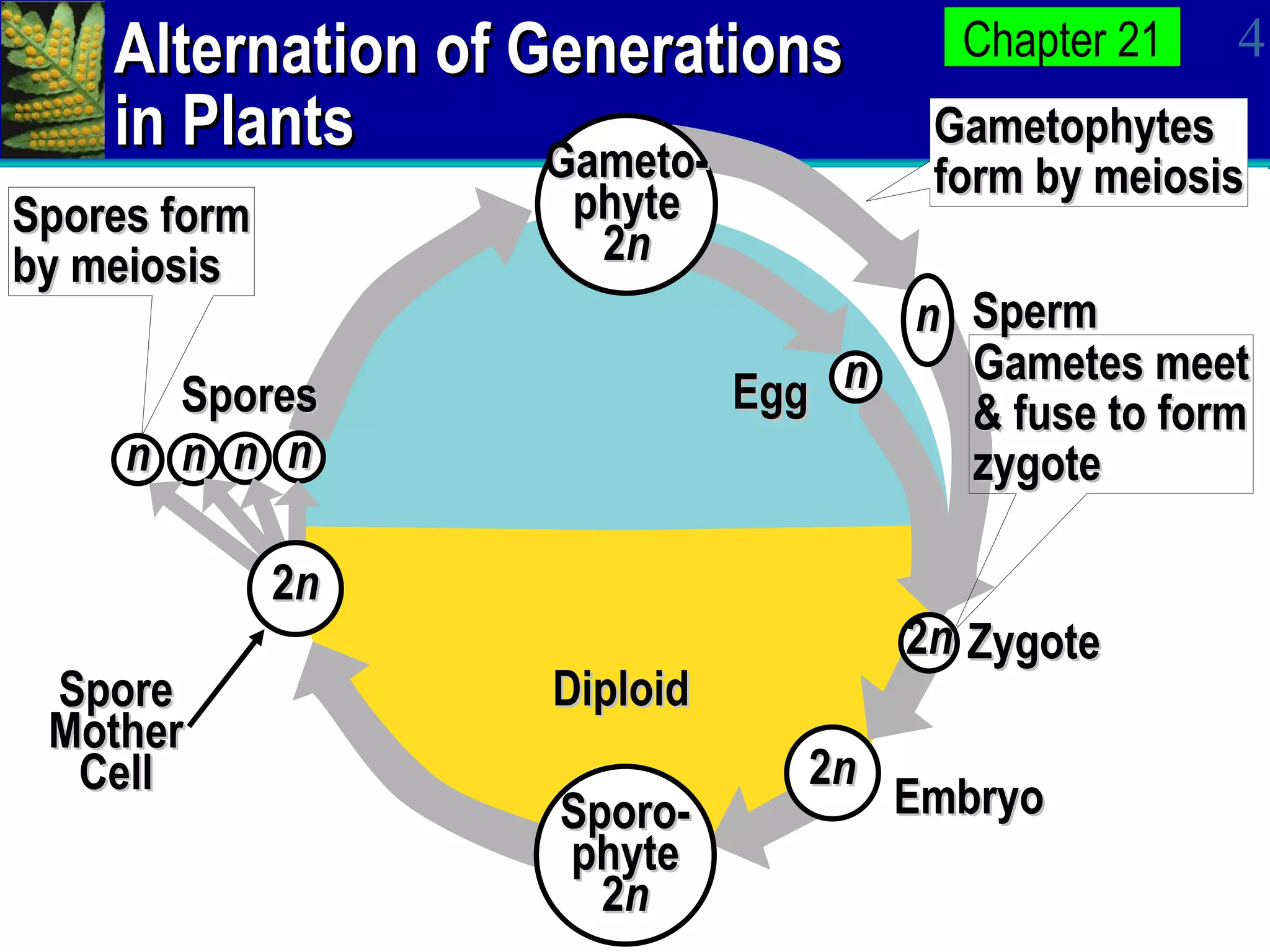
Alternation of Generations Diploid  sporophyte  plant produces haploid spores through meiosis Spores divide by mitosis and develop into haploid gametophyte plants Haploid  gametophyte  plant produces haploid gametes through mitosis Gametes fuse to form diploid  zygotes , which divide by mitosis and develop into diploid sporophytes
Alternation of Generations in Plants Gametophytes form by meiosis Spores form by meiosis n n n Spore Mother Cell Egg Sperm Gametes meet & fuse to form zygote Zygote Embryo Sporo- phyte 2 n Spores n Gameto- phyte 2 n n n 2 n 2 n 2 n Haploid Diploid
Evolution of Plants The evolutionary origin of plants Division Rhodophyta—red algae Division Phaeophyta—brown algae Division Chlorophyta—green algae and the origin of land plants
Green Algae Several lines of evidence support the hypothesis that green algae gave rise to plants DNA comparisons show that green algae are plants’ closest living relatives Both use the same type of chlorophyll and accessory pigments in photosynthesis Both store food as starch Both have cell walls made of cellulose
Fresh Water Ancestors Most green algae live in fresh water, suggesting that early plants evolved in freshwater habitats Early green algae must have evolved characteristics to withstand the challenges of fresh water habitats, e.g. temperature extremes, periods of dryness These adaptations provided a foundation for  descendants to evolve traits for life on land
The Evolution of Land Plants Roots and rootlike structures (anchor & absorb) Vascular tissue for transport of water & nutrients Stiffening substance (lignin) for support Waxy covering (cuticle) limits evaporation Stomatal pores Mediate gas exchange Regulate water vapor loss Evolutionary adaptations in plant reproduction Early algae relied on water currents for fertilization Dry land adaptation include the generation of pollen, seeds, flowers, and fruit… Adaptations in the alternation of generations…
Reproduction Without Water Pollen A reduced male gametophyte that allows wind (instead of water) to carry sperm to eggs Seeds Nourish, protect, and help disperse developing embryos Flowers Attract pollinators  Fruits Attract animals to disperse seeds
Major Groups of Plants Bryophytes  ( nonvascular plants ) Lack well-developed structures for conducting water and nutrients Tracheophytes  ( Vascular plants  ) Have a complex vascular system
Evolutionary Tree of Major Plant Groups Ancestral Algae Liver- worts Mosses True vascular tissue & lignin appear Ferns Gymno- sperms Seeds and pollen appear Flowers & Fruits appear Angio- sperms Bryophytes Seed Plants Tracheophytes
The Bryophytes Nonvascular plants No true roots, leaves, and stems Still require a moist environment Anchoring rhizoids absorb water & nutrients Reproductive structures protect gametes Still depend on water for fertilization Dominant gametophyte generation
Liverworts & Mosses Liverworts Female Gametophyte Archegonium (a) Mosses Female Gametophytes Sporophytes (b)
The Bryophytes: Reproduction Gametes develop within protected structures on gametophyte Archegonia  (singular, archegonium) produce eggs Antheridia  (singular, antheridium) produce sperm Archegonia and antheridia may be located on the same plant or on different plants
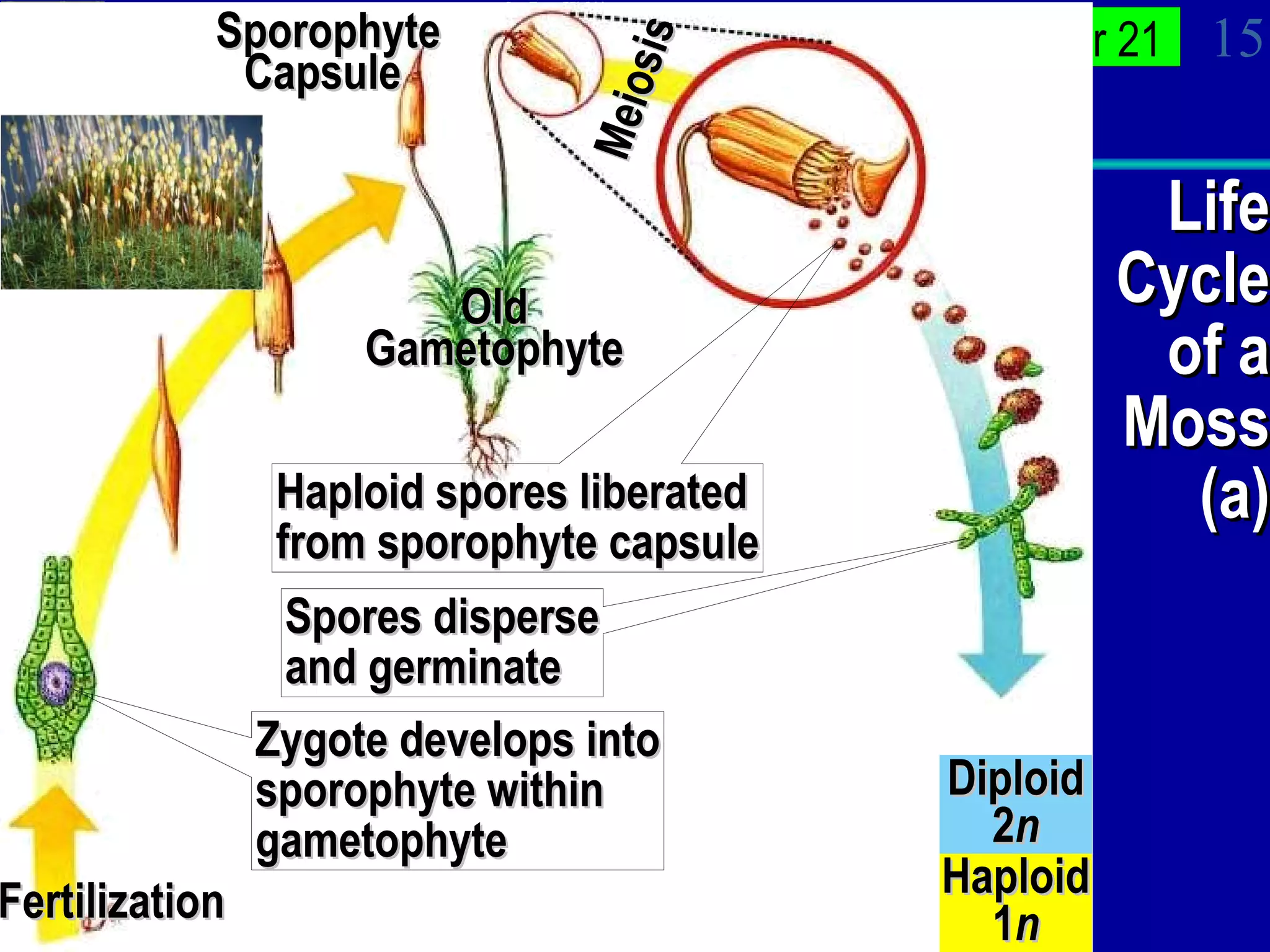
Life Cycle of a Moss (a) Zygote develops into sporophyte within gametophyte Sporophyte Capsule  Fertilization  Meiosis  Haploid spores liberated from sporophyte capsule Old Gametophyte Spores disperse and germinate Haploid 1 n Diploid 2 n
Life Cycle of a Moss (b) Haploid 1 n Diploid 2 n Spore germinates into gametophyte Leafy Gametophyte Archegonium produces egg Antheridium produces sperm Sperm swim to egg Fertilization
The Vascular Plants Have roots, stems, and leaves Have  vessels  impregnated with the stiffening agent lignin Sporophyte generation is dominant Include the seedless vascular plants and the seed plants
Division Tracheophyta: Vascular Plants Adapted to life in drier conditions Had to generate body support Vessels to conduct water and nutrients A stiffening substance called lignin Seedless plants: club mosses, horsetails, and ferns Sporophyte generation more dominant Fertilization still relies on water
Life Cycle of Ferns (a) Haploid 1 n Diploid 2 n Gametophyte Sporophyte develops from gametophyte Root Stem Sporophyte Masses of Sporangia Meiosis Haploid spores liberated from sporangium Sporangium
Life Cycle of Ferns (b) Haploid 1 n Diploid 2 n Haploid spores liberated from sporangium Spores disperse & germinate Gametophyte Archegonium produces egg Antheridium produces sperm Sperm swim to egg Fertilization
Seedless Plants Club Mosses Horsetails Ferns
Seed Plants: General Dominance of the sporophyte generation Reproductive adaptations Pollen  Wind and pollinators for fertilization Water not required for fertilization Seeds Stores food for embryo Embryo protection for unfavorable environments
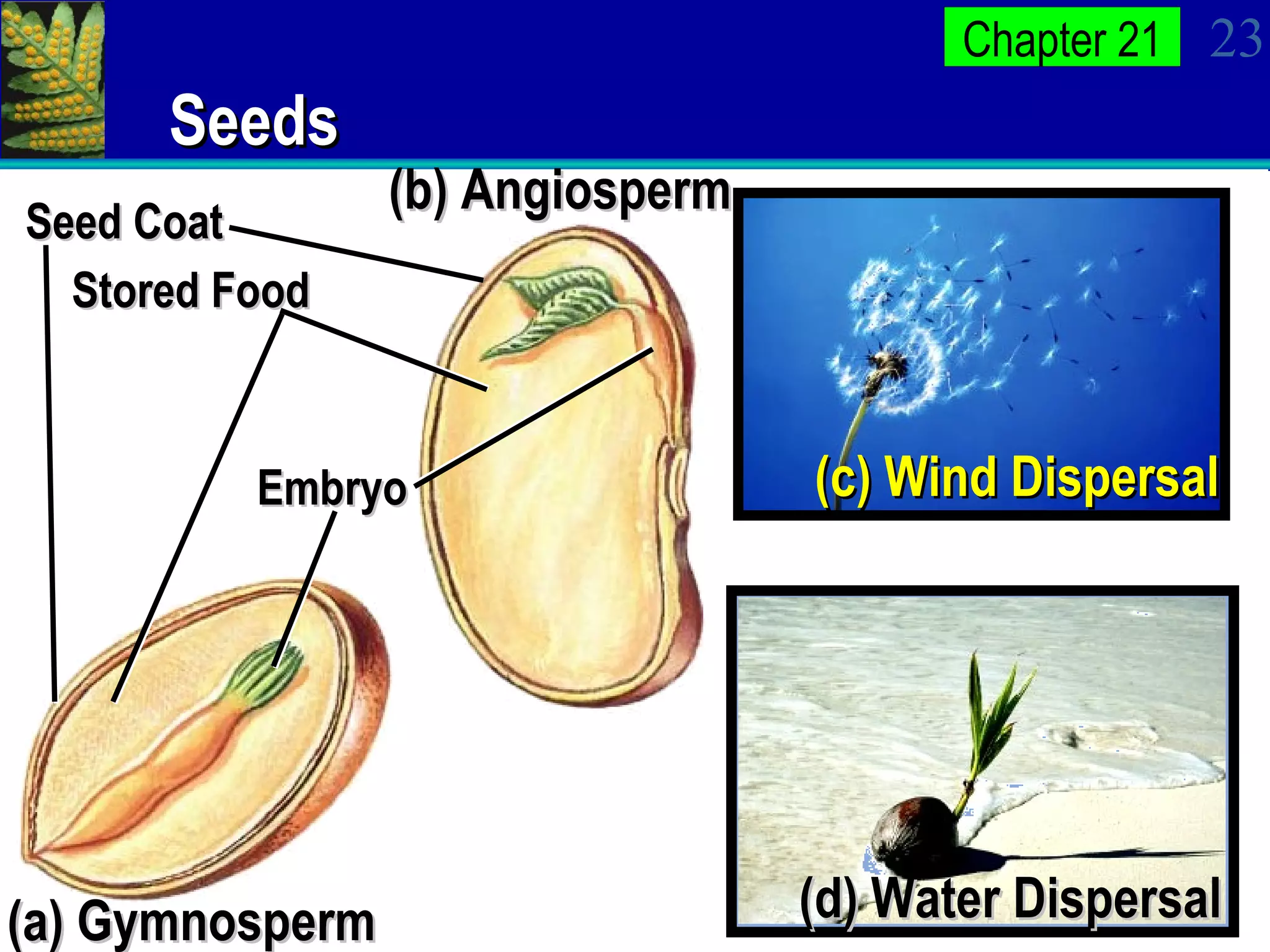
Seeds (a) Gymnosperm (d) Water Dispersal (c) Wind Dispersal Stored Food Embryo Seed Coat (b) Angiosperm
Seed Plants: Gymnosperms Nonflowering seed plants Produce "naked seeds" Three divisions: Coniferophyta Cycadophyta Ginkgophyta Conifers are adapted to dry, cold conditions Thin, waterproof needles to decrease evaporation Evergreen; year-round photosynthesis Produce an "antifreeze" substance in sap
Two Uncommon Gymnosperms (a) Gingko (b) A Cycad – either  male or female
Gymnosperms: Conifers Adapted to dry, cold conditions: Retain green leaves throughout the year (evergreen) Thin, needle-like leaves covered with waterproofing material to reduce evaporation Produce an  “antifreeze” in sap
Life Cycle of the Pine (a)  Haploid 1 n Diploid 2 n Mature Sporophyte Seedlings (Sporophyte) Male Cone Male Scale MEIOSIS Male gametophytes (pollen) liberated Female Cone Female Scale Ovule Spore-forming Cell MEIOSIS
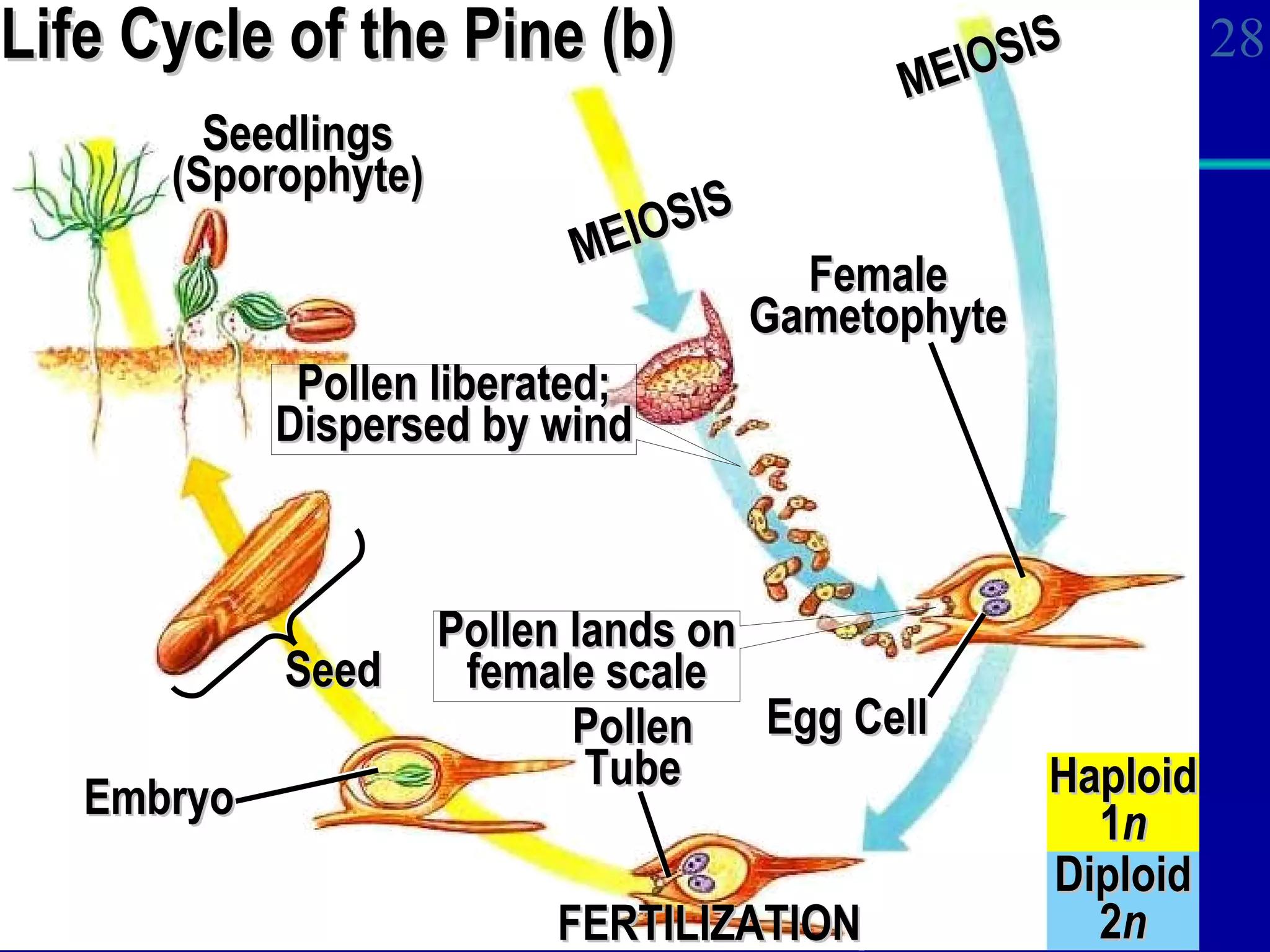
Life Cycle of the Pine (b) Haploid 1 n Diploid 2 n MEIOSIS Pollen liberated; Dispersed by wind MEIOSIS Seedlings (Sporophyte) Egg Cell Female Gametophyte Pollen lands on female scale Pollen Tube FERTILIZATION Seed Embryo
Seed Plants: Angiosperms Flowering seed plants The dominant plant form on Earth Major evolutionary adaptations Flowers to attract pollinators Fruit to protect seeds and developing embryo Broad leaves Increase photosynthesis during the growing season Shed during periods of cold and drought
Monocot vs Dicot Class Monocotyledoneae (monocots): grasses, grains, corn 1 cotyledon leave veins in parallel lines Flower parts, in multiple of 3 scattered vascular bundles Class Dicotyledoneae (dicots): hardwood trees, shrubs, and herbs 2 cotyledons, web-like veins, flower  petals in 4/5s, ringed vascular bundles
 
Flowers Flowers  are reproductive structures in which both male and female gametophytes are formed Believed to have evolved when gymnosperm ancestors formed an association with animals Animals benefited by eating some of the protein-rich pollen Plants benefited by using animals as pollinators Most flowers are showy and attract animal pollinators (e.g. insects)
Life Cycle of a Flowering Plant (a) Fruit Seed Food Embryo Seed Coat Seedling Flower Anther MEIOSIS Ovary Ovule Spore-forming Cell Haploid 1 n Diploid 2 n
Life Cycle of a Flowering Plant (b) Fruit MEIOSIS MEIOSIS Spore Female Gametophyte Egg Cell Pollen (male gametophyte) Stigma Pollen Tube Sperm Nuclei FERTILIZATION Haploid 1 n Diploid 2 n
Fruits Encourage Seed Dispersal Fruits  are mature ovaries that contain developing seeds Various fruit adaptations help disperse seeds Edible fruits entice animals to eat them (seeds pass through digestive tract unharmed) Burrs cling to animal fur Winged fruits are carried through the air
Broad Leaves Broad leaves of angiosperms collect more sunlight for photosynthesis than narrow leaves of gymnosperms Temperate angiosperms drop leaves to conserve water when it is in short supply (fall, winter) Tropical and subtropical angiosperms are evergreen May shed leaves during dry season
Broad Leaves Photosynthetic advantage is offset by fact that broad, tender leaves are more appealing to herbivores than tough, waxy needles of conifers Angiosperm defenses include Physical defenses (thorns, spines, resins) Chemical defenses (make plant tissue poisonous or distasteful)
Crucial Ecological Role Through photosynthesis, plants provide food, directly or indirectly, for all of the animals, fungi, and non-photosynthetic microbes on land Plants produce oxygen gas as a byproduct of photosynthesis, continually replenishing oxygen in the atmosphere
Crucial Ecological Role Plants help create and maintain soil Dead plant material is decomposed by fungi, prokaryotes, and other decomposers Decomposed plant tissue becomes part of the soil, making it more fertile Roots of living plants help hold soil together, preventing erosion by wind and water
Human Necessities and Luxuries Plants provide shelter Wood  is used to construct housing  Plants provide fuel Wood: important fuel for warming and cooking in many parts of the world Coal: derived from the remains of ancient plants that have been transformed by geological processes
Human Necessities and Luxuries Plants provide medicine Many medicines and drugs  were originally found in and extracted from plants, e.g. aspirin, Taxol, morphine Plants provide pleasure Flowers, gardens, and lawns Coffee, tea, and wine
The End

Plant APBio

  • 1.
  • 2.
    Key Features ofPlants Multicellularity Ability to photosynthesize (most) Exhibit alternation of generations (a multicellular diploid generation alternates with a multicellular haploid generation)
  • 3.
    Alternation of GenerationsDiploid sporophyte plant produces haploid spores through meiosis Spores divide by mitosis and develop into haploid gametophyte plants Haploid gametophyte plant produces haploid gametes through mitosis Gametes fuse to form diploid zygotes , which divide by mitosis and develop into diploid sporophytes
  • 4.
    Alternation of Generationsin Plants Gametophytes form by meiosis Spores form by meiosis n n n Spore Mother Cell Egg Sperm Gametes meet & fuse to form zygote Zygote Embryo Sporo- phyte 2 n Spores n Gameto- phyte 2 n n n 2 n 2 n 2 n Haploid Diploid
  • 5.
    Evolution of PlantsThe evolutionary origin of plants Division Rhodophyta—red algae Division Phaeophyta—brown algae Division Chlorophyta—green algae and the origin of land plants
  • 6.
    Green Algae Severallines of evidence support the hypothesis that green algae gave rise to plants DNA comparisons show that green algae are plants’ closest living relatives Both use the same type of chlorophyll and accessory pigments in photosynthesis Both store food as starch Both have cell walls made of cellulose
  • 7.
    Fresh Water AncestorsMost green algae live in fresh water, suggesting that early plants evolved in freshwater habitats Early green algae must have evolved characteristics to withstand the challenges of fresh water habitats, e.g. temperature extremes, periods of dryness These adaptations provided a foundation for descendants to evolve traits for life on land
  • 8.
    The Evolution ofLand Plants Roots and rootlike structures (anchor & absorb) Vascular tissue for transport of water & nutrients Stiffening substance (lignin) for support Waxy covering (cuticle) limits evaporation Stomatal pores Mediate gas exchange Regulate water vapor loss Evolutionary adaptations in plant reproduction Early algae relied on water currents for fertilization Dry land adaptation include the generation of pollen, seeds, flowers, and fruit… Adaptations in the alternation of generations…
  • 9.
    Reproduction Without WaterPollen A reduced male gametophyte that allows wind (instead of water) to carry sperm to eggs Seeds Nourish, protect, and help disperse developing embryos Flowers Attract pollinators Fruits Attract animals to disperse seeds
  • 10.
    Major Groups ofPlants Bryophytes ( nonvascular plants ) Lack well-developed structures for conducting water and nutrients Tracheophytes ( Vascular plants ) Have a complex vascular system
  • 11.
    Evolutionary Tree ofMajor Plant Groups Ancestral Algae Liver- worts Mosses True vascular tissue & lignin appear Ferns Gymno- sperms Seeds and pollen appear Flowers & Fruits appear Angio- sperms Bryophytes Seed Plants Tracheophytes
  • 12.
    The Bryophytes Nonvascularplants No true roots, leaves, and stems Still require a moist environment Anchoring rhizoids absorb water & nutrients Reproductive structures protect gametes Still depend on water for fertilization Dominant gametophyte generation
  • 13.
    Liverworts & MossesLiverworts Female Gametophyte Archegonium (a) Mosses Female Gametophytes Sporophytes (b)
  • 14.
    The Bryophytes: ReproductionGametes develop within protected structures on gametophyte Archegonia (singular, archegonium) produce eggs Antheridia (singular, antheridium) produce sperm Archegonia and antheridia may be located on the same plant or on different plants
  • 15.
    Life Cycle ofa Moss (a) Zygote develops into sporophyte within gametophyte Sporophyte Capsule Fertilization Meiosis Haploid spores liberated from sporophyte capsule Old Gametophyte Spores disperse and germinate Haploid 1 n Diploid 2 n
  • 16.
    Life Cycle ofa Moss (b) Haploid 1 n Diploid 2 n Spore germinates into gametophyte Leafy Gametophyte Archegonium produces egg Antheridium produces sperm Sperm swim to egg Fertilization
  • 17.
    The Vascular PlantsHave roots, stems, and leaves Have vessels impregnated with the stiffening agent lignin Sporophyte generation is dominant Include the seedless vascular plants and the seed plants
  • 18.
    Division Tracheophyta: VascularPlants Adapted to life in drier conditions Had to generate body support Vessels to conduct water and nutrients A stiffening substance called lignin Seedless plants: club mosses, horsetails, and ferns Sporophyte generation more dominant Fertilization still relies on water
  • 19.
    Life Cycle ofFerns (a) Haploid 1 n Diploid 2 n Gametophyte Sporophyte develops from gametophyte Root Stem Sporophyte Masses of Sporangia Meiosis Haploid spores liberated from sporangium Sporangium
  • 20.
    Life Cycle ofFerns (b) Haploid 1 n Diploid 2 n Haploid spores liberated from sporangium Spores disperse & germinate Gametophyte Archegonium produces egg Antheridium produces sperm Sperm swim to egg Fertilization
  • 21.
    Seedless Plants ClubMosses Horsetails Ferns
  • 22.
    Seed Plants: GeneralDominance of the sporophyte generation Reproductive adaptations Pollen Wind and pollinators for fertilization Water not required for fertilization Seeds Stores food for embryo Embryo protection for unfavorable environments
  • 23.
    Seeds (a) Gymnosperm(d) Water Dispersal (c) Wind Dispersal Stored Food Embryo Seed Coat (b) Angiosperm
  • 24.
    Seed Plants: GymnospermsNonflowering seed plants Produce "naked seeds" Three divisions: Coniferophyta Cycadophyta Ginkgophyta Conifers are adapted to dry, cold conditions Thin, waterproof needles to decrease evaporation Evergreen; year-round photosynthesis Produce an "antifreeze" substance in sap
  • 25.
    Two Uncommon Gymnosperms(a) Gingko (b) A Cycad – either male or female
  • 26.
    Gymnosperms: Conifers Adaptedto dry, cold conditions: Retain green leaves throughout the year (evergreen) Thin, needle-like leaves covered with waterproofing material to reduce evaporation Produce an “antifreeze” in sap
  • 27.
    Life Cycle ofthe Pine (a) Haploid 1 n Diploid 2 n Mature Sporophyte Seedlings (Sporophyte) Male Cone Male Scale MEIOSIS Male gametophytes (pollen) liberated Female Cone Female Scale Ovule Spore-forming Cell MEIOSIS
  • 28.
    Life Cycle ofthe Pine (b) Haploid 1 n Diploid 2 n MEIOSIS Pollen liberated; Dispersed by wind MEIOSIS Seedlings (Sporophyte) Egg Cell Female Gametophyte Pollen lands on female scale Pollen Tube FERTILIZATION Seed Embryo
  • 29.
    Seed Plants: AngiospermsFlowering seed plants The dominant plant form on Earth Major evolutionary adaptations Flowers to attract pollinators Fruit to protect seeds and developing embryo Broad leaves Increase photosynthesis during the growing season Shed during periods of cold and drought
  • 30.
    Monocot vs DicotClass Monocotyledoneae (monocots): grasses, grains, corn 1 cotyledon leave veins in parallel lines Flower parts, in multiple of 3 scattered vascular bundles Class Dicotyledoneae (dicots): hardwood trees, shrubs, and herbs 2 cotyledons, web-like veins, flower petals in 4/5s, ringed vascular bundles
  • 31.
  • 32.
    Flowers Flowers are reproductive structures in which both male and female gametophytes are formed Believed to have evolved when gymnosperm ancestors formed an association with animals Animals benefited by eating some of the protein-rich pollen Plants benefited by using animals as pollinators Most flowers are showy and attract animal pollinators (e.g. insects)
  • 33.
    Life Cycle ofa Flowering Plant (a) Fruit Seed Food Embryo Seed Coat Seedling Flower Anther MEIOSIS Ovary Ovule Spore-forming Cell Haploid 1 n Diploid 2 n
  • 34.
    Life Cycle ofa Flowering Plant (b) Fruit MEIOSIS MEIOSIS Spore Female Gametophyte Egg Cell Pollen (male gametophyte) Stigma Pollen Tube Sperm Nuclei FERTILIZATION Haploid 1 n Diploid 2 n
  • 35.
    Fruits Encourage SeedDispersal Fruits are mature ovaries that contain developing seeds Various fruit adaptations help disperse seeds Edible fruits entice animals to eat them (seeds pass through digestive tract unharmed) Burrs cling to animal fur Winged fruits are carried through the air
  • 36.
    Broad Leaves Broadleaves of angiosperms collect more sunlight for photosynthesis than narrow leaves of gymnosperms Temperate angiosperms drop leaves to conserve water when it is in short supply (fall, winter) Tropical and subtropical angiosperms are evergreen May shed leaves during dry season
  • 37.
    Broad Leaves Photosyntheticadvantage is offset by fact that broad, tender leaves are more appealing to herbivores than tough, waxy needles of conifers Angiosperm defenses include Physical defenses (thorns, spines, resins) Chemical defenses (make plant tissue poisonous or distasteful)
  • 38.
    Crucial Ecological RoleThrough photosynthesis, plants provide food, directly or indirectly, for all of the animals, fungi, and non-photosynthetic microbes on land Plants produce oxygen gas as a byproduct of photosynthesis, continually replenishing oxygen in the atmosphere
  • 39.
    Crucial Ecological RolePlants help create and maintain soil Dead plant material is decomposed by fungi, prokaryotes, and other decomposers Decomposed plant tissue becomes part of the soil, making it more fertile Roots of living plants help hold soil together, preventing erosion by wind and water
  • 40.
    Human Necessities andLuxuries Plants provide shelter Wood is used to construct housing Plants provide fuel Wood: important fuel for warming and cooking in many parts of the world Coal: derived from the remains of ancient plants that have been transformed by geological processes
  • 41.
    Human Necessities andLuxuries Plants provide medicine Many medicines and drugs were originally found in and extracted from plants, e.g. aspirin, Taxol, morphine Plants provide pleasure Flowers, gardens, and lawns Coffee, tea, and wine
  • 42.