DNA: Molecule of Heredity
Genes Are Made of DNA Known since the late 1800s: Heritable information is carried in discrete units called  genes  Genes are parts of structures called  chromosomes Chromosomes are made of deoxyribonucleic acid ( DNA ) and  protein
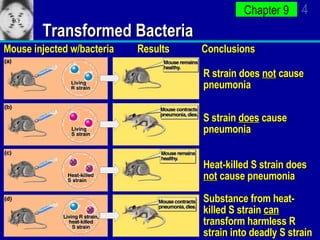
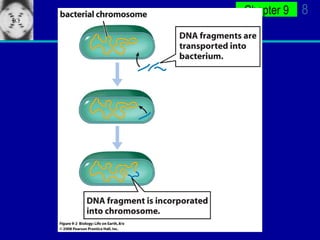
Genes Are Made of DNA Transformed bacteria revealed the link between genes and DNA F. Griffith worked with two strains of  Streptococcus pneumoniae  bacteria S strain caused pneumonia when injected into mice, killing them R strain did not cause pneumonia when injected
Transformed Bacteria Mouse injected w/bacteria Results Conclusions R strain does  not  cause pneumonia S strain  does  cause pneumonia Heat-killed S strain does  not  cause pneumonia Substance from heat-killed S strain  can  transform harmless R strain into deadly S strain
Genes Are Made of DNA Deductions from Griffith’s experiment  (1920s) Living safe bacteria (R strain) were changed by something in the dead (but normally disease-causing) S strain The living R strain bacteria were  transformed  by genetic material released by the S strain
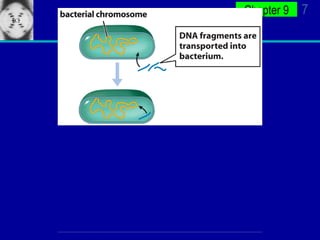
Genes Are Made of DNA Later findings by Avery, MacLeod, and McCarty (1940s) The transforming molecule from the S strain was  DNA
 
 
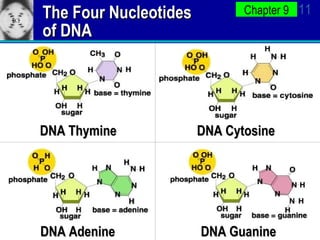
DNA Is Composed of Four Nucleotides DNA is made of chains of small subunits called  nucleotides Each nucleotide has three components: Phosphate group Deoxyribose sugar One of four  nitrogen-containing bases Thymine Cytosine Adenine Guanine
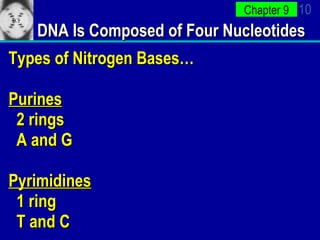
DNA Is Composed of Four Nucleotides Types of Nitrogen Bases… Purines 2 rings A and G Pyrimidines 1 ring T and C
The Four Nucleotides of DNA DNA Thymine DNA Cytosine DNA Guanine DNA Adenine
DNA Is Composed of Four Nucleotides In 1940, biochemist E. Chargaff determined that: In a DNA molecule, amounts of A = T, G = C “ Chargaff’s Rule”
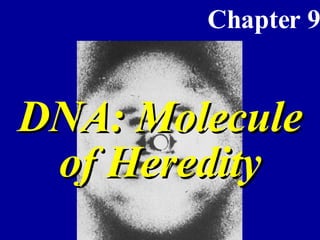
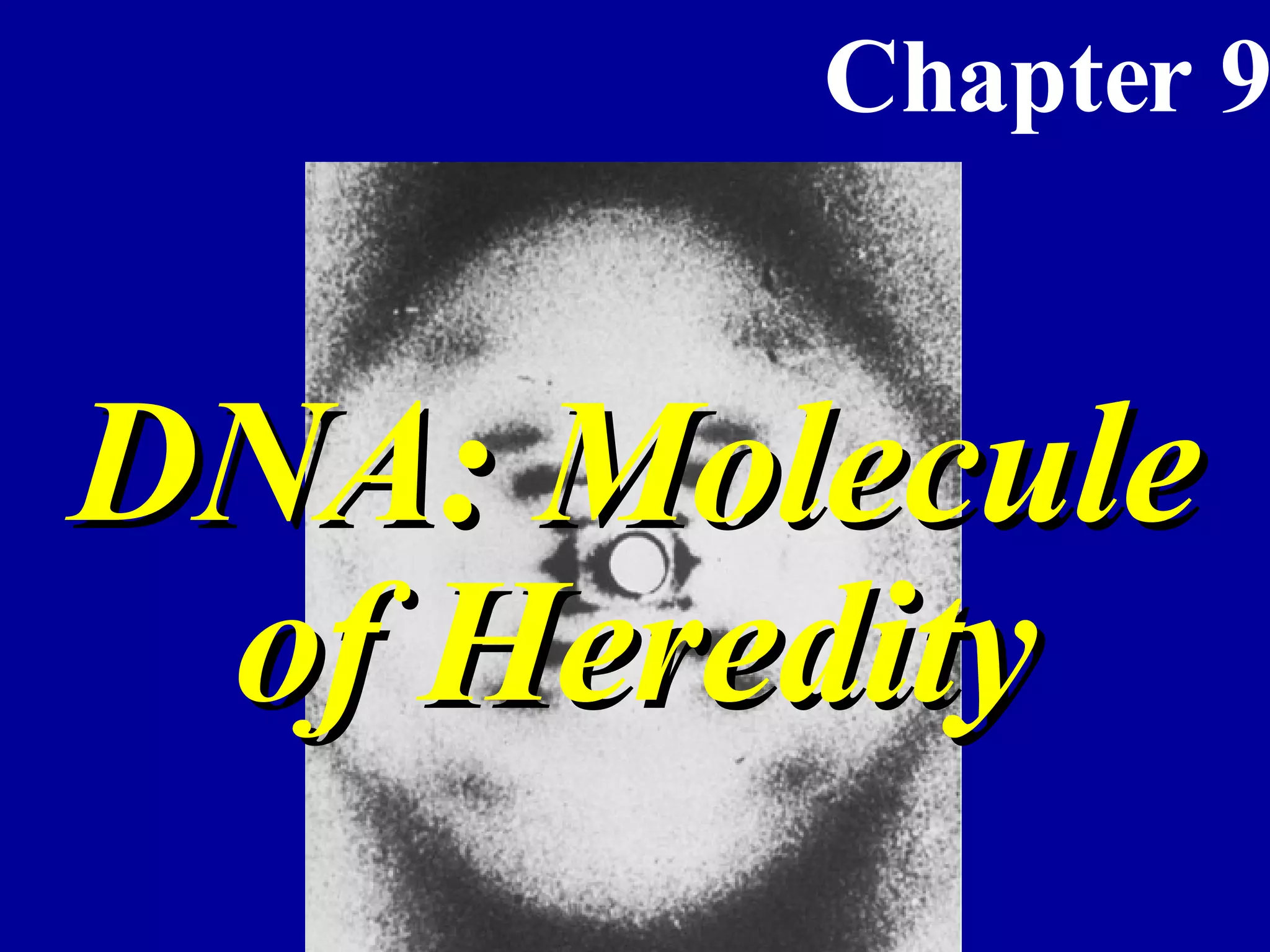
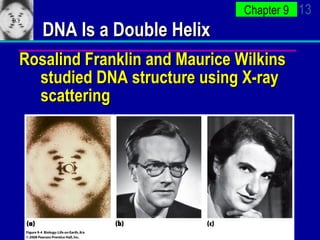
DNA Is a Double Helix Rosalind Franklin and Maurice Wilkins studied DNA structure using X-ray scattering
DNA Is a Double Helix From X-ray diffraction patterns they deduced that DNA … Is long and thin Has a uniform diameter of 2 nanometers  Is helical, and is twisted like a corkscrew Consists of repeating subunits
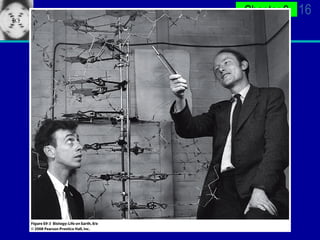
DNA Is a Double Helix James Watson and Francis Crick combined the X-ray data with bonding theory to deduce DNA structure: DNA is made of two strands of nucleotides The deoxyribose and phosphate portions make up the  sugar-phosphate backbone
 
Please don’t admire Dr Watson… He is "inherently gloomy about the prospect of Africa". –October 2007 To him, the real cause of Africa's woes is that black people are inherently less intelligent than other races. "All our social policies are based on the fact that their intelligence is the same as ours — whereas all the testing says not really,"  He hoped that everyone was equal, he continued, but "people who have to deal with black employees find this not true".
Please don’t admire Dr Watson… (Amount of melanin in the skin) was why black people and Latinos had reputations as lovers — something, he said, of which the English could not be accused. -2000 "Whenever you interview fat people, you feel bad because you know you're not going to hire them," -2000 In 1997, he even said a woman should be allowed to abort a fetus if tests had shown it would be a homosexual and the mother deemed this undesirable.
James Watson is AMERICAN.  Not British.  He was born in Chicago.  Studied and researched in London but spent less that 5 years there.  He currently resides at Cold Spring Harbor Lab in Huntington, Long Island NY.  He is currently suspended from the lab he founded due to his remarks.  (Update 10/25/07…he just “retired”) More quotes…
Watson has repeatedly supported genetic screening and genetic engineering in public lectures and interviews, arguing that stupidity is a disease and the "really stupid" bottom 10% of people should be cured He has also suggested that beauty could be genetically engineered, saying "People say it would be terrible if we made all girls pretty. I think it would be great .”
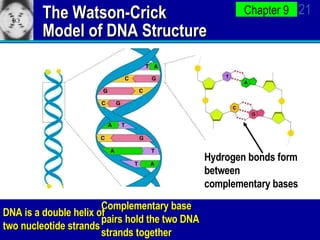
The Watson-Crick Model of DNA Structure Hydrogen bonds form between complementary bases Complementary base pairs hold the two DNA strands together DNA is a double helix of two nucleotide strands
Hydrogen Bonds   Nitrogen-containing bases protrude inward from sugar-phosphate backbone Hydrogen bonds hold certain nitrogenous base pairs together A bonds with T, G bonds with C Bonding bases called  complementary base pairs A and T bond with TWO Hydrogen bonds G and C bond with THREE Hydro. bonds
How Does DNA Encode Information? How can a molecule with only 4 simple parts be the carrier of genetic information? The key lies in the  sequence , not  number , of subunits Within a DNA strand, the four types of bases can be arranged in any linear order, and this sequence is what encodes genetic information
How Does DNA Encode Information? The genetic code is analogous to languages, where small sets of letters combine in various ways to make up many different words English has 26 letters Hawaiian has 12 letters The binary language of computers uses only 2 “letters” (0 and 1, or “on” and “off”)
How Does DNA Encode Information? The sequence of only four nucleotides can produce many different combinations A 10 nucleotide sequence can code for greater than 1 million different combinations
DNA Replication All cells come from pre-existing cells Cells reproduce by dividing in half Each of two daughter cells gets an exact copy of parent cell’s genetic information Duplication of the parent cell DNA is called  replication
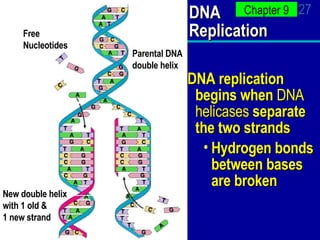
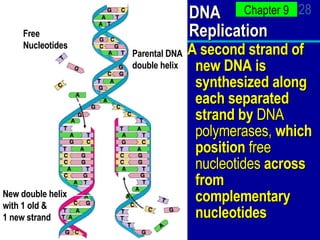
DNA Replication DNA replication begins when  DNA helicases  separate the two strands Hydrogen bonds between bases are broken Parental DNA  double helix New double helix with 1 old & 1 new strand Free Nucleotides
DNA Replication A second strand of new DNA is synthesized along each separated strand by  DNA polymerases,  which position  free   nucleotides  across from complementary nucleotides Parental DNA  double helix New double helix with 1 old & 1 new strand Free Nucleotides
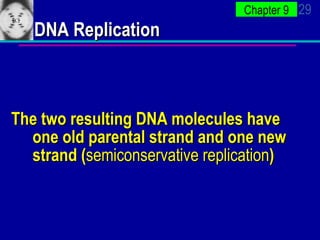
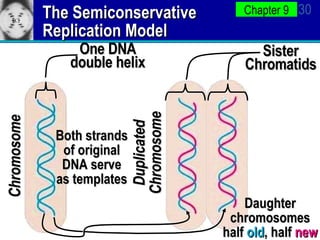
DNA Replication The two resulting DNA molecules have one old parental strand and one new strand ( semiconservative replication )
The Semiconservative Replication Model One DNA double helix Duplicated Chromosome Chromosome Daughter chromosomes half  old , half  new Both strands of original DNA serve as templates Sister Chromatids
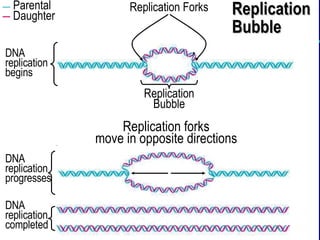
Replication Bubble Replication forks move in opposite directions Replication Forks Replication Bubble Parental Daughter DNA replication begins DNA replication progresses DNA replication completed
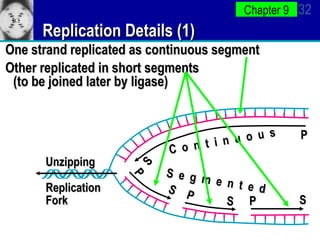
Replication Details (1) One strand replicated as continuous segment Other replicated in short segments (to be joined later by ligase) Replication Fork P P P P S S S S C  o  n  t  i  n  u  o  u  s S  e  g  m  e  n  t  e  d Unzipping
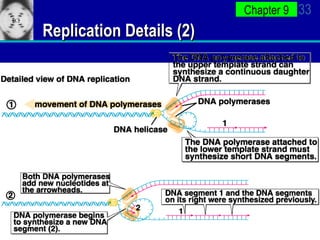
Replication Details (2)
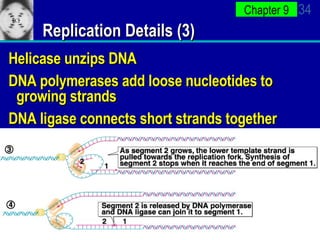
Replication Details (3) Helicase unzips DNA DNA polymerases add loose nucleotides to growing strands DNA ligase connects short strands together
Replication And Proofreading During replication, DNA polymerase mismatches nucleotides once every 10,000 base pairs DNA repair enzymes “proofread” each new daughter strand, replacing mismatched nucleotides However…
Mistakes Do Happen DNA is damaged in a number of ways Spontaneous chemical breakdown at body temperature Certain chemicals (some components of cigarette smoke) UV light from the sun causes DNA damage DNA damage leads to uncontrollable cell division and skin cancer
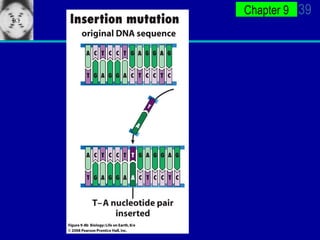
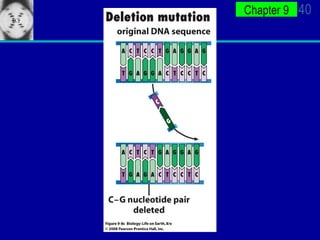
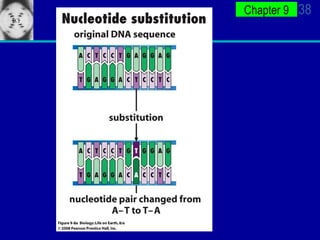
Types of Mutations Point mutation  - individual nucleotide in the DNA sequence is changed  Insertion mutation  - one or more nucleotide pairs are inserted into the DNA double helix  Deletion mutation  - one or more nucleotide pairs are removed from the double helix


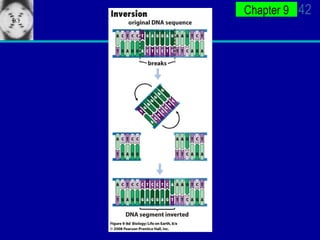
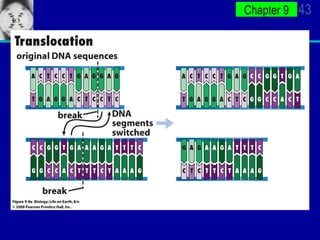
Types of Mutations Inversion  - piece of DNA is cut out of a chromosome, turned around, and re-inserted into the gap  Translocation  - chunk of DNA (often very large) is removed from one chromosome and attached to another
 
 
The end

DNA-APBio Ch 9

  • 1.
  • 2.
    Genes Are Madeof DNA Known since the late 1800s: Heritable information is carried in discrete units called genes Genes are parts of structures called chromosomes Chromosomes are made of deoxyribonucleic acid ( DNA ) and protein
  • 3.
    Genes Are Madeof DNA Transformed bacteria revealed the link between genes and DNA F. Griffith worked with two strains of Streptococcus pneumoniae bacteria S strain caused pneumonia when injected into mice, killing them R strain did not cause pneumonia when injected
  • 4.
    Transformed Bacteria Mouseinjected w/bacteria Results Conclusions R strain does not cause pneumonia S strain does cause pneumonia Heat-killed S strain does not cause pneumonia Substance from heat-killed S strain can transform harmless R strain into deadly S strain
  • 5.
    Genes Are Madeof DNA Deductions from Griffith’s experiment (1920s) Living safe bacteria (R strain) were changed by something in the dead (but normally disease-causing) S strain The living R strain bacteria were transformed by genetic material released by the S strain
  • 6.
    Genes Are Madeof DNA Later findings by Avery, MacLeod, and McCarty (1940s) The transforming molecule from the S strain was DNA
  • 7.
  • 8.
  • 9.
    DNA Is Composedof Four Nucleotides DNA is made of chains of small subunits called nucleotides Each nucleotide has three components: Phosphate group Deoxyribose sugar One of four nitrogen-containing bases Thymine Cytosine Adenine Guanine
  • 10.
    DNA Is Composedof Four Nucleotides Types of Nitrogen Bases… Purines 2 rings A and G Pyrimidines 1 ring T and C
  • 11.
    The Four Nucleotidesof DNA DNA Thymine DNA Cytosine DNA Guanine DNA Adenine
  • 12.
    DNA Is Composedof Four Nucleotides In 1940, biochemist E. Chargaff determined that: In a DNA molecule, amounts of A = T, G = C “ Chargaff’s Rule”
  • 13.
    DNA Is aDouble Helix Rosalind Franklin and Maurice Wilkins studied DNA structure using X-ray scattering
  • 14.
    DNA Is aDouble Helix From X-ray diffraction patterns they deduced that DNA … Is long and thin Has a uniform diameter of 2 nanometers Is helical, and is twisted like a corkscrew Consists of repeating subunits
  • 15.
    DNA Is aDouble Helix James Watson and Francis Crick combined the X-ray data with bonding theory to deduce DNA structure: DNA is made of two strands of nucleotides The deoxyribose and phosphate portions make up the sugar-phosphate backbone
  • 16.
  • 17.
    Please don’t admireDr Watson… He is "inherently gloomy about the prospect of Africa". –October 2007 To him, the real cause of Africa's woes is that black people are inherently less intelligent than other races. "All our social policies are based on the fact that their intelligence is the same as ours — whereas all the testing says not really," He hoped that everyone was equal, he continued, but "people who have to deal with black employees find this not true".
  • 18.
    Please don’t admireDr Watson… (Amount of melanin in the skin) was why black people and Latinos had reputations as lovers — something, he said, of which the English could not be accused. -2000 "Whenever you interview fat people, you feel bad because you know you're not going to hire them," -2000 In 1997, he even said a woman should be allowed to abort a fetus if tests had shown it would be a homosexual and the mother deemed this undesirable.
  • 19.
    James Watson isAMERICAN. Not British. He was born in Chicago. Studied and researched in London but spent less that 5 years there. He currently resides at Cold Spring Harbor Lab in Huntington, Long Island NY. He is currently suspended from the lab he founded due to his remarks. (Update 10/25/07…he just “retired”) More quotes…
  • 20.
    Watson has repeatedlysupported genetic screening and genetic engineering in public lectures and interviews, arguing that stupidity is a disease and the "really stupid" bottom 10% of people should be cured He has also suggested that beauty could be genetically engineered, saying "People say it would be terrible if we made all girls pretty. I think it would be great .”
  • 21.
    The Watson-Crick Modelof DNA Structure Hydrogen bonds form between complementary bases Complementary base pairs hold the two DNA strands together DNA is a double helix of two nucleotide strands
  • 22.
    Hydrogen Bonds Nitrogen-containing bases protrude inward from sugar-phosphate backbone Hydrogen bonds hold certain nitrogenous base pairs together A bonds with T, G bonds with C Bonding bases called complementary base pairs A and T bond with TWO Hydrogen bonds G and C bond with THREE Hydro. bonds
  • 23.
    How Does DNAEncode Information? How can a molecule with only 4 simple parts be the carrier of genetic information? The key lies in the sequence , not number , of subunits Within a DNA strand, the four types of bases can be arranged in any linear order, and this sequence is what encodes genetic information
  • 24.
    How Does DNAEncode Information? The genetic code is analogous to languages, where small sets of letters combine in various ways to make up many different words English has 26 letters Hawaiian has 12 letters The binary language of computers uses only 2 “letters” (0 and 1, or “on” and “off”)
  • 25.
    How Does DNAEncode Information? The sequence of only four nucleotides can produce many different combinations A 10 nucleotide sequence can code for greater than 1 million different combinations
  • 26.
    DNA Replication Allcells come from pre-existing cells Cells reproduce by dividing in half Each of two daughter cells gets an exact copy of parent cell’s genetic information Duplication of the parent cell DNA is called replication
  • 27.
    DNA Replication DNAreplication begins when DNA helicases separate the two strands Hydrogen bonds between bases are broken Parental DNA double helix New double helix with 1 old & 1 new strand Free Nucleotides
  • 28.
    DNA Replication Asecond strand of new DNA is synthesized along each separated strand by DNA polymerases, which position free nucleotides across from complementary nucleotides Parental DNA double helix New double helix with 1 old & 1 new strand Free Nucleotides
  • 29.
    DNA Replication Thetwo resulting DNA molecules have one old parental strand and one new strand ( semiconservative replication )
  • 30.
    The Semiconservative ReplicationModel One DNA double helix Duplicated Chromosome Chromosome Daughter chromosomes half old , half new Both strands of original DNA serve as templates Sister Chromatids
  • 31.
    Replication Bubble Replicationforks move in opposite directions Replication Forks Replication Bubble Parental Daughter DNA replication begins DNA replication progresses DNA replication completed
  • 32.
    Replication Details (1)One strand replicated as continuous segment Other replicated in short segments (to be joined later by ligase) Replication Fork P P P P S S S S C o n t i n u o u s S e g m e n t e d Unzipping
  • 33.
  • 34.
    Replication Details (3)Helicase unzips DNA DNA polymerases add loose nucleotides to growing strands DNA ligase connects short strands together
  • 35.
    Replication And ProofreadingDuring replication, DNA polymerase mismatches nucleotides once every 10,000 base pairs DNA repair enzymes “proofread” each new daughter strand, replacing mismatched nucleotides However…
  • 36.
    Mistakes Do HappenDNA is damaged in a number of ways Spontaneous chemical breakdown at body temperature Certain chemicals (some components of cigarette smoke) UV light from the sun causes DNA damage DNA damage leads to uncontrollable cell division and skin cancer
  • 37.
    Types of MutationsPoint mutation - individual nucleotide in the DNA sequence is changed Insertion mutation - one or more nucleotide pairs are inserted into the DNA double helix Deletion mutation - one or more nucleotide pairs are removed from the double helix
  • 38.
  • 39.
  • 40.
  • 41.
    Types of MutationsInversion - piece of DNA is cut out of a chromosome, turned around, and re-inserted into the gap Translocation - chunk of DNA (often very large) is removed from one chromosome and attached to another
  • 42.
  • 43.
  • 44.