PLANT  KINGDOM
Main Characteristics Eukaryotic cells Have cell walls made of cellulose Autotrophic – Photosynthetic  Adapted to nearly every environment on earth. Sexual and asexual reproduction
Classification Vascular Plants Have tissues that make up a system that carries water, nutrients and other substances. Non-vascular Plants Have no vascular tissue and substances are transported through the cell walls.
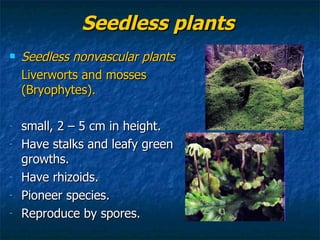
Seedless plants Seedless nonvascular plants Liverworts and mosses (Bryophytes). small, 2 – 5 cm in height. Have stalks and leafy green growths. Have rhizoids. Pioneer species. Reproduce by spores.
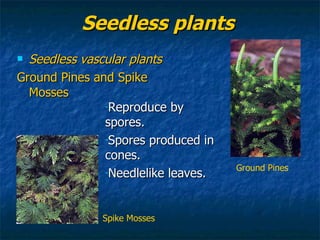
Seedless plants Seedless vascular plants Ground Pines and Spike Mosses Reproduce by spores. Spores produced in cones. Needlelike leaves. Spike Mosses Ground Pines
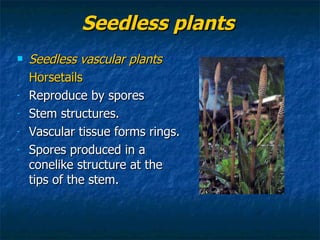
Seedless plants Seedless vascular plants Horsetails Reproduce by spores Stem structures. Vascular tissue forms rings. Spores produced in a conelike structure at the tips of the stem.
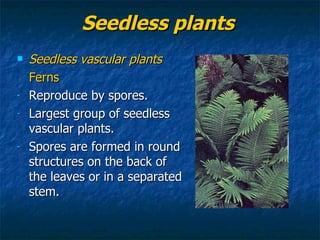
Seedless plants Seedless vascular plants Ferns Reproduce by spores. Largest group of seedless vascular plants. Spores are formed in round structures on the back of the leaves or in a separated stem.
Seed plants Vascular Tissue : Xylem:  Transports water and dissolved substances from the roots up to the leaves. Have roots, stems, leaves and vascular tissue. Seeds contain an embryo and stores food. Phloem:  Transports food from where is made to other plants of the plant.
Seed plants Stem Supports the structures, allows movement of materials.  Can be herbaceous or woody. Roots Moves substances up to the stems, anchor plants, store food (carrots). Leaves Trap light and produce food. Have  stomata  to exchange gases and water.
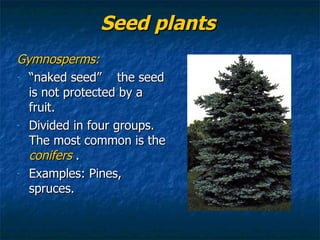
Seed plants Gymnosperms: “ naked seed”  the seed is not protected by a fruit. Divided in four groups. The most common is the  conifers  . Examples: Pines, spruces.
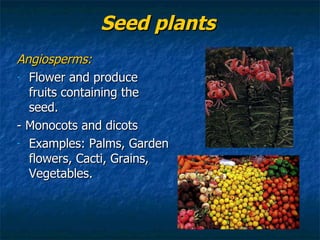
Seed plants Angiosperms: Flower and produce fruits containing the seed. - Monocots and dicots Examples: Palms, Garden flowers, Cacti, Grains, Vegetables.
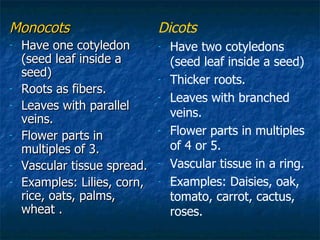
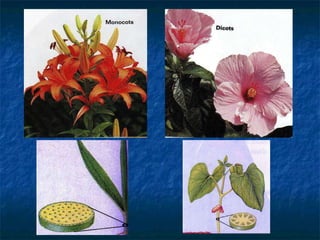
Monocots Have one cotyledon (seed leaf inside a seed) Roots as fibers.  Leaves with parallel veins. Flower parts in multiples of 3.  Vascular tissue spread. Examples: Lilies, corn, rice, oats, palms, wheat . Dicots Have two cotyledons (seed leaf inside a seed) Thicker roots.  Leaves with branched veins. Flower parts in multiples of 4 or 5.  Vascular tissue in a ring.  Examples: Daisies, oak, tomato, carrot, cactus, roses.
 

P L A N T S

  • 1.
  • 2.
    Main Characteristics Eukaryoticcells Have cell walls made of cellulose Autotrophic – Photosynthetic Adapted to nearly every environment on earth. Sexual and asexual reproduction
  • 3.
    Classification Vascular PlantsHave tissues that make up a system that carries water, nutrients and other substances. Non-vascular Plants Have no vascular tissue and substances are transported through the cell walls.
  • 4.
    Seedless plants Seedlessnonvascular plants Liverworts and mosses (Bryophytes). small, 2 – 5 cm in height. Have stalks and leafy green growths. Have rhizoids. Pioneer species. Reproduce by spores.
  • 5.
    Seedless plants Seedlessvascular plants Ground Pines and Spike Mosses Reproduce by spores. Spores produced in cones. Needlelike leaves. Spike Mosses Ground Pines
  • 6.
    Seedless plants Seedlessvascular plants Horsetails Reproduce by spores Stem structures. Vascular tissue forms rings. Spores produced in a conelike structure at the tips of the stem.
  • 7.
    Seedless plants Seedlessvascular plants Ferns Reproduce by spores. Largest group of seedless vascular plants. Spores are formed in round structures on the back of the leaves or in a separated stem.
  • 8.
    Seed plants VascularTissue : Xylem: Transports water and dissolved substances from the roots up to the leaves. Have roots, stems, leaves and vascular tissue. Seeds contain an embryo and stores food. Phloem: Transports food from where is made to other plants of the plant.
  • 9.
    Seed plants StemSupports the structures, allows movement of materials. Can be herbaceous or woody. Roots Moves substances up to the stems, anchor plants, store food (carrots). Leaves Trap light and produce food. Have stomata to exchange gases and water.
  • 10.
    Seed plants Gymnosperms:“ naked seed” the seed is not protected by a fruit. Divided in four groups. The most common is the conifers . Examples: Pines, spruces.
  • 11.
    Seed plants Angiosperms:Flower and produce fruits containing the seed. - Monocots and dicots Examples: Palms, Garden flowers, Cacti, Grains, Vegetables.
  • 12.
    Monocots Have onecotyledon (seed leaf inside a seed) Roots as fibers. Leaves with parallel veins. Flower parts in multiples of 3. Vascular tissue spread. Examples: Lilies, corn, rice, oats, palms, wheat . Dicots Have two cotyledons (seed leaf inside a seed) Thicker roots. Leaves with branched veins. Flower parts in multiples of 4 or 5. Vascular tissue in a ring. Examples: Daisies, oak, tomato, carrot, cactus, roses.
  • 13.