The Origin of Species
Speciation I Requirements Isolation of populations Genetic divergence Speciation has seldom been observed in nature Allopatric speciation Sympatric speciation Ecological isolation Chromosomal aberrations Animals Plants
Speciation II Types of speciation Divergent speciation Phyletic speciation Models of speciation Gradualism Punctuated equilibrium
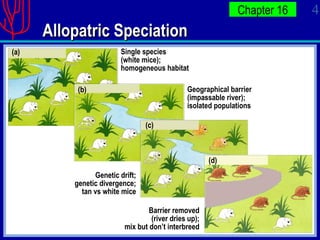
Allopatric Speciation Single species (white mice); homogeneous habitat Geographical barrier (impassable river); isolated populations Genetic drift; genetic divergence; tan vs white mice Barrier removed (river dries up); mix but don’t interbreed (a) (b) (c) (d)
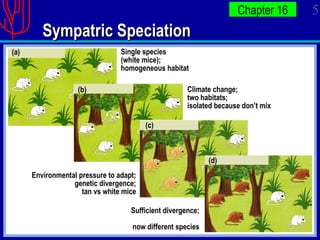
Sympatric Speciation Single species (white mice); homogeneous habitat (a) Climate change; two habitats; isolated because don’t mix (b) Environmental pressure to adapt; genetic divergence; tan vs white mice (c) Sufficient divergence;   now different species (d)
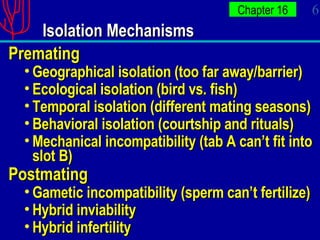
Isolation Mechanisms Premating Geographical isolation (too far away/barrier) Ecological isolation (bird vs. fish) Temporal isolation (different mating seasons) Behavioral isolation (courtship and rituals) Mechanical incompatibility (tab A can’t fit into slot B) Postmating Gametic incompatibility (sperm can’t fertilize) Hybrid inviability Hybrid infertility
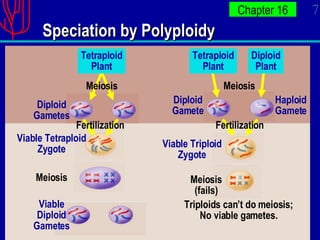
Speciation by Polyploidy Diploid Gamete Meiosis Diploid Gametes Viable Tetraploid Zygote Viable Diploid Gametes Haploid Gamete Viable Triploid Zygote Meiosis (fails) Triploids can’t do meiosis; No viable gametes. Tetraploid Plant Tetraploid Plant Diploid Plant Meiosis Fertilization Meiosis Fertilization
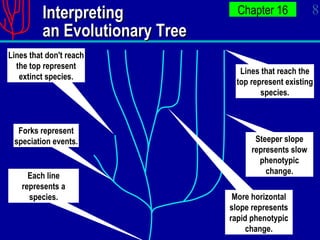
Interpreting an Evolutionary Tree Lines that don't reach the top represent extinct species. Forks represent speciation events. Each line represents a species. Lines that reach the top represent existing species. Steeper slope represents slow phenotypic change. More horizontal slope represents rapid phenotypic change.
Systematics: Seeking Order Amidst Diversity
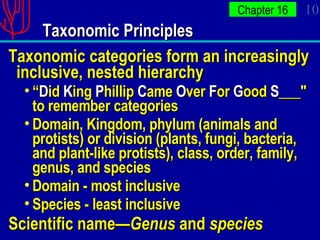
Taxonomic Principles Taxonomic categories form an increasingly inclusive, nested hierarchy “ D id  K ing  P hillip  C ame  O ver   F or   G ood  S ___" to remember categories Domain, Kingdom, phylum (animals and protists) or division (plants, fungi, bacteria, and plant-like protists), class, order, family, genus, and species Domain - most inclusive Species - least inclusive Scientific name— Genus  and  species
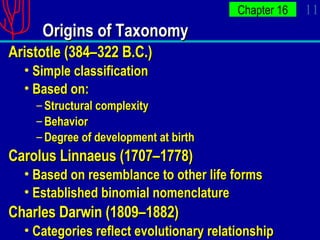
Origins of Taxonomy Aristotle (384–322 B.C.) Simple classification Based on: Structural complexity Behavior Degree of development at birth Carolus Linnaeus (1707–1778) Based on resemblance to other life forms Established binomial nomenclature Charles Darwin (1809–1882) Categories reflect evolutionary relationship
The Changing Classification System Prior to 1970—two-kingdom system Plants and animals 1969—Roger Whittaker—five-kingdom system Monera, Protista, Fungi, Plantae, Animalia 1990—Carl Woese—three-domain system Bacteria, Archaea, Eukarya Discovered that kingdom Monera included two very distinct groups (Bacteria and Archaea) based on nucleotide sequences of ribosomal RNA
Problems concerning  classification of species The  biological species concept  defines species as “groups of interbreeding natural populations, which are reproductively isolated from other such groups” Cannot be applied to asexually reproducing organisms The  phylogenetic species concept  defines a species as “the smallest diagnosable group that contains all the descendants of a single common ancestor” Can be applied to sexually and asexually reproducing organisms May eventually replace the biological species concept
Biodiversity How many species exist? 1.5 million species categorized Up to 30 million species may exist 7000 to 10,000 new species described/y Many classified species are becoming extinct as their habitats are destroyed
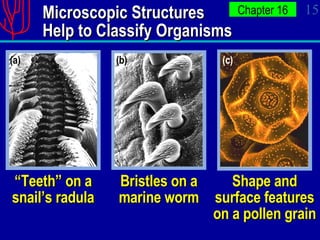
Microscopic Structures Help to Classify Organisms (a) (b) (c) Bristles on a marine worm “ Teeth” on a snail’s radula Shape and surface features on a pollen grain
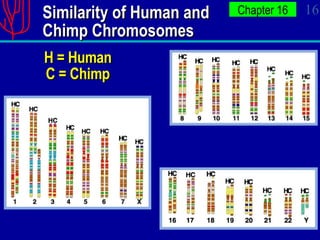
Similarity of Human and Chimp Chromosomes H = Human C = Chimp
Modern Criteria for Classification Anatomy - homologous structures Developmental stages - embryology Biochemical similarities - use of genetic information
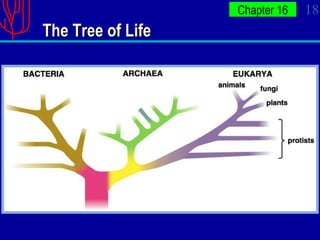
The Tree of Life
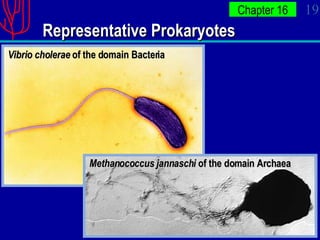
Representative Prokaryotes Vibrio cholerae  of the domain Bacteria Methanococcus jannaschi  of the domain Archaea
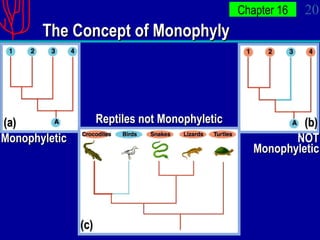
The Concept of Monophyly Monophyletic NOT Monophyletic (a) (b) (c) Reptiles not Monophyletic
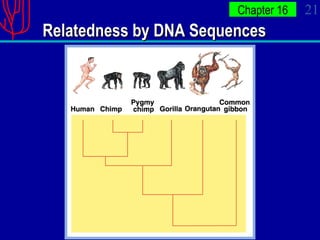
Relatedness by DNA Sequences
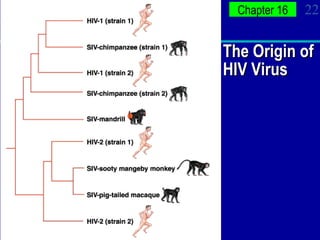
The Origin of HIV Virus
The End

Speciation and Systematics APBioCh16and18

  • 1.
  • 2.
    Speciation I RequirementsIsolation of populations Genetic divergence Speciation has seldom been observed in nature Allopatric speciation Sympatric speciation Ecological isolation Chromosomal aberrations Animals Plants
  • 3.
    Speciation II Typesof speciation Divergent speciation Phyletic speciation Models of speciation Gradualism Punctuated equilibrium
  • 4.
    Allopatric Speciation Singlespecies (white mice); homogeneous habitat Geographical barrier (impassable river); isolated populations Genetic drift; genetic divergence; tan vs white mice Barrier removed (river dries up); mix but don’t interbreed (a) (b) (c) (d)
  • 5.
    Sympatric Speciation Singlespecies (white mice); homogeneous habitat (a) Climate change; two habitats; isolated because don’t mix (b) Environmental pressure to adapt; genetic divergence; tan vs white mice (c) Sufficient divergence; now different species (d)
  • 6.
    Isolation Mechanisms PrematingGeographical isolation (too far away/barrier) Ecological isolation (bird vs. fish) Temporal isolation (different mating seasons) Behavioral isolation (courtship and rituals) Mechanical incompatibility (tab A can’t fit into slot B) Postmating Gametic incompatibility (sperm can’t fertilize) Hybrid inviability Hybrid infertility
  • 7.
    Speciation by PolyploidyDiploid Gamete Meiosis Diploid Gametes Viable Tetraploid Zygote Viable Diploid Gametes Haploid Gamete Viable Triploid Zygote Meiosis (fails) Triploids can’t do meiosis; No viable gametes. Tetraploid Plant Tetraploid Plant Diploid Plant Meiosis Fertilization Meiosis Fertilization
  • 8.
    Interpreting an EvolutionaryTree Lines that don't reach the top represent extinct species. Forks represent speciation events. Each line represents a species. Lines that reach the top represent existing species. Steeper slope represents slow phenotypic change. More horizontal slope represents rapid phenotypic change.
  • 9.
  • 10.
    Taxonomic Principles Taxonomiccategories form an increasingly inclusive, nested hierarchy “ D id K ing P hillip C ame O ver F or G ood S ___" to remember categories Domain, Kingdom, phylum (animals and protists) or division (plants, fungi, bacteria, and plant-like protists), class, order, family, genus, and species Domain - most inclusive Species - least inclusive Scientific name— Genus and species
  • 11.
    Origins of TaxonomyAristotle (384–322 B.C.) Simple classification Based on: Structural complexity Behavior Degree of development at birth Carolus Linnaeus (1707–1778) Based on resemblance to other life forms Established binomial nomenclature Charles Darwin (1809–1882) Categories reflect evolutionary relationship
  • 12.
    The Changing ClassificationSystem Prior to 1970—two-kingdom system Plants and animals 1969—Roger Whittaker—five-kingdom system Monera, Protista, Fungi, Plantae, Animalia 1990—Carl Woese—three-domain system Bacteria, Archaea, Eukarya Discovered that kingdom Monera included two very distinct groups (Bacteria and Archaea) based on nucleotide sequences of ribosomal RNA
  • 13.
    Problems concerning classification of species The biological species concept defines species as “groups of interbreeding natural populations, which are reproductively isolated from other such groups” Cannot be applied to asexually reproducing organisms The phylogenetic species concept defines a species as “the smallest diagnosable group that contains all the descendants of a single common ancestor” Can be applied to sexually and asexually reproducing organisms May eventually replace the biological species concept
  • 14.
    Biodiversity How manyspecies exist? 1.5 million species categorized Up to 30 million species may exist 7000 to 10,000 new species described/y Many classified species are becoming extinct as their habitats are destroyed
  • 15.
    Microscopic Structures Helpto Classify Organisms (a) (b) (c) Bristles on a marine worm “ Teeth” on a snail’s radula Shape and surface features on a pollen grain
  • 16.
    Similarity of Humanand Chimp Chromosomes H = Human C = Chimp
  • 17.
    Modern Criteria forClassification Anatomy - homologous structures Developmental stages - embryology Biochemical similarities - use of genetic information
  • 18.
  • 19.
    Representative Prokaryotes Vibriocholerae of the domain Bacteria Methanococcus jannaschi of the domain Archaea
  • 20.
    The Concept ofMonophyly Monophyletic NOT Monophyletic (a) (b) (c) Reptiles not Monophyletic
  • 21.
  • 22.
    The Origin ofHIV Virus
  • 23.