How Plants Colonized the Land 
and Evolution of Seed Plants 
Selected Topics in Biology 
Ariane B. Sogo-an 
MST Biology
Objectives 
At the end of the lesson, the MST Biology 
students are expected to conduct the following 
with at least 80% level of accuracy: 
– Relate Evolution and Biodiversity of Plant Kingdom 
– Trace the evolutionary modification of plants 
throughout time. 
– Determine the different plant group per 
evolutionary modification and characteristics.
Biodiversity and Evolution 
• There are more than 290,000 recorded species 
of plants known today to be inhibiting the 
planet earth and most of them adapted 
mechanisms to be able for them to inhabit 
various corners of the world such as deserts, 
grassland and forest.
Biodiversity and Evolution 
• There are even terrestrial plants that 
seemingly shares characteristics from aquatic 
plants thus pushing the curiosity of mankind 
to try to explain the origin of plants and how it 
colonized the world since the beginning of 
time.
Biodiversity and Evolution 
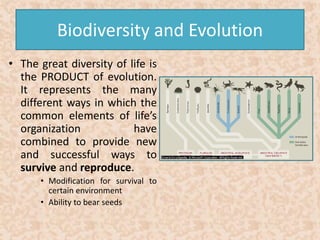
• The great diversity of life is 
the PRODUCT of evolution. 
It represents the many 
different ways in which the 
common elements of life’s 
organization have 
combined to provide new 
and successful ways to 
survive and reproduce. 
• Modification for survival to 
certain environment 
• Ability to bear seeds
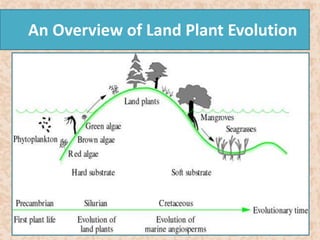
An Overview of Land Plant Evolution
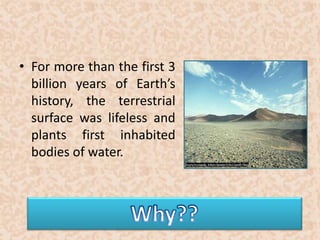
• For more than the first 3 
billion years of Earth’s 
history, the terrestrial 
surface was lifeless and 
plants first inhabited 
bodies of water.
• The movement onto land carried many 
benefits: including unfiltered sun, more 
plentiful CO2, nutrient-rich soil, and few 
herbivores or pathogens
Aquatic to Terrestrial plants 
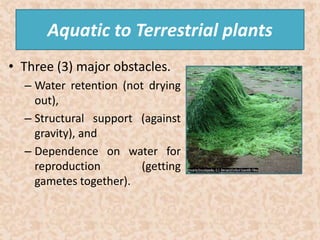
• Three (3) major obstacles. 
– Water retention (not drying 
out), 
– Structural support (against 
gravity), and 
– Dependence on water for 
reproduction (getting 
gametes together).
Shared Traits of Algae and Plants 
• Like brown, red, and some green algae, plants 
are multicellular, eukaryotic, photosynthetic 
autotrophs. 
• Like green algae, plants have cellulose cell 
walls. 
• Like green algae, euglenids, and some 
dinoflagellates, plants have chlorophylls a and 
b.
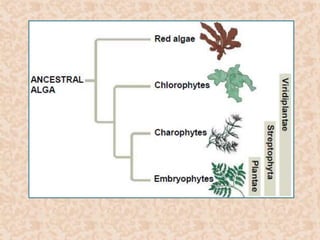
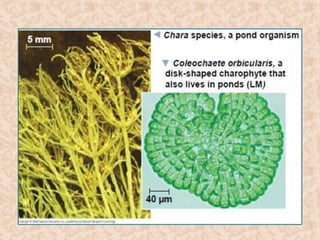
Charophytes 
• Many species of Charophyte algae live in 
shallow water around the edges of lakes and 
ponds. How do they withstand that kind of 
situation? 
– Sporopollenin - a layer of a durable polymer that 
prevents exposed zygotes from drying out. 
– It was traced scientists that a similar chemical 
adaptation is found in the sporopollenin walls that 
encase plant spores.
EVIDENCES THAT SUPPORT THE PHYLOGENETIC 
CONNECTION BETWEEN LAND PLANTS AND GREEN ALGAE 
• Homologous chloroplasts 
• presence of chlorophyll b and beta-carotene and 
thylakoids stacked as grana. DNA comparison with 
terrestrial. 
• Homologous cellulose walls 
– cellulose comprises 20-26% of the cell wall.
EVIDENCES THAT SUPPORT THE PHYLOGENETIC 
CONNECTION BETWEEN LAND PLANTS AND GREEN ALGAE 
• Homologous peroxisomes 
– Both land plants and charophycean algae package 
enzymes that minimize the costs of photorespiration 
in peroxisomes. 
• Phagmoplasts 
– These plate-like structures occur during cell division 
only in land plants and charopyceans. 
• Flagellated sperm 
– Many plants have flagellated sperm, which match 
charophycean sperm closely in ultrastructure.
EVIDENCES THAT SUPPORT THE PHYLOGENETIC 
CONNECTION BETWEEN LAND PLANTS AND GREEN ALGAE 
• Molecular systematics 
– In addition to similarities derived from 
comparisons of chloroplast genes, analyses of 
several nuclear genes also provide evidence of a 
Charophycean ancestry of plants.
Terrestrial Plant Adaptation 
• Alternation of generations and multicellular, 
dependent embryos 
• Spores produced in sporangia 
• Multicellular gametangia 
• Apicalmeristem
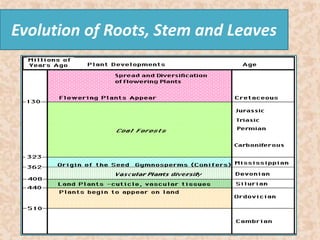
Evolution of Roots, Stem and Leaves
Physiological modifications of plants 
to survive above sea level: 
• root system. 
• shoot system 
• Stems grew and branches extensively only after plants 
developed a biochemical capacity to synthesize and 
deposit lignin, an organic compound in cell wall. 
• xylem (distributes water) and phloem (distributes 
dissolved sugars and other photosynthetic products). 
• Cuticle 
• Stomata
Further adaptations of plants 
• Cuticle 
• Mycorrhizae – important to plants without 
roots. Nitrogen fixing agent. 
• Secondary compounds – ex. alkaloids, 
terpenes, and tannins
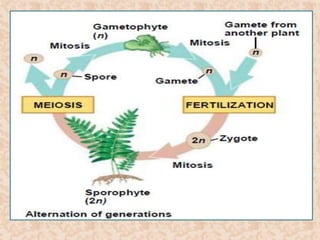
From Haploid to Diploid Dominance 
• In Algae, a haploid (n) phase in the form of 
gametophytes (gamete producing bodies), 
dominates their life cycles. 
• The dipoid (2n) phase is the zygote, which 
forms when gametes fuse at fertilization.
Evolution of Pollen and Seeds 
• Like some seedless species, seed bearing 
plants produce not one but two (2) types of 
spores. 
• This condition is called heterospory, an 
opposed to homospory (only one type). 
• pollen grains, which develop into a mature 
sperm bearing male gametophytes. 
– do not require free-standing water to reach the 
egg
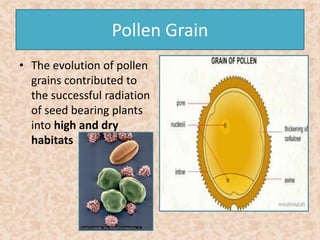
Pollen Grain 
• The evolution of pollen 
grains contributed to 
the successful radiation 
of seed bearing plants 
into high and dry 
habitats
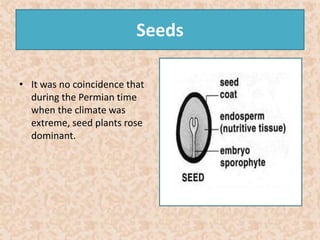
Seeds 
• It was no coincidence that 
during the Permian time 
when the climate was 
extreme, seed plants rose 
dominant.
Plant Diversity 
• Bryophytes 
• The Bryophytes lineage consists of about 
18,600 species called mosses, liverworts and 
hornworts. 
• These nonvascular plants are mostly well 
adapted to grow in fully or seasonally moist 
habitats although there is also other rare 
types of mosses thriving in deserts and 
windswept plateaus of Antartica.
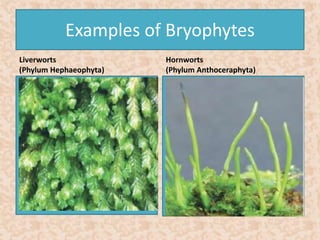
Examples of Bryophytes 
Liverworts 
(Phylum Hephaeophyta) 
Hornworts 
(Phylum Anthoceraphyta)
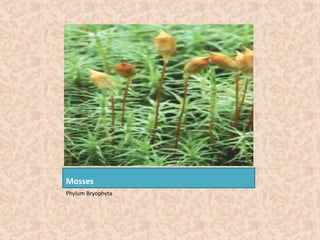
Mosses 
Phylum Bryophyta
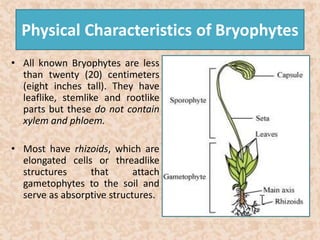
Physical Characteristics of Bryophytes 
• All known Bryophytes are less 
than twenty (20) centimeters 
(eight inches tall). They have 
leaflike, stemlike and rootlike 
parts but these do not contain 
xylem and phloem. 
• Most have rhizoids, which are 
elongated cells or threadlike 
structures that attach 
gametophytes to the soil and 
serve as absorptive structures.
Evolution of Bryophytes 
• Presence of Cuticle 
• Cellular Jacket 
• Large gametophytes
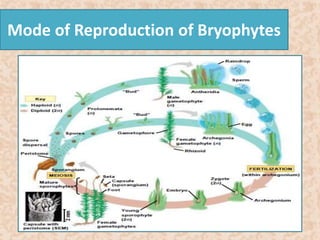
Mode of Reproduction of Bryophytes
SEEDLESS VASCULAR PLANTS 
• Descendants of seedless plants lineage still 
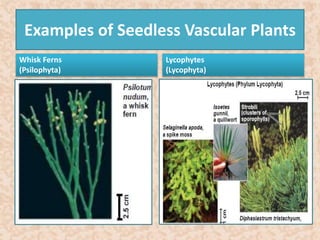
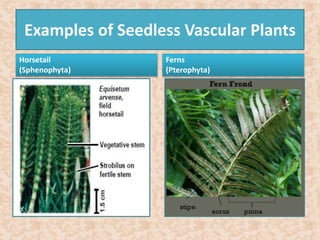
exist today such as whisk ferns, lycophytes, 
horsetails and ferns.
How does Vascular plants differ from Bryophytes? 
• Sporophytes does not remain attached to 
gametophyte 
• It has true vascular tissues 
• Seedless Vascular plants is larger and have 
longer lived phase life cycle
Characteristics of Seedless Vascular 
plants 
• Most seedless vascular plants live in wet, 
humid places, and their gametophytes lack 
vascular tissues. Water droplets clinging to the 
plants are the only means by which flagellated 
sperm can reach the eggs.
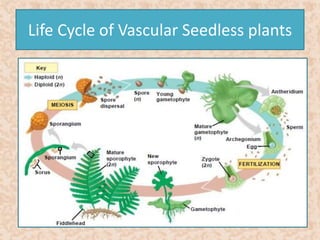
Life Cycle of Vascular Seedless plants
Examples of Seedless Vascular Plants 
Whisk Ferns 
(Psilophyta) 
Lycophytes 
(Lycophyta)
Examples of Seedless Vascular Plants 
Horsetail 
(Sphenophyta) 
Ferns 
(Pterophyta)
RISE OF THE SEED-BEARING PLANTS 
• In terms of diversity, numbers and 
distribution, they would become the most 
successful groups of the plant kingdom. 
• Seed Ferns, Gymnospserm and much later the 
angiosperm were the dominant groups.
How do they differ from Seedless 
Vascular Plants? 
• Besides microspores, seed-bearing plants 
also reproduce megaspores – these develop 
within ovules the female reproductive 
structures which at maturity are seeds. 
• Each ovule consists of female gametophytes 
(with its egg cell), nutrient-rich tissue, and a 
jacket of cell layers which develops into seed 
coats. A zygote will form inside the ovule.
• Compared with the seedless vascular plants, 
gymnosperms had water conserving traits, 
including thick cuticles and stomata recessed 
below the surface of the leaf.
How do Pines Reproduce? 
• Pine tress produces pine cones. 
• The scales are parts of a mature female cone 
which bears ovules in which megaspores formed 
and developed into female gametophytes. 
• Pine trees also produce male cones, in which 
microspores forms and develop into pollen 
grains. 
• Pollination is completed when some land on 
ovules of female cones. 
• For pines, fertilization occurs months or a year 
after pollination.
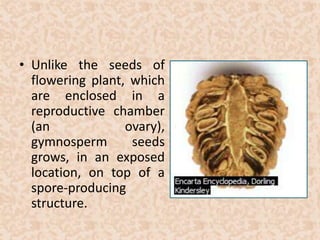
• Unlike the seeds of 
flowering plant, which 
are enclosed in a 
reproductive chamber 
(an ovary), 
gymnosperm seeds 
grows, in an exposed 
location, on top of a 
spore-producing 
structure.
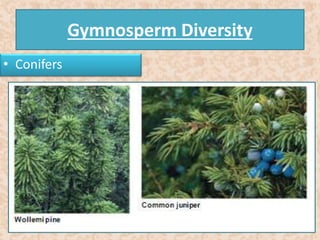
Gymnosperm Diversity 
• Conifers
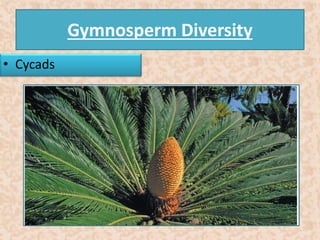
Gymnosperm Diversity 
• Cycads
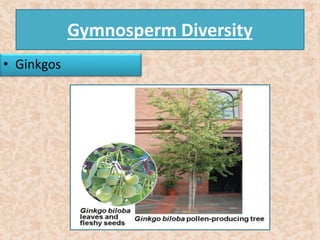
Gymnosperm Diversity 
• Ginkgos
Angiosperms – The Flowering, Seed 
Bearing plant 
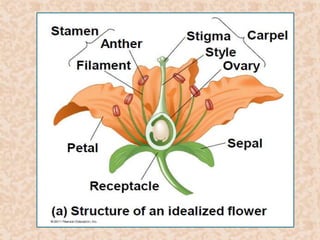
• Only the Angiosperm produce specialized 
reproductive structures called Flowers. 
• Angeion, which means vessel, refers to the 
female reproductive parts at the center of the 
flower. The enlarged base of the “vessel” is 
the floral ovary, where ovules and seeds 
develop.
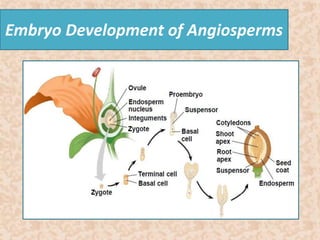
Embryo Development of Angiosperms
Embryo Development in Angiosperm 
• The first mitotic division of the zygote splits the 
fertilized egg into a basal cell and a terminal cell 
• The basal cell produces a multicellular suspensor, 
which anchors the embryo to the parent plant 
• The terminal cell gives rise to most of the embryo 
• The cotyledons form and the embryo elongates
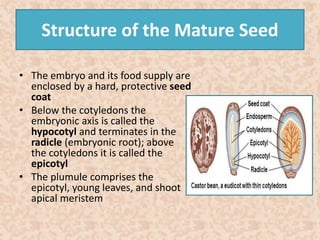
Structure of the Mature Seed 
• The embryo and its food supply are 
enclosed by a hard, protective seed 
coat 
• Below the cotyledons the 
embryonic axis is called the 
hypocotyl and terminates in the 
radicle (embryonic root); above 
the cotyledons it is called the 
epicotyl 
• The plumule comprises the 
epicotyl, young leaves, and shoot 
apical meristem
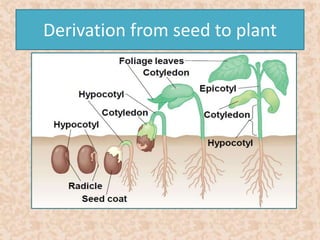
Derivation from seed to plant
• Seeds gives rise to mature plants when their 
dormancy is disrupted in the presence of 
water. Hypocotyl gives rise to shoot system of 
the plant, Cotyledon diminishes once the 
plant is already able to have stable transport 
of nourishments.
• There are two (2) classes of flowering plants 
called the dicots and monocots. 
• The monocots are grass and "grass-like" 
angiosperms (flowering plants). Particularly, the 
embryos of monocots have only a single (mono-) 
first leaf (a.k.a., seed leaves or cotyledon), 
vascular bundles are arranged throughout the 
stem’s ground tissue and leaf venation projects in 
parallel unlike in Dicots which has netted 
venation and their vascular bundles are arranged 
in a ring.
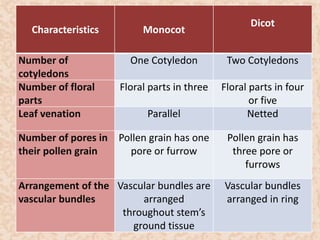
Characteristics Monocot 
Dicot 
Number of 
cotyledons 
One Cotyledon Two Cotyledons 
Number of floral 
parts 
Floral parts in three Floral parts in four 
or five 
Leaf venation Parallel Netted 
Number of pores in 
their pollen grain 
Pollen grain has one 
pore or furrow 
Pollen grain has 
three pore or 
furrows 
Arrangement of the 
vascular bundles 
Vascular bundles are 
arranged 
throughout stem’s 
ground tissue 
Vascular bundles 
arranged in ring
END OF REPORT

How plants colonized the land and evolution

  • 1.
    How Plants Colonizedthe Land and Evolution of Seed Plants Selected Topics in Biology Ariane B. Sogo-an MST Biology
  • 2.
    Objectives At theend of the lesson, the MST Biology students are expected to conduct the following with at least 80% level of accuracy: – Relate Evolution and Biodiversity of Plant Kingdom – Trace the evolutionary modification of plants throughout time. – Determine the different plant group per evolutionary modification and characteristics.
  • 3.
    Biodiversity and Evolution • There are more than 290,000 recorded species of plants known today to be inhibiting the planet earth and most of them adapted mechanisms to be able for them to inhabit various corners of the world such as deserts, grassland and forest.
  • 4.
    Biodiversity and Evolution • There are even terrestrial plants that seemingly shares characteristics from aquatic plants thus pushing the curiosity of mankind to try to explain the origin of plants and how it colonized the world since the beginning of time.
  • 5.
    Biodiversity and Evolution • The great diversity of life is the PRODUCT of evolution. It represents the many different ways in which the common elements of life’s organization have combined to provide new and successful ways to survive and reproduce. • Modification for survival to certain environment • Ability to bear seeds
  • 6.
    An Overview ofLand Plant Evolution
  • 7.
    • For morethan the first 3 billion years of Earth’s history, the terrestrial surface was lifeless and plants first inhabited bodies of water.
  • 8.
    • The movementonto land carried many benefits: including unfiltered sun, more plentiful CO2, nutrient-rich soil, and few herbivores or pathogens
  • 9.
    Aquatic to Terrestrialplants • Three (3) major obstacles. – Water retention (not drying out), – Structural support (against gravity), and – Dependence on water for reproduction (getting gametes together).
  • 10.
    Shared Traits ofAlgae and Plants • Like brown, red, and some green algae, plants are multicellular, eukaryotic, photosynthetic autotrophs. • Like green algae, plants have cellulose cell walls. • Like green algae, euglenids, and some dinoflagellates, plants have chlorophylls a and b.
  • 13.
    Charophytes • Manyspecies of Charophyte algae live in shallow water around the edges of lakes and ponds. How do they withstand that kind of situation? – Sporopollenin - a layer of a durable polymer that prevents exposed zygotes from drying out. – It was traced scientists that a similar chemical adaptation is found in the sporopollenin walls that encase plant spores.
  • 14.
    EVIDENCES THAT SUPPORTTHE PHYLOGENETIC CONNECTION BETWEEN LAND PLANTS AND GREEN ALGAE • Homologous chloroplasts • presence of chlorophyll b and beta-carotene and thylakoids stacked as grana. DNA comparison with terrestrial. • Homologous cellulose walls – cellulose comprises 20-26% of the cell wall.
  • 15.
    EVIDENCES THAT SUPPORTTHE PHYLOGENETIC CONNECTION BETWEEN LAND PLANTS AND GREEN ALGAE • Homologous peroxisomes – Both land plants and charophycean algae package enzymes that minimize the costs of photorespiration in peroxisomes. • Phagmoplasts – These plate-like structures occur during cell division only in land plants and charopyceans. • Flagellated sperm – Many plants have flagellated sperm, which match charophycean sperm closely in ultrastructure.
  • 16.
    EVIDENCES THAT SUPPORTTHE PHYLOGENETIC CONNECTION BETWEEN LAND PLANTS AND GREEN ALGAE • Molecular systematics – In addition to similarities derived from comparisons of chloroplast genes, analyses of several nuclear genes also provide evidence of a Charophycean ancestry of plants.
  • 17.
    Terrestrial Plant Adaptation • Alternation of generations and multicellular, dependent embryos • Spores produced in sporangia • Multicellular gametangia • Apicalmeristem
  • 18.
    Evolution of Roots,Stem and Leaves
  • 19.
    Physiological modifications ofplants to survive above sea level: • root system. • shoot system • Stems grew and branches extensively only after plants developed a biochemical capacity to synthesize and deposit lignin, an organic compound in cell wall. • xylem (distributes water) and phloem (distributes dissolved sugars and other photosynthetic products). • Cuticle • Stomata
  • 20.
    Further adaptations ofplants • Cuticle • Mycorrhizae – important to plants without roots. Nitrogen fixing agent. • Secondary compounds – ex. alkaloids, terpenes, and tannins
  • 21.
    From Haploid toDiploid Dominance • In Algae, a haploid (n) phase in the form of gametophytes (gamete producing bodies), dominates their life cycles. • The dipoid (2n) phase is the zygote, which forms when gametes fuse at fertilization.
  • 23.
    Evolution of Pollenand Seeds • Like some seedless species, seed bearing plants produce not one but two (2) types of spores. • This condition is called heterospory, an opposed to homospory (only one type). • pollen grains, which develop into a mature sperm bearing male gametophytes. – do not require free-standing water to reach the egg
  • 24.
    Pollen Grain •The evolution of pollen grains contributed to the successful radiation of seed bearing plants into high and dry habitats
  • 25.
    Seeds • Itwas no coincidence that during the Permian time when the climate was extreme, seed plants rose dominant.
  • 26.
    Plant Diversity •Bryophytes • The Bryophytes lineage consists of about 18,600 species called mosses, liverworts and hornworts. • These nonvascular plants are mostly well adapted to grow in fully or seasonally moist habitats although there is also other rare types of mosses thriving in deserts and windswept plateaus of Antartica.
  • 27.
    Examples of Bryophytes Liverworts (Phylum Hephaeophyta) Hornworts (Phylum Anthoceraphyta)
  • 28.
  • 29.
    Physical Characteristics ofBryophytes • All known Bryophytes are less than twenty (20) centimeters (eight inches tall). They have leaflike, stemlike and rootlike parts but these do not contain xylem and phloem. • Most have rhizoids, which are elongated cells or threadlike structures that attach gametophytes to the soil and serve as absorptive structures.
  • 30.
    Evolution of Bryophytes • Presence of Cuticle • Cellular Jacket • Large gametophytes
  • 31.
    Mode of Reproductionof Bryophytes
  • 32.
    SEEDLESS VASCULAR PLANTS • Descendants of seedless plants lineage still exist today such as whisk ferns, lycophytes, horsetails and ferns.
  • 33.
    How does Vascularplants differ from Bryophytes? • Sporophytes does not remain attached to gametophyte • It has true vascular tissues • Seedless Vascular plants is larger and have longer lived phase life cycle
  • 34.
    Characteristics of SeedlessVascular plants • Most seedless vascular plants live in wet, humid places, and their gametophytes lack vascular tissues. Water droplets clinging to the plants are the only means by which flagellated sperm can reach the eggs.
  • 35.
    Life Cycle ofVascular Seedless plants
  • 36.
    Examples of SeedlessVascular Plants Whisk Ferns (Psilophyta) Lycophytes (Lycophyta)
  • 37.
    Examples of SeedlessVascular Plants Horsetail (Sphenophyta) Ferns (Pterophyta)
  • 38.
    RISE OF THESEED-BEARING PLANTS • In terms of diversity, numbers and distribution, they would become the most successful groups of the plant kingdom. • Seed Ferns, Gymnospserm and much later the angiosperm were the dominant groups.
  • 39.
    How do theydiffer from Seedless Vascular Plants? • Besides microspores, seed-bearing plants also reproduce megaspores – these develop within ovules the female reproductive structures which at maturity are seeds. • Each ovule consists of female gametophytes (with its egg cell), nutrient-rich tissue, and a jacket of cell layers which develops into seed coats. A zygote will form inside the ovule.
  • 40.
    • Compared withthe seedless vascular plants, gymnosperms had water conserving traits, including thick cuticles and stomata recessed below the surface of the leaf.
  • 41.
    How do PinesReproduce? • Pine tress produces pine cones. • The scales are parts of a mature female cone which bears ovules in which megaspores formed and developed into female gametophytes. • Pine trees also produce male cones, in which microspores forms and develop into pollen grains. • Pollination is completed when some land on ovules of female cones. • For pines, fertilization occurs months or a year after pollination.
  • 42.
    • Unlike theseeds of flowering plant, which are enclosed in a reproductive chamber (an ovary), gymnosperm seeds grows, in an exposed location, on top of a spore-producing structure.
  • 43.
  • 44.
  • 45.
  • 46.
    Angiosperms – TheFlowering, Seed Bearing plant • Only the Angiosperm produce specialized reproductive structures called Flowers. • Angeion, which means vessel, refers to the female reproductive parts at the center of the flower. The enlarged base of the “vessel” is the floral ovary, where ovules and seeds develop.
  • 48.
  • 49.
    Embryo Development inAngiosperm • The first mitotic division of the zygote splits the fertilized egg into a basal cell and a terminal cell • The basal cell produces a multicellular suspensor, which anchors the embryo to the parent plant • The terminal cell gives rise to most of the embryo • The cotyledons form and the embryo elongates
  • 50.
    Structure of theMature Seed • The embryo and its food supply are enclosed by a hard, protective seed coat • Below the cotyledons the embryonic axis is called the hypocotyl and terminates in the radicle (embryonic root); above the cotyledons it is called the epicotyl • The plumule comprises the epicotyl, young leaves, and shoot apical meristem
  • 51.
  • 52.
    • Seeds givesrise to mature plants when their dormancy is disrupted in the presence of water. Hypocotyl gives rise to shoot system of the plant, Cotyledon diminishes once the plant is already able to have stable transport of nourishments.
  • 53.
    • There aretwo (2) classes of flowering plants called the dicots and monocots. • The monocots are grass and "grass-like" angiosperms (flowering plants). Particularly, the embryos of monocots have only a single (mono-) first leaf (a.k.a., seed leaves or cotyledon), vascular bundles are arranged throughout the stem’s ground tissue and leaf venation projects in parallel unlike in Dicots which has netted venation and their vascular bundles are arranged in a ring.
  • 54.
    Characteristics Monocot Dicot Number of cotyledons One Cotyledon Two Cotyledons Number of floral parts Floral parts in three Floral parts in four or five Leaf venation Parallel Netted Number of pores in their pollen grain Pollen grain has one pore or furrow Pollen grain has three pore or furrows Arrangement of the vascular bundles Vascular bundles are arranged throughout stem’s ground tissue Vascular bundles arranged in ring
  • 57.