(multicellular green plants and advanced algae)
Further divided into 5 divisions
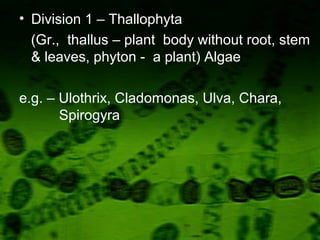
• Division 1 – Thallophyta
(Gr., thallus – plant body without root, stem
& leaves, phyton - a plant) Algae
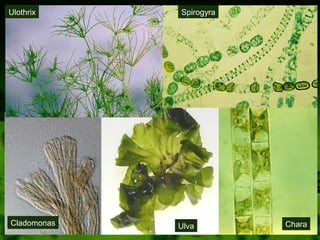
e.g. – Ulothrix, Cladomonas, Ulva, Chara,
Spirogyra
Ulothrix Spirogyra
Cladomonas Ulva Chara
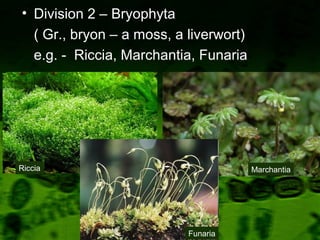
• Division 2 – Bryophyta
( Gr., bryon – a moss, a liverwort)
e.g. - Riccia, Marchantia, Funaria
Riccia Marchantia
Funaria
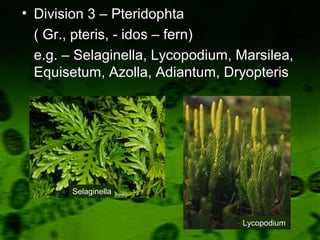
• Division 3 – Pteridophta
( Gr., pteris, - idos – fern)
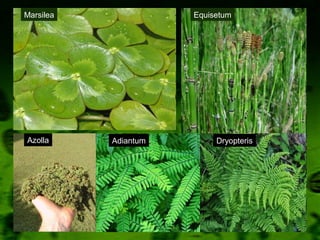
e.g. – Selaginella, Lycopodium, Marsilea,
Equisetum, Azolla, Adiantum, Dryopteris
Selaginella
Lycopodium
Marsilea Equisetum
Azolla Adiantum Dryopteris
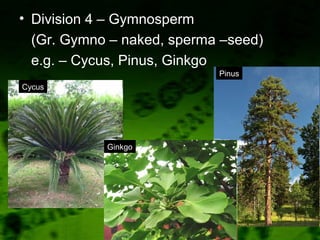
• Division 4 – Gymnosperm
(Gr. Gymno – naked, sperma –seed)
e.g. – Cycus, Pinus, Ginkgo
Cycus
Pinus
Ginkgo
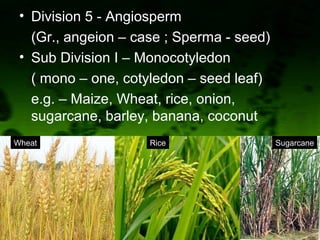
• Division 5 - Angiosperm
(Gr., angeion – case ; Sperma - seed)
• Sub Division I – Monocotyledon
( mono – one, cotyledon – seed leaf)
e.g. – Maize, Wheat, rice, onion,
sugarcane, barley, banana, coconut
Wheat Rice Sugarcane
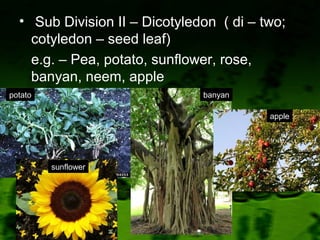
• Sub Division II – Dicotyledon ( di – two;
cotyledon – seed leaf)
e.g. – Pea, potato, sunflower, rose,
banyan, neem, apple
potato
sunflower
banyan
apple
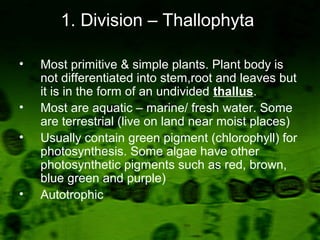
1. Division – Thallophyta
• Most primitive & simple plants. Plant body is
not differentiated into stem,root and leaves but
it is in the form of an undivided thallus.
• Most are aquatic – marine/ fresh water. Some
are terrestrial (live on land near moist places)
• Usually contain green pigment (chlorophyll) for
photosynthesis. Some algae have other
photosynthetic pigments such as red, brown,
blue green and purple)
• Autotrophic
• cellulose cell wall around cell
• Vascular tissue absent
• Reproduction – Asexual- generally by spores
• Sex organs simple, single celled, no embryo
formation
• Green algae - Ulothrix, Cladophora, Spirogyra,
Ulva, Chara
• Red algae – Batra, Polysiphonia
• Brown algae – Laminaria, Fucus, Sargassum
2. Division – Bryophyta
• multicellular, small, simplest land plants
confined to shady damp places
• Plant body - flat, green thallus in
liverworts & leafy, erect structures in
mosses
• lack true roots, stem and leaves and have
no flower
• True vascular system absent
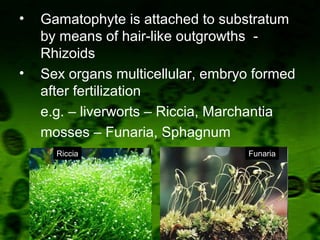
• Gamatophyte is attached to substratum
by means of hair-like outgrowths -
Rhizoids
• Sex organs multicellular, embryo formed
after fertilization
e.g. – liverworts – Riccia, Marchantia
mosses – Funaria, Sphagnum
Riccia Funaria
3. Division – Pteriodophyta
• Found in shady & damp places
• plant body is made of root, stem and leaves
• Vascular system – well developed
• have no flowers & do not produce seeds
• sex organs – multicellula & jacketed by sterile
cells, fertilized egg develops into embryo
• e.g. Selaginella, Lycopodium, Equisetum,
Marsilea, Azolla, Adiantum, Dryopteris, Pteris,
Pteridium
4. Division – Gymnosperm
• Most primitive & simple seed plants
• seeds are naked & not enclosed within
fruits
• usually perennial, evergreen and woody
plants
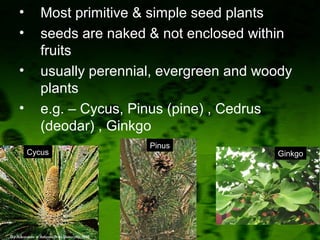
• e.g. – Cycus, Pinus (pine) , Cedrus
(deodar) , Ginkgo
Cycus
Pinus
Ginkgo
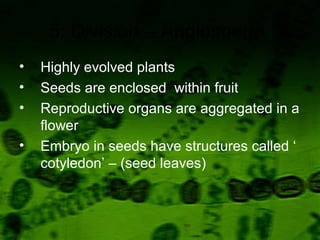
5. Division – Angiosperm
• Highly evolved plants
• Seeds are enclosed within fruit
• Reproductive organs are aggregated in a
flower
• Embryo in seeds have structures called ‘
cotyledon’ – (seed leaves)
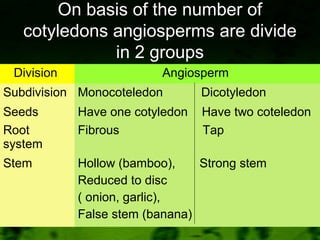
On basis of the number of
cotyledons angiosperms are divide
in 2 groups
Division Angiosperm
Subdivision Monocoteledon Dicotyledon
Seeds Have one cotyledon Have two coteledon
Root
system
Fibrous Tap
Stem Hollow (bamboo), Strong stem
Reduced to disc
( onion, garlic),
False stem (banana)
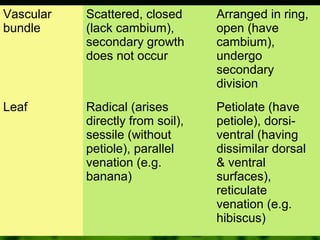
Vascular
bundle
Scattered, closed
(lack cambium),
secondary growth
does not occur
Arranged in ring,
open (have
cambium),
undergo
secondary
division
Leaf Radical (arises
directly from soil),
sessile (without
petiole), parallel
venation (e.g.
banana)
Petiolate (have
petiole), dorsi-
ventral (having
dissimilar dorsal
& ventral
surfaces),
reticulate
venation (e.g.
hibiscus)
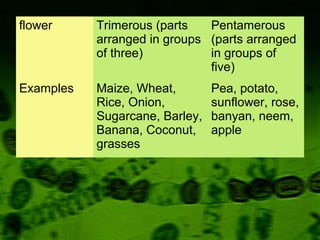
flower Trimerous (parts
arranged in groups
of three)
Pentamerous
(parts arranged
in groups of
five)
Examples Maize, Wheat,
Rice, Onion,
Sugarcane, Barley,
Banana, Coconut,
grasses
Pea, potato,
sunflower, rose,
banyan, neem,
apple

Kingdom plantae

  • 1.
    (multicellular green plantsand advanced algae) Further divided into 5 divisions
  • 2.
    • Division 1– Thallophyta (Gr., thallus – plant body without root, stem & leaves, phyton - a plant) Algae e.g. – Ulothrix, Cladomonas, Ulva, Chara, Spirogyra
  • 3.
  • 4.
    • Division 2– Bryophyta ( Gr., bryon – a moss, a liverwort) e.g. - Riccia, Marchantia, Funaria Riccia Marchantia Funaria
  • 5.
    • Division 3– Pteridophta ( Gr., pteris, - idos – fern) e.g. – Selaginella, Lycopodium, Marsilea, Equisetum, Azolla, Adiantum, Dryopteris Selaginella Lycopodium
  • 6.
  • 7.
    • Division 4– Gymnosperm (Gr. Gymno – naked, sperma –seed) e.g. – Cycus, Pinus, Ginkgo Cycus Pinus Ginkgo
  • 8.
    • Division 5- Angiosperm (Gr., angeion – case ; Sperma - seed) • Sub Division I – Monocotyledon ( mono – one, cotyledon – seed leaf) e.g. – Maize, Wheat, rice, onion, sugarcane, barley, banana, coconut Wheat Rice Sugarcane
  • 9.
    • Sub DivisionII – Dicotyledon ( di – two; cotyledon – seed leaf) e.g. – Pea, potato, sunflower, rose, banyan, neem, apple potato sunflower banyan apple
  • 10.
    1. Division –Thallophyta • Most primitive & simple plants. Plant body is not differentiated into stem,root and leaves but it is in the form of an undivided thallus. • Most are aquatic – marine/ fresh water. Some are terrestrial (live on land near moist places) • Usually contain green pigment (chlorophyll) for photosynthesis. Some algae have other photosynthetic pigments such as red, brown, blue green and purple) • Autotrophic
  • 11.
    • cellulose cellwall around cell • Vascular tissue absent • Reproduction – Asexual- generally by spores • Sex organs simple, single celled, no embryo formation • Green algae - Ulothrix, Cladophora, Spirogyra, Ulva, Chara • Red algae – Batra, Polysiphonia • Brown algae – Laminaria, Fucus, Sargassum
  • 12.
    2. Division –Bryophyta • multicellular, small, simplest land plants confined to shady damp places • Plant body - flat, green thallus in liverworts & leafy, erect structures in mosses • lack true roots, stem and leaves and have no flower • True vascular system absent
  • 13.
    • Gamatophyte isattached to substratum by means of hair-like outgrowths - Rhizoids • Sex organs multicellular, embryo formed after fertilization e.g. – liverworts – Riccia, Marchantia mosses – Funaria, Sphagnum Riccia Funaria
  • 14.
    3. Division –Pteriodophyta • Found in shady & damp places • plant body is made of root, stem and leaves • Vascular system – well developed • have no flowers & do not produce seeds • sex organs – multicellula & jacketed by sterile cells, fertilized egg develops into embryo • e.g. Selaginella, Lycopodium, Equisetum, Marsilea, Azolla, Adiantum, Dryopteris, Pteris, Pteridium
  • 15.
    4. Division –Gymnosperm • Most primitive & simple seed plants • seeds are naked & not enclosed within fruits • usually perennial, evergreen and woody plants • e.g. – Cycus, Pinus (pine) , Cedrus (deodar) , Ginkgo Cycus Pinus Ginkgo
  • 16.
    5. Division –Angiosperm • Highly evolved plants • Seeds are enclosed within fruit • Reproductive organs are aggregated in a flower • Embryo in seeds have structures called ‘ cotyledon’ – (seed leaves)
  • 17.
    On basis ofthe number of cotyledons angiosperms are divide in 2 groups Division Angiosperm Subdivision Monocoteledon Dicotyledon Seeds Have one cotyledon Have two coteledon Root system Fibrous Tap Stem Hollow (bamboo), Strong stem Reduced to disc ( onion, garlic), False stem (banana)
  • 18.
    Vascular bundle Scattered, closed (lack cambium), secondarygrowth does not occur Arranged in ring, open (have cambium), undergo secondary division Leaf Radical (arises directly from soil), sessile (without petiole), parallel venation (e.g. banana) Petiolate (have petiole), dorsi- ventral (having dissimilar dorsal & ventral surfaces), reticulate venation (e.g. hibiscus)
  • 19.
    flower Trimerous (parts arrangedin groups of three) Pentamerous (parts arranged in groups of five) Examples Maize, Wheat, Rice, Onion, Sugarcane, Barley, Banana, Coconut, grasses Pea, potato, sunflower, rose, banyan, neem, apple