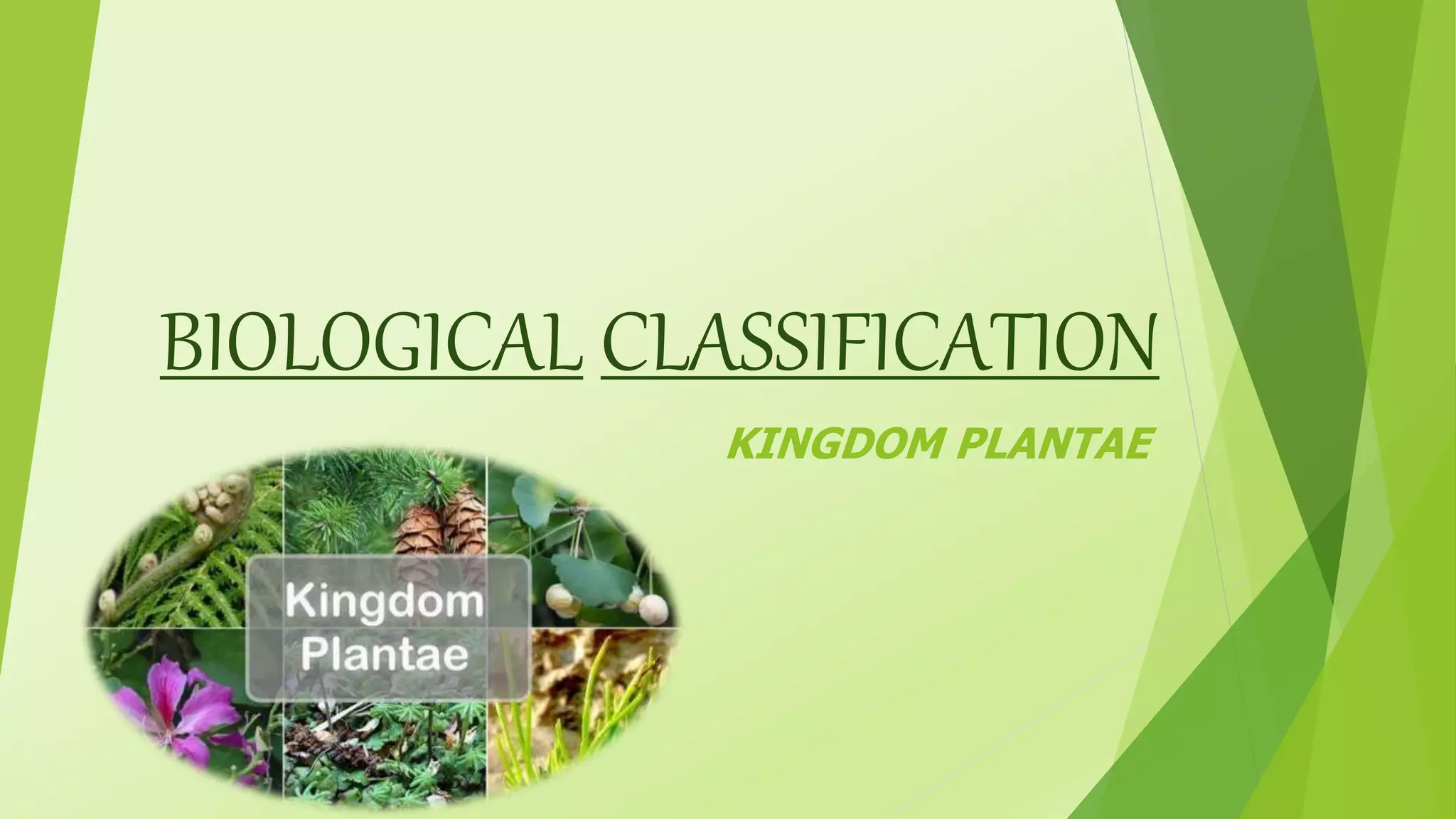
BIOLOGICAL CLASSIFICATION
KINGDOM PLANTAE
INTRODUCTION
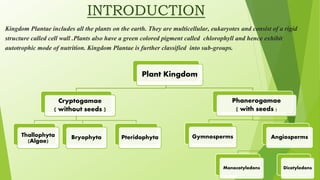
Kingdom Plantae includes all the plants on the earth. They are multicellular, eukaryotes and consist of a rigid
structure called cell wall .Plants also have a green colored pigment called chlorophyll and hence exhibit
autotrophic mode of nutrition. Kingdom Plantae is further classified into sub-groups.
Plant Kingdom
Cryptogamae
( without seeds )
Thallophyta
(Algae)
Bryophyta Pteridophyta
Phanerogamae
( with seeds )
Gymnosperms Angiosperms
Monocotyledons Dicotyledons
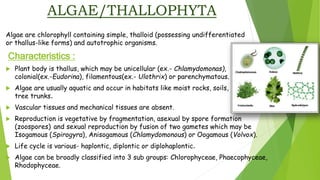
ALGAE/THALLOPHYTA
Algae are chlorophyll containing simple, thalloid (possessing undifferentiated
or thallus-like forms) and autotrophic organisms.
Characteristics :
 Plant body is thallus, which may be unicellular (ex.- Chlamydomonas),
colonial(ex.-Eudorina), filamentous(ex.- Ulothrix) or parenchymatous.
 Algae are usually aquatic and occur in habitats like moist rocks, soils,
tree trunks.
 Vascular tissues and mechanical tissues are absent.
 Reproduction is vegetative by fragmentation, asexual by spore formation
(zoospores) and sexual reproduction by fusion of two gametes which may be
Isogamous (Spirogyra), Anisogamous (Chlamydomonous) or Oogamous (Volvox).
 Life cycle is various- haplontic, diplontic or diplohaplontic.
 Algae can be broadly classified into 3 sub groups: Chlorophyceae, Phaecophyceae,
Rhodophyceae.
CLASSES OF ALGAE
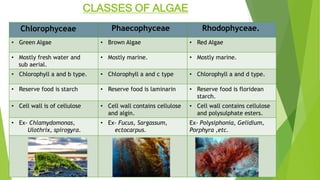
Chlorophyceae Phaecophyceae Rhodophyceae.
• Green Algae • Brown Algae • Red Algae
• Mostly fresh water and
sub aerial.
• Mostly marine. • Mostly marine.
• Chlorophyll a and b type. • Chlorophyll a and c type • Chlorophyll a and d type.
• Reserve food is starch • Reserve food is laminarin • Reserve food is floridean
starch.
• Cell wall is of cellulose • Cell wall contains cellulose
and algin.
• Cell wall contains cellulose
and polysulphate esters.
• Ex- Chlamydomonas,
Ulothrix, spirogyra.
• Ex- Fucus, Sargassum,
ectocarpus.
Ex- Polysiphonia, Gelidium,
Porphyra ,etc.
Economic Importance of Algae :
 Photosynthesis : Algae are estimated to fix nearly 50% of global
carbon dioxide through photosynthesis.
 Food : A number of brown algae ( Laminaria, Sargassum) are used
as food in some countries.
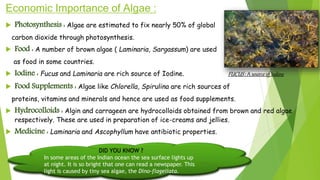
 Iodine : Fucus and Laminaria are rich source of Iodine. FUCUS : A source of Iodine
 Food Supplements : Algae like Chlorella, Spirulina are rich sources of
proteins, vitamins and minerals and hence are used as food supplements.
 Hydrocolloids : Algin and carrageen are hydrocolloids obtained from brown and red algae
respectively. These are used in preparation of ice-creams and jellies.
 Medicine : Laminaria and Ascophyllum have antibiotic properties.
DID YOU KNOW ?
In some areas of the Indian ocean the sea surface lights up
at night. It is so bright that one can read a newspaper. This
light is caused by tiny sea algae, the Dino-flagellata.
BRYOPHYTA
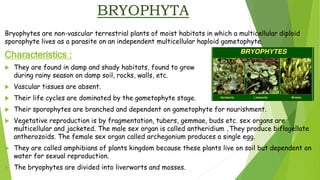
Bryophytes are non-vascular terrestrial plants of moist habitats in which a multicellular diploid
sporophyte lives as a parasite on an independent multicellular haploid gametophyte.
Characteristics :
 They are found in damp and shady habitats, found to grow
during rainy season on damp soil, rocks, walls, etc.
 Vascular tissues are absent.
 Their life cycles are dominated by the gametophyte stage.
 Their sporophytes are branched and dependent on gametophyte for nourishment.
 Vegetative reproduction is by fragmentation, tubers, gemmae, buds etc. sex organs are
multicellular and jacketed. The male sex organ is called antheridium .They produce biflagellate
antherozoids. The female sex organ called archegonium produces a single egg.
 They are called amphibians of plants kingdom because these plants live on soil but dependent on
water for sexual reproduction.
 The bryophytes are divided into liverworts and mosses.
Bryophytes Hepaticopsida (Liverworts)
 Liverworts grow in moist, shady habitats such as marshy ground, damp soil, etc.
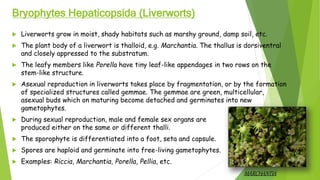
 The plant body of a liverwort is thalloid, e.g. Marchantia. The thallus is dorsiventral
and closely appressed to the substratum.
 The leafy members like Porella have tiny leaf-like appendages in two rows on the
stem-like structure.
 Asexual reproduction in liverworts takes place by fragmentation, or by the formation
of specialized structures called gemmae. The gemmae are green, multicellular,
asexual buds which on maturing become detached and germinates into new
gametophytes.
 During sexual reproduction, male and female sex organs are
produced either on the same or different thalli.
 The sporophyte is differentiated into a foot, seta and capsule.
 Spores are haploid and germinate into free-living gametophytes.
 Examples: Riccia, Marchantia, Porella, Pellia, etc.
MARCHANTIA
Bryopsida (Mosses)
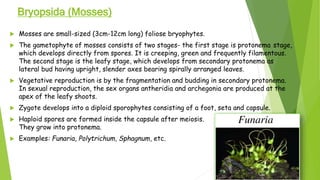
 Mosses are small-sized (3cm-12cm long) foliose bryophytes.
 The gametophyte of mosses consists of two stages- the first stage is protonema stage,
which develops directly from spores. It is creeping, green and frequently filamentous.
The second stage is the leafy stage, which develops from secondary protonema as
lateral bud having upright, slender axes bearing spirally arranged leaves.
 Vegetative reproduction is by the fragmentation and budding in secondary protonema.
In sexual reproduction, the sex organs antheridia and archegonia are produced at the
apex of the leafy shoots.
 Zygote develops into a diploid sporophytes consisting of a foot, seta and capsule.
 Haploid spores are formed inside the capsule after meiosis.
They grow into protonema.
 Examples: Funaria, Polytrichum, Sphagnum, etc.
PTERIDOPHYTA
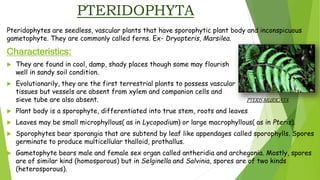
Pteridophytes are seedless, vascular plants that have sporophytic plant body and inconspicuous
gametophyte. They are commonly called ferns. Ex- Dryopteris, Marsilea.
Characteristics:
 They are found in cool, damp, shady places though some may flourish
well in sandy soil condition.
 Evolutionarily, they are the first terrestrial plants to possess vascular
tissues but vessels are absent from xylem and companion cells and
sieve tube are also absent. PTERIS MURICATA
 Plant body is a sporophyte, differentiated into true stem, roots and leaves
 Leaves may be small microphyllous( as in Lycopodium) or large macrophyllous( as in Pteris).
 Sporophytes bear sporangia that are subtend by leaf like appendages called sporophylls. Spores
germinate to produce multicellular thalloid, prothallus.
 Gametophyte bears male and female sex organ called antheridia and archegonia. Mostly, spores
are of similar kind (homosporous) but in Selginella and Salvinia, spores are of two kinds
(heterosporous).
GYMNOSPERMS
Gymnosperms are those plants in which the ovules are not enclosed inside the ovary wall and
remain exposed before and after fertilisation. These are woody perennial plants which include
medium sized or tall trees and a few shrubs.
Characteristics:
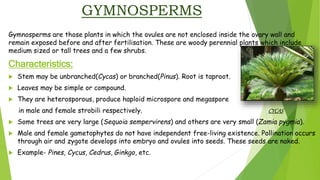
 Stem may be unbranched(Cycas) or branched(Pinus). Root is taproot.
 Leaves may be simple or compound.
 They are heterosporous, produce haploid microspore and megaspore
in male and female strobili respectively. CYCAS
 Some trees are very large (Sequoia sempervirens) and others are very small (Zamia pygmia).
 Male and female gametophytes do not have independent free-living existence. Pollination occurs
through air and zygote develops into embryo and ovules into seeds. These seeds are naked.
 Example- Pines, Cycus, Cedrus, Ginkgo, etc.
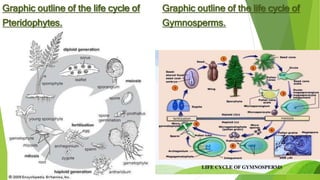
Graphic outline of the life cycle of
Pteridophytes.
Graphic outline of the life cycle of
Gymnosperms.
ANGIOSPERMS
Angiosperms are those plants in which seeds are enclosed in the fruit. They are the most abundant
plants. They may be herbs, shrubs or trees .
Characteristics :
 These flowering plants grow in all sorts of habitats.
 They have a well-developed conducting tissue for the conduction
of water, mineral, nutrients and organic food.
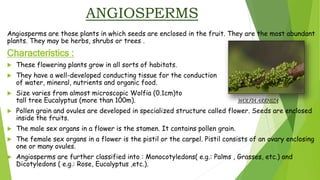
 Size varies from almost microscopic Wolfia (0.1cm)to
tall tree Eucalyptus (more than 100m). WOLFIA ARRHIZA
 Pollen grain and ovules are developed in specialized structure called flower. Seeds are enclosed
inside the fruits.
 The male sex organs in a flower is the stamen. It contains pollen grain.
 The female sex organs in a flower is the pistil or the carpel. Pistil consists of an ovary enclosing
one or many ovules.
 Angiosperms are further classified into : Monocotyledons( e.g.: Palms , Grasses, etc.) and
Dicotyledons ( e.g.: Rose, Eucalyptus ,etc.).
Monocotyledons:
 It contains a single cotyledon only.
 Leaves have a parallel venation. They have a fibrous root system.
 More number of closed vascular bundle.
 Floral parts are tri-, tetra- or pentamerous.
 Seeds are endospermic.
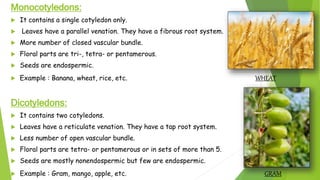
 Example : Banana, wheat, rice, etc. WHEAT
Dicotyledons:
 It contains two cotyledons.
 Leaves have a reticulate venation. They have a tap root system.
 Less number of open vascular bundle.
 Floral parts are tetra- or pentamerous or in sets of more than 5.
 Seeds are mostly nonendospermic but few are endospermic.
 Example : Gram, mango, apple, etc. GRAM
BIBLIOGRAPHY
All the information that was needed for this presentation was taken from
these sources:
 https://study.com
 https://www.biologydiscussion.com

Plant Kingdom

  • 1.
  • 2.
    INTRODUCTION Kingdom Plantae includesall the plants on the earth. They are multicellular, eukaryotes and consist of a rigid structure called cell wall .Plants also have a green colored pigment called chlorophyll and hence exhibit autotrophic mode of nutrition. Kingdom Plantae is further classified into sub-groups. Plant Kingdom Cryptogamae ( without seeds ) Thallophyta (Algae) Bryophyta Pteridophyta Phanerogamae ( with seeds ) Gymnosperms Angiosperms Monocotyledons Dicotyledons
  • 3.
    ALGAE/THALLOPHYTA Algae are chlorophyllcontaining simple, thalloid (possessing undifferentiated or thallus-like forms) and autotrophic organisms. Characteristics :  Plant body is thallus, which may be unicellular (ex.- Chlamydomonas), colonial(ex.-Eudorina), filamentous(ex.- Ulothrix) or parenchymatous.  Algae are usually aquatic and occur in habitats like moist rocks, soils, tree trunks.  Vascular tissues and mechanical tissues are absent.  Reproduction is vegetative by fragmentation, asexual by spore formation (zoospores) and sexual reproduction by fusion of two gametes which may be Isogamous (Spirogyra), Anisogamous (Chlamydomonous) or Oogamous (Volvox).  Life cycle is various- haplontic, diplontic or diplohaplontic.  Algae can be broadly classified into 3 sub groups: Chlorophyceae, Phaecophyceae, Rhodophyceae.
  • 4.
    CLASSES OF ALGAE ChlorophyceaePhaecophyceae Rhodophyceae. • Green Algae • Brown Algae • Red Algae • Mostly fresh water and sub aerial. • Mostly marine. • Mostly marine. • Chlorophyll a and b type. • Chlorophyll a and c type • Chlorophyll a and d type. • Reserve food is starch • Reserve food is laminarin • Reserve food is floridean starch. • Cell wall is of cellulose • Cell wall contains cellulose and algin. • Cell wall contains cellulose and polysulphate esters. • Ex- Chlamydomonas, Ulothrix, spirogyra. • Ex- Fucus, Sargassum, ectocarpus. Ex- Polysiphonia, Gelidium, Porphyra ,etc.
  • 5.
    Economic Importance ofAlgae :  Photosynthesis : Algae are estimated to fix nearly 50% of global carbon dioxide through photosynthesis.  Food : A number of brown algae ( Laminaria, Sargassum) are used as food in some countries.  Iodine : Fucus and Laminaria are rich source of Iodine. FUCUS : A source of Iodine  Food Supplements : Algae like Chlorella, Spirulina are rich sources of proteins, vitamins and minerals and hence are used as food supplements.  Hydrocolloids : Algin and carrageen are hydrocolloids obtained from brown and red algae respectively. These are used in preparation of ice-creams and jellies.  Medicine : Laminaria and Ascophyllum have antibiotic properties. DID YOU KNOW ? In some areas of the Indian ocean the sea surface lights up at night. It is so bright that one can read a newspaper. This light is caused by tiny sea algae, the Dino-flagellata.
  • 6.
    BRYOPHYTA Bryophytes are non-vascularterrestrial plants of moist habitats in which a multicellular diploid sporophyte lives as a parasite on an independent multicellular haploid gametophyte. Characteristics :  They are found in damp and shady habitats, found to grow during rainy season on damp soil, rocks, walls, etc.  Vascular tissues are absent.  Their life cycles are dominated by the gametophyte stage.  Their sporophytes are branched and dependent on gametophyte for nourishment.  Vegetative reproduction is by fragmentation, tubers, gemmae, buds etc. sex organs are multicellular and jacketed. The male sex organ is called antheridium .They produce biflagellate antherozoids. The female sex organ called archegonium produces a single egg.  They are called amphibians of plants kingdom because these plants live on soil but dependent on water for sexual reproduction.  The bryophytes are divided into liverworts and mosses.
  • 7.
    Bryophytes Hepaticopsida (Liverworts) Liverworts grow in moist, shady habitats such as marshy ground, damp soil, etc.  The plant body of a liverwort is thalloid, e.g. Marchantia. The thallus is dorsiventral and closely appressed to the substratum.  The leafy members like Porella have tiny leaf-like appendages in two rows on the stem-like structure.  Asexual reproduction in liverworts takes place by fragmentation, or by the formation of specialized structures called gemmae. The gemmae are green, multicellular, asexual buds which on maturing become detached and germinates into new gametophytes.  During sexual reproduction, male and female sex organs are produced either on the same or different thalli.  The sporophyte is differentiated into a foot, seta and capsule.  Spores are haploid and germinate into free-living gametophytes.  Examples: Riccia, Marchantia, Porella, Pellia, etc. MARCHANTIA
  • 8.
    Bryopsida (Mosses)  Mossesare small-sized (3cm-12cm long) foliose bryophytes.  The gametophyte of mosses consists of two stages- the first stage is protonema stage, which develops directly from spores. It is creeping, green and frequently filamentous. The second stage is the leafy stage, which develops from secondary protonema as lateral bud having upright, slender axes bearing spirally arranged leaves.  Vegetative reproduction is by the fragmentation and budding in secondary protonema. In sexual reproduction, the sex organs antheridia and archegonia are produced at the apex of the leafy shoots.  Zygote develops into a diploid sporophytes consisting of a foot, seta and capsule.  Haploid spores are formed inside the capsule after meiosis. They grow into protonema.  Examples: Funaria, Polytrichum, Sphagnum, etc.
  • 9.
    PTERIDOPHYTA Pteridophytes are seedless,vascular plants that have sporophytic plant body and inconspicuous gametophyte. They are commonly called ferns. Ex- Dryopteris, Marsilea. Characteristics:  They are found in cool, damp, shady places though some may flourish well in sandy soil condition.  Evolutionarily, they are the first terrestrial plants to possess vascular tissues but vessels are absent from xylem and companion cells and sieve tube are also absent. PTERIS MURICATA  Plant body is a sporophyte, differentiated into true stem, roots and leaves  Leaves may be small microphyllous( as in Lycopodium) or large macrophyllous( as in Pteris).  Sporophytes bear sporangia that are subtend by leaf like appendages called sporophylls. Spores germinate to produce multicellular thalloid, prothallus.  Gametophyte bears male and female sex organ called antheridia and archegonia. Mostly, spores are of similar kind (homosporous) but in Selginella and Salvinia, spores are of two kinds (heterosporous).
  • 10.
    GYMNOSPERMS Gymnosperms are thoseplants in which the ovules are not enclosed inside the ovary wall and remain exposed before and after fertilisation. These are woody perennial plants which include medium sized or tall trees and a few shrubs. Characteristics:  Stem may be unbranched(Cycas) or branched(Pinus). Root is taproot.  Leaves may be simple or compound.  They are heterosporous, produce haploid microspore and megaspore in male and female strobili respectively. CYCAS  Some trees are very large (Sequoia sempervirens) and others are very small (Zamia pygmia).  Male and female gametophytes do not have independent free-living existence. Pollination occurs through air and zygote develops into embryo and ovules into seeds. These seeds are naked.  Example- Pines, Cycus, Cedrus, Ginkgo, etc.
  • 11.
    Graphic outline ofthe life cycle of Pteridophytes. Graphic outline of the life cycle of Gymnosperms.
  • 12.
    ANGIOSPERMS Angiosperms are thoseplants in which seeds are enclosed in the fruit. They are the most abundant plants. They may be herbs, shrubs or trees . Characteristics :  These flowering plants grow in all sorts of habitats.  They have a well-developed conducting tissue for the conduction of water, mineral, nutrients and organic food.  Size varies from almost microscopic Wolfia (0.1cm)to tall tree Eucalyptus (more than 100m). WOLFIA ARRHIZA  Pollen grain and ovules are developed in specialized structure called flower. Seeds are enclosed inside the fruits.  The male sex organs in a flower is the stamen. It contains pollen grain.  The female sex organs in a flower is the pistil or the carpel. Pistil consists of an ovary enclosing one or many ovules.  Angiosperms are further classified into : Monocotyledons( e.g.: Palms , Grasses, etc.) and Dicotyledons ( e.g.: Rose, Eucalyptus ,etc.).
  • 13.
    Monocotyledons:  It containsa single cotyledon only.  Leaves have a parallel venation. They have a fibrous root system.  More number of closed vascular bundle.  Floral parts are tri-, tetra- or pentamerous.  Seeds are endospermic.  Example : Banana, wheat, rice, etc. WHEAT Dicotyledons:  It contains two cotyledons.  Leaves have a reticulate venation. They have a tap root system.  Less number of open vascular bundle.  Floral parts are tetra- or pentamerous or in sets of more than 5.  Seeds are mostly nonendospermic but few are endospermic.  Example : Gram, mango, apple, etc. GRAM
  • 14.
    BIBLIOGRAPHY All the informationthat was needed for this presentation was taken from these sources:  https://study.com  https://www.biologydiscussion.com