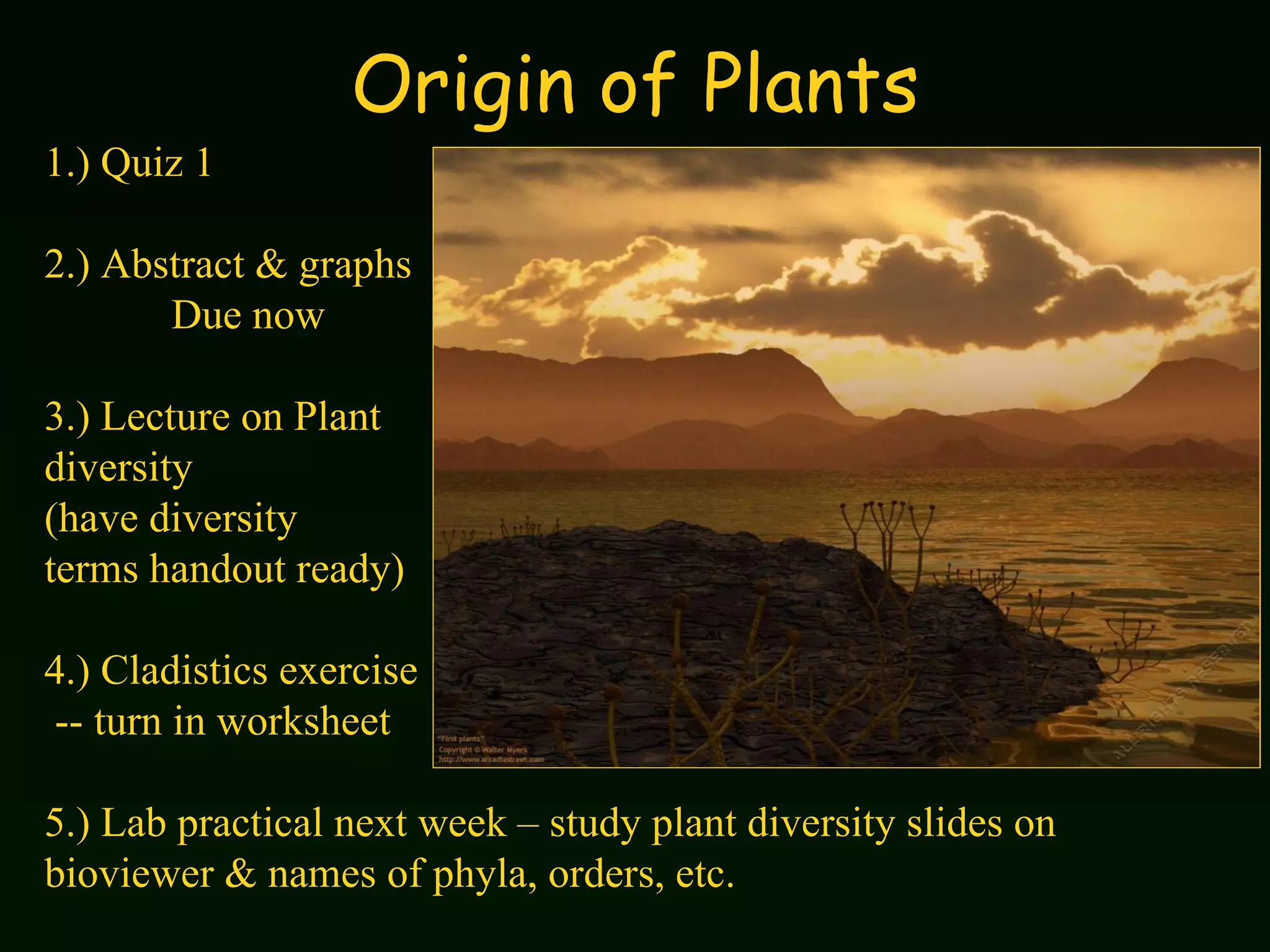
Origin of Plants 1.) Quiz 1 2.) Abstract & graphs  Due now 3.) Lecture on Plant  diversity (have diversity  terms handout ready) 4.) Cladistics exercise  -- turn in worksheet 5.) Lab practical next week – study plant diversity slides on bioviewer & names of phyla, orders, etc.
Principal Biological Concepts A.  Charophytes as probable ancestors to terrestrial plants. B.  Terrestrial adaptations. C.  Alternation of generations. D.  Archegonia/ antheridia. E.  Vascular tissues. F.  Seeds.  G. Characters and synapomorphies of plant clades
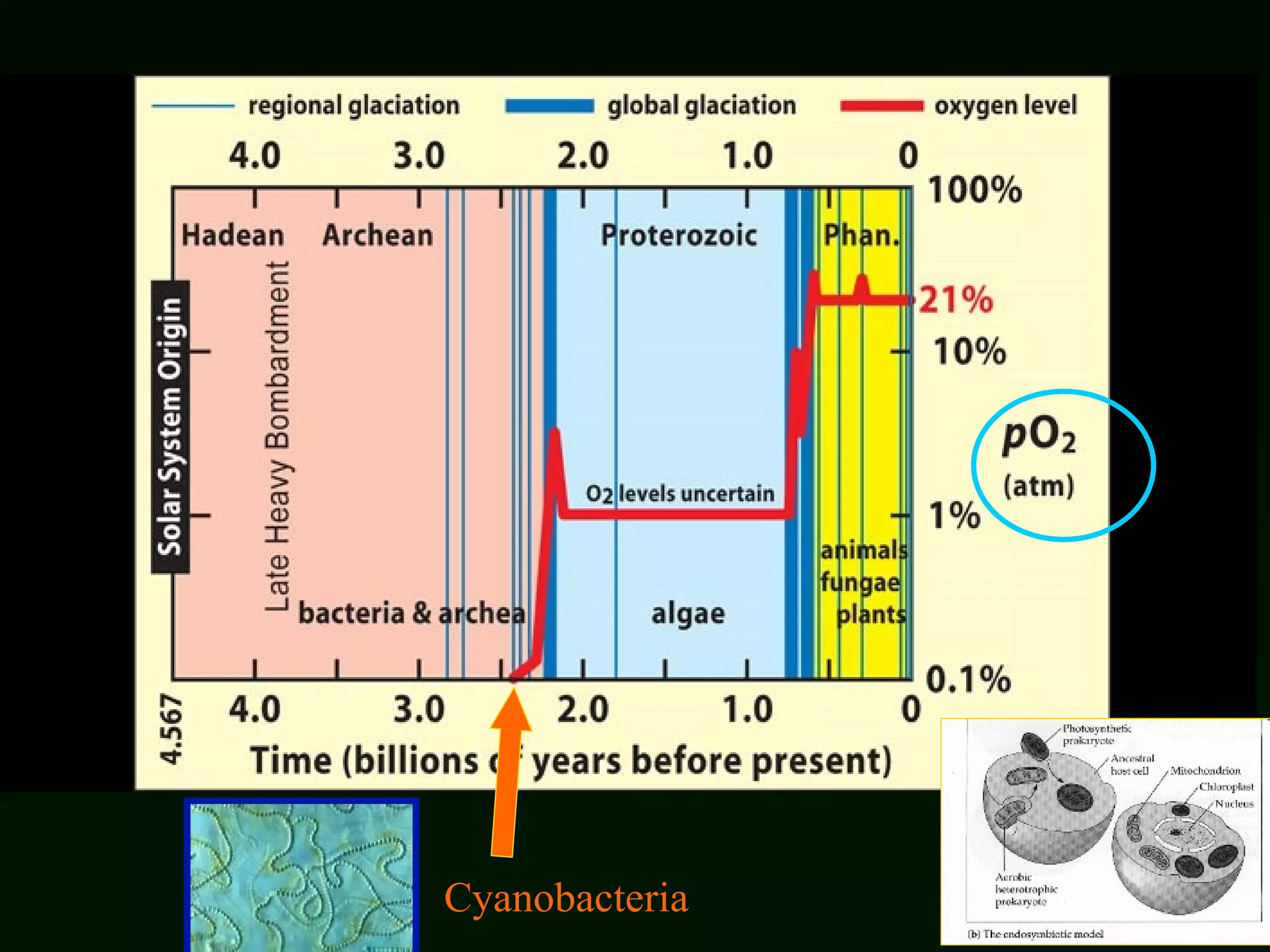
Cyanobacteria
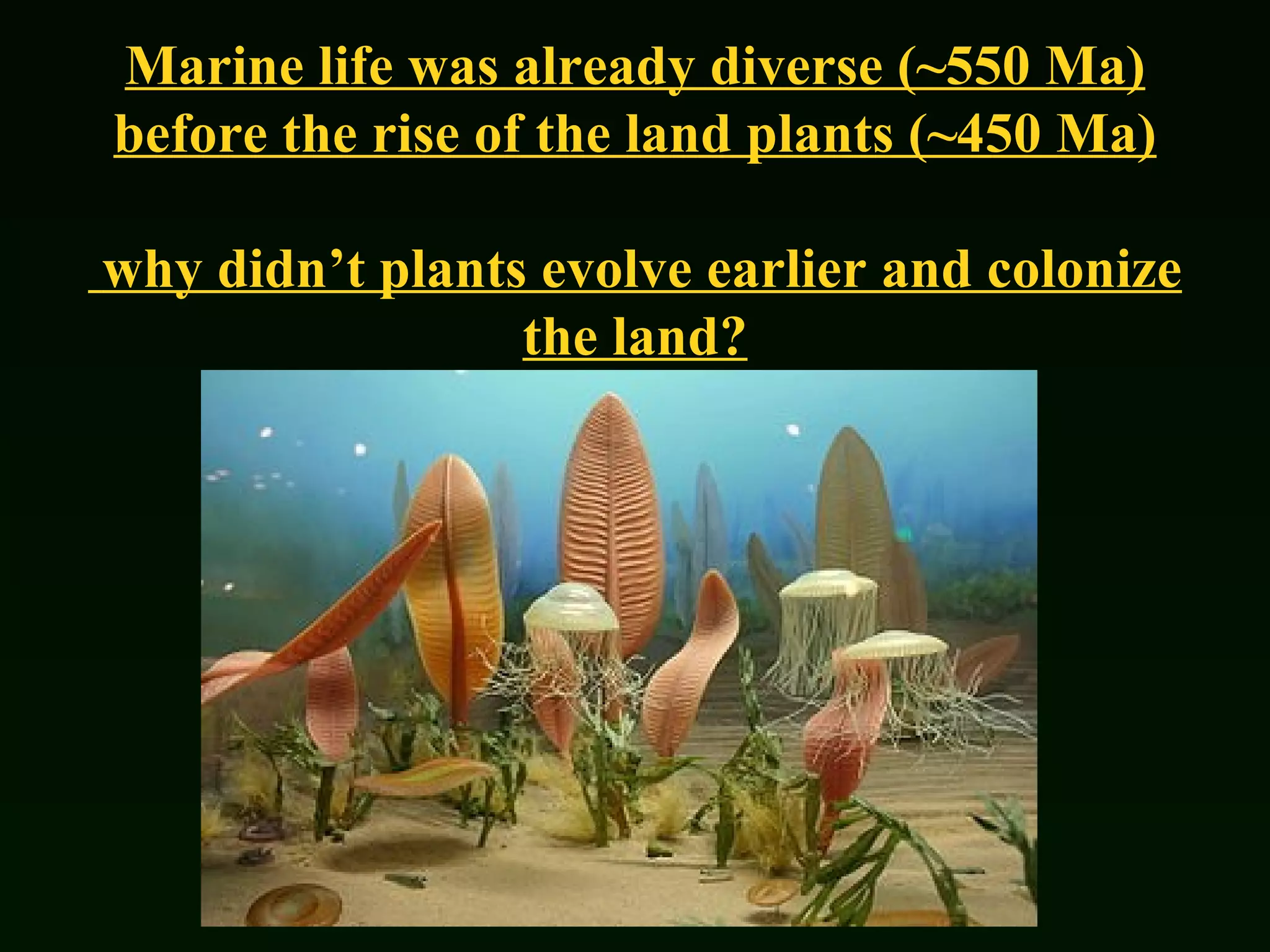
Marine life was already diverse (~550 Ma) before the rise of the land plants (~450 Ma) why didn’t plants evolve earlier and colonize the land?
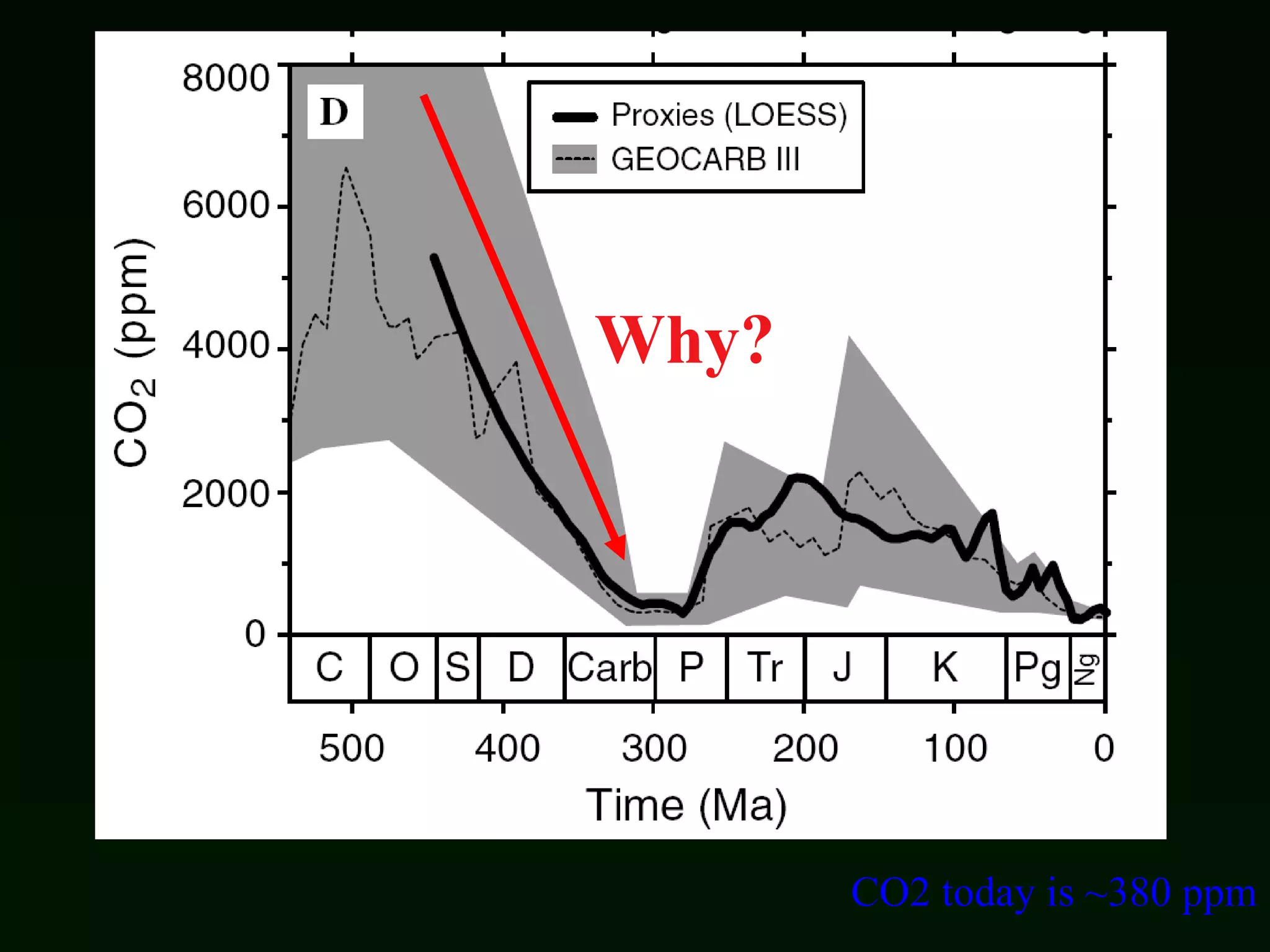
CO2 today is ~380 ppm Why?
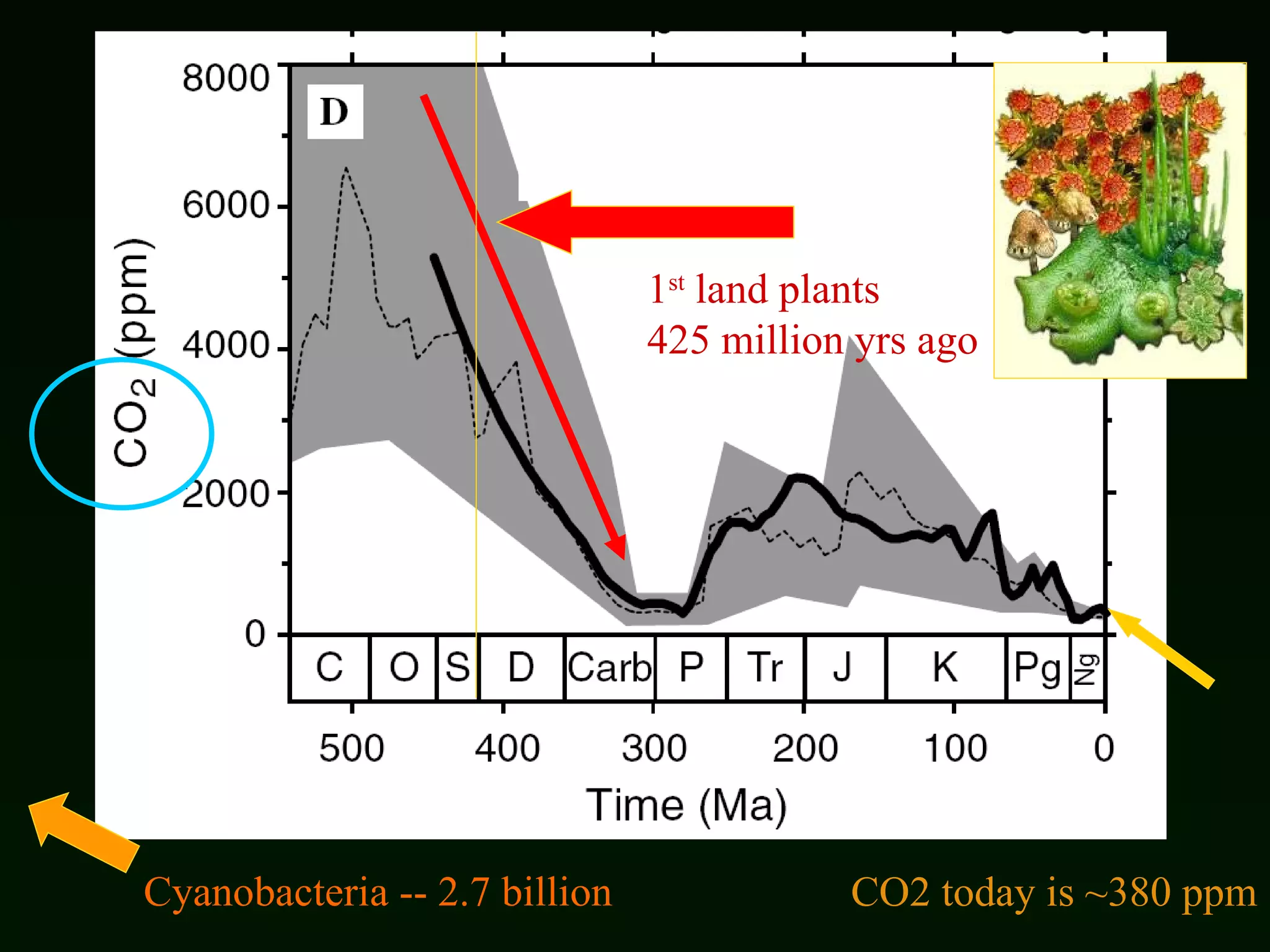
CO2 today is ~380 ppm Cyanobacteria -- 2.7 billion   1 st  land plants  425 million yrs ago
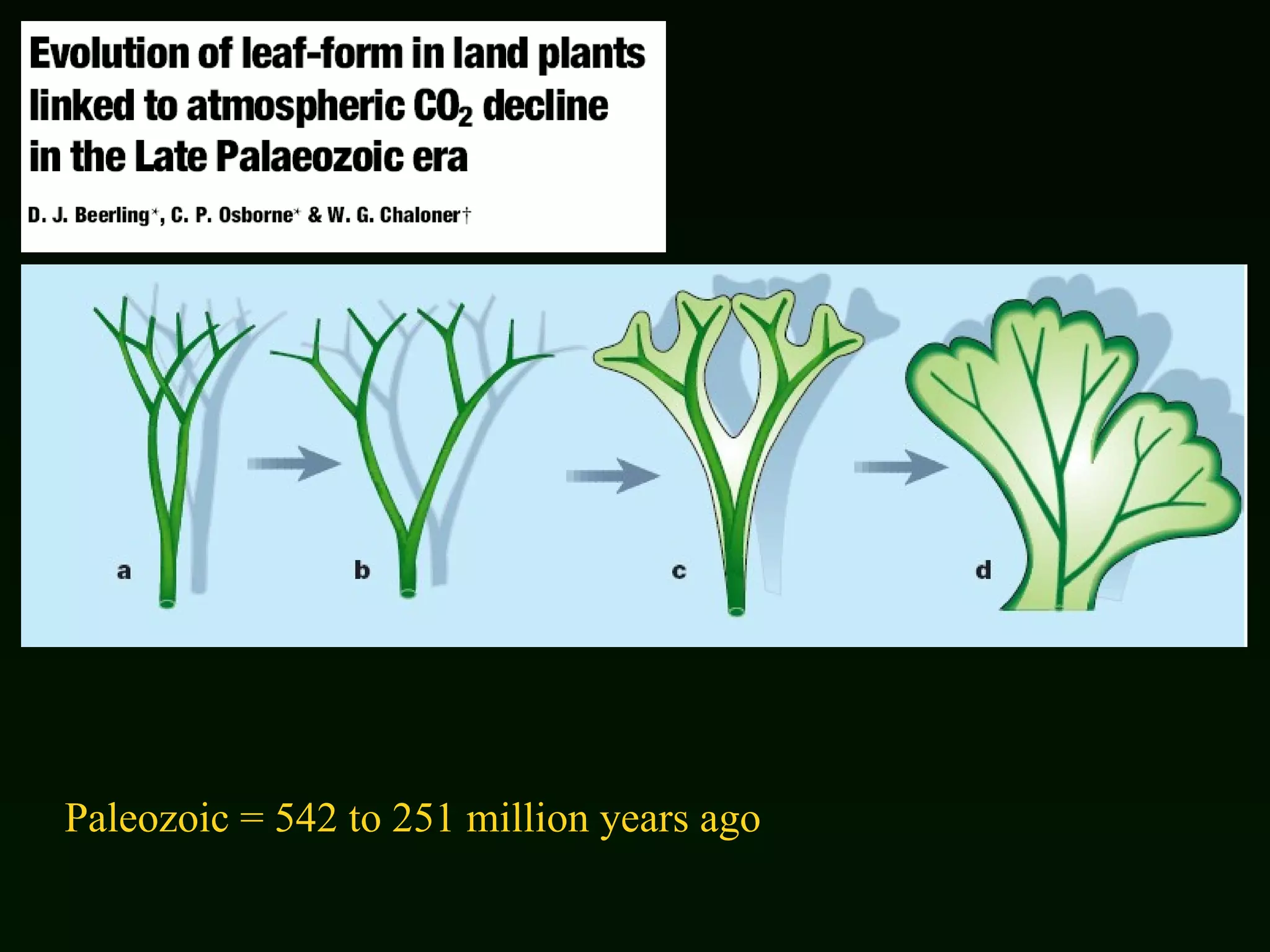
Paleozoic = 542 to 251 million years ago
http://www.seedmagazine.com/news/2009/02/the_evolution_of_life_in_60_se.php
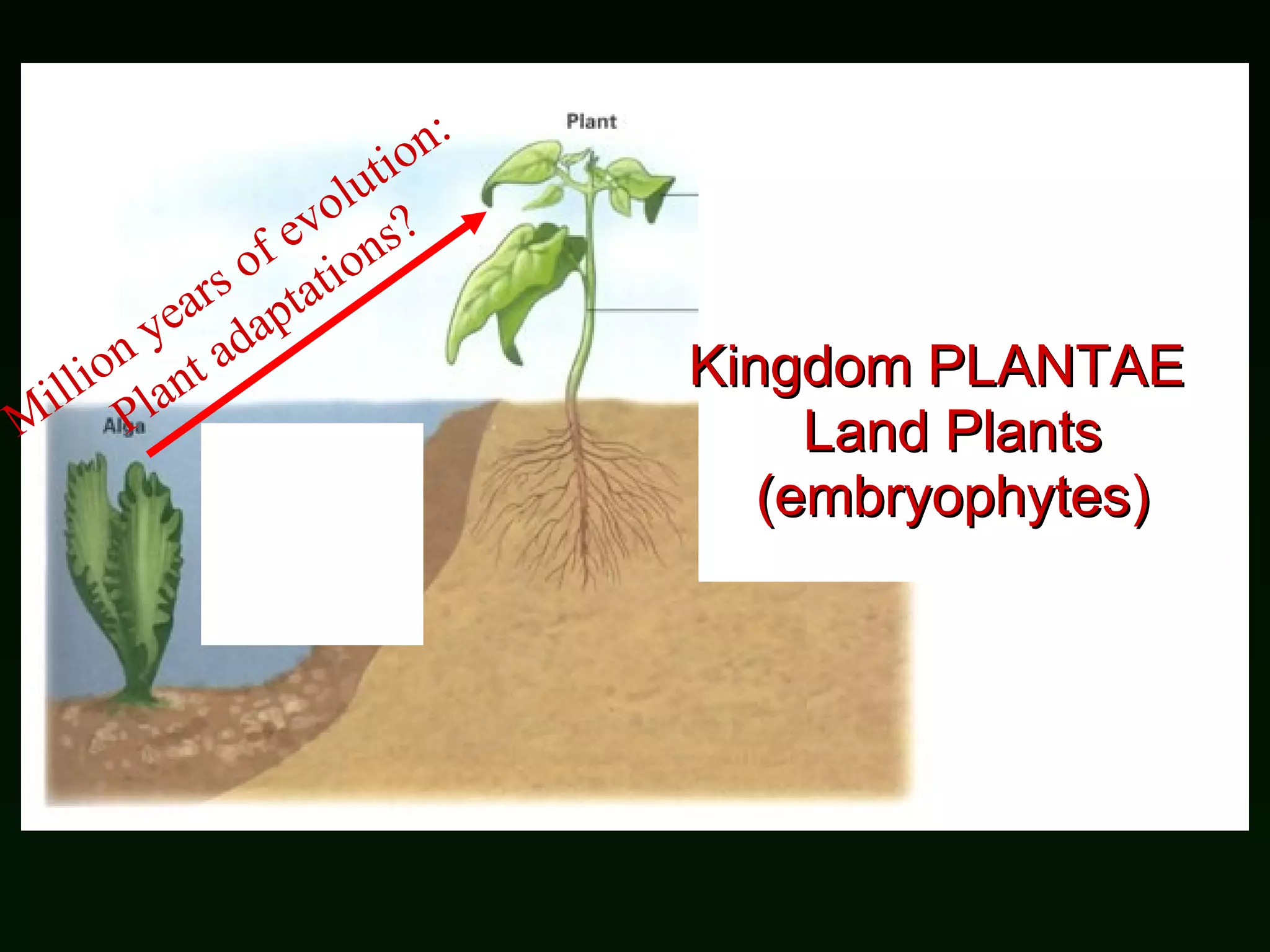
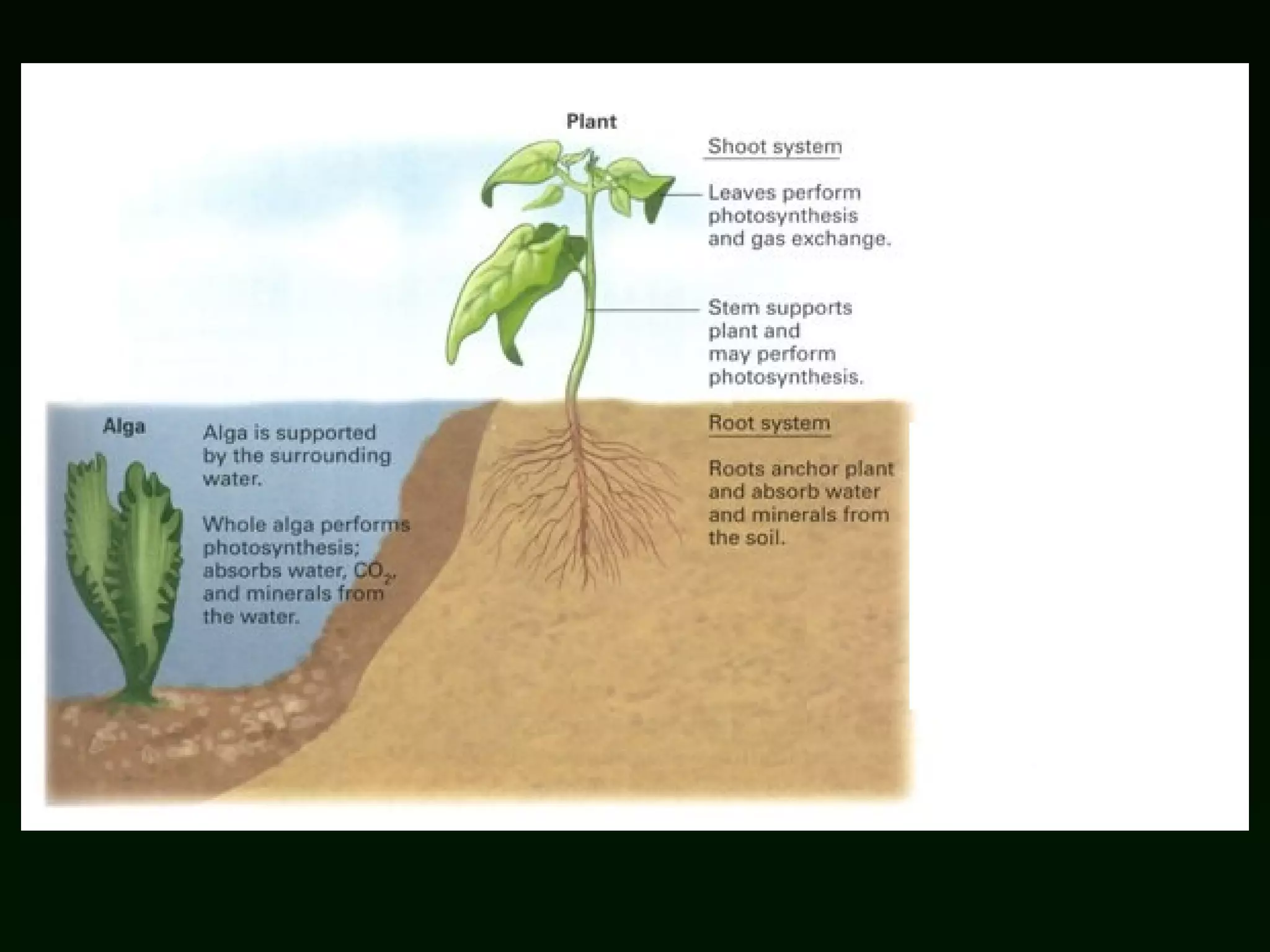
Million years of evolution:  Plant adaptations? Kingdom PLANTAE  Land Plants (embryophytes)
Million years of evolution:  Plant adaptations? Adaptations to land
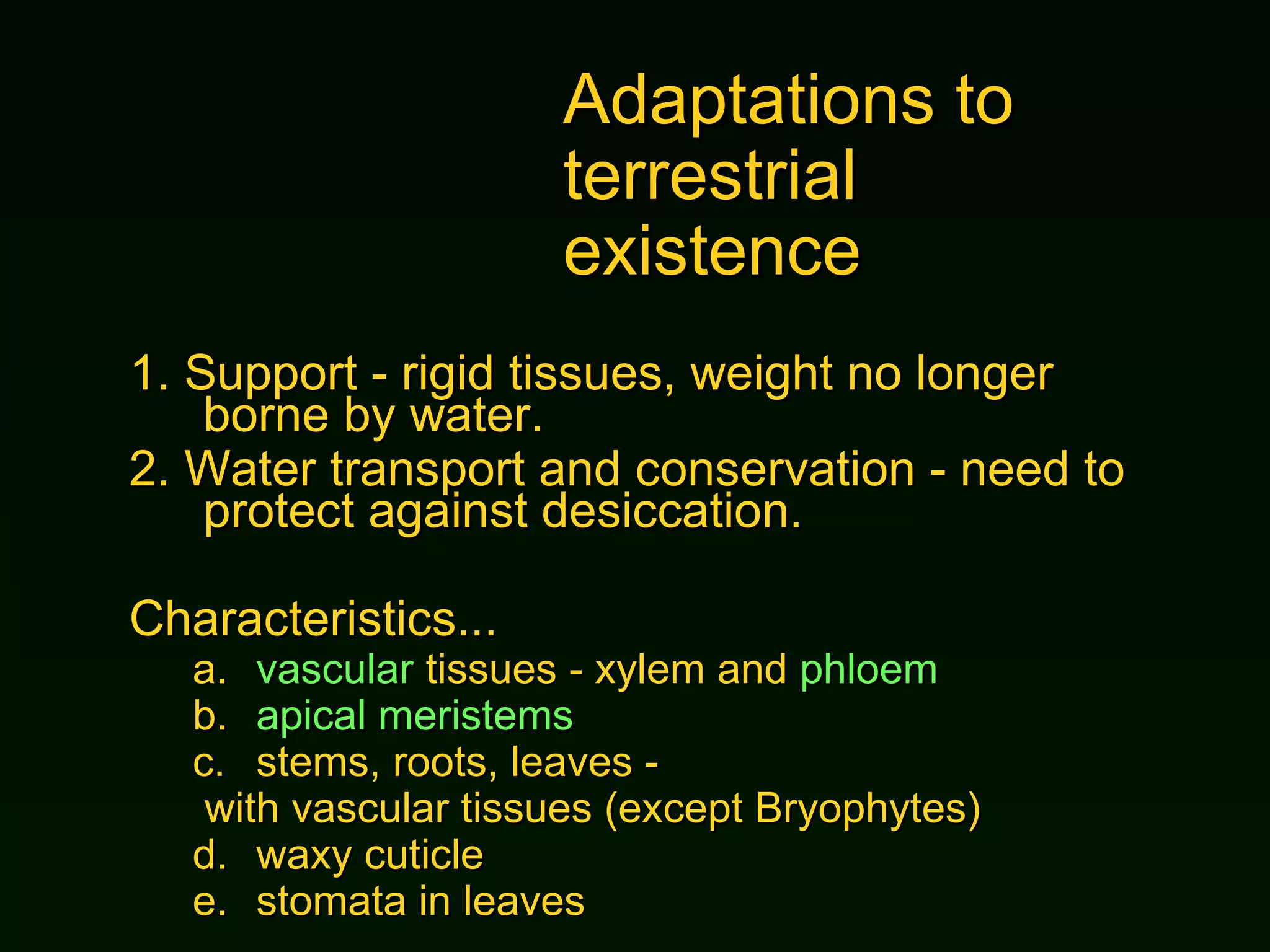
Adaptations to  terrestrial existence 1.  Support - rigid tissues, weight no longer borne by water. 2.  Water transport and conservation - need to protect against desiccation. Characteristics... a. vascular  tissues - xylem and  phloem b. apical meristems stems, roots, leaves - with vascular tissues (except Bryophytes) d. waxy cuticle e. stomata in leaves
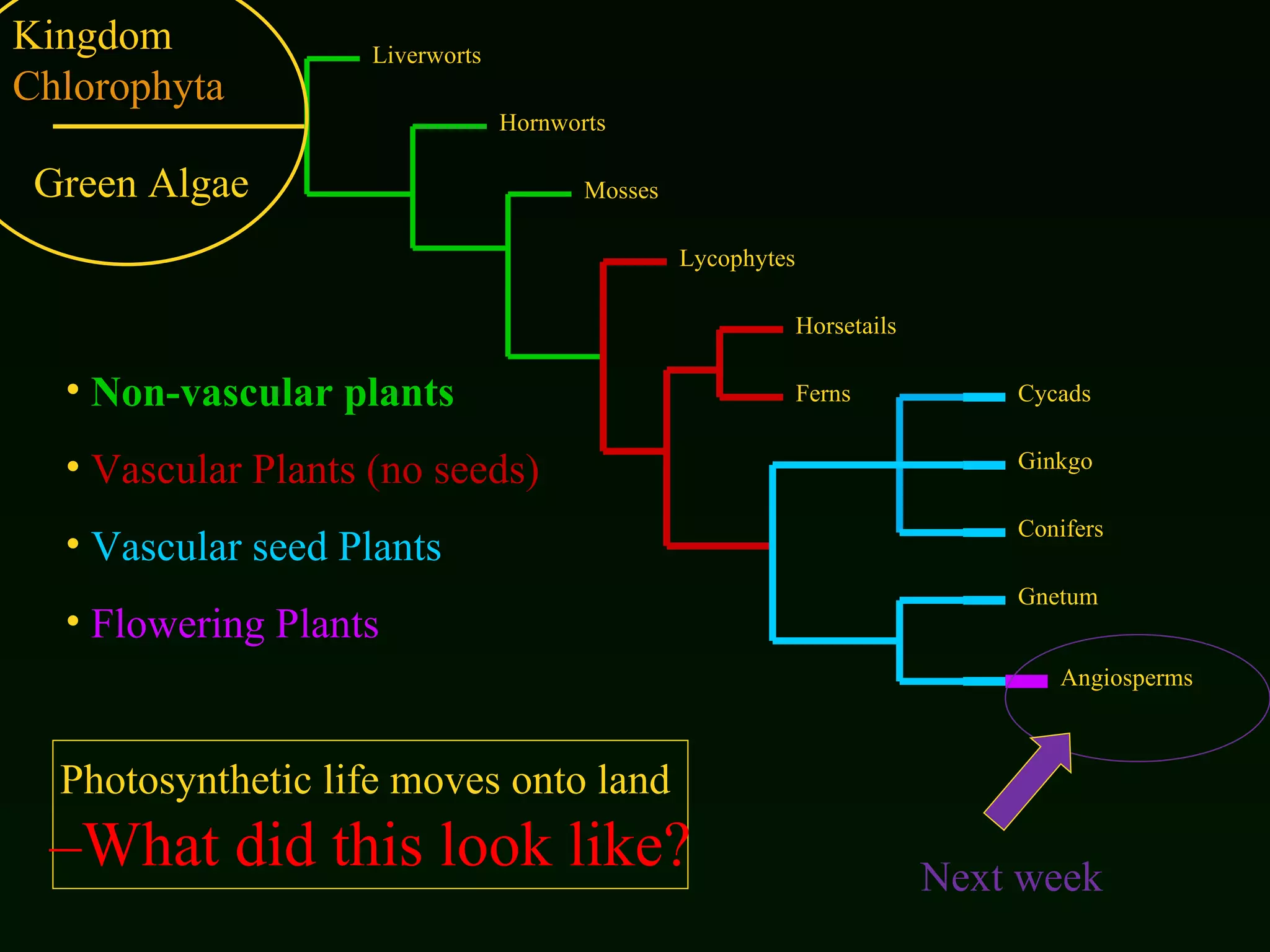
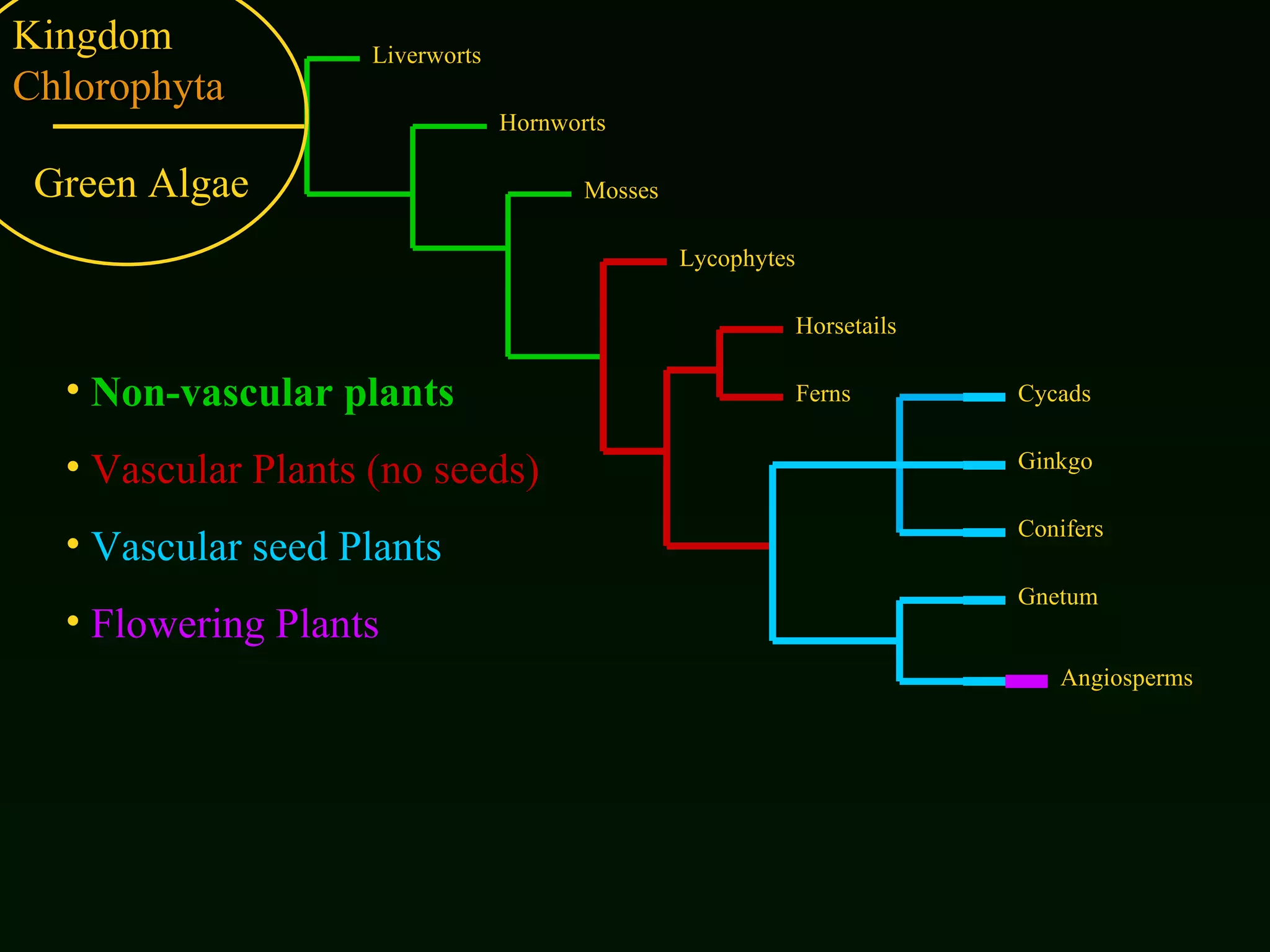
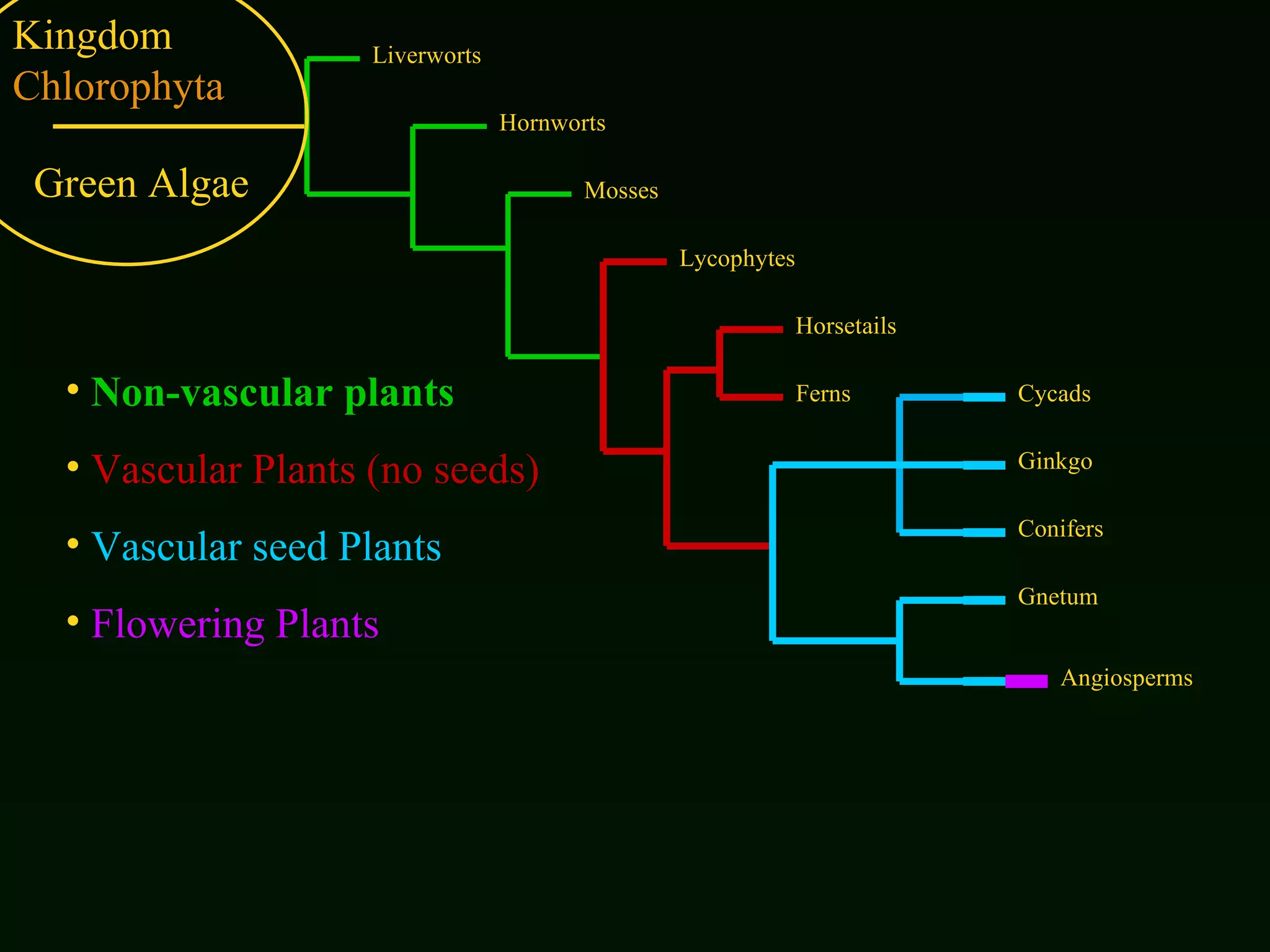
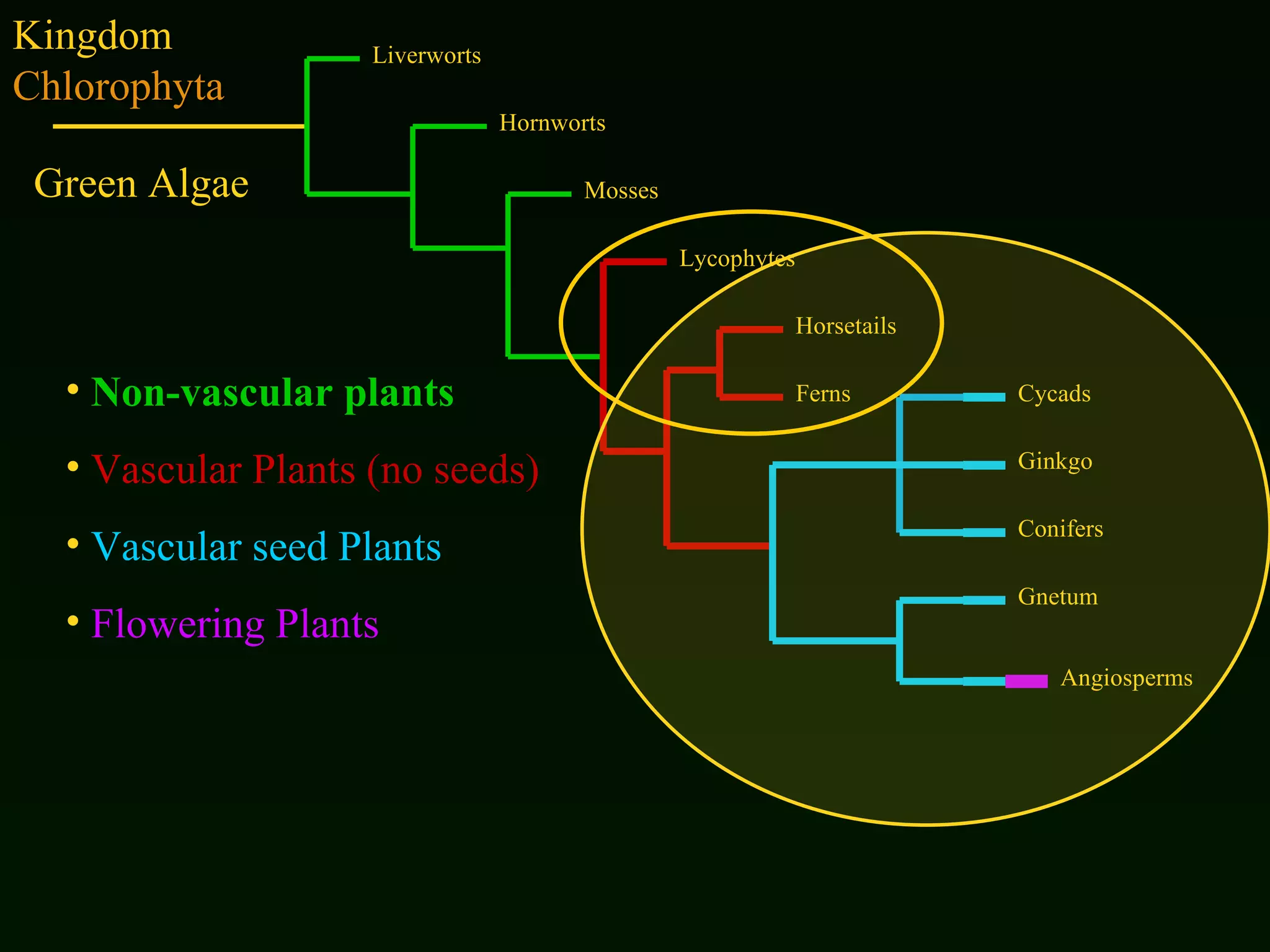
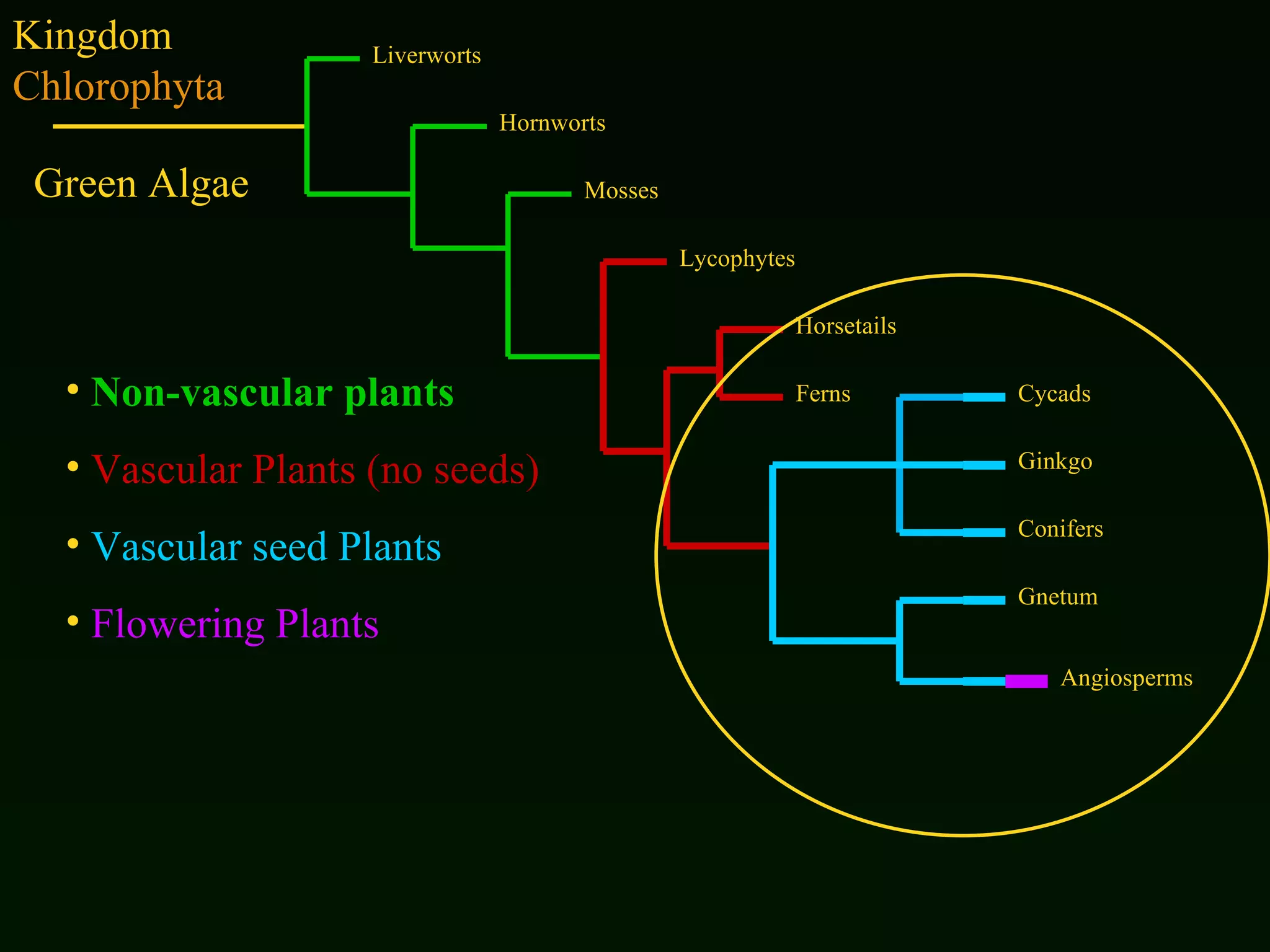
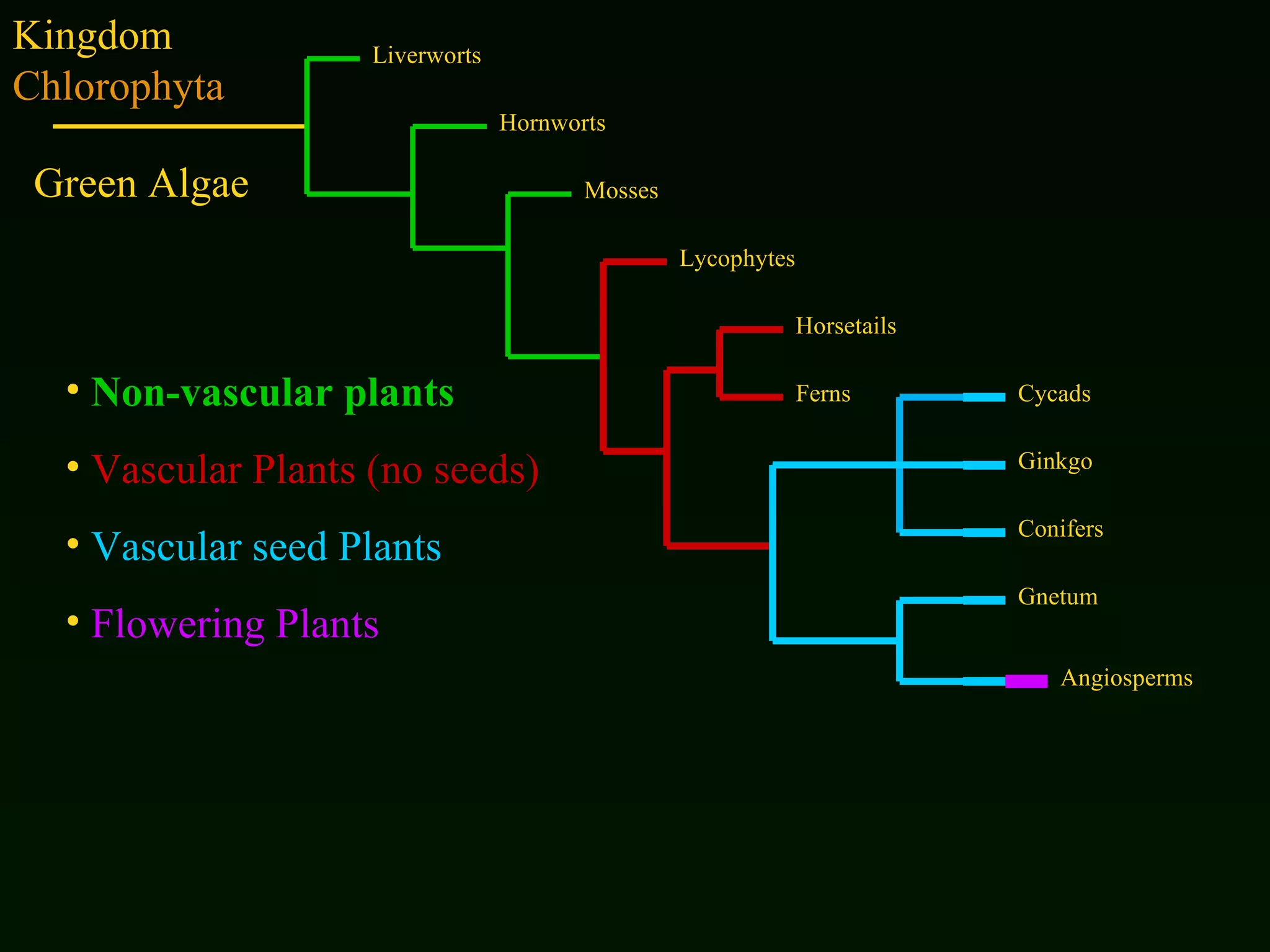
Kingdom  Chlorophyta Photosynthetic life moves onto land  – What did this look like? Non-vascular plants Vascular Plants   (no seeds) Vascular seed Plants Flowering Plants Liverworts Hornworts Mosses Lycophytes Horsetails Ferns Cycads Ginkgo Conifers Gnetum Angiosperms Green Algae Next week
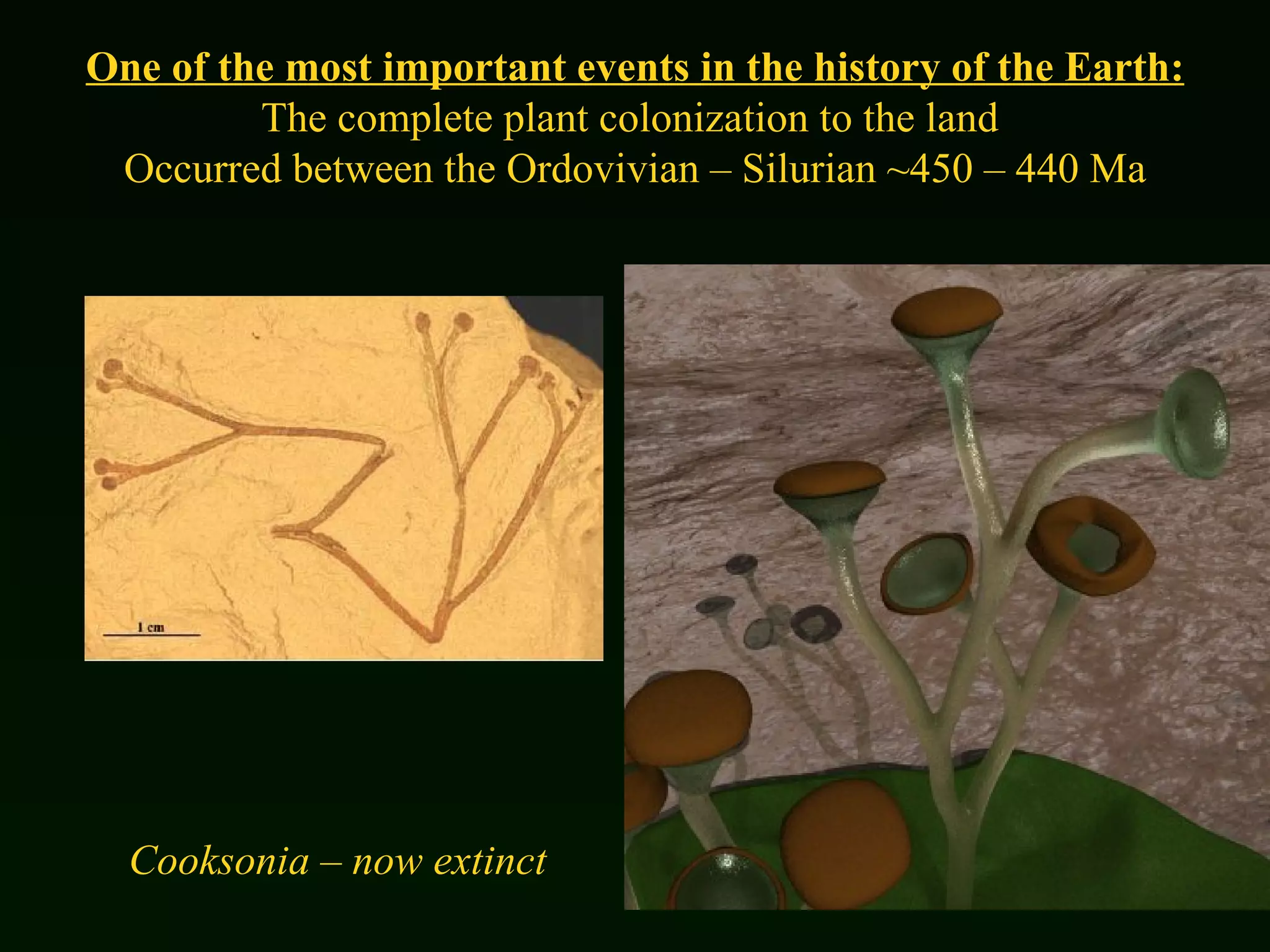
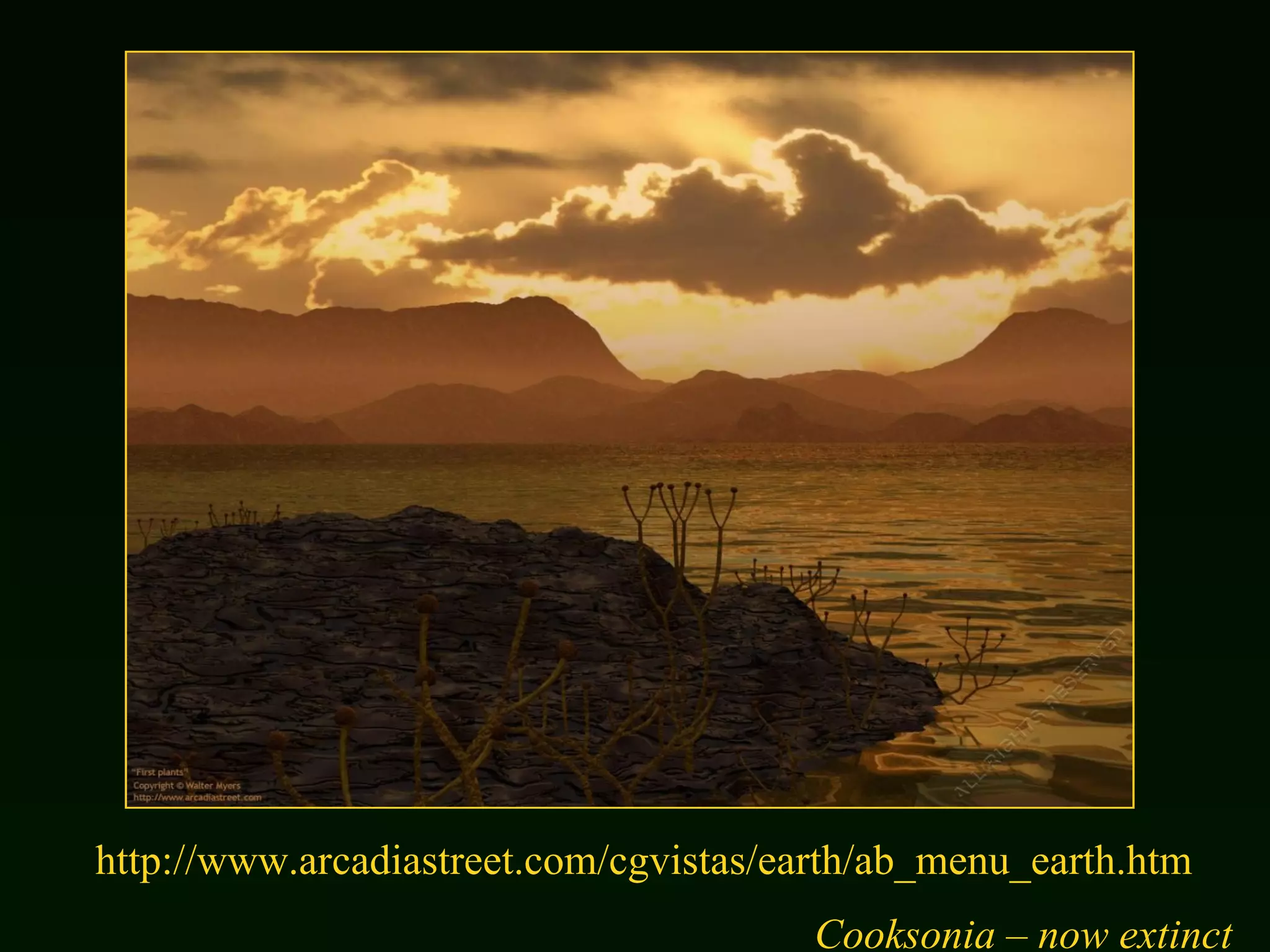
One of the most important events in the history of the Earth: The complete plant colonization to the land  Occurred between the Ordovivian – Silurian ~450 – 440 Ma Cooksonia – now extinct
http://www.arcadiastreet.com/cgvistas/earth/ab_menu_earth.htm Cooksonia – now extinct
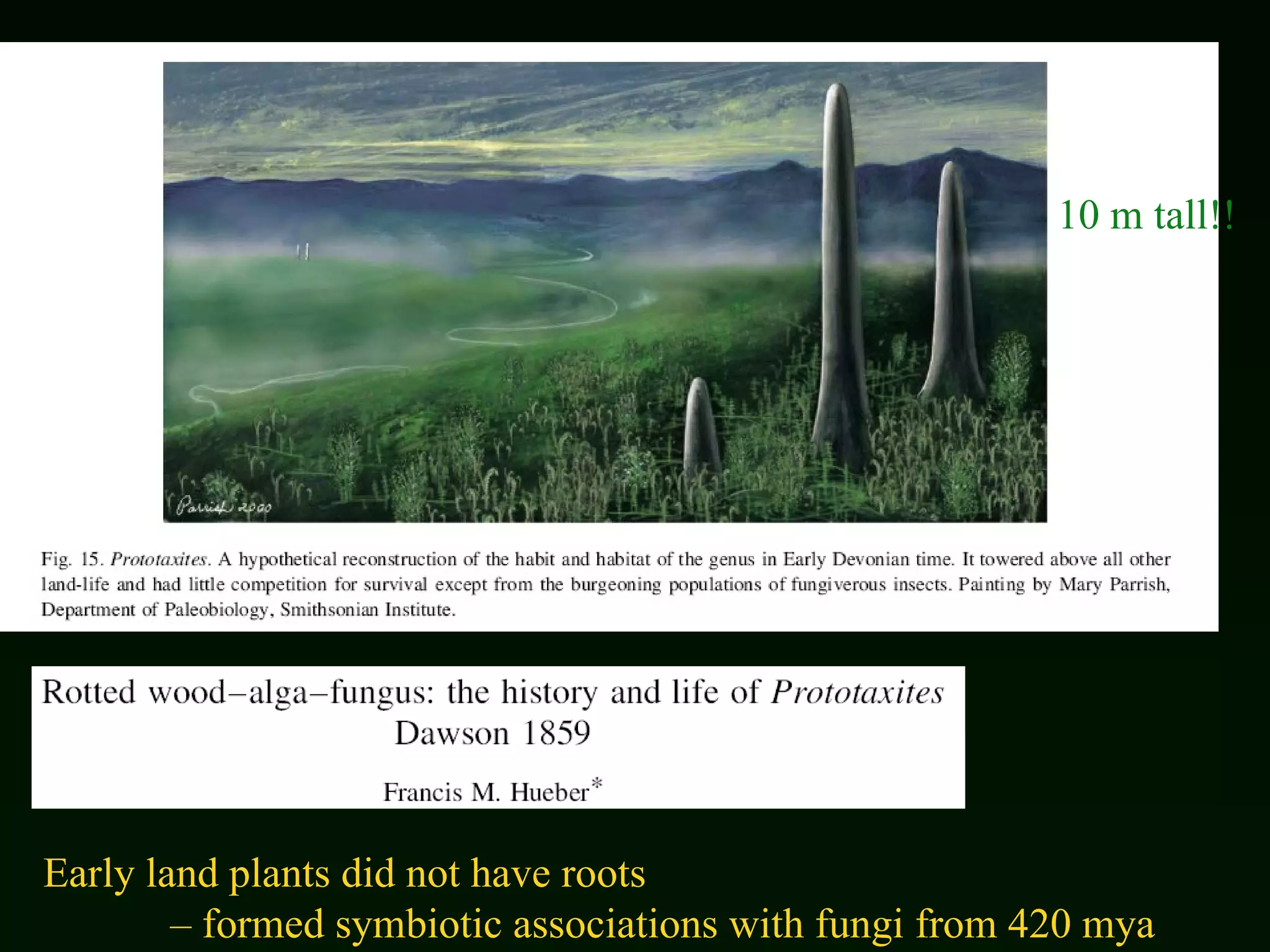
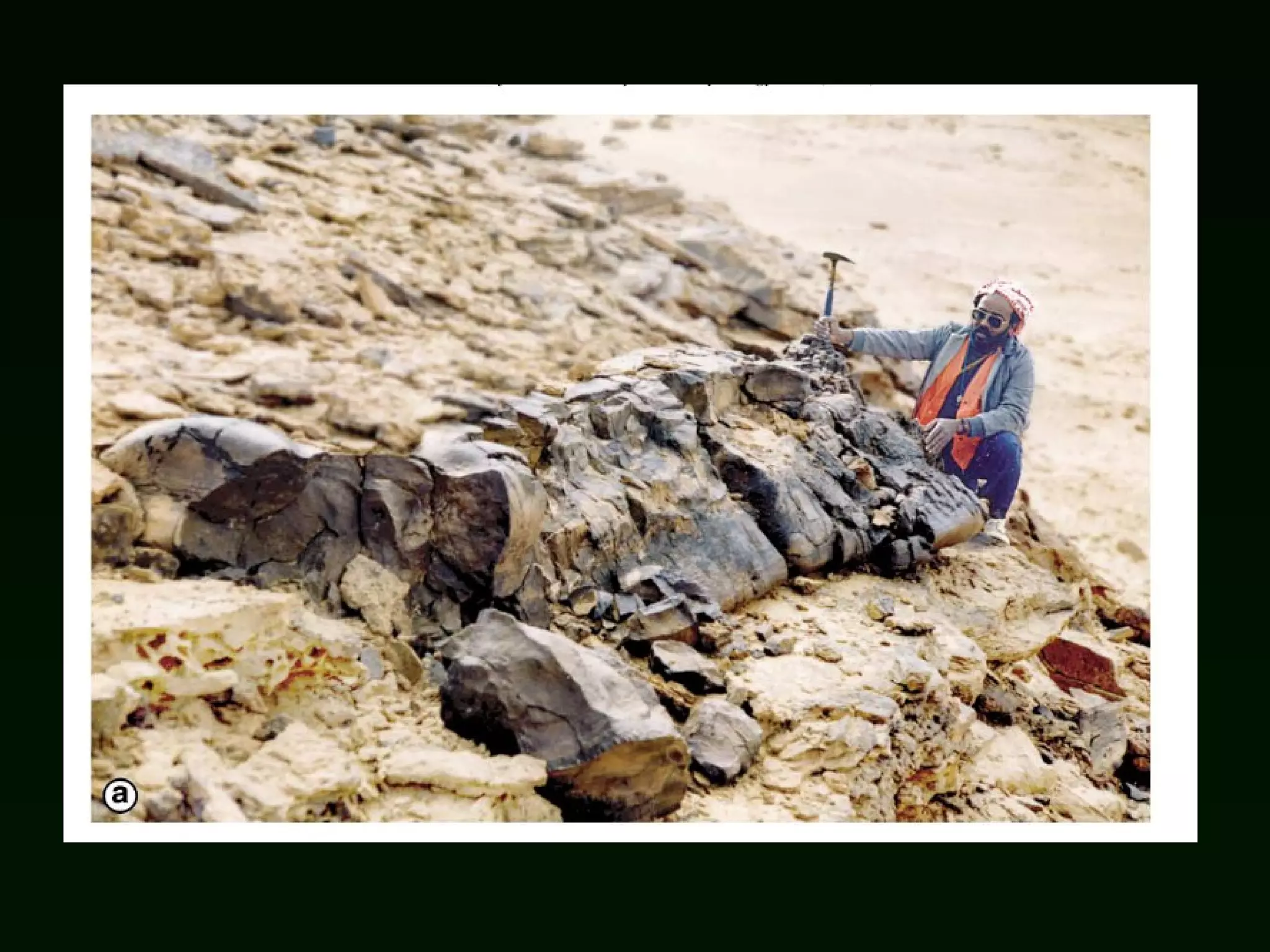
10 m tall!! Early land plants did not have roots  –  formed symbiotic associations with fungi from 420 mya
 
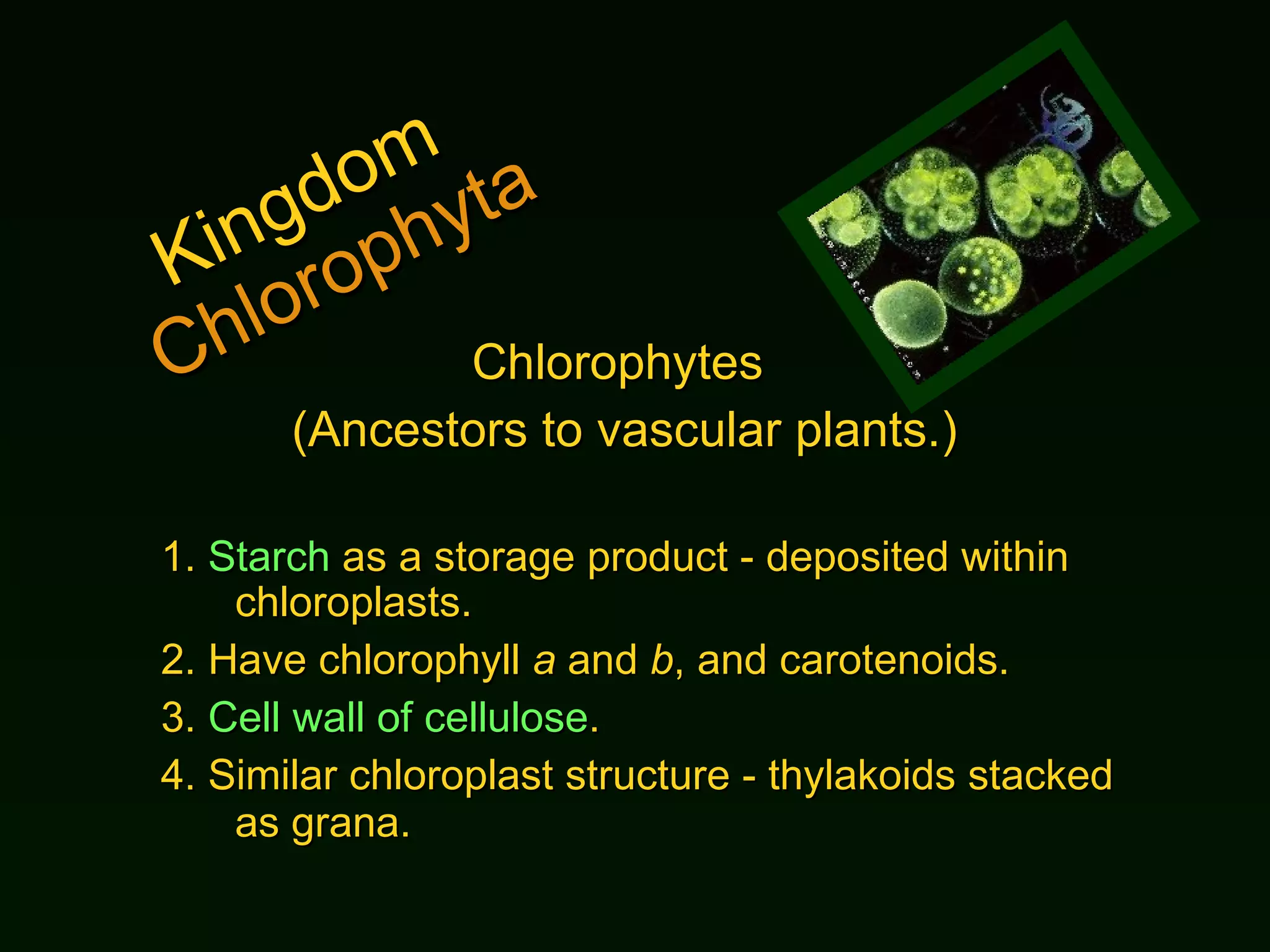
Kingdom  Chlorophyta Chlorophytes  (Ancestors to vascular plants.) 1.  Starch  as a storage product - deposited within chloroplasts.  2.  Have chlorophyll  a  and  b , and carotenoids.  3.  Cell wall of cellulose .  4.  Similar chloroplast structure - thylakoids stacked as grana.
Kingdom  Chlorophyta Non-vascular plants Vascular Plants   (no seeds) Vascular seed Plants Flowering Plants Liverworts Hornworts Mosses Lycophytes Horsetails Ferns Cycads Ginkgo Conifers Gnetum Angiosperms Green Algae
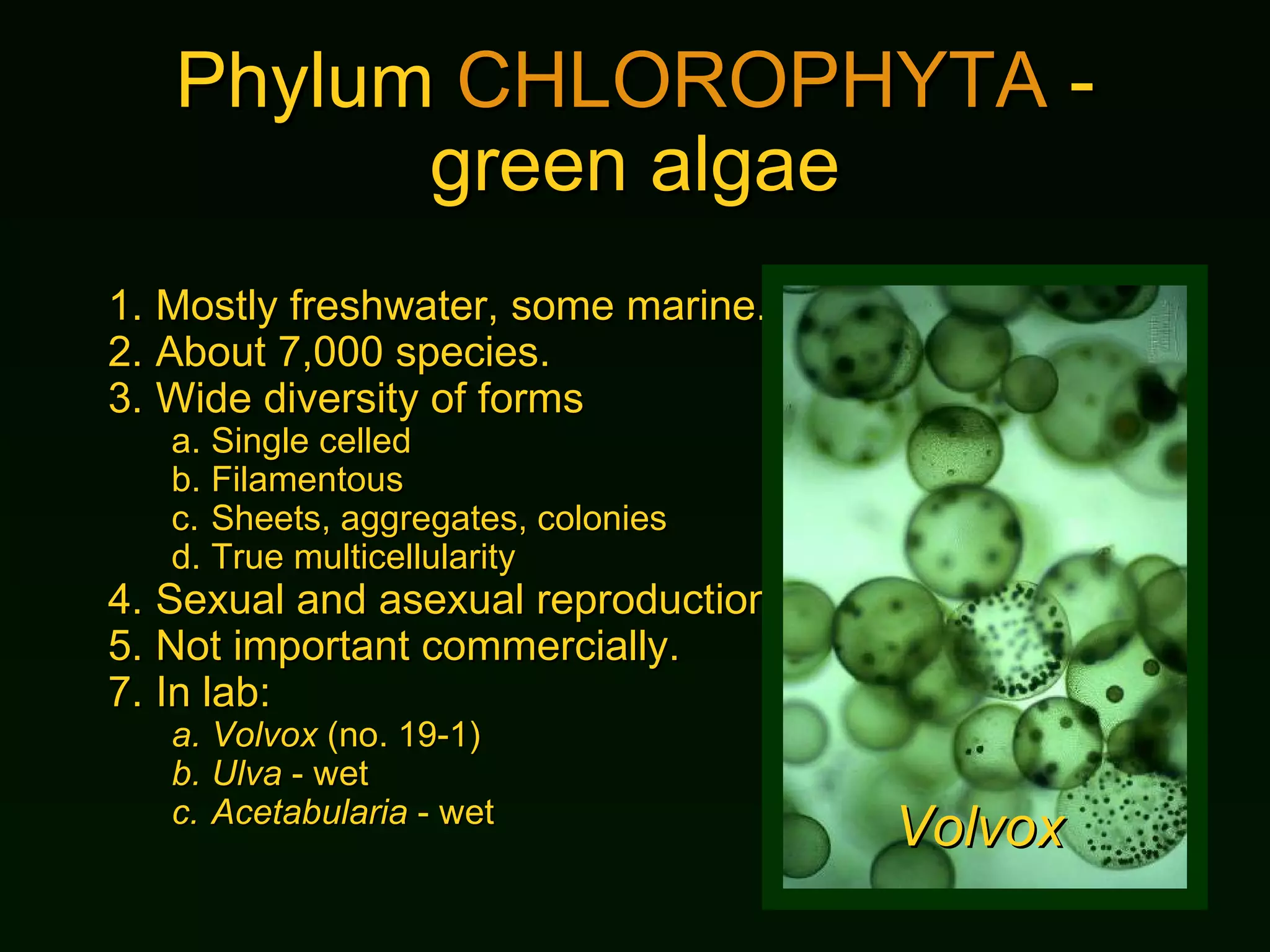
Phylum  CHLOROPHYTA  - green algae 1. Mostly freshwater, some marine.  2. About 7,000 species.  3. Wide diversity of forms a. Single celled b. Filamentous c. Sheets, aggregates, colonies d. True multicellularity 4. Sexual and asexual reproduction.  5. Not important commercially.  7. In lab:  a. Volvox  (no. 19-1)  b. Ulva  - wet c. Acetabularia  - wet Volvox
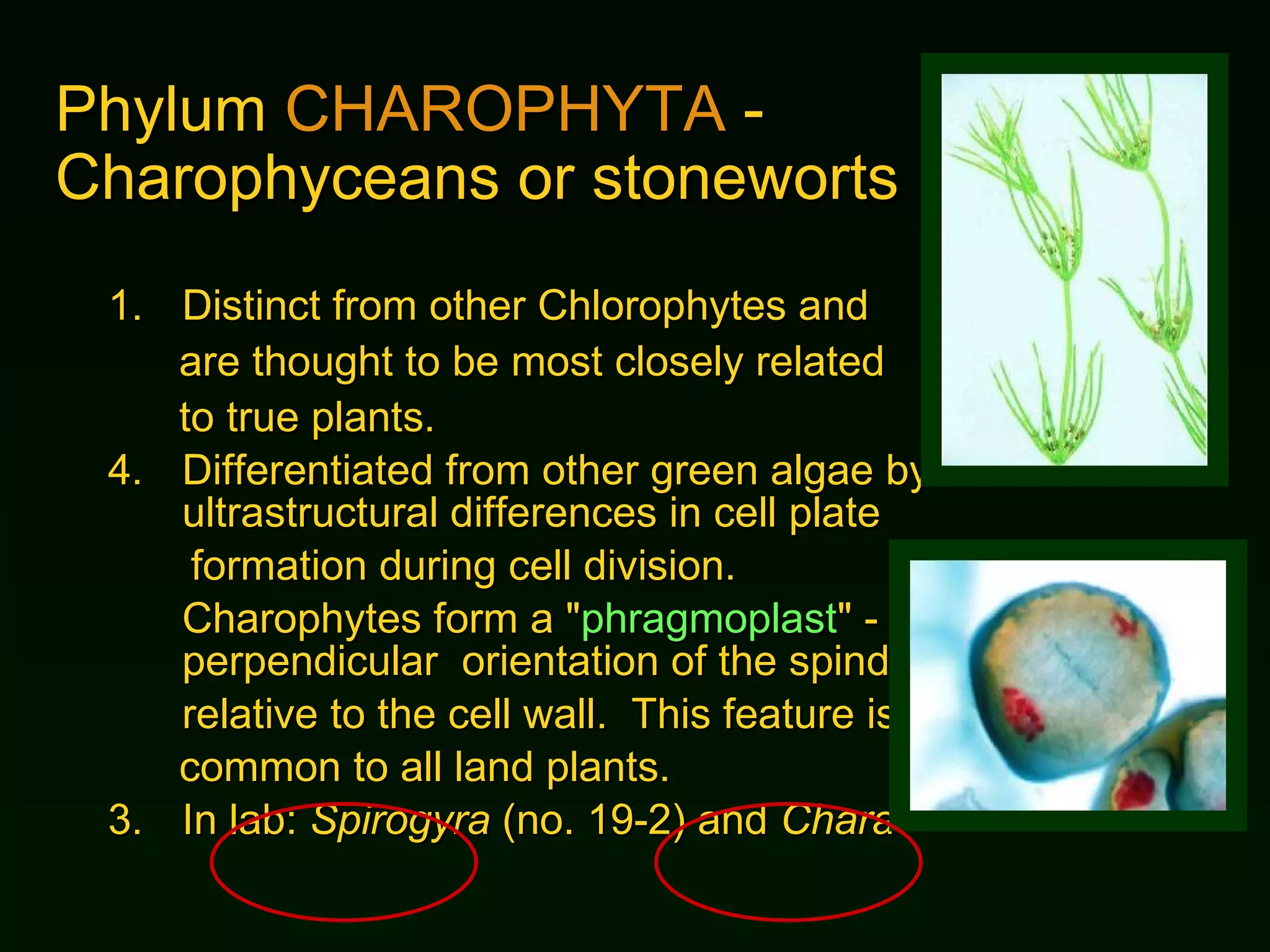
Phylum  CHAROPHYTA  -  Charophyceans or stoneworts Distinct from other Chlorophytes and  are thought to be most closely related to true plants.  Differentiated from other green algae by ultrastructural differences in cell plate  formation during cell division.  Charophytes form a " phragmoplast " - a perpendicular  orientation of the spindle  relative to the cell wall.  This feature is common to all land plants. 3. In lab:  Spirogyra  (no. 19-2) and  Chara
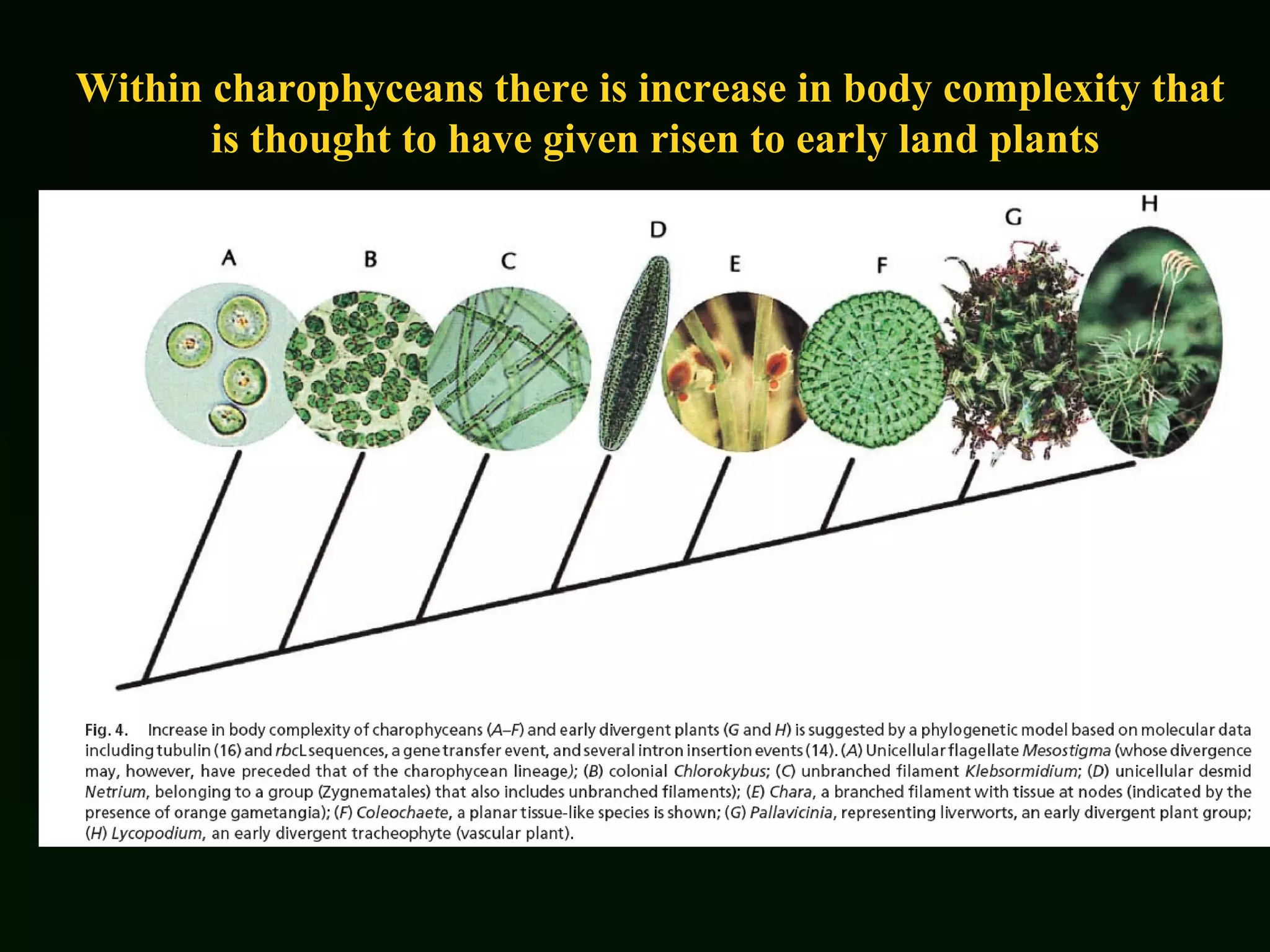
Within charophyceans there is increase in body complexity that  is thought to have given risen to early land plants
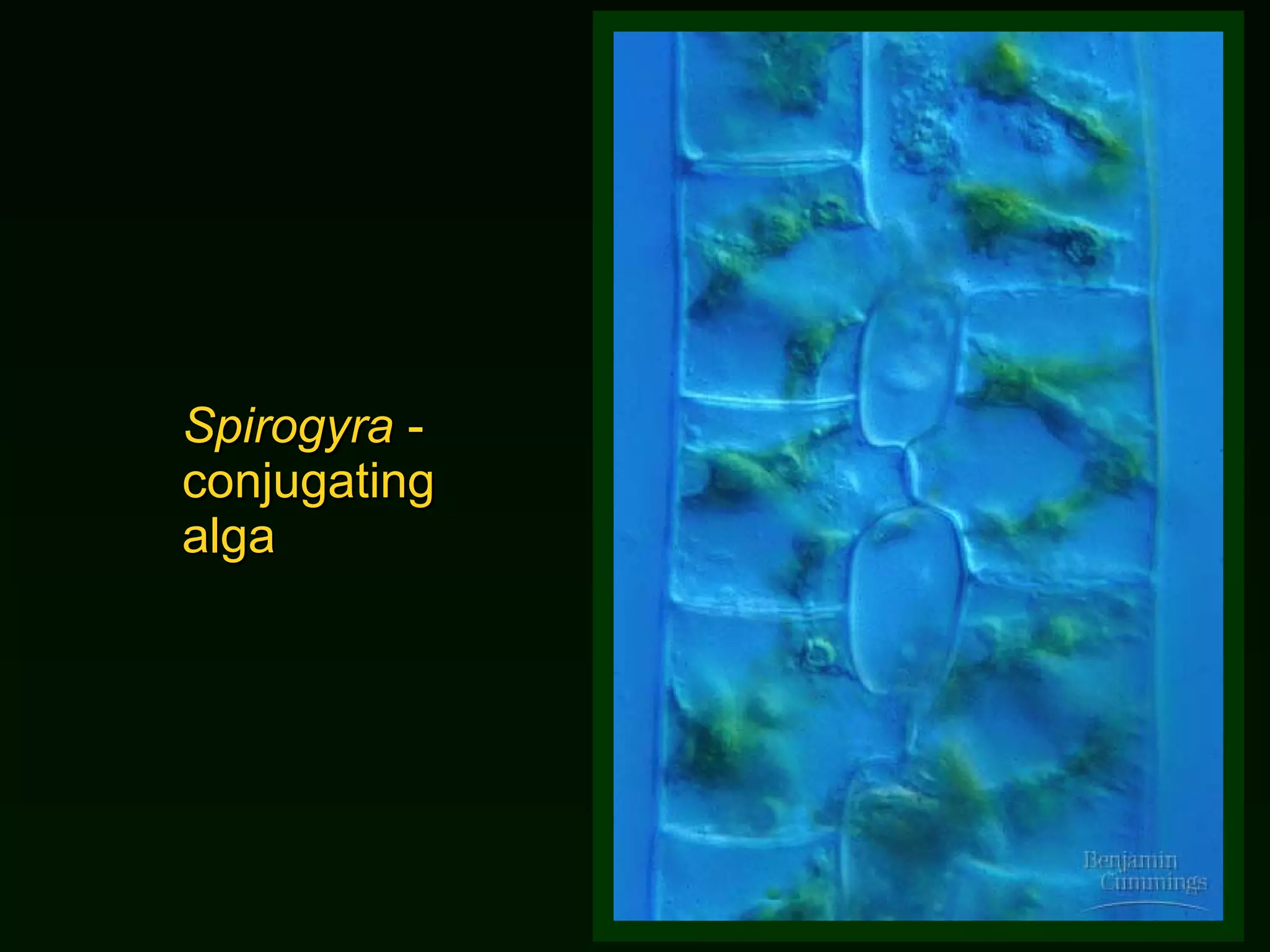
Spirogyra  -  conjugating alga
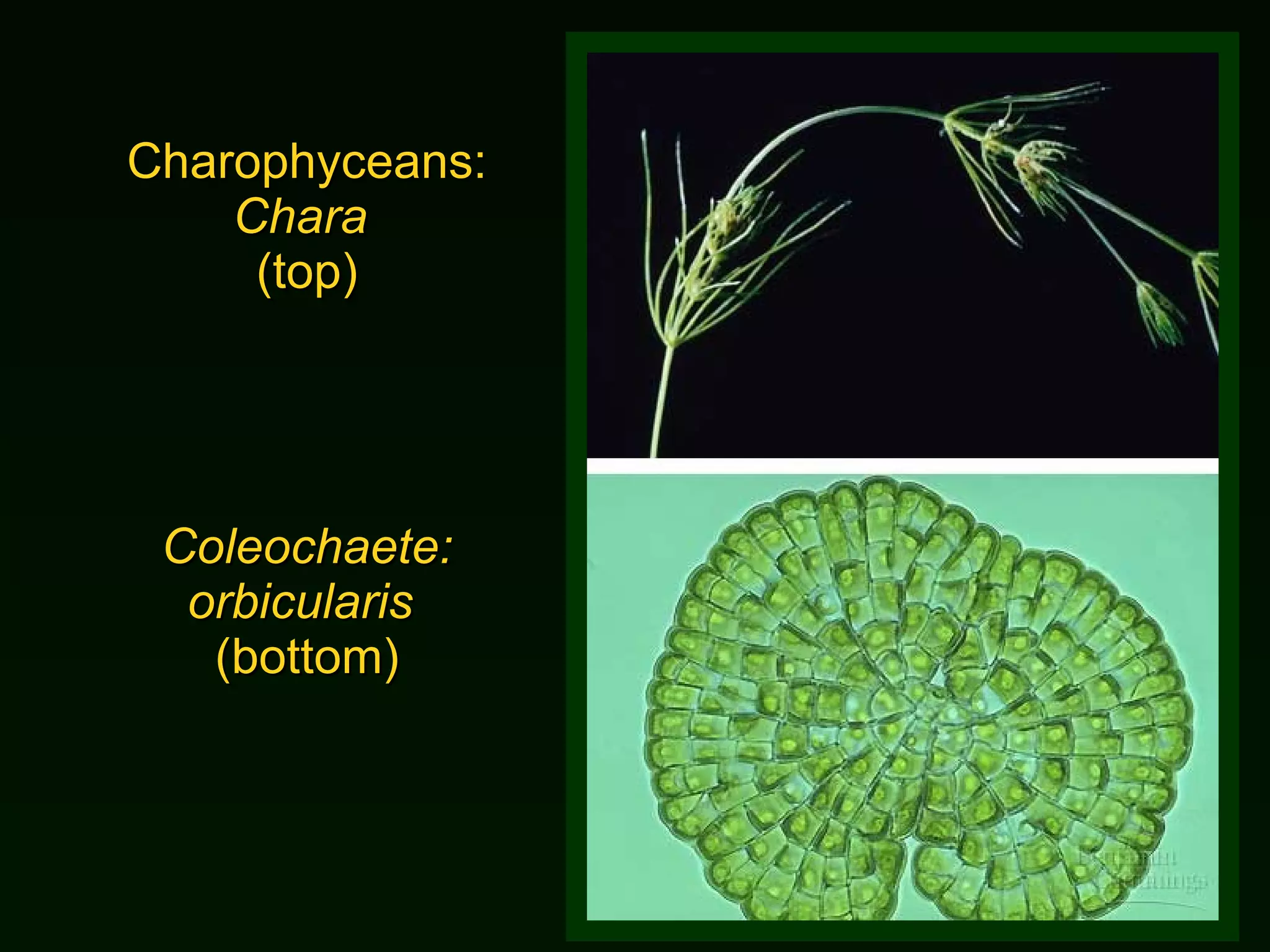
Charophyceans:  Chara   (top) Coleochaete: orbicularis   (bottom)
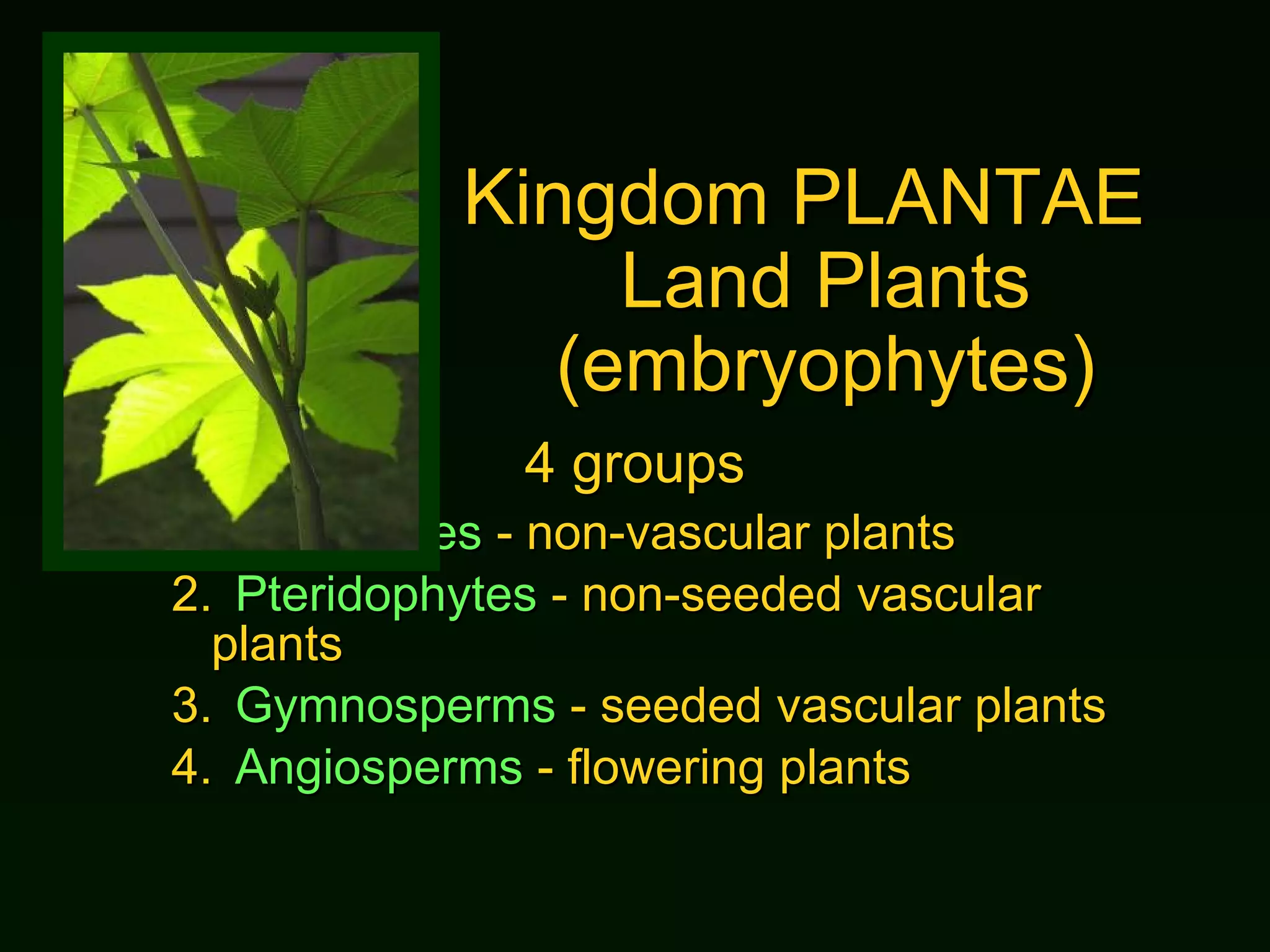
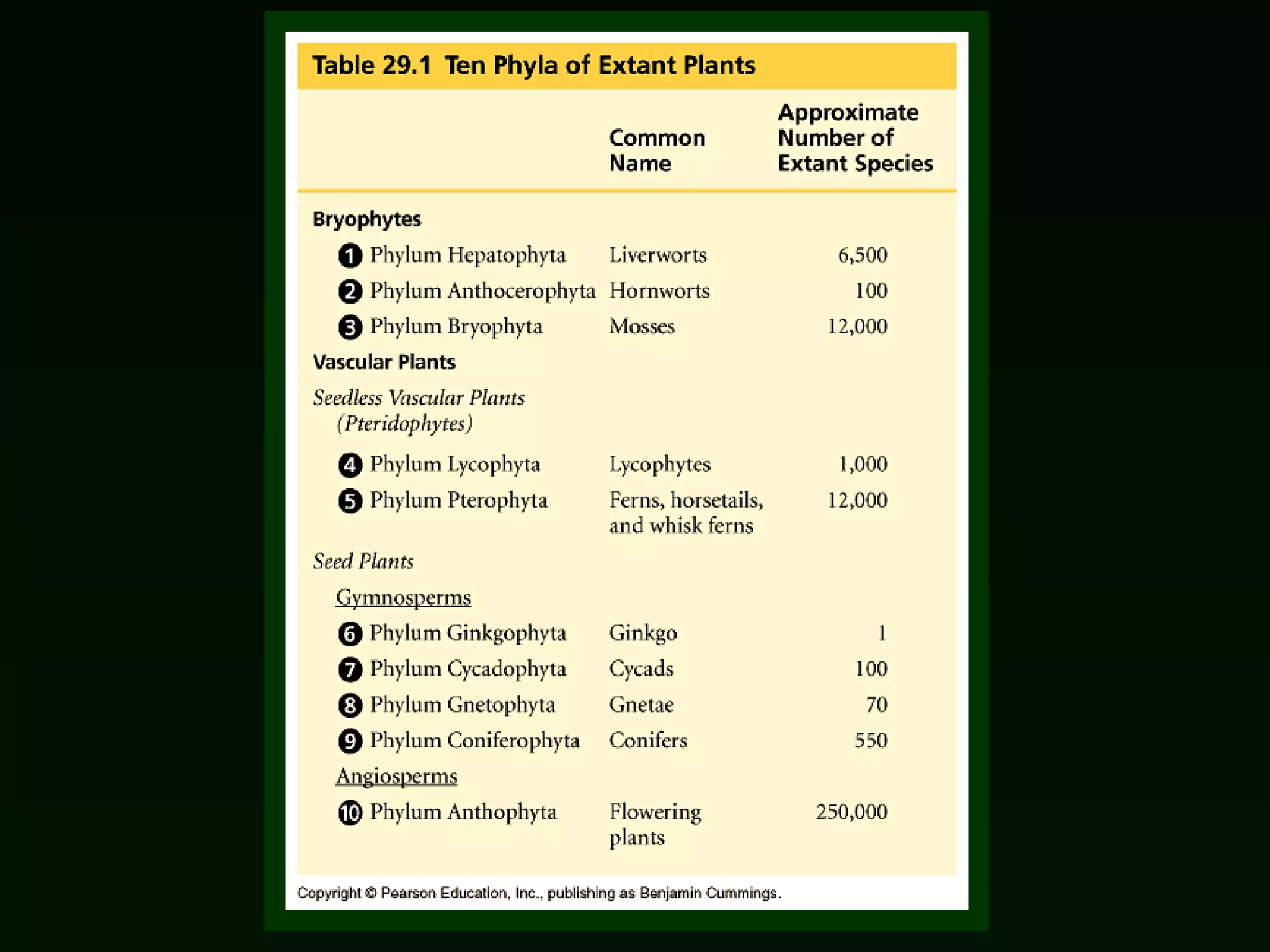
Kingdom PLANTAE  Land Plants (embryophytes) 4 groups 1. Bryophytes  - non-vascular plants 2. Pteridophytes  - non-seeded vascular plants 3. Gymnosperms  - seeded vascular plants 4. Angiosperms  - flowering plants
Kingdom  Chlorophyta Non-vascular plants Vascular Plants   (no seeds) Vascular seed Plants Flowering Plants Liverworts Hornworts Mosses Lycophytes Horsetails Ferns Cycads Ginkgo Conifers Gnetum Angiosperms Green Algae
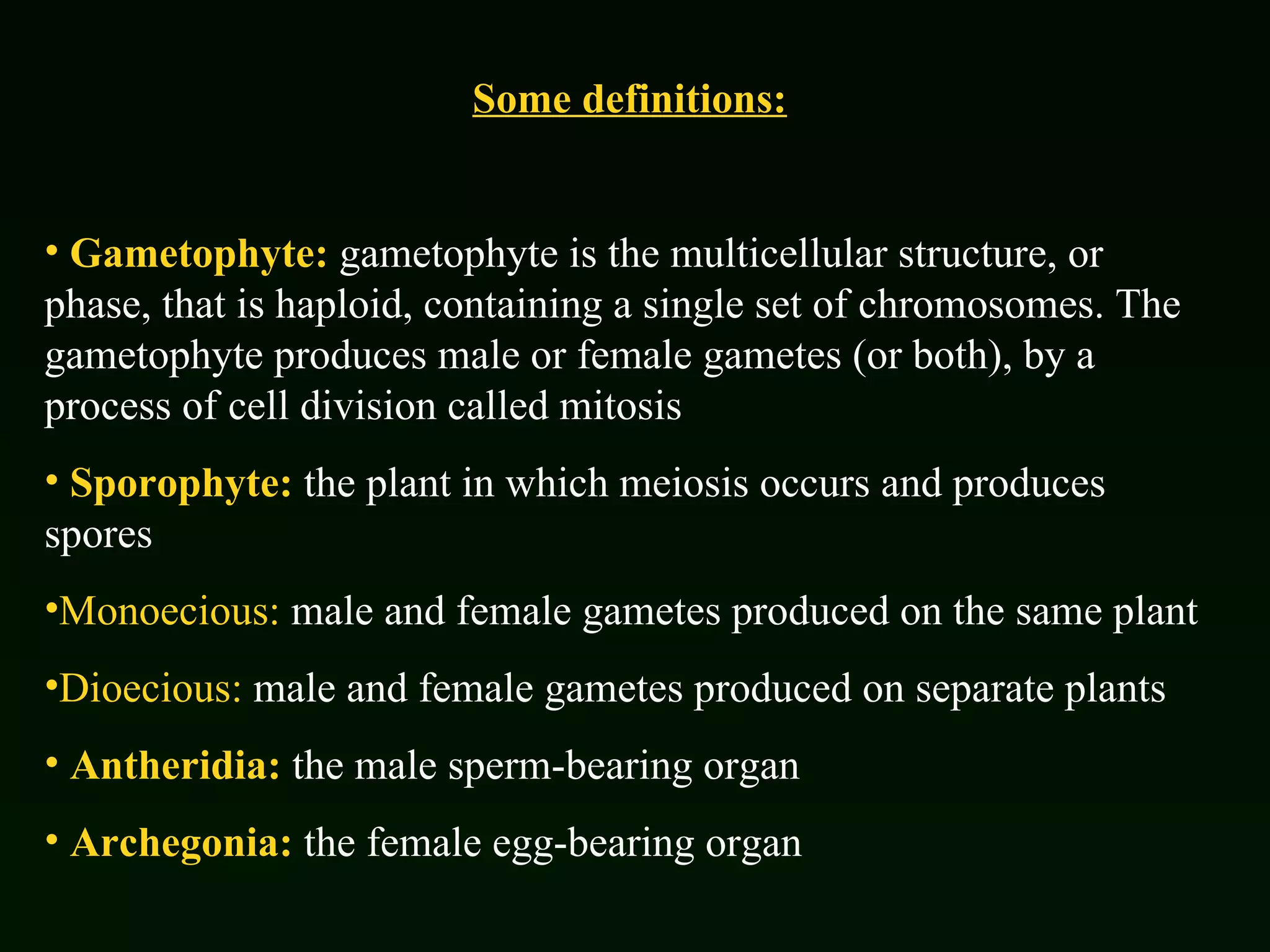
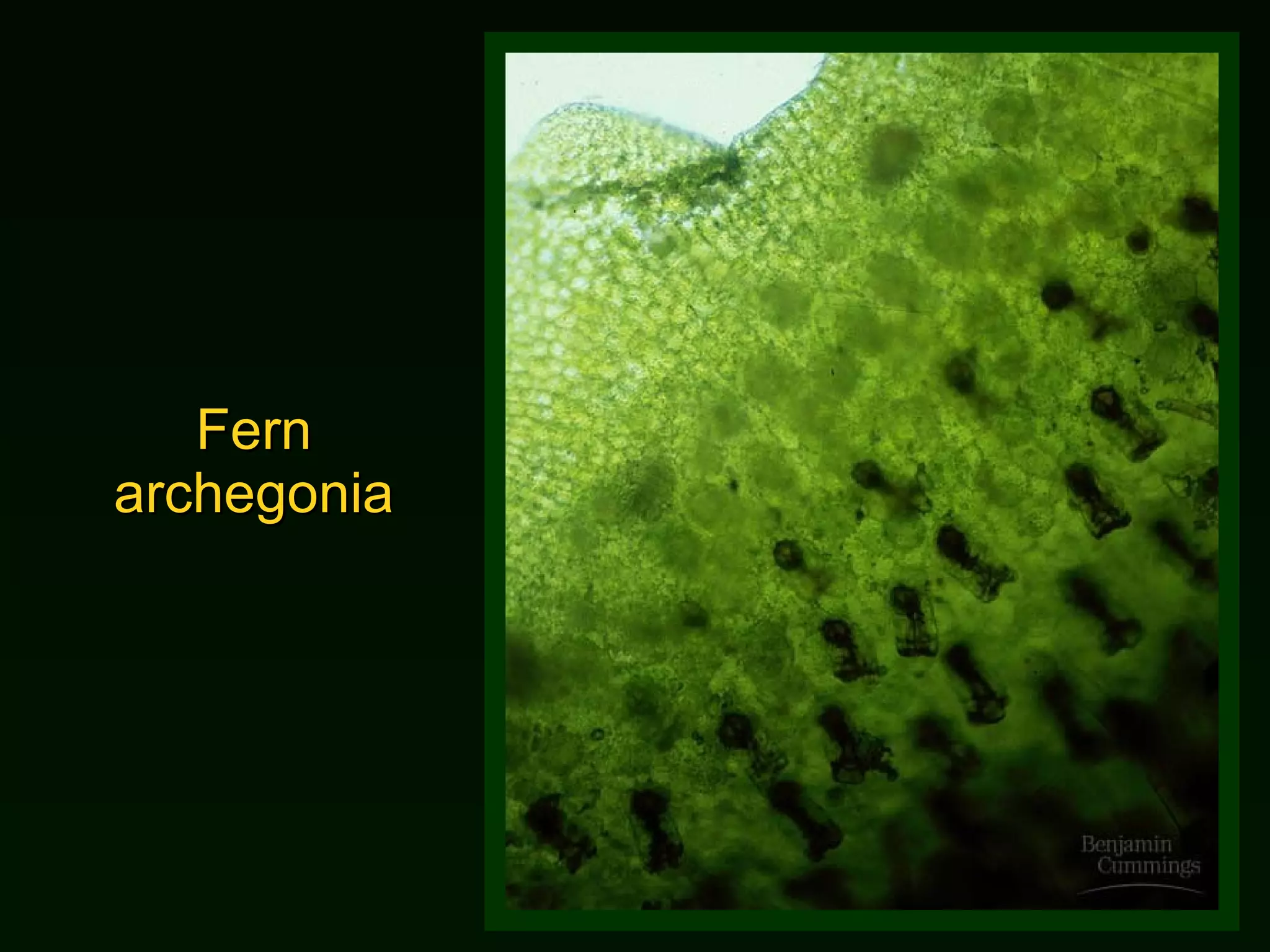
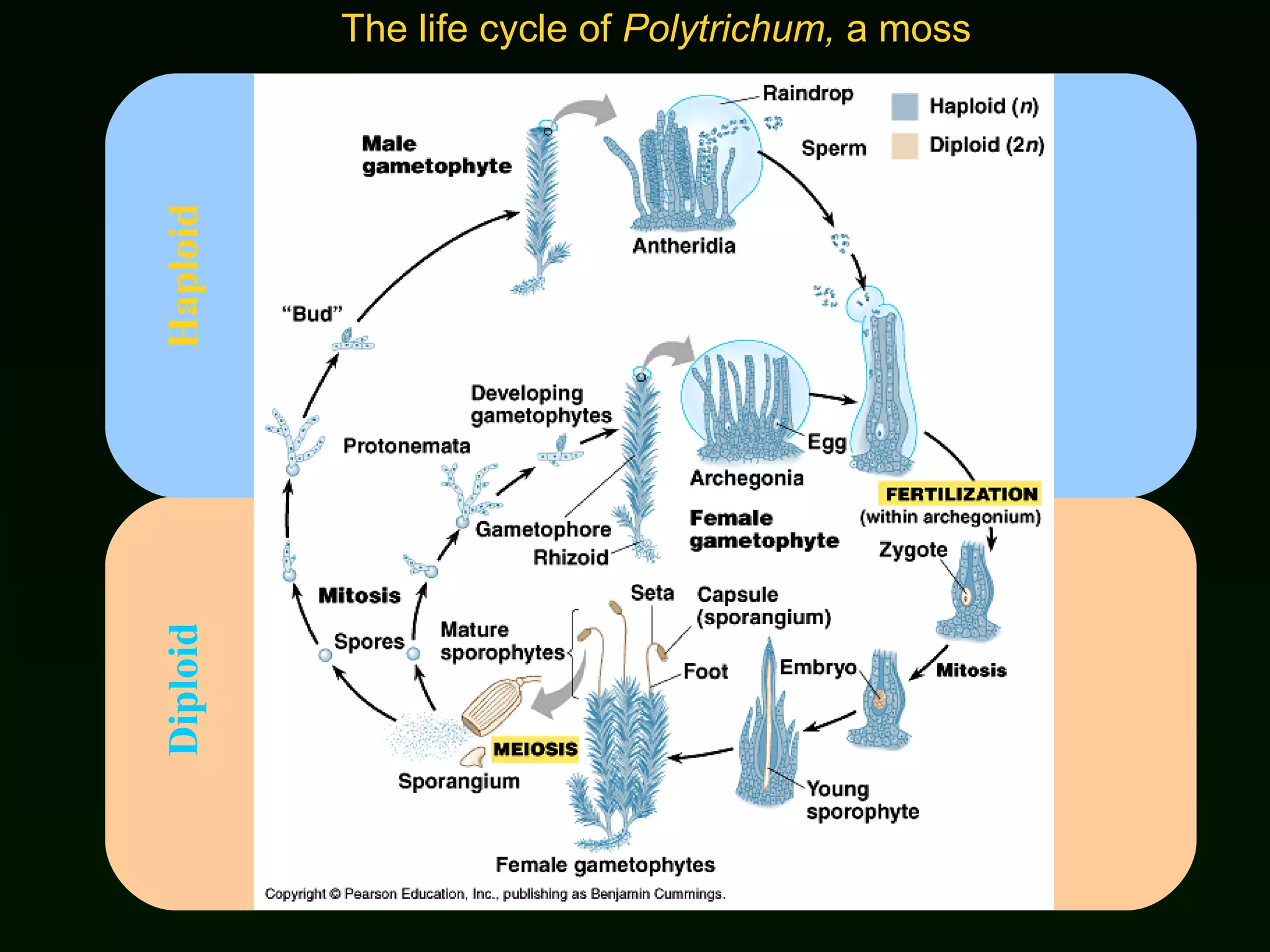
Some definitions: Gametophyte:  gametophyte is the multicellular structure, or phase, that is haploid, containing a single set of chromosomes. The gametophyte produces male or female gametes (or both), by a process of cell division called mitosis Sporophyte:  the plant in which meiosis occurs and produces spores Monoecious:  male and female gametes produced on the same plant Dioecious:  male and female gametes produced on separate plants Antheridia:  the male sperm-bearing organ Archegonia:  the female egg-bearing organ
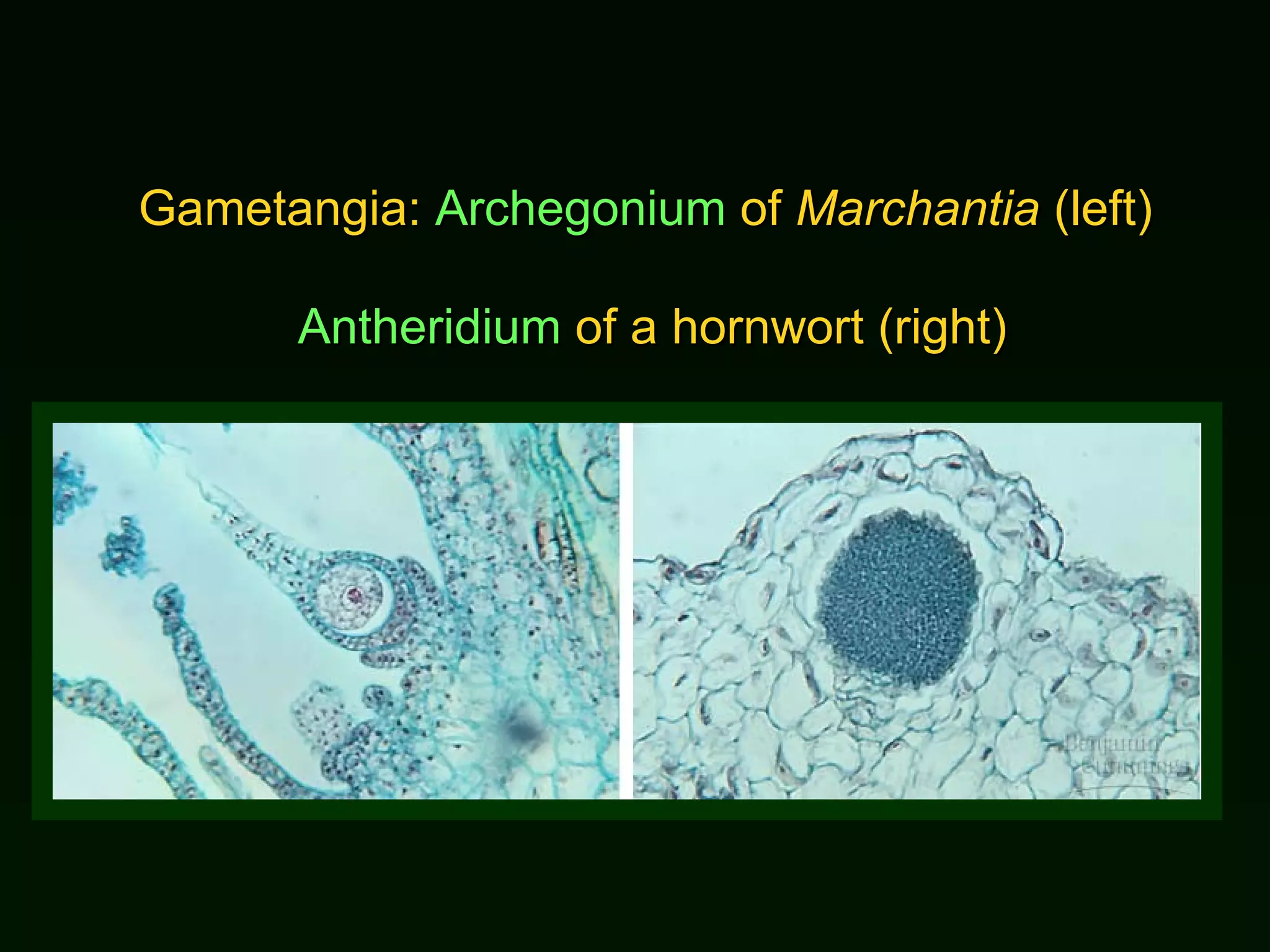
Gametangia:  Archegonium  of  Marchantia  (left)  Antheridium  of a hornwort (right)
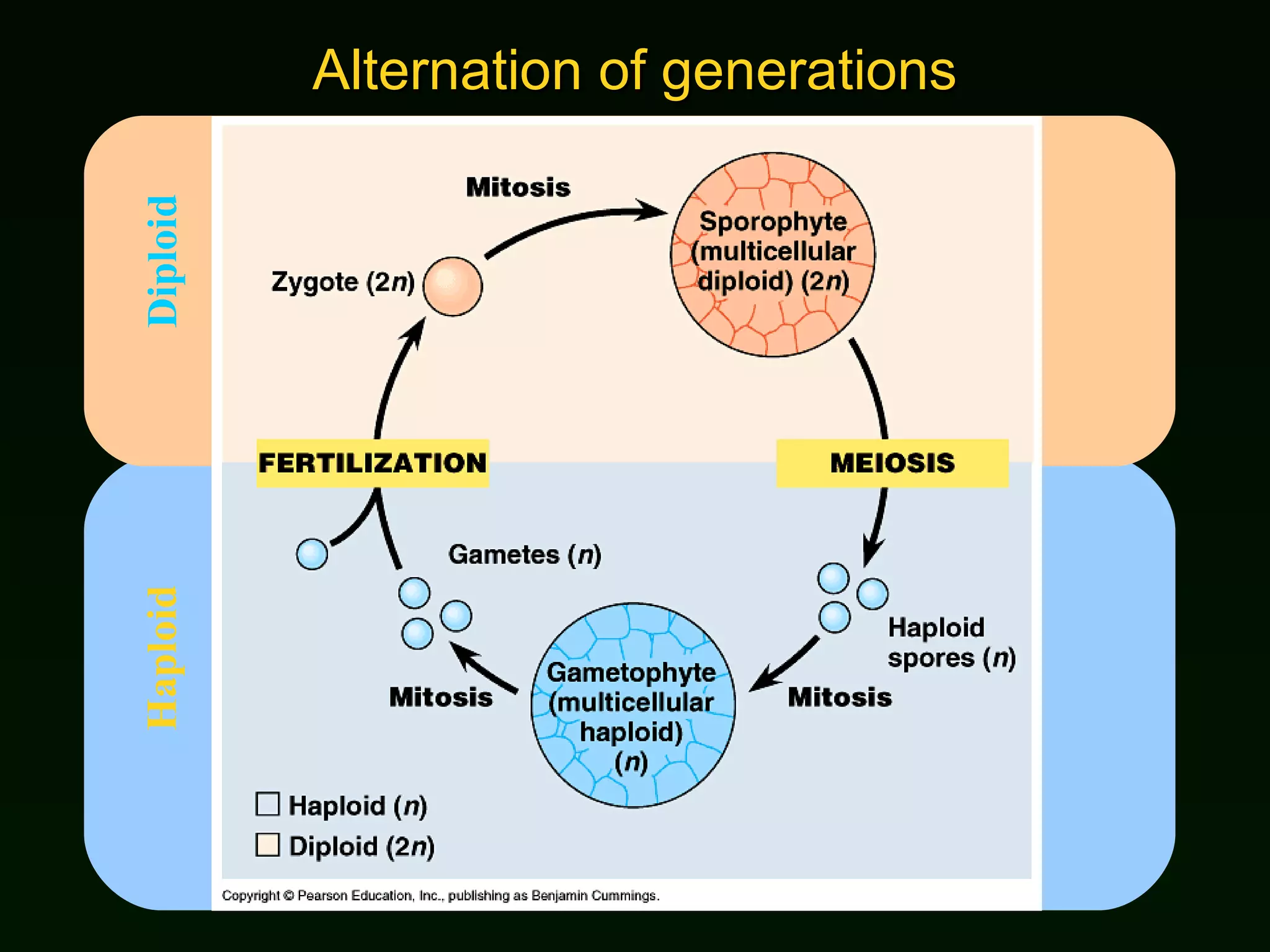
Alternation of generations Diploid Haploid
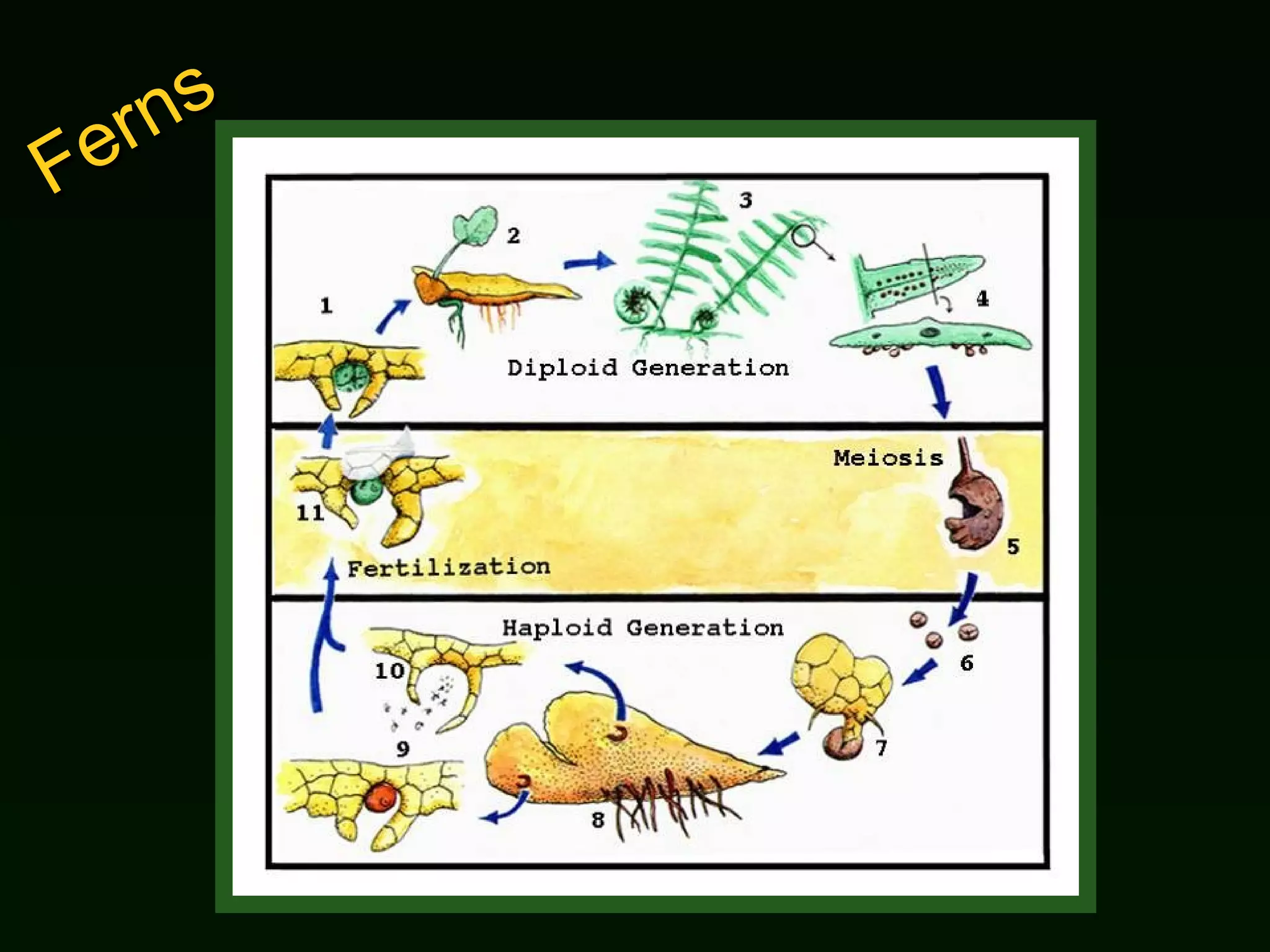
Alternation of generations 1.  Alternation between sporophyte (spore-producing) and gametophyte (gamete-producing),  diploid  and  haploid . 2.  Transitions of generations marked by  meiosis  and  syngamy  (fertilization) . 3.  Evolutionarily important - haploid genes in plant gametophytes are transcribed (unlike those in animals).  Gives the possibility of rapid selection.
Land plants: Apical meristems of shoots and roots shoots roots
" BRYOPHYTES " -  non-vascular land plants A. Gametophyte  dominant –  sporophyte  reduced B. Often with separate sexes ( dioecious ). C. Antheridia - produce flagellated sperm. D. Archegonia - produce egg and house developing embryo (sporophyte). E. Antheridia and archegonia, or modifications thereof, are found in all early plant groups (through ferns). F. Water required for sperm transfer.  Sperm are flagellated (i.e., motile).  This is true of all primitive plants.  Hornwort Liverwort Moss Moss
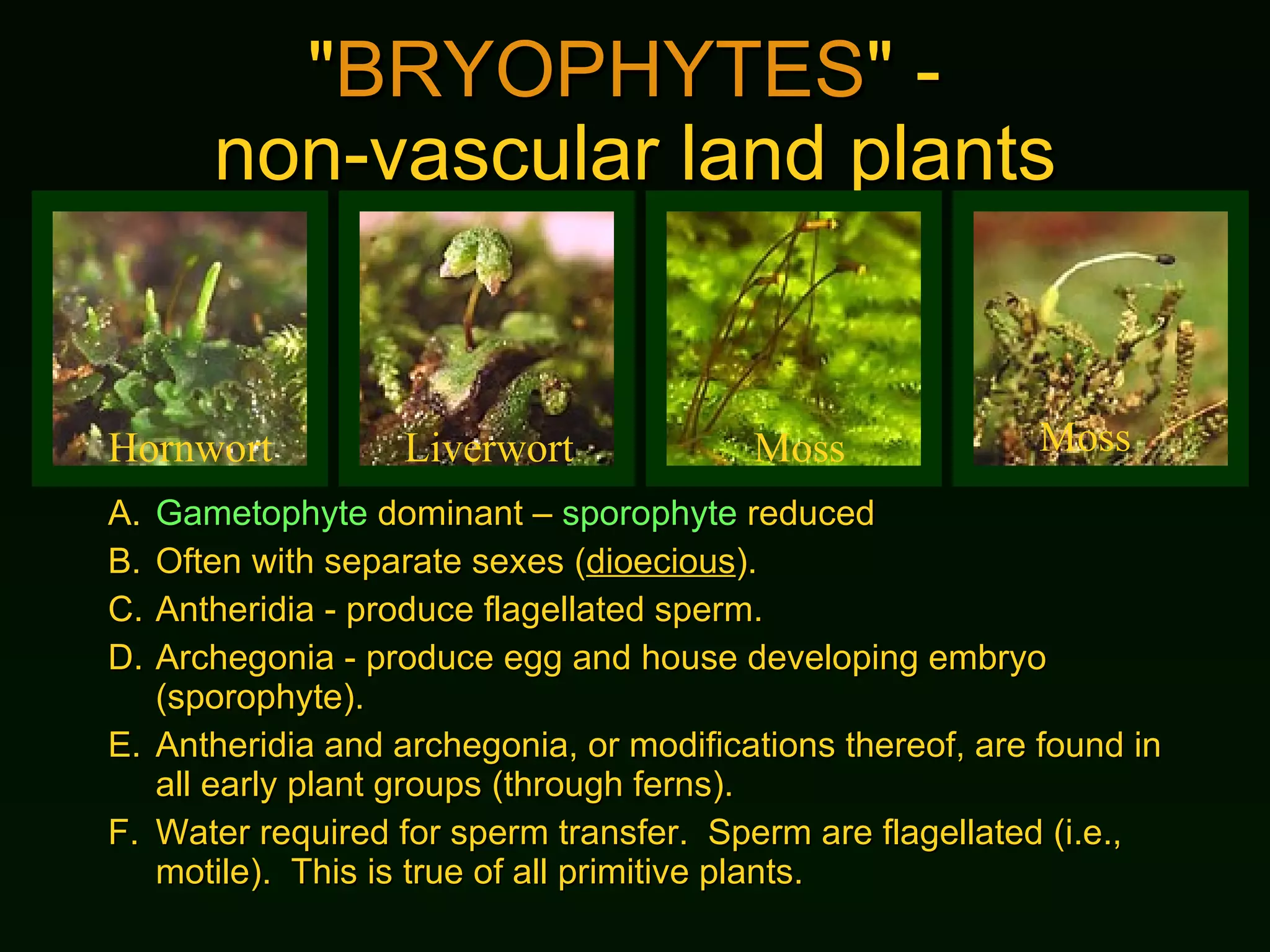
Kingdom  Chlorophyta Non-vascular plants Vascular Plants   (no seeds) Vascular seed Plants Flowering Plants Liverworts Hornworts Mosses Lycophytes Horsetails Ferns Cycads Ginkgo Conifers Gnetum Angiosperms Green Algae
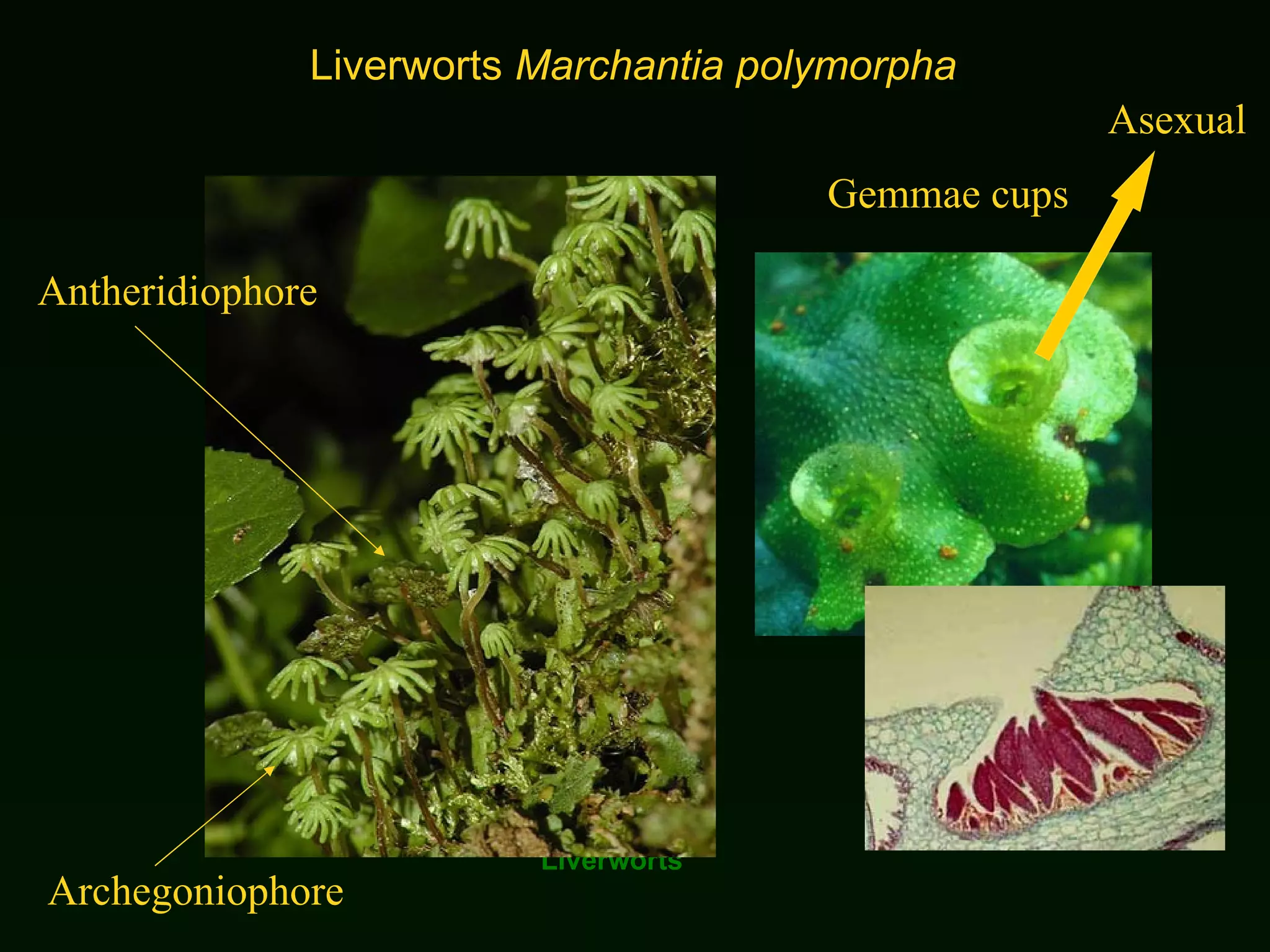
Two phyla 1. Phylum  Hepatophyta - liverworts a. antheridia and archegonia borne on gametangiophores -  antheridiophores  and  archegoniophores , respectively. asexual reproduction with  gemmae cups . 2. Phylum  Bryophyta  - mosses NO VASCULAR TISSUE - therefore - small size  (limits of diffusion),  moist habitats, close to ground.
Liverworts Liverworts  Marchantia polymorpha Gemmae cups Archegoniophore Antheridiophore Asexual
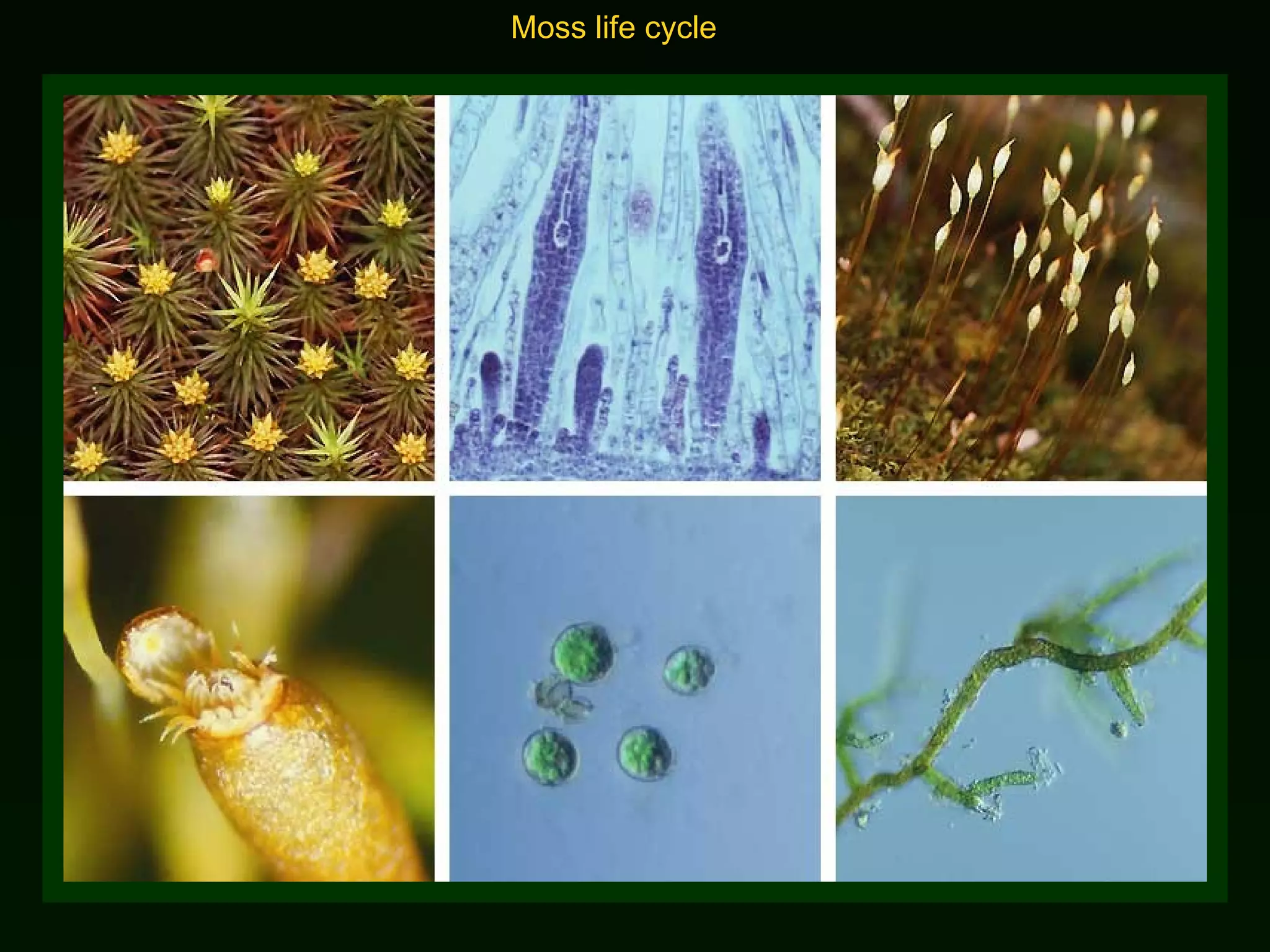
The life cycle of  Polytrichum,  a moss Diploid Haploid
Moss life cycle
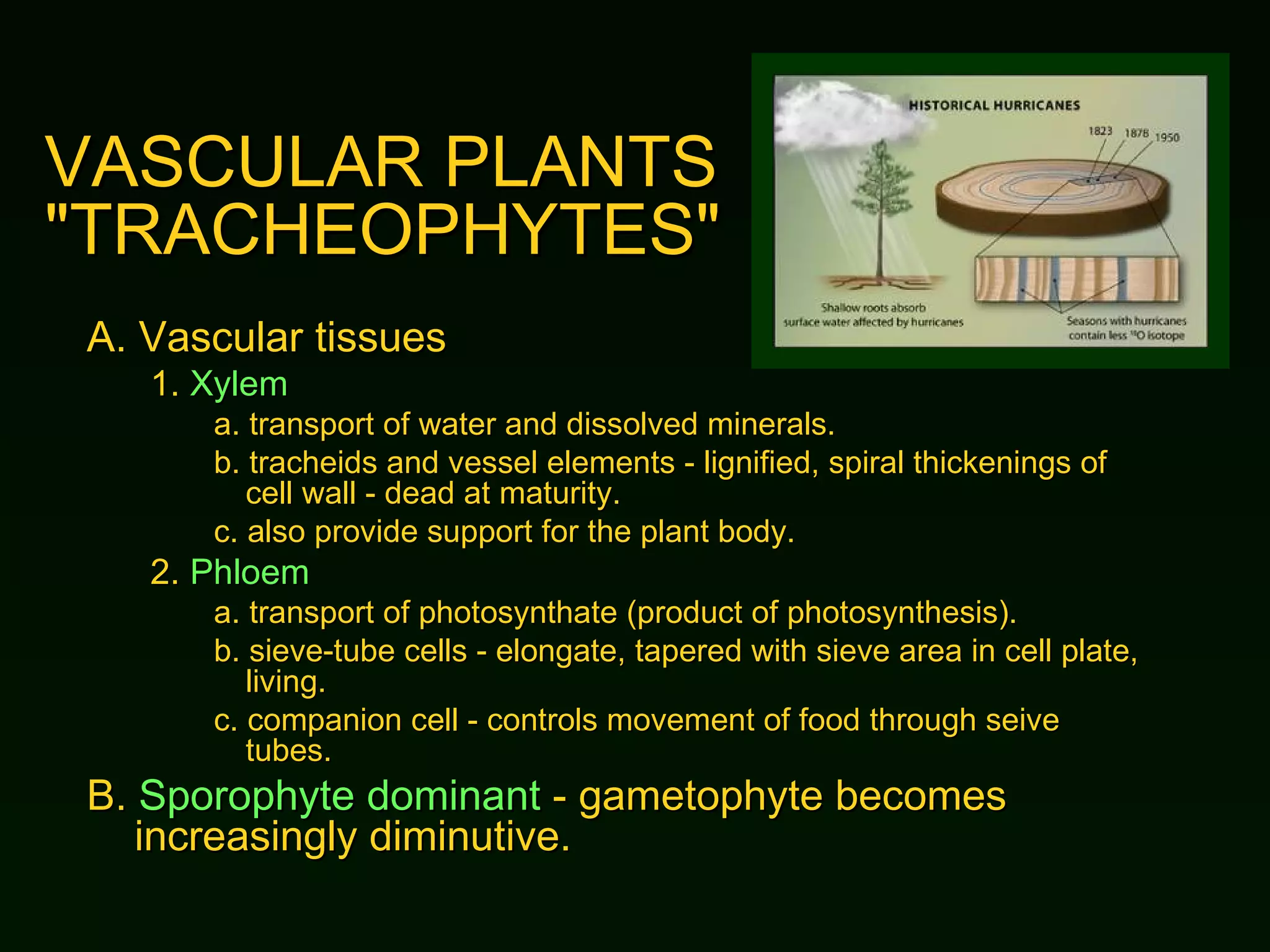
VASCULAR PLANTS  "TRACHEOPHYTES" A.  Vascular tissues 1. Xylem a.  transport of water and dissolved minerals. b.  tracheids and vessel elements - lignified, spiral thickenings of cell wall - dead at maturity. c.  also provide support for the plant body. 2. Phloem a.  transport of photosynthate (product of photosynthesis). b.  sieve-tube cells - elongate, tapered with sieve area in cell plate, living. c.  companion cell - controls movement of food through seive tubes. B.  Sporophyte dominant  - gametophyte becomes increasingly diminutive.
Kingdom  Chlorophyta Non-vascular plants Vascular Plants   (no seeds) Vascular seed Plants Flowering Plants Liverworts Hornworts Mosses Lycophytes Horsetails Ferns Cycads Ginkgo Conifers Gnetum Angiosperms Green Algae
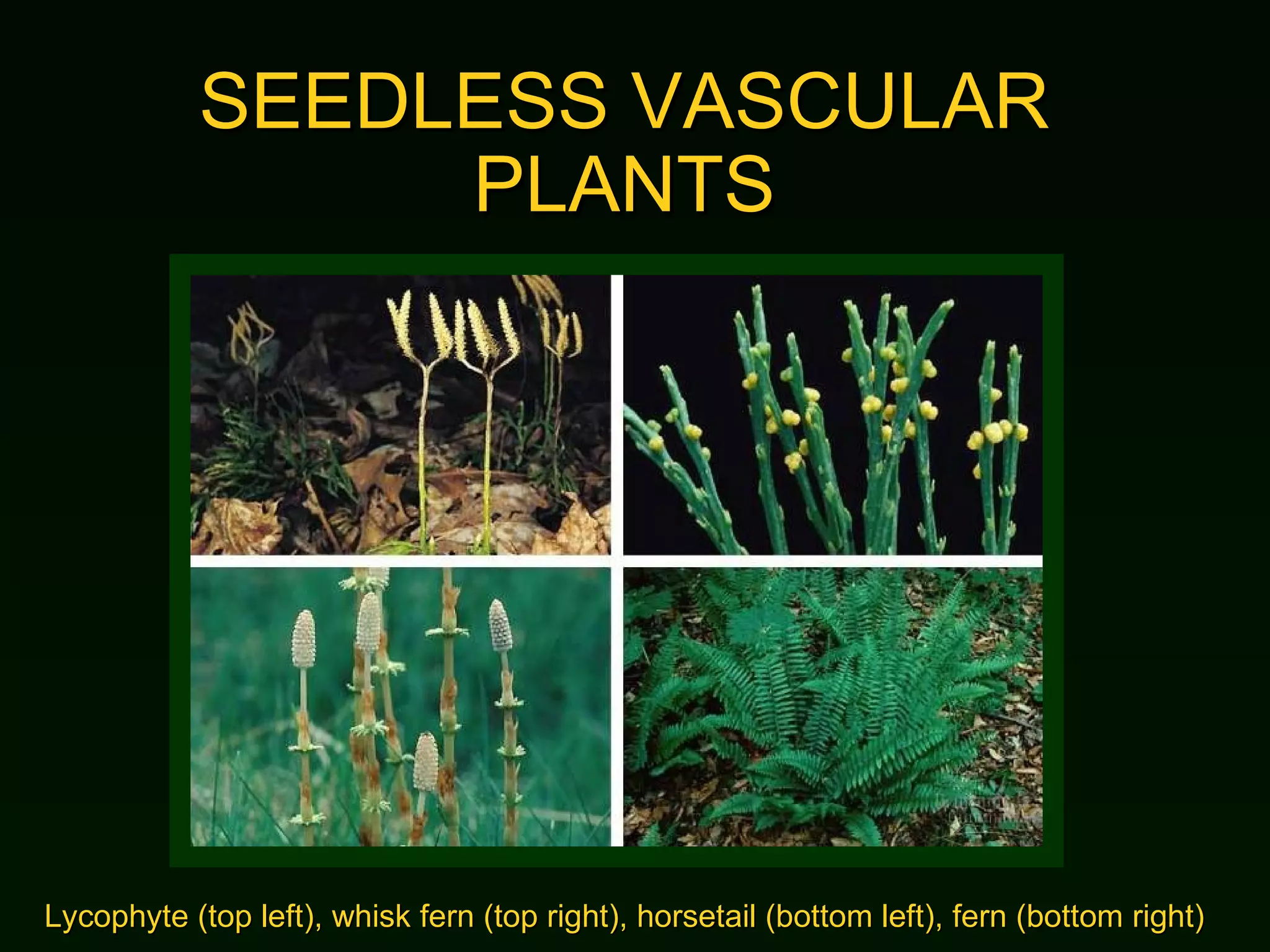
SEEDLESS VASCULAR PLANTS Lycophyte (top left), whisk fern (top right), horsetail (bottom left), fern (bottom right)
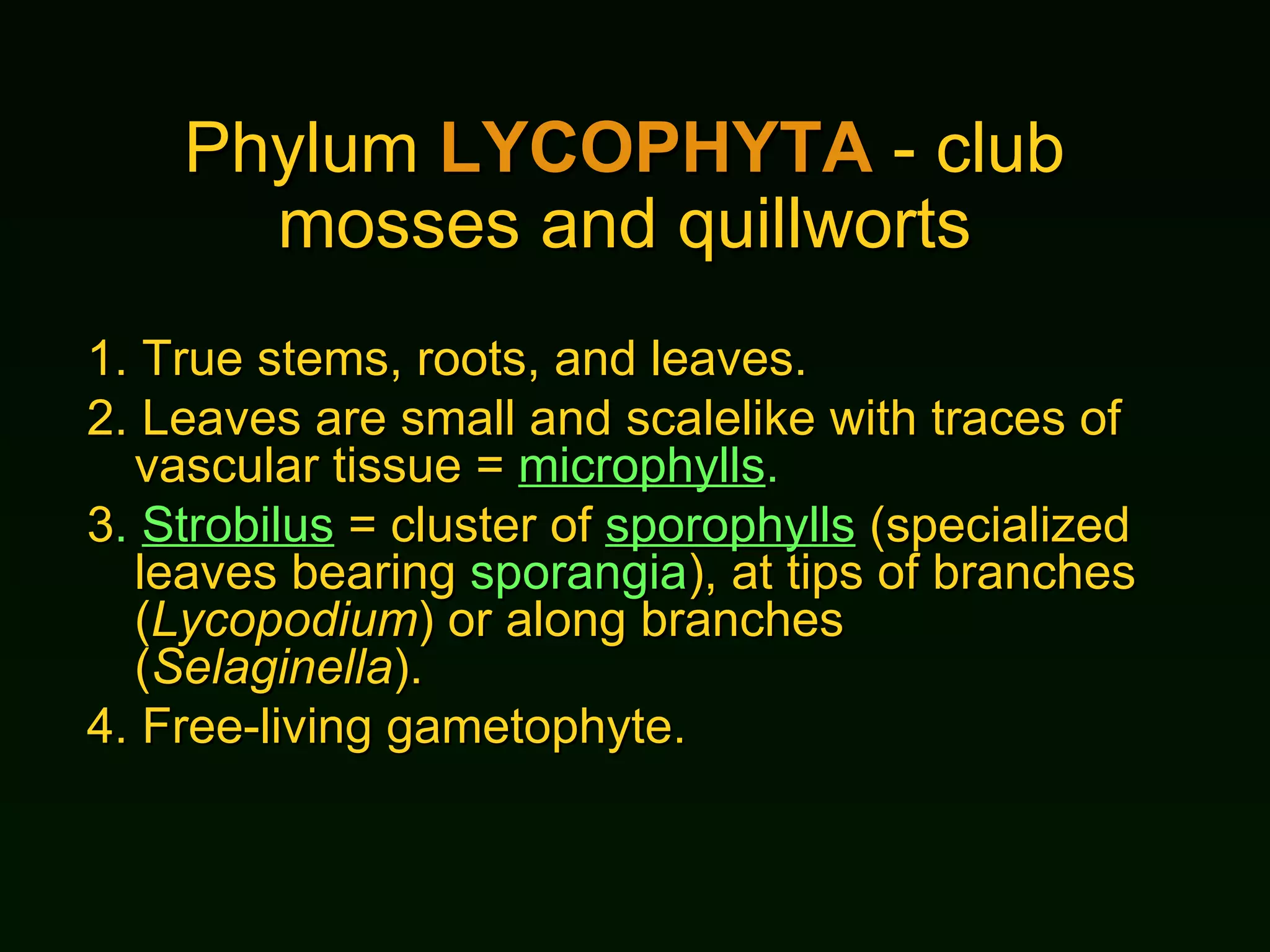
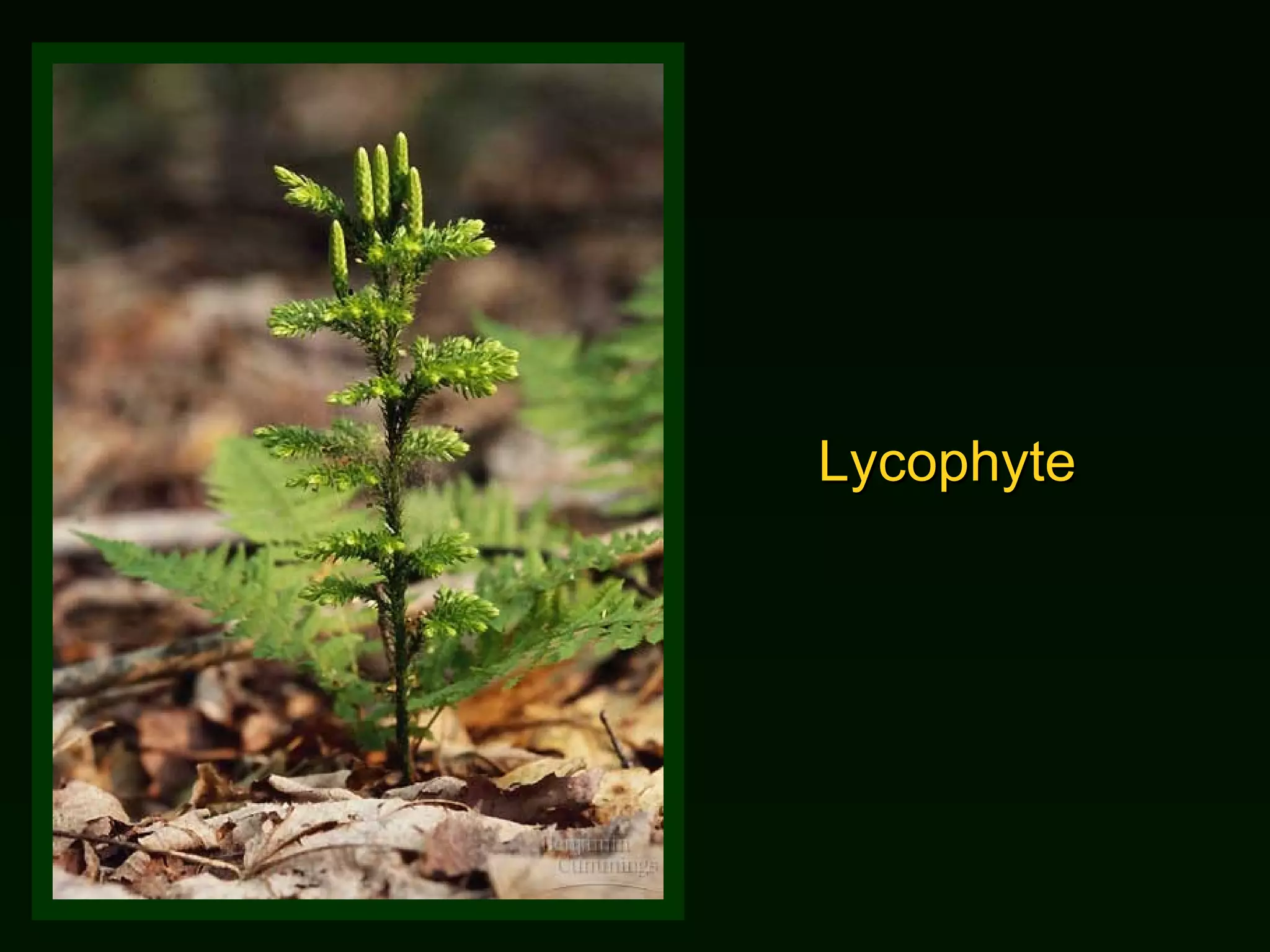
Phylum  LYCOPHYTA  - club mosses and quillworts 1.  True stems, roots, and leaves. 2.  Leaves are small and scalelike with traces of vascular tissue =  microphylls . 3 .  Strobilus  = cluster of  sporophylls  (specialized leaves bearing  sporangia ), at tips of branches ( Lycopodium ) or along branches ( Selaginella ). 4.  Free-living gametophyte.
Lycophyte
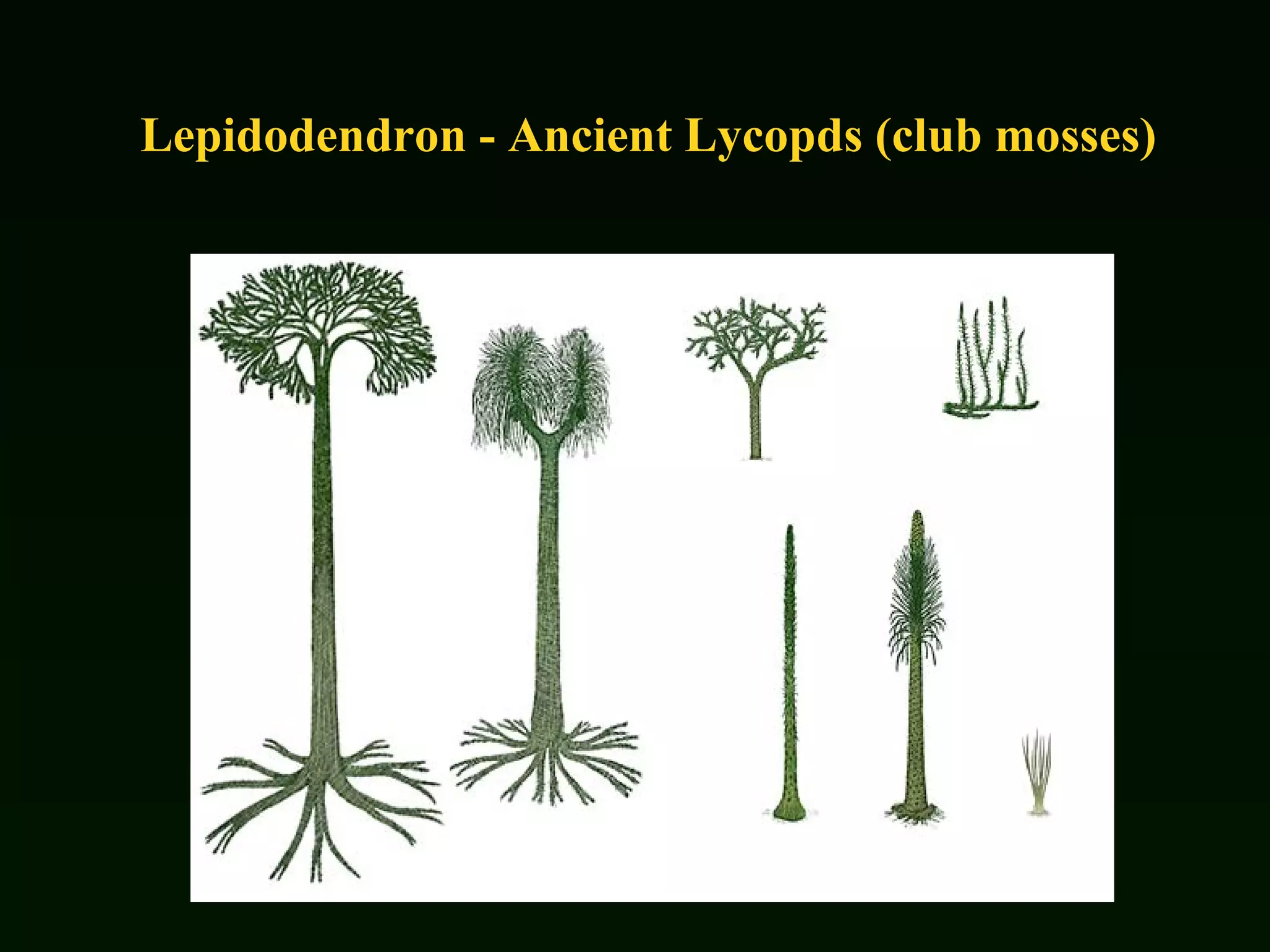
Lepidodendron - Ancient Lycopds (club mosses)
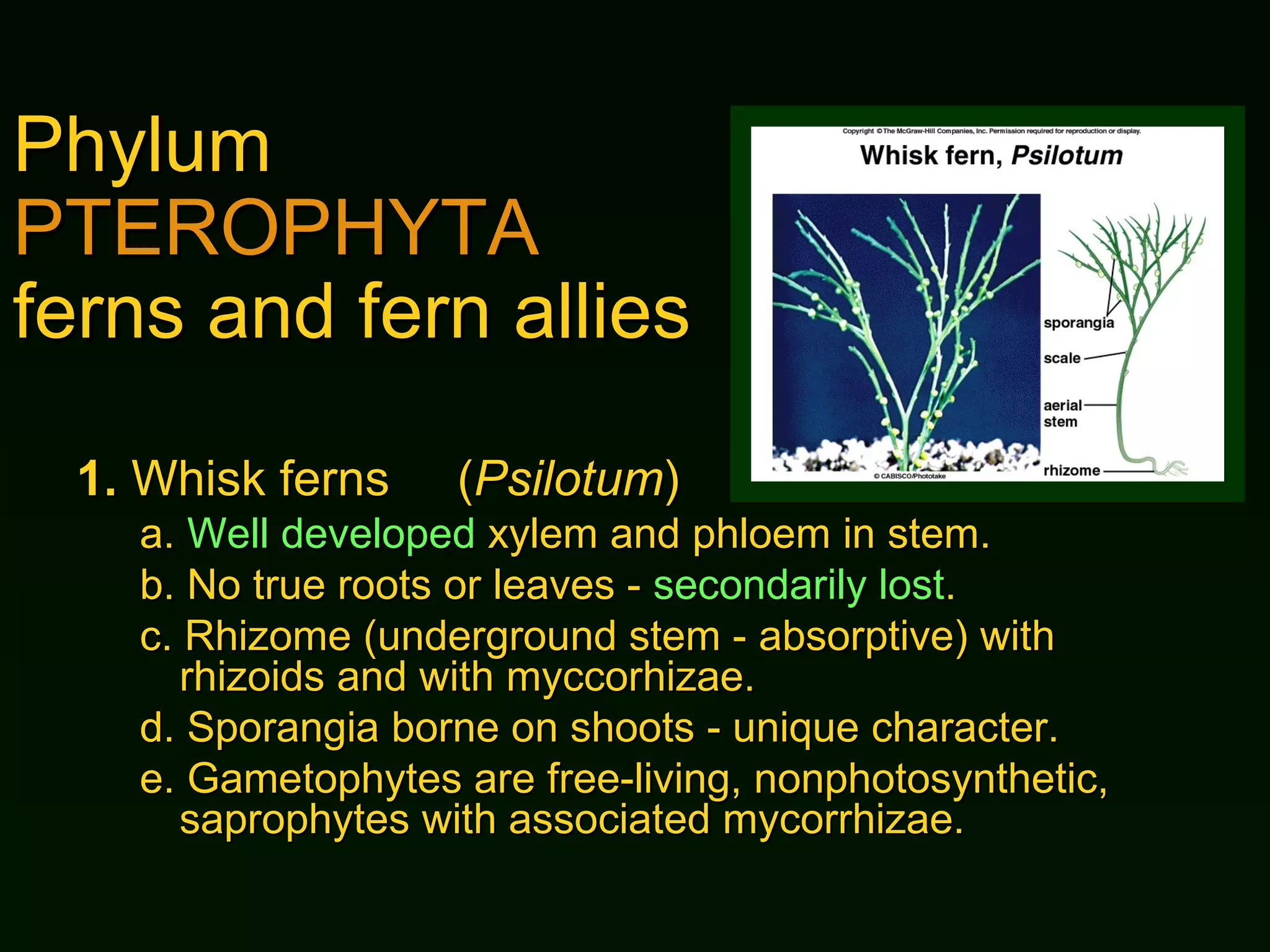
Phylum  PTEROPHYTA ferns and fern allies 1.  Whisk ferns ( Psilotum ) a.  Well developed  xylem and phloem in stem. b.  No true roots or leaves -  secondarily lost . c.  Rhizome (underground stem - absorptive) with rhizoids and with myccorhizae. d.  Sporangia borne on shoots - unique character. e.  Gametophytes are free-living, nonphotosynthetic, saprophytes with associated mycorrhizae.
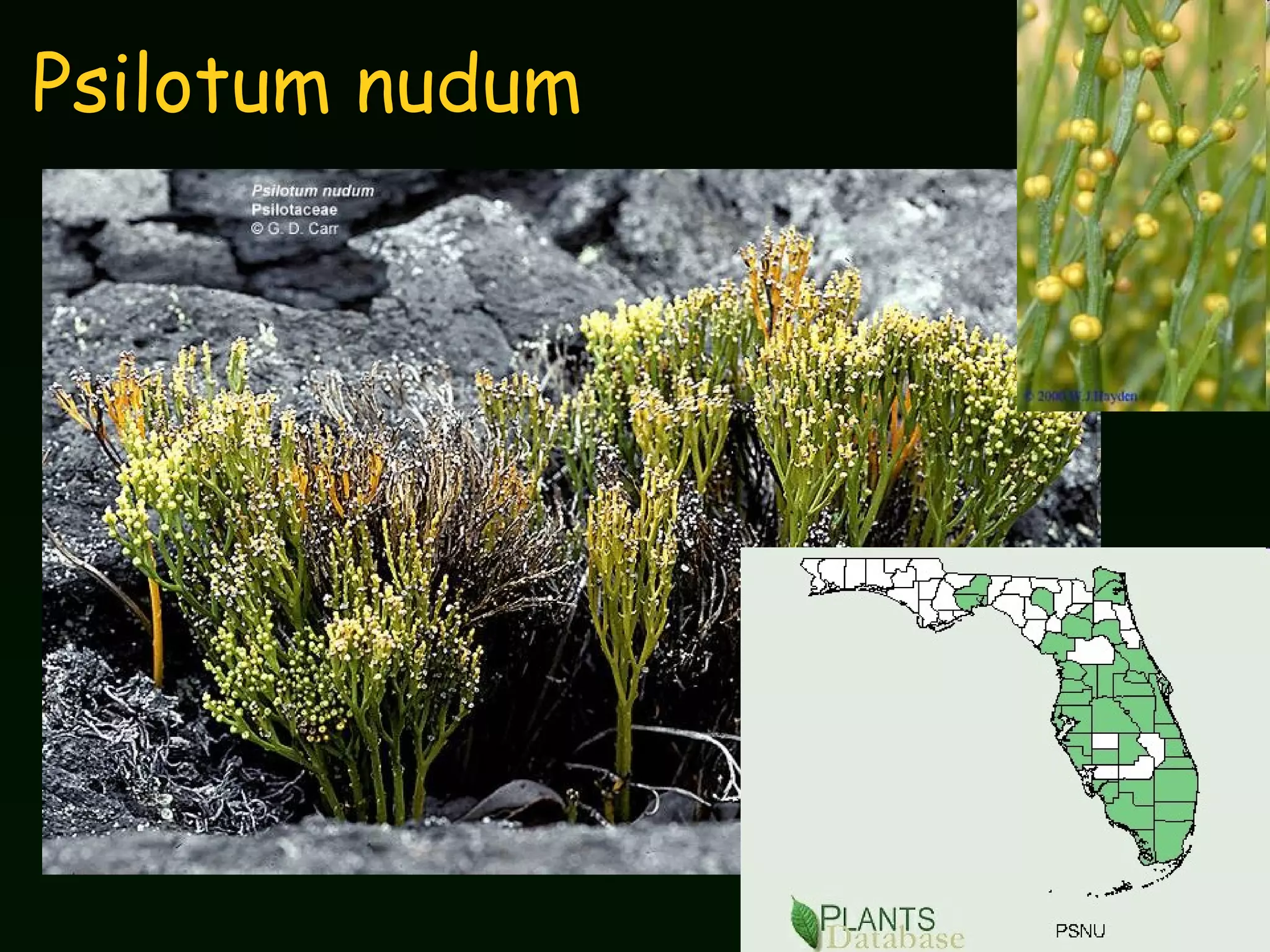
Psilotum nudum
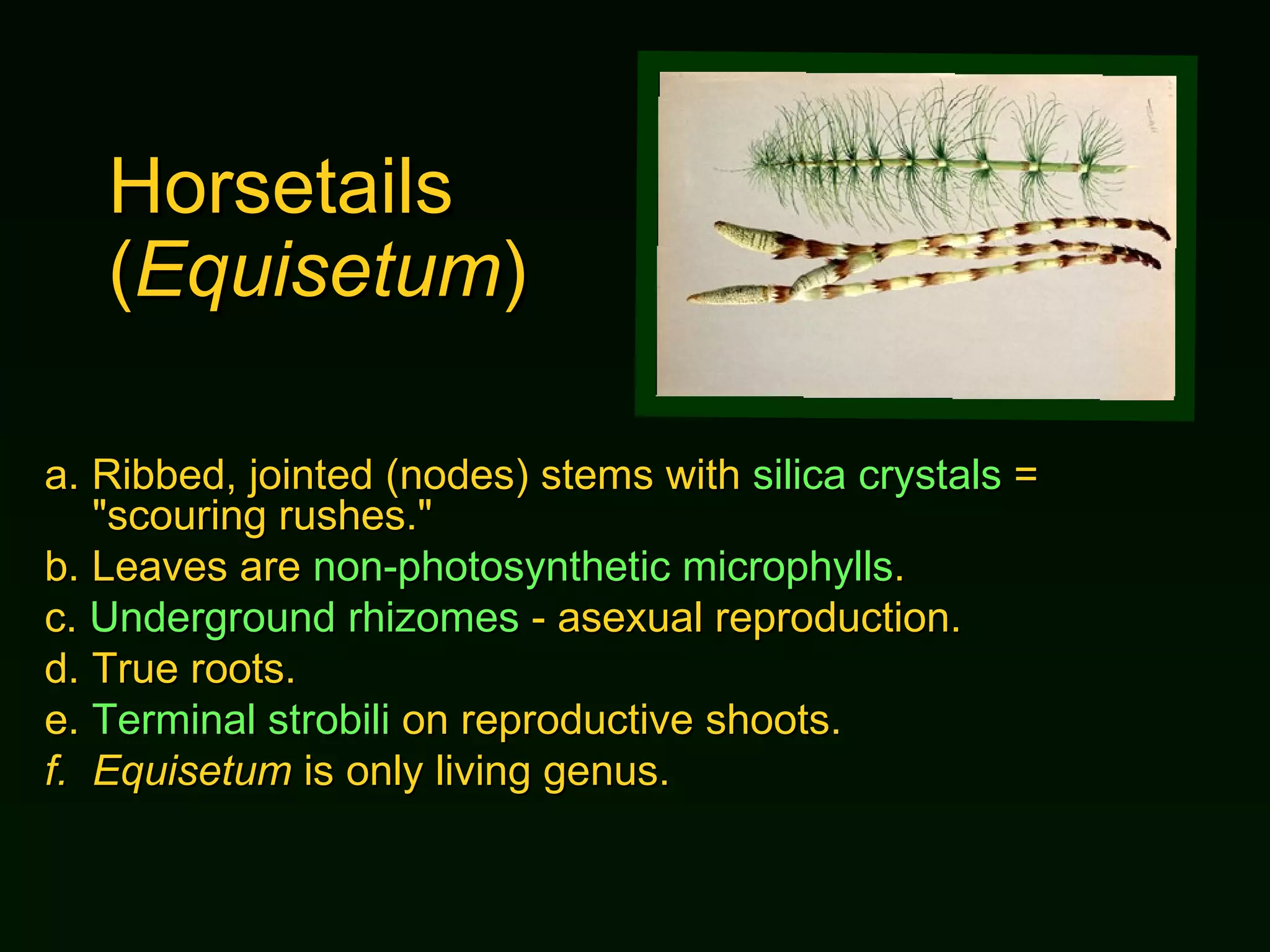
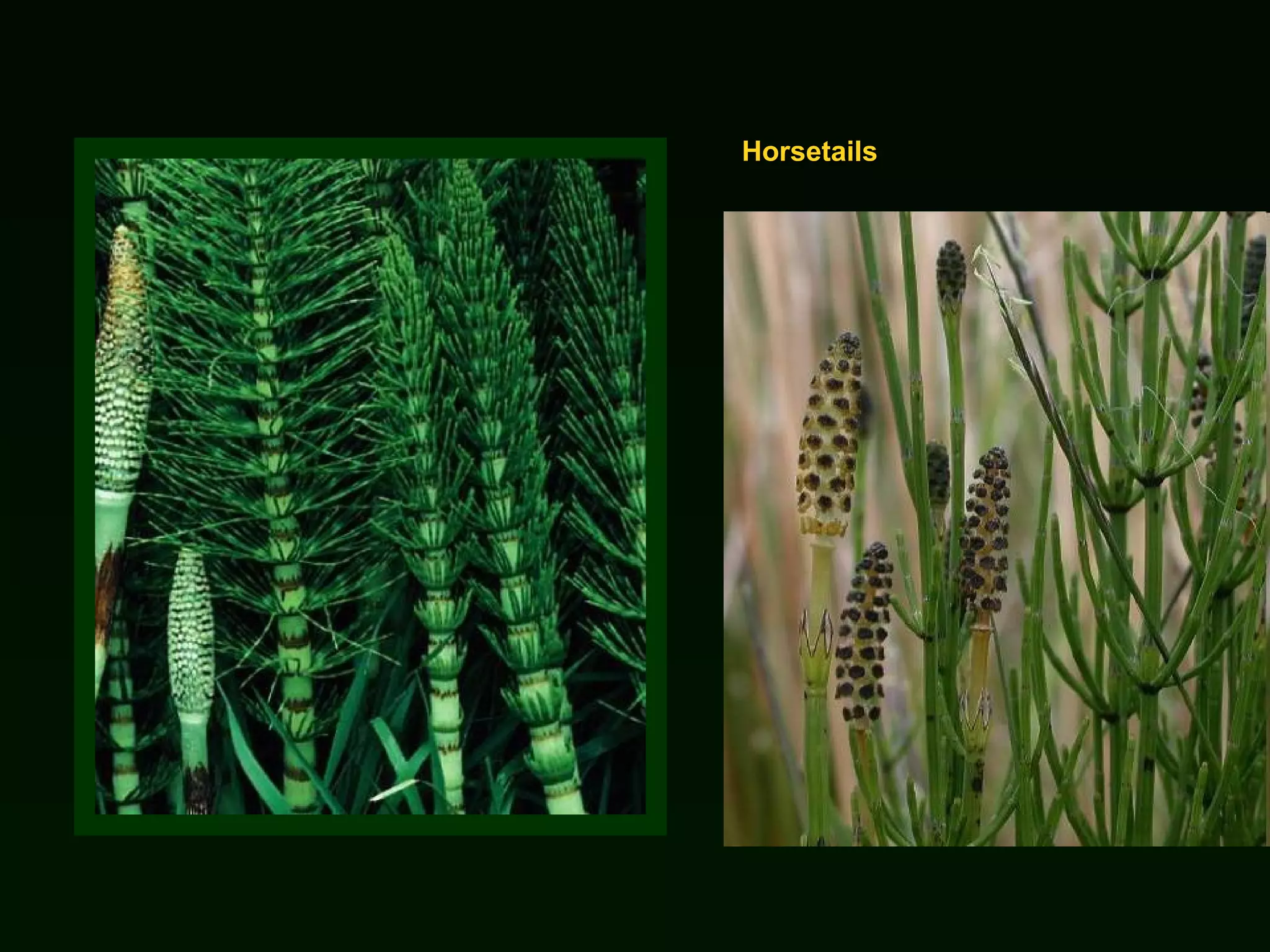
Horsetails ( Equisetum ) a.  Ribbed, jointed (nodes) stems with  silica crystals  = "scouring rushes." b.  Leaves are  non-photosynthetic microphylls . c.  Underground rhizomes  - asexual reproduction. d.  True roots. e.  Terminal strobili  on reproductive shoots. f. Equisetum  is only living genus.
Horsetails
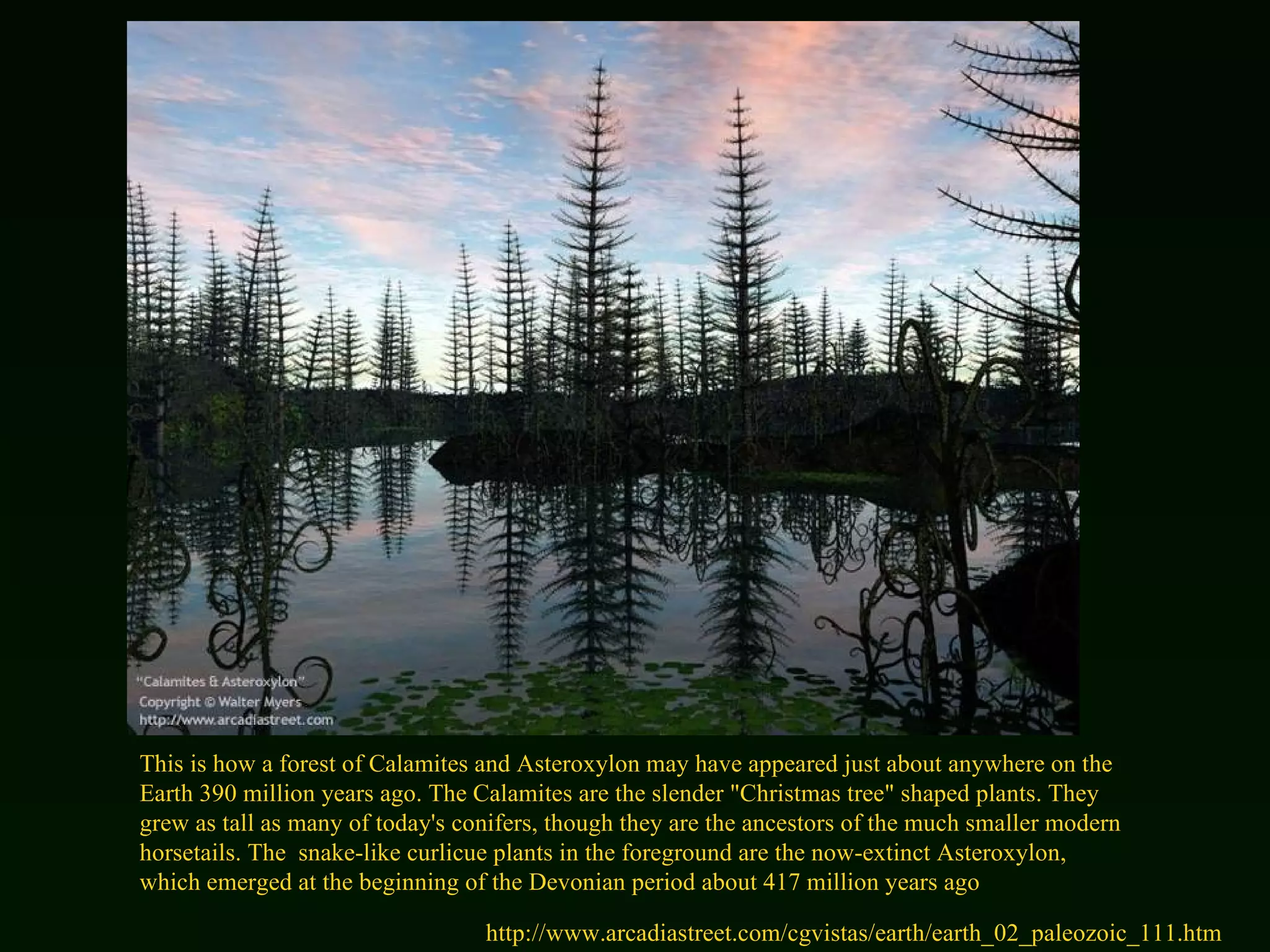
This is how a forest of Calamites and Asteroxylon may have appeared just about anywhere on the Earth 390 million years ago. The Calamites are the slender "Christmas tree" shaped plants. They grew as tall as many of today's conifers, though they are the ancestors of the much smaller modern horsetails. The  snake-like curlicue plants in the foreground are the now-extinct Asteroxylon, which emerged at the beginning of the Devonian period about 417 million years ago  http://www.arcadiastreet.com/cgvistas/earth/earth_02_paleozoic_111.htm
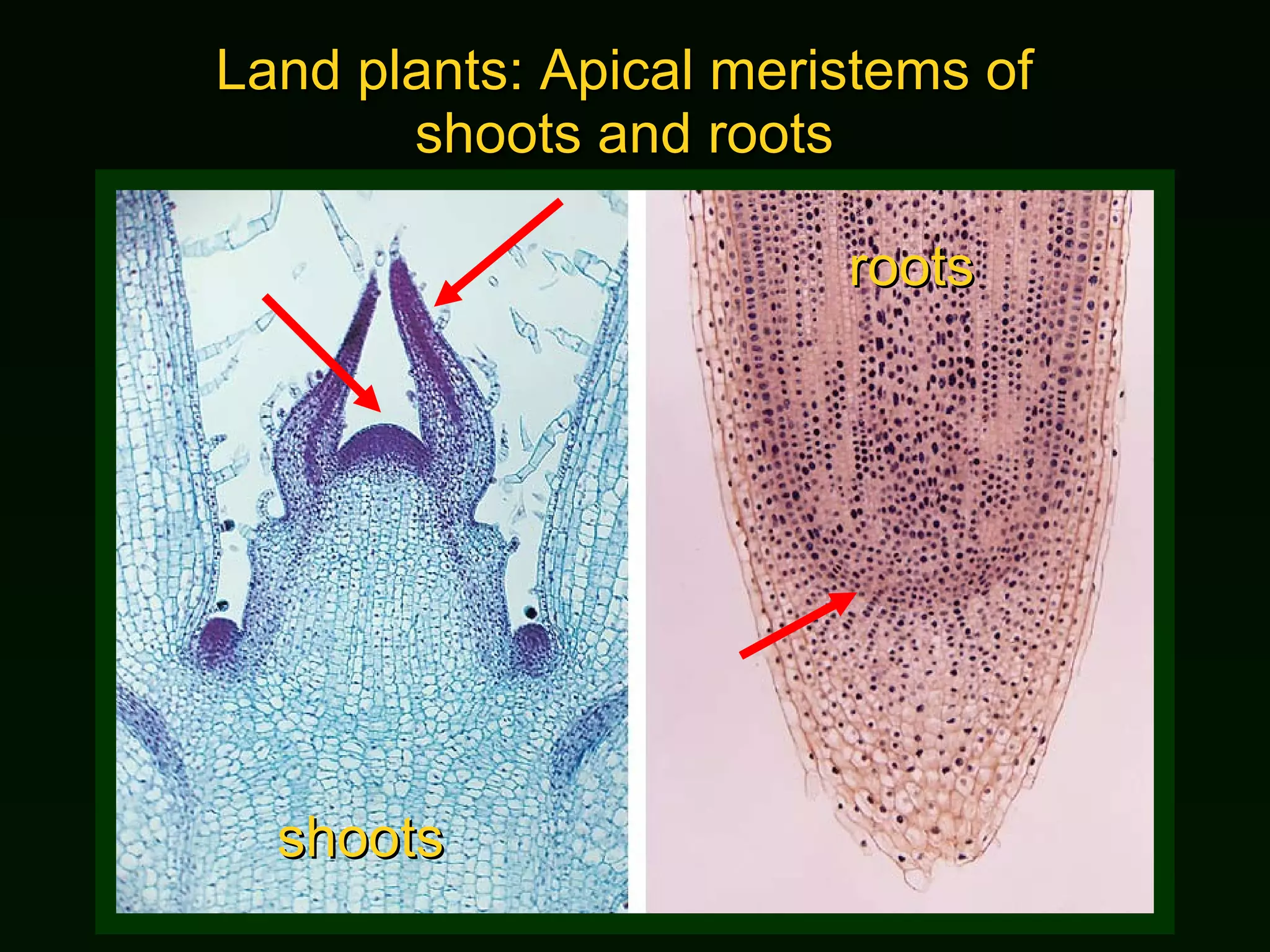
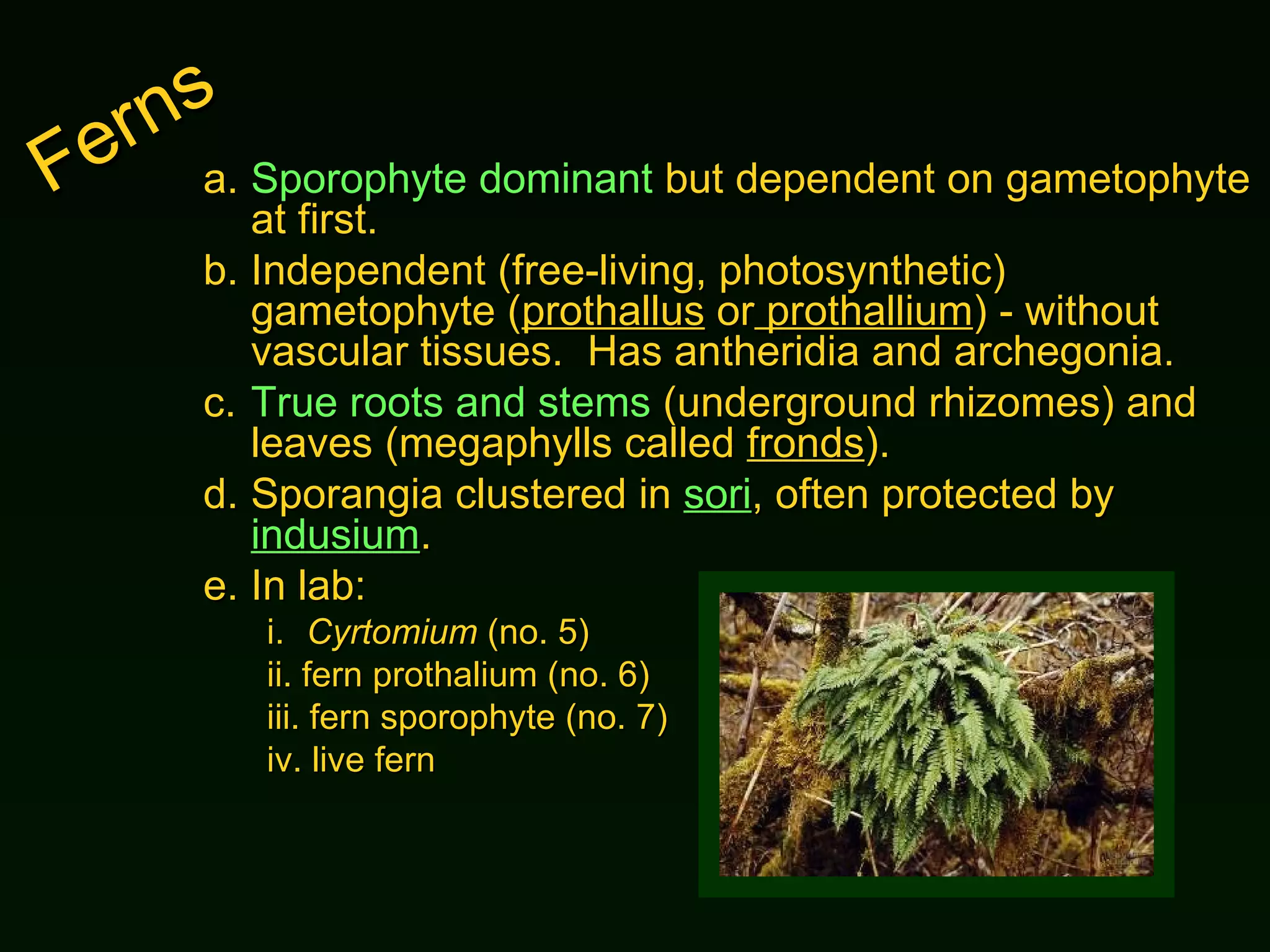
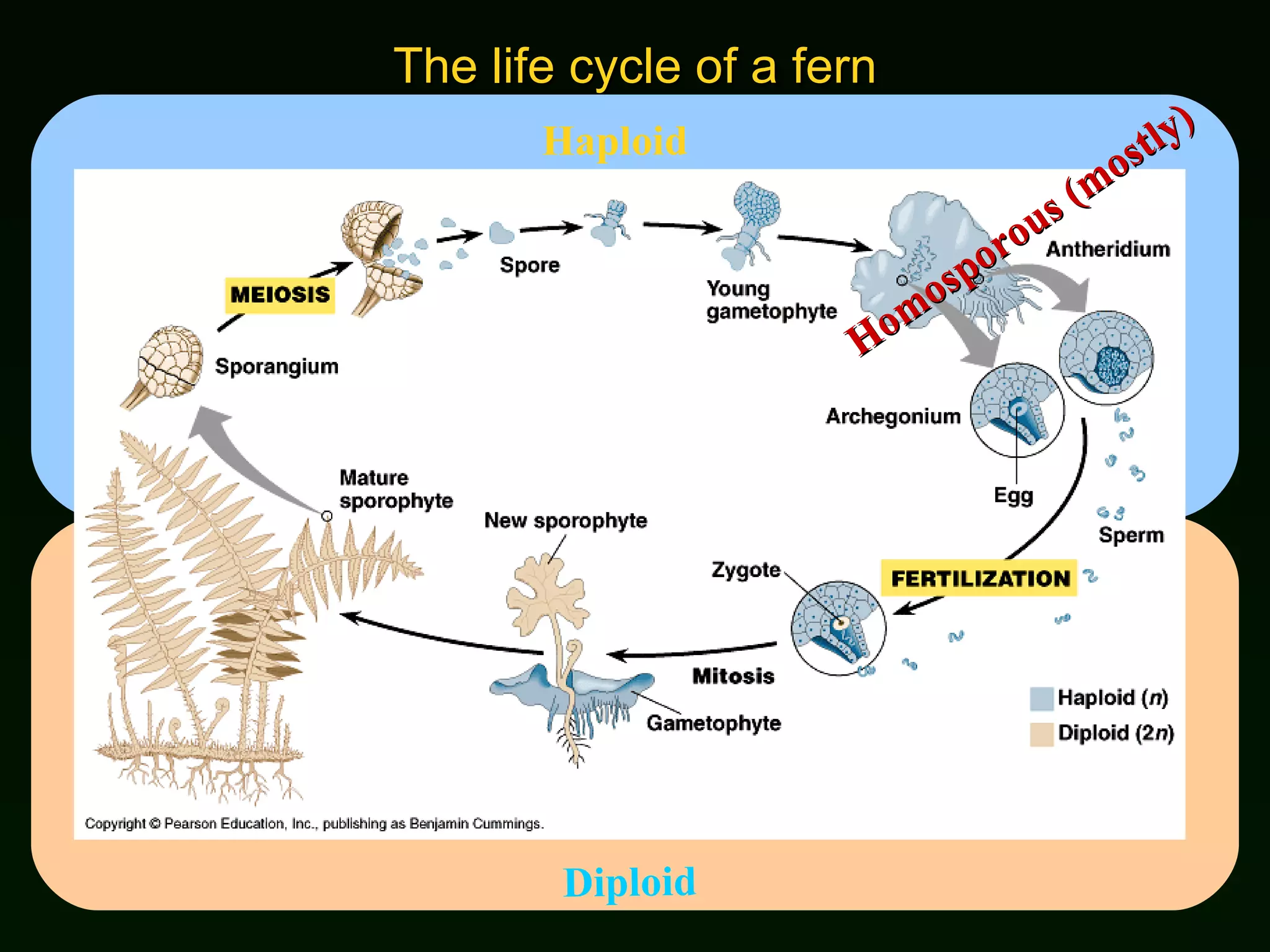
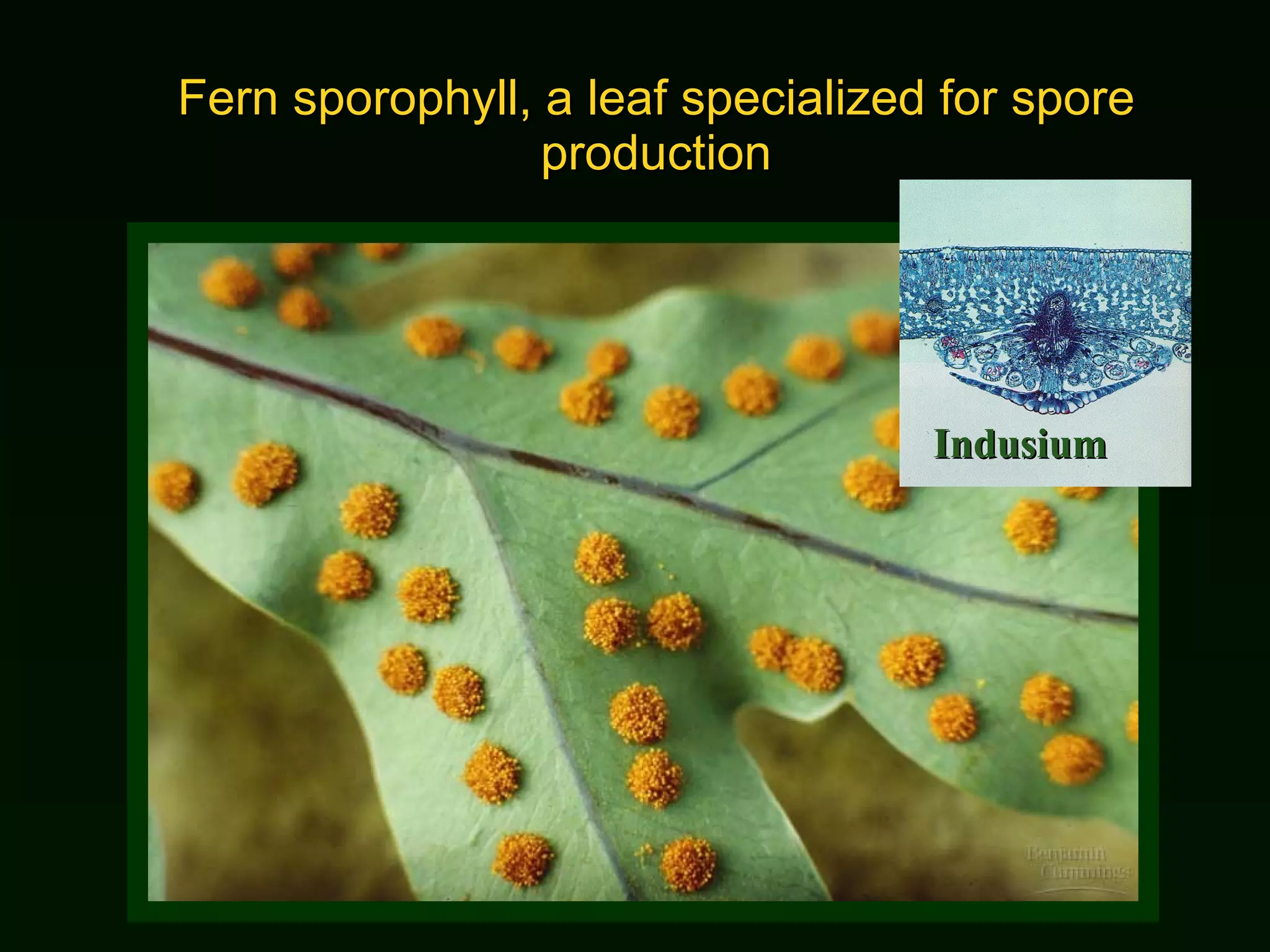
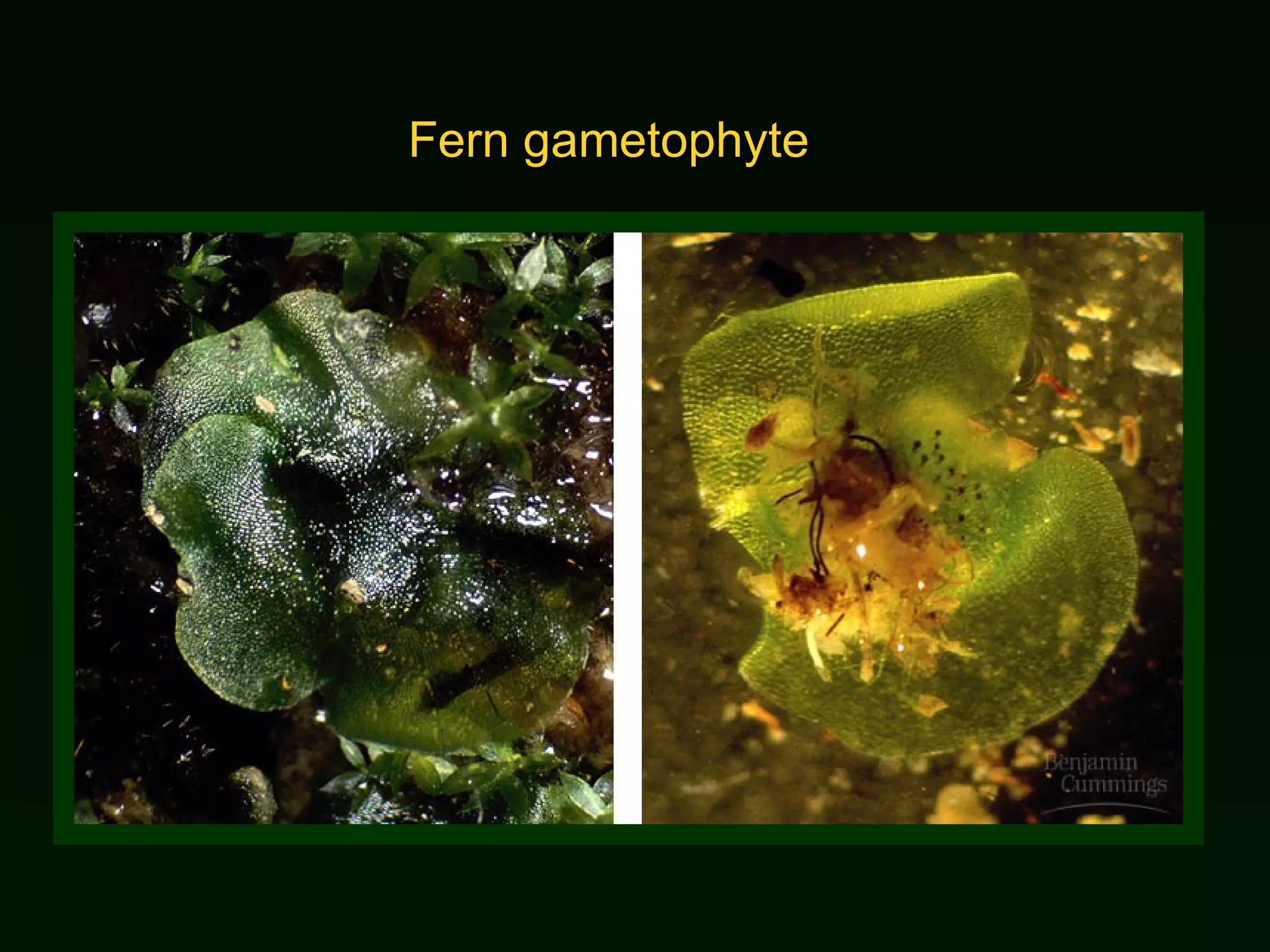
Ferns  a. Sporophyte dominant  but dependent on gametophyte at first. b. Independent (free-living, photosynthetic) gametophyte ( prothallus  or  prothallium ) - without vascular tissues.  Has antheridia and archegonia. c. True roots and stems  (underground rhizomes) and leaves (megaphylls called  fronds ). d. Sporangia clustered in  sori , often protected by  indusium . e. In lab: i. Cyrtomium  (no. 5) ii.  fern prothalium (no. 6) iii.  fern sporophyte (no. 7) iv.  live fern
The life cycle of a fern Haploid Diploid Homosporous (mostly)
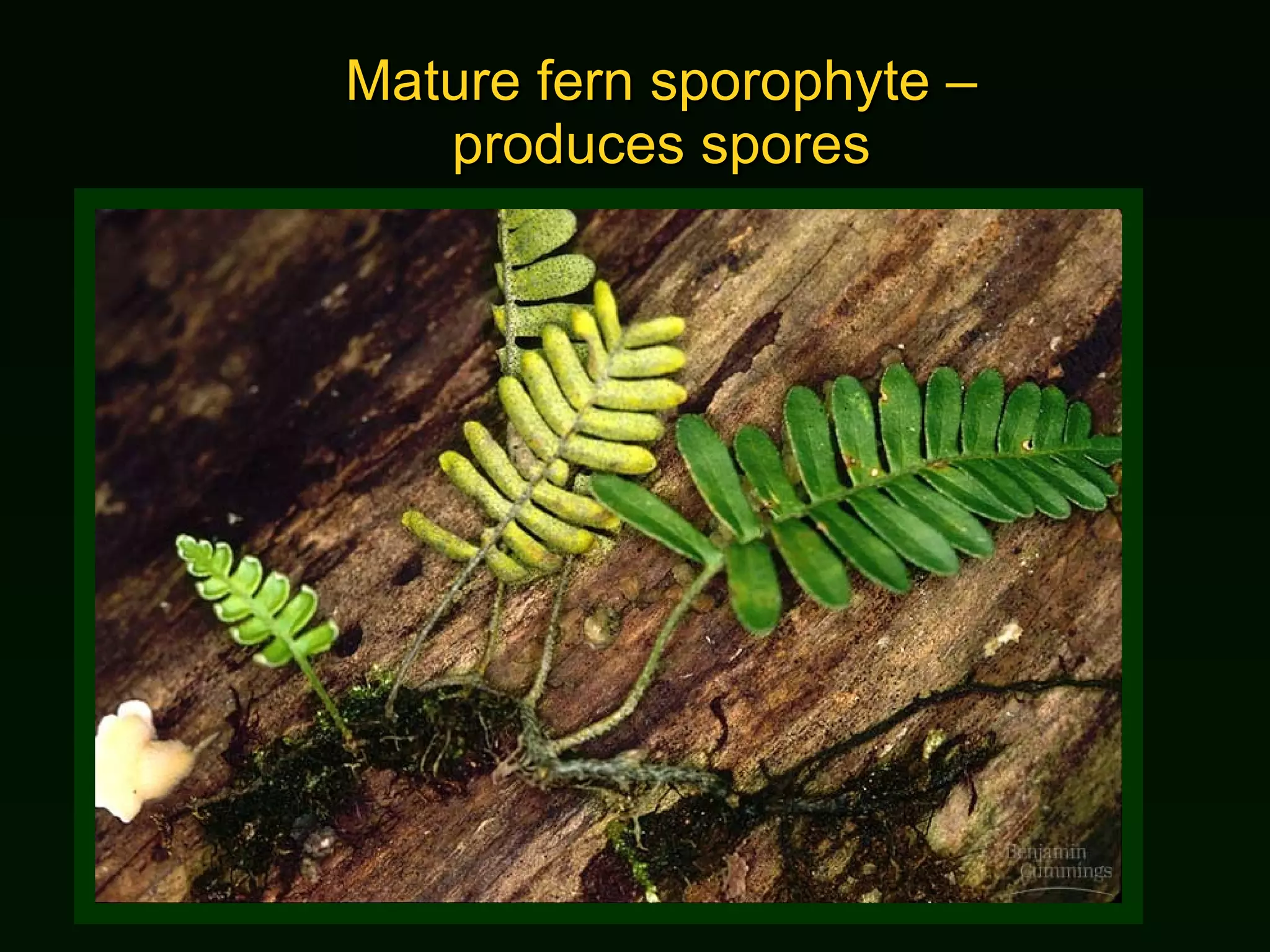
Fern sporophyll, a leaf specialized for spore production Indusium
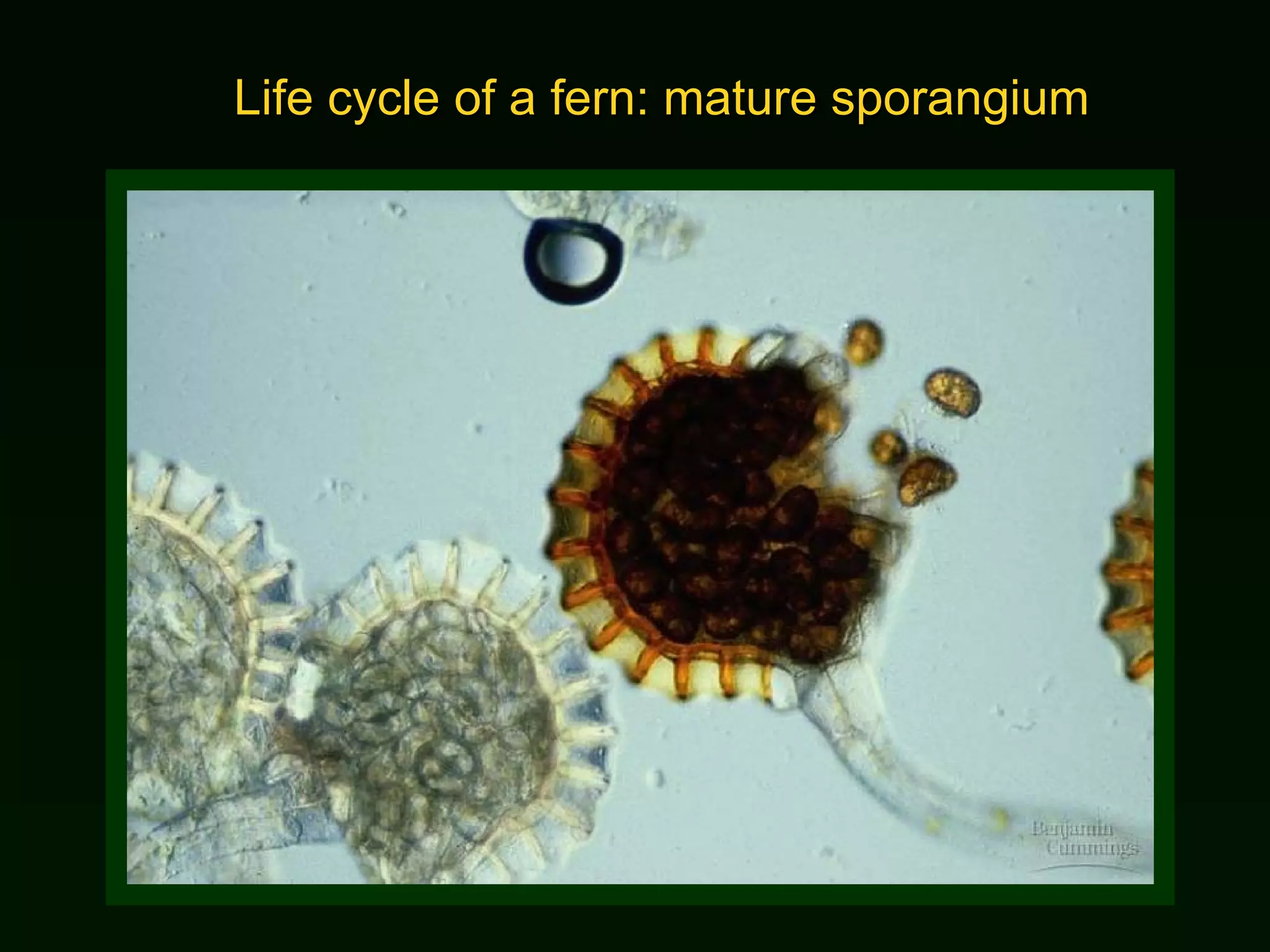
Life cycle of a fern: mature sporangium
Fern gametophyte
Fern archegonia
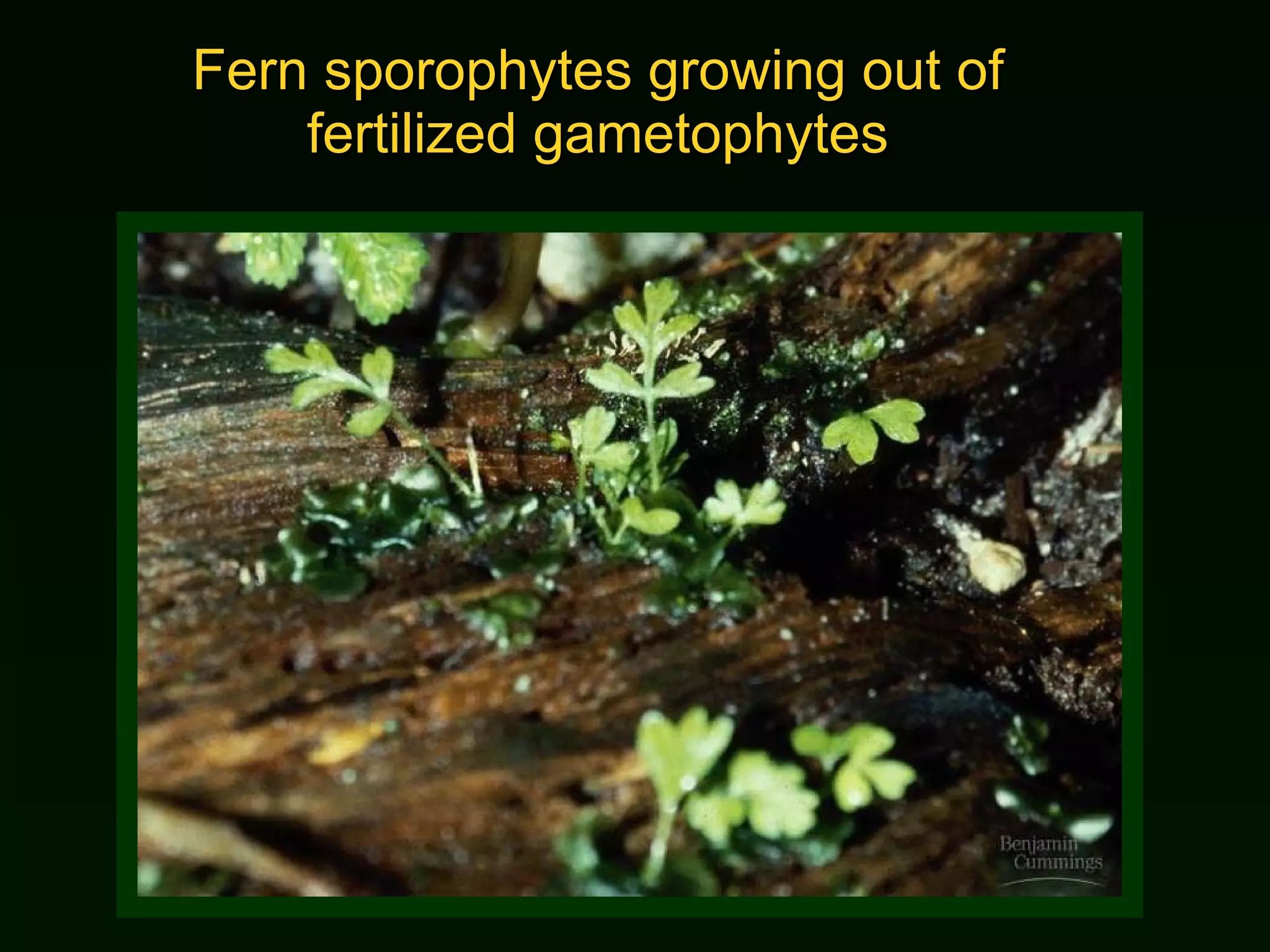
Fern sporophytes growing out of fertilized gametophytes
Mature fern sporophyte – produces spores
Ferns
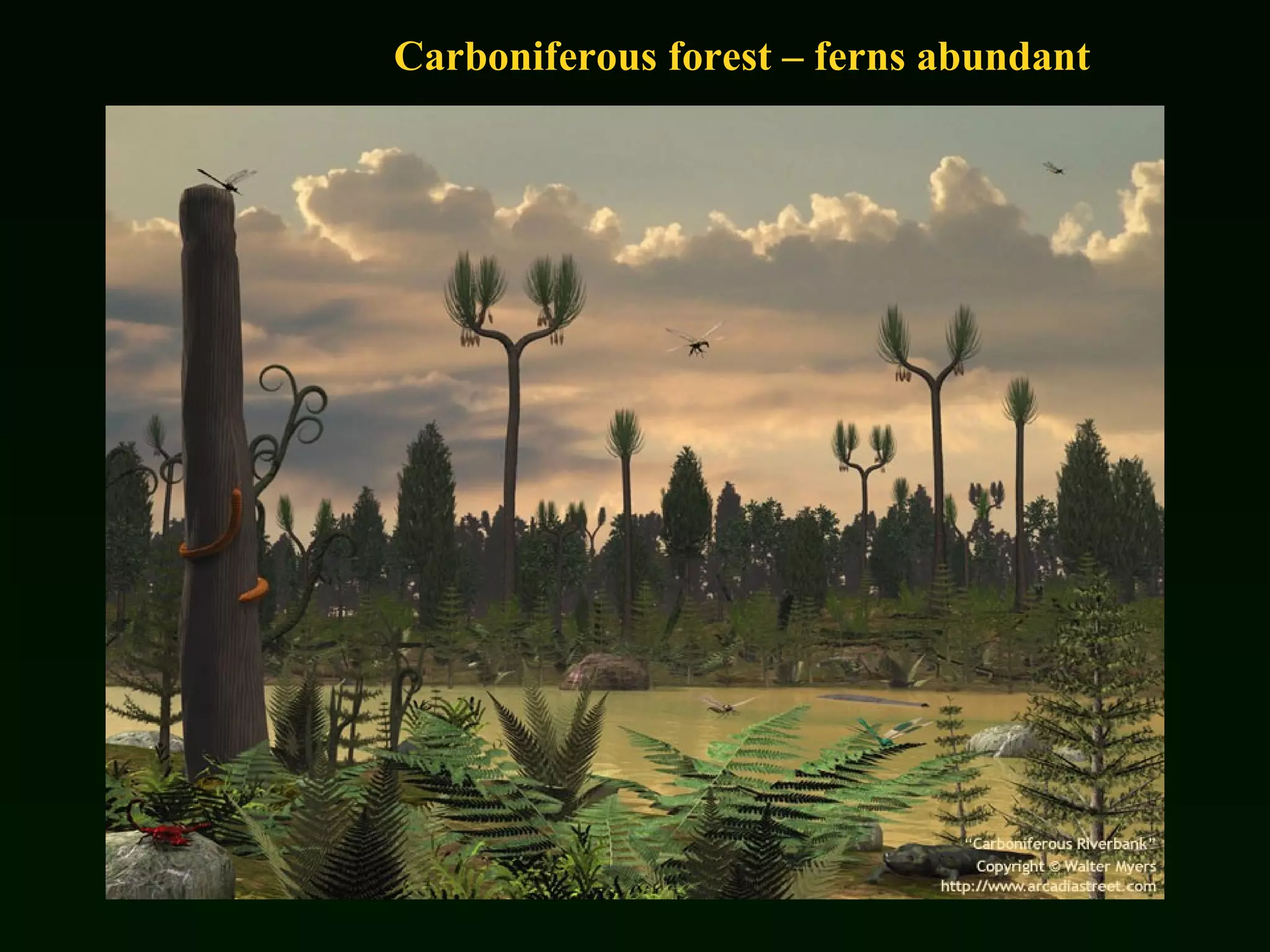
Carboniferous forest – ferns abundant
SEED PLANTS  " SPERMATOPHYTES " A.  Seed = plant embryo protected by integument (“seed coat”). B.  "GYMNOSPERMS" - "naked seeds"-  seeds without protection of ovary. C.  Sporophyte dominant - gametophyte reduced to very small size. 1.  Megagametophyte  - multicellular archegonium. 2 .  Microgametophyte  - pollen grains - 3 or 4 cells.  No antheridia. 3.  “Mega” and “micro” are used in higher plants to denote the larger female structures and the smaller male ones.
Kingdom  Chlorophyta Non-vascular plants Vascular Plants   (no seeds) Vascular seed Plants Flowering Plants Liverworts Hornworts Mosses Lycophytes Horsetails Ferns Cycads Ginkgo Conifers Gnetum Angiosperms Green Algae
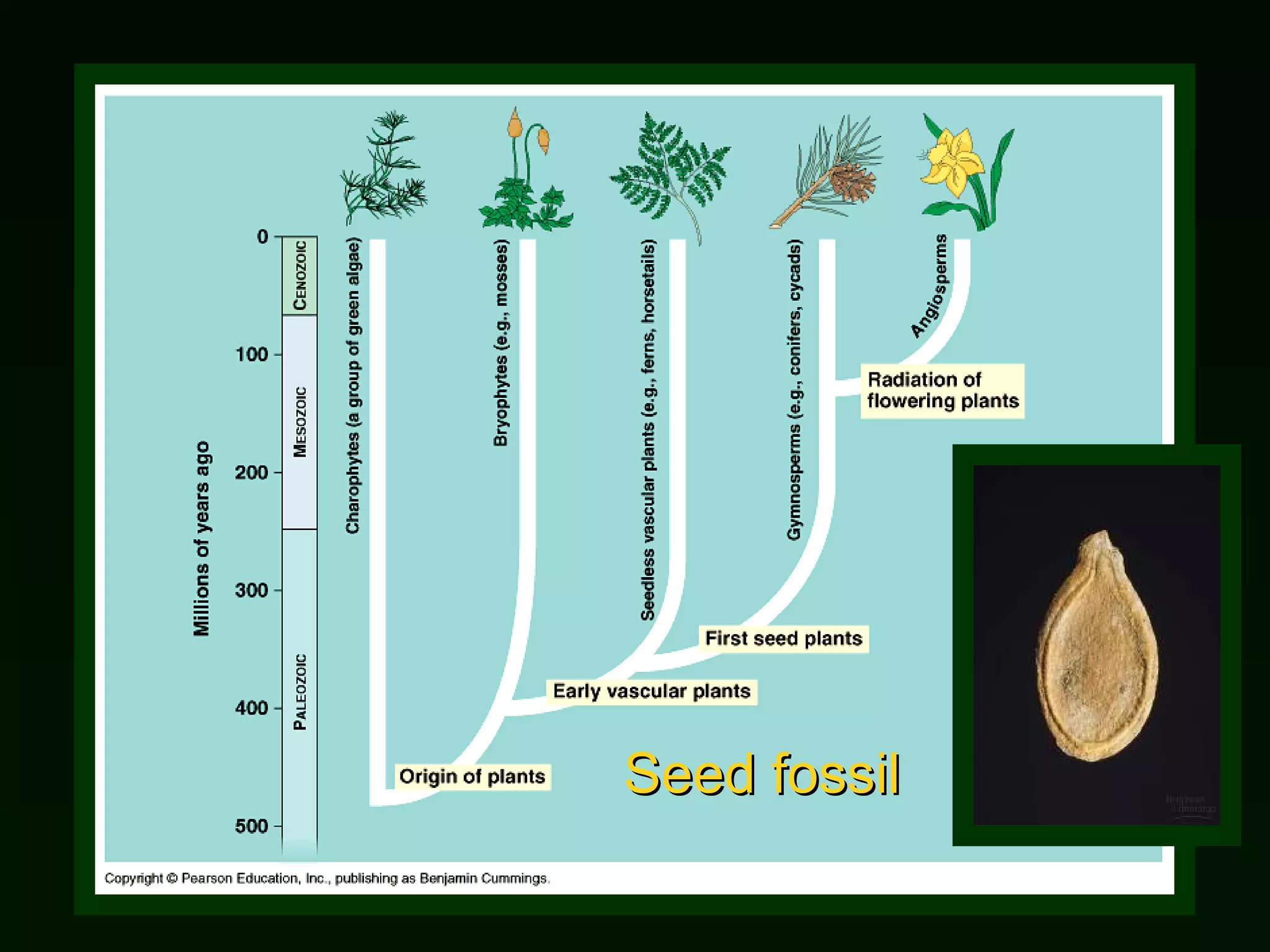
Seed fossil
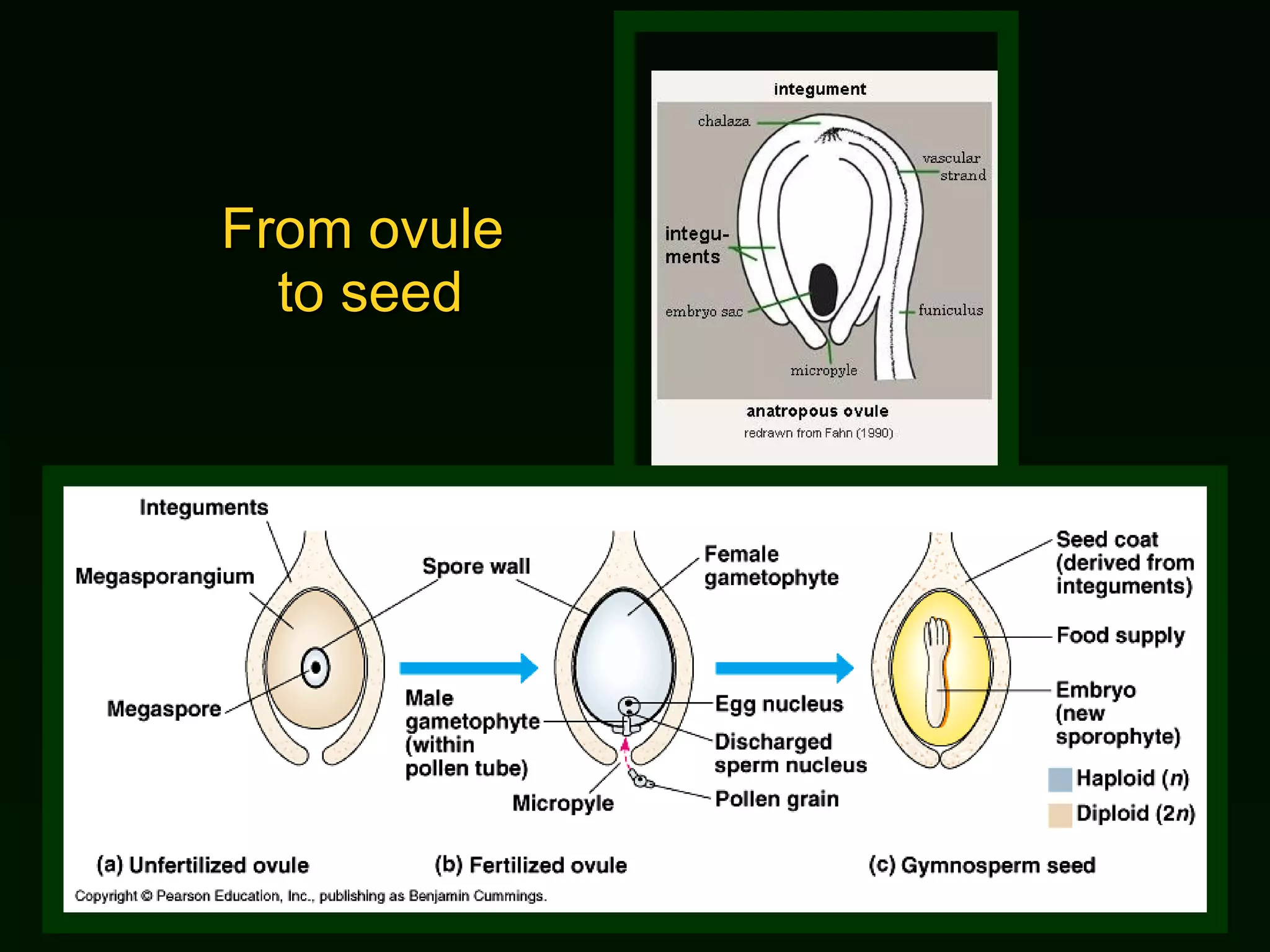
From ovule  to seed
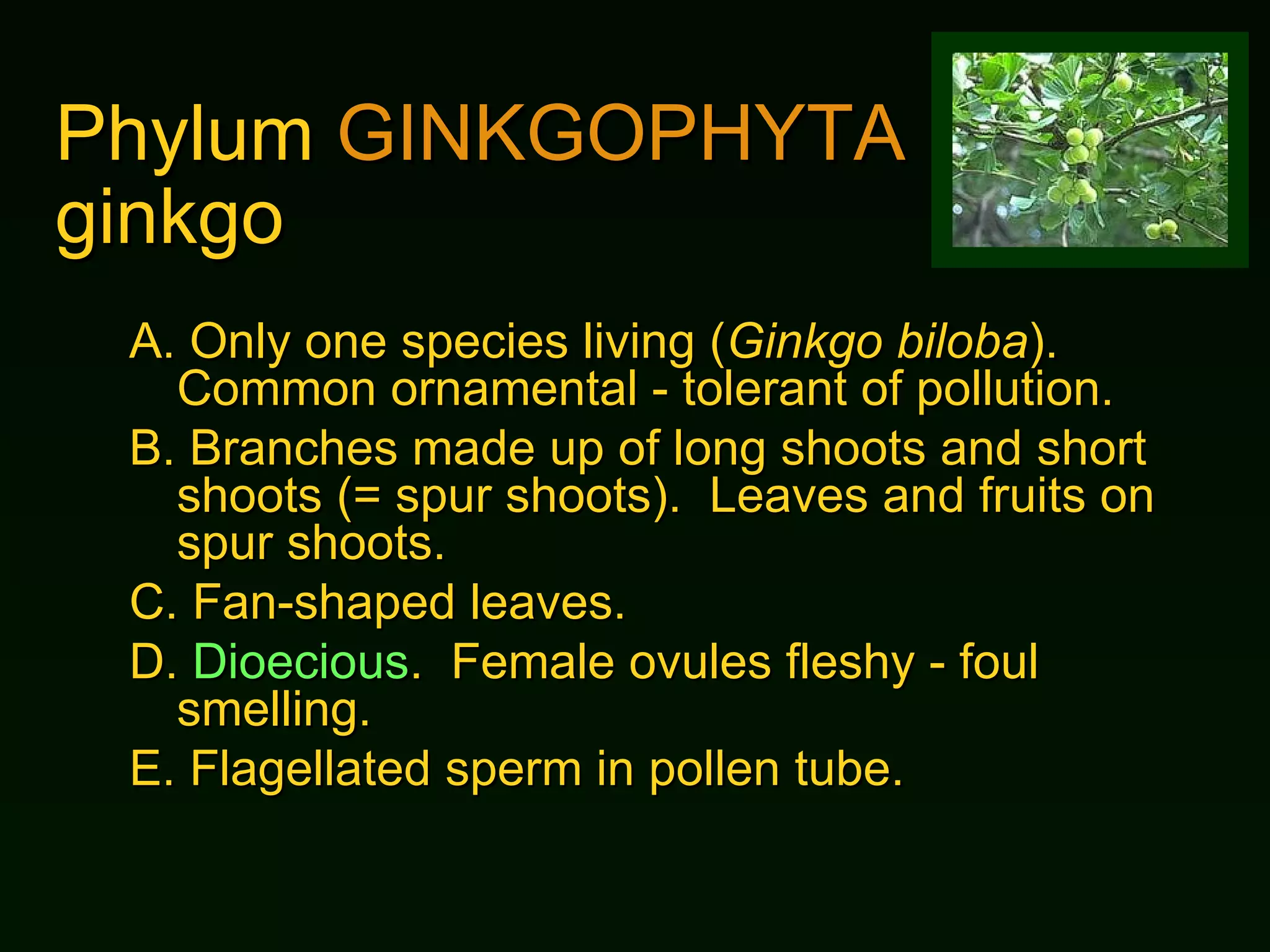
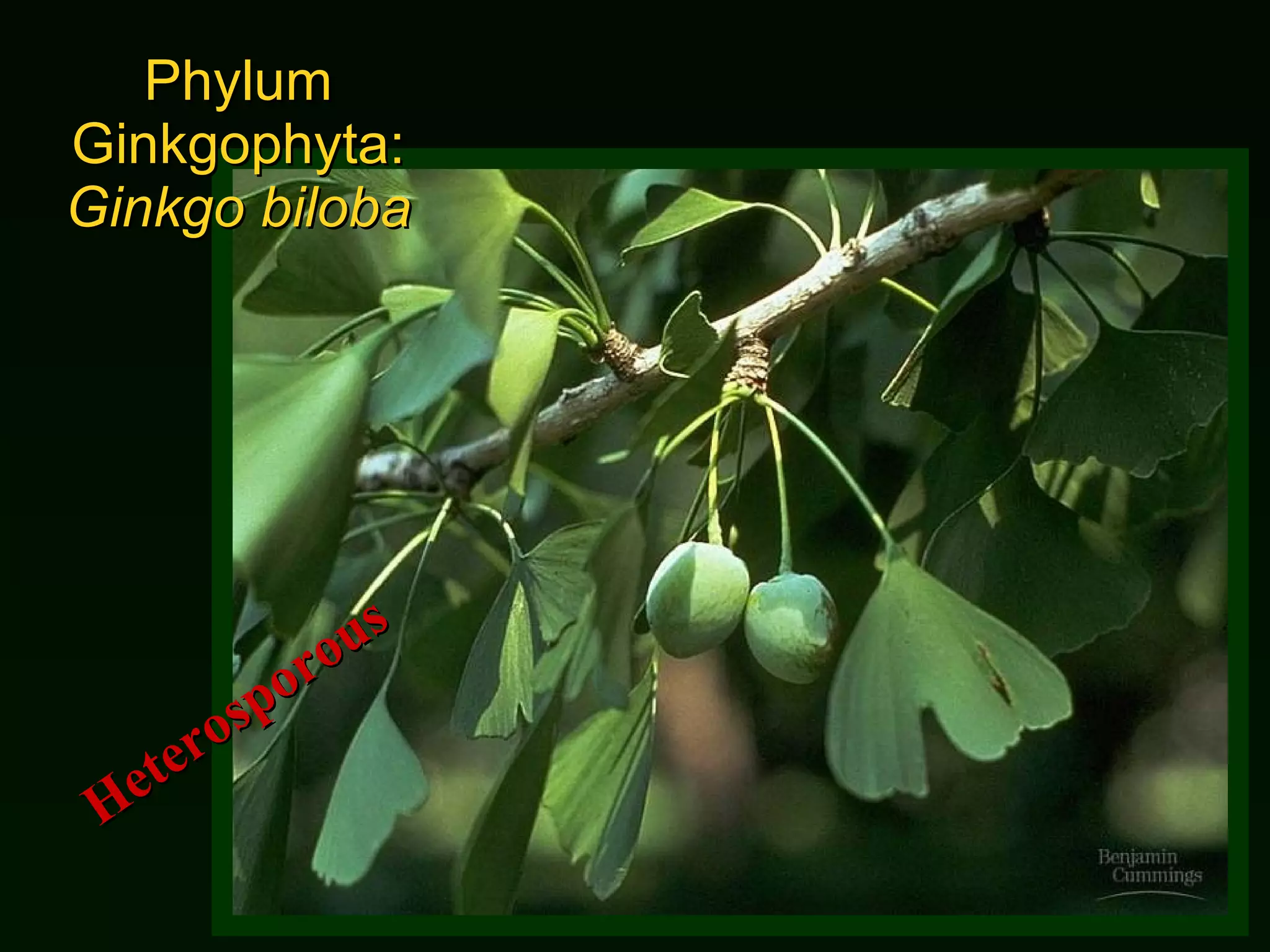
Phylum  GINKGOPHYTA   ginkgo A.  Only one species living ( Ginkgo biloba ).  Common ornamental - tolerant of pollution. B.  Branches made up of long shoots and short shoots (= spur shoots).  Leaves and fruits on spur shoots. C.  Fan-shaped leaves. D.  Dioecious .  Female ovules fleshy - foul smelling. E.  Flagellated sperm in pollen tube.
Phylum Ginkgophyta:  Ginkgo biloba Heterosporous
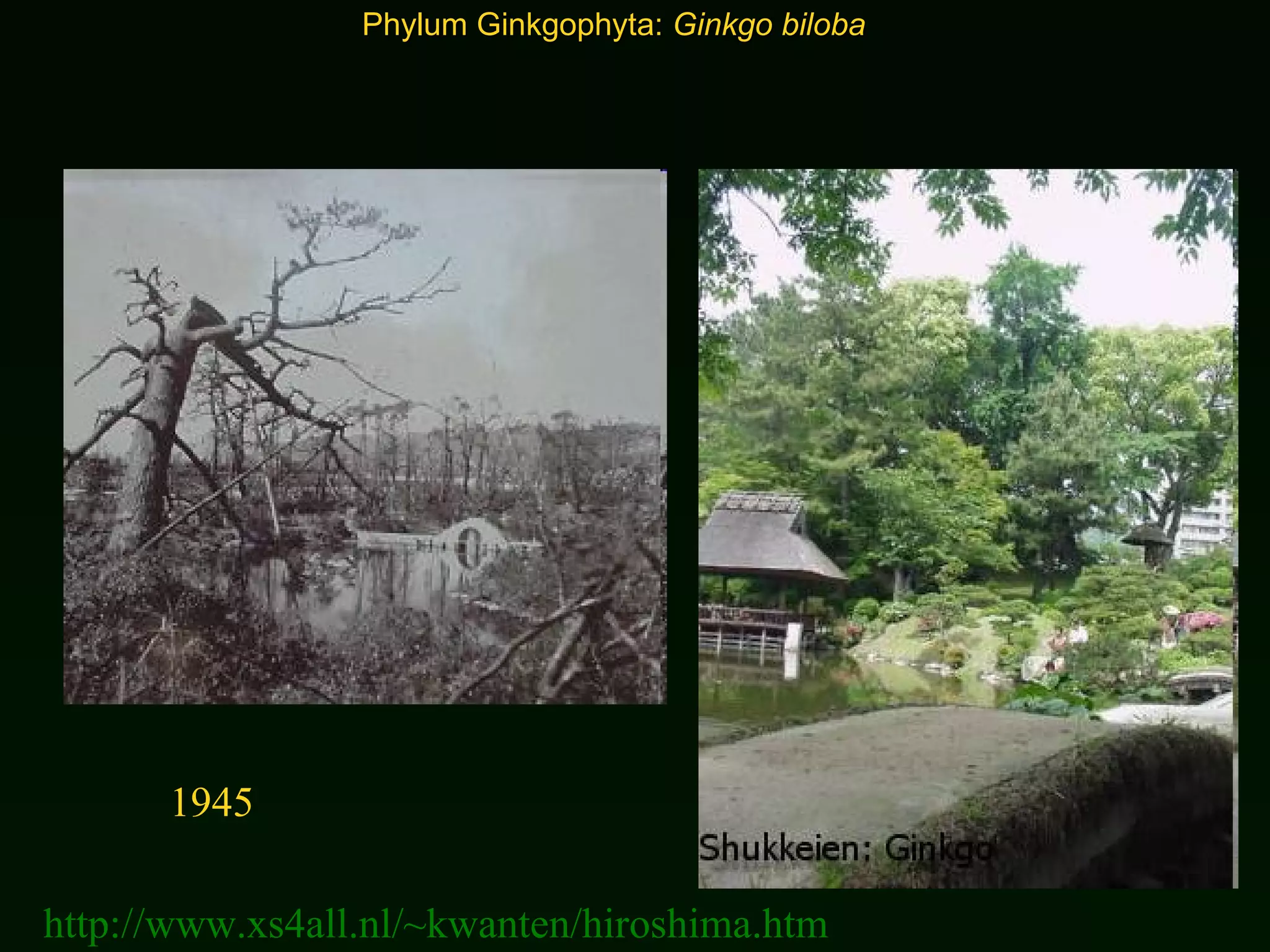
Phylum Ginkgophyta:  Ginkgo biloba 1945 http://www.xs4all.nl/~kwanten/hiroshima.htm
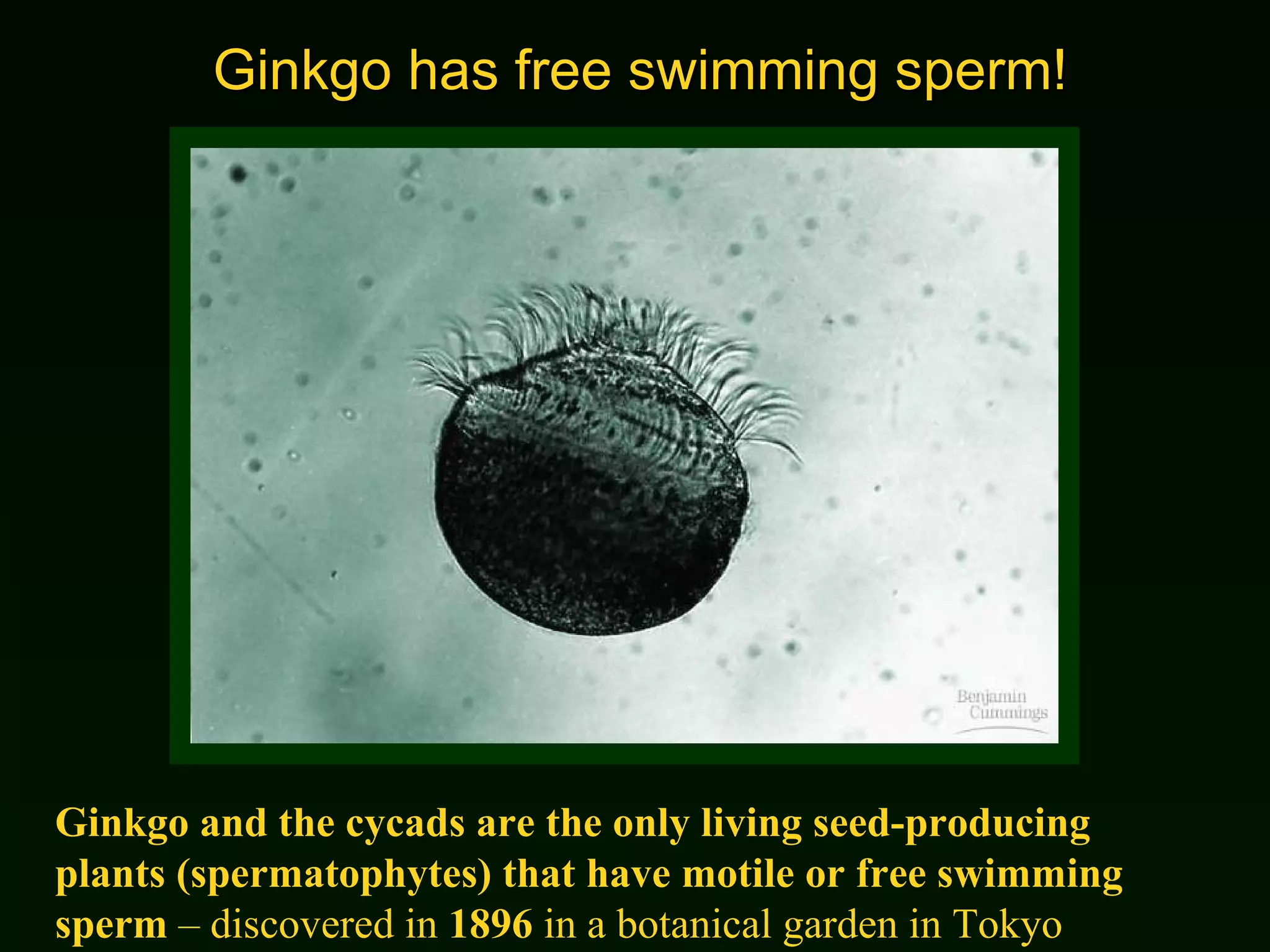
Ginkgo has free swimming sperm! Ginkgo and the cycads are the only living seed-producing plants (spermatophytes) that have motile or free swimming sperm  – discovered in  1896  in a botanical garden in Tokyo
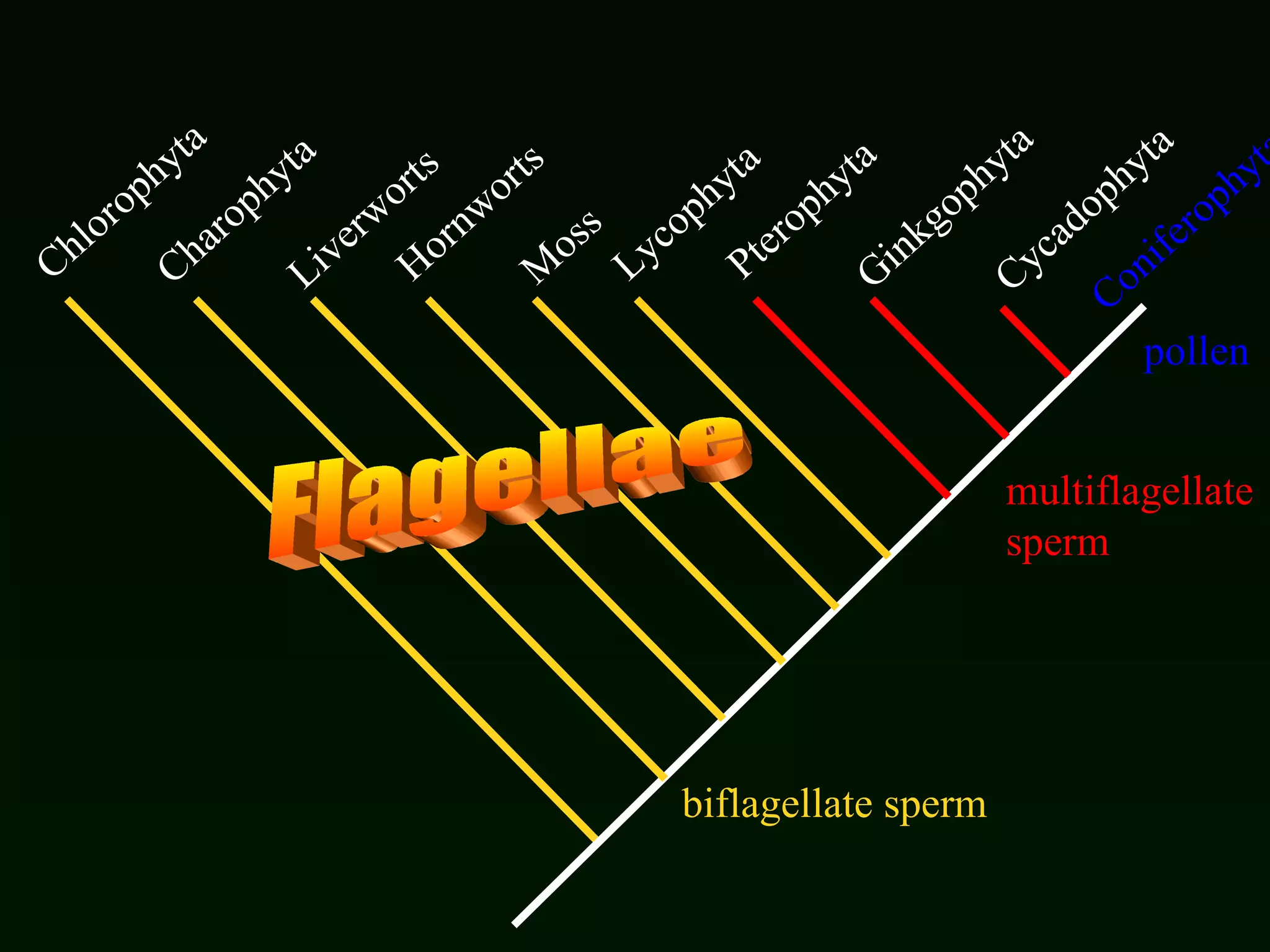
Chlorophyta Charophyta Liverworts Hornworts Moss Lycophyta Pterophyta Ginkgophyta Cycadophyta Coniferophyta biflagellate sperm multiflagellate  sperm pollen Flagellae
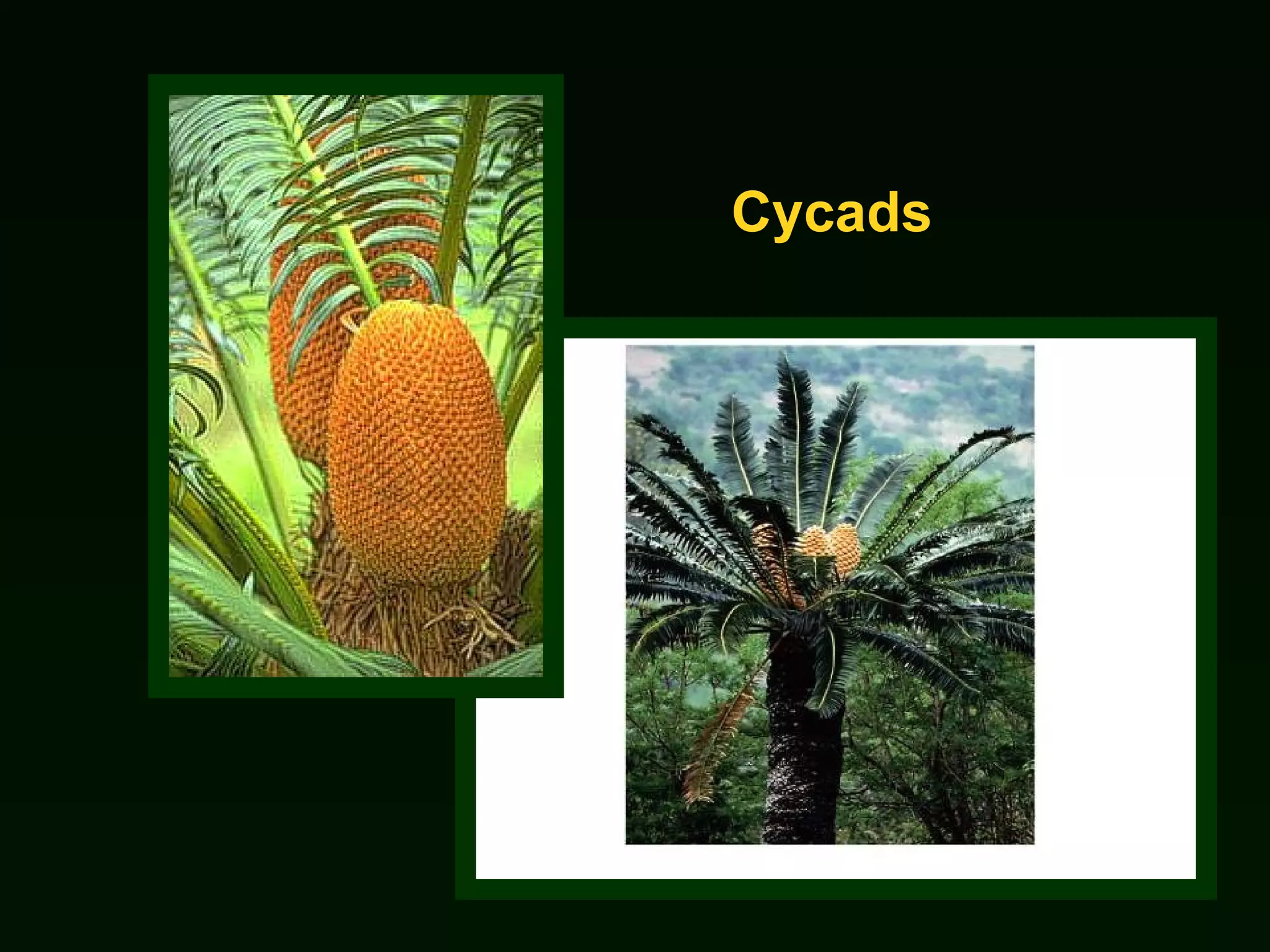
Phylum  CYCADOPHYTA  - cycads A.  Tropical and subtropical. B.  Palm-like with large, pinnate leaves. C.  Terminal cones - plants are  dioecious .  Strobili and seeds may take 10 years to mature. D.  Sperm are multiflagellated, wind-blown to female cone or some carried by beetle pollinators. Enters fluids secreted around micropyle.  Pollen tube carries sperm nuclei to egg. E.  In lab: 1.  live  Cycas 2.  live  Zamia  - only cycad native to United States.
Cycads
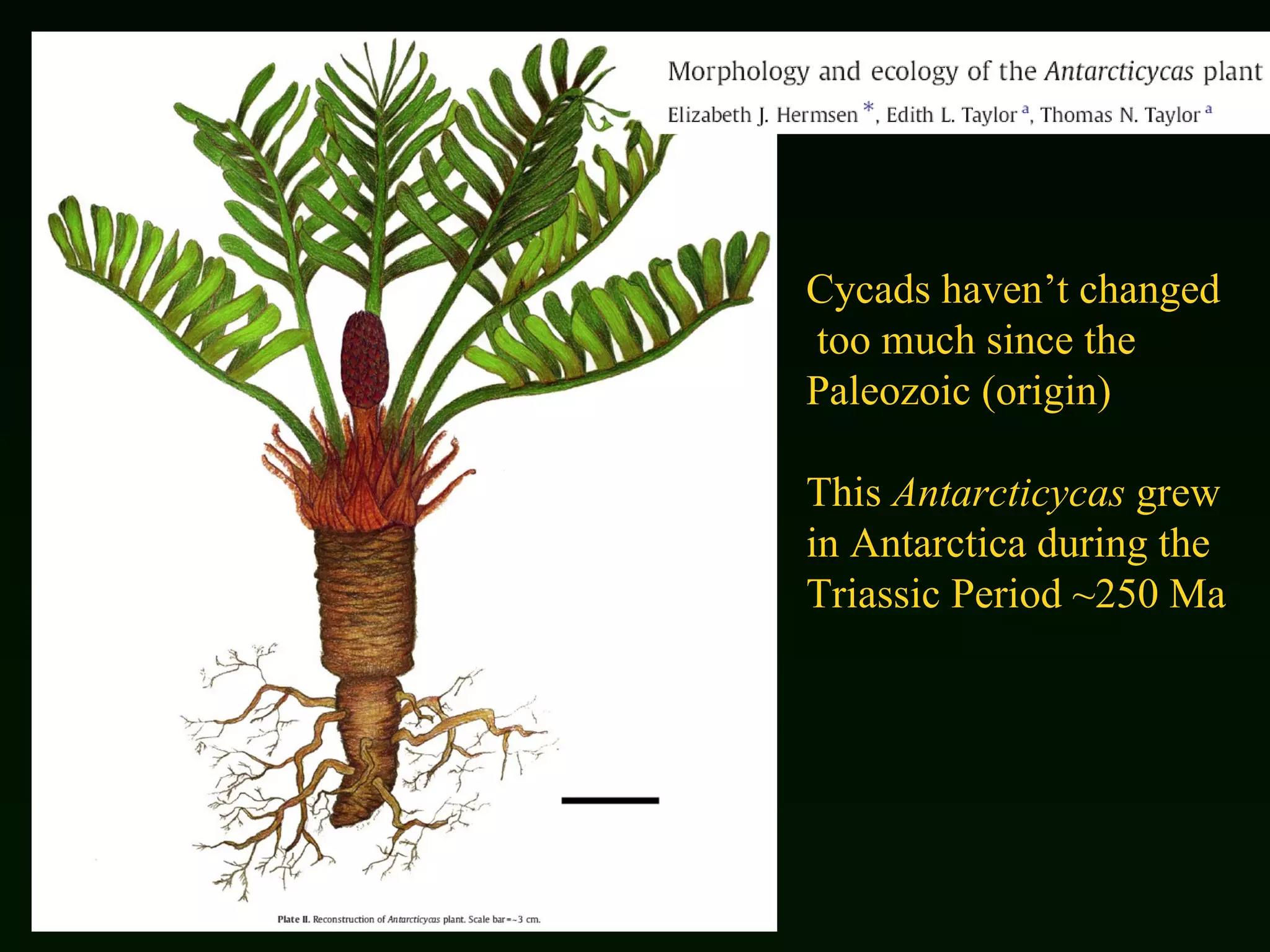
Cycads haven’t changed  too much since the  Paleozoic (origin) This  Antarcticycas  grew in Antarctica during the  Triassic Period ~250 Ma
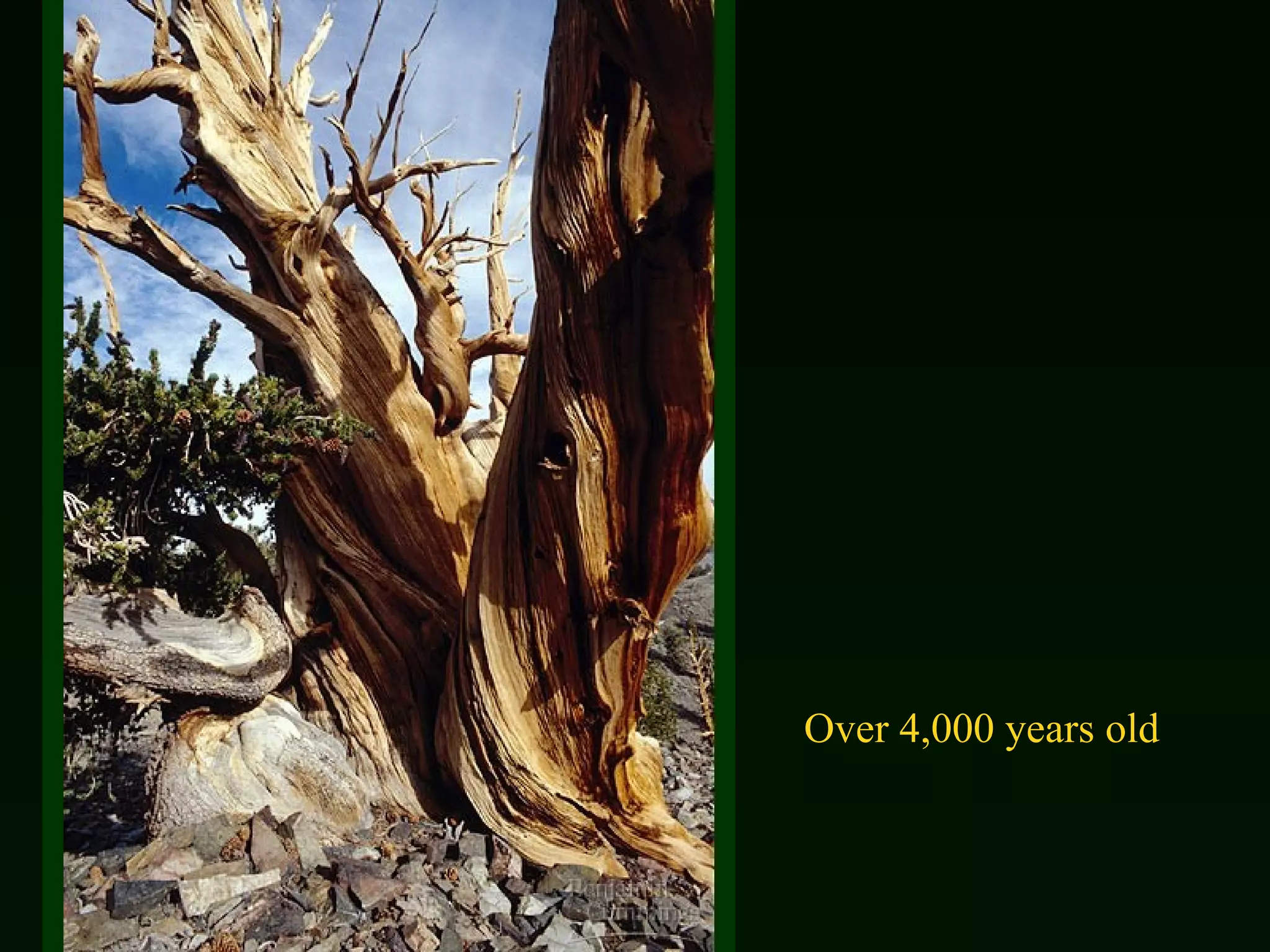
Phylum  CONIFEROPHYTA 500-600 species "evergreens” pines, firs, larches, spruce, etc.  Tallest = redwood 372 feet Oldest = bristlecone pine >4,900 years Most massive = Sequoia 102.6 feet circumference at base.
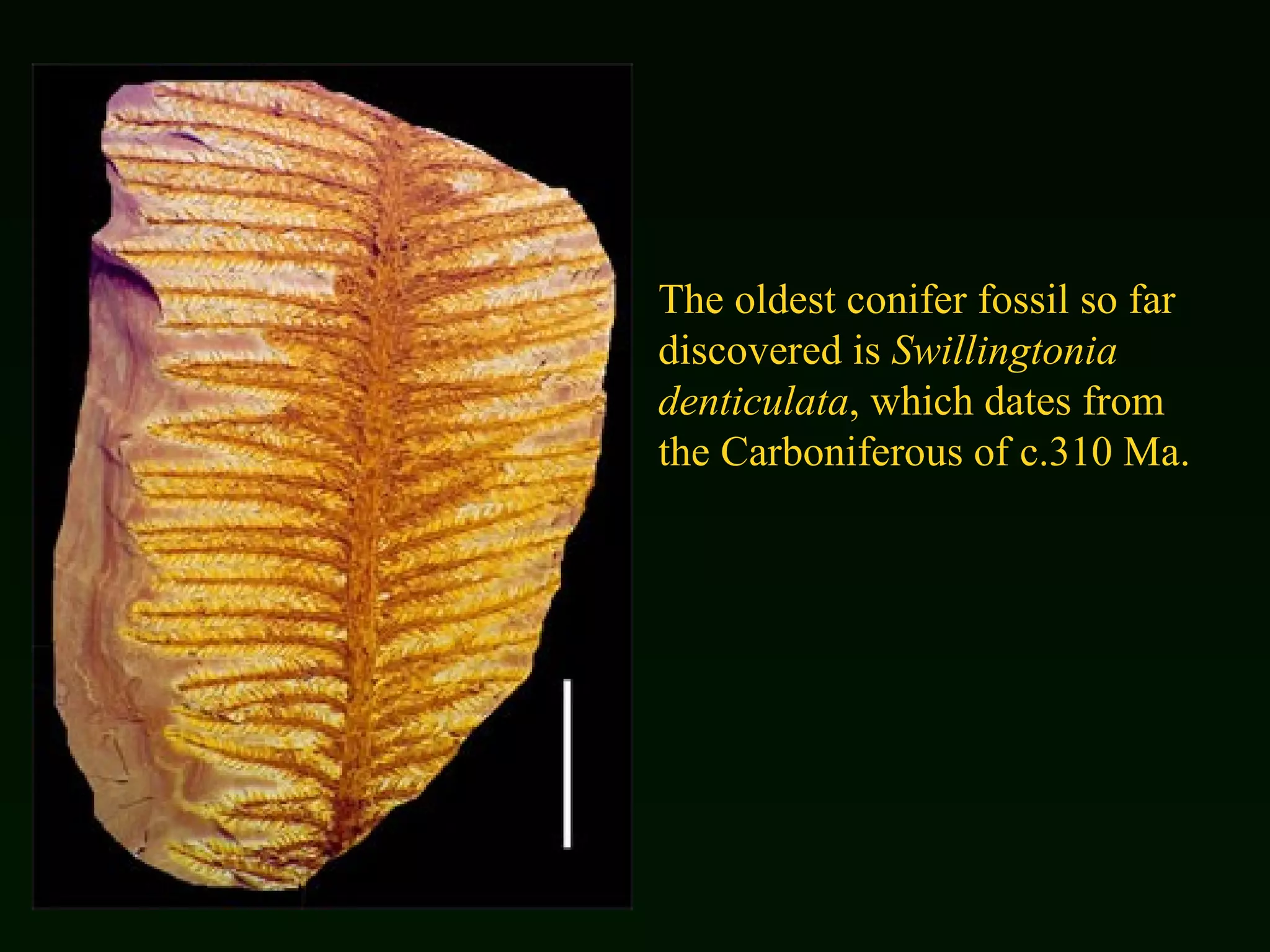
The oldest conifer fossil so far discovered is  Swillingtonia denticulata , which dates from the Carboniferous of c.310 Ma. 
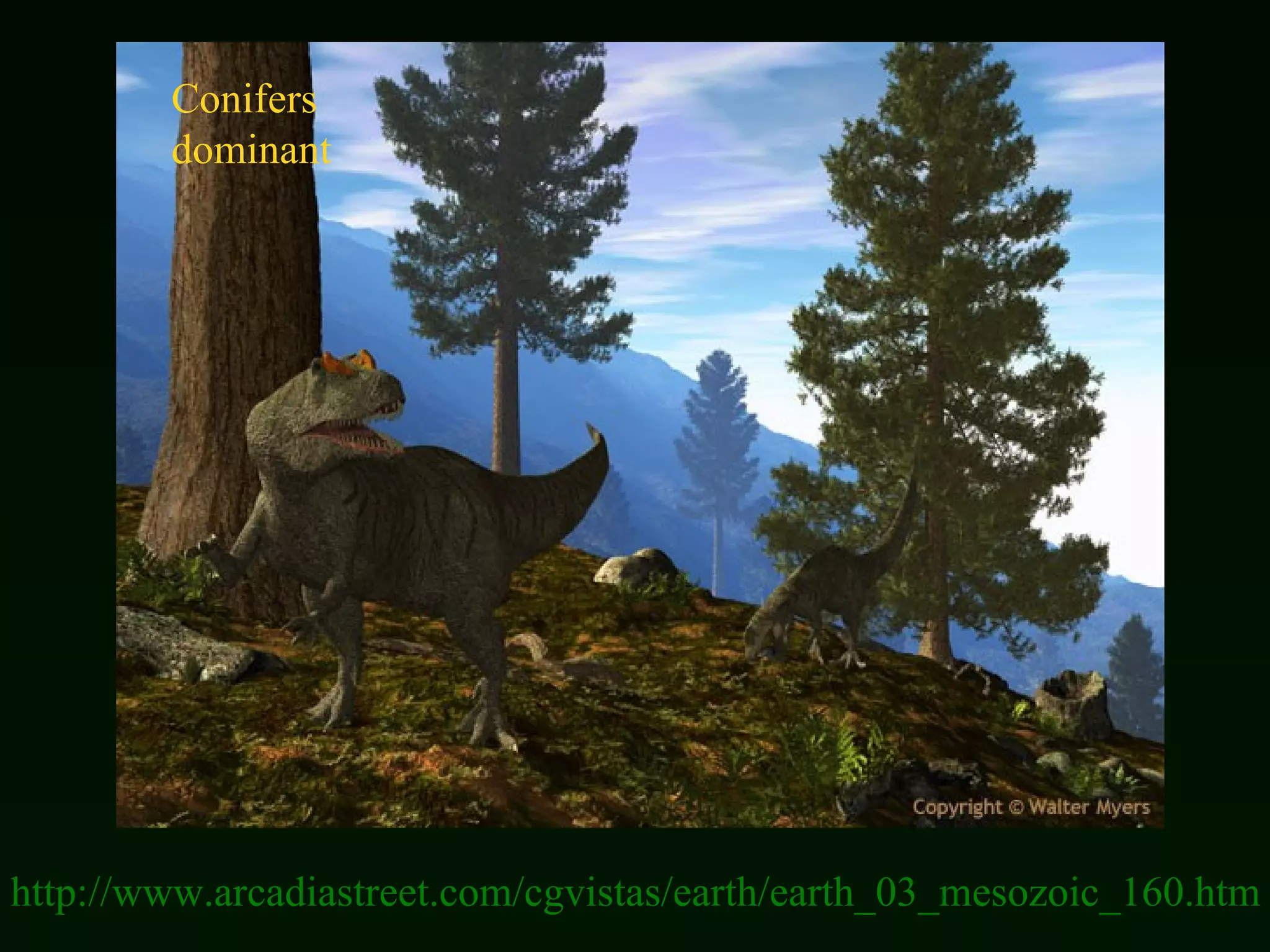
http://www.arcadiastreet.com/cgvistas/earth/earth_03_mesozoic_160.htm Conifers dominant
Sequoia  Sempervirens ( Cupressaceae )   Tallest redwoods over 300 feet
Over 4,000 years old
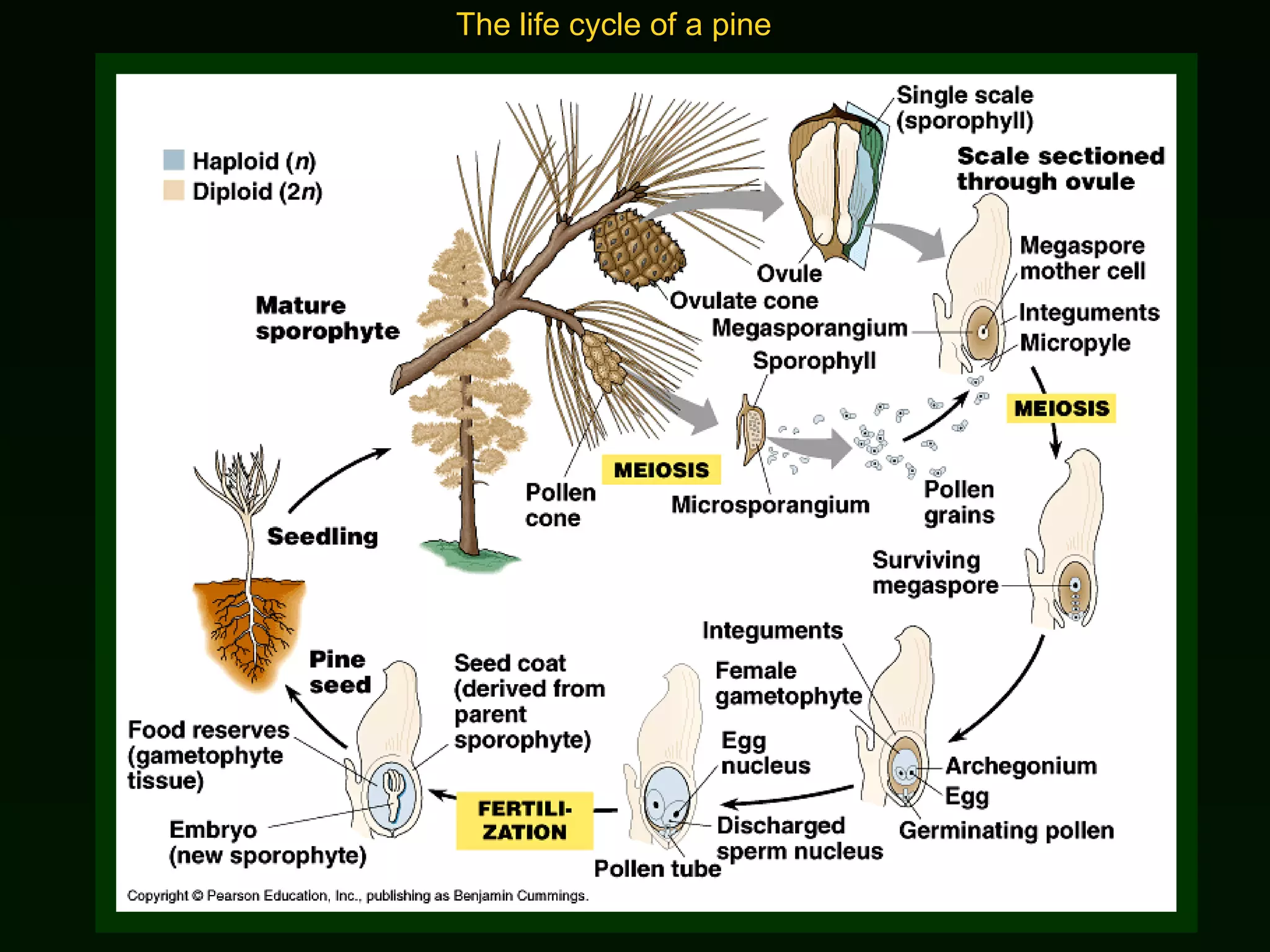
A.  Monoecious B.  Strobili = cones - borne on spur shoots  1.  Staminate cones - male -  microsporangia  on  microsporophylls . 2.  Ovulate cones - female -  ovules  on ovulate scales with woody bract. a.  Ovule = female gametophyte (haploid) surrounded by nucellus and integument (both diploid).  Mature ovule = seed. C.  Wind-blown pollen enters the ovulate cones when they are very small.  Pollen tubes (immotile sperm) grow very slowly.  So - fertilization may not occur for many months, even years, until the seed cones and the megagametophytes have matured. 1.  Two sperm nuclei in pollen tube but only one is functional; the other degenerates. D.  Reproduction  does not depend on water . E.  Well over 1 year passes between pollination and fertilization.  Seeds usually not mature until 2nd summer. F.  Fire very important to many of these species. "Fire Ecology"
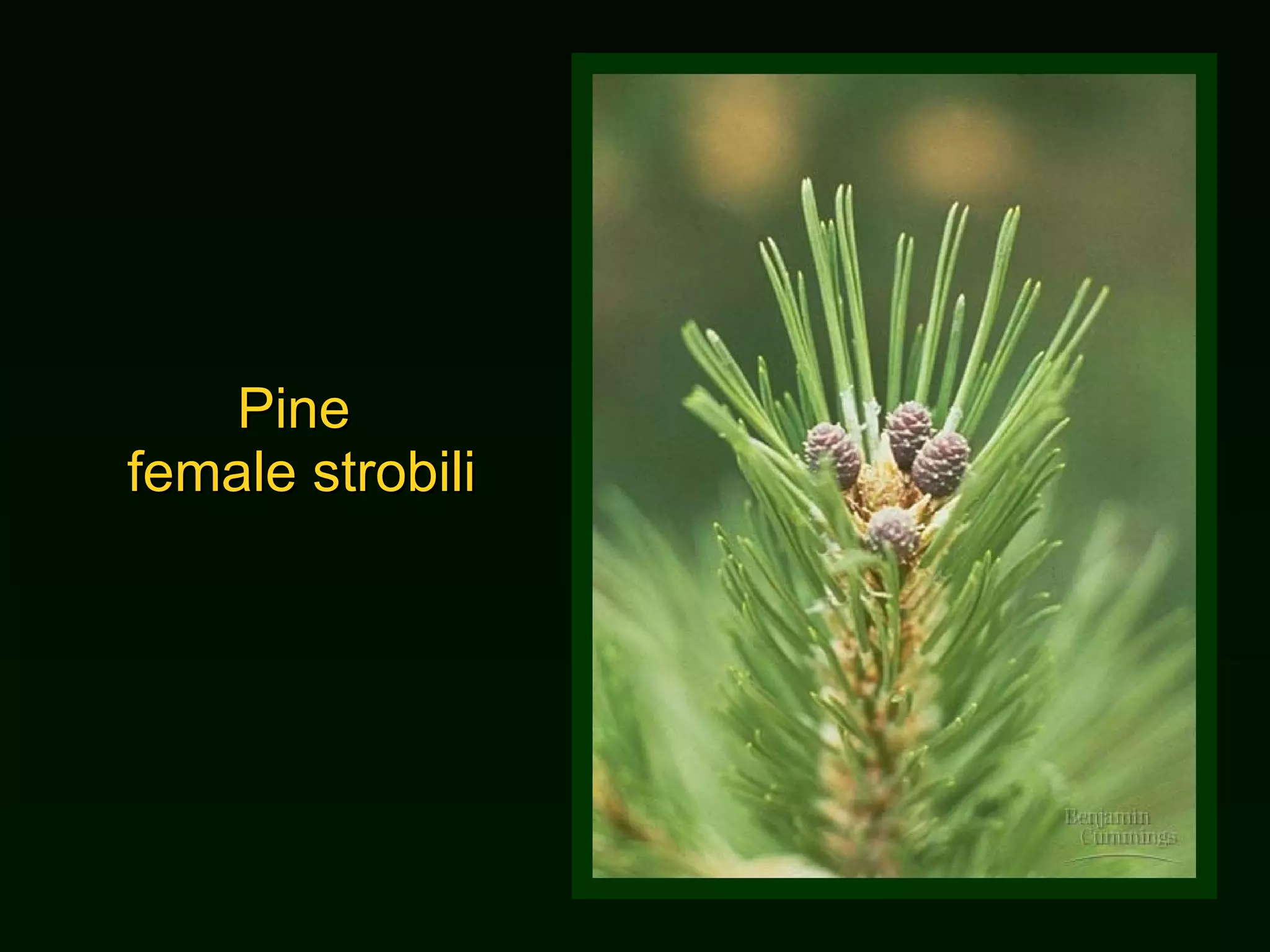
Pine  female strobili
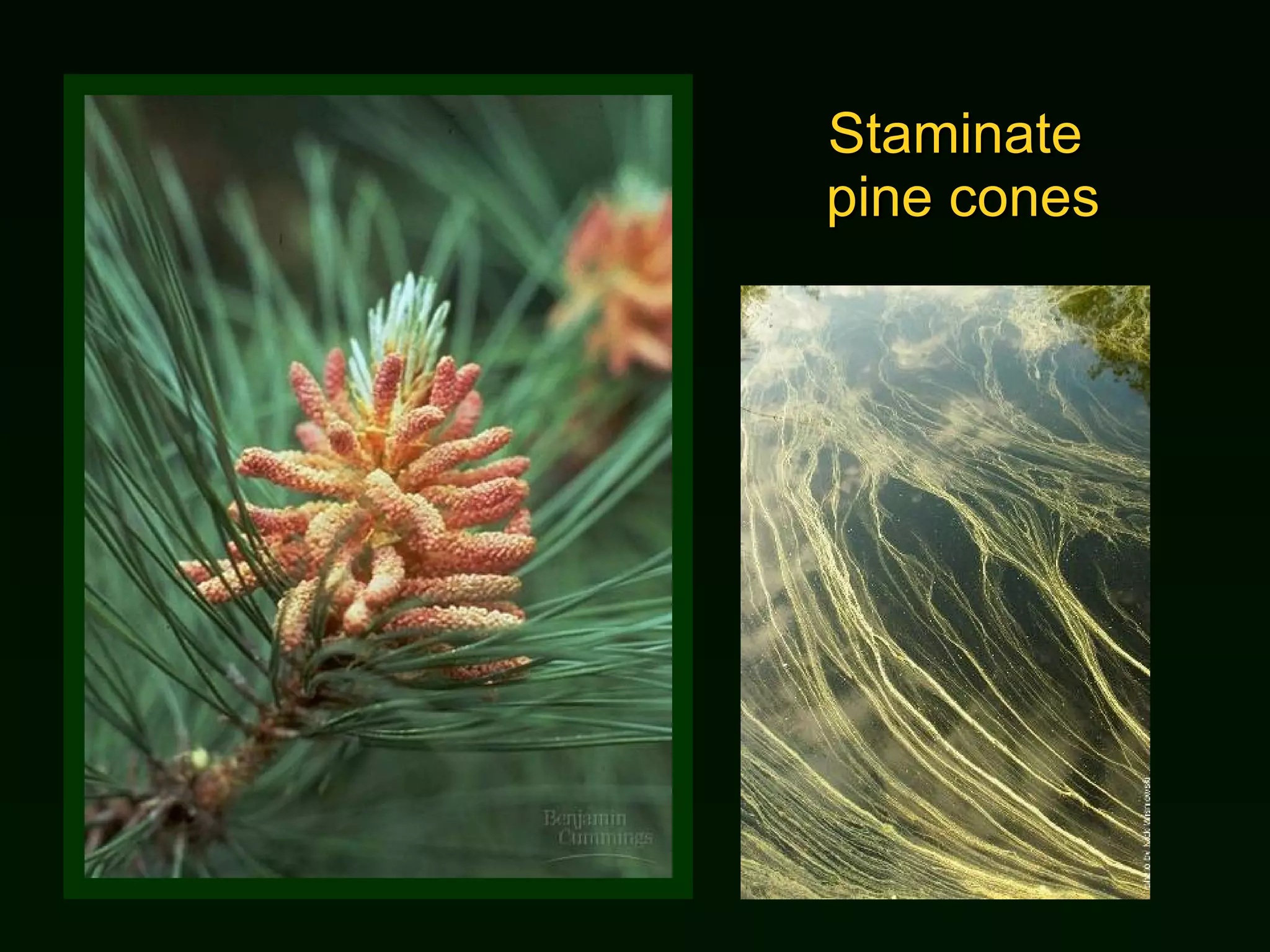
Staminate  pine cones
The life cycle of a pine
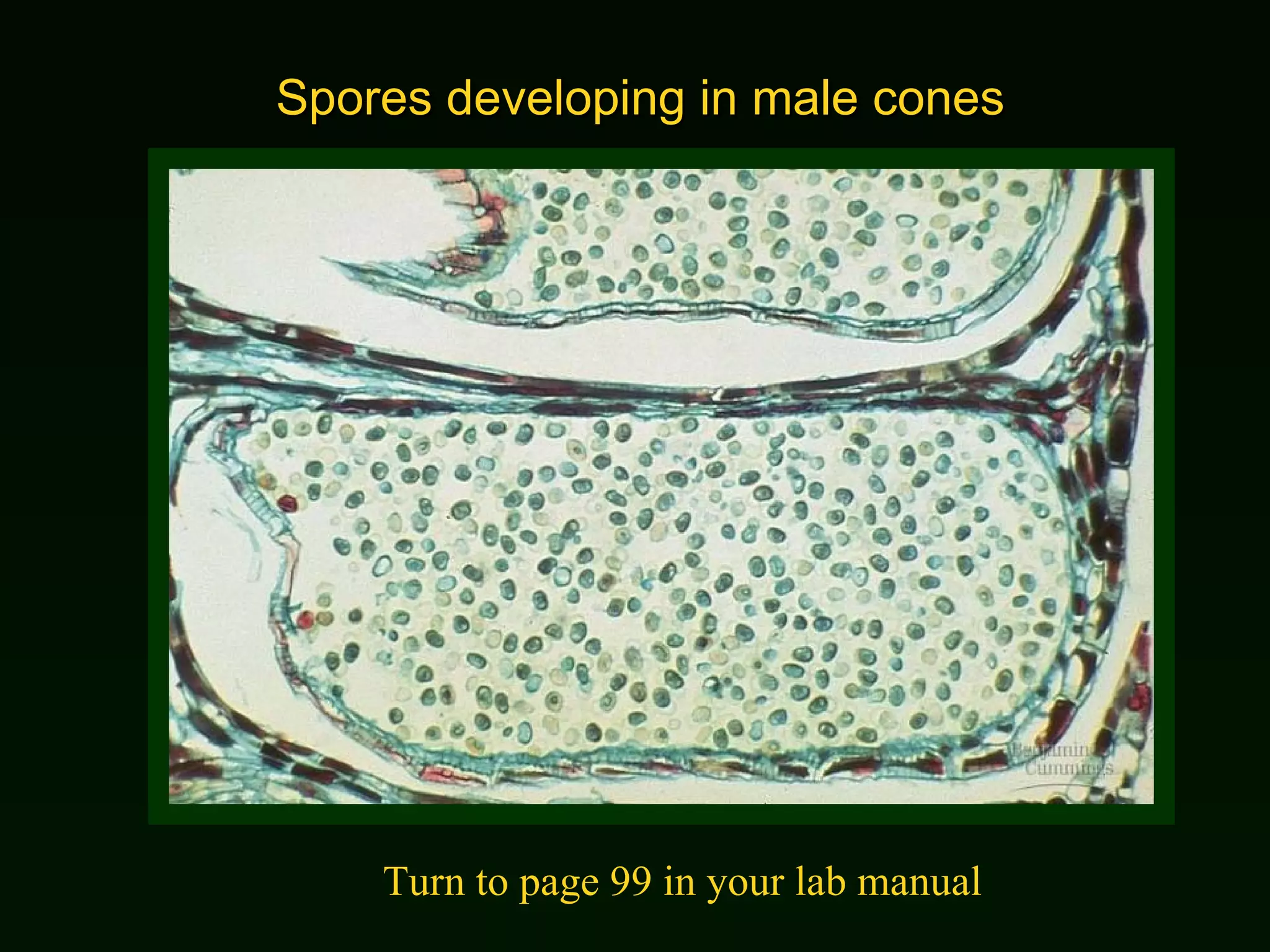
Spores developing in male cones Turn to page 99 in your lab manual
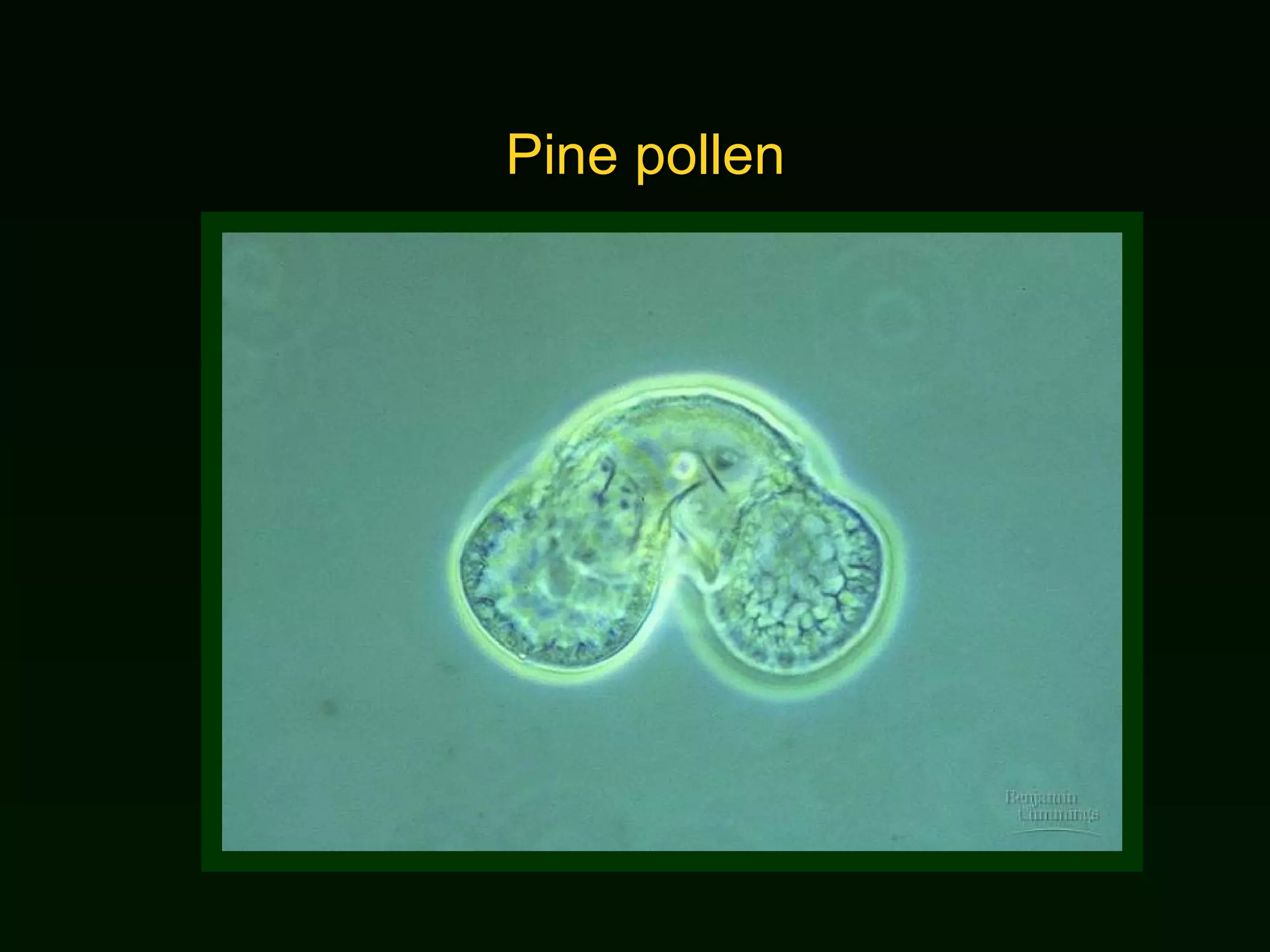
Pine pollen
 
Kingdom  Chlorophyta Non-vascular plants Vascular Plants   (no seeds) Vascular seed Plants Flowering Plants Liverworts Hornworts Mosses Lycophytes Horsetails Ferns Cycads Ginkgo Conifers Gnetum Angiosperms Green Algae
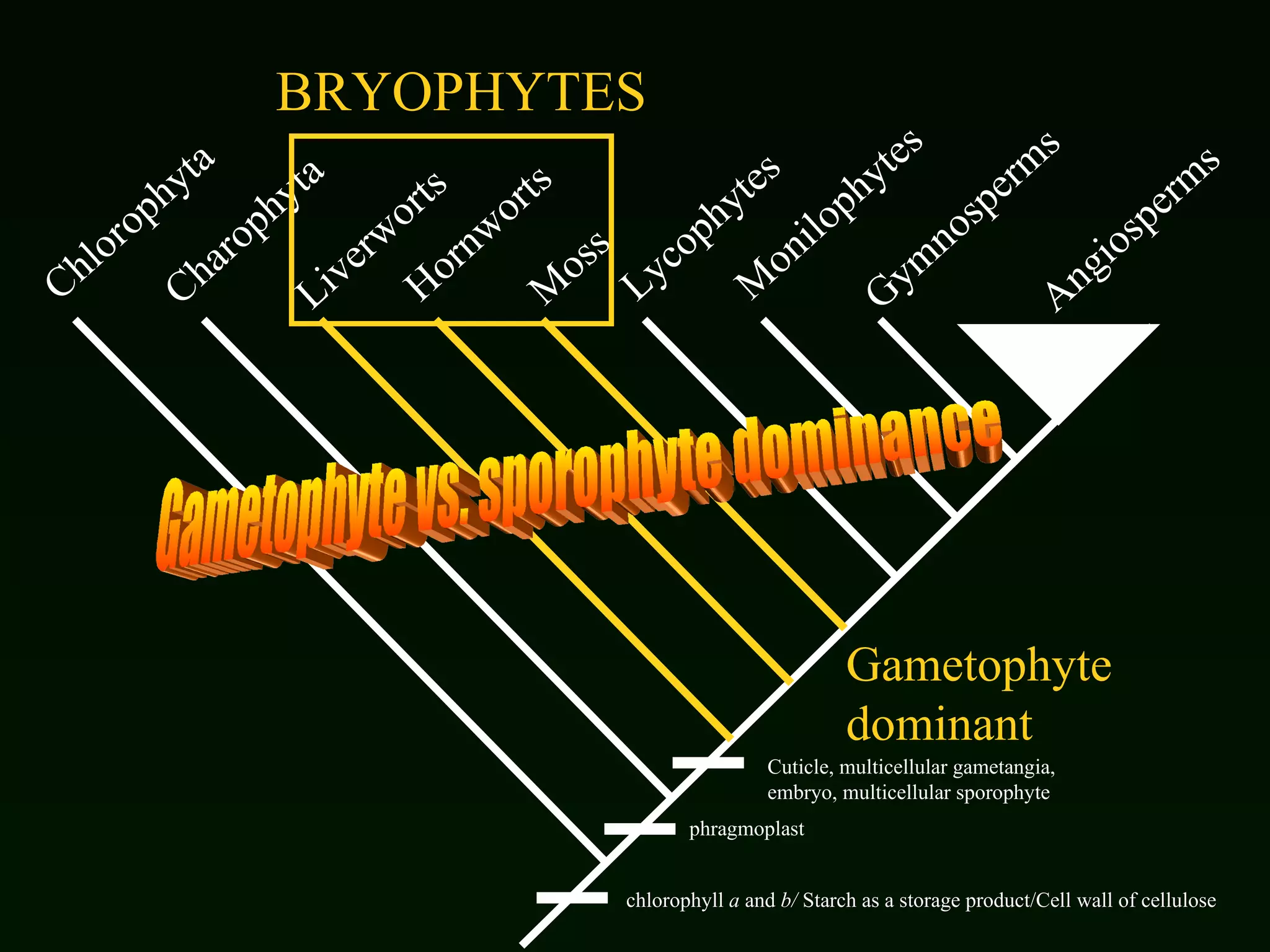
Chlorophyta Charophyta Liverworts Hornworts Moss Lycophytes Monilophytes Gymnosperms Angiosperms chlorophyll  a  and  b/  Starch as a storage product/Cell wall of cellulose phragmoplast Cuticle, multicellular gametangia, embryo, multicellular sporophyte BRYOPHYTES Gametophyte dominant Gametophyte vs. sporophyte dominance
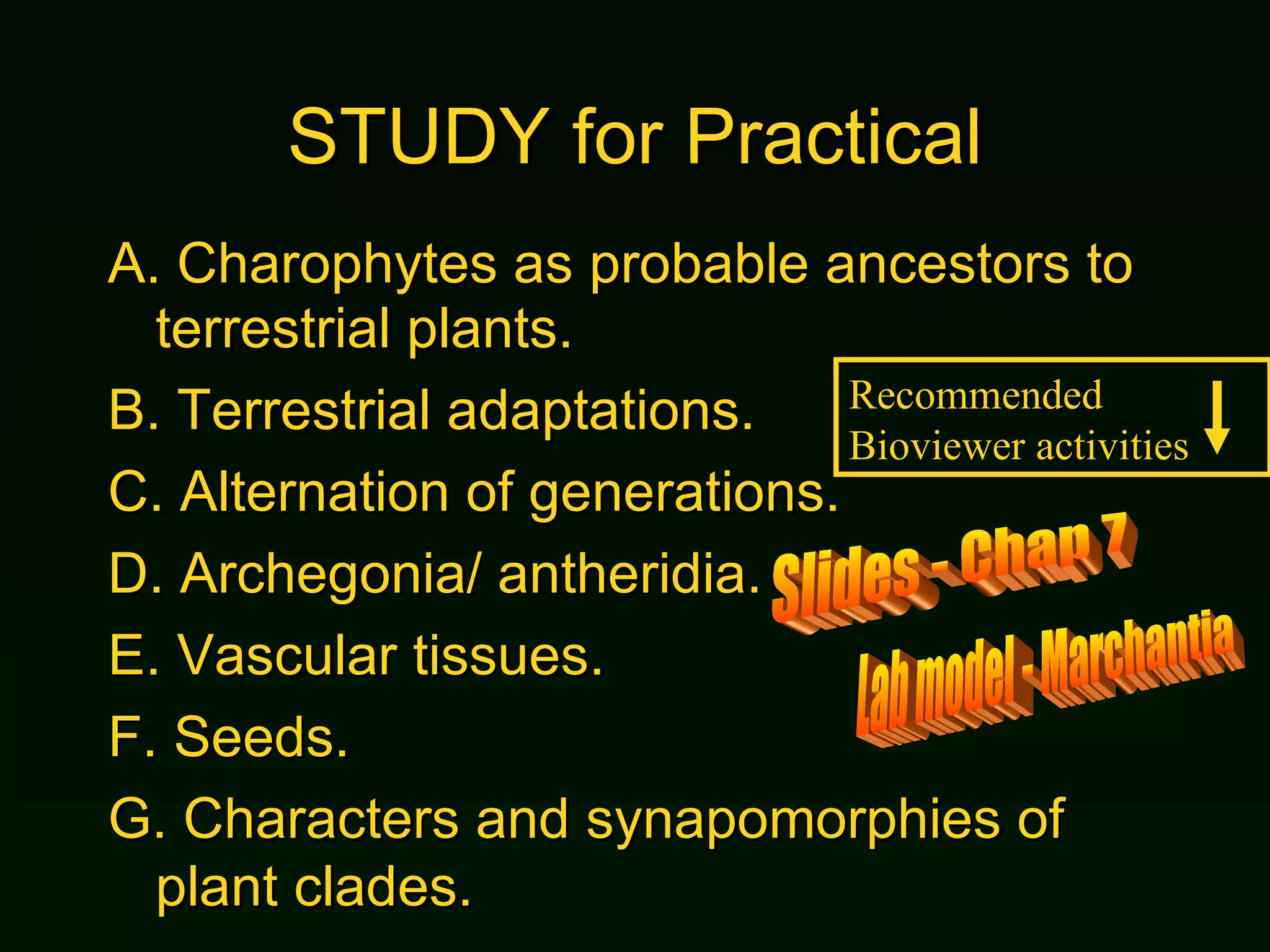
STUDY for Practical A.  Charophytes as probable ancestors to terrestrial plants. B.  Terrestrial adaptations. C.  Alternation of generations. D.  Archegonia/ antheridia. E.  Vascular tissues. F.  Seeds.  G. Characters and synapomorphies of plant clades. Slides - Chap 7 Lab model - Marchantia Recommended Bioviewer activities
Cladistic Analysis exercise Data sheet   (Relationships of Plant Taxa), pp. 103-104. You must complete the taxon-character matrix.  Complete everything except that for Magnolia and Gladiola this week. Due at the end of class today

Lab 5 Origin Of Plants

  • 1.
    Origin of Plants1.) Quiz 1 2.) Abstract & graphs Due now 3.) Lecture on Plant diversity (have diversity terms handout ready) 4.) Cladistics exercise -- turn in worksheet 5.) Lab practical next week – study plant diversity slides on bioviewer & names of phyla, orders, etc.
  • 2.
    Principal Biological ConceptsA. Charophytes as probable ancestors to terrestrial plants. B. Terrestrial adaptations. C. Alternation of generations. D. Archegonia/ antheridia. E. Vascular tissues. F. Seeds. G. Characters and synapomorphies of plant clades
  • 3.
  • 4.
    Marine life wasalready diverse (~550 Ma) before the rise of the land plants (~450 Ma) why didn’t plants evolve earlier and colonize the land?
  • 5.
    CO2 today is~380 ppm Why?
  • 6.
    CO2 today is~380 ppm Cyanobacteria -- 2.7 billion 1 st land plants 425 million yrs ago
  • 7.
    Paleozoic = 542to 251 million years ago
  • 8.
  • 9.
    Million years ofevolution: Plant adaptations? Kingdom PLANTAE Land Plants (embryophytes)
  • 10.
    Million years ofevolution: Plant adaptations? Adaptations to land
  • 11.
    Adaptations to terrestrial existence 1. Support - rigid tissues, weight no longer borne by water. 2. Water transport and conservation - need to protect against desiccation. Characteristics... a. vascular tissues - xylem and phloem b. apical meristems stems, roots, leaves - with vascular tissues (except Bryophytes) d. waxy cuticle e. stomata in leaves
  • 12.
    Kingdom ChlorophytaPhotosynthetic life moves onto land – What did this look like? Non-vascular plants Vascular Plants (no seeds) Vascular seed Plants Flowering Plants Liverworts Hornworts Mosses Lycophytes Horsetails Ferns Cycads Ginkgo Conifers Gnetum Angiosperms Green Algae Next week
  • 13.
    One of themost important events in the history of the Earth: The complete plant colonization to the land Occurred between the Ordovivian – Silurian ~450 – 440 Ma Cooksonia – now extinct
  • 14.
  • 15.
    10 m tall!!Early land plants did not have roots – formed symbiotic associations with fungi from 420 mya
  • 16.
  • 17.
    Kingdom ChlorophytaChlorophytes (Ancestors to vascular plants.) 1. Starch as a storage product - deposited within chloroplasts. 2. Have chlorophyll a and b , and carotenoids. 3. Cell wall of cellulose . 4. Similar chloroplast structure - thylakoids stacked as grana.
  • 18.
    Kingdom ChlorophytaNon-vascular plants Vascular Plants (no seeds) Vascular seed Plants Flowering Plants Liverworts Hornworts Mosses Lycophytes Horsetails Ferns Cycads Ginkgo Conifers Gnetum Angiosperms Green Algae
  • 19.
    Phylum CHLOROPHYTA - green algae 1. Mostly freshwater, some marine. 2. About 7,000 species. 3. Wide diversity of forms a. Single celled b. Filamentous c. Sheets, aggregates, colonies d. True multicellularity 4. Sexual and asexual reproduction. 5. Not important commercially. 7. In lab: a. Volvox (no. 19-1) b. Ulva - wet c. Acetabularia - wet Volvox
  • 20.
    Phylum CHAROPHYTA - Charophyceans or stoneworts Distinct from other Chlorophytes and are thought to be most closely related to true plants. Differentiated from other green algae by ultrastructural differences in cell plate formation during cell division. Charophytes form a " phragmoplast " - a perpendicular orientation of the spindle relative to the cell wall. This feature is common to all land plants. 3. In lab: Spirogyra (no. 19-2) and Chara
  • 21.
    Within charophyceans thereis increase in body complexity that is thought to have given risen to early land plants
  • 22.
    Spirogyra - conjugating alga
  • 23.
    Charophyceans: Chara (top) Coleochaete: orbicularis (bottom)
  • 24.
    Kingdom PLANTAE Land Plants (embryophytes) 4 groups 1. Bryophytes - non-vascular plants 2. Pteridophytes - non-seeded vascular plants 3. Gymnosperms - seeded vascular plants 4. Angiosperms - flowering plants
  • 25.
    Kingdom ChlorophytaNon-vascular plants Vascular Plants (no seeds) Vascular seed Plants Flowering Plants Liverworts Hornworts Mosses Lycophytes Horsetails Ferns Cycads Ginkgo Conifers Gnetum Angiosperms Green Algae
  • 26.
    Some definitions: Gametophyte: gametophyte is the multicellular structure, or phase, that is haploid, containing a single set of chromosomes. The gametophyte produces male or female gametes (or both), by a process of cell division called mitosis Sporophyte: the plant in which meiosis occurs and produces spores Monoecious: male and female gametes produced on the same plant Dioecious: male and female gametes produced on separate plants Antheridia: the male sperm-bearing organ Archegonia: the female egg-bearing organ
  • 27.
    Gametangia: Archegonium of Marchantia (left) Antheridium of a hornwort (right)
  • 28.
  • 29.
    Alternation of generations1. Alternation between sporophyte (spore-producing) and gametophyte (gamete-producing), diploid and haploid . 2. Transitions of generations marked by meiosis and syngamy (fertilization) . 3. Evolutionarily important - haploid genes in plant gametophytes are transcribed (unlike those in animals). Gives the possibility of rapid selection.
  • 30.
    Land plants: Apicalmeristems of shoots and roots shoots roots
  • 31.
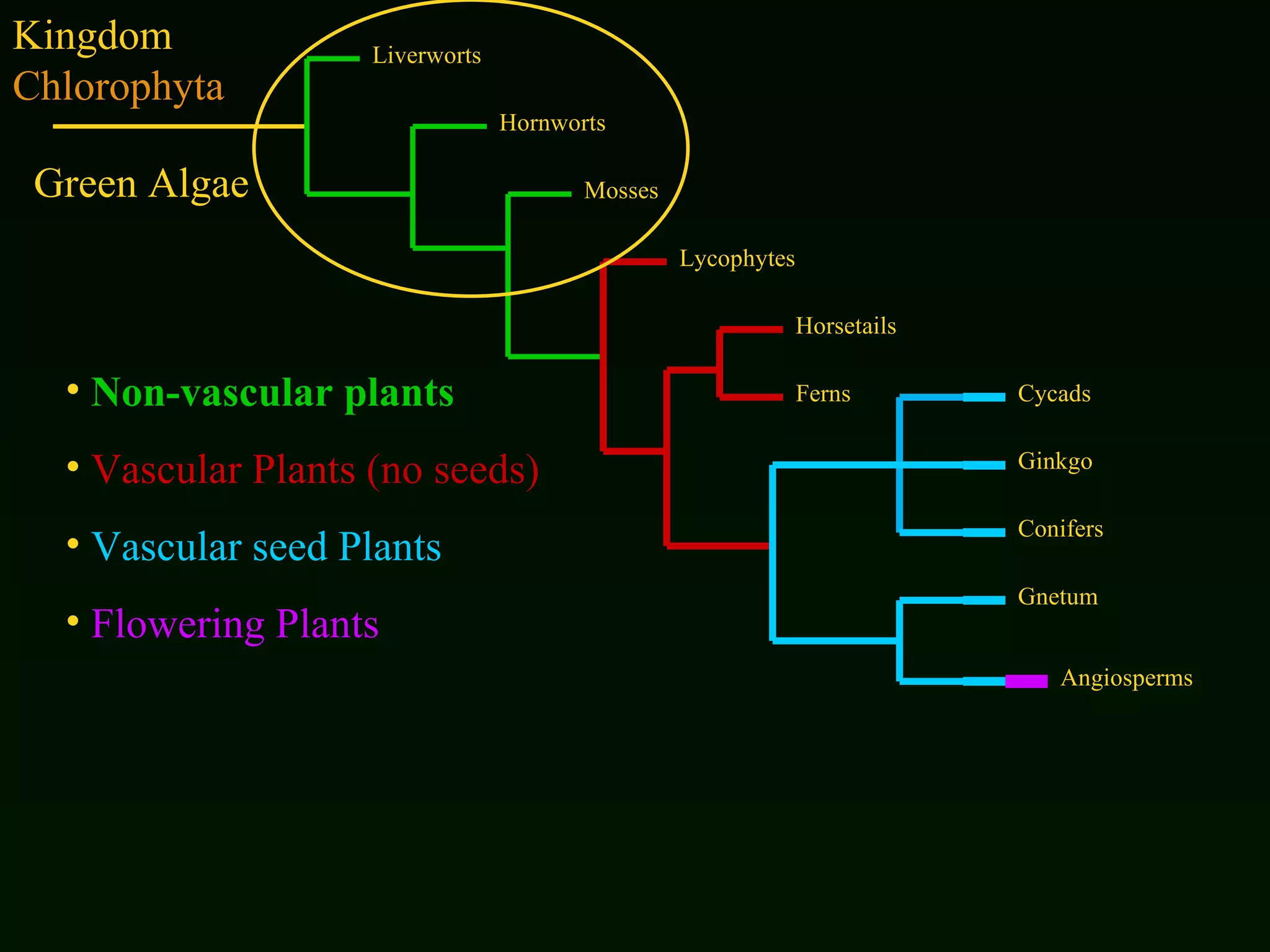
    " BRYOPHYTES "- non-vascular land plants A. Gametophyte dominant – sporophyte reduced B. Often with separate sexes ( dioecious ). C. Antheridia - produce flagellated sperm. D. Archegonia - produce egg and house developing embryo (sporophyte). E. Antheridia and archegonia, or modifications thereof, are found in all early plant groups (through ferns). F. Water required for sperm transfer. Sperm are flagellated (i.e., motile). This is true of all primitive plants. Hornwort Liverwort Moss Moss
  • 32.
    Kingdom ChlorophytaNon-vascular plants Vascular Plants (no seeds) Vascular seed Plants Flowering Plants Liverworts Hornworts Mosses Lycophytes Horsetails Ferns Cycads Ginkgo Conifers Gnetum Angiosperms Green Algae
  • 33.
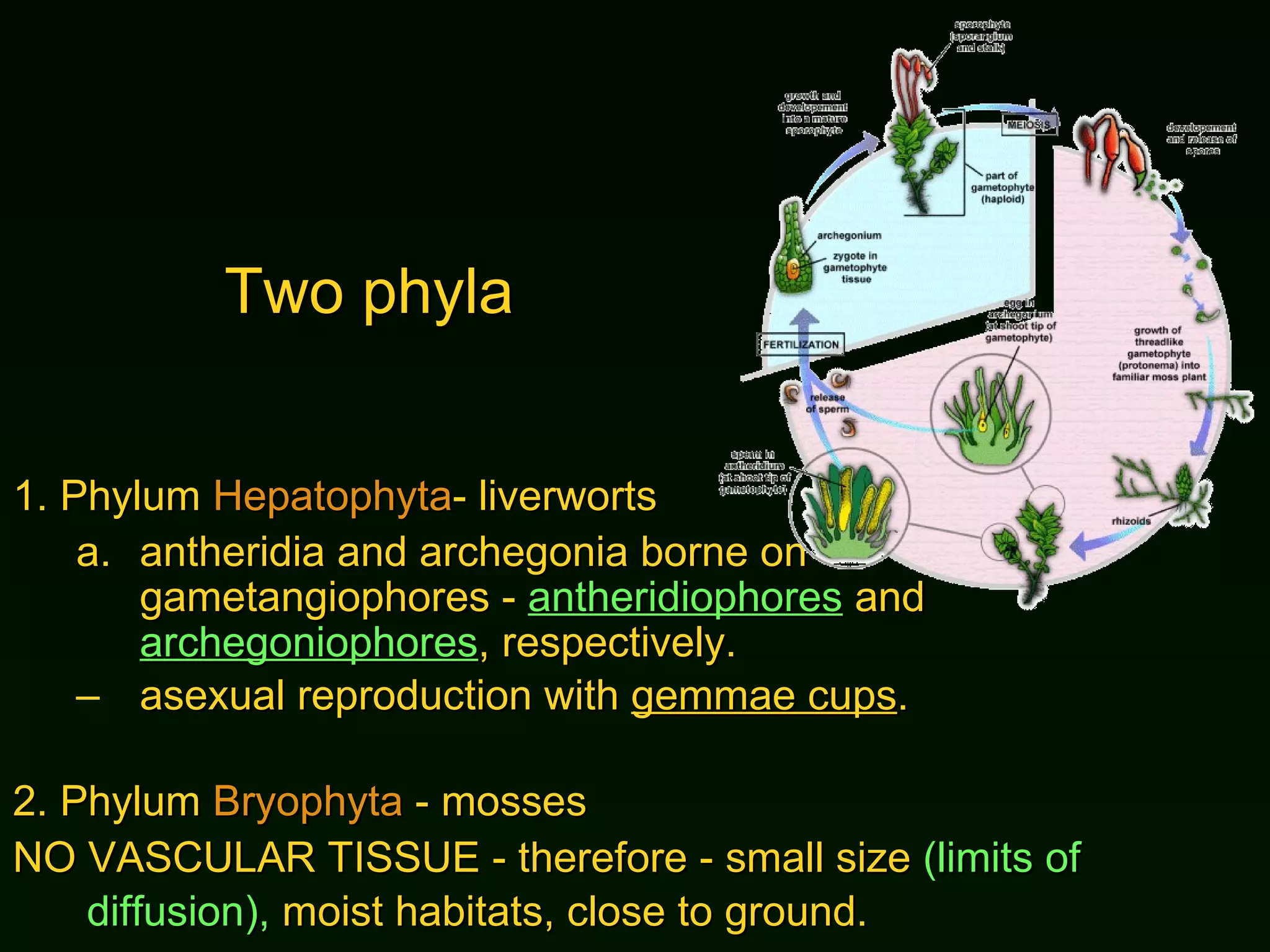
    Two phyla 1.Phylum Hepatophyta - liverworts a. antheridia and archegonia borne on gametangiophores - antheridiophores and archegoniophores , respectively. asexual reproduction with gemmae cups . 2. Phylum Bryophyta - mosses NO VASCULAR TISSUE - therefore - small size (limits of diffusion), moist habitats, close to ground.
  • 34.
    Liverworts Liverworts Marchantia polymorpha Gemmae cups Archegoniophore Antheridiophore Asexual
  • 35.
    The life cycleof Polytrichum, a moss Diploid Haploid
  • 36.
  • 37.
    VASCULAR PLANTS "TRACHEOPHYTES" A. Vascular tissues 1. Xylem a. transport of water and dissolved minerals. b. tracheids and vessel elements - lignified, spiral thickenings of cell wall - dead at maturity. c. also provide support for the plant body. 2. Phloem a. transport of photosynthate (product of photosynthesis). b. sieve-tube cells - elongate, tapered with sieve area in cell plate, living. c. companion cell - controls movement of food through seive tubes. B. Sporophyte dominant - gametophyte becomes increasingly diminutive.
  • 38.
    Kingdom ChlorophytaNon-vascular plants Vascular Plants (no seeds) Vascular seed Plants Flowering Plants Liverworts Hornworts Mosses Lycophytes Horsetails Ferns Cycads Ginkgo Conifers Gnetum Angiosperms Green Algae
  • 39.
    SEEDLESS VASCULAR PLANTSLycophyte (top left), whisk fern (top right), horsetail (bottom left), fern (bottom right)
  • 40.
    Phylum LYCOPHYTA - club mosses and quillworts 1. True stems, roots, and leaves. 2. Leaves are small and scalelike with traces of vascular tissue = microphylls . 3 . Strobilus = cluster of sporophylls (specialized leaves bearing sporangia ), at tips of branches ( Lycopodium ) or along branches ( Selaginella ). 4. Free-living gametophyte.
  • 41.
  • 42.
    Lepidodendron - AncientLycopds (club mosses)
  • 43.
    Phylum PTEROPHYTAferns and fern allies 1. Whisk ferns ( Psilotum ) a. Well developed xylem and phloem in stem. b. No true roots or leaves - secondarily lost . c. Rhizome (underground stem - absorptive) with rhizoids and with myccorhizae. d. Sporangia borne on shoots - unique character. e. Gametophytes are free-living, nonphotosynthetic, saprophytes with associated mycorrhizae.
  • 44.
  • 45.
    Horsetails ( Equisetum) a. Ribbed, jointed (nodes) stems with silica crystals = "scouring rushes." b. Leaves are non-photosynthetic microphylls . c. Underground rhizomes - asexual reproduction. d. True roots. e. Terminal strobili on reproductive shoots. f. Equisetum is only living genus.
  • 46.
  • 47.
    This is howa forest of Calamites and Asteroxylon may have appeared just about anywhere on the Earth 390 million years ago. The Calamites are the slender "Christmas tree" shaped plants. They grew as tall as many of today's conifers, though they are the ancestors of the much smaller modern horsetails. The  snake-like curlicue plants in the foreground are the now-extinct Asteroxylon, which emerged at the beginning of the Devonian period about 417 million years ago http://www.arcadiastreet.com/cgvistas/earth/earth_02_paleozoic_111.htm
  • 48.
    Ferns a.Sporophyte dominant but dependent on gametophyte at first. b. Independent (free-living, photosynthetic) gametophyte ( prothallus or prothallium ) - without vascular tissues. Has antheridia and archegonia. c. True roots and stems (underground rhizomes) and leaves (megaphylls called fronds ). d. Sporangia clustered in sori , often protected by indusium . e. In lab: i. Cyrtomium (no. 5) ii. fern prothalium (no. 6) iii. fern sporophyte (no. 7) iv. live fern
  • 49.
    The life cycleof a fern Haploid Diploid Homosporous (mostly)
  • 50.
    Fern sporophyll, aleaf specialized for spore production Indusium
  • 51.
    Life cycle ofa fern: mature sporangium
  • 52.
  • 53.
  • 54.
    Fern sporophytes growingout of fertilized gametophytes
  • 55.
    Mature fern sporophyte– produces spores
  • 56.
  • 57.
  • 58.
    SEED PLANTS " SPERMATOPHYTES " A. Seed = plant embryo protected by integument (“seed coat”). B. "GYMNOSPERMS" - "naked seeds"- seeds without protection of ovary. C. Sporophyte dominant - gametophyte reduced to very small size. 1. Megagametophyte - multicellular archegonium. 2 . Microgametophyte - pollen grains - 3 or 4 cells. No antheridia. 3. “Mega” and “micro” are used in higher plants to denote the larger female structures and the smaller male ones.
  • 59.
    Kingdom ChlorophytaNon-vascular plants Vascular Plants (no seeds) Vascular seed Plants Flowering Plants Liverworts Hornworts Mosses Lycophytes Horsetails Ferns Cycads Ginkgo Conifers Gnetum Angiosperms Green Algae
  • 60.
  • 61.
    From ovule to seed
  • 62.
    Phylum GINKGOPHYTA ginkgo A. Only one species living ( Ginkgo biloba ). Common ornamental - tolerant of pollution. B. Branches made up of long shoots and short shoots (= spur shoots). Leaves and fruits on spur shoots. C. Fan-shaped leaves. D. Dioecious . Female ovules fleshy - foul smelling. E. Flagellated sperm in pollen tube.
  • 63.
    Phylum Ginkgophyta: Ginkgo biloba Heterosporous
  • 64.
    Phylum Ginkgophyta: Ginkgo biloba 1945 http://www.xs4all.nl/~kwanten/hiroshima.htm
  • 65.
    Ginkgo has freeswimming sperm! Ginkgo and the cycads are the only living seed-producing plants (spermatophytes) that have motile or free swimming sperm – discovered in 1896 in a botanical garden in Tokyo
  • 66.
    Chlorophyta Charophyta LiverwortsHornworts Moss Lycophyta Pterophyta Ginkgophyta Cycadophyta Coniferophyta biflagellate sperm multiflagellate sperm pollen Flagellae
  • 67.
    Phylum CYCADOPHYTA - cycads A. Tropical and subtropical. B. Palm-like with large, pinnate leaves. C. Terminal cones - plants are dioecious . Strobili and seeds may take 10 years to mature. D. Sperm are multiflagellated, wind-blown to female cone or some carried by beetle pollinators. Enters fluids secreted around micropyle. Pollen tube carries sperm nuclei to egg. E. In lab: 1. live Cycas 2. live Zamia - only cycad native to United States.
  • 68.
  • 69.
    Cycads haven’t changed too much since the Paleozoic (origin) This Antarcticycas grew in Antarctica during the Triassic Period ~250 Ma
  • 70.
    Phylum CONIFEROPHYTA500-600 species "evergreens” pines, firs, larches, spruce, etc. Tallest = redwood 372 feet Oldest = bristlecone pine >4,900 years Most massive = Sequoia 102.6 feet circumference at base.
  • 71.
    The oldest coniferfossil so far discovered is Swillingtonia denticulata , which dates from the Carboniferous of c.310 Ma. 
  • 72.
  • 73.
    Sequoia Sempervirens( Cupressaceae ) Tallest redwoods over 300 feet
  • 74.
  • 75.
    A. MonoeciousB. Strobili = cones - borne on spur shoots 1. Staminate cones - male - microsporangia on microsporophylls . 2. Ovulate cones - female - ovules on ovulate scales with woody bract. a. Ovule = female gametophyte (haploid) surrounded by nucellus and integument (both diploid). Mature ovule = seed. C. Wind-blown pollen enters the ovulate cones when they are very small. Pollen tubes (immotile sperm) grow very slowly. So - fertilization may not occur for many months, even years, until the seed cones and the megagametophytes have matured. 1. Two sperm nuclei in pollen tube but only one is functional; the other degenerates. D. Reproduction does not depend on water . E. Well over 1 year passes between pollination and fertilization. Seeds usually not mature until 2nd summer. F. Fire very important to many of these species. "Fire Ecology"
  • 76.
    Pine femalestrobili
  • 77.
  • 78.
    The life cycleof a pine
  • 79.
    Spores developing inmale cones Turn to page 99 in your lab manual
  • 80.
  • 81.
  • 82.
    Kingdom ChlorophytaNon-vascular plants Vascular Plants (no seeds) Vascular seed Plants Flowering Plants Liverworts Hornworts Mosses Lycophytes Horsetails Ferns Cycads Ginkgo Conifers Gnetum Angiosperms Green Algae
  • 83.
    Chlorophyta Charophyta LiverwortsHornworts Moss Lycophytes Monilophytes Gymnosperms Angiosperms chlorophyll a and b/ Starch as a storage product/Cell wall of cellulose phragmoplast Cuticle, multicellular gametangia, embryo, multicellular sporophyte BRYOPHYTES Gametophyte dominant Gametophyte vs. sporophyte dominance
  • 84.
    STUDY for PracticalA. Charophytes as probable ancestors to terrestrial plants. B. Terrestrial adaptations. C. Alternation of generations. D. Archegonia/ antheridia. E. Vascular tissues. F. Seeds. G. Characters and synapomorphies of plant clades. Slides - Chap 7 Lab model - Marchantia Recommended Bioviewer activities
  • 85.
    Cladistic Analysis exerciseData sheet (Relationships of Plant Taxa), pp. 103-104. You must complete the taxon-character matrix. Complete everything except that for Magnolia and Gladiola this week. Due at the end of class today

Editor's Notes

  • #3 Begin with these terms see what we know about them after lecture
  • #18 Characteristics that lead to a land adaptation Remember traits that distinguish the outgroup from the rest of the clade.
  • #20 The Charophyta are a lineage of green algae that live in freshwater habitats. A subgroup of the Charophyta called the Charales represents the closest living relative to the land plants.
  • #21 Outgroup - common ancestral trait - common to all of those in the clade. After this we should look for shared derived characteristics that define the clade.
  • #23 Asexual reproduction - exchange chromosomes - advantages? Disadvantages?
  • #28 Know for practical. What are these? Male or female?
  • #31 Leaves?
  • #34 Make sure to note antheridiospores and archegoniospores
  • #35 An asexual budlike propagule as in liverworts, capable of developing into a new individual; a bud. Small cups formed on the surface of a Liverwort's thallus in which the gemmae are formed
  • #41 Anytime you see “phyll” it means leaf
  • #42 Terminal stroboli
  • #44 What does secondarily lost mean?
  • #46 Pioneer brush - they used ot use them to wash pans etc. because they have silica in the stems and pioneers often had no water to use to wash. Long ago there used to be many species of horsetail they are extinct why?
  • #47 They used to grow as big as trees - 30 feet high
  • #49 Megaphylls = big leaves!
  • #51 An enclosing membrane, as that covering the sorus of a fern
  • #53 Archegonium and antheridium mature at different rates why?
  • #61 Age of earth etc.
  • #63 Monoytypic phylum How can we have a flagellated sperm and have a wind blown pollination? What pollinates this plant?
  • #64 Next two slides illustrate this - fruit and a sperm
  • #76 Why are pine trees all the same height? Even growth forests
  • #80 Point out structures - you name
  • #86 This information - think of it like a scavenger hunt!