How Do Ecosystems Work?
Energy and Nutrient Pathways Energy moves in a one-way flow through communities within ecosystems The energy to drive life’s activities comes from the sun  It is used and transformed in the chemical reactions that power life It is ultimately converted to heat that radiates back into space
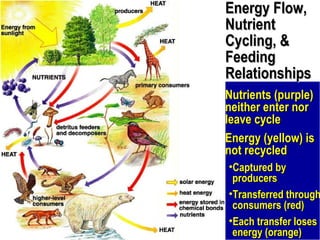
Energy Flow, Nutrient Cycling, & Feeding Relationships Nutrients  (purple) neither enter nor leave cycle Energy (yellow) is not recycled Captured by producers Transferred through consumers (red) Each transfer loses energy (orange)
Energy Entry Via Photosynthesis   Electromagnetic waves carry energy from the sun to the Earth  Most solar energy reaching Earth is reflected or absorbed  Only about 1% of total energy is available for photosynthesis Photosynthetic organisms capture only about 3% of this amount
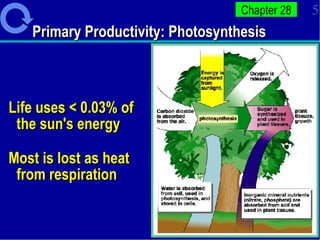
Primary Productivity: Photosynthesis Life uses < 0.03% of the sun's energy Most is lost as heat from respiration
Energy Entry via Photosynthesis Net primary productivity  is energy that photosynthetic organisms store and make available to the community over time Determines how much life an ecosystem can support  Can be measured as the amount of energy ( calories ) or  biomass  (dry weight of organic material) stored or added to the ecosystem per unit area over time
Energy Entry via Photosynthesis   Productivity of an ecosystem is influenced by The availability of nutrients and sunlight to producers The availability of water Temperature
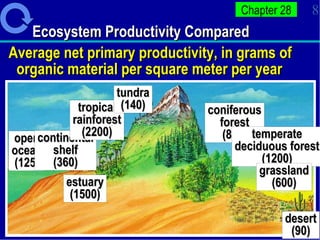
Ecosystem Productivity Compared Average net primary productivity, in grams of organic material per square meter per year open ocean (125) continental shelf (360) estuary (1500) tropical rainforest (2200) tundra (140) coniferous forest (800) temperate deciduous forest (1200) grassland (600) desert (90)
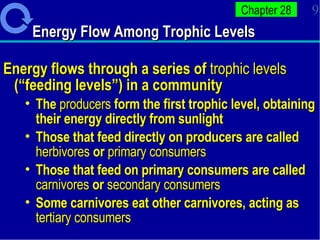
Energy Flow Among Trophic Levels  Energy flows through a series of  trophic levels  (“feeding levels”) in a community  The  producers  form the first trophic level, obtaining their energy directly from sunlight  Those that feed directly on producers are called  herbivores  or  primary   consumers Those that feed on primary consumers are called  carnivores  or  secondary consumers Some carnivores eat other carnivores, acting as  tertiary consumers
Energy Flow Among Trophic Levels Some animals are  omnivores , acting as primary, secondary, and occasionally tertiary consumers at different times Example: humans
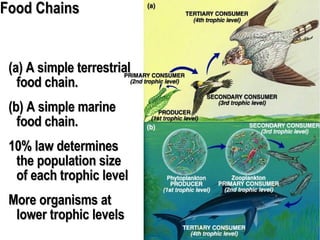
Food Chains  A  food chain  is a linear feeding relationship with just one representative at each trophic level  Different ecosystems have radically different food chains Natural communities rarely contain well-defined groups of primary, secondary, and tertiary consumers
Food Chains (a) A simple terrestrial food chain. (b) A simple marine food chain. 10% law determines the population size of each trophic level More organisms at lower trophic levels
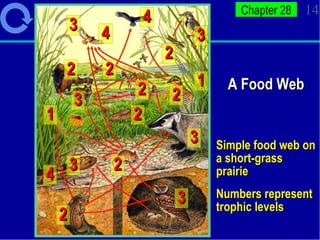
Food Webs  A  food web  shows the actual feeding relationships in a community, including its many interconnecting food chains
A Food Web Simple food web on a short-grass prairie Numbers represent trophic levels 1 1 2 2 2 2 2 2 2 2 3 3 3 3 3 3 4 4 4
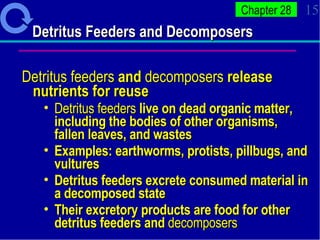
Detritus Feeders and Decomposers Detritus feeders  and  decomposers  release nutrients for reuse Detritus feeders  live on dead organic matter, including the bodies of other organisms, fallen leaves, and wastes Examples: earthworms, protists, pillbugs, and vultures Detritus feeders excrete consumed material in a decomposed state  Their excretory products are food for other detritus feeders and  decomposers
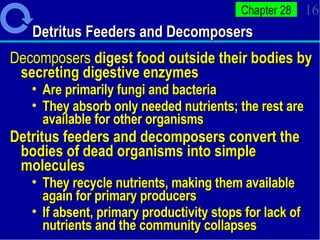
Detritus Feeders and Decomposers Decomposers  digest food outside their bodies by secreting digestive enzymes Are primarily fungi and bacteria  They absorb only needed nutrients; the rest are available for other organisms  Detritus feeders and decomposers convert the bodies of dead organisms into simple molecules  They recycle nutrients, making them available again for primary producers If absent, primary productivity stops for lack of nutrients and the community collapses
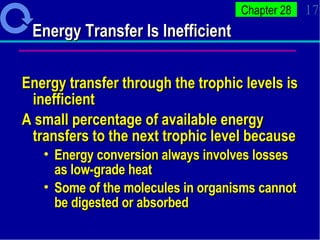
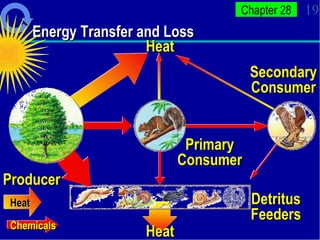
Energy Transfer Is Inefficient Energy transfer through the trophic levels is inefficient A small percentage of available energy transfers to the next trophic level because Energy conversion always involves losses as low-grade heat Some of the molecules in organisms cannot be digested or absorbed
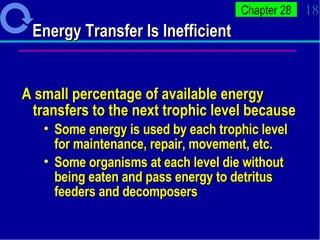
Energy Transfer Is Inefficient A small percentage of available energy transfers to the next trophic level because Some energy is used by each trophic level for maintenance, repair, movement, etc.  Some organisms at each level die without being eaten and pass energy to detritus feeders and decomposers
Energy Transfer and Loss Heat Heat Producer Primary Consumer Secondary Consumer Detritus Feeders Heat Chemicals
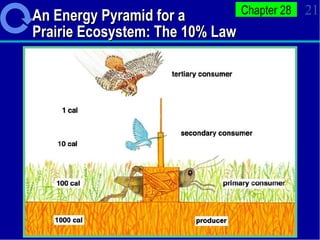
Energy Pyramids  Energy pyramids  illustrate energy transfer between trophic levels The net energy transfer between trophic levels is roughly 10% efficient  An  energy pyramid  represents this, with primary producers on the bottom and higher trophic levels stacked on top
An Energy Pyramid for a Prairie Ecosystem: The 10% Law
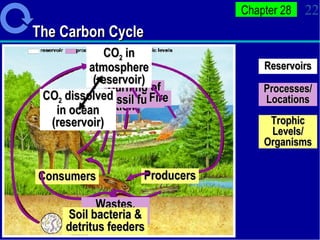
The Carbon Cycle Reservoirs Processes/ Locations Trophic Levels/ Organisms CO 2  in atmosphere (reservoir) Producers Consumers Wastes, Dead bodies Soil bacteria & detritus feeders CO 2  in atmosphere (reservoir) Consumers Wastes, Dead bodies Soil bacteria & detritus feeders CO 2  in atmosphere (reservoir) Wastes, Dead bodies Soil bacteria & detritus feeders CO 2  in atmosphere (reservoir) Respitation CO 2  in atmosphere (reservoir) Burning of fossil fuels CO 2  in atmosphere (reservoir) Fire CO 2  in atmosphere (reservoir) CO 2  dissolved in ocean (reservoir) CO 2  in atmosphere (reservoir)
Energy Pyramids  Sometimes biomass is used as a measure of the energy stored at each trophic level A similar  biomass pyramid  can be constructed  This pattern of energy transfer has some important ramifications Plants dominate most communities because they have the most energy available to them, followed by herbivores and carnivores  We can feed more people directly on grain than on meat from animals fed on grain
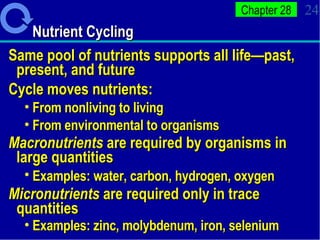
Nutrient Cycling Same pool of nutrients supports all life—past, present, and future Cycle moves nutrients: From nonliving to living From environmental to organisms Macronutrients  are required by organisms in large quantities Examples: water, carbon, hydrogen, oxygen   Micronutrients  are required only in trace quantities  Examples: zinc, molybdenum, iron, selenium
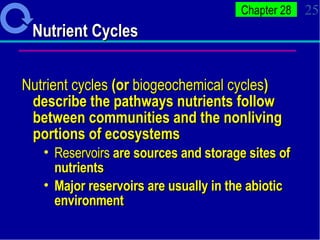
Nutrient Cycles Nutrient cycles  (or  biogeochemical cycles ) describe the pathways nutrients follow between communities and the nonliving portions of ecosystems  Reservoirs  are sources and storage sites of nutrients  Major reservoirs are usually in the abiotic environment
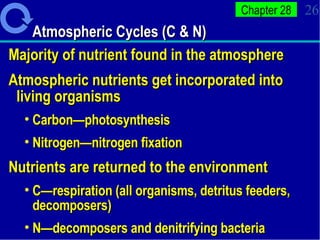
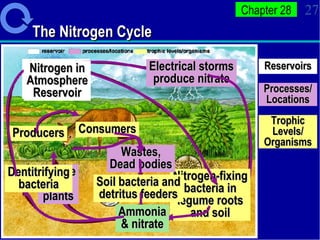
Atmospheric Cycles (C & N) Majority of nutrient found in the atmosphere Atmospheric nutrients get incorporated into living organisms Carbon—photosynthesis Nitrogen—nitrogen fixation Nutrients are returned to the environment C—respiration (all organisms, detritus feeders, decomposers) N—decomposers and denitrifying bacteria
The Nitrogen Cycle Nitrogen in Atmosphere Reservoir Nitrogen in Atmosphere Reservoir Electrical storms produce nitrate Ammonia & nitrate Nitrogen-fixing bacteria in legume roots and soil Ammonia & nitrate Uptake by plants Producers Consumers Wastes, Dead bodies Soil bacteria and detritus feeders Ammonia & nitrate Dentitrifying bacteria Nitrogen in Atmosphere Reservoir Reservoirs Processes/ Locations Trophic Levels/ Organisms
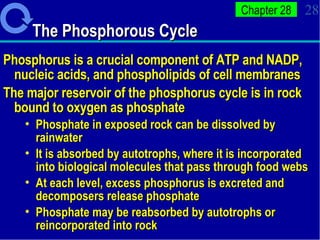
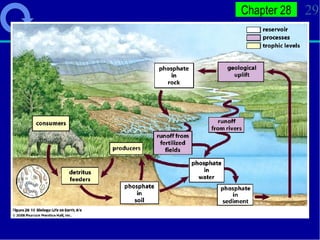
The Phosphorous Cycle Phosphorus is a crucial component of ATP and NADP, nucleic acids, and phospholipids of cell membranes  The major reservoir of the phosphorus cycle is in rock bound to oxygen as phosphate Phosphate in exposed rock can be dissolved by rainwater It is absorbed by autotrophs, where it is incorporated into biological molecules that pass through food webs At each level, excess phosphorus is excreted and decomposers release phosphate Phosphate may be reabsorbed by autotrophs or reincorporated into rock
 
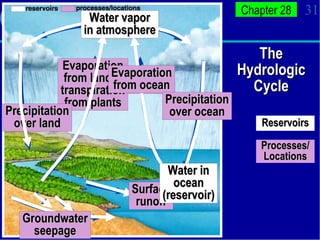
The Hydrologic Cycle Water molecules remain chemically unchanged during the  hydrologic cycle The major reservoir of water is the ocean Contains more than 97% of Earth’s water Solar energy evaporates water, and it comes back to Earth as precipitation
The Hydrologic Cycle Evaporation from land & transpiration from plants Precipitation over land Water vapor in atmosphere Water in ocean (reservoir) Evaporation from ocean Water vapor in atmosphere Water in ocean (reservoir) Groundwater seepage Surface runoff Water in ocean (reservoir) Precipitation over ocean Reservoirs Processes/ Locations
The Hydrologic Cycle With human population growth, fresh water has become scarce Water scarcity limits crop growth  Pumping water from underground aquifers is rapidly depleting many of them  Contaminated drinking water is consumed by over 1 billion people in developing countries each year, killing millions of children
What Causes Acid Rain? Beginning in the Industrial Revolution, we have relied heavily on fossil fuels for heat, light, transportation, industry, and agriculture Reliance on fossils fuels leads to two environmental problems Acid rain Global warming
What Causes Acid Rain? Acid rain ( acid deposition ) is due to excess industrial production of sulfur dioxide and nitrogen oxides that our natural ecosystems can’t absorb and recycle Sulfur dioxide  Released primarily from coal and oil power plants Forms sulfuric acid when it combines with water vapor Nitrogen oxides  Released from vehicles, power plants, and industry Combines with water vapor to form nitric acid
Acid Rain Days later, and often hundreds of miles from the source, the acids fall Eat away at statues and buildings Damage trees and crops Alter lake communities Acid rain examples Adirondack Mountains—dead lakes Mount Mitchell, N.C.—fog pH = 2.9 Black Triangle in Europe Soil pH = 2.2 Thermal inversions Infant mortality
Interfering with the Carbon Cycle Between 345–280 million years ago, the bodies of many plants and animals were buried, escaping decomposition Over time, these carbon sources were converted to fossil fuels by heat and pressure  Fossil fuels remained untouched until the beginning of the Industrial Revolution Burning the fuels released it as CO 2  into the air
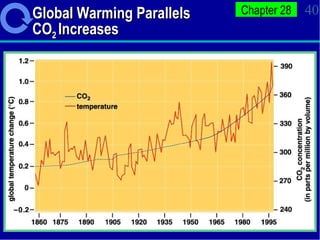
Interfering with the Carbon Cycle Human activities release almost 7 billion tons of carbon (in the form of CO2,) into the atmosphere each year About half of this carbon is absorbed into the oceans, plants and soil The other half remains in the atmosphere, fueling  global warming
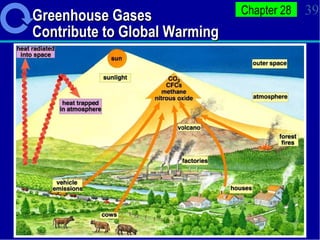
Greenhouse Effect Gases which interfere with cooling of Earth CO 2 Use of fossil fuels Global deforestation by slash & burn CFCs (A/C & refrigeration gases) Methane NO Global warming What might be the consequences of global warming?
Greenhouse Gases Contribute to Global Warming
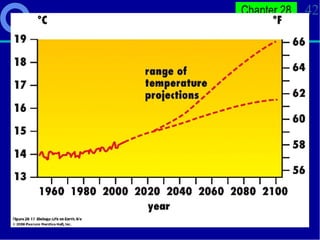
Global Warming Parallels CO 2  Increases
Severe Consequences   A meltdown is occurring Glaciers and ice sheets have been melting at unprecedented rates Rising sea levels will flood many coastal cities and wetlands and may increase hurricane intensity More extreme weather patterns are predicted Warming will alter air and water currents, changing precipitation patterns More severe droughts and greater extremes in rainfall may lead to more frequent crop failures and flooding
 
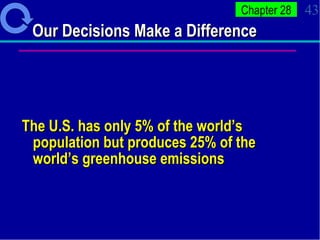
Our Decisions Make a Difference  The U.S. has only 5% of the world’s population but produces 25% of the world’s greenhouse emissions
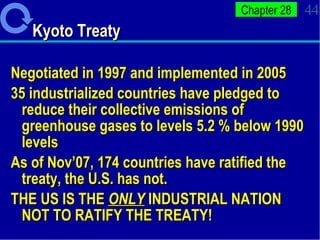
Kyoto Treaty Negotiated in 1997 and implemented in 2005 35 industrialized countries have pledged to reduce their collective emissions of greenhouse gases to levels 5.2 % below 1990 levels As of Nov’07, 174 countries have ratified the treaty, the U.S. has not.  THE US IS THE  ONLY  INDUSTRIAL NATION NOT TO RATIFY THE TREATY!
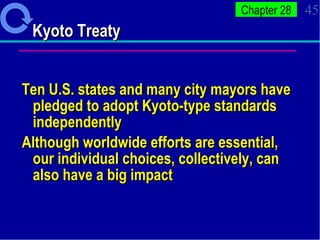
Kyoto Treaty Ten U.S. states and many city mayors have pledged to adopt Kyoto-type standards independently Although worldwide efforts are essential, our individual choices, collectively, can also have a big impact
The End

How Ecosystems Work APBio

  • 1.
  • 2.
    Energy and NutrientPathways Energy moves in a one-way flow through communities within ecosystems The energy to drive life’s activities comes from the sun It is used and transformed in the chemical reactions that power life It is ultimately converted to heat that radiates back into space
  • 3.
    Energy Flow, NutrientCycling, & Feeding Relationships Nutrients (purple) neither enter nor leave cycle Energy (yellow) is not recycled Captured by producers Transferred through consumers (red) Each transfer loses energy (orange)
  • 4.
    Energy Entry ViaPhotosynthesis Electromagnetic waves carry energy from the sun to the Earth Most solar energy reaching Earth is reflected or absorbed Only about 1% of total energy is available for photosynthesis Photosynthetic organisms capture only about 3% of this amount
  • 5.
    Primary Productivity: PhotosynthesisLife uses < 0.03% of the sun's energy Most is lost as heat from respiration
  • 6.
    Energy Entry viaPhotosynthesis Net primary productivity is energy that photosynthetic organisms store and make available to the community over time Determines how much life an ecosystem can support Can be measured as the amount of energy ( calories ) or biomass (dry weight of organic material) stored or added to the ecosystem per unit area over time
  • 7.
    Energy Entry viaPhotosynthesis Productivity of an ecosystem is influenced by The availability of nutrients and sunlight to producers The availability of water Temperature
  • 8.
    Ecosystem Productivity ComparedAverage net primary productivity, in grams of organic material per square meter per year open ocean (125) continental shelf (360) estuary (1500) tropical rainforest (2200) tundra (140) coniferous forest (800) temperate deciduous forest (1200) grassland (600) desert (90)
  • 9.
    Energy Flow AmongTrophic Levels Energy flows through a series of trophic levels (“feeding levels”) in a community The producers form the first trophic level, obtaining their energy directly from sunlight Those that feed directly on producers are called herbivores or primary consumers Those that feed on primary consumers are called carnivores or secondary consumers Some carnivores eat other carnivores, acting as tertiary consumers
  • 10.
    Energy Flow AmongTrophic Levels Some animals are omnivores , acting as primary, secondary, and occasionally tertiary consumers at different times Example: humans
  • 11.
    Food Chains A food chain is a linear feeding relationship with just one representative at each trophic level Different ecosystems have radically different food chains Natural communities rarely contain well-defined groups of primary, secondary, and tertiary consumers
  • 12.
    Food Chains (a)A simple terrestrial food chain. (b) A simple marine food chain. 10% law determines the population size of each trophic level More organisms at lower trophic levels
  • 13.
    Food Webs A food web shows the actual feeding relationships in a community, including its many interconnecting food chains
  • 14.
    A Food WebSimple food web on a short-grass prairie Numbers represent trophic levels 1 1 2 2 2 2 2 2 2 2 3 3 3 3 3 3 4 4 4
  • 15.
    Detritus Feeders andDecomposers Detritus feeders and decomposers release nutrients for reuse Detritus feeders live on dead organic matter, including the bodies of other organisms, fallen leaves, and wastes Examples: earthworms, protists, pillbugs, and vultures Detritus feeders excrete consumed material in a decomposed state Their excretory products are food for other detritus feeders and decomposers
  • 16.
    Detritus Feeders andDecomposers Decomposers digest food outside their bodies by secreting digestive enzymes Are primarily fungi and bacteria They absorb only needed nutrients; the rest are available for other organisms Detritus feeders and decomposers convert the bodies of dead organisms into simple molecules They recycle nutrients, making them available again for primary producers If absent, primary productivity stops for lack of nutrients and the community collapses
  • 17.
    Energy Transfer IsInefficient Energy transfer through the trophic levels is inefficient A small percentage of available energy transfers to the next trophic level because Energy conversion always involves losses as low-grade heat Some of the molecules in organisms cannot be digested or absorbed
  • 18.
    Energy Transfer IsInefficient A small percentage of available energy transfers to the next trophic level because Some energy is used by each trophic level for maintenance, repair, movement, etc. Some organisms at each level die without being eaten and pass energy to detritus feeders and decomposers
  • 19.
    Energy Transfer andLoss Heat Heat Producer Primary Consumer Secondary Consumer Detritus Feeders Heat Chemicals
  • 20.
    Energy Pyramids Energy pyramids illustrate energy transfer between trophic levels The net energy transfer between trophic levels is roughly 10% efficient An energy pyramid represents this, with primary producers on the bottom and higher trophic levels stacked on top
  • 21.
    An Energy Pyramidfor a Prairie Ecosystem: The 10% Law
  • 22.
    The Carbon CycleReservoirs Processes/ Locations Trophic Levels/ Organisms CO 2 in atmosphere (reservoir) Producers Consumers Wastes, Dead bodies Soil bacteria & detritus feeders CO 2 in atmosphere (reservoir) Consumers Wastes, Dead bodies Soil bacteria & detritus feeders CO 2 in atmosphere (reservoir) Wastes, Dead bodies Soil bacteria & detritus feeders CO 2 in atmosphere (reservoir) Respitation CO 2 in atmosphere (reservoir) Burning of fossil fuels CO 2 in atmosphere (reservoir) Fire CO 2 in atmosphere (reservoir) CO 2 dissolved in ocean (reservoir) CO 2 in atmosphere (reservoir)
  • 23.
    Energy Pyramids Sometimes biomass is used as a measure of the energy stored at each trophic level A similar biomass pyramid can be constructed This pattern of energy transfer has some important ramifications Plants dominate most communities because they have the most energy available to them, followed by herbivores and carnivores We can feed more people directly on grain than on meat from animals fed on grain
  • 24.
    Nutrient Cycling Samepool of nutrients supports all life—past, present, and future Cycle moves nutrients: From nonliving to living From environmental to organisms Macronutrients are required by organisms in large quantities Examples: water, carbon, hydrogen, oxygen Micronutrients are required only in trace quantities Examples: zinc, molybdenum, iron, selenium
  • 25.
    Nutrient Cycles Nutrientcycles (or biogeochemical cycles ) describe the pathways nutrients follow between communities and the nonliving portions of ecosystems Reservoirs are sources and storage sites of nutrients Major reservoirs are usually in the abiotic environment
  • 26.
    Atmospheric Cycles (C& N) Majority of nutrient found in the atmosphere Atmospheric nutrients get incorporated into living organisms Carbon—photosynthesis Nitrogen—nitrogen fixation Nutrients are returned to the environment C—respiration (all organisms, detritus feeders, decomposers) N—decomposers and denitrifying bacteria
  • 27.
    The Nitrogen CycleNitrogen in Atmosphere Reservoir Nitrogen in Atmosphere Reservoir Electrical storms produce nitrate Ammonia & nitrate Nitrogen-fixing bacteria in legume roots and soil Ammonia & nitrate Uptake by plants Producers Consumers Wastes, Dead bodies Soil bacteria and detritus feeders Ammonia & nitrate Dentitrifying bacteria Nitrogen in Atmosphere Reservoir Reservoirs Processes/ Locations Trophic Levels/ Organisms
  • 28.
    The Phosphorous CyclePhosphorus is a crucial component of ATP and NADP, nucleic acids, and phospholipids of cell membranes The major reservoir of the phosphorus cycle is in rock bound to oxygen as phosphate Phosphate in exposed rock can be dissolved by rainwater It is absorbed by autotrophs, where it is incorporated into biological molecules that pass through food webs At each level, excess phosphorus is excreted and decomposers release phosphate Phosphate may be reabsorbed by autotrophs or reincorporated into rock
  • 29.
  • 30.
    The Hydrologic CycleWater molecules remain chemically unchanged during the hydrologic cycle The major reservoir of water is the ocean Contains more than 97% of Earth’s water Solar energy evaporates water, and it comes back to Earth as precipitation
  • 31.
    The Hydrologic CycleEvaporation from land & transpiration from plants Precipitation over land Water vapor in atmosphere Water in ocean (reservoir) Evaporation from ocean Water vapor in atmosphere Water in ocean (reservoir) Groundwater seepage Surface runoff Water in ocean (reservoir) Precipitation over ocean Reservoirs Processes/ Locations
  • 32.
    The Hydrologic CycleWith human population growth, fresh water has become scarce Water scarcity limits crop growth Pumping water from underground aquifers is rapidly depleting many of them Contaminated drinking water is consumed by over 1 billion people in developing countries each year, killing millions of children
  • 33.
    What Causes AcidRain? Beginning in the Industrial Revolution, we have relied heavily on fossil fuels for heat, light, transportation, industry, and agriculture Reliance on fossils fuels leads to two environmental problems Acid rain Global warming
  • 34.
    What Causes AcidRain? Acid rain ( acid deposition ) is due to excess industrial production of sulfur dioxide and nitrogen oxides that our natural ecosystems can’t absorb and recycle Sulfur dioxide Released primarily from coal and oil power plants Forms sulfuric acid when it combines with water vapor Nitrogen oxides Released from vehicles, power plants, and industry Combines with water vapor to form nitric acid
  • 35.
    Acid Rain Dayslater, and often hundreds of miles from the source, the acids fall Eat away at statues and buildings Damage trees and crops Alter lake communities Acid rain examples Adirondack Mountains—dead lakes Mount Mitchell, N.C.—fog pH = 2.9 Black Triangle in Europe Soil pH = 2.2 Thermal inversions Infant mortality
  • 36.
    Interfering with theCarbon Cycle Between 345–280 million years ago, the bodies of many plants and animals were buried, escaping decomposition Over time, these carbon sources were converted to fossil fuels by heat and pressure Fossil fuels remained untouched until the beginning of the Industrial Revolution Burning the fuels released it as CO 2 into the air
  • 37.
    Interfering with theCarbon Cycle Human activities release almost 7 billion tons of carbon (in the form of CO2,) into the atmosphere each year About half of this carbon is absorbed into the oceans, plants and soil The other half remains in the atmosphere, fueling global warming
  • 38.
    Greenhouse Effect Gaseswhich interfere with cooling of Earth CO 2 Use of fossil fuels Global deforestation by slash & burn CFCs (A/C & refrigeration gases) Methane NO Global warming What might be the consequences of global warming?
  • 39.
    Greenhouse Gases Contributeto Global Warming
  • 40.
  • 41.
    Severe Consequences A meltdown is occurring Glaciers and ice sheets have been melting at unprecedented rates Rising sea levels will flood many coastal cities and wetlands and may increase hurricane intensity More extreme weather patterns are predicted Warming will alter air and water currents, changing precipitation patterns More severe droughts and greater extremes in rainfall may lead to more frequent crop failures and flooding
  • 42.
  • 43.
    Our Decisions Makea Difference The U.S. has only 5% of the world’s population but produces 25% of the world’s greenhouse emissions
  • 44.
    Kyoto Treaty Negotiatedin 1997 and implemented in 2005 35 industrialized countries have pledged to reduce their collective emissions of greenhouse gases to levels 5.2 % below 1990 levels As of Nov’07, 174 countries have ratified the treaty, the U.S. has not. THE US IS THE ONLY INDUSTRIAL NATION NOT TO RATIFY THE TREATY!
  • 45.
    Kyoto Treaty TenU.S. states and many city mayors have pledged to adopt Kyoto-type standards independently Although worldwide efforts are essential, our individual choices, collectively, can also have a big impact
  • 46.