Physiology of Colour vision
Othman Al-Abbadi, M.D
Definition
• The ability to discriminate between colours
excited by light of different wavelengths.
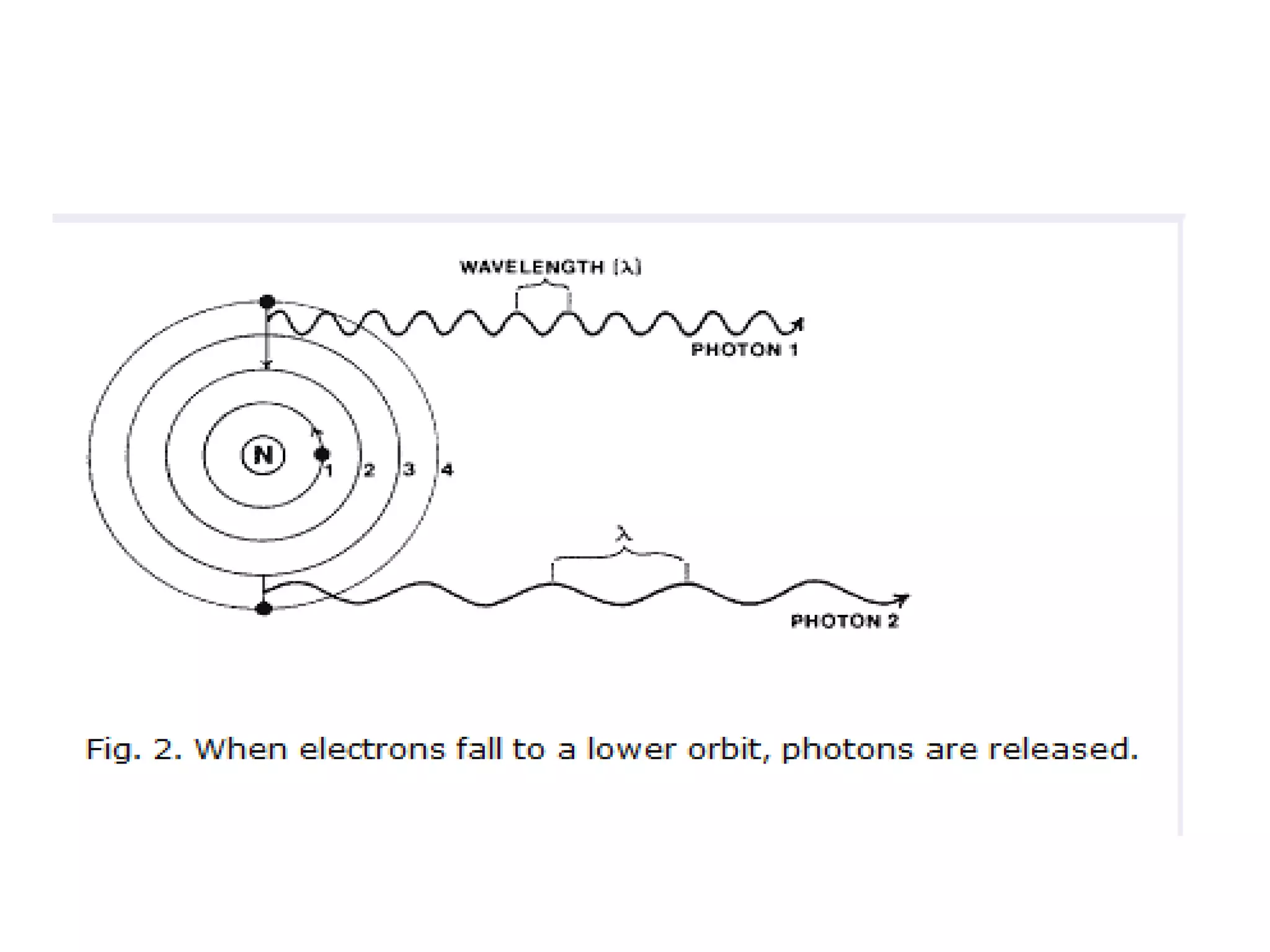
Visible light
• Electromagnetic energy
is wavelength between
380 -760 nm
Theories of color vision
1. The Trichromatic theory, or Young–Helmholtz
theory; states that there’re 3 types of cones, each
containing a different photopigment & maximally
sensitive to one of three primary colours… which
means that any colour consists of admixture of
three primary colours.
2. The opponent colour theory; states that the
visual system interprets color in an antagonistic
way: red vs. green, blue vs. yellow, black vs. white.
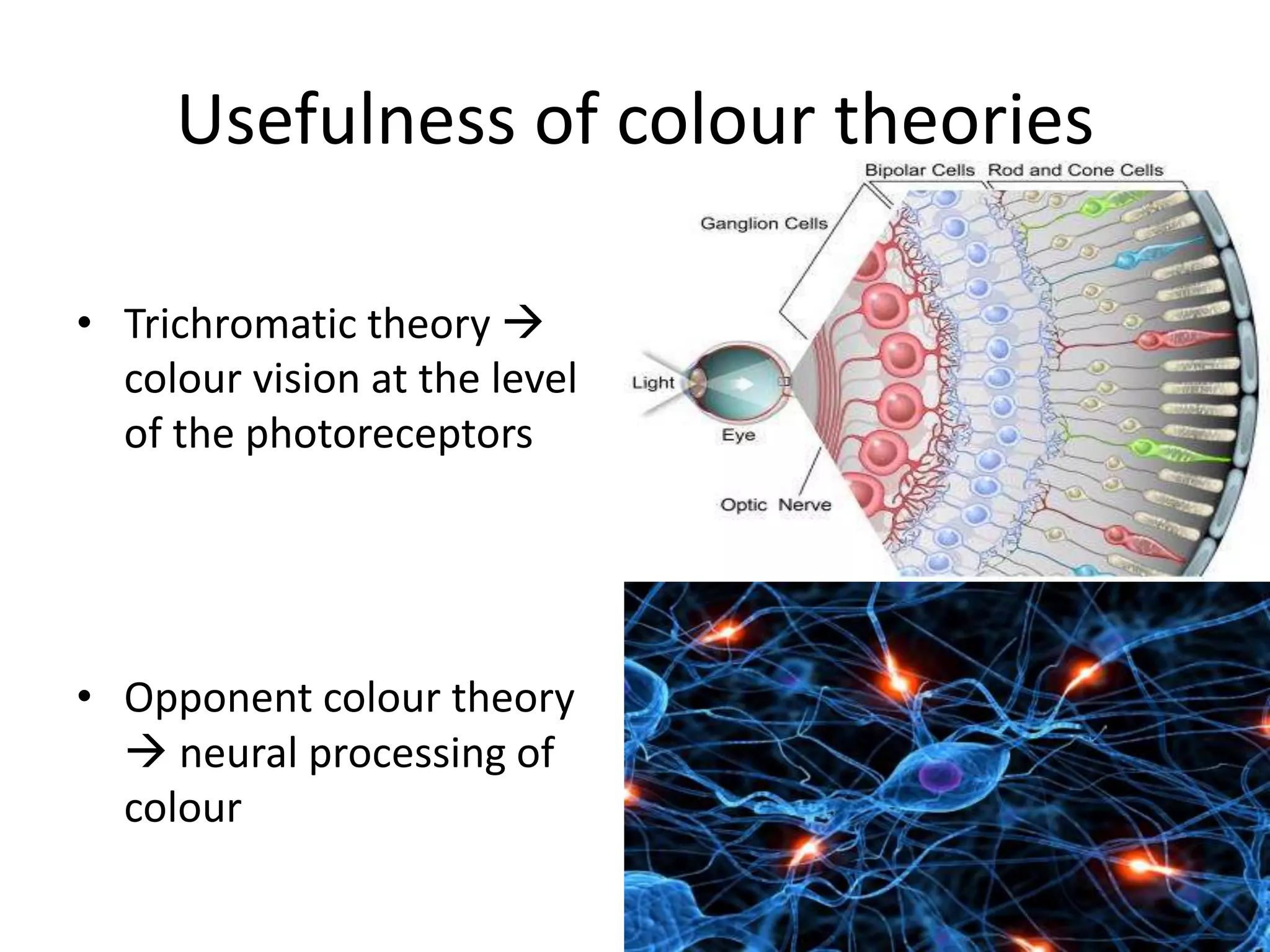
Usefulness of colour theories
• Trichromatic theory 
colour vision at the level
of the photoreceptors
• Opponent colour theory
 neural processing of
colour
Photochemistry of colour vision
• Capture of a photon Irreversible photochemical
isomerization of
chromophores
Series of Protein
conformational changes
Active
pigmen
t
Catalyst
Transducin
Active form
cGMP
phosphodiestera
se
Decrease
cGMP
Decrease
cation
conductan
ce
Hyperpolarizati
on of the
photoreceptors
• Blue or short(SWS)
– contain cyanolabe, which absorbs the short wavelengths
best. Its maximal sensitivity is at 440 nm.
• Green or middle (MWS)
– contain chlorolabe, which is best stimulated by
intermediate wavelengths. Its maximal sensitivity is to a
wavelength of 535 nm
• Red or (LWS)
– contain erythrolabe, which preferentially absorbs quanta
of longer wavelengths. It is best stimulated by light of a
wavelength of 565 nm, but its spectrum extends to the
long wavelengths.
• The 3 cone type represent the 3 primary
additive colors
• Each pigment has a distinct absorption
spectrum
• The peak of absorbance vary but their
absorbance spectra overlap so that a
combination of 1 , 2 or 3 react to a given light
stimulus
Signal processing in the retina
• Color perception require photon absorption
by the 3 classes of receptors with different
spectral responses
• The chemical results then transmitted to
opponent processes
Signal processing in the retina
• Color perception
require photon
absorption by the 3
classes of receptors
with different spectral
responses
• The chemical results
then transmitted to
opponent processes
• Generation of action
potentials at the level of
cones
Horizontal cells
• Two types of responses ;
– Luminosity response :
Hyperpolarizing response with broad spectral
sensitivity
– Chromatic response :hyperpolarizing for part of the
spectrum and depolarizing for the remainder
Evidence for the opponent color coding
• Bipolar cells :
• Center surround spatial pattern
• Not completely understood.
• Amacrine cells :
• Automatic color control
Ganglionic cells
• First Direct evidence for colour coding.
• When all 3 types of cones stimulate the same ganglion
the resultant signal is white
• Opponent color cell :
– Some cells are stimulated by one color type and inhibited
by the other
– Successive colour contrast
• Double opponent color cell :
– Opponent for both color and space
– Simultaneous colour contrast
Processing of color signals in LGB
• All LGB neurons carry information from more than
one cone cell
• Color information carried by the ganglionic cells is
relayed to the parvocellular portion of the LGB
• Spectrally non opponent cells constitute about 30%
of all LGB neurons
• Spectrally opponent cells make 60% (2 types):
– R+/G-
– R-/G+
– B+/Y-
– B-/Y+
Distribution of color vision in the
retina
• Trichromatic color vision mechanisms extend 20 –
30 degrees from the point of fixation
• Peripheral to this red green become
indistiguishable
• In the far periphery all color sense is lost
• The very center of the fovea (1/8 degree) is blue
blind
Phenomena associated with colour
sense
1. Simultaneous colour contrast
2. Successive colour contrast
3. Phenomenon of colour constancy
4. Hierarchy of colour coded cells
1. Opponent colour cells ganglion cells & LGB
2. Double opponent cells layer IV of area 17
3. Complex & hypercomplex colour coded cells
layers II,III,V,VI of area 17
Colour metric
• To overcome the problem of each person have
their name of one single colour.
1. CIE system
2. Munsell system
Normal colour components
Hue: the perceptual pigmentation
difference experience with varying
wavelengths, this is what we are
actually referring to when we use
terms such as "green" or "blue."
Saturation: refers to the degree of
freedom from dilution with white.
(Purity of the color)
Lightness: depends on the luminosity of
the component wavelength.
490 nm 590 nm
PhotopicScotopic
• STATE OF DARK
ADAPTATION (PURKINJE
EFFECT)
• When the eye is light
adapted (daytime),
yellow, yellow green,
and orange appear
brighter than do blues,
greens, and reds. The
cones' peak sensitivity
is to light of 555 nm.
• at dusk, although the
brightness of all colors
decreases, blues and
greens appear to gain in
relative brightness
when compared with
yellows and reds.
Color Blindness
• Normal individual is said to be Trichromate
• Congenital
• Acquired
Congenital color blindness
• X-linked recessive
• Males 3-4% & females 0.4%
• Two types:
– Dyschromatopsia: colour confusion
• Anomalous trichromatism
– Protanomalous
– Deuteranomalous
– Tritanomalous
• Dichromatism
– Protanopia
– Deuteranopia
– Tritanopia
– Achromatopsia
• Cone monochromatism
• Rod monochromatism
Deuteranopia
Protanopia
Acquired color blindness
• Damage to the macula or optic nerve
• Usually associated with central scotoma or
decreased V.A
• Blue-Yellow deficiency retinal lesions as CSR,
macular edema
• Red-Green defieciency optic nerve lesions as
optic neuritis, optic nerve compression
• Acquired blue color defects (blue blindness) may
occur in old age due to increased sclerosis of
crystalline lens.
Color vision testing
• 1. Pseudoisochromatic color confusion charts
• Most common.
• Using Ishihara plates.
• 2. Hue arrangement tasks
• Farnsworth munsell 100
hue test
• Farnsworth panel D 15
• Lanthonthy desaturated
D-15
• Farnsworth-Munsell tests
use Munsell color chips
mounted in caps. The
colors differ only in hue.
They have the same
saturation and brightness.
There are two tests: the
D-15 and the FM-100.
• The current model of the
FM-100 actually has 85
chips.)
D-15 Test
• The D-15 hues, which are selected from all parts of the color
wheel, are provided in a box. The reference cap (blue) is fixed to
the box. The examiner removes the other caps from the box and
arranges them in random order. According to the manual, the
examiner then states, “The object of the test is to arrange the
buttons according to color. Take the button which looks most like
the reference button and place it next to it, then …” After the test
is finished, the examiner flips over the box and records the order of
the chips. Trichromats arrange them from 1 to 15.
• Deutans arrange them as follows: 1, 15, 2, 3, 14, 13, 4, 12, 5, 11, 6,
7, 10, 9, and 8;
• protans arrange them as 15, 1, 14, 2, 13, 12, 3, 4, 11, 10, 5, 9, 6, 8,
and 7.
• The examiner then connects the numbers on the score sheet in the
order in which the patient has placed them
FM-100 Test
• n the FM-100, 85 hues,
which, if arranged in a
circle, would make a color
wheel, are divided into
four boxes.
• The dominant
wavelengths of box one
run from red to yellow;
box two, from yellow to
blue green; box three,
from blue green to
purple; and box four, from
purple back to red
Physiology of colour vision

Physiology of colour vision

  • 1.
    Physiology of Colourvision Othman Al-Abbadi, M.D
  • 2.
    Definition • The abilityto discriminate between colours excited by light of different wavelengths.
  • 4.
    Visible light • Electromagneticenergy is wavelength between 380 -760 nm
  • 6.
    Theories of colorvision 1. The Trichromatic theory, or Young–Helmholtz theory; states that there’re 3 types of cones, each containing a different photopigment & maximally sensitive to one of three primary colours… which means that any colour consists of admixture of three primary colours. 2. The opponent colour theory; states that the visual system interprets color in an antagonistic way: red vs. green, blue vs. yellow, black vs. white.
  • 7.
    Usefulness of colourtheories • Trichromatic theory  colour vision at the level of the photoreceptors • Opponent colour theory  neural processing of colour
  • 8.
    Photochemistry of colourvision • Capture of a photon Irreversible photochemical isomerization of chromophores Series of Protein conformational changes Active pigmen t Catalyst Transducin Active form cGMP phosphodiestera se Decrease cGMP Decrease cation conductan ce Hyperpolarizati on of the photoreceptors
  • 9.
    • Blue orshort(SWS) – contain cyanolabe, which absorbs the short wavelengths best. Its maximal sensitivity is at 440 nm. • Green or middle (MWS) – contain chlorolabe, which is best stimulated by intermediate wavelengths. Its maximal sensitivity is to a wavelength of 535 nm • Red or (LWS) – contain erythrolabe, which preferentially absorbs quanta of longer wavelengths. It is best stimulated by light of a wavelength of 565 nm, but its spectrum extends to the long wavelengths.
  • 10.
    • The 3cone type represent the 3 primary additive colors • Each pigment has a distinct absorption spectrum • The peak of absorbance vary but their absorbance spectra overlap so that a combination of 1 , 2 or 3 react to a given light stimulus
  • 12.
    Signal processing inthe retina • Color perception require photon absorption by the 3 classes of receptors with different spectral responses • The chemical results then transmitted to opponent processes
  • 13.
    Signal processing inthe retina • Color perception require photon absorption by the 3 classes of receptors with different spectral responses • The chemical results then transmitted to opponent processes
  • 14.
    • Generation ofaction potentials at the level of cones
  • 15.
    Horizontal cells • Twotypes of responses ; – Luminosity response : Hyperpolarizing response with broad spectral sensitivity – Chromatic response :hyperpolarizing for part of the spectrum and depolarizing for the remainder Evidence for the opponent color coding
  • 16.
    • Bipolar cells: • Center surround spatial pattern • Not completely understood. • Amacrine cells : • Automatic color control
  • 17.
    Ganglionic cells • FirstDirect evidence for colour coding. • When all 3 types of cones stimulate the same ganglion the resultant signal is white • Opponent color cell : – Some cells are stimulated by one color type and inhibited by the other – Successive colour contrast • Double opponent color cell : – Opponent for both color and space – Simultaneous colour contrast
  • 18.
    Processing of colorsignals in LGB • All LGB neurons carry information from more than one cone cell • Color information carried by the ganglionic cells is relayed to the parvocellular portion of the LGB • Spectrally non opponent cells constitute about 30% of all LGB neurons • Spectrally opponent cells make 60% (2 types): – R+/G- – R-/G+ – B+/Y- – B-/Y+
  • 19.
    Distribution of colorvision in the retina • Trichromatic color vision mechanisms extend 20 – 30 degrees from the point of fixation • Peripheral to this red green become indistiguishable • In the far periphery all color sense is lost • The very center of the fovea (1/8 degree) is blue blind
  • 21.
    Phenomena associated withcolour sense 1. Simultaneous colour contrast 2. Successive colour contrast 3. Phenomenon of colour constancy 4. Hierarchy of colour coded cells 1. Opponent colour cells ganglion cells & LGB 2. Double opponent cells layer IV of area 17 3. Complex & hypercomplex colour coded cells layers II,III,V,VI of area 17
  • 22.
    Colour metric • Toovercome the problem of each person have their name of one single colour. 1. CIE system 2. Munsell system
  • 23.
    Normal colour components Hue:the perceptual pigmentation difference experience with varying wavelengths, this is what we are actually referring to when we use terms such as "green" or "blue." Saturation: refers to the degree of freedom from dilution with white. (Purity of the color) Lightness: depends on the luminosity of the component wavelength.
  • 24.
  • 25.
  • 26.
    • STATE OFDARK ADAPTATION (PURKINJE EFFECT) • When the eye is light adapted (daytime), yellow, yellow green, and orange appear brighter than do blues, greens, and reds. The cones' peak sensitivity is to light of 555 nm. • at dusk, although the brightness of all colors decreases, blues and greens appear to gain in relative brightness when compared with yellows and reds.
  • 27.
    Color Blindness • Normalindividual is said to be Trichromate • Congenital • Acquired
  • 28.
    Congenital color blindness •X-linked recessive • Males 3-4% & females 0.4% • Two types: – Dyschromatopsia: colour confusion • Anomalous trichromatism – Protanomalous – Deuteranomalous – Tritanomalous • Dichromatism – Protanopia – Deuteranopia – Tritanopia – Achromatopsia • Cone monochromatism • Rod monochromatism
  • 29.
  • 30.
  • 31.
    Acquired color blindness •Damage to the macula or optic nerve • Usually associated with central scotoma or decreased V.A • Blue-Yellow deficiency retinal lesions as CSR, macular edema • Red-Green defieciency optic nerve lesions as optic neuritis, optic nerve compression • Acquired blue color defects (blue blindness) may occur in old age due to increased sclerosis of crystalline lens.
  • 32.
    Color vision testing •1. Pseudoisochromatic color confusion charts • Most common. • Using Ishihara plates.
  • 35.
    • 2. Huearrangement tasks • Farnsworth munsell 100 hue test • Farnsworth panel D 15 • Lanthonthy desaturated D-15 • Farnsworth-Munsell tests use Munsell color chips mounted in caps. The colors differ only in hue. They have the same saturation and brightness. There are two tests: the D-15 and the FM-100. • The current model of the FM-100 actually has 85 chips.)
  • 36.
    D-15 Test • TheD-15 hues, which are selected from all parts of the color wheel, are provided in a box. The reference cap (blue) is fixed to the box. The examiner removes the other caps from the box and arranges them in random order. According to the manual, the examiner then states, “The object of the test is to arrange the buttons according to color. Take the button which looks most like the reference button and place it next to it, then …” After the test is finished, the examiner flips over the box and records the order of the chips. Trichromats arrange them from 1 to 15. • Deutans arrange them as follows: 1, 15, 2, 3, 14, 13, 4, 12, 5, 11, 6, 7, 10, 9, and 8; • protans arrange them as 15, 1, 14, 2, 13, 12, 3, 4, 11, 10, 5, 9, 6, 8, and 7. • The examiner then connects the numbers on the score sheet in the order in which the patient has placed them
  • 39.
    FM-100 Test • nthe FM-100, 85 hues, which, if arranged in a circle, would make a color wheel, are divided into four boxes. • The dominant wavelengths of box one run from red to yellow; box two, from yellow to blue green; box three, from blue green to purple; and box four, from purple back to red