Retinoschisis
Othman Al-Abbadi, M.D
Definition
• Separation or splitting of the NSR into inner
and outer layers with severing of neurones
and complete loss of visual function in the
affected area.
Senile
• Prevalence
– 5% of the population >20 years
– Particularly in hypermetropics
• Typical retinoschisis
– Split occurs in the outer plexiform layer
• Reticular retinoschisis
– Split occurs at the level of RNFL
Symptoms
• NO Photopsia NOR floaters
• Visual field defect but rarely noticed
• If any, result from VH or a progressive RD
Signs
• Bilateral in 50-80%
• Early  Extreme Inferotemporal periphery
– exaggeration of microcystoid degeneration
• Elevation is convex, smooth, thin and relatively
immobile
• May progress circumferentially until it has
involved the entire periphery
– Typical usually remains anterior to the equator
– Reticular is more likely to spread posteriorly
• The surface of the inner layer may show
sclerosis of blood vessels & ‘snowflakes’
(whitish remnants of Müller cell footplates)
• Breaks may be present in one or both layers
– Inner layer breaks are small and round
– outer layer breaks are usually larger, with rolled
edges & located behind the equator
• Distinction between the typical and reticular
types is difficult clinically, though the inner
layer is thinner and tends to be more elevated
in the latter; differentiation is based
principally on behaviour, with complications
much more common in the reticular form
Complications
• RD is rare
– even in an eye with breaks in both layers the
incidence is only around 1%
– The detachment is almost always asymptomatic,
infrequently progressive and rarely requires
surgery
• Posterior extension to involve the fovea
– very rare
• Vitreous haemorrhage is rare
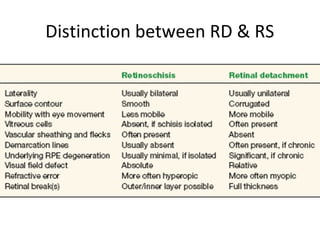
Distinction between RD & RS
Juvenile
• Bilateral maculopathy, with associated peripheral
retinoschisis in 50%
• Splitting occurs at RNFL
• Inheritance is XLR
• Poor prognosis
• Due to progressive maculopathy; visual acuity
deteriorates during the first two decades, but
may remain reasonably stable until the fifth or
sixth decades before further deterioration
Symptoms
• Presentation
– Between the ages of 5-10 years
• Reading difficulties
• squint or nystagmus occurs in infancy
– associated with advanced peripheral retinoschisis,
often with VH
• Carrier females are generally asymptomatic
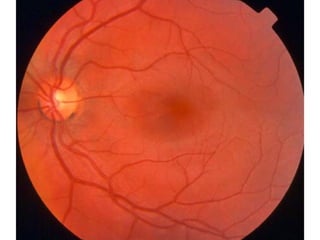
• Foveal schisis
– Spoke-like striae radiating from the foveola,
associated with cystoid changes
• Whitish drusen-like dots and pigment
variation may be seen
• Peripheral schisis predominantly involves the
inferotemporal quadrant
– Does not extend
– Inner layer may develop oval defects
– Defects may coalesce, leaving only retinal blood
vessels floating in the vitreous (‘vitreous veils’)
Complications
• Vitreous and intra-schisis haemorrhage
• Neovascularization
• Subretinal exudation
• Rhegmatogenous or tractional RD
• Traumatic rupture of the foveal schisis
Investigations
• OCT
– Documenting maculopathy progression
• FAF
– spoke-like patterns
– central hypoautofluorescence with surrounding
hyperautofluorescence
• FA
– Mild window defects but NO leakage
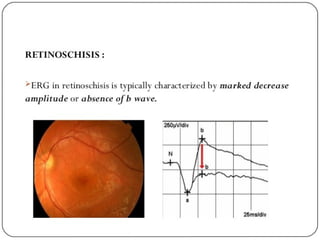
• ERG
– Normal in eyes with isolated maculopathy
– Selective decrease in amplitude of the b-wave on
scotopic and photopic testing
Management
• Small lesions found incidentally need annual
follow-up
• Progression towards the fovea
– Retinopexy or surgical repair
• Recurrent VH
– PPV
• In cases of Maculopathy
– Topical or oral CAI
– Reduce foveal thickness and improve visual acuity in
some patients
After treatment with CAI
Retinoschisis
Retinoschisis

Retinoschisis

  • 1.
  • 2.
    Definition • Separation orsplitting of the NSR into inner and outer layers with severing of neurones and complete loss of visual function in the affected area.
  • 9.
    Senile • Prevalence – 5%of the population >20 years – Particularly in hypermetropics • Typical retinoschisis – Split occurs in the outer plexiform layer • Reticular retinoschisis – Split occurs at the level of RNFL
  • 10.
    Symptoms • NO PhotopsiaNOR floaters • Visual field defect but rarely noticed • If any, result from VH or a progressive RD
  • 11.
    Signs • Bilateral in50-80% • Early  Extreme Inferotemporal periphery – exaggeration of microcystoid degeneration • Elevation is convex, smooth, thin and relatively immobile • May progress circumferentially until it has involved the entire periphery – Typical usually remains anterior to the equator – Reticular is more likely to spread posteriorly
  • 14.
    • The surfaceof the inner layer may show sclerosis of blood vessels & ‘snowflakes’ (whitish remnants of Müller cell footplates) • Breaks may be present in one or both layers – Inner layer breaks are small and round – outer layer breaks are usually larger, with rolled edges & located behind the equator
  • 15.
    • Distinction betweenthe typical and reticular types is difficult clinically, though the inner layer is thinner and tends to be more elevated in the latter; differentiation is based principally on behaviour, with complications much more common in the reticular form
  • 16.
    Complications • RD israre – even in an eye with breaks in both layers the incidence is only around 1% – The detachment is almost always asymptomatic, infrequently progressive and rarely requires surgery • Posterior extension to involve the fovea – very rare • Vitreous haemorrhage is rare
  • 17.
  • 19.
    Juvenile • Bilateral maculopathy,with associated peripheral retinoschisis in 50% • Splitting occurs at RNFL • Inheritance is XLR • Poor prognosis • Due to progressive maculopathy; visual acuity deteriorates during the first two decades, but may remain reasonably stable until the fifth or sixth decades before further deterioration
  • 22.
    Symptoms • Presentation – Betweenthe ages of 5-10 years • Reading difficulties • squint or nystagmus occurs in infancy – associated with advanced peripheral retinoschisis, often with VH • Carrier females are generally asymptomatic
  • 23.
    • Foveal schisis –Spoke-like striae radiating from the foveola, associated with cystoid changes
  • 24.
    • Whitish drusen-likedots and pigment variation may be seen • Peripheral schisis predominantly involves the inferotemporal quadrant – Does not extend – Inner layer may develop oval defects – Defects may coalesce, leaving only retinal blood vessels floating in the vitreous (‘vitreous veils’)
  • 26.
    Complications • Vitreous andintra-schisis haemorrhage • Neovascularization • Subretinal exudation • Rhegmatogenous or tractional RD • Traumatic rupture of the foveal schisis
  • 27.
    Investigations • OCT – Documentingmaculopathy progression • FAF – spoke-like patterns – central hypoautofluorescence with surrounding hyperautofluorescence
  • 28.
    • FA – Mildwindow defects but NO leakage • ERG – Normal in eyes with isolated maculopathy – Selective decrease in amplitude of the b-wave on scotopic and photopic testing
  • 30.
    Management • Small lesionsfound incidentally need annual follow-up • Progression towards the fovea – Retinopexy or surgical repair • Recurrent VH – PPV • In cases of Maculopathy – Topical or oral CAI – Reduce foveal thickness and improve visual acuity in some patients
  • 31.

Editor's Notes

  • #30 a-wave cones & rods B-wave bipolar & muller C-wave RPE