DR NILESH KATE
MBBS,MD
ASSOCIATE PROF
ESIC MEDICAL COLLEGE, GULBARGA.
DEPT. OF PHYSIOLOGY
COLOUR
VISION.
OBJECTIVES.






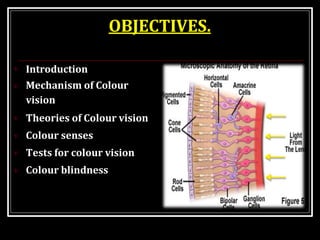
Introduction
Mechanism of Colour
vision
Theories of Colour vision
Colour senses
Tests for colour vision
Colour blindness
INTRODUCTION
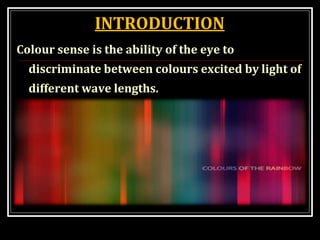
Colour sense is the ability of the eye to
discriminate between colours excited by light of
different wave lengths.
Features Of Colour Vision
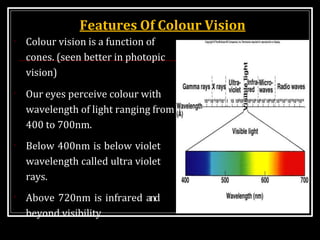
 Colour vision is a function of
cones. (seen better in photopic
vision)
 Our eyes perceive colour with
wavelength of light ranging from
400 to 700nm.
 Below 400nm is below violet
wavelength called ultra violet
rays.
 Above 720nm is infrared and
beyond visibility.
Basic of Colours
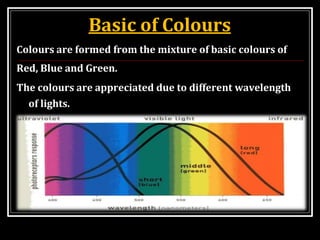
Colours are formed from the mixture of basic colours of
Red, Blue and Green.
The colours are appreciated due to different wavelength
of lights.
Physics of colours
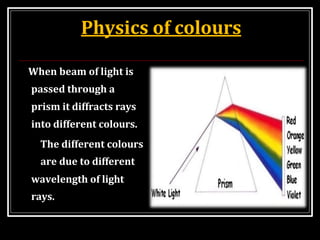
When beam of light is
passed through a
prism it diffracts rays
into different colours.
The different colours
are due to different
wavelength of light
rays.
Types of Vision
Two types of vision they are
1.Achromatic:
Sensation of white
vision with no colour vision
2. Chromatic:
I ) Spectral colour vision
ii) Extra spectral colour
vision
- i.e., Mixing of two spectrum
Types of Colours
There are two types of colours.
They are
1. Primary colour :
Blue,
Green, Red and mixing of three
colours
2. Complementary colours:
When
two colours are mixed in
appropriate amount it cancel the
colours and produces white
sensation
Physiology of Vision
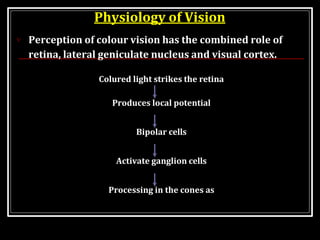
 Perception of colour vision has the combined role of
retina, lateral geniculate nucleus and visual cortex.
Colured light strikes the retina
Produces local potential
Bipolar cells
Activate ganglion cells
Processing in the cones as
Physiology of
Vision
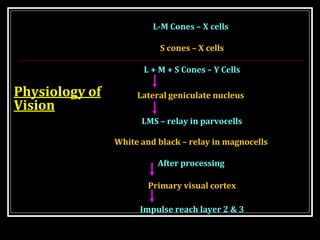
L-M Cones – X cells
S cones – X cells
L + M + S Cones – Y Cells
Lateral geniculate nucleus
LMS – relay in parvocells
White and black – relay in magnocells
After processing
Primary visual cortex
Impulse reach layer 2 & 3
Physiology of Vision
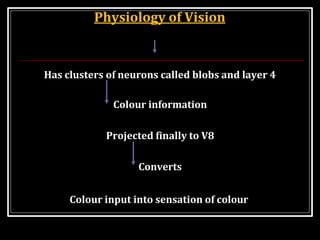
Has clusters of neurons called blobs and layer 4
Colour information
Projected finally to V8
Converts
Colour input into sensation of colour
Theories of Colour Vision
 1.Young-Helmholtz theory of colour vision
(trichromatic colour theory)
 2. Granits dominator and modulator theory
 3. Hering’s opponent colour theory
Young-Helmholtz theory of colour vision
(trichromatic colour theory)
There are three primary colours red, green and blue.
There are three types of cones with different pigments.
The three pigments are:
1. Erythrolabe (Porphyropsin -- red)
2. Chlorolabe (Lodopsin-- green)
3. Cyanolabe (Cyanopsin -- blue)
Theories of Colour Vision
Sensation of any given colour is determined by the
relative frequency of impulses reaching the brain from
each of the three cone systems.


Colour blindness is classified based on this theory.
This theory fails to explain the black sensation as black is
also considered as a colour.
This also fails to explain how the peripheral colour blind
zones perceive yellow, white or grey sensations.
Granits dominator and modulator theory
 Granit introduced micro-electrodes into the ganglion cells
and investigate the sensitivity to light of various
wavelengths.
a) Dominator.
b) Modulator cells.


a) Dominators: These respond to the whole visual spectrum.
These are supposed to detect the intensity of the light but
not the colour.
This is due to ‘Y’ ganglion cells.
Granits dominator and modulator theory
b) Modulators: These respond
maximum to a narrow
wavelength of light.
There are three groups of
modulators,
blue light of wavelength 450
—470 nm
green light of wavelength 520
—540 nm
red yellow light of 500—600 nm.
Granits dominator and modulator
theory
 Hence the
modulators are
responsible for colour
vision. According to
the latest concept the
X ganglion cells are
supposed to be the
modulators.
Friday, February 6, 2015
Theories of Colour Vision
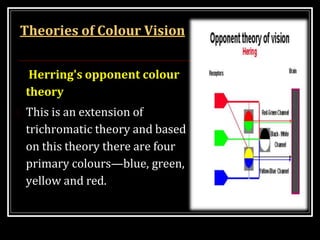
Herring's opponent colour
theory
 This is an extension of
trichromatic theory and based
on this theory there are four
primary colours—blue, green,
yellow and red.
Hering’s opponent colour
theory
 According to this
theory the
photochemical
substances give one
sensation on
breakdown and a
different one on
resynthesis.
 According to this
theory,
complementary
colours become
antagonistic to its
respective primary
colours.
Photo chemical
substance
Hering' s opponent colour
theory
Sensation
1. White - black - Break down
- Resynthesis
- White
- Black
2. Red - green - Breakdown
- Resynthesis
- Red on & green off
-Green on &Red
-off
3. Yellow - blue - Breakdown
- Resynthesis
- Yellow on & blue off
-Blue on &
- yellow off
AFTER IMAGE
 After looking at a bright object, if the eyes
are closed, the image remains more distinct
for someone and then fades away gradually.
This phenomenon is called after image.
Positive after Image
 After looking at a bright
object, if the eyes are
closed or fixed on a
black surface, the after
image appears to be
bright and with same
colour of the object. It
is called Positive after
image
Friday, February 6, 2015
Negative after Image
 After looking at bright
object, if the eyes are
fixed on white surface
the after image appears
in the complementary
color. It is called
Negative after image.
Friday, February 6, 2015
Colour Blindness


Insensitive to colours i.e.,
inability on the part of an
individual to recognize the
colours is called colour
blindness
Inheritance of colours
blindness;




Inherited sex linked
anomaly
Due to abnormal gene on
X-chromosomes
Females are the carriers
Incidence in Males – 8%
Females –0.4 %
Inheritance
Friday, February 6, 2015
Colour Blindness
 The classification of colour blindness is based on
the Young-Helmholtz theory of colour vision
 Based on three receptor theory, individuals
suffering from colour blindness are classified
into:
1. Trichromats.
2. Dichromats.
3. Monochromats.
Colour Blindness
1. Trichromats These are the people with weakness for
one primary colour. Accordingly, these are classified
into:
a) Protanomolous Weakness to red colour—common
occurrance is 6% and sex-linked.
b) Deuteranomalous Weakness to green colour -
occurance is 6% and sex-linked.
c) Tritanomalous weakness to blue clolour—rare, not
sex-linked.
Friday, February 6, 2015
Colour Blindness
2.Dichromats: These are the
individuals with two cone
systems. These cannot
appreciate one primary colour.
Accordingly they may have:
a) Protanopia — blindness to red.
Phorphyropsin pigment is
absent.
b) Deuteranopia—blindness to
green. lodopsin pigment is
absent.
c) Tritanopia — blindness to blue.
Cyanopsin pigment is absent.
Monochromats
They have only one
cone system. These
people can see
black, white and
shades of grey.
Friday, February 6, 2015
Tests For Colour Vision
Ishihara charts:
Charts containing
some numbers made up
of different coloured and
sized dots on a similar
background.
Inability to identity a
number suggests some
defect of colour vision.
Tests For Colour Vision
Holmgren wool test:
Different coloured wools
are placed together .
The subject will be given
coloured wool and asked to
pick up a similar coloured
wool.
Tests For Colour Vision
Eldridge green lantern:
This consists of different
coloured windows with a light
source in the centre. The subject
should identify the colour of the
window. The effect of mist or fog on
the coloured window can also be
studied. This is used for testing
railway employees.
Eldridge green lantern
Importance: Pilots,
navigators, vehicle drivers
and railway employees
require normal colour
vision as they deal with
colours for running their
machines.
Friday, February 6, 2015
Significance of Colour Vision
Pilots, Navigators, vehicle drivers and railway
employees require normal colour vision as they
deal with colours for running their machines.
Thank you…

colourvision-.pptx

  • 1.
    DR NILESH KATE MBBS,MD ASSOCIATEPROF ESIC MEDICAL COLLEGE, GULBARGA. DEPT. OF PHYSIOLOGY COLOUR VISION.
  • 2.
    OBJECTIVES.       Introduction Mechanism of Colour vision Theoriesof Colour vision Colour senses Tests for colour vision Colour blindness
  • 3.
    INTRODUCTION Colour sense isthe ability of the eye to discriminate between colours excited by light of different wave lengths.
  • 4.
    Features Of ColourVision  Colour vision is a function of cones. (seen better in photopic vision)  Our eyes perceive colour with wavelength of light ranging from 400 to 700nm.  Below 400nm is below violet wavelength called ultra violet rays.  Above 720nm is infrared and beyond visibility.
  • 5.
    Basic of Colours Coloursare formed from the mixture of basic colours of Red, Blue and Green. The colours are appreciated due to different wavelength of lights.
  • 6.
    Physics of colours Whenbeam of light is passed through a prism it diffracts rays into different colours. The different colours are due to different wavelength of light rays.
  • 7.
    Types of Vision Twotypes of vision they are 1.Achromatic: Sensation of white vision with no colour vision 2. Chromatic: I ) Spectral colour vision ii) Extra spectral colour vision - i.e., Mixing of two spectrum
  • 8.
    Types of Colours Thereare two types of colours. They are 1. Primary colour : Blue, Green, Red and mixing of three colours 2. Complementary colours: When two colours are mixed in appropriate amount it cancel the colours and produces white sensation
  • 9.
    Physiology of Vision Perception of colour vision has the combined role of retina, lateral geniculate nucleus and visual cortex. Colured light strikes the retina Produces local potential Bipolar cells Activate ganglion cells Processing in the cones as
  • 10.
    Physiology of Vision L-M Cones– X cells S cones – X cells L + M + S Cones – Y Cells Lateral geniculate nucleus LMS – relay in parvocells White and black – relay in magnocells After processing Primary visual cortex Impulse reach layer 2 & 3
  • 11.
    Physiology of Vision Hasclusters of neurons called blobs and layer 4 Colour information Projected finally to V8 Converts Colour input into sensation of colour
  • 12.
    Theories of ColourVision  1.Young-Helmholtz theory of colour vision (trichromatic colour theory)  2. Granits dominator and modulator theory  3. Hering’s opponent colour theory
  • 13.
    Young-Helmholtz theory ofcolour vision (trichromatic colour theory) There are three primary colours red, green and blue. There are three types of cones with different pigments. The three pigments are: 1. Erythrolabe (Porphyropsin -- red) 2. Chlorolabe (Lodopsin-- green) 3. Cyanolabe (Cyanopsin -- blue)
  • 14.
    Theories of ColourVision Sensation of any given colour is determined by the relative frequency of impulses reaching the brain from each of the three cone systems.   Colour blindness is classified based on this theory. This theory fails to explain the black sensation as black is also considered as a colour. This also fails to explain how the peripheral colour blind zones perceive yellow, white or grey sensations.
  • 15.
    Granits dominator andmodulator theory  Granit introduced micro-electrodes into the ganglion cells and investigate the sensitivity to light of various wavelengths. a) Dominator. b) Modulator cells.   a) Dominators: These respond to the whole visual spectrum. These are supposed to detect the intensity of the light but not the colour. This is due to ‘Y’ ganglion cells.
  • 16.
    Granits dominator andmodulator theory b) Modulators: These respond maximum to a narrow wavelength of light. There are three groups of modulators, blue light of wavelength 450 —470 nm green light of wavelength 520 —540 nm red yellow light of 500—600 nm.
  • 17.
    Granits dominator andmodulator theory  Hence the modulators are responsible for colour vision. According to the latest concept the X ganglion cells are supposed to be the modulators. Friday, February 6, 2015
  • 18.
    Theories of ColourVision Herring's opponent colour theory  This is an extension of trichromatic theory and based on this theory there are four primary colours—blue, green, yellow and red.
  • 19.
    Hering’s opponent colour theory According to this theory the photochemical substances give one sensation on breakdown and a different one on resynthesis.  According to this theory, complementary colours become antagonistic to its respective primary colours.
  • 20.
    Photo chemical substance Hering' sopponent colour theory Sensation 1. White - black - Break down - Resynthesis - White - Black 2. Red - green - Breakdown - Resynthesis - Red on & green off -Green on &Red -off 3. Yellow - blue - Breakdown - Resynthesis - Yellow on & blue off -Blue on & - yellow off
  • 21.
    AFTER IMAGE  Afterlooking at a bright object, if the eyes are closed, the image remains more distinct for someone and then fades away gradually. This phenomenon is called after image.
  • 22.
    Positive after Image After looking at a bright object, if the eyes are closed or fixed on a black surface, the after image appears to be bright and with same colour of the object. It is called Positive after image Friday, February 6, 2015
  • 23.
    Negative after Image After looking at bright object, if the eyes are fixed on white surface the after image appears in the complementary color. It is called Negative after image. Friday, February 6, 2015
  • 24.
    Colour Blindness   Insensitive tocolours i.e., inability on the part of an individual to recognize the colours is called colour blindness Inheritance of colours blindness;     Inherited sex linked anomaly Due to abnormal gene on X-chromosomes Females are the carriers Incidence in Males – 8% Females –0.4 %
  • 25.
  • 26.
    Colour Blindness  Theclassification of colour blindness is based on the Young-Helmholtz theory of colour vision  Based on three receptor theory, individuals suffering from colour blindness are classified into: 1. Trichromats. 2. Dichromats. 3. Monochromats.
  • 27.
    Colour Blindness 1. TrichromatsThese are the people with weakness for one primary colour. Accordingly, these are classified into: a) Protanomolous Weakness to red colour—common occurrance is 6% and sex-linked. b) Deuteranomalous Weakness to green colour - occurance is 6% and sex-linked. c) Tritanomalous weakness to blue clolour—rare, not sex-linked. Friday, February 6, 2015
  • 28.
    Colour Blindness 2.Dichromats: Theseare the individuals with two cone systems. These cannot appreciate one primary colour. Accordingly they may have: a) Protanopia — blindness to red. Phorphyropsin pigment is absent. b) Deuteranopia—blindness to green. lodopsin pigment is absent. c) Tritanopia — blindness to blue. Cyanopsin pigment is absent.
  • 29.
    Monochromats They have onlyone cone system. These people can see black, white and shades of grey. Friday, February 6, 2015
  • 30.
  • 31.
    Tests For ColourVision Ishihara charts: Charts containing some numbers made up of different coloured and sized dots on a similar background. Inability to identity a number suggests some defect of colour vision.
  • 32.
    Tests For ColourVision Holmgren wool test: Different coloured wools are placed together . The subject will be given coloured wool and asked to pick up a similar coloured wool.
  • 33.
    Tests For ColourVision Eldridge green lantern: This consists of different coloured windows with a light source in the centre. The subject should identify the colour of the window. The effect of mist or fog on the coloured window can also be studied. This is used for testing railway employees.
  • 34.
    Eldridge green lantern Importance:Pilots, navigators, vehicle drivers and railway employees require normal colour vision as they deal with colours for running their machines. Friday, February 6, 2015
  • 35.
    Significance of ColourVision Pilots, Navigators, vehicle drivers and railway employees require normal colour vision as they deal with colours for running their machines.
  • 36.