BY
DR.ANUPAMA MANOHARAN
JUNIOR RESIDENT
DEPARTMENT OPHTHALMOLOGY
UGMCH OOTY (TN)
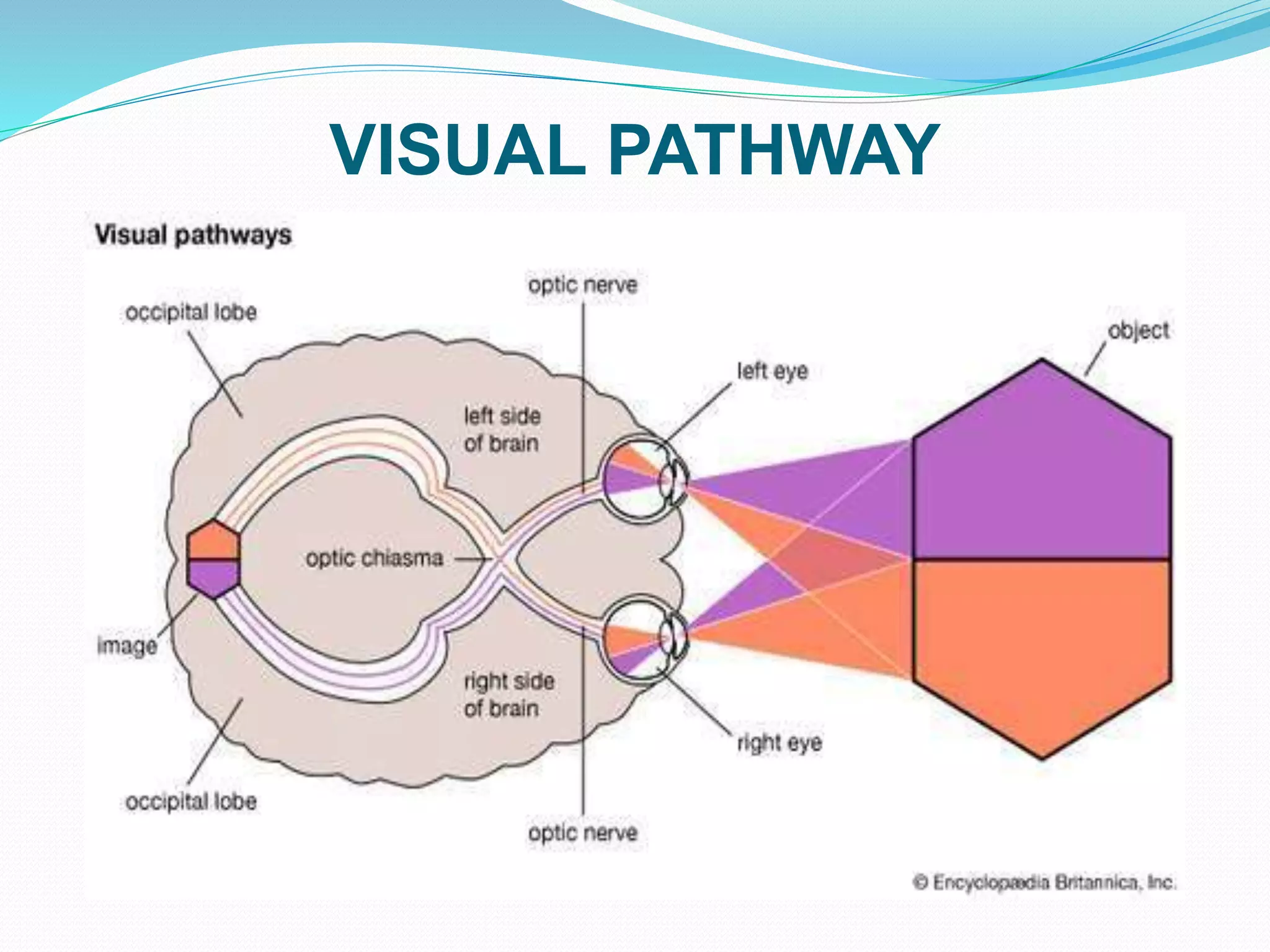
VISUAL PATHWAY
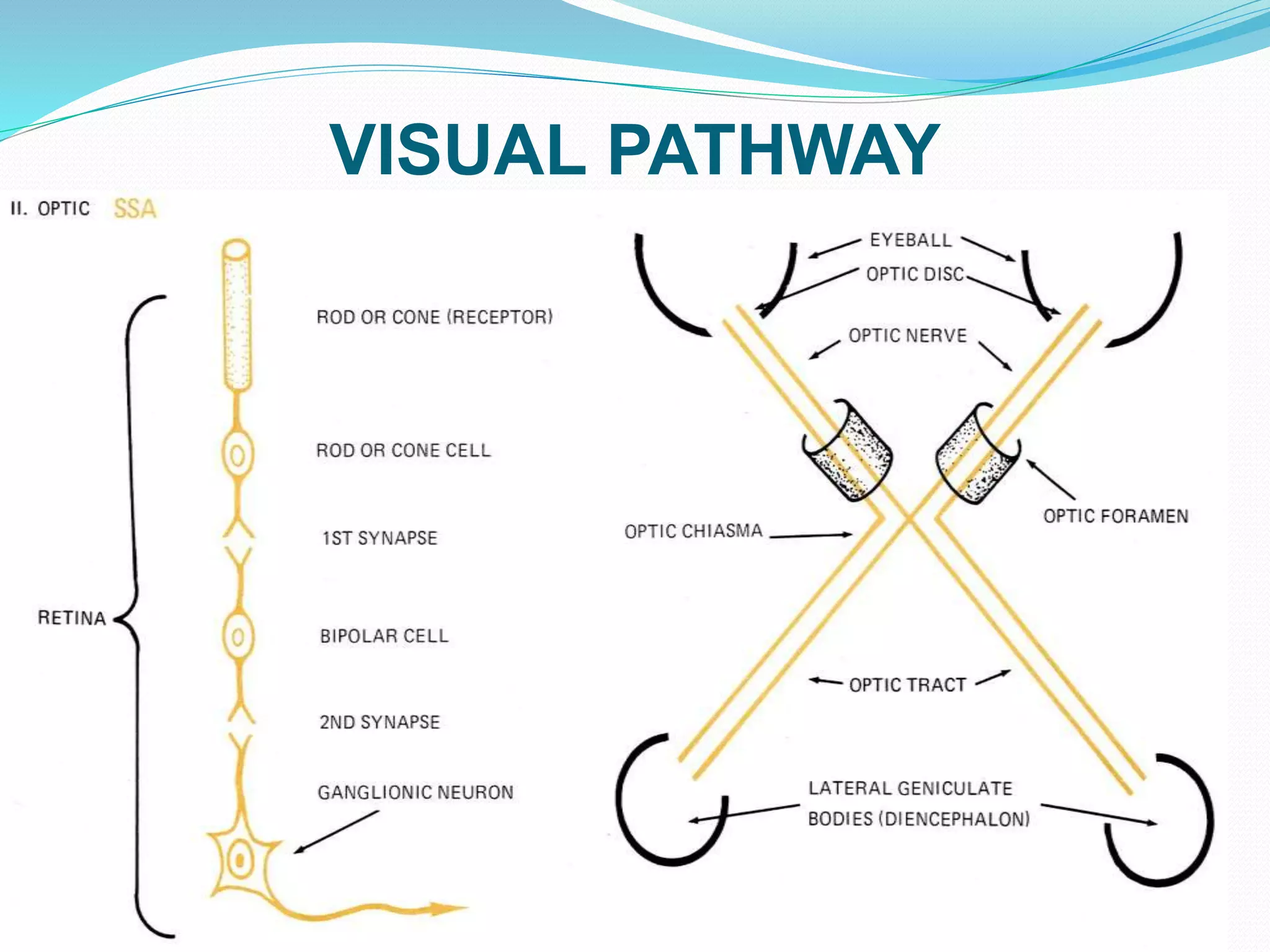
VISUAL PATHWAY
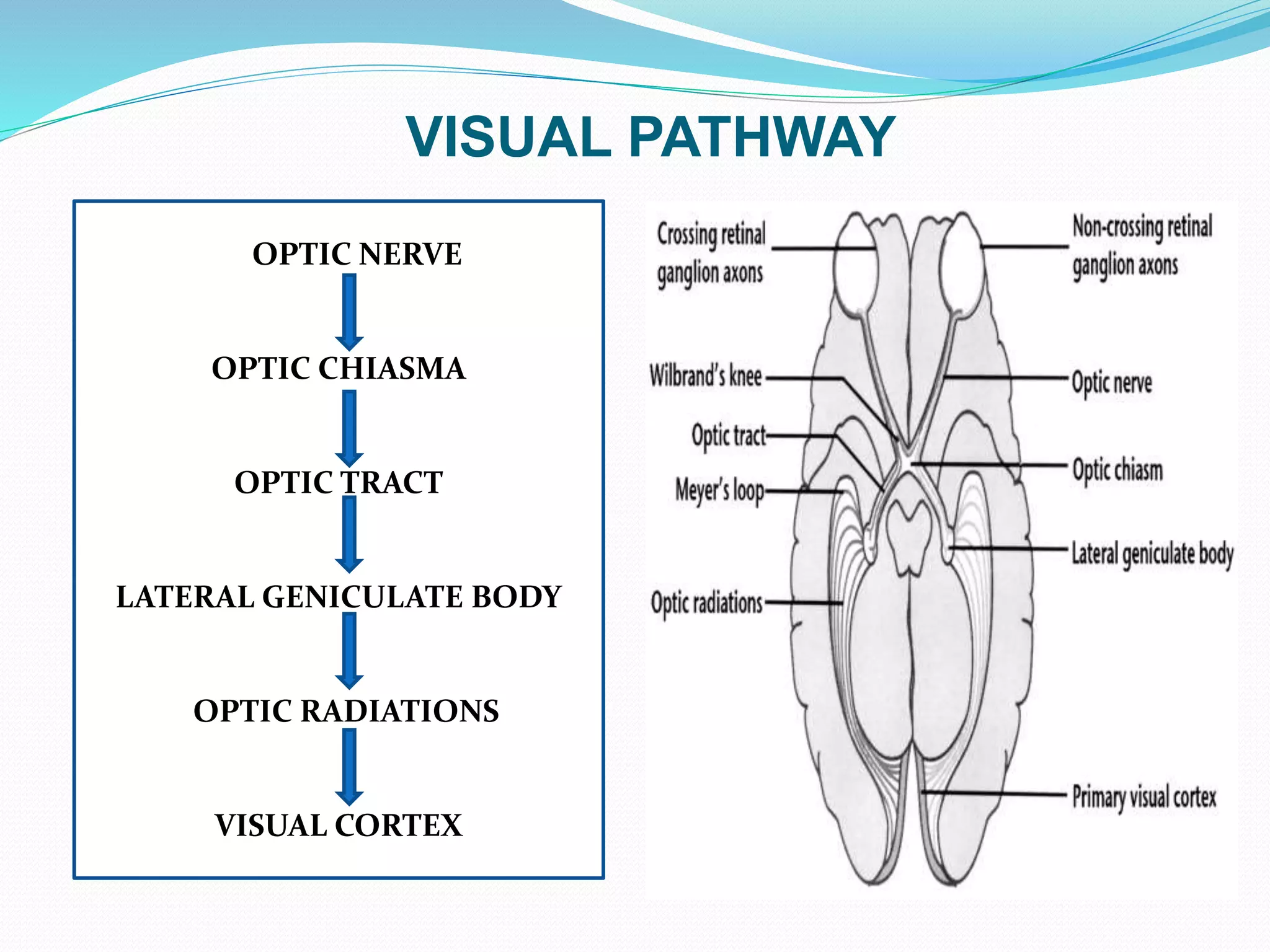
VISUAL PATHWAY
OPTIC NERVE
OPTIC CHIASMA
OPTIC TRACT
LATERAL GENICULATE BODY
OPTIC RADIATIONS
VISUAL CORTEX
ANATOMY OF DIFFERENT COMPONENTS OF
VISUAL PATHWAY
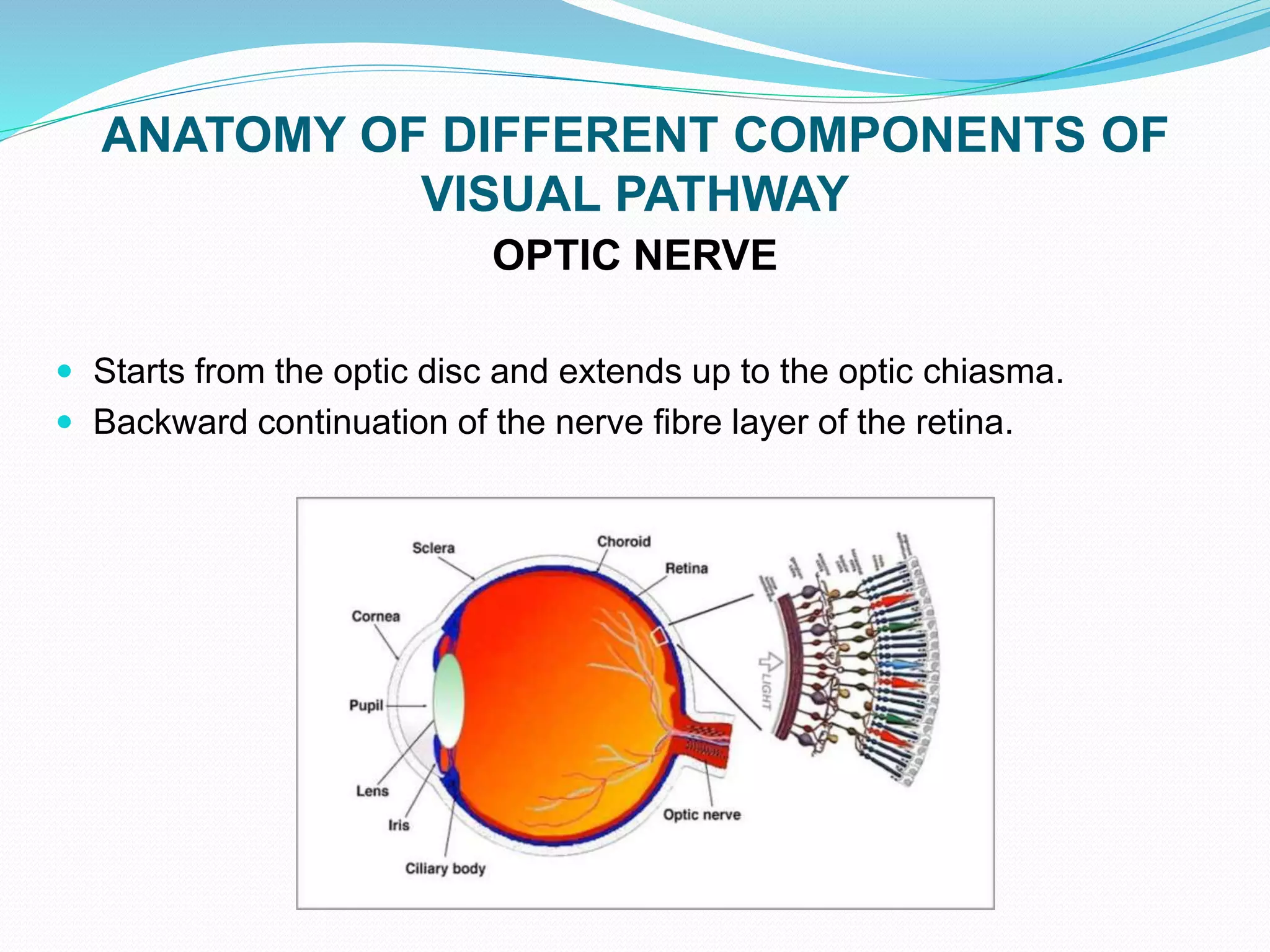
OPTIC NERVE
 Starts from the optic disc and extends up to the optic chiasma.
 Backward continuation of the nerve fibre layer of the retina.
OPTIC NERVE
Morphologically and embryologically- comparable
to sensory tract (white matter) of the brain
 Outgrowth of the brain
 Not covered by neurilemma(does not regenerate when cut)
 Fibres of the optic nerve-million in number,2-10 micrometre in
diameter.
 Surrounded by meninges
 Both the primary and secondary sensory neurons are in the
retina.
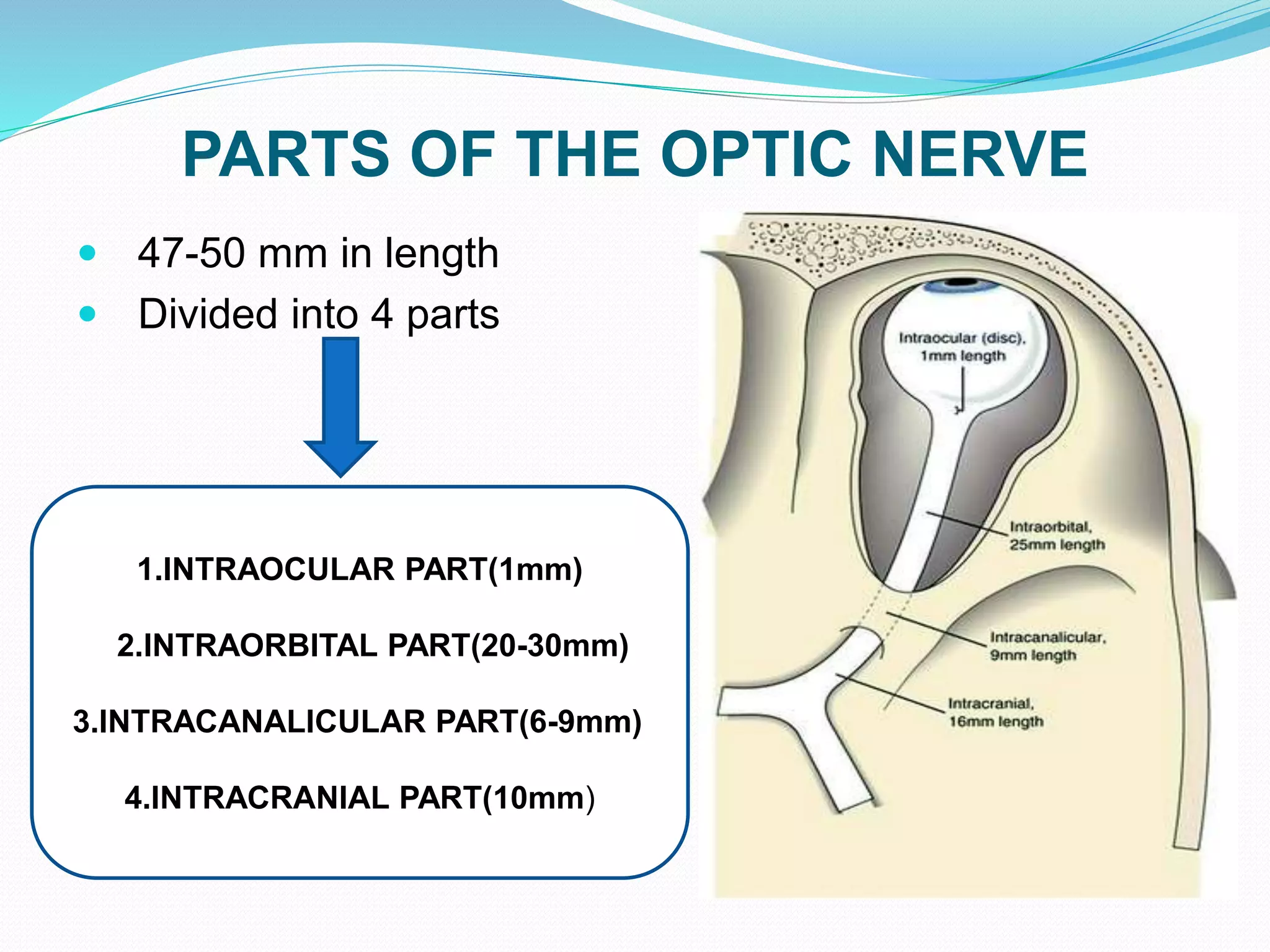
PARTS OF THE OPTIC NERVE
 47-50 mm in length
 Divided into 4 parts
1.INTRAOCULAR PART(1mm)
2.INTRAORBITAL PART(20-30mm)
3.INTRACANALICULAR PART(6-9mm)
4.INTRACRANIAL PART(10mm)
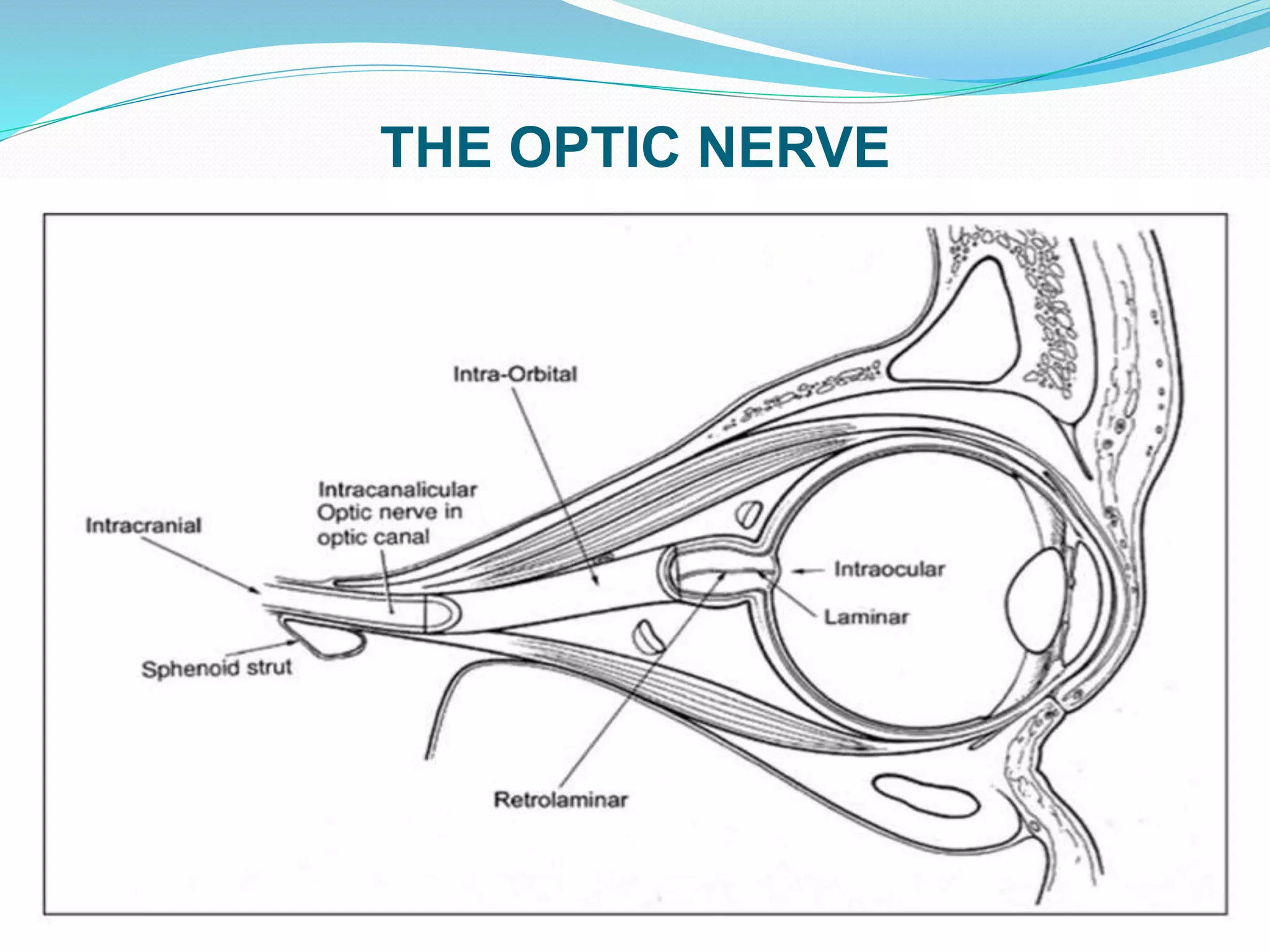
THE OPTIC NERVE
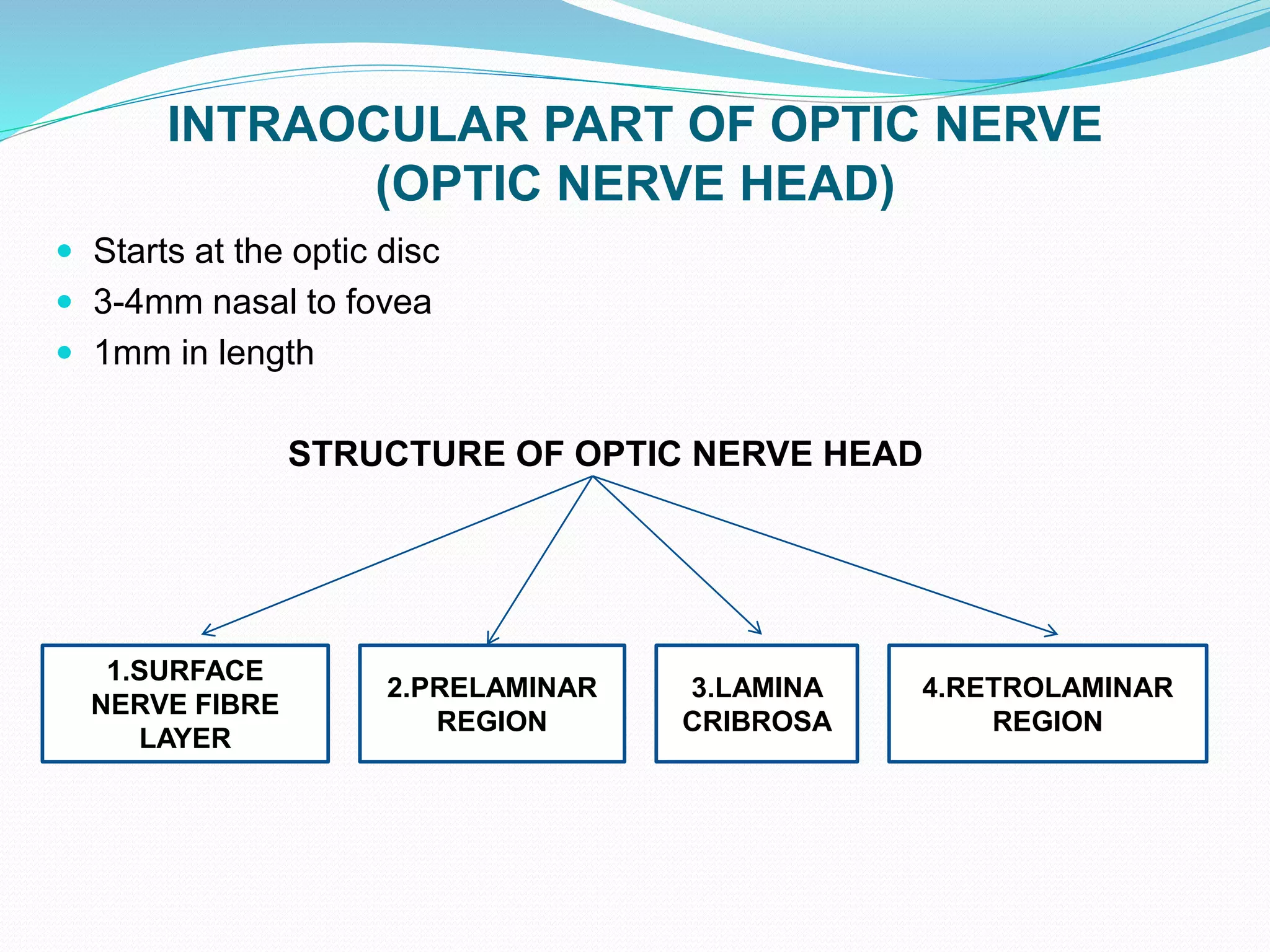
INTRAOCULAR PART OF OPTIC NERVE
(OPTIC NERVE HEAD)
 Starts at the optic disc
 3-4mm nasal to fovea
 1mm in length
STRUCTURE OF OPTIC NERVE HEAD
1.SURFACE
NERVE FIBRE
LAYER
2.PRELAMINAR
REGION
3.LAMINA
CRIBROSA
4.RETROLAMINAR
REGION
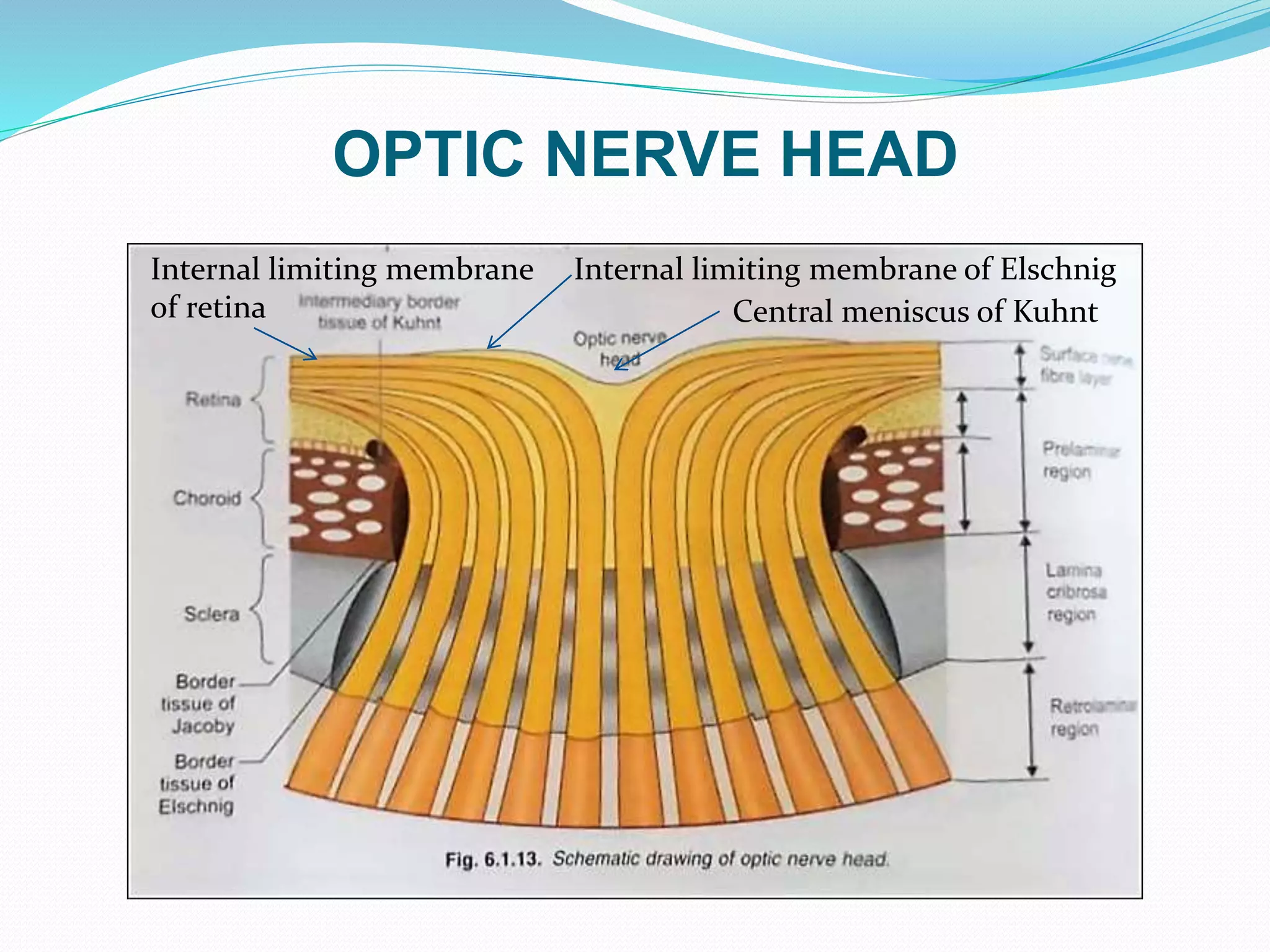
OPTIC NERVE HEAD
Central meniscus of Kuhnt
Internal limiting membrane
of retina
Internal limiting membrane of Elschnig
STRUCTURE OF OPTIC NERVE HEAD
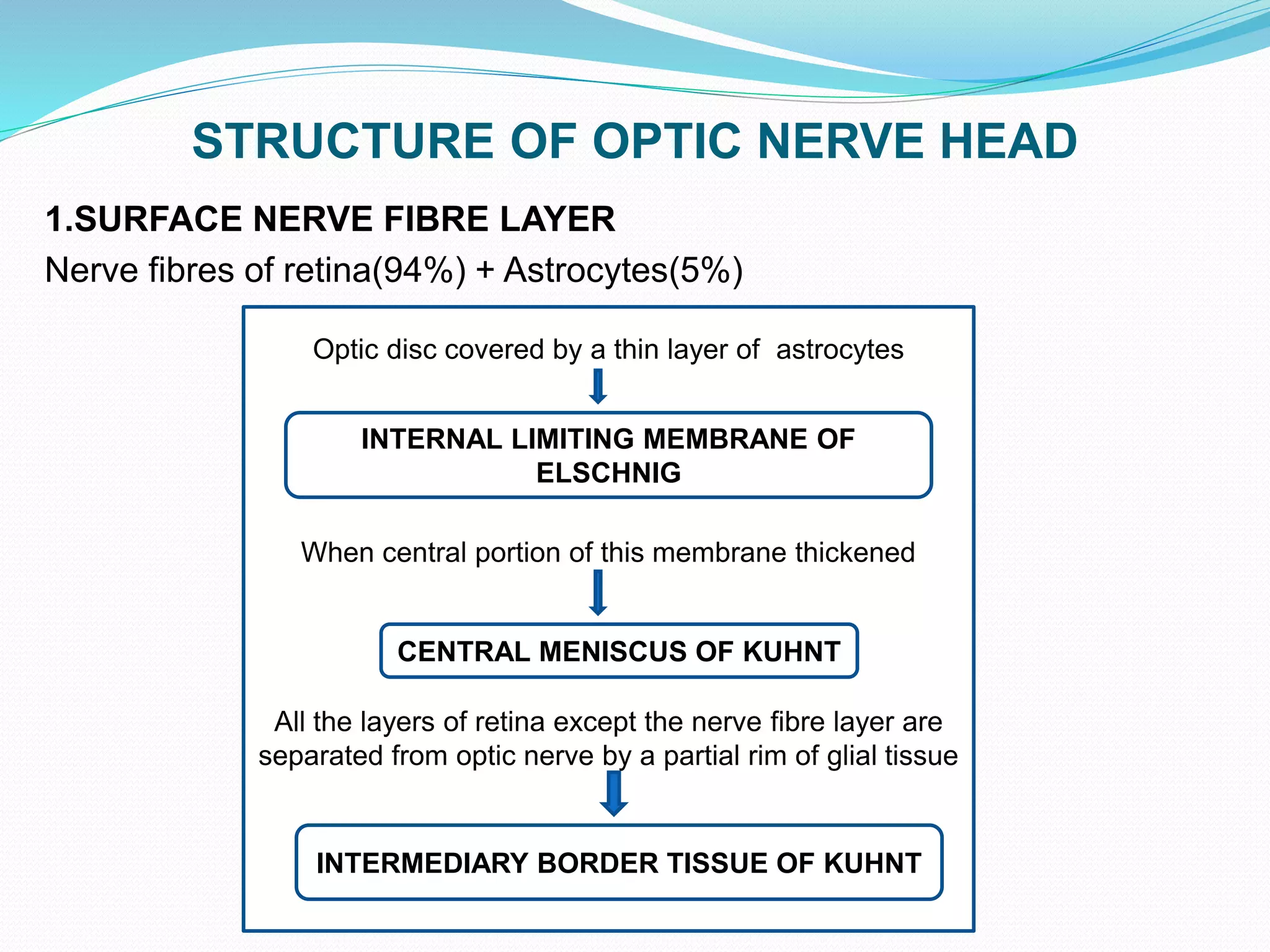
1.SURFACE NERVE FIBRE LAYER
Nerve fibres of retina(94%) + Astrocytes(5%)
Optic disc covered by a thin layer of astrocytes
When central portion of this membrane thickened
All the layers of retina except the nerve fibre layer are
separated from optic nerve by a partial rim of glial tissue
INTERNAL LIMITING MEMBRANE OF
ELSCHNIG
CENTRAL MENISCUS OF KUHNT
INTERMEDIARY BORDER TISSUE OF KUHNT
STRUCTURE OF OPTIC NERVE HEAD
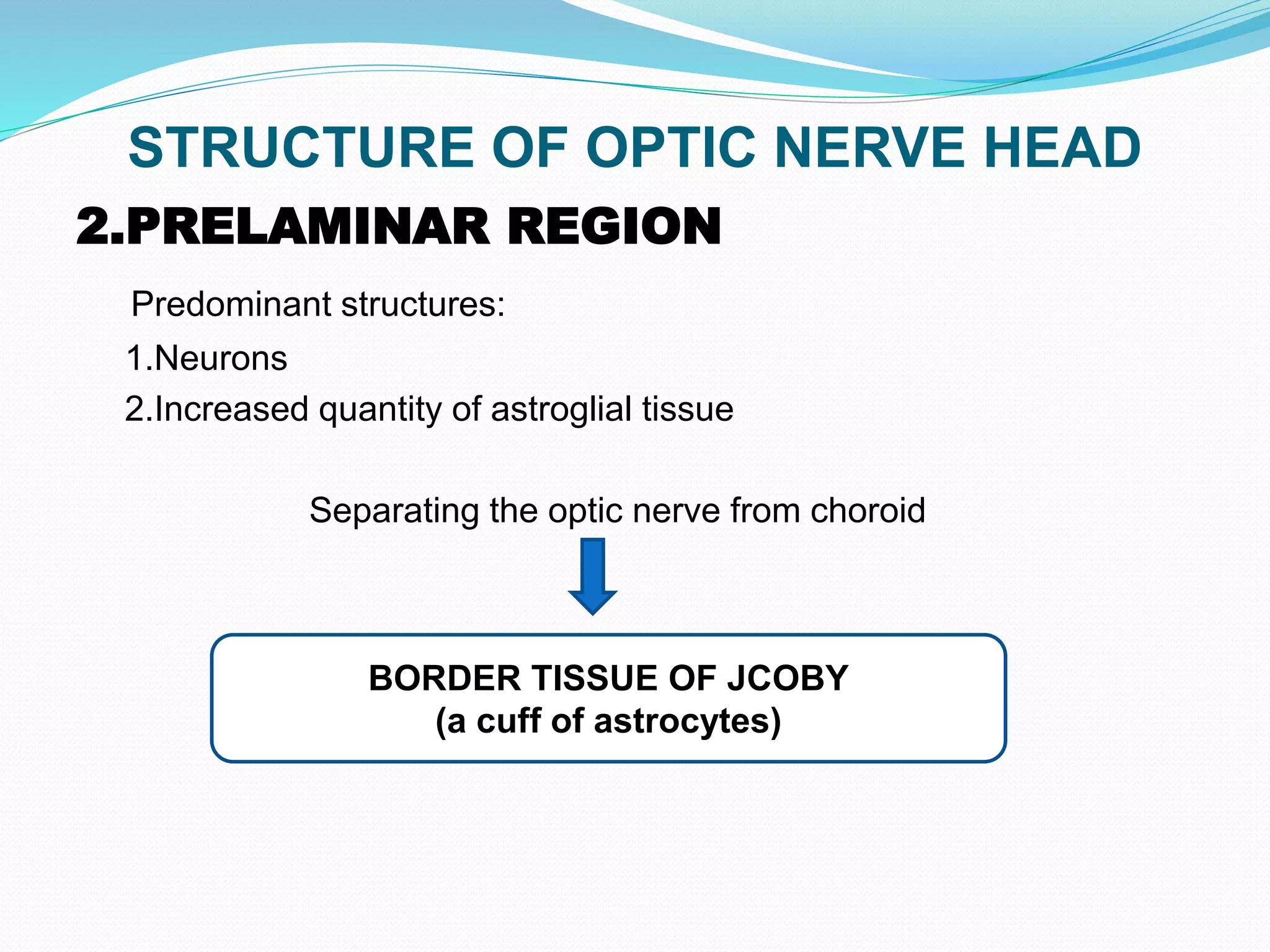
2.PRELAMINAR REGION
Predominant structures:
1.Neurons
2.Increased quantity of astroglial tissue
Separating the optic nerve from choroid
BORDER TISSUE OF JCOBY
(a cuff of astrocytes)
STRUCTURE OF OPTIC NERVE HEAD
3.LAMINA CRIBROSA:
 Main structural support of the optic nerve as it exits the globe.
 Fibrillar seive like structure
 Fenestrated sheets of scleral connective tissue lined by glial tissue
 Bridges posterior scleral foramina or scleral canal
Rim of collagenous connective tissue with admixture of glial cells
intervening between choroid and sclera and optic nerve fibres
BORDER TISSUE OF ELSCHNIG
STRUCTURE OF OPTIC NERVE HEAD
4.RETROLAMINAR REGION:
 Decrease in astrocytes
 Acquisition of myelin supplied by oligodendrocytes
 Addition of myelin sheath doubles the diameter of the optic nerve
(from 1.5-3mm) as it passes through sclera
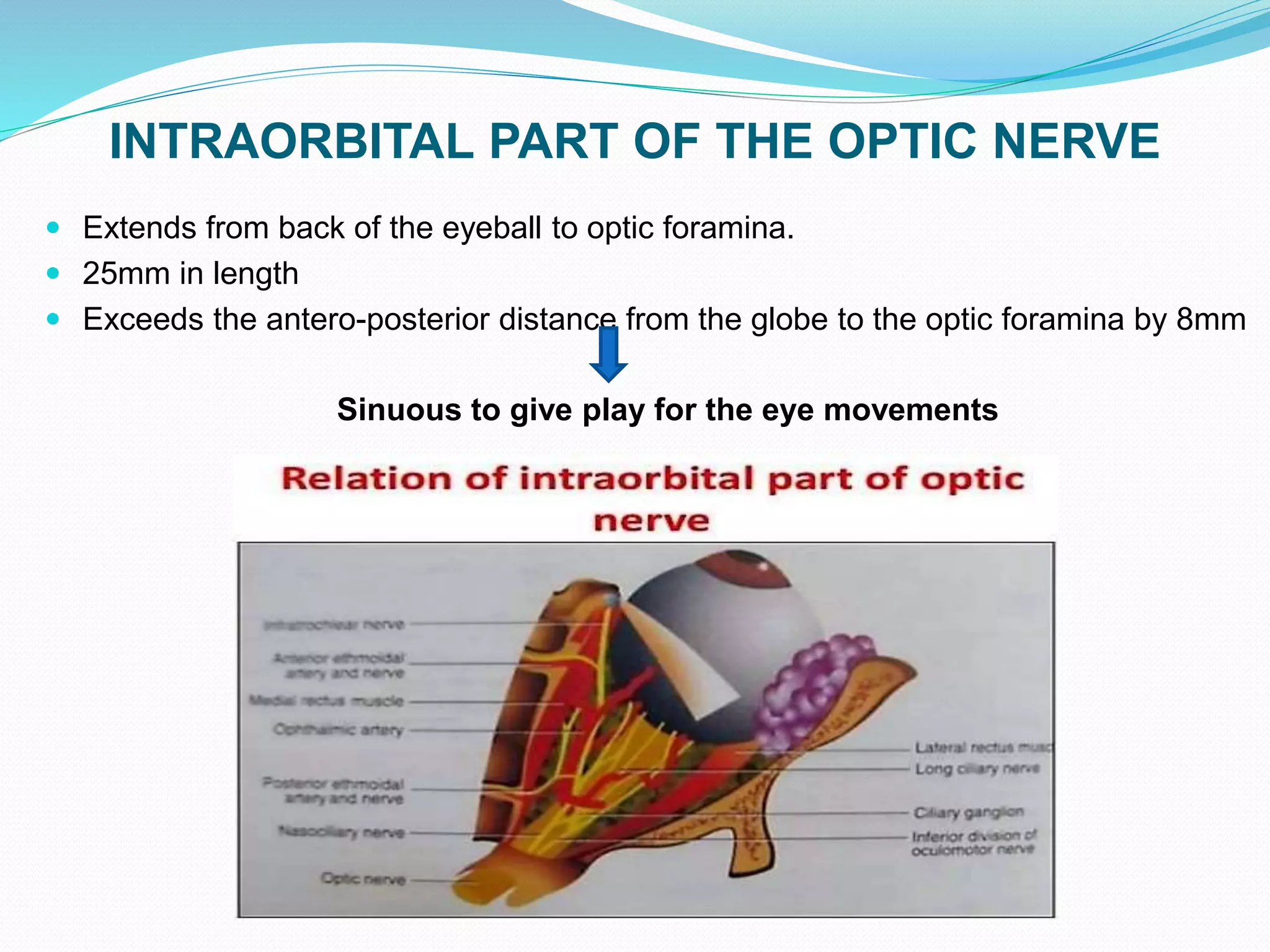
INTRAORBITAL PART OF THE OPTIC NERVE
 Extends from back of the eyeball to optic foramina.
 25mm in length
 Exceeds the antero-posterior distance from the globe to the optic foramina by 8mm
Sinuous to give play for the eye movements
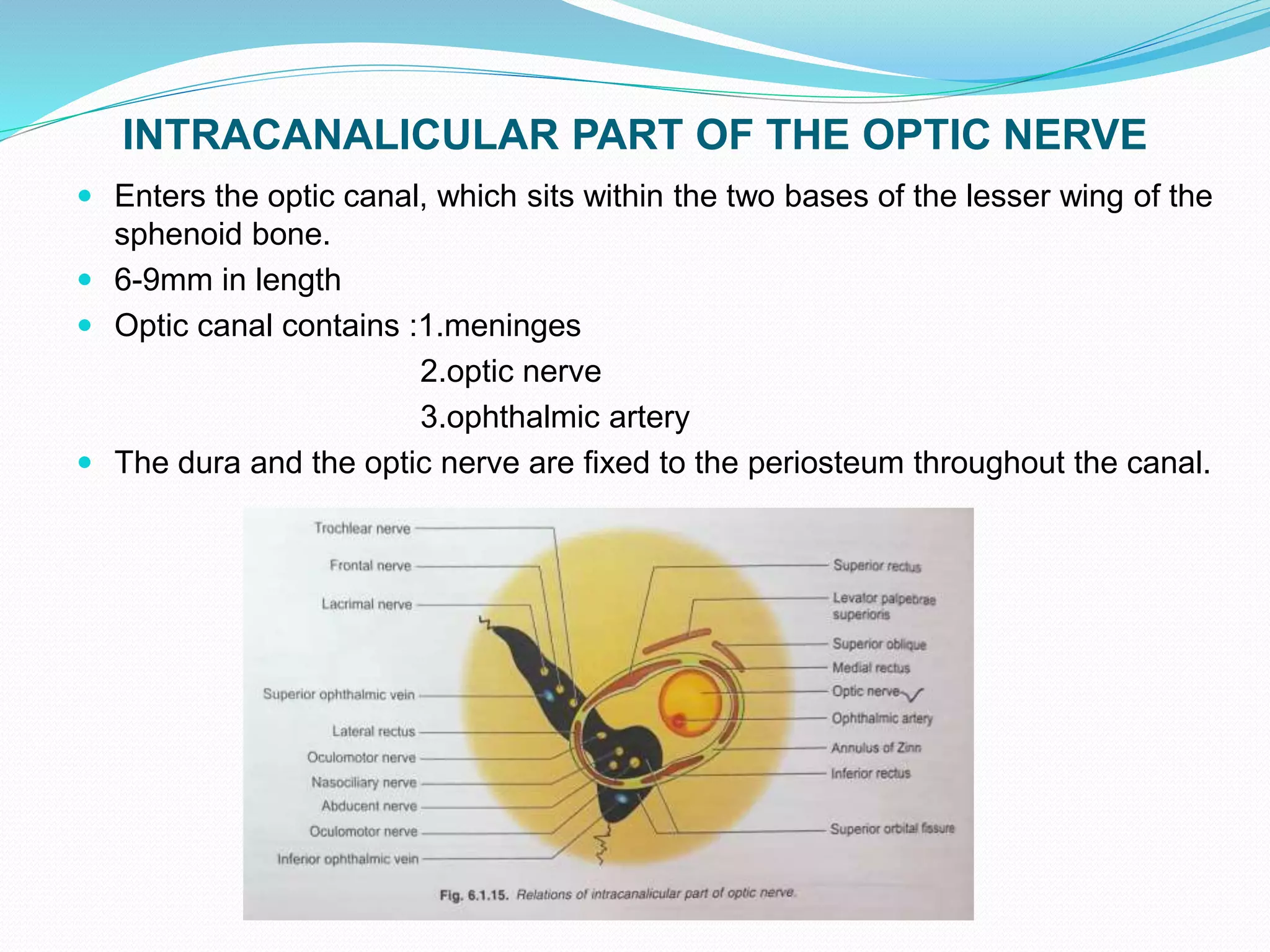
INTRACANALICULAR PART OF THE OPTIC NERVE
 Enters the optic canal, which sits within the two bases of the lesser wing of the
sphenoid bone.
 6-9mm in length
 Optic canal contains :1.meninges
2.optic nerve
3.ophthalmic artery
 The dura and the optic nerve are fixed to the periosteum throughout the canal.
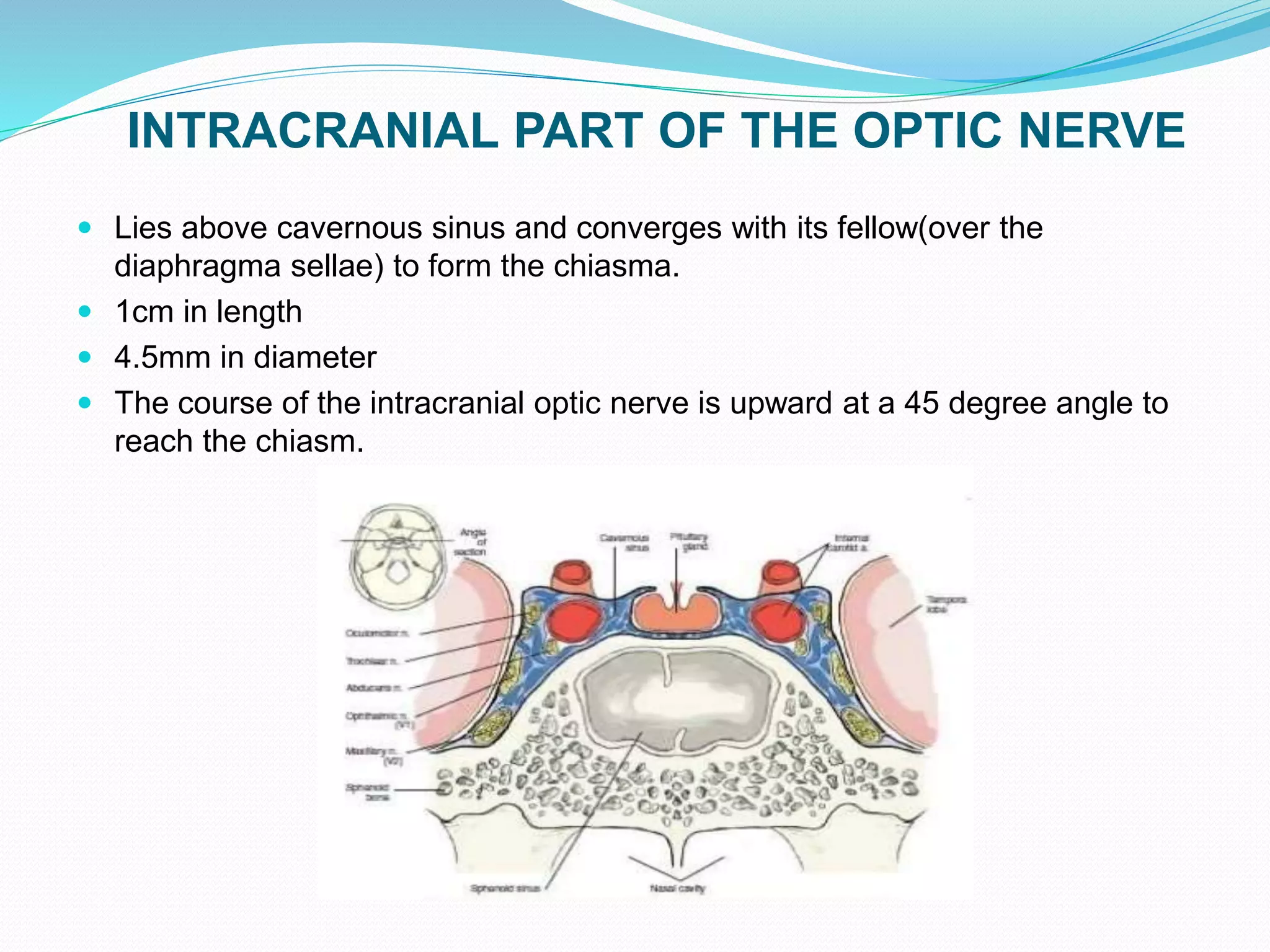
INTRACRANIAL PART OF THE OPTIC NERVE
 Lies above cavernous sinus and converges with its fellow(over the
diaphragma sellae) to form the chiasma.
 1cm in length
 4.5mm in diameter
 The course of the intracranial optic nerve is upward at a 45 degree angle to
reach the chiasm.
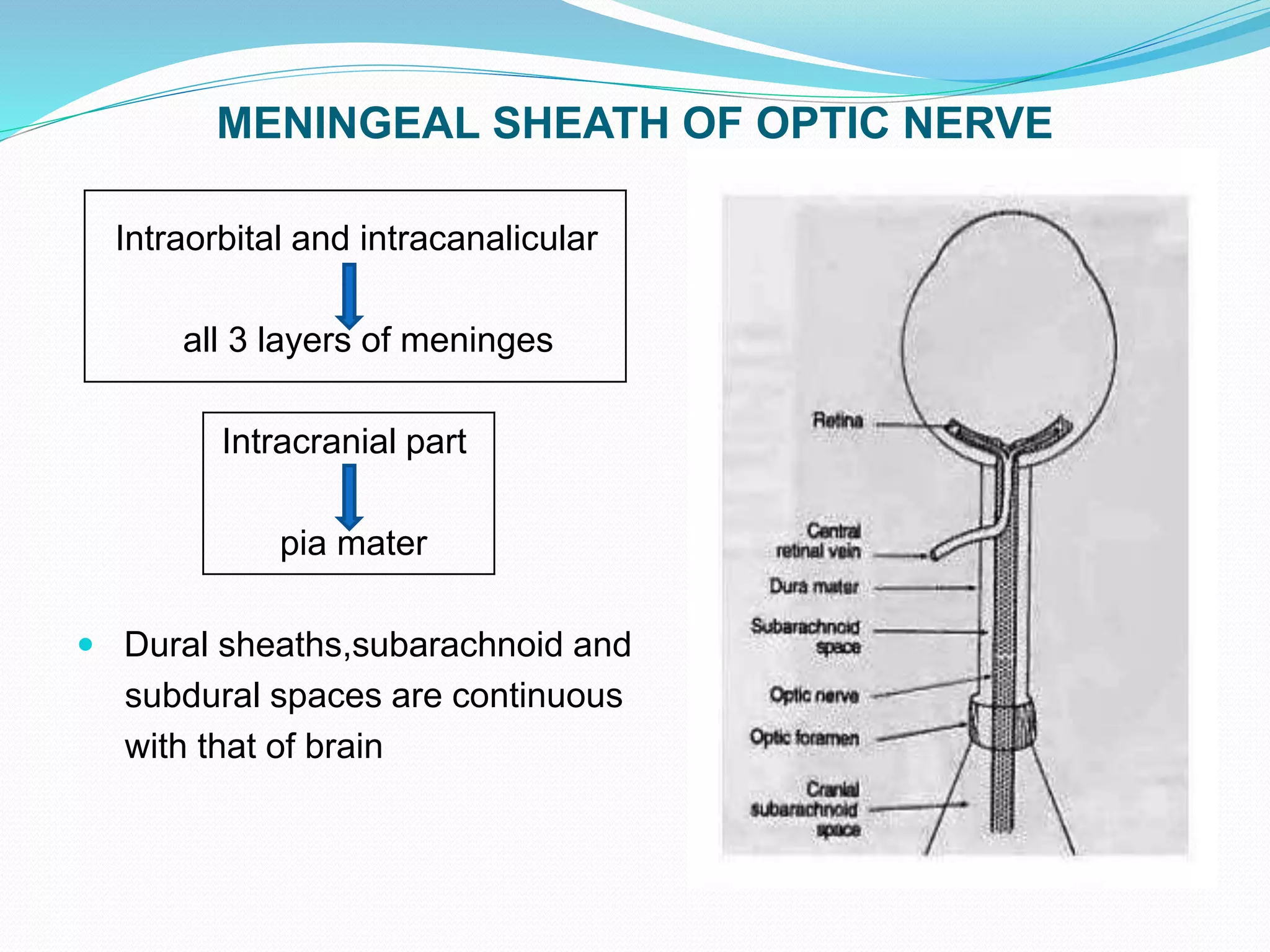
MENINGEAL SHEATH OF OPTIC NERVE
Intraorbital and intracanalicular
all 3 layers of meninges
Intracranial part
pia mater
 Dural sheaths,subarachnoid and
subdural spaces are continuous
with that of brain
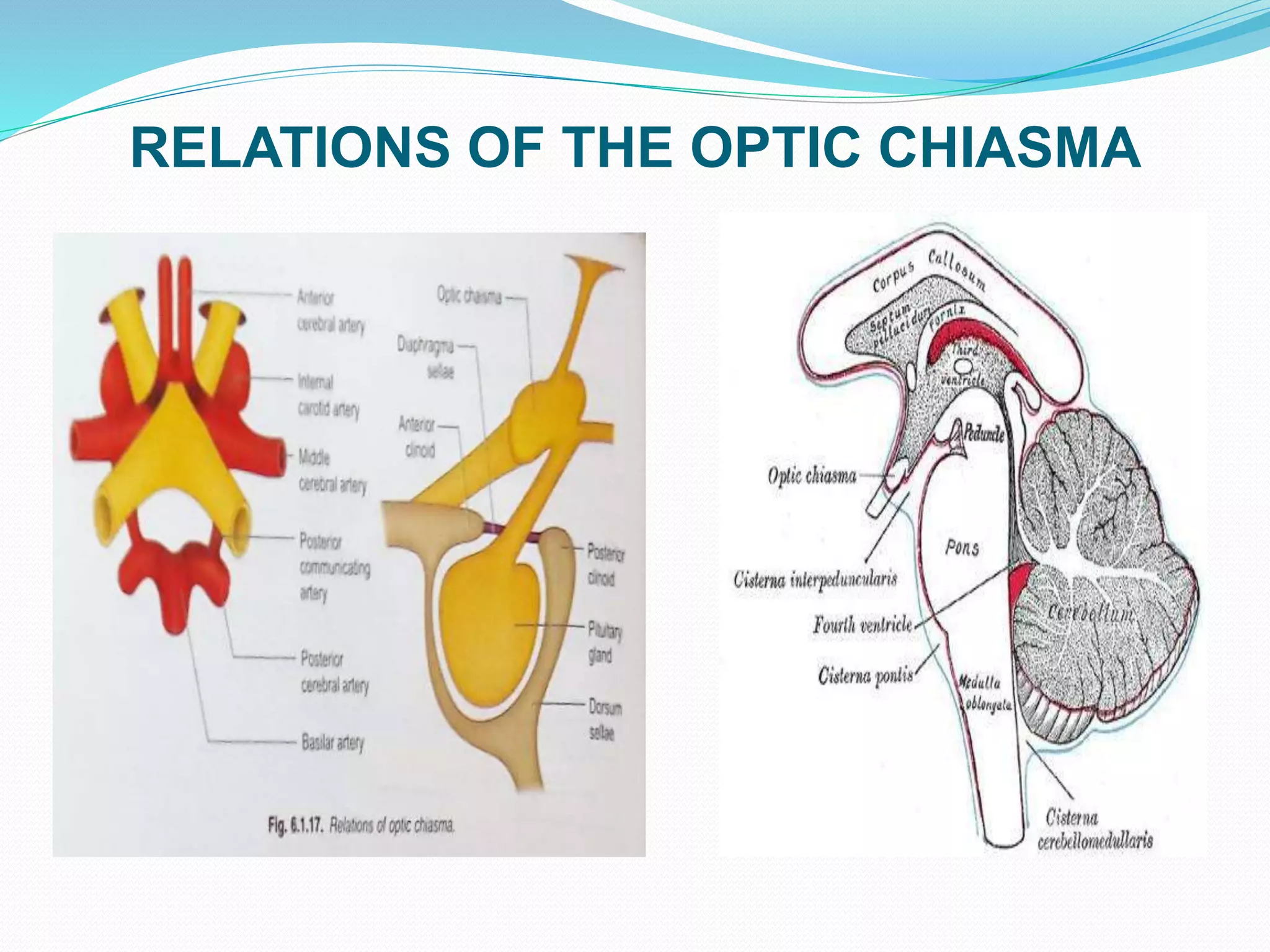
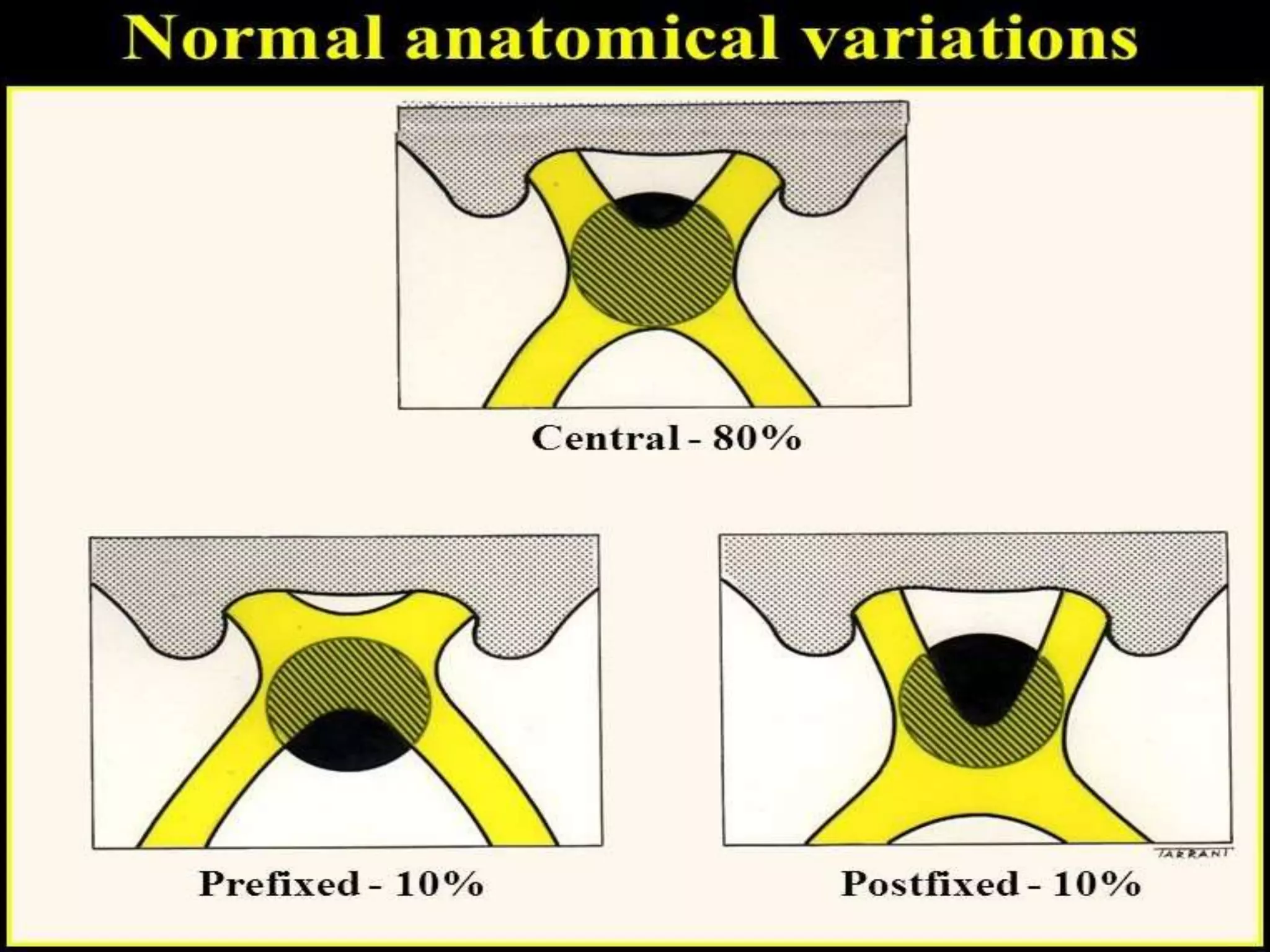
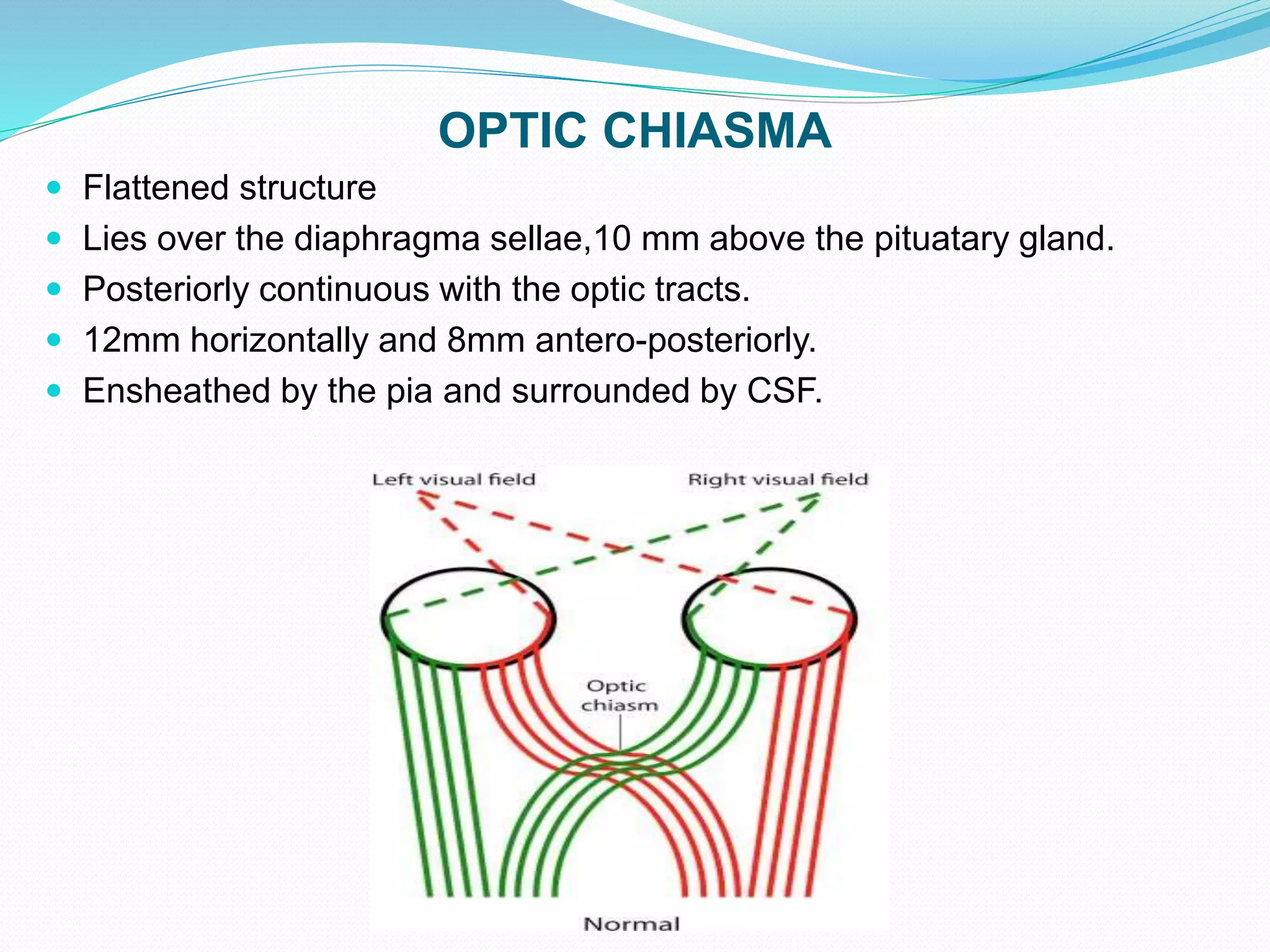
OPTIC CHIASMA
 Flattened structure
 Lies over the diaphragma sellae,10 mm above the pituatary gland.
 Posteriorly continuous with the optic tracts.
 12mm horizontally and 8mm antero-posteriorly.
 Ensheathed by the pia and surrounded by CSF.
RELATIONS OF THE OPTIC CHIASMA
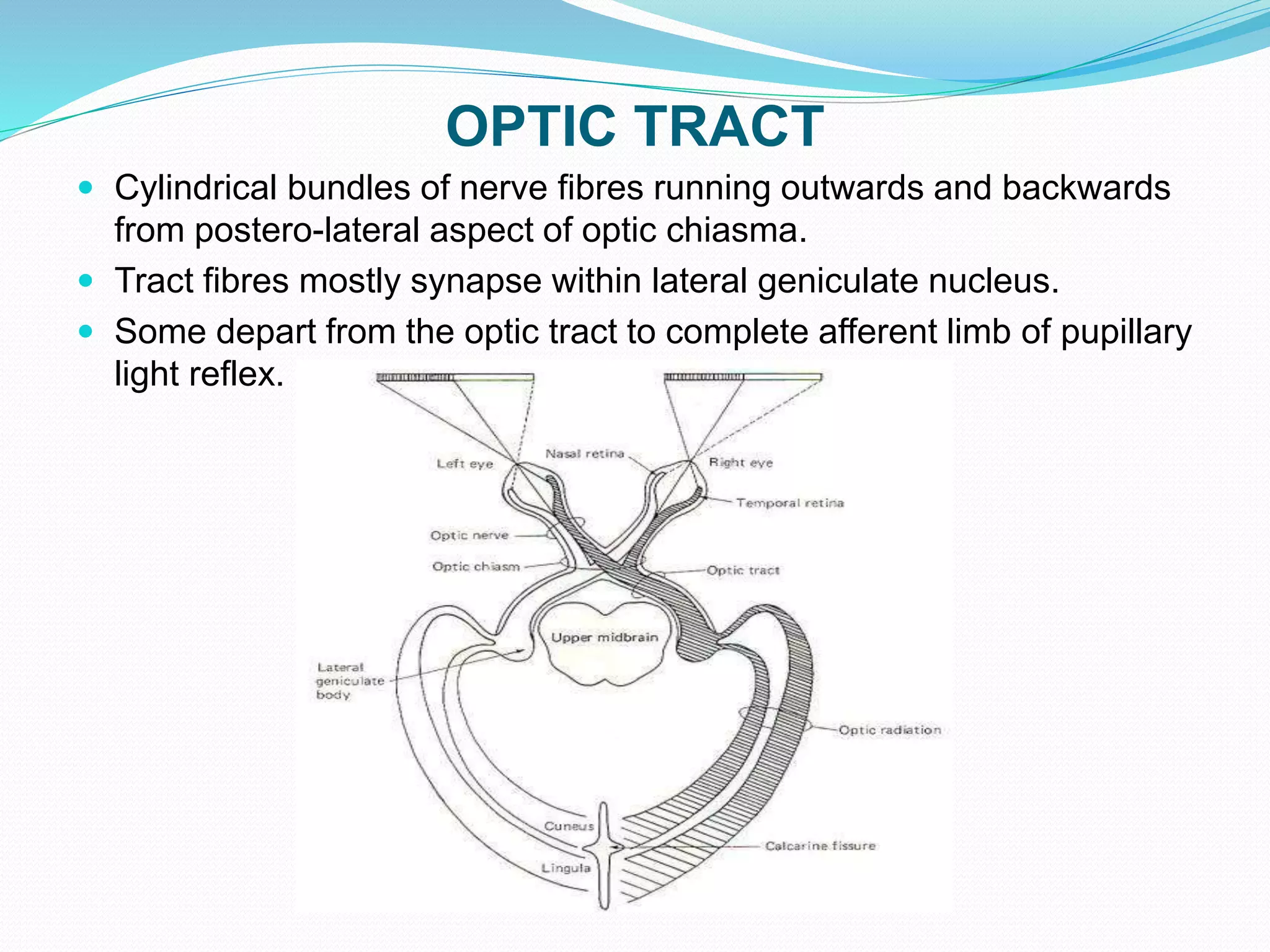
OPTIC TRACT
 Cylindrical bundles of nerve fibres running outwards and backwards
from postero-lateral aspect of optic chiasma.
 Tract fibres mostly synapse within lateral geniculate nucleus.
 Some depart from the optic tract to complete afferent limb of pupillary
light reflex.
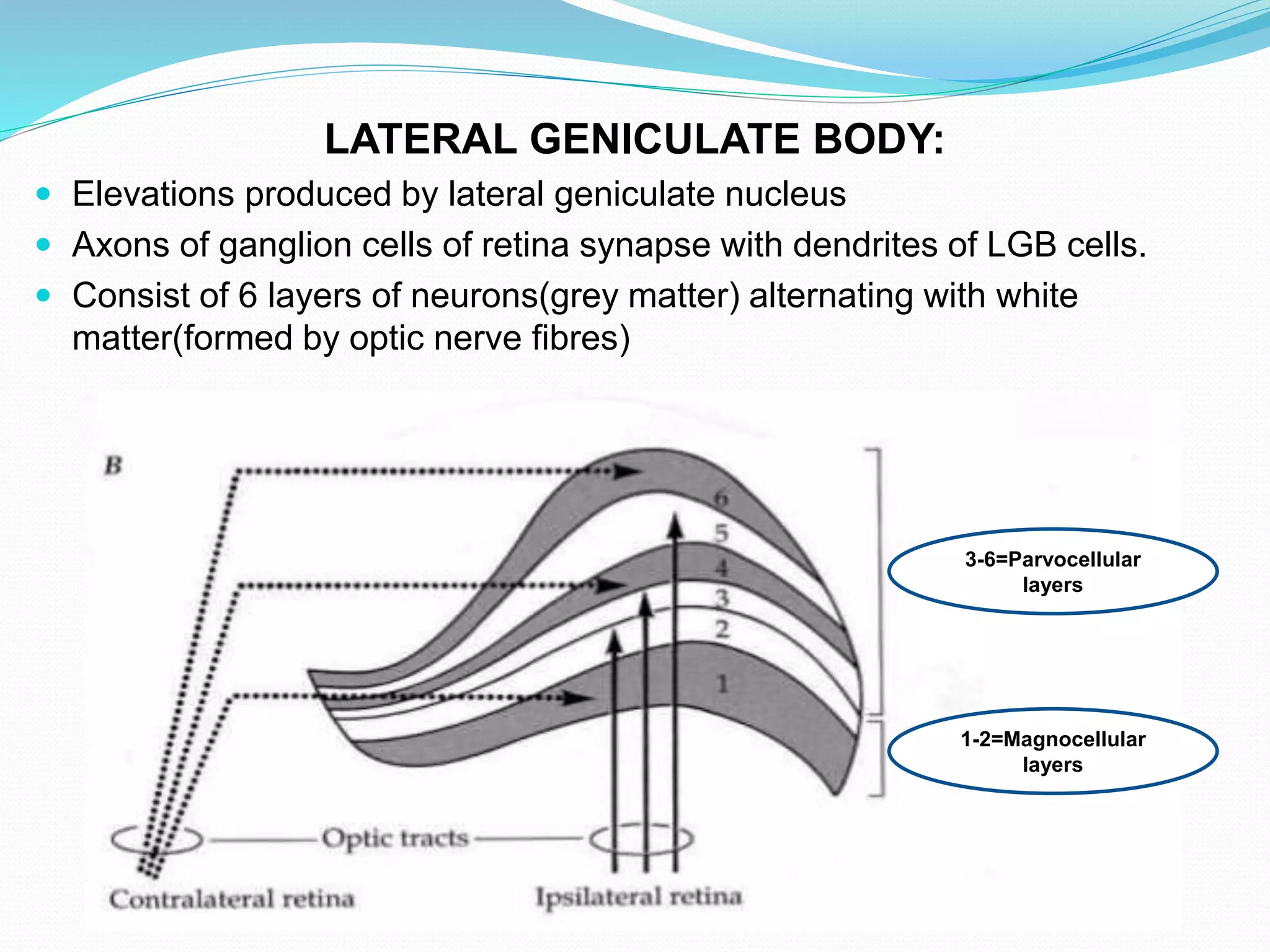
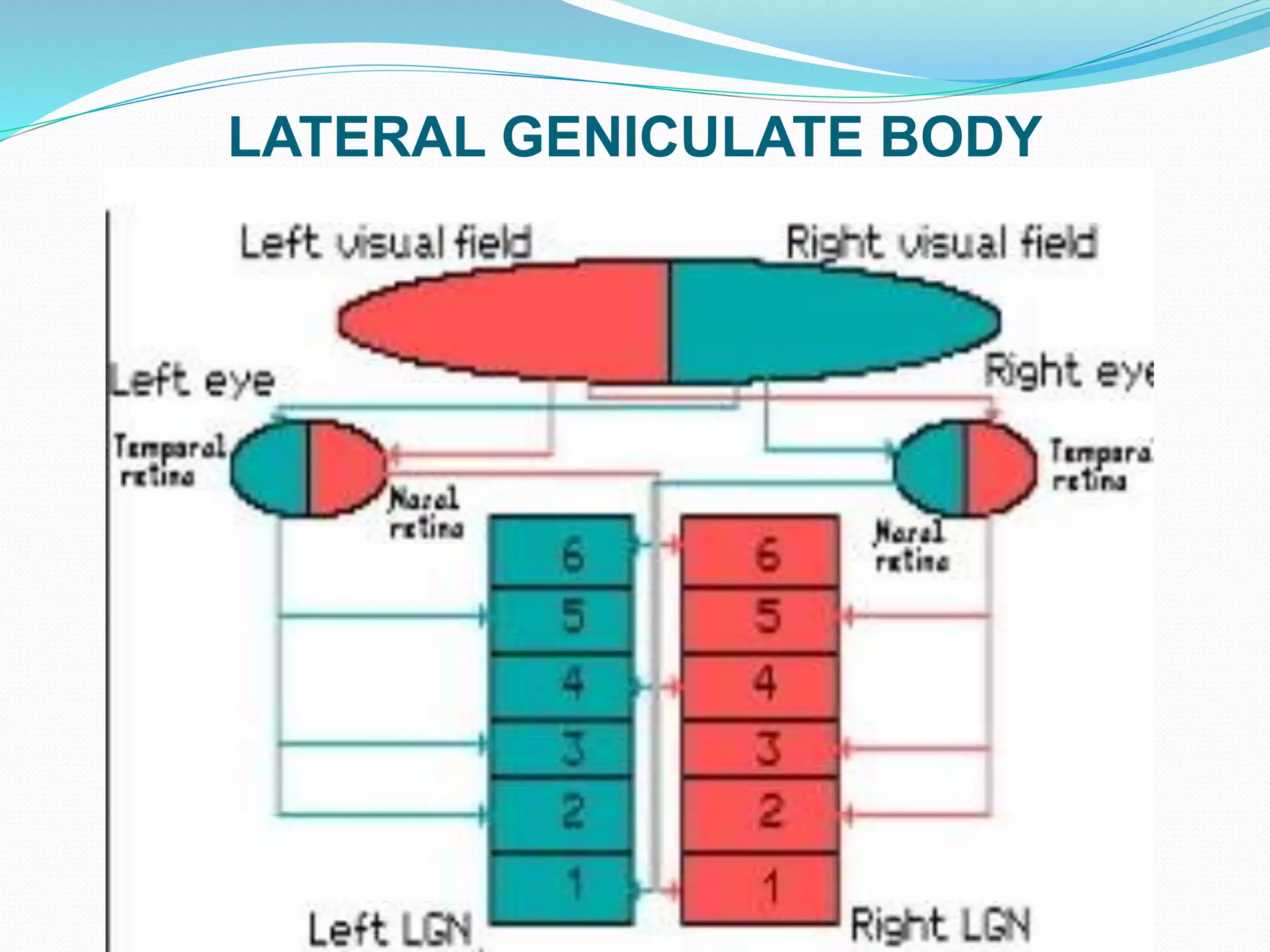
LATERAL GENICULATE BODY:
 Elevations produced by lateral geniculate nucleus
 Axons of ganglion cells of retina synapse with dendrites of LGB cells.
 Consist of 6 layers of neurons(grey matter) alternating with white
matter(formed by optic nerve fibres)
3-6=Parvocellular
layers
1-2=Magnocellular
layers
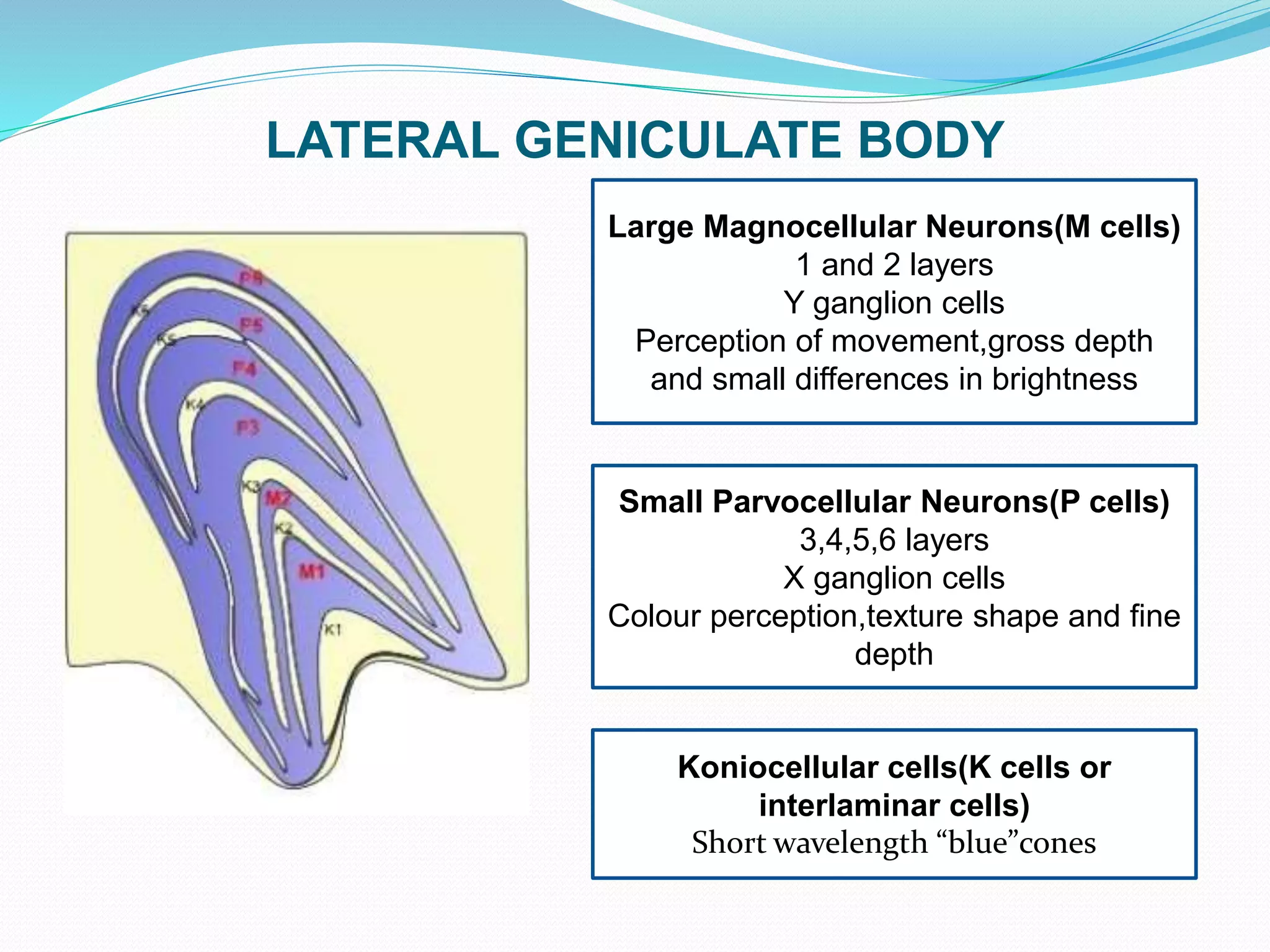
LATERAL GENICULATE BODY
Large Magnocellular Neurons(M cells)
1 and 2 layers
Y ganglion cells
Perception of movement,gross depth
and small differences in brightness
Small Parvocellular Neurons(P cells)
3,4,5,6 layers
X ganglion cells
Colour perception,texture shape and fine
depth
Koniocellular cells(K cells or
interlaminar cells)
Short wavelength “blue”cones
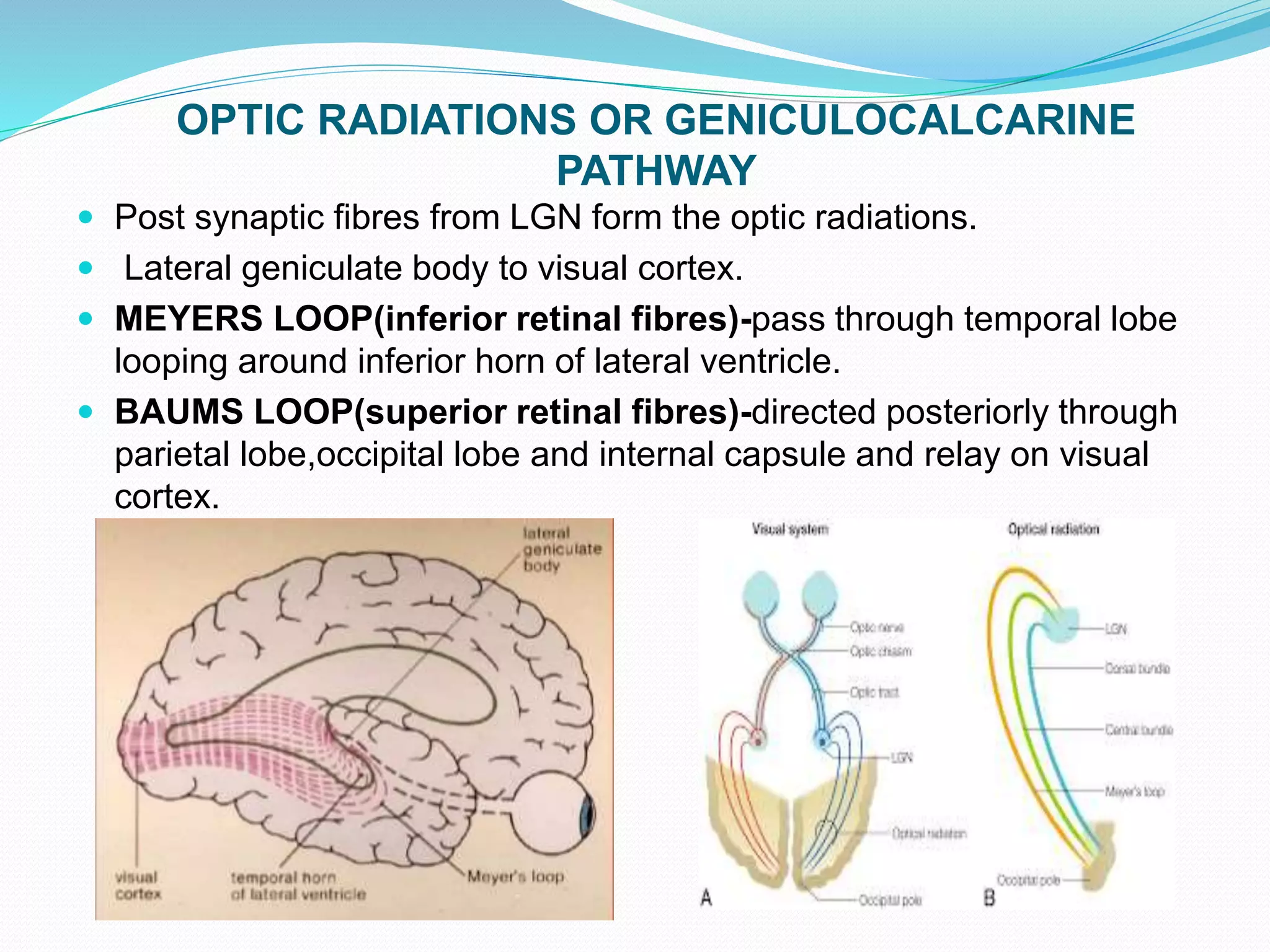
OPTIC RADIATIONS OR GENICULOCALCARINE
PATHWAY
 Post synaptic fibres from LGN form the optic radiations.
 Lateral geniculate body to visual cortex.
 MEYERS LOOP(inferior retinal fibres)-pass through temporal lobe
looping around inferior horn of lateral ventricle.
 BAUMS LOOP(superior retinal fibres)-directed posteriorly through
parietal lobe,occipital lobe and internal capsule and relay on visual
cortex.
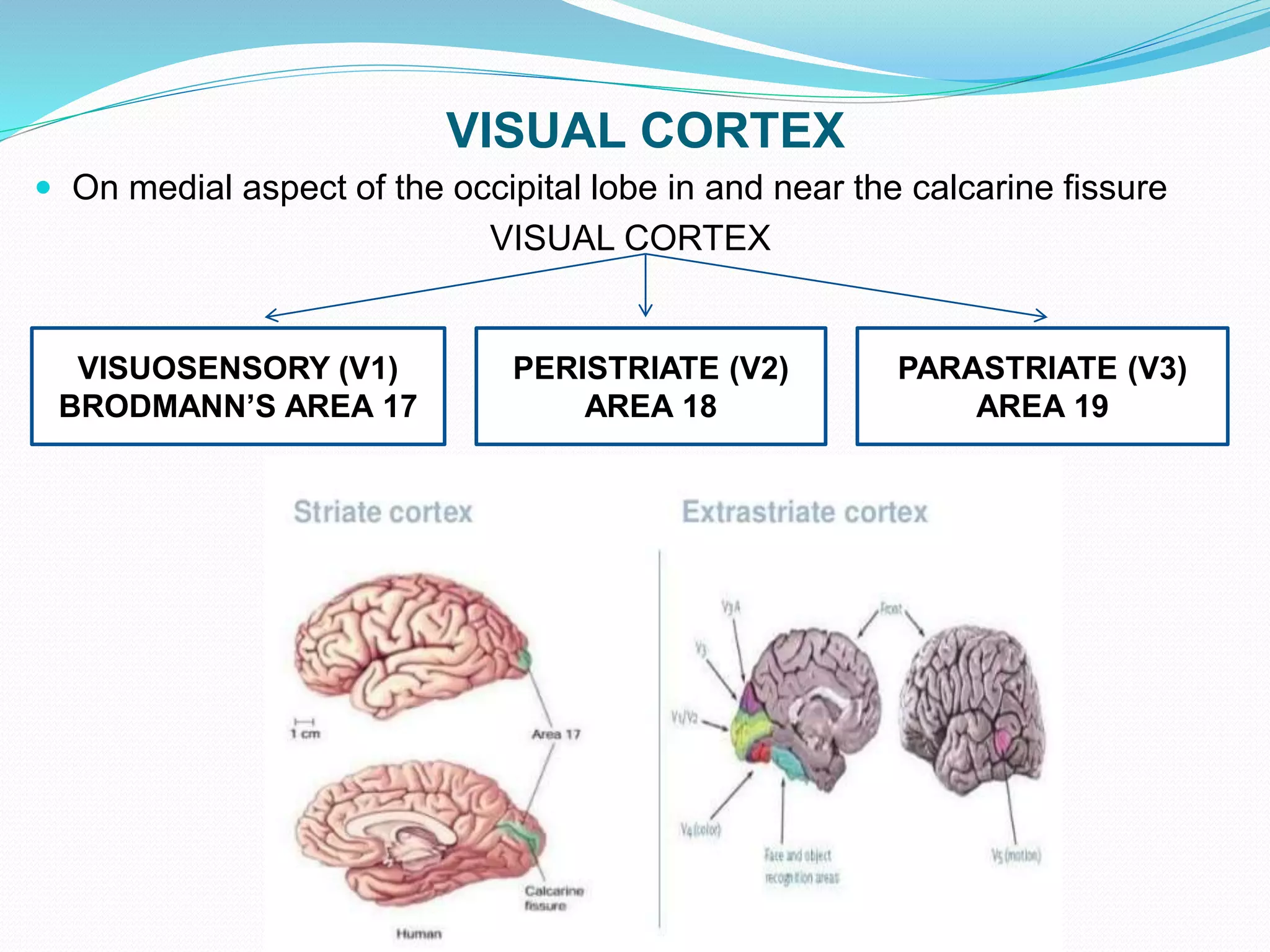
VISUAL CORTEX
 On medial aspect of the occipital lobe in and near the calcarine fissure
VISUAL CORTEX
VISUOSENSORY (V1)
BRODMANN’S AREA 17
PERISTRIATE (V2)
AREA 18
PARASTRIATE (V3)
AREA 19
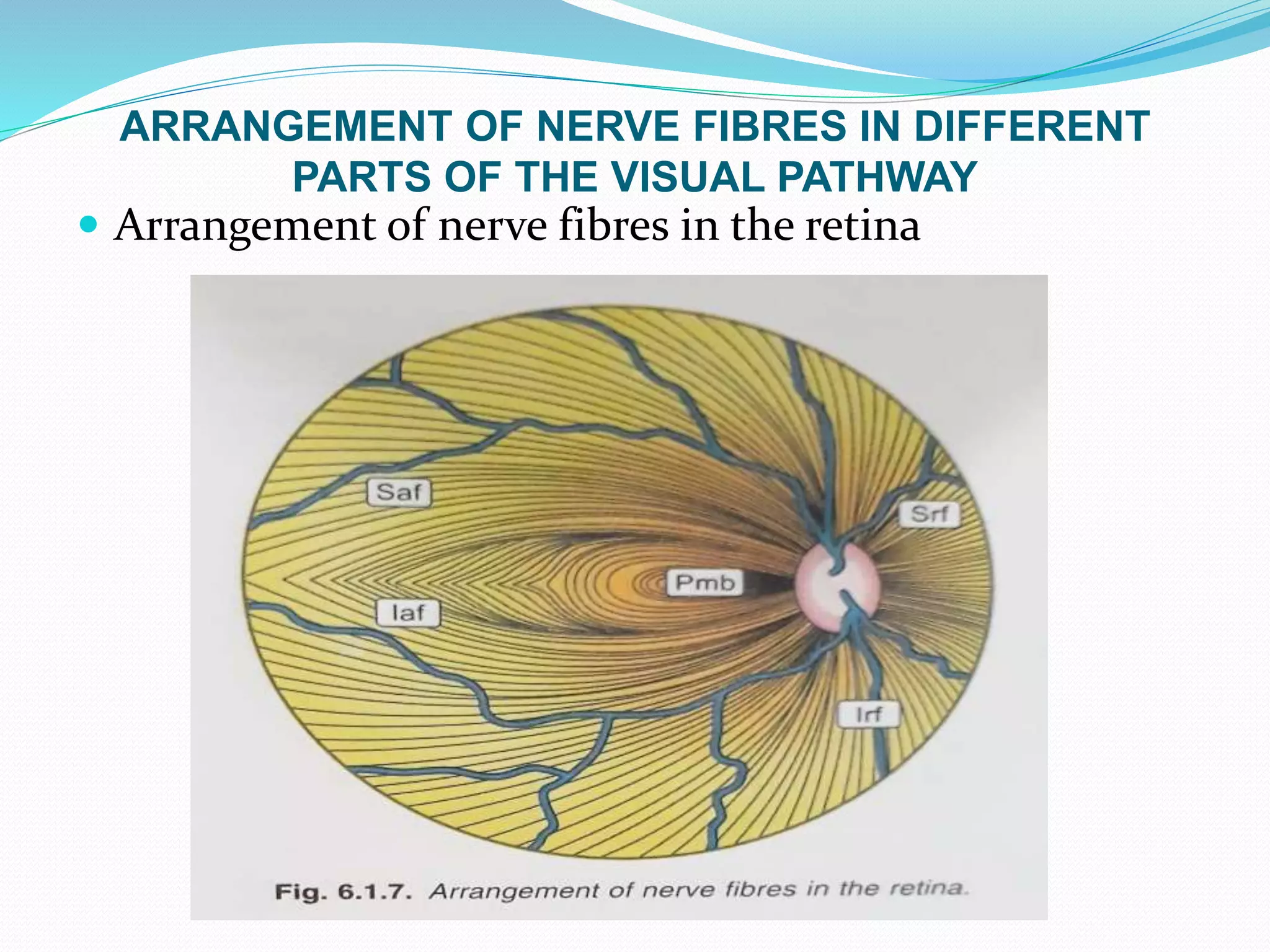
ARRANGEMENT OF NERVE FIBRES IN DIFFERENT
PARTS OF THE VISUAL PATHWAY
 Arrangement of nerve fibres in the retina
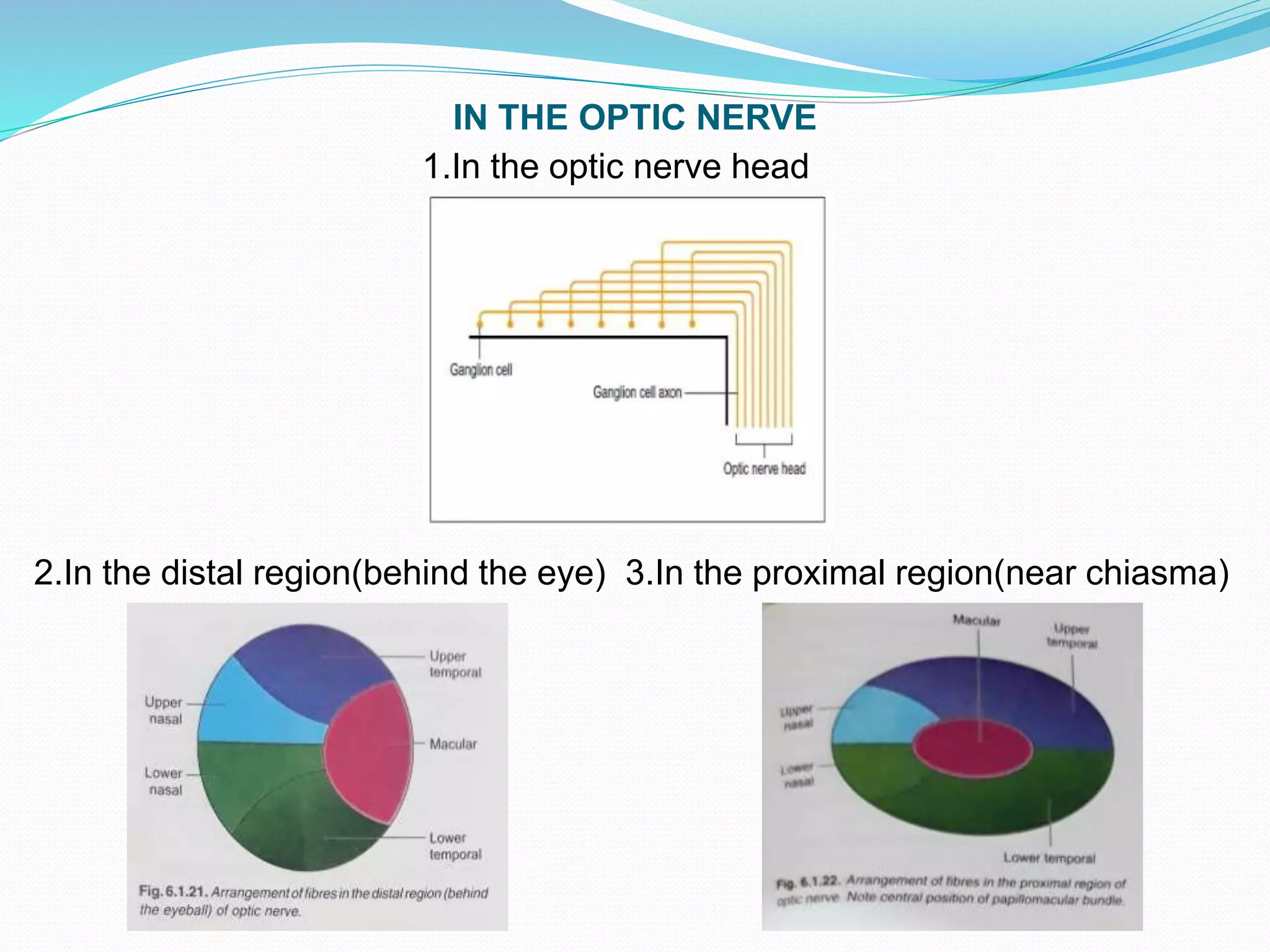
IN THE OPTIC NERVE
1.In the optic nerve head
2.In the distal region(behind the eye) 3.In the proximal region(near chiasma)
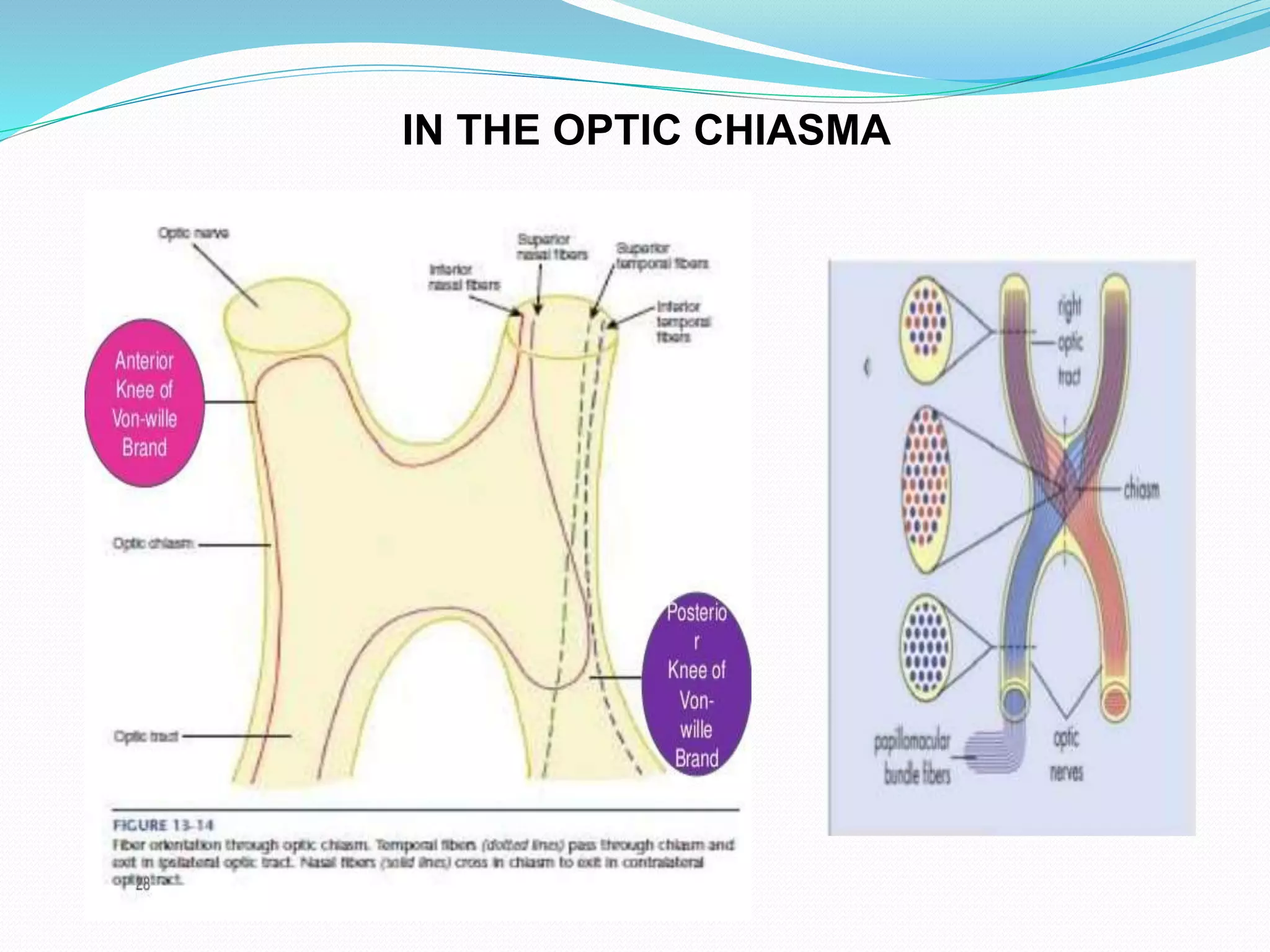
IN THE OPTIC CHIASMA
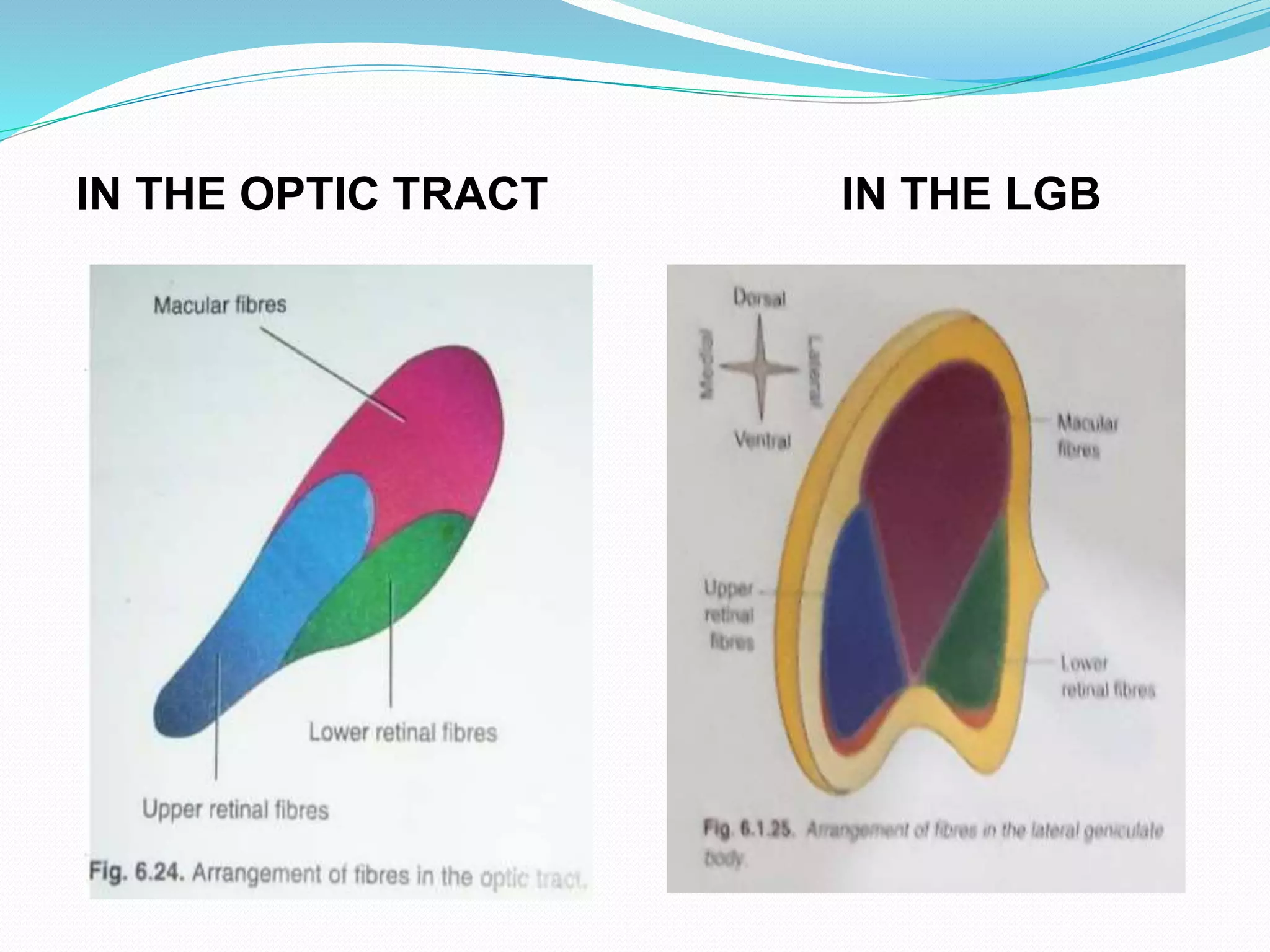
IN THE OPTIC TRACT IN THE LGB
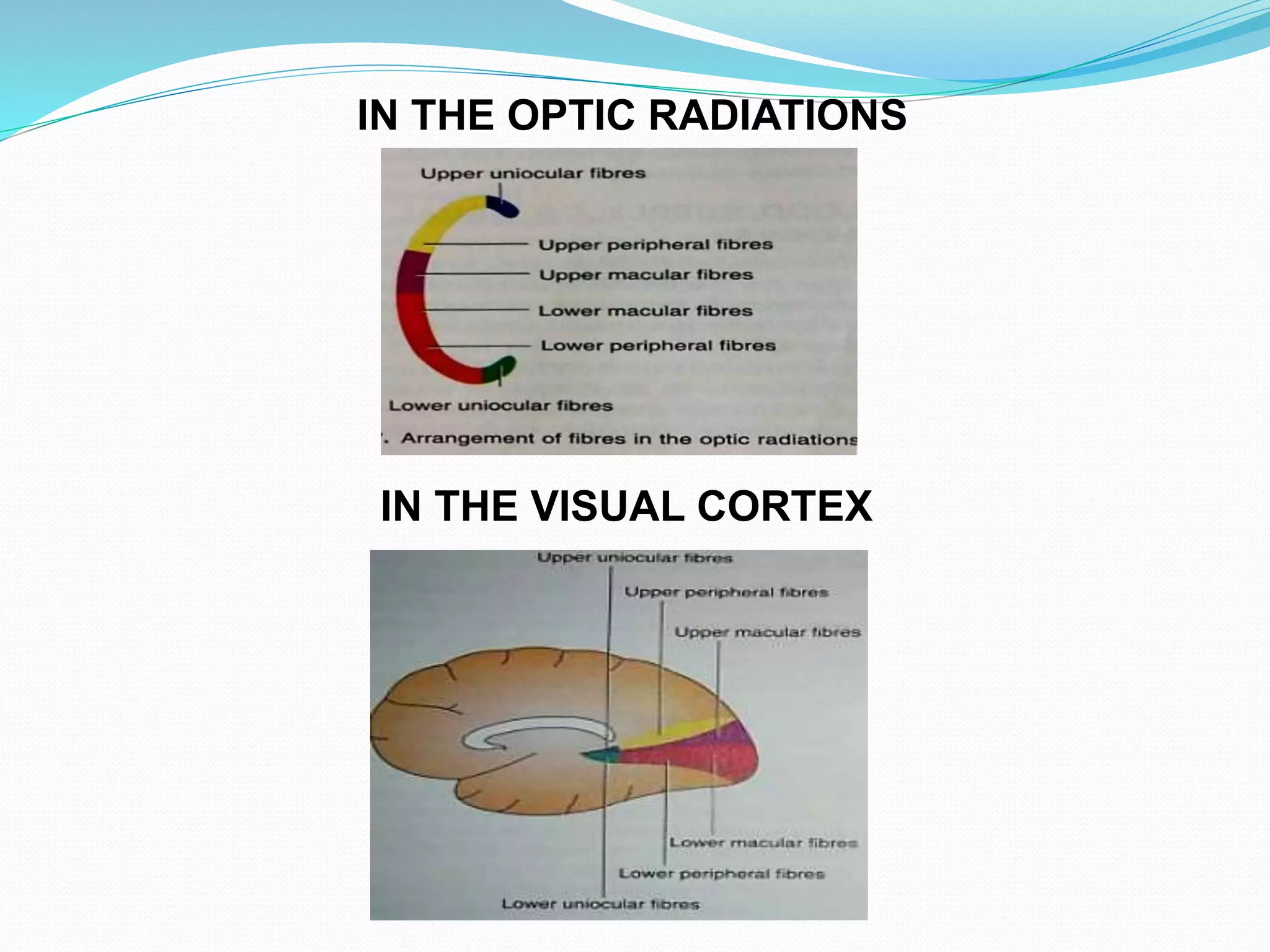
IN THE OPTIC RADIATIONS
IN THE VISUAL CORTEX
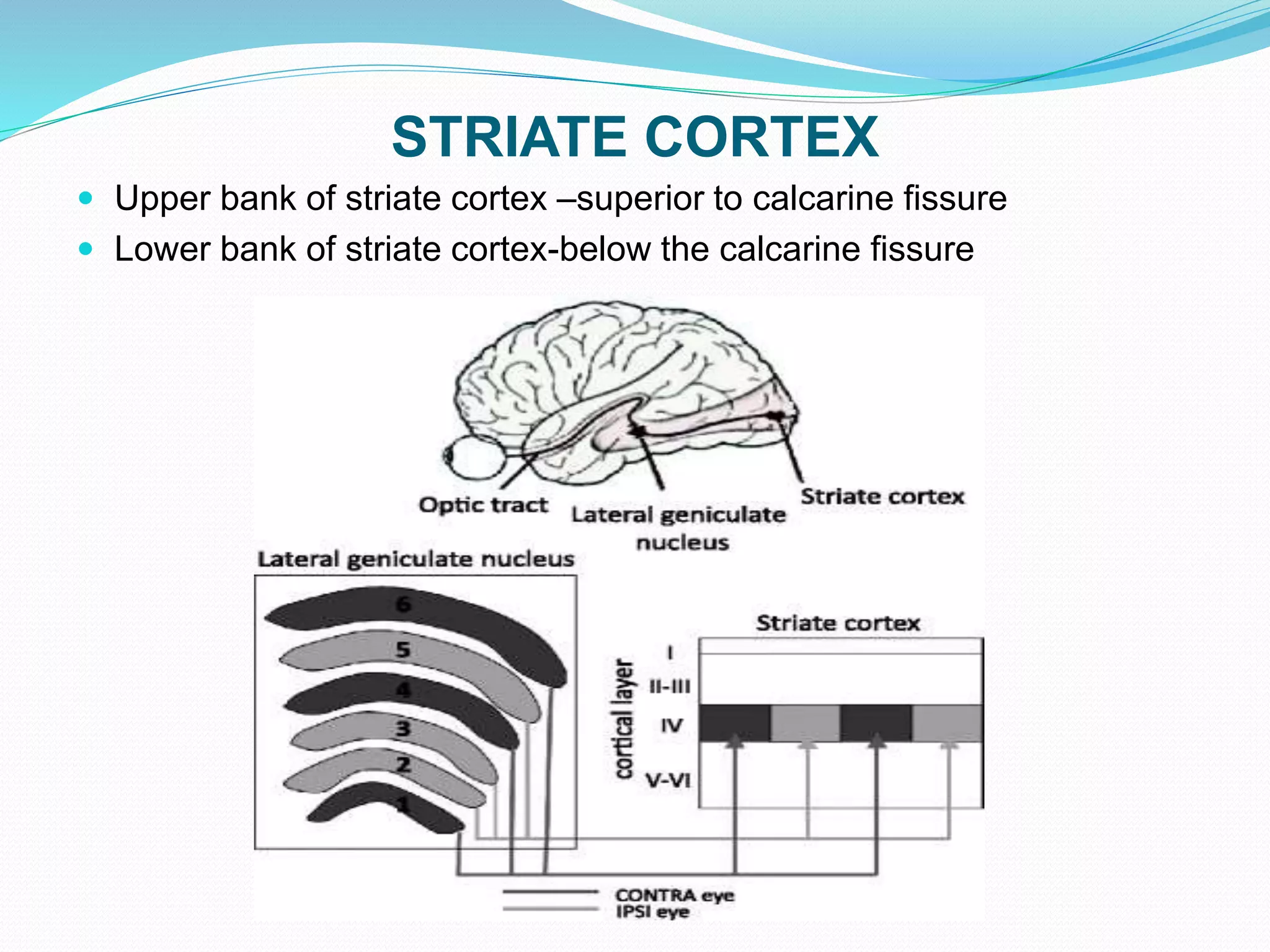
STRIATE CORTEX
 Upper bank of striate cortex –superior to calcarine fissure
 Lower bank of striate cortex-below the calcarine fissure
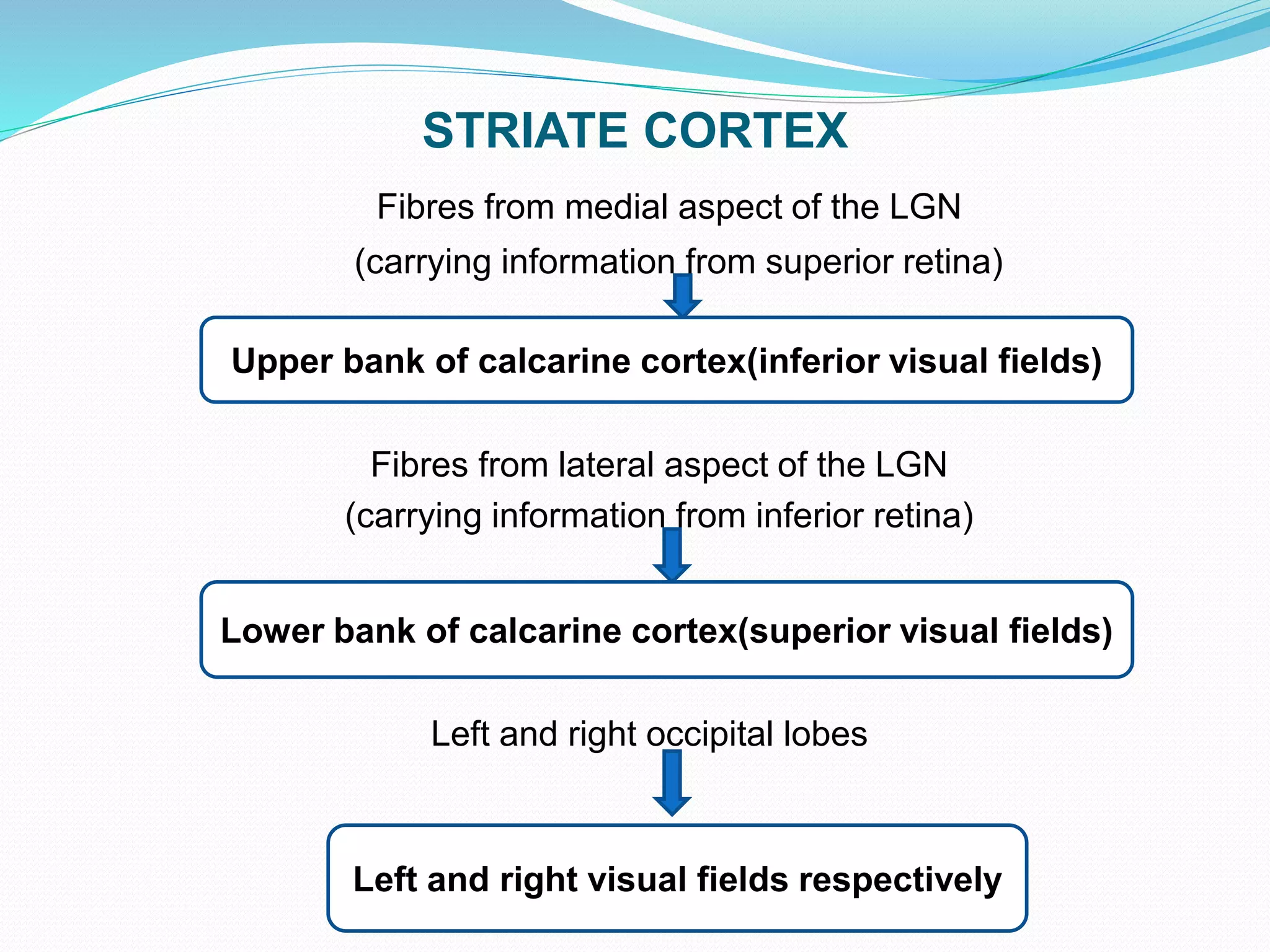
STRIATE CORTEX
Fibres from medial aspect of the LGN
(carrying information from superior retina)
Fibres from lateral aspect of the LGN
(carrying information from inferior retina)
Left and right occipital lobes
Upper bank of calcarine cortex(inferior visual fields)
Lower bank of calcarine cortex(superior visual fields)
Left and right visual fields respectively
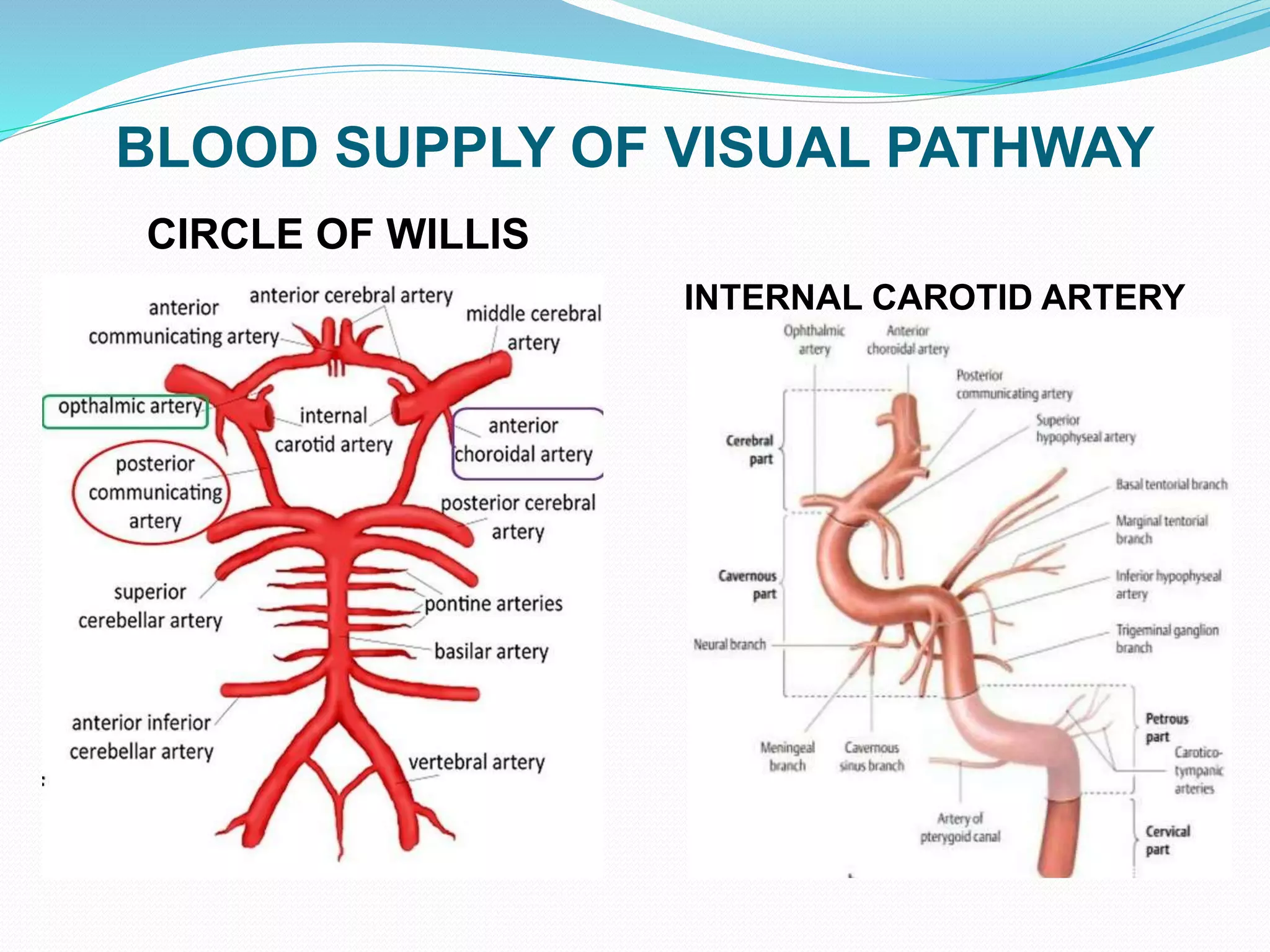
BLOOD SUPPLY OF VISUAL PATHWAY
CIRCLE OF WILLIS
INTERNAL CAROTID ARTERY
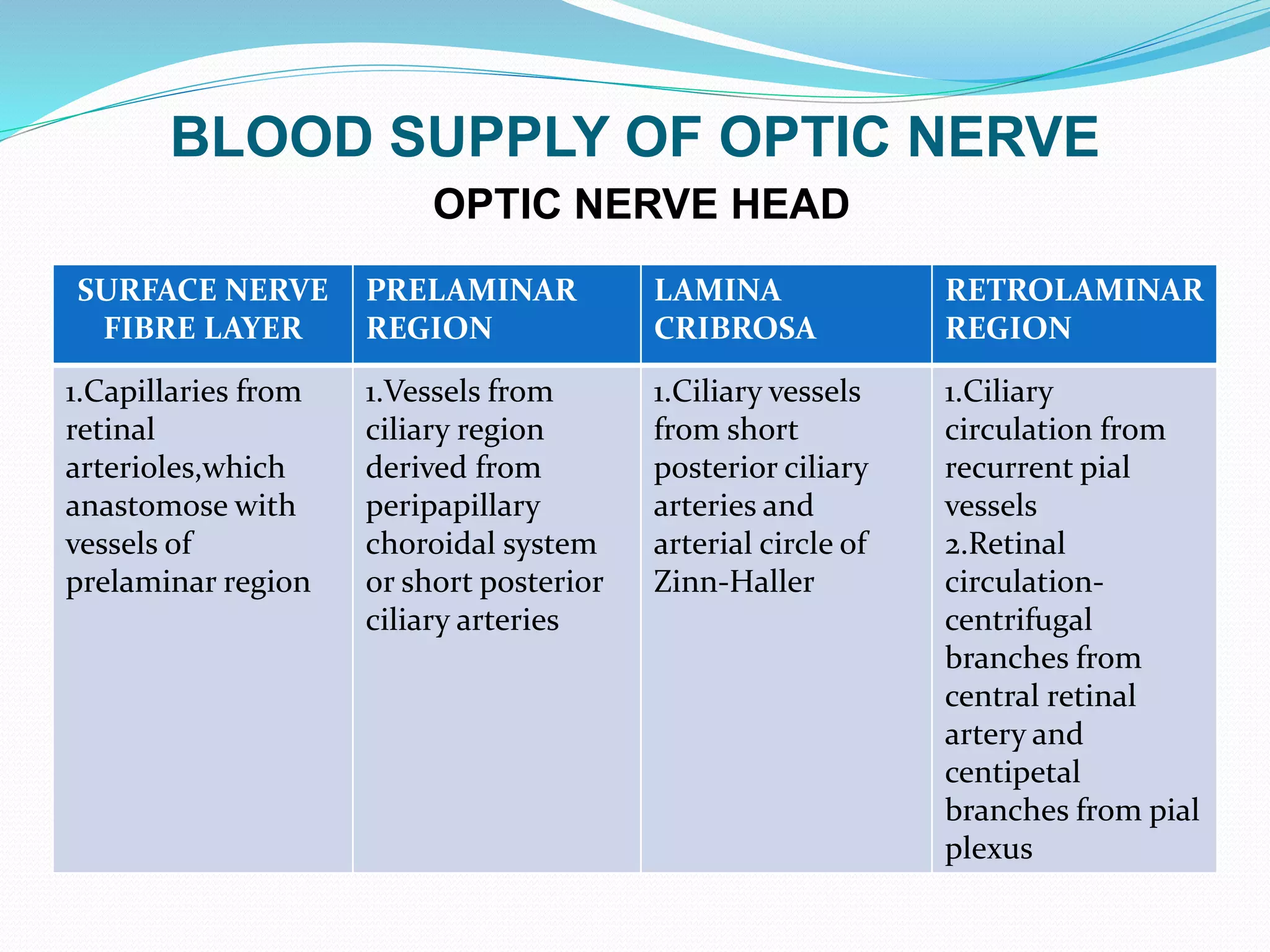
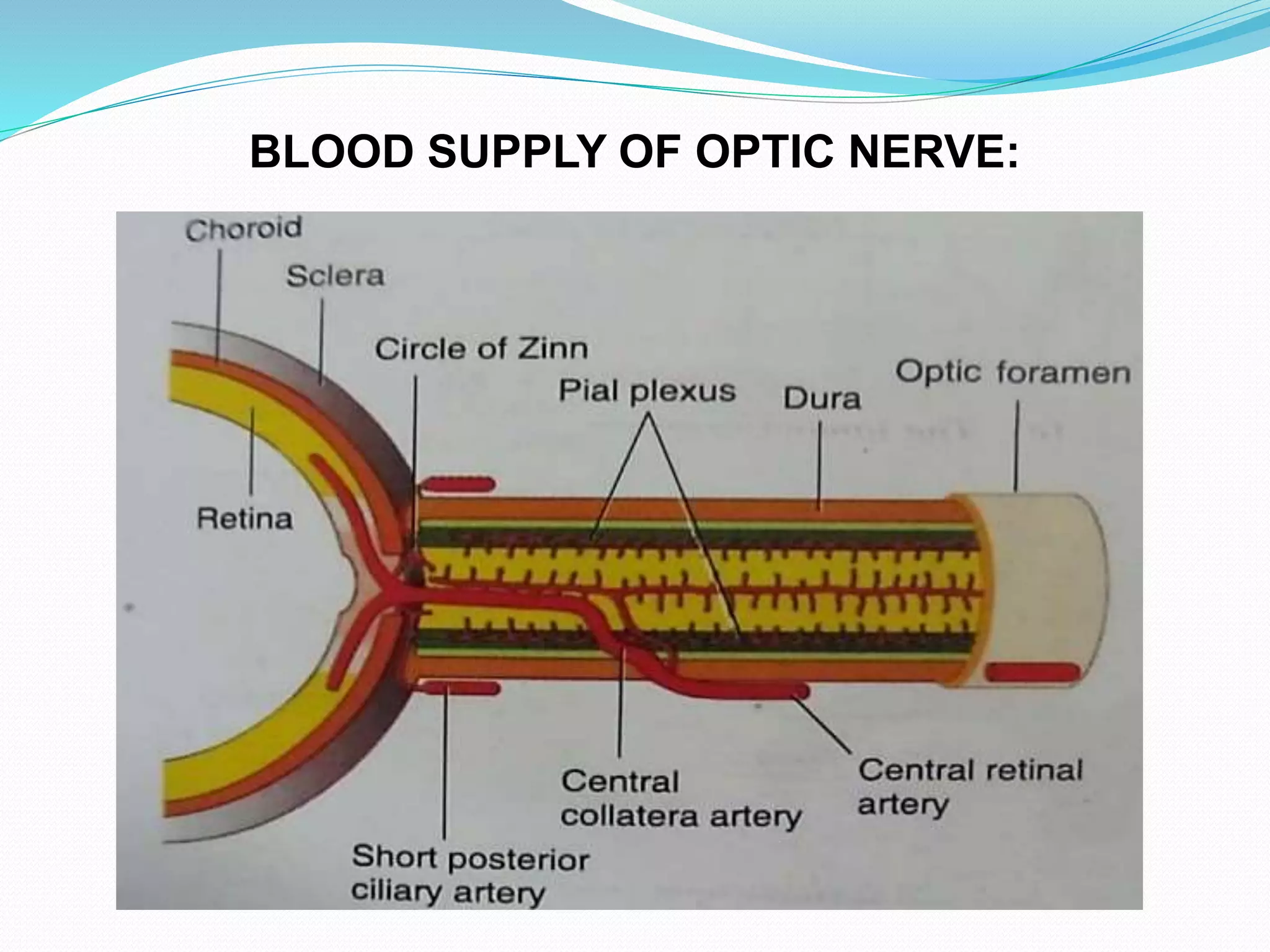
BLOOD SUPPLY OF OPTIC NERVE
OPTIC NERVE HEAD
SURFACE NERVE
FIBRE LAYER
PRELAMINAR
REGION
LAMINA
CRIBROSA
RETROLAMINAR
REGION
1.Capillaries from
retinal
arterioles,which
anastomose with
vessels of
prelaminar region
1.Vessels from
ciliary region
derived from
peripapillary
choroidal system
or short posterior
ciliary arteries
1.Ciliary vessels
from short
posterior ciliary
arteries and
arterial circle of
Zinn-Haller
1.Ciliary
circulation from
recurrent pial
vessels
2.Retinal
circulation-
centrifugal
branches from
central retinal
artery and
centipetal
branches from pial
plexus
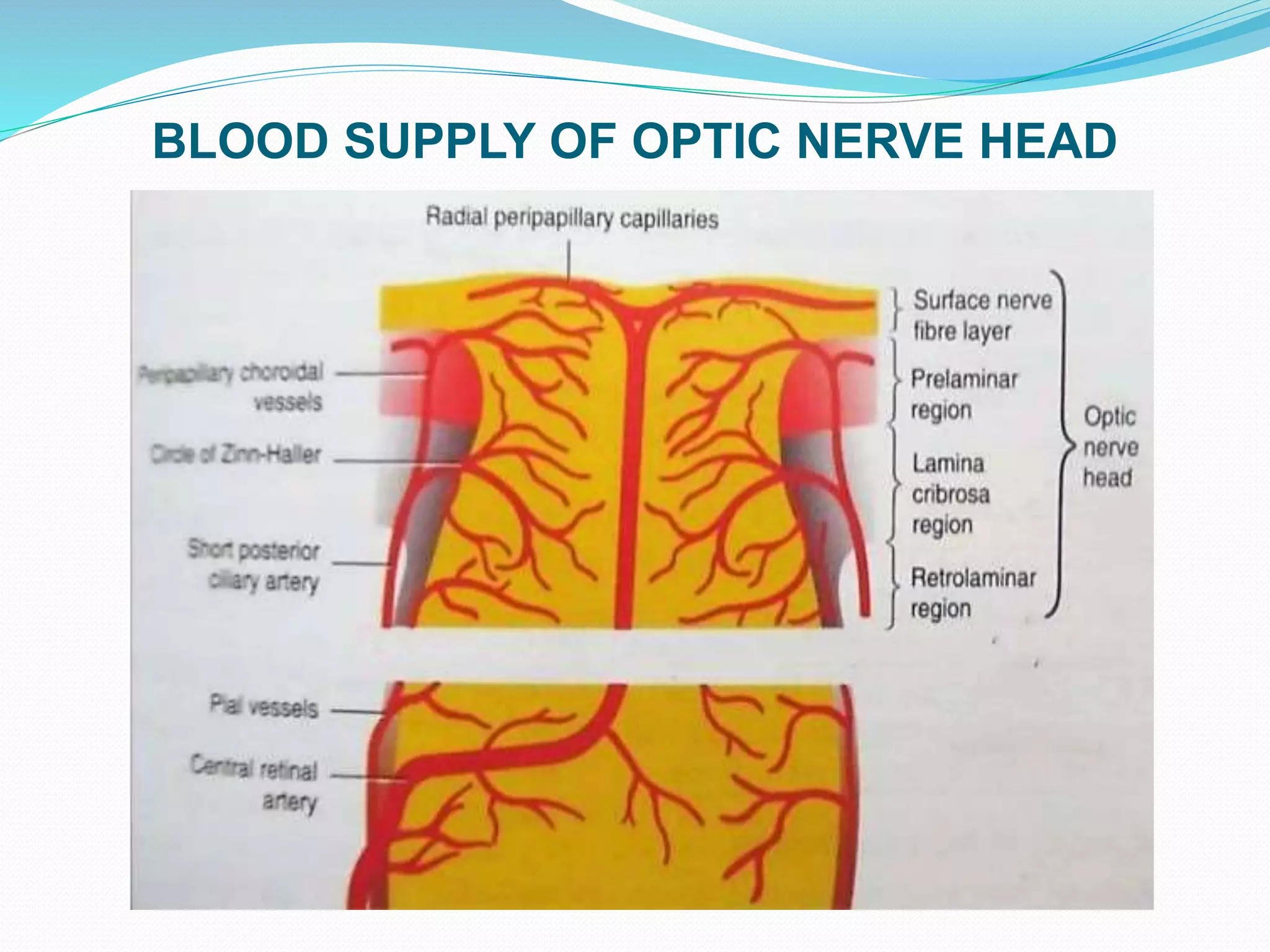
BLOOD SUPPLY OF OPTIC NERVE HEAD
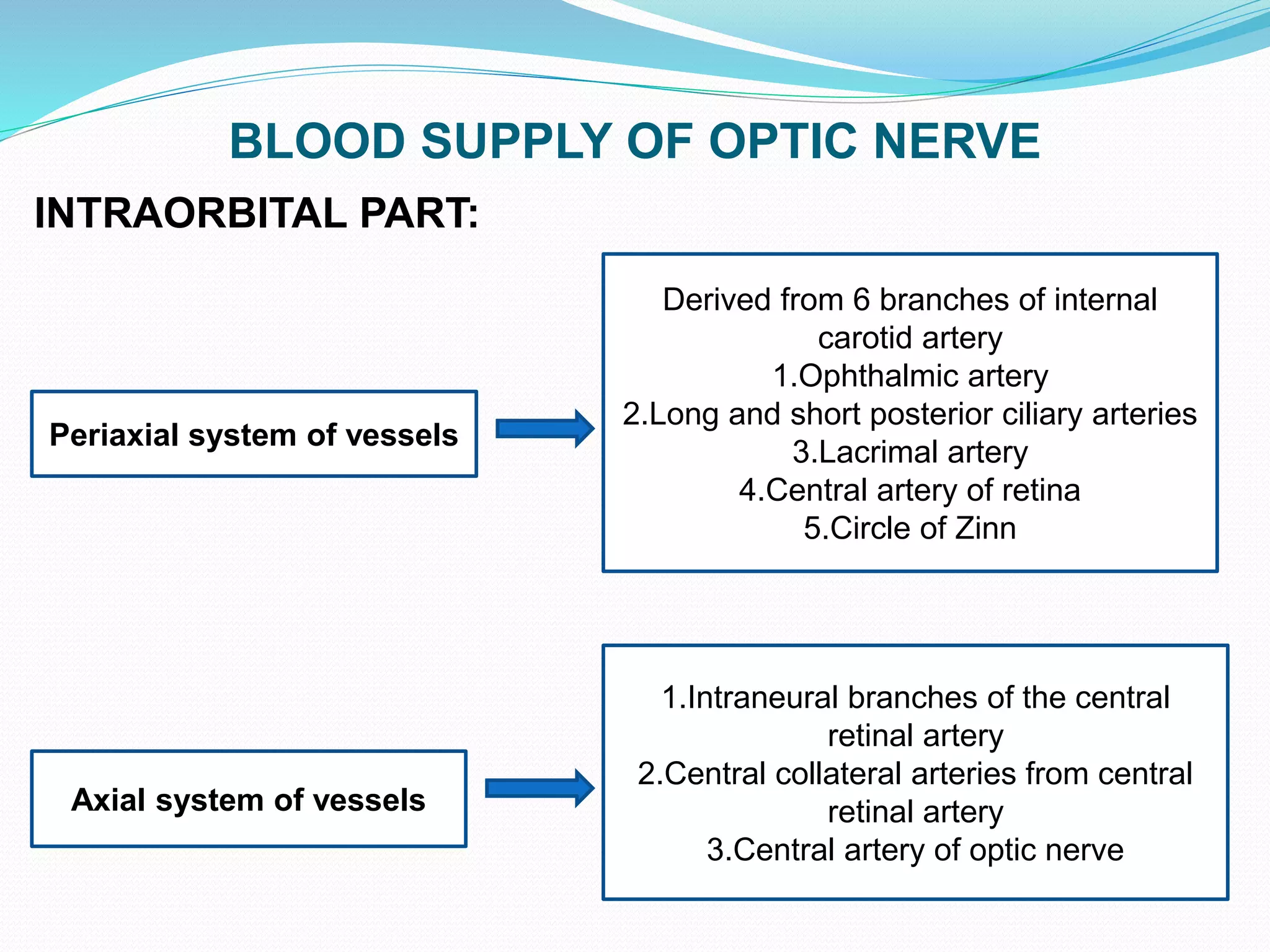
BLOOD SUPPLY OF OPTIC NERVE
INTRAORBITAL PART:
Periaxial system of vessels
Derived from 6 branches of internal
carotid artery
1.Ophthalmic artery
2.Long and short posterior ciliary arteries
3.Lacrimal artery
4.Central artery of retina
5.Circle of Zinn
Axial system of vessels
1.Intraneural branches of the central
retinal artery
2.Central collateral arteries from central
retinal artery
3.Central artery of optic nerve
BLOOD SUPPLY OF OPTIC NERVE:
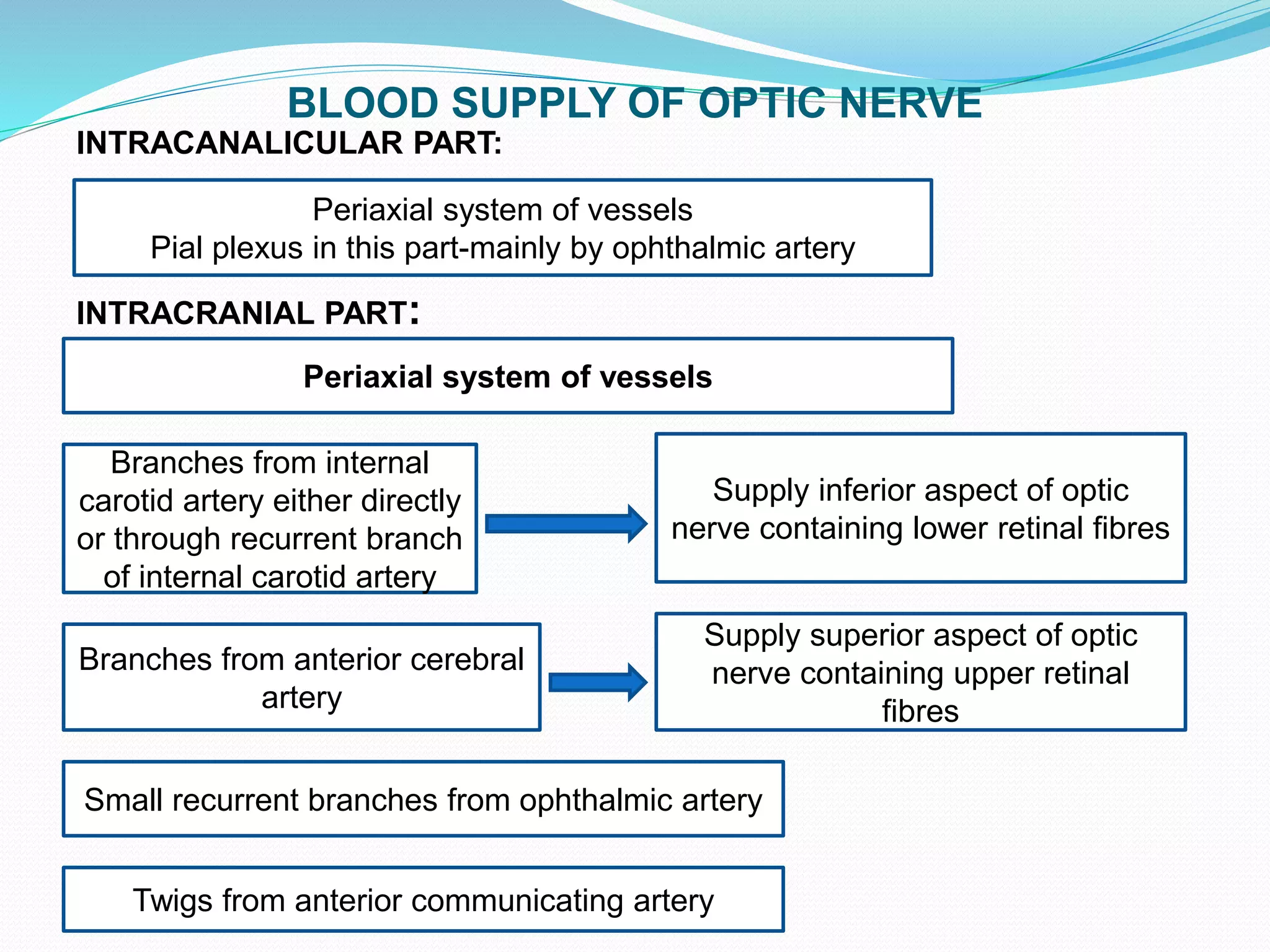
BLOOD SUPPLY OF OPTIC NERVE
INTRACANALICULAR PART:
INTRACRANIAL PART:
Periaxial system of vessels
Pial plexus in this part-mainly by ophthalmic artery
Periaxial system of vessels
Branches from internal
carotid artery either directly
or through recurrent branch
of internal carotid artery
Branches from anterior cerebral
artery
Small recurrent branches from ophthalmic artery
Supply inferior aspect of optic
nerve containing lower retinal fibres
Supply superior aspect of optic
nerve containing upper retinal
fibres
Twigs from anterior communicating artery
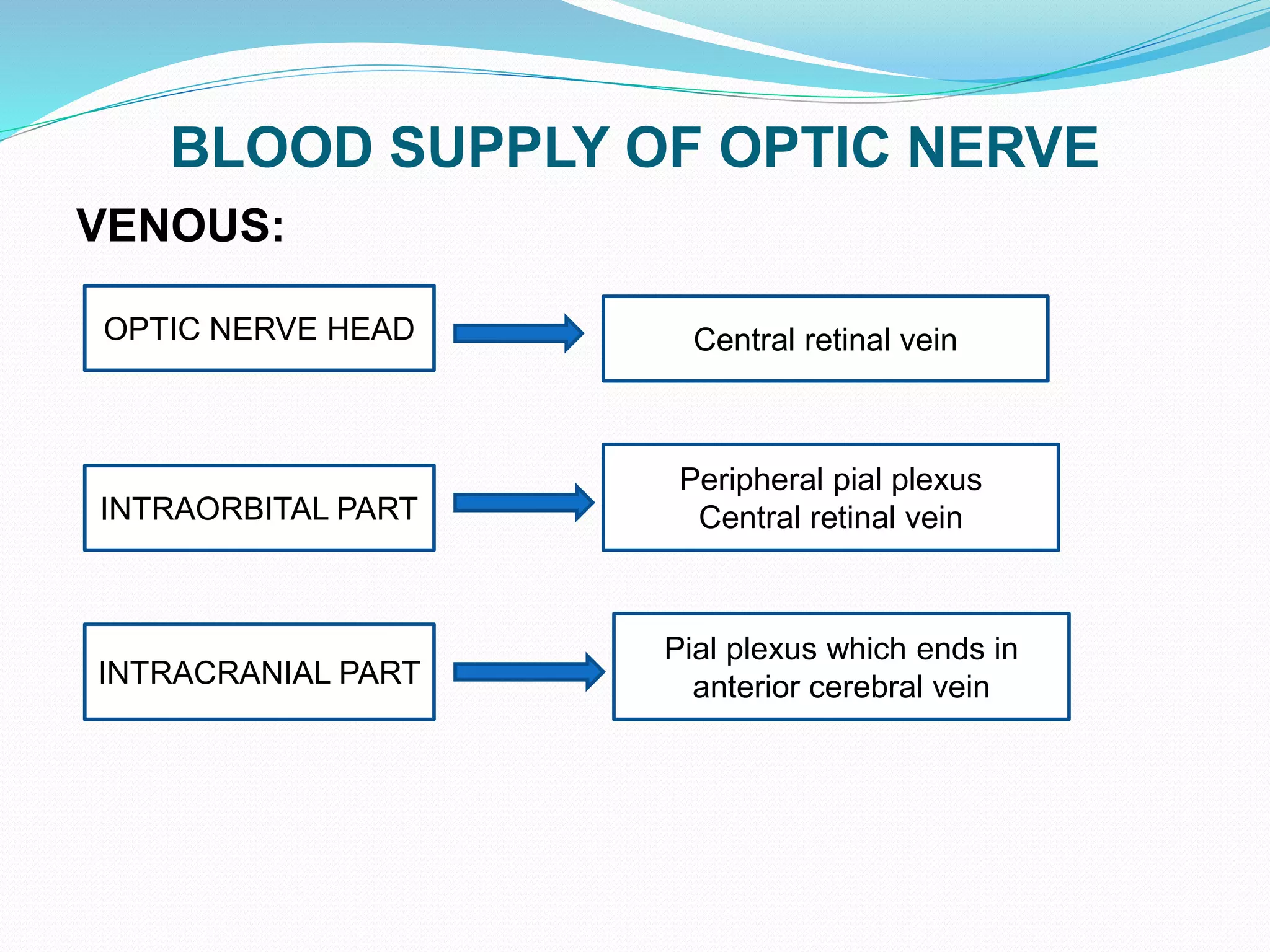
BLOOD SUPPLY OF OPTIC NERVE
VENOUS:
OPTIC NERVE HEAD Central retinal vein
INTRAORBITAL PART
Peripheral pial plexus
Central retinal vein
INTRACRANIAL PART
Pial plexus which ends in
anterior cerebral vein
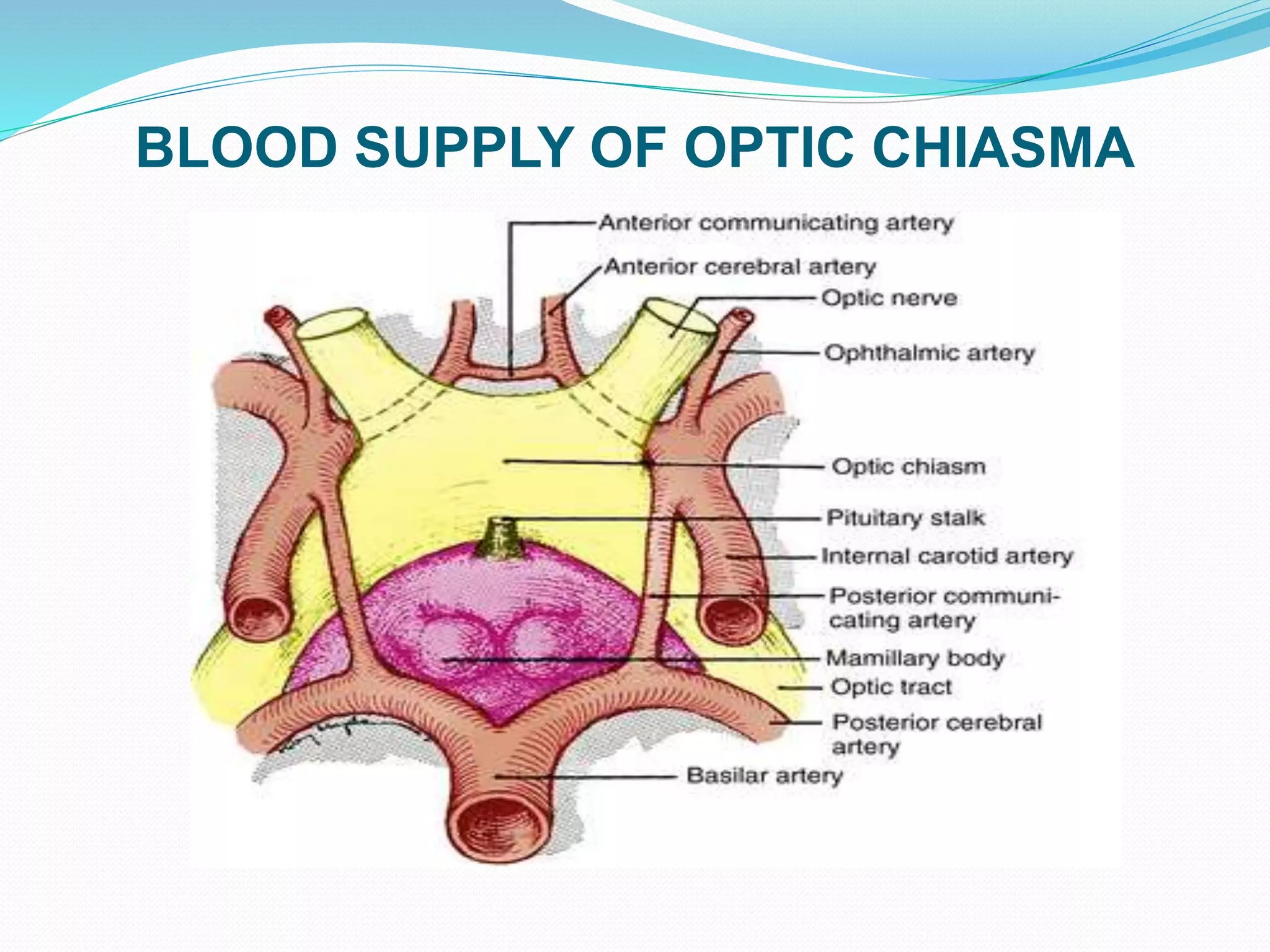
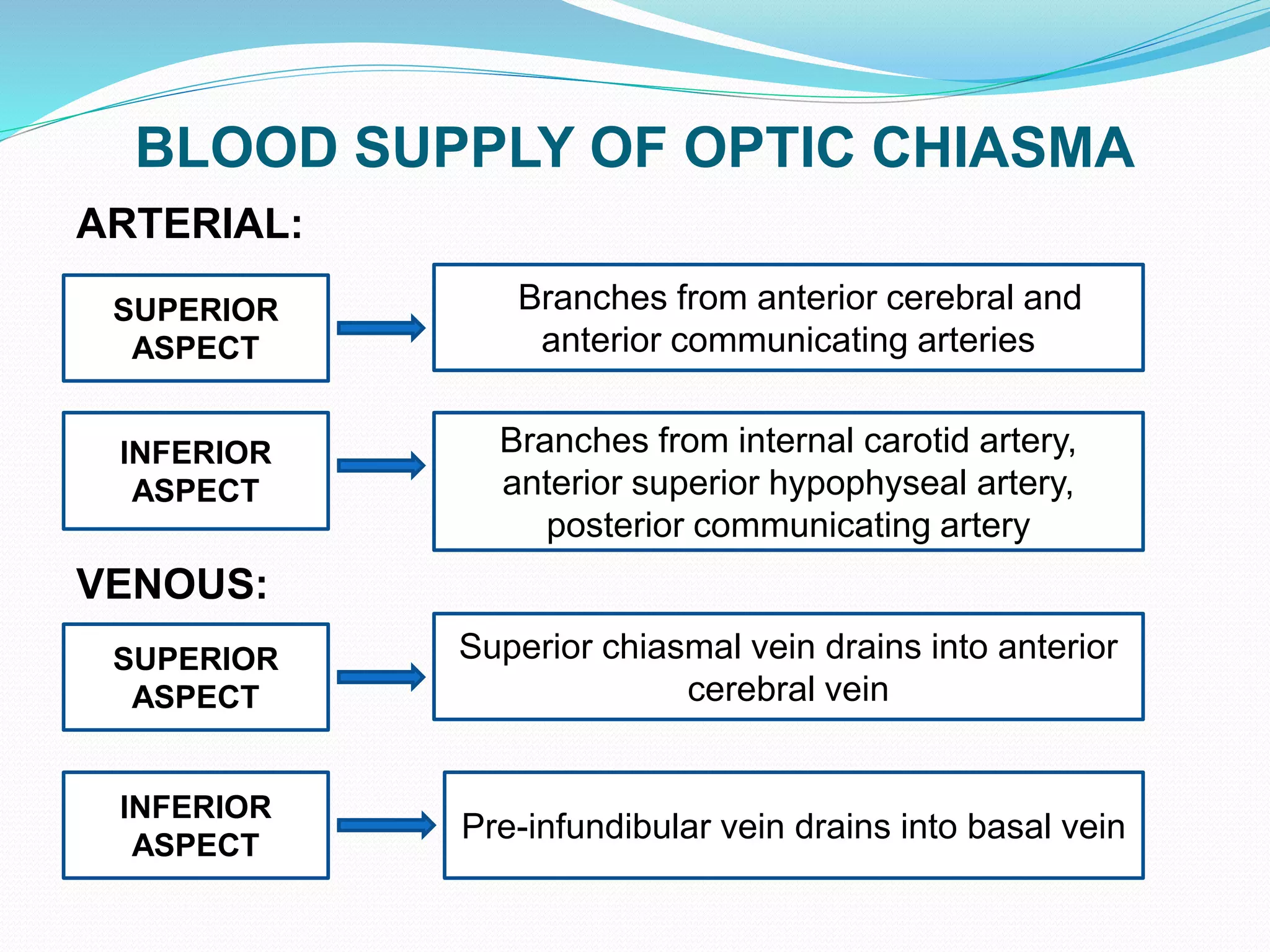
BLOOD SUPPLY OF OPTIC CHIASMA
ARTERIAL:
VENOUS:
SUPERIOR
ASPECT
BBranches from anterior cerebral and
anterior communicating arteries
INFERIOR
ASPECT
Branches from internal carotid artery,
anterior superior hypophyseal artery,
posterior communicating artery
SUPERIOR
ASPECT
Superior chiasmal vein drains into anterior
cerebral vein
INFERIOR
ASPECT
Pre-infundibular vein drains into basal vein
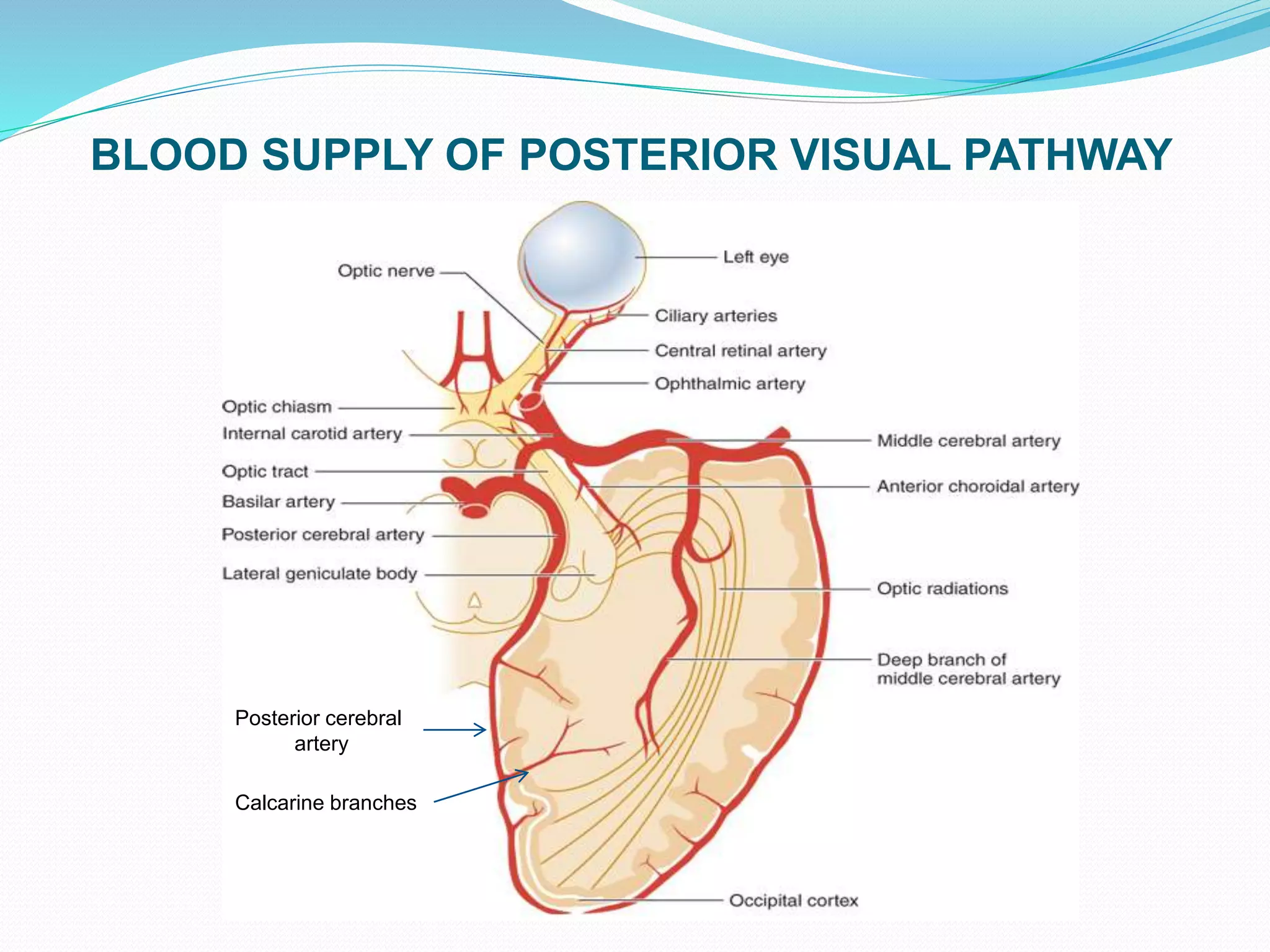
BLOOD SUPPLY OF POSTERIOR VISUAL PATHWAY
Posterior cerebral
artery
Calcarine branches
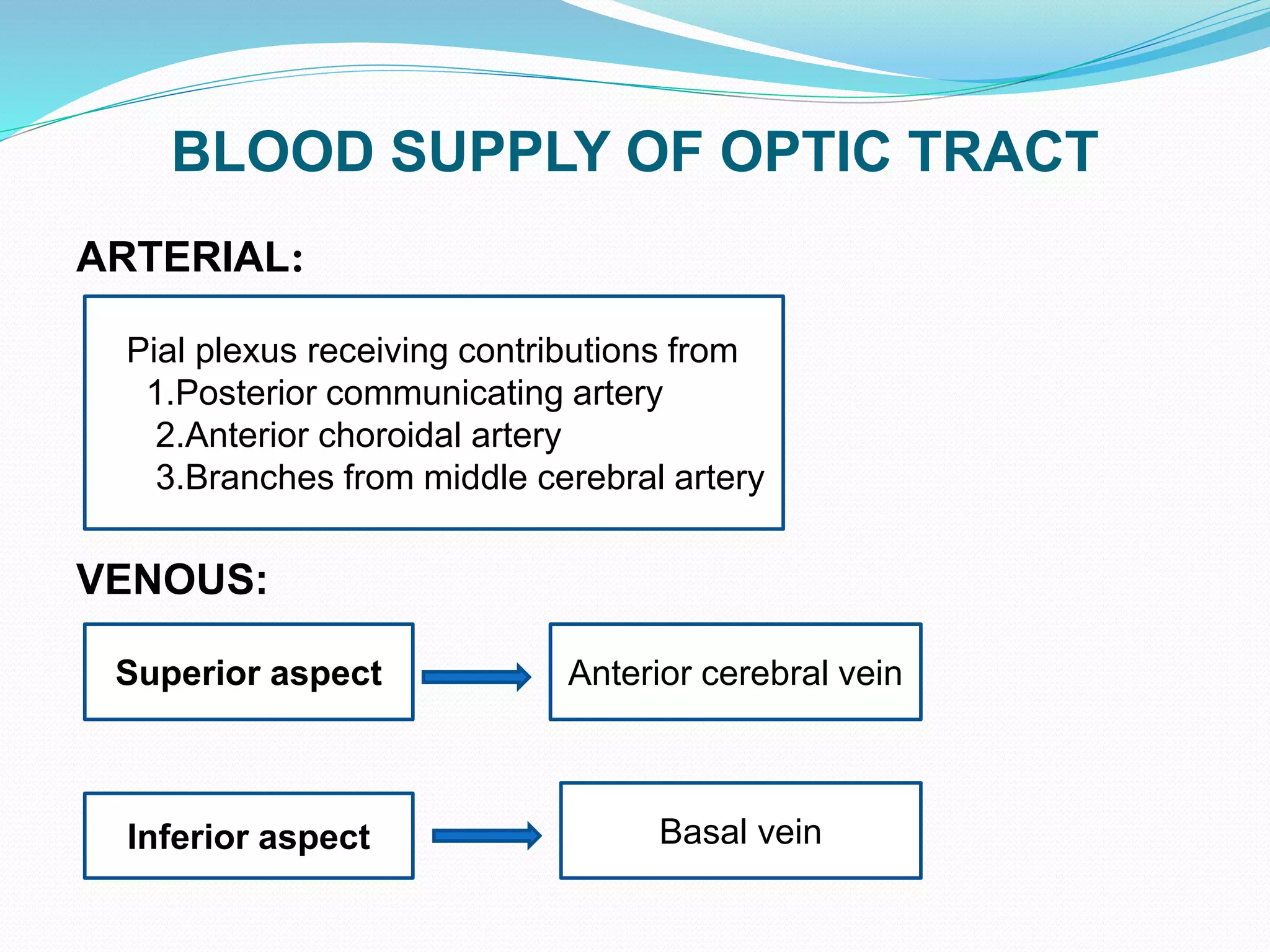
BLOOD SUPPLY OF OPTIC TRACT
ARTERIAL:
VENOUS:
Pial plexus receiving contributions from
1.Posterior communicating artery
2.Anterior choroidal artery
3.Branches from middle cerebral artery
Superior aspect Anterior cerebral vein
Inferior aspect Basal vein
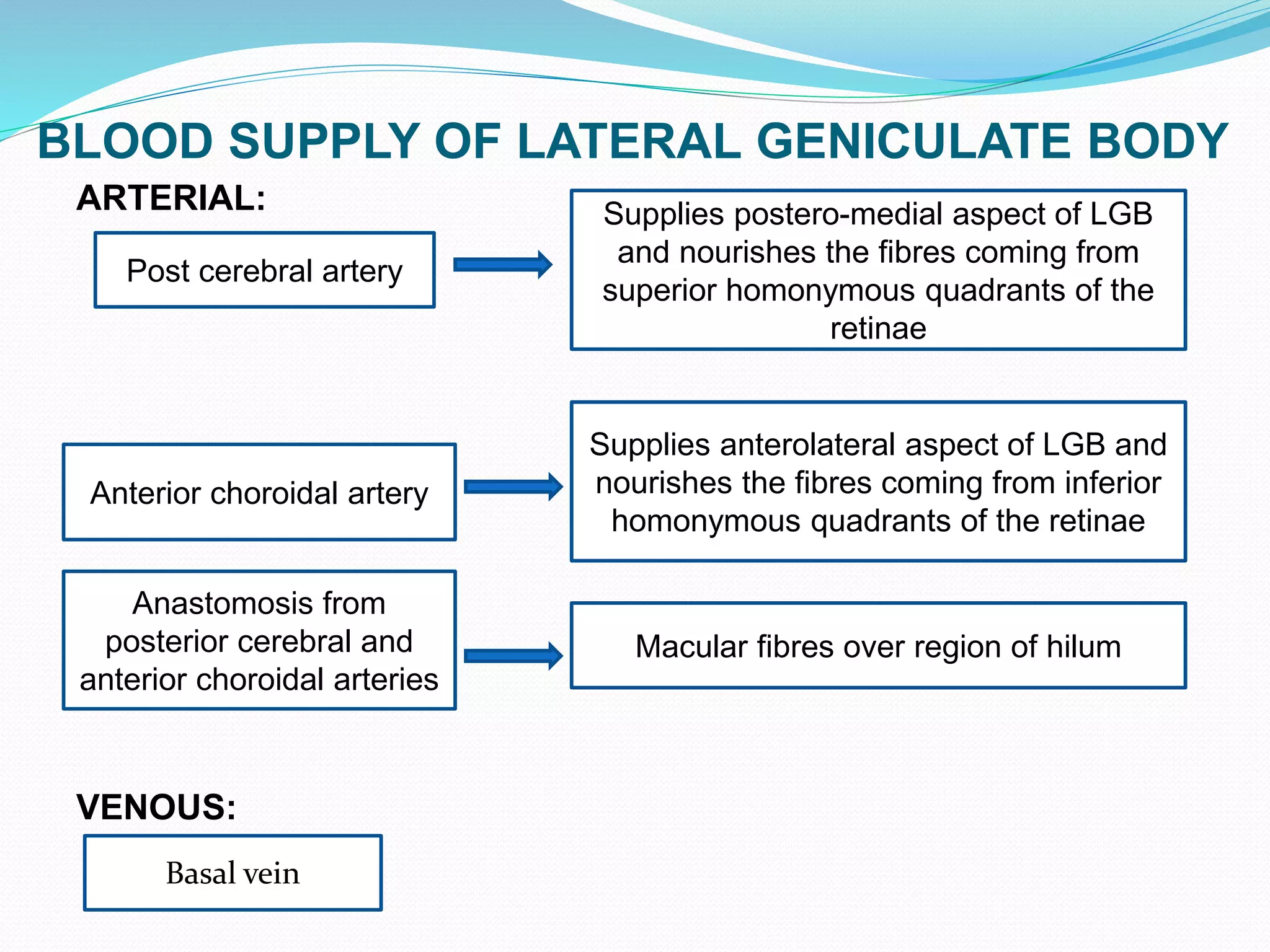
BLOOD SUPPLY OF LATERAL GENICULATE BODY
ARTERIAL:
VENOUS:
Post cerebral artery
Supplies postero-medial aspect of LGB
and nourishes the fibres coming from
superior homonymous quadrants of the
retinae
Anterior choroidal artery
Supplies anterolateral aspect of LGB and
nourishes the fibres coming from inferior
homonymous quadrants of the retinae
Anastomosis from
posterior cerebral and
anterior choroidal arteries
Macular fibres over region of hilum
Basal vein
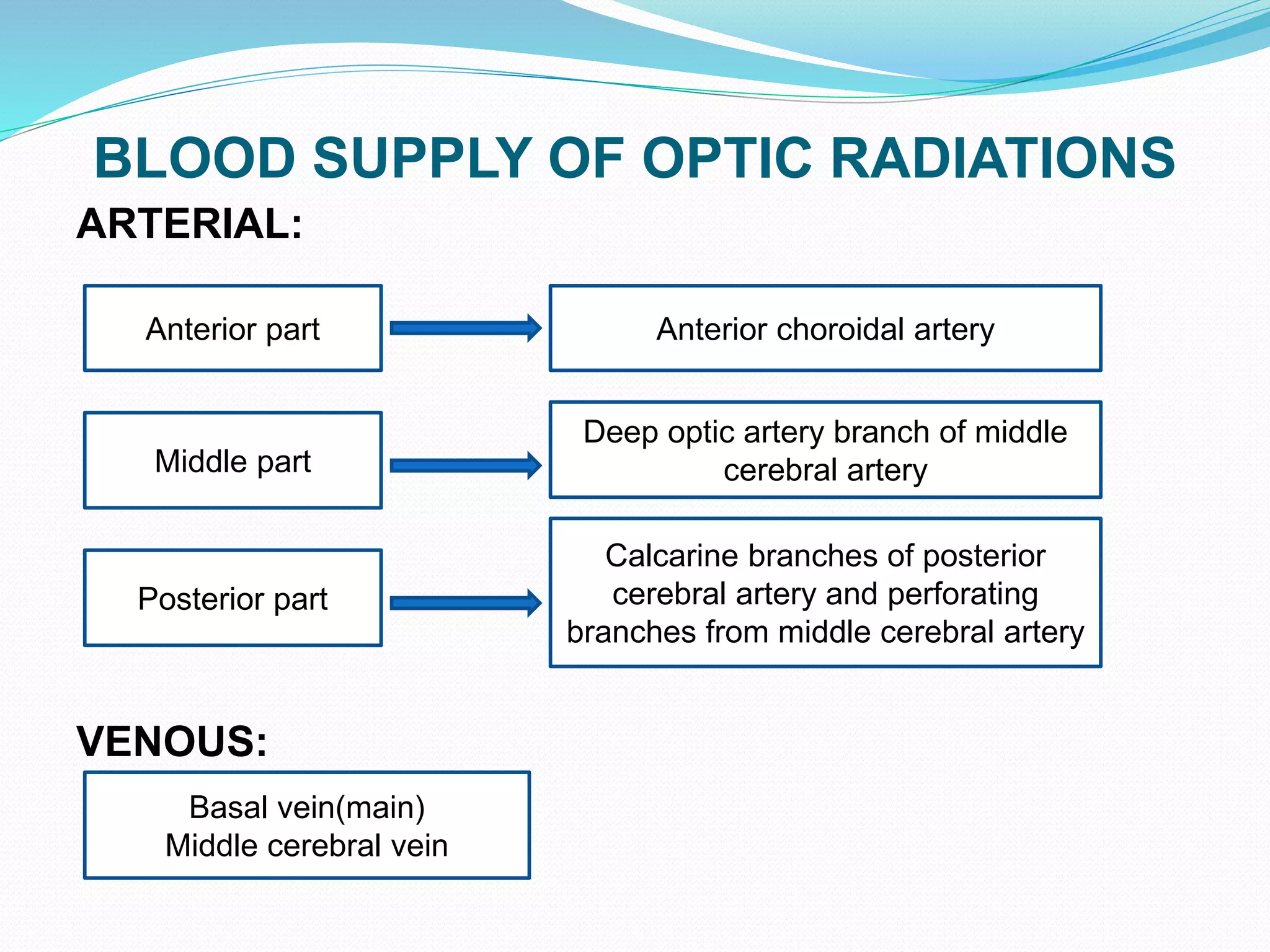
BLOOD SUPPLY OF OPTIC RADIATIONS
ARTERIAL:
VENOUS:
Anterior part
Middle part
Posterior part
Anterior choroidal artery
Deep optic artery branch of middle
cerebral artery
Calcarine branches of posterior
cerebral artery and perforating
branches from middle cerebral artery
Basal vein(main)
Middle cerebral vein
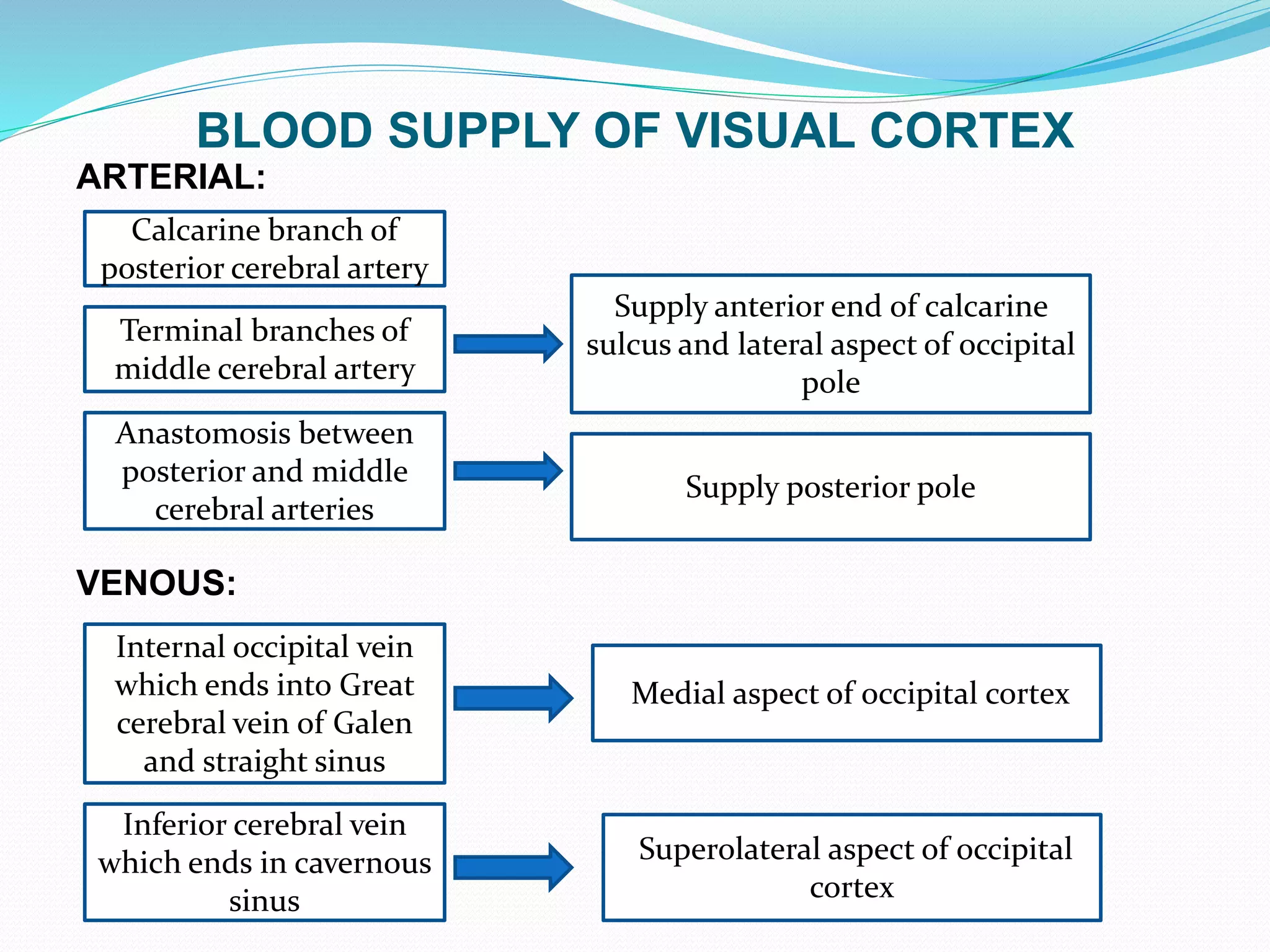
BLOOD SUPPLY OF VISUAL CORTEX
ARTERIAL:
VENOUS:
Calcarine branch of
posterior cerebral artery
Terminal branches of
middle cerebral artery
Supply anterior end of calcarine
sulcus and lateral aspect of occipital
pole
Anastomosis between
posterior and middle
cerebral arteries
Supply posterior pole
Internal occipital vein
which ends into Great
cerebral vein of Galen
and straight sinus
Medial aspect of occipital cortex
Inferior cerebral vein
which ends in cavernous
sinus
Superolateral aspect of occipital
cortex
THANK YOU

Visual pathway ppt

  • 1.
  • 2.
  • 3.
  • 4.
    VISUAL PATHWAY OPTIC NERVE OPTICCHIASMA OPTIC TRACT LATERAL GENICULATE BODY OPTIC RADIATIONS VISUAL CORTEX
  • 5.
    ANATOMY OF DIFFERENTCOMPONENTS OF VISUAL PATHWAY OPTIC NERVE  Starts from the optic disc and extends up to the optic chiasma.  Backward continuation of the nerve fibre layer of the retina.
  • 6.
    OPTIC NERVE Morphologically andembryologically- comparable to sensory tract (white matter) of the brain  Outgrowth of the brain  Not covered by neurilemma(does not regenerate when cut)  Fibres of the optic nerve-million in number,2-10 micrometre in diameter.  Surrounded by meninges  Both the primary and secondary sensory neurons are in the retina.
  • 7.
    PARTS OF THEOPTIC NERVE  47-50 mm in length  Divided into 4 parts 1.INTRAOCULAR PART(1mm) 2.INTRAORBITAL PART(20-30mm) 3.INTRACANALICULAR PART(6-9mm) 4.INTRACRANIAL PART(10mm)
  • 8.
  • 9.
    INTRAOCULAR PART OFOPTIC NERVE (OPTIC NERVE HEAD)  Starts at the optic disc  3-4mm nasal to fovea  1mm in length STRUCTURE OF OPTIC NERVE HEAD 1.SURFACE NERVE FIBRE LAYER 2.PRELAMINAR REGION 3.LAMINA CRIBROSA 4.RETROLAMINAR REGION
  • 10.
    OPTIC NERVE HEAD Centralmeniscus of Kuhnt Internal limiting membrane of retina Internal limiting membrane of Elschnig
  • 11.
    STRUCTURE OF OPTICNERVE HEAD 1.SURFACE NERVE FIBRE LAYER Nerve fibres of retina(94%) + Astrocytes(5%) Optic disc covered by a thin layer of astrocytes When central portion of this membrane thickened All the layers of retina except the nerve fibre layer are separated from optic nerve by a partial rim of glial tissue INTERNAL LIMITING MEMBRANE OF ELSCHNIG CENTRAL MENISCUS OF KUHNT INTERMEDIARY BORDER TISSUE OF KUHNT
  • 12.
    STRUCTURE OF OPTICNERVE HEAD 2.PRELAMINAR REGION Predominant structures: 1.Neurons 2.Increased quantity of astroglial tissue Separating the optic nerve from choroid BORDER TISSUE OF JCOBY (a cuff of astrocytes)
  • 13.
    STRUCTURE OF OPTICNERVE HEAD 3.LAMINA CRIBROSA:  Main structural support of the optic nerve as it exits the globe.  Fibrillar seive like structure  Fenestrated sheets of scleral connective tissue lined by glial tissue  Bridges posterior scleral foramina or scleral canal Rim of collagenous connective tissue with admixture of glial cells intervening between choroid and sclera and optic nerve fibres BORDER TISSUE OF ELSCHNIG
  • 14.
    STRUCTURE OF OPTICNERVE HEAD 4.RETROLAMINAR REGION:  Decrease in astrocytes  Acquisition of myelin supplied by oligodendrocytes  Addition of myelin sheath doubles the diameter of the optic nerve (from 1.5-3mm) as it passes through sclera
  • 15.
    INTRAORBITAL PART OFTHE OPTIC NERVE  Extends from back of the eyeball to optic foramina.  25mm in length  Exceeds the antero-posterior distance from the globe to the optic foramina by 8mm Sinuous to give play for the eye movements
  • 16.
    INTRACANALICULAR PART OFTHE OPTIC NERVE  Enters the optic canal, which sits within the two bases of the lesser wing of the sphenoid bone.  6-9mm in length  Optic canal contains :1.meninges 2.optic nerve 3.ophthalmic artery  The dura and the optic nerve are fixed to the periosteum throughout the canal.
  • 17.
    INTRACRANIAL PART OFTHE OPTIC NERVE  Lies above cavernous sinus and converges with its fellow(over the diaphragma sellae) to form the chiasma.  1cm in length  4.5mm in diameter  The course of the intracranial optic nerve is upward at a 45 degree angle to reach the chiasm.
  • 18.
    MENINGEAL SHEATH OFOPTIC NERVE Intraorbital and intracanalicular all 3 layers of meninges Intracranial part pia mater  Dural sheaths,subarachnoid and subdural spaces are continuous with that of brain
  • 19.
    OPTIC CHIASMA  Flattenedstructure  Lies over the diaphragma sellae,10 mm above the pituatary gland.  Posteriorly continuous with the optic tracts.  12mm horizontally and 8mm antero-posteriorly.  Ensheathed by the pia and surrounded by CSF.
  • 20.
    RELATIONS OF THEOPTIC CHIASMA
  • 22.
    OPTIC TRACT  Cylindricalbundles of nerve fibres running outwards and backwards from postero-lateral aspect of optic chiasma.  Tract fibres mostly synapse within lateral geniculate nucleus.  Some depart from the optic tract to complete afferent limb of pupillary light reflex.
  • 23.
    LATERAL GENICULATE BODY: Elevations produced by lateral geniculate nucleus  Axons of ganglion cells of retina synapse with dendrites of LGB cells.  Consist of 6 layers of neurons(grey matter) alternating with white matter(formed by optic nerve fibres) 3-6=Parvocellular layers 1-2=Magnocellular layers
  • 24.
  • 25.
    LATERAL GENICULATE BODY LargeMagnocellular Neurons(M cells) 1 and 2 layers Y ganglion cells Perception of movement,gross depth and small differences in brightness Small Parvocellular Neurons(P cells) 3,4,5,6 layers X ganglion cells Colour perception,texture shape and fine depth Koniocellular cells(K cells or interlaminar cells) Short wavelength “blue”cones
  • 26.
    OPTIC RADIATIONS ORGENICULOCALCARINE PATHWAY  Post synaptic fibres from LGN form the optic radiations.  Lateral geniculate body to visual cortex.  MEYERS LOOP(inferior retinal fibres)-pass through temporal lobe looping around inferior horn of lateral ventricle.  BAUMS LOOP(superior retinal fibres)-directed posteriorly through parietal lobe,occipital lobe and internal capsule and relay on visual cortex.
  • 27.
    VISUAL CORTEX  Onmedial aspect of the occipital lobe in and near the calcarine fissure VISUAL CORTEX VISUOSENSORY (V1) BRODMANN’S AREA 17 PERISTRIATE (V2) AREA 18 PARASTRIATE (V3) AREA 19
  • 28.
    ARRANGEMENT OF NERVEFIBRES IN DIFFERENT PARTS OF THE VISUAL PATHWAY  Arrangement of nerve fibres in the retina
  • 29.
    IN THE OPTICNERVE 1.In the optic nerve head 2.In the distal region(behind the eye) 3.In the proximal region(near chiasma)
  • 30.
    IN THE OPTICCHIASMA
  • 31.
    IN THE OPTICTRACT IN THE LGB
  • 32.
    IN THE OPTICRADIATIONS IN THE VISUAL CORTEX
  • 33.
    STRIATE CORTEX  Upperbank of striate cortex –superior to calcarine fissure  Lower bank of striate cortex-below the calcarine fissure
  • 34.
    STRIATE CORTEX Fibres frommedial aspect of the LGN (carrying information from superior retina) Fibres from lateral aspect of the LGN (carrying information from inferior retina) Left and right occipital lobes Upper bank of calcarine cortex(inferior visual fields) Lower bank of calcarine cortex(superior visual fields) Left and right visual fields respectively
  • 35.
    BLOOD SUPPLY OFVISUAL PATHWAY CIRCLE OF WILLIS INTERNAL CAROTID ARTERY
  • 36.
    BLOOD SUPPLY OFOPTIC NERVE OPTIC NERVE HEAD SURFACE NERVE FIBRE LAYER PRELAMINAR REGION LAMINA CRIBROSA RETROLAMINAR REGION 1.Capillaries from retinal arterioles,which anastomose with vessels of prelaminar region 1.Vessels from ciliary region derived from peripapillary choroidal system or short posterior ciliary arteries 1.Ciliary vessels from short posterior ciliary arteries and arterial circle of Zinn-Haller 1.Ciliary circulation from recurrent pial vessels 2.Retinal circulation- centrifugal branches from central retinal artery and centipetal branches from pial plexus
  • 37.
    BLOOD SUPPLY OFOPTIC NERVE HEAD
  • 38.
    BLOOD SUPPLY OFOPTIC NERVE INTRAORBITAL PART: Periaxial system of vessels Derived from 6 branches of internal carotid artery 1.Ophthalmic artery 2.Long and short posterior ciliary arteries 3.Lacrimal artery 4.Central artery of retina 5.Circle of Zinn Axial system of vessels 1.Intraneural branches of the central retinal artery 2.Central collateral arteries from central retinal artery 3.Central artery of optic nerve
  • 39.
    BLOOD SUPPLY OFOPTIC NERVE:
  • 40.
    BLOOD SUPPLY OFOPTIC NERVE INTRACANALICULAR PART: INTRACRANIAL PART: Periaxial system of vessels Pial plexus in this part-mainly by ophthalmic artery Periaxial system of vessels Branches from internal carotid artery either directly or through recurrent branch of internal carotid artery Branches from anterior cerebral artery Small recurrent branches from ophthalmic artery Supply inferior aspect of optic nerve containing lower retinal fibres Supply superior aspect of optic nerve containing upper retinal fibres Twigs from anterior communicating artery
  • 41.
    BLOOD SUPPLY OFOPTIC NERVE VENOUS: OPTIC NERVE HEAD Central retinal vein INTRAORBITAL PART Peripheral pial plexus Central retinal vein INTRACRANIAL PART Pial plexus which ends in anterior cerebral vein
  • 42.
    BLOOD SUPPLY OFOPTIC CHIASMA
  • 43.
    BLOOD SUPPLY OFOPTIC CHIASMA ARTERIAL: VENOUS: SUPERIOR ASPECT BBranches from anterior cerebral and anterior communicating arteries INFERIOR ASPECT Branches from internal carotid artery, anterior superior hypophyseal artery, posterior communicating artery SUPERIOR ASPECT Superior chiasmal vein drains into anterior cerebral vein INFERIOR ASPECT Pre-infundibular vein drains into basal vein
  • 44.
    BLOOD SUPPLY OFPOSTERIOR VISUAL PATHWAY Posterior cerebral artery Calcarine branches
  • 45.
    BLOOD SUPPLY OFOPTIC TRACT ARTERIAL: VENOUS: Pial plexus receiving contributions from 1.Posterior communicating artery 2.Anterior choroidal artery 3.Branches from middle cerebral artery Superior aspect Anterior cerebral vein Inferior aspect Basal vein
  • 46.
    BLOOD SUPPLY OFLATERAL GENICULATE BODY ARTERIAL: VENOUS: Post cerebral artery Supplies postero-medial aspect of LGB and nourishes the fibres coming from superior homonymous quadrants of the retinae Anterior choroidal artery Supplies anterolateral aspect of LGB and nourishes the fibres coming from inferior homonymous quadrants of the retinae Anastomosis from posterior cerebral and anterior choroidal arteries Macular fibres over region of hilum Basal vein
  • 47.
    BLOOD SUPPLY OFOPTIC RADIATIONS ARTERIAL: VENOUS: Anterior part Middle part Posterior part Anterior choroidal artery Deep optic artery branch of middle cerebral artery Calcarine branches of posterior cerebral artery and perforating branches from middle cerebral artery Basal vein(main) Middle cerebral vein
  • 48.
    BLOOD SUPPLY OFVISUAL CORTEX ARTERIAL: VENOUS: Calcarine branch of posterior cerebral artery Terminal branches of middle cerebral artery Supply anterior end of calcarine sulcus and lateral aspect of occipital pole Anastomosis between posterior and middle cerebral arteries Supply posterior pole Internal occipital vein which ends into Great cerebral vein of Galen and straight sinus Medial aspect of occipital cortex Inferior cerebral vein which ends in cavernous sinus Superolateral aspect of occipital cortex
  • 49.