COLOR VISION
THEORY
Presenter- Shayri Pillai
Liberia Eye Centre
JFK Memorial Medical Centre
LV Prasad Eye Institute
India
AUGUST 19 2019
John Ferris Basic sciences in Ophthalmology: Self assessment text
2nd edition U.K P-408
The perceived color of an object is influence by:
 The wavelength of the reflected light from the object.
 The color of the other nearby objects within the visual
field.
 The spectral composition of the illuminating light.
 The state of light adaptation of the eye.
 The physical properties of the object alone.
 A special property of the cone system is color vision.
 Perceiving color allows humans (and many other
animals) to discriminate objects on the basis of the
distribution of the wavelengths of light that they reflect
to the eye.
 The perception of color is a response to
electromagnetic energy at wavelengths between 400
and 700 nm, which is absorbed by cone outer
segment visual pigments.
Skuta,G.L. et.Al. American Academy of Ophthalmology Retina and Vitreo
us
2011 Edition.USA P.48
 Unlike rods, which contain a single photo pigment.
 There are three types of cones, that differ in the photo
pigment .
 Each of these photo pigments has a different
sensitivity to light of different wavelengths
 Each cone contains 1 of 3 types of photolabile
pigments.
 Blue-sensitive (short-wavelength), green sensitive
(middle-wavelength), and red-sensitive (long-
wavelength) cones are commonly referred to as the
initiators of color vision.
Skuta,G.L. et.Al. American Academy of Ophthalmology Retina and Vitreous
2011 Edition.USA P.48
Spectral sensitivity of Cone Pigments
A.R.Elkington,H.J.Frank,M.J.Greaney Clinical Optics 3rd Edition U.K. P-3
 The integrative cells in the retina and higher visual centers
are organized primarily to recognize contrasts between
light or colors.
 The receptive fields of color-sensitive cells typically have
regions that compare the intensity of red versus green or
blue versus yellow.
Skuta,G.L. et.Al. American Academy of Ophthalmology Retina and Vitreous
2011 Edition.USA P.49
Many theories have attempted to explain the properties of
human color vision, but two have been particularly influential:
 The trichromatic theory (of Young, Helmholz and Maxwell)
postulated. Three types of “particles” each with a tuned
“resonance “ which together could represent any color.
 The opponent color theory (of Hering) points out that
some colors appear to be “mutually exclusive”.
 Color vision is trichromatic at the level of the photo
receptors, but color opponency is explained by
subsequent neural processing.
John Ferris Basic sciences in Ophthalmology: Self assessement text
2nd edition U.K P-409
 Most people can match any color in a test stimulus by
adjusting the intensity of three superimposed light sources
generating long, medium, and short wavelengths.
 The fact that only three such sources are needed to match
(nearly) all the perceived colors is strong confirmation of
the fact that color sensation is based on the relative levels
of activity in three sets of cones with different absorption
spectra.
Trichromatic Theory
 That color vision is trichromatic was first
recognized by Young,Helmholz and Maxwell at
the beginning of the nineteenth century (thus,
people with normal color vision are
called trichromats).
Classification
The color vision is classified into three categories:
 Trichromatism-
Anomalous trichromatism can differentiate all colors but ind
icate a shift/reduction in the corresponding cone.
 Dichromatism-
Absence of any of one cone. It also called color blindness
 Monochromatism-
Totally unable to differentiate colors of equal brightness
Types of Visual Defects:
 A congenital color vision defect occurs if a cone
pigment is absent or if there is a shift in its spectral
sensitivity.
 Deuteranopia, protanopia and tritanopia indicate
absence of green, red and blue cone function.
 Deuteranomaly, protanomaly and tritanomaly indicate a
shift in the corresponding cone sensitivity.
A.R.Elkington,H.J.Frank,M.J.Greaney Clinical Optics 3rd EditionU.K. P-2
 The X-chromosome carries genes encoding for red and
green pigment whereas chromosome 7 carries the blue
pigment gene.
 Of men 8% and of women 0.5% have a defect of the red/
green system; the commonest is deuteranomaly which
occurs in 5% of men and 0.3% of women.
 Tritan defects are rare.
A.R.Elkington,H.J.Frank,M.J.Greaney Clinical Optics 3rd Edition U.K. P-2
 Congenital color defects characteristically affect particular
parts of the color spectrum.
 Acquired color defects occur throughout the spectrum but
may be more pronounced in some regions.
For example, acquired optic nerve disease tends to cause
red -green defects.
 An exception occurs in glaucoma and in autosomal
dominant optic neuropathy which initially cause a
predominantly blue– yellow deficit.
A.R.Elkington,H.J.Frank,M.J.Greaney Clinical Optics 3rd Edition U.K. P-3
 It has recently been found that visual field loss in
glaucoma is detected earlier if perimetry is performed
using a blue light stimulus on a yellow background.
 Acquired retinal disease tends to cause blue–yellow
defects (except in cone dystrophy and Stargardt's
disease, which cause a predominantly red–green
defect).
A.R.Elkington,H.J.Frank,M.J.Greaney Clinical Optics 3rd EditionU.K. P-3
There are two objectives in testing for color blindness:
 The exact nature of the defect.
 Whether the subject is likely to be a source of danger
to the community.
Sihota, R. et.al. Parson’s: Diseases of the Eye. 22nd Edition 2015. India. P-107
Clinical Testing of Color Vision
Clinical tests of color vision are designed to be
performed in illumination equivalent to afternoon
daylight in the northern hemisphere.
A.R.Elkington,H.J.Frank,M.J.Greaney Clinical Optics 3rd EditionU.K. P-3
Color Vision Test
 Pseudoisochromatic Test Plates:
 Ishihara Plates,Dvorine,AHRR plates
 Hue discrimination/Arrangement Tests:
 The Farnsworth D-15 Test
 The Farnsworth Munsell-100 Hue Test
Sihota, R. et.al. Parson’s: Diseases of the Eye. 22nd Edition 2015. India. P-109
 Anamaloscopes-
 The Nagel Anamaloscope
 Color Naming and color sorting:
 Lantern Test,Yarn Test
Sihota, R. et.al. Parson’s: Diseases of the Eye. 22nd Edition 2015. India. P-108
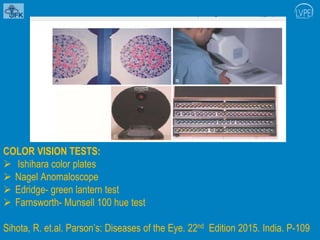
COLOR VISION TESTS:
 Ishihara color plates
 Nagel Anomaloscope
 Edridge- green lantern test
 Farnsworth- Munsell 100 hue test
Sihota, R. et.al. Parson’s: Diseases of the Eye. 22nd Edition 2015. India. P-109
Thank you!
Excellence Equity Efficiency
L V Prasad Eye Institute

Color Vision.pptx

  • 1.
    COLOR VISION THEORY Presenter- ShayriPillai Liberia Eye Centre JFK Memorial Medical Centre LV Prasad Eye Institute India AUGUST 19 2019
  • 2.
    John Ferris Basicsciences in Ophthalmology: Self assessment text 2nd edition U.K P-408 The perceived color of an object is influence by:  The wavelength of the reflected light from the object.  The color of the other nearby objects within the visual field.  The spectral composition of the illuminating light.  The state of light adaptation of the eye.  The physical properties of the object alone.
  • 3.
     A specialproperty of the cone system is color vision.  Perceiving color allows humans (and many other animals) to discriminate objects on the basis of the distribution of the wavelengths of light that they reflect to the eye.  The perception of color is a response to electromagnetic energy at wavelengths between 400 and 700 nm, which is absorbed by cone outer segment visual pigments. Skuta,G.L. et.Al. American Academy of Ophthalmology Retina and Vitreo us 2011 Edition.USA P.48
  • 4.
     Unlike rods,which contain a single photo pigment.  There are three types of cones, that differ in the photo pigment .  Each of these photo pigments has a different sensitivity to light of different wavelengths
  • 5.
     Each conecontains 1 of 3 types of photolabile pigments.  Blue-sensitive (short-wavelength), green sensitive (middle-wavelength), and red-sensitive (long- wavelength) cones are commonly referred to as the initiators of color vision. Skuta,G.L. et.Al. American Academy of Ophthalmology Retina and Vitreous 2011 Edition.USA P.48
  • 6.
    Spectral sensitivity ofCone Pigments A.R.Elkington,H.J.Frank,M.J.Greaney Clinical Optics 3rd Edition U.K. P-3
  • 7.
     The integrativecells in the retina and higher visual centers are organized primarily to recognize contrasts between light or colors.  The receptive fields of color-sensitive cells typically have regions that compare the intensity of red versus green or blue versus yellow. Skuta,G.L. et.Al. American Academy of Ophthalmology Retina and Vitreous 2011 Edition.USA P.49
  • 8.
    Many theories haveattempted to explain the properties of human color vision, but two have been particularly influential:  The trichromatic theory (of Young, Helmholz and Maxwell) postulated. Three types of “particles” each with a tuned “resonance “ which together could represent any color.  The opponent color theory (of Hering) points out that some colors appear to be “mutually exclusive”.  Color vision is trichromatic at the level of the photo receptors, but color opponency is explained by subsequent neural processing. John Ferris Basic sciences in Ophthalmology: Self assessement text 2nd edition U.K P-409
  • 9.
     Most peoplecan match any color in a test stimulus by adjusting the intensity of three superimposed light sources generating long, medium, and short wavelengths.  The fact that only three such sources are needed to match (nearly) all the perceived colors is strong confirmation of the fact that color sensation is based on the relative levels of activity in three sets of cones with different absorption spectra. Trichromatic Theory
  • 10.
     That colorvision is trichromatic was first recognized by Young,Helmholz and Maxwell at the beginning of the nineteenth century (thus, people with normal color vision are called trichromats).
  • 11.
    Classification The color visionis classified into three categories:  Trichromatism- Anomalous trichromatism can differentiate all colors but ind icate a shift/reduction in the corresponding cone.  Dichromatism- Absence of any of one cone. It also called color blindness  Monochromatism- Totally unable to differentiate colors of equal brightness
  • 12.
    Types of VisualDefects:  A congenital color vision defect occurs if a cone pigment is absent or if there is a shift in its spectral sensitivity.  Deuteranopia, protanopia and tritanopia indicate absence of green, red and blue cone function.  Deuteranomaly, protanomaly and tritanomaly indicate a shift in the corresponding cone sensitivity. A.R.Elkington,H.J.Frank,M.J.Greaney Clinical Optics 3rd EditionU.K. P-2
  • 13.
     The X-chromosomecarries genes encoding for red and green pigment whereas chromosome 7 carries the blue pigment gene.  Of men 8% and of women 0.5% have a defect of the red/ green system; the commonest is deuteranomaly which occurs in 5% of men and 0.3% of women.  Tritan defects are rare. A.R.Elkington,H.J.Frank,M.J.Greaney Clinical Optics 3rd Edition U.K. P-2
  • 14.
     Congenital colordefects characteristically affect particular parts of the color spectrum.  Acquired color defects occur throughout the spectrum but may be more pronounced in some regions. For example, acquired optic nerve disease tends to cause red -green defects.  An exception occurs in glaucoma and in autosomal dominant optic neuropathy which initially cause a predominantly blue– yellow deficit. A.R.Elkington,H.J.Frank,M.J.Greaney Clinical Optics 3rd Edition U.K. P-3
  • 15.
     It hasrecently been found that visual field loss in glaucoma is detected earlier if perimetry is performed using a blue light stimulus on a yellow background.  Acquired retinal disease tends to cause blue–yellow defects (except in cone dystrophy and Stargardt's disease, which cause a predominantly red–green defect). A.R.Elkington,H.J.Frank,M.J.Greaney Clinical Optics 3rd EditionU.K. P-3
  • 16.
    There are twoobjectives in testing for color blindness:  The exact nature of the defect.  Whether the subject is likely to be a source of danger to the community. Sihota, R. et.al. Parson’s: Diseases of the Eye. 22nd Edition 2015. India. P-107
  • 17.
    Clinical Testing ofColor Vision Clinical tests of color vision are designed to be performed in illumination equivalent to afternoon daylight in the northern hemisphere. A.R.Elkington,H.J.Frank,M.J.Greaney Clinical Optics 3rd EditionU.K. P-3
  • 18.
    Color Vision Test Pseudoisochromatic Test Plates:  Ishihara Plates,Dvorine,AHRR plates  Hue discrimination/Arrangement Tests:  The Farnsworth D-15 Test  The Farnsworth Munsell-100 Hue Test Sihota, R. et.al. Parson’s: Diseases of the Eye. 22nd Edition 2015. India. P-109
  • 19.
     Anamaloscopes-  TheNagel Anamaloscope  Color Naming and color sorting:  Lantern Test,Yarn Test Sihota, R. et.al. Parson’s: Diseases of the Eye. 22nd Edition 2015. India. P-108
  • 20.
    COLOR VISION TESTS: Ishihara color plates  Nagel Anomaloscope  Edridge- green lantern test  Farnsworth- Munsell 100 hue test Sihota, R. et.al. Parson’s: Diseases of the Eye. 22nd Edition 2015. India. P-109
  • 21.
    Thank you! Excellence EquityEfficiency L V Prasad Eye Institute