Mooren ulcer
Peripheral ulcerative keratitis
Neurotrophic keratitis
Exposure keratitis
Non infectious keratitis
Peripheral corneal thinning
Thinning and/or ulceration preferentially affecting the
peripheral rather than the central cornea, and spreading
around the margin.
It should be noted that any cause of corneal ulceration can
affect the periphery
Types
Mooren ulcer.
Terrien marginal degeneration.
Dellen.*
Associated with systemic autoimmune disease.
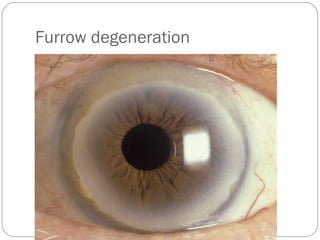
Others; Ocular rosacea, furrow degeneration* (mild
peripheral thinning in the elderly, usually benign), pellucid
marginal degeneration
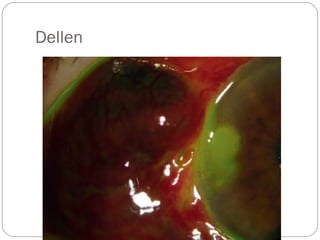
Dellen
Localized corneal disturbance associated with drying of a focal
area
Usually associated with an adjacent elevated lesion as
pinguecula or large subconjunctival haemorrhage that impairs
physiological lubrication.
Generally mild though can occasionally be severe.
Dellen
Furrow degeneration
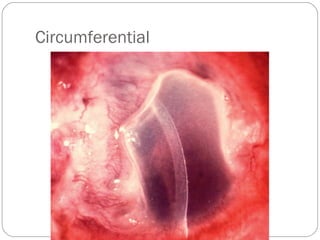
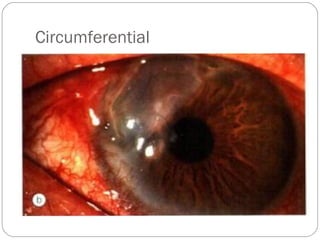
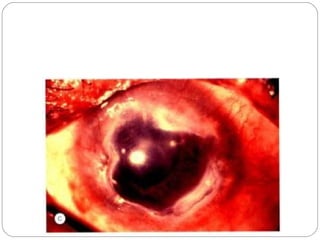
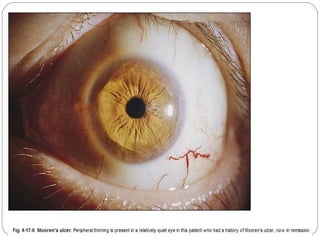
Mooren ulcer
Rare autoimmue disease
Characterized by:
progressive,
peripheral,
circumferential,
stromal corneal ulceration
slightly central to the corneoscleral limbus
with later central spread
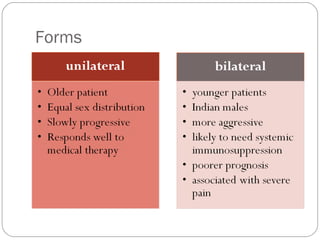
Forms
Symptoms
Severe pain
Photophobia
Blurring of vision
Signs
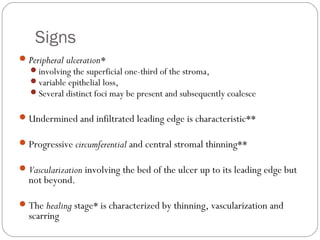
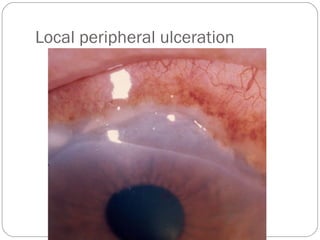
Peripheral ulceration*
involving the superficial one-third of the stroma,
variable epithelial loss,
Several distinct foci may be present and subsequently coalesce
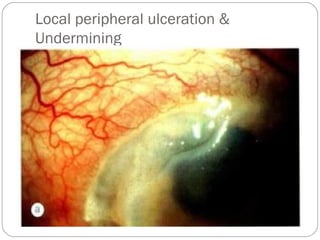
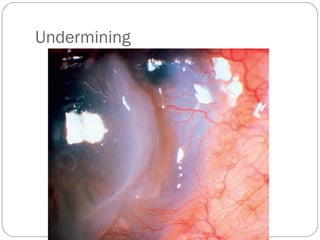
Undermined and infiltrated leading edge is characteristic**
Progressive circumferential and central stromal thinning**
Vascularization involving the bed of the ulcer up to its leading edge but
not beyond.
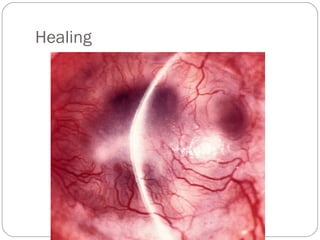
The healing stage* is characterized by thinning, vascularization and
scarring
Local peripheral ulceration
Local peripheral ulceration &
Undermining
Undermining
Circumferential
Circumferential
Healing
Complications
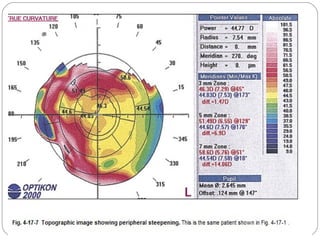
Severe astigmatism due to extensive vascularization & fibrosis
Perforation following minor trauma (spontaneous perforation is
unlikely)
Secondary bacterial infection
Cataract
Glaucoma
DDx
Management
Topical :
Steroids (Q1hr combined with A.B)
Cyclosporin (weeks to show signiificant effect)
Artificial tears
Collagenase inhibitors (acetylcystine)
bandage contact lenses may reduce discomfort and promote
epithelial healing.
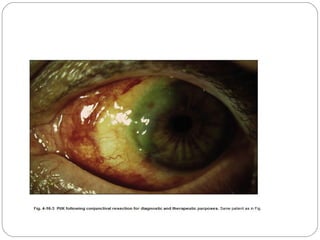
Conjunctival resection
may be combined with excision of necrotic tissue
performed if there is no response to topical steroids.
The excised area should extend 4 mm back from the limbus
and 2 mm beyond the circumferential margins.
Keratoepithelioplasty (suturing of a donor corneal lenticule
onto the scleral bed) may be combined to produce a physical
barrier against conjunctival regrowth and further melting.
Steroids are continued postoperatively
Systemic
Immunosuppression should be instituted earlier for
bilateral disease
advanced involvement at presentation
Systemic collagenase inhibitors such as doxycycline may be
beneficial.
Lamellar keratectomy involving dissection of the residual
central island in advanced disease may remove the stimulus
for further inflammation.
Surgery
Prognosis
Most patients who have unilateral disease respond fairly well
to topical corticosteroids and conjunctival resection.
For more severe bilateral cases, the prognosis is poor, and
the primary goal is to reduce the likelihood of perforation
and preserve the structure of the eye.
Peripheral ulcerative karatitis
Peripheral ulcerative keratitis
Destructive inflammation of the peripheral cornea associated
with corneal epithelial sloughing and keratolysis.
Severe peripheral corneal infiltration, ulceration or thinning
unexplained by evident ocular disease should prompt
investigation for a (potentially life-threatening) systemic
collagen vascular disorder.
The mechanism includes immune complex deposition in
peripheral cornea, episcleral and conjunctival capillary
occlusion with secondary cytokine release and inflammatory
cell recruitment, the upregulation of collagenases and
reduced activity of their inhibitors.
Systemic associations
Rheumatoid arthritis (most common).
PUK is bilateral in 30% and tends to occur in advanced RA.
Wegener granulomatosis (2nd
most common)
In contrast to RA ocular complications are the initial presentation in
50%.
Other conditions include polyarteritis nodosa, relapsing
polychondritis and SLE.
Symptoms
Foreign body sensation
Pain,
Photophobia
Blurred Vision
Signs
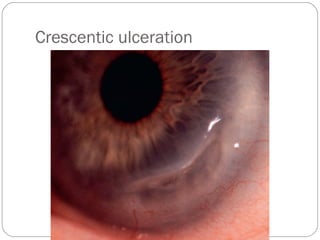
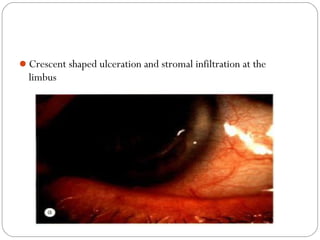
Crescentic ulceration*
with an epithelial defect, thinning and stromal infiltration at the limbus
Spread is circumferential and occasionally central
in contrast to Mooren ulcer, extension into the sclera may occur.
Limbitis, episcleritis or scleritis are usually present; as with a Mooren
ulcer, there is no separation between the ulcerative process and the
limbus.
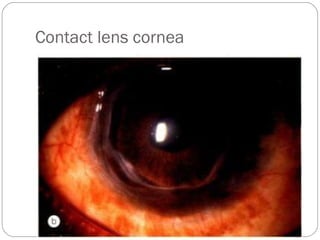
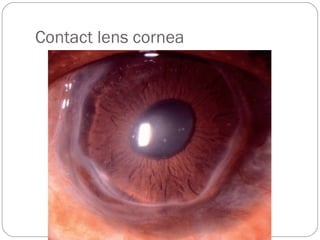
Contact lens cornea*
Perforation.
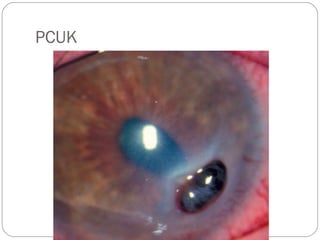
Rheumatoid paracentral ulcerative keratitis (PCUK)*
thought to be a distinct entity
punched-out more centrally located lesion with little infiltrate in a quiet eye.
Perforation can occur rapidly
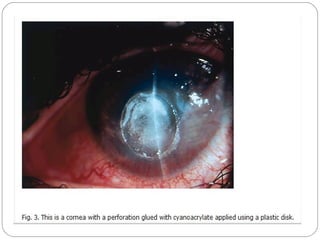
usually a good response to topical ciclosporin, with bandage contact lens and
tissue glue application if necessary, rather than systemic treatment.
Crescentic ulceration
Crescent shaped ulceration and stromal infiltration at the
limbus
Contact lens cornea
Contact lens cornea
PCUK
Management
Principally with systemic immunosuppression in collaboration
with a rheumatologist.
Topical
Artificial tears (preservative-free).
Antibiotics as prophylaxis if an epithelial defect is present.
Steroids may worsen thinning so are generally avoided
Systemic
Steroids (via pulsed IV administration) are used to control acute
disease, with immunosuppressive therapy and biological blockers for
longer-term management.
Tetracycline for its anticollagenase effect.
Surgical management is generally as for Mooren ulcer, including
conjunctival excision if medical treatment is ineffective.
Terrien marginal degeneration
Idiopathic thinning of the peripheral cornea
Young adult to elderly patients
Uncommon
75% males
Usually bilateral
Although usually categorized as a degeneration, some cases
are associated with episodic episcleritis or scleritis.
Symptoms
Asymptomatic,
but gradual visual deterioration can occur due to
astigmatism.
A few patients experience episodic pain and inflammation
Signs
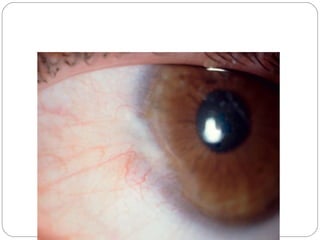
Fine yellow–white refractile stromal opacities*, frequently
associated with mild superficial vascularization,
usually start superiorly,
spread circumferentially
separated from the limbus by a clear zone.
no epithelial defect, and on cursory examination the condition may
resemble arcus senilis.
Slowly progressive circumferential thinning*
results in a peripheral gutter, the outer slope of which shelves
gradually, while the central part rises sharply. A band of lipid is
commonly present at the central edge
Perforation is rare but may be spontaneous or follow blunt
trauma.
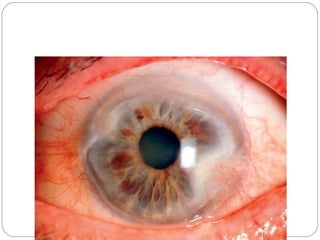
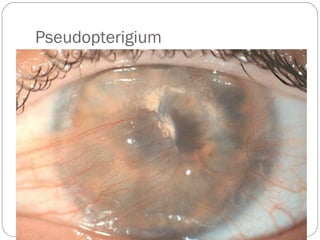
Pseudopterygia* sometimes develop
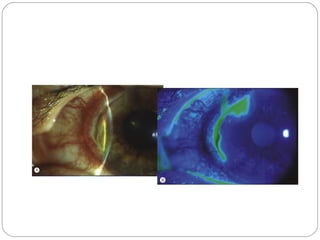
Pseudopterigium
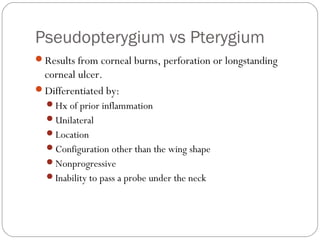
Pseudopterygium vs Pterygium
Results from corneal burns, perforation or longstanding
corneal ulcer.
Differentiated by:
Hx of prior inflammation
Unilateral
Location
Configuration other than the wing shape
Nonprogressive
Inability to pass a probe under the neck
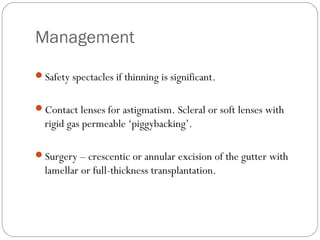
Management
Safety spectacles if thinning is significant.
Contact lenses for astigmatism. Scleral or soft lenses with
rigid gas permeable ‘piggybacking’.
Surgery – crescentic or annular excision of the gutter with
lamellar or full-thickness transplantation.
Neurotrophic keratitis
Pathophysiology
Loss of trigeminal innervation to the cornea resulting in
partial or complete anaesthesia.
Also it leads to intracellular oedema, exfoliation, loss of
goblet cells and epithelial breakdown with persistent
ulceration.
The trophic ulceration results from abnormal repair of
corneal epithelium secondary to abnormal epithelial cell
turnover and reduced reflex tearing
Normally, a bidirectional interaction occurs between epithelial
cells and nerve endings.
Adrenergic stimulation leads to increased cAMP, which
inhibits mitosis.
Cholinergic stimulation leads to increased cGMP, which
increases cell turnover
Substance P may play a role in normal and abnormal epithelial
cell turnover
Disruption of the sensory and sympathetic pathways is thought to
lead to decreased cell division.[
Cells therefore fail to resist the effects of trauma (microtrauma)
and desiccation, which normally lead to reflex tearing
Causes
Trigeminal ganglion surgical ablation for neuralgia,
stroke,
tumour,
peripheral neuropathy due to DM,
ocular disease such as herpes simplex and herpes zoster keratitis
(the most common causes).
Causes
Toxicity of certain topical medications :
Anasthetics
NSAID
B blockers
Carbonic anhydarse inhibitors
Ocular manifestation
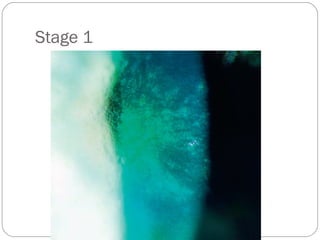
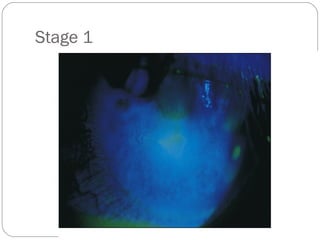
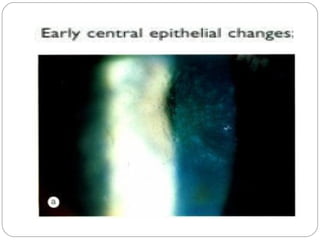
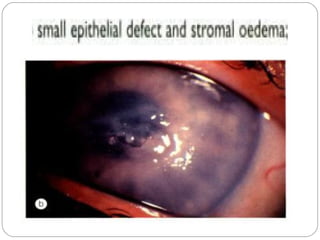
three stages of neurotrophic keratitis.
Stage 1*: interpalpebral epithelial irregularity and staining,
with mild opacification, oedema and tiny focal defects (SPKs)
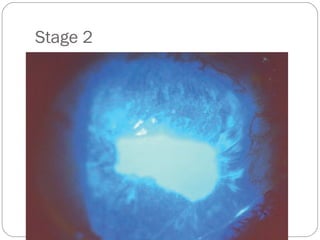
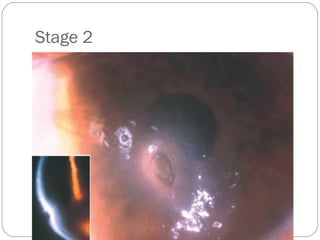
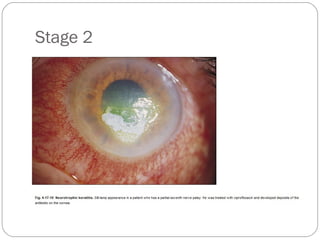
Stage 2*: is characterized by a frank epithelial defect,
which typically is associated with mild anterior stromal
inflammation. Folds in Descemet’s membrane often develop.
The epithelium at the edges of the defect tends to be
characteristically “heaped up” with grayish, swollen
epithelium.
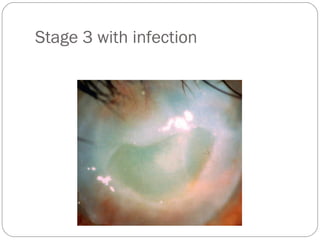
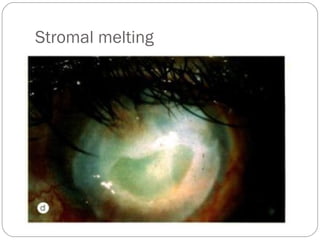
Stage 3*: involves stromal melting and occasionally
perforation
Stage 1
Stage 1
Stage 2
Stage 2
Stage 2
Stage 3 with infection
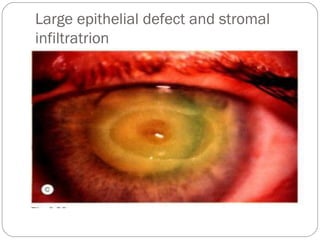
Large epithelial defect and stromal
infiltratrion
Stromal melting
Management
Discontinuation, if possible, of potentially toxic medications.
Topical lubricants (non-preserved) for associated dry eye or
corneal exposure.
Anticollagenase agents: topical (e.g. acetylcysteine,
tetracycline ointment) or systemic (e.g. tetracyclines).
Protection of the ocular surface:
Simple taping of the lids, particularly at night, may provide modest
protection.
Botulinum toxin-induced ptosis.
Tarsorrhaphy.
Therapeutic silicone contact lenses may be fitted, provided the eye is
carefully monitored for infection.
Amniotic membrane patching with temporary central tarsorrhaphy.
Prognosis
Patients with superficial punctate staining should be
maintained on regular lubrication .
Persistent defects respond best to tarsorrhaphy.
Signs of infection must be followed closely. Patients should
be advised that neurotrophic ulcers tend to recur and
are difficult to heal. More severe, progressive, sterile or
infectious ulcers may progress to descemetocele or
perforation
Exposure keratopathy
Pathogensis
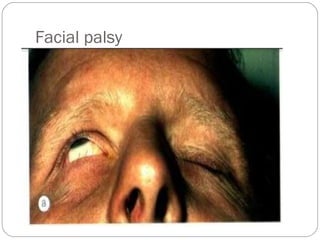
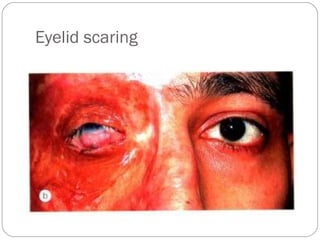
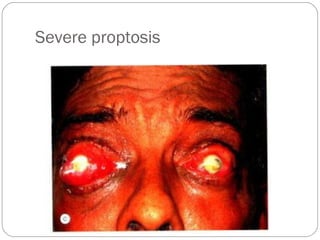
Results from incomplete lid closure (lagophthalmos), with
drying of the cornea despite normal tear production.
Mild exposure is normal in some individuals but may become
symptomatic if poor bell`s phenomenon.
Facial palsy
Eyelid scaring
Severe proptosis
Symptoms
Foreign body sensation
Tearing
Photophopia
Signs
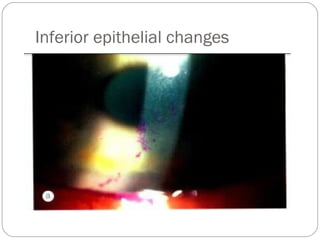
Mild punctate epithelial changes involving the inferior third
of the cornea, particularly with nocturnal lagophthalmos.
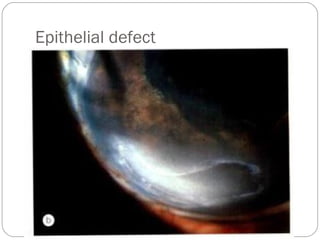
Epithelial breakdown*
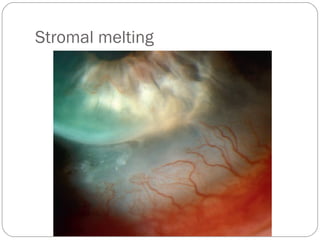
Stromal melting*, occasionally leading to perforation.
Inferior fibrovascular change with Salzmann degeneration
may develop over time.
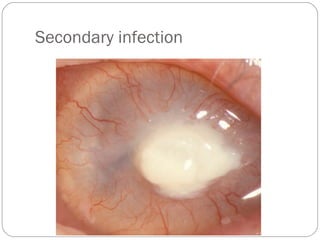
Secondary infection*
Inferior epithelial changes
Epithelial defect
Stromal melting
Secondary infection
Management
Treatment depends on the severity of exposure and whether
recovery is anticipated.
Reversible exposure
Artificial tears (unpreserved) during the day and ointment at
night.
Taping the lid closed at night may be an alternative to
ointment.
Bandage silicone hydrogel or scleral contact lenses.
Management of proptosis by orbital decompression if
necessary.
Temporary tarsorrhaphy.
Permanent exposure
Permanent tarsorrhaphy.
Gold weight upper lid insertion for facial nerve palsy.
Permanent central tarsorrhaphy, amniotic membrane
grafting or conjunctival flap when vision is poor.
Thank you

Non-Infectious keratitis

  • 1.
    Mooren ulcer Peripheral ulcerativekeratitis Neurotrophic keratitis Exposure keratitis Non infectious keratitis
  • 2.
    Peripheral corneal thinning Thinningand/or ulceration preferentially affecting the peripheral rather than the central cornea, and spreading around the margin. It should be noted that any cause of corneal ulceration can affect the periphery
  • 3.
    Types Mooren ulcer. Terrien marginaldegeneration. Dellen.* Associated with systemic autoimmune disease. Others; Ocular rosacea, furrow degeneration* (mild peripheral thinning in the elderly, usually benign), pellucid marginal degeneration
  • 4.
    Dellen Localized corneal disturbanceassociated with drying of a focal area Usually associated with an adjacent elevated lesion as pinguecula or large subconjunctival haemorrhage that impairs physiological lubrication. Generally mild though can occasionally be severe.
  • 5.
  • 6.
  • 7.
  • 8.
    Rare autoimmue disease Characterizedby: progressive, peripheral, circumferential, stromal corneal ulceration slightly central to the corneoscleral limbus with later central spread
  • 9.
  • 10.
  • 11.
    Signs Peripheral ulceration* involving thesuperficial one-third of the stroma, variable epithelial loss, Several distinct foci may be present and subsequently coalesce Undermined and infiltrated leading edge is characteristic** Progressive circumferential and central stromal thinning** Vascularization involving the bed of the ulcer up to its leading edge but not beyond. The healing stage* is characterized by thinning, vascularization and scarring
  • 12.
  • 13.
  • 14.
  • 15.
  • 16.
  • 18.
  • 20.
    Complications Severe astigmatism dueto extensive vascularization & fibrosis Perforation following minor trauma (spontaneous perforation is unlikely) Secondary bacterial infection Cataract Glaucoma
  • 22.
  • 23.
    Management Topical : Steroids (Q1hrcombined with A.B) Cyclosporin (weeks to show signiificant effect) Artificial tears Collagenase inhibitors (acetylcystine) bandage contact lenses may reduce discomfort and promote epithelial healing.
  • 24.
    Conjunctival resection may becombined with excision of necrotic tissue performed if there is no response to topical steroids. The excised area should extend 4 mm back from the limbus and 2 mm beyond the circumferential margins. Keratoepithelioplasty (suturing of a donor corneal lenticule onto the scleral bed) may be combined to produce a physical barrier against conjunctival regrowth and further melting. Steroids are continued postoperatively
  • 25.
    Systemic Immunosuppression should beinstituted earlier for bilateral disease advanced involvement at presentation Systemic collagenase inhibitors such as doxycycline may be beneficial. Lamellar keratectomy involving dissection of the residual central island in advanced disease may remove the stimulus for further inflammation.
  • 26.
  • 27.
    Prognosis Most patients whohave unilateral disease respond fairly well to topical corticosteroids and conjunctival resection. For more severe bilateral cases, the prognosis is poor, and the primary goal is to reduce the likelihood of perforation and preserve the structure of the eye.
  • 28.
  • 29.
    Peripheral ulcerative keratitis Destructiveinflammation of the peripheral cornea associated with corneal epithelial sloughing and keratolysis. Severe peripheral corneal infiltration, ulceration or thinning unexplained by evident ocular disease should prompt investigation for a (potentially life-threatening) systemic collagen vascular disorder. The mechanism includes immune complex deposition in peripheral cornea, episcleral and conjunctival capillary occlusion with secondary cytokine release and inflammatory cell recruitment, the upregulation of collagenases and reduced activity of their inhibitors.
  • 30.
    Systemic associations Rheumatoid arthritis(most common). PUK is bilateral in 30% and tends to occur in advanced RA. Wegener granulomatosis (2nd most common) In contrast to RA ocular complications are the initial presentation in 50%. Other conditions include polyarteritis nodosa, relapsing polychondritis and SLE.
  • 31.
  • 32.
    Signs Crescentic ulceration* with anepithelial defect, thinning and stromal infiltration at the limbus Spread is circumferential and occasionally central in contrast to Mooren ulcer, extension into the sclera may occur. Limbitis, episcleritis or scleritis are usually present; as with a Mooren ulcer, there is no separation between the ulcerative process and the limbus. Contact lens cornea* Perforation. Rheumatoid paracentral ulcerative keratitis (PCUK)* thought to be a distinct entity punched-out more centrally located lesion with little infiltrate in a quiet eye. Perforation can occur rapidly usually a good response to topical ciclosporin, with bandage contact lens and tissue glue application if necessary, rather than systemic treatment.
  • 33.
  • 34.
    Crescent shaped ulcerationand stromal infiltration at the limbus
  • 36.
  • 37.
  • 38.
  • 39.
    Management Principally with systemicimmunosuppression in collaboration with a rheumatologist. Topical Artificial tears (preservative-free). Antibiotics as prophylaxis if an epithelial defect is present. Steroids may worsen thinning so are generally avoided Systemic Steroids (via pulsed IV administration) are used to control acute disease, with immunosuppressive therapy and biological blockers for longer-term management. Tetracycline for its anticollagenase effect. Surgical management is generally as for Mooren ulcer, including conjunctival excision if medical treatment is ineffective.
  • 42.
  • 43.
    Idiopathic thinning ofthe peripheral cornea Young adult to elderly patients Uncommon 75% males Usually bilateral Although usually categorized as a degeneration, some cases are associated with episodic episcleritis or scleritis.
  • 44.
    Symptoms Asymptomatic, but gradual visualdeterioration can occur due to astigmatism. A few patients experience episodic pain and inflammation
  • 45.
    Signs Fine yellow–white refractilestromal opacities*, frequently associated with mild superficial vascularization, usually start superiorly, spread circumferentially separated from the limbus by a clear zone. no epithelial defect, and on cursory examination the condition may resemble arcus senilis. Slowly progressive circumferential thinning* results in a peripheral gutter, the outer slope of which shelves gradually, while the central part rises sharply. A band of lipid is commonly present at the central edge Perforation is rare but may be spontaneous or follow blunt trauma. Pseudopterygia* sometimes develop
  • 48.
  • 49.
    Pseudopterygium vs Pterygium Resultsfrom corneal burns, perforation or longstanding corneal ulcer. Differentiated by: Hx of prior inflammation Unilateral Location Configuration other than the wing shape Nonprogressive Inability to pass a probe under the neck
  • 50.
    Management Safety spectacles ifthinning is significant. Contact lenses for astigmatism. Scleral or soft lenses with rigid gas permeable ‘piggybacking’. Surgery – crescentic or annular excision of the gutter with lamellar or full-thickness transplantation.
  • 51.
  • 52.
    Pathophysiology Loss of trigeminalinnervation to the cornea resulting in partial or complete anaesthesia. Also it leads to intracellular oedema, exfoliation, loss of goblet cells and epithelial breakdown with persistent ulceration. The trophic ulceration results from abnormal repair of corneal epithelium secondary to abnormal epithelial cell turnover and reduced reflex tearing
  • 53.
    Normally, a bidirectionalinteraction occurs between epithelial cells and nerve endings. Adrenergic stimulation leads to increased cAMP, which inhibits mitosis. Cholinergic stimulation leads to increased cGMP, which increases cell turnover Substance P may play a role in normal and abnormal epithelial cell turnover Disruption of the sensory and sympathetic pathways is thought to lead to decreased cell division.[ Cells therefore fail to resist the effects of trauma (microtrauma) and desiccation, which normally lead to reflex tearing
  • 54.
    Causes Trigeminal ganglion surgicalablation for neuralgia, stroke, tumour, peripheral neuropathy due to DM, ocular disease such as herpes simplex and herpes zoster keratitis (the most common causes).
  • 55.
    Causes Toxicity of certaintopical medications : Anasthetics NSAID B blockers Carbonic anhydarse inhibitors
  • 56.
    Ocular manifestation three stagesof neurotrophic keratitis. Stage 1*: interpalpebral epithelial irregularity and staining, with mild opacification, oedema and tiny focal defects (SPKs) Stage 2*: is characterized by a frank epithelial defect, which typically is associated with mild anterior stromal inflammation. Folds in Descemet’s membrane often develop. The epithelium at the edges of the defect tends to be characteristically “heaped up” with grayish, swollen epithelium. Stage 3*: involves stromal melting and occasionally perforation
  • 57.
  • 58.
  • 59.
  • 60.
  • 61.
  • 62.
    Stage 3 withinfection
  • 65.
    Large epithelial defectand stromal infiltratrion
  • 66.
  • 67.
    Management Discontinuation, if possible,of potentially toxic medications. Topical lubricants (non-preserved) for associated dry eye or corneal exposure. Anticollagenase agents: topical (e.g. acetylcysteine, tetracycline ointment) or systemic (e.g. tetracyclines). Protection of the ocular surface: Simple taping of the lids, particularly at night, may provide modest protection. Botulinum toxin-induced ptosis. Tarsorrhaphy. Therapeutic silicone contact lenses may be fitted, provided the eye is carefully monitored for infection. Amniotic membrane patching with temporary central tarsorrhaphy.
  • 68.
    Prognosis Patients with superficialpunctate staining should be maintained on regular lubrication . Persistent defects respond best to tarsorrhaphy. Signs of infection must be followed closely. Patients should be advised that neurotrophic ulcers tend to recur and are difficult to heal. More severe, progressive, sterile or infectious ulcers may progress to descemetocele or perforation
  • 69.
  • 70.
    Pathogensis Results from incompletelid closure (lagophthalmos), with drying of the cornea despite normal tear production. Mild exposure is normal in some individuals but may become symptomatic if poor bell`s phenomenon.
  • 72.
  • 73.
  • 74.
  • 75.
  • 76.
    Signs Mild punctate epithelialchanges involving the inferior third of the cornea, particularly with nocturnal lagophthalmos. Epithelial breakdown* Stromal melting*, occasionally leading to perforation. Inferior fibrovascular change with Salzmann degeneration may develop over time. Secondary infection*
  • 77.
  • 78.
  • 79.
  • 80.
  • 81.
    Management Treatment depends onthe severity of exposure and whether recovery is anticipated.
  • 82.
    Reversible exposure Artificial tears(unpreserved) during the day and ointment at night. Taping the lid closed at night may be an alternative to ointment. Bandage silicone hydrogel or scleral contact lenses. Management of proptosis by orbital decompression if necessary. Temporary tarsorrhaphy.
  • 83.
    Permanent exposure Permanent tarsorrhaphy. Goldweight upper lid insertion for facial nerve palsy. Permanent central tarsorrhaphy, amniotic membrane grafting or conjunctival flap when vision is poor.
  • 84.