Downloaded 181 times



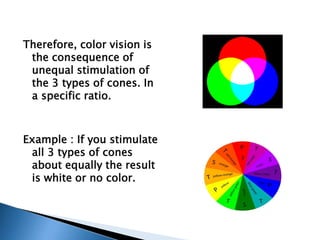




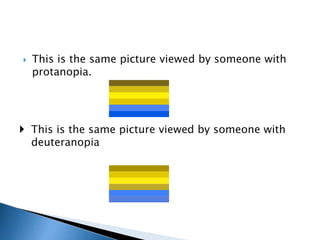


Color vision is the ability to perceive differences between wavelengths of light using cone cells in the retina that are sensitive to red, green, and blue light. There are two main theories of color vision: Young-Helmholtz theory proposes three types of cone cells each sensitive to a primary color, while Hering's theory proposes that some colors appear mutually exclusive like red-green and yellow-blue. Color blindness is caused by deficiencies in perceiving one or more primary colors and can range from anomalous trichromacy where one color is defective to dichromacy where one color is completely absent to rare monochromacy where only one color is perceived.


