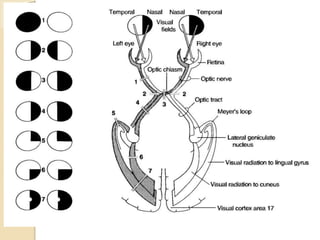
Visual Pathway
Anatomy Of Visual Pathway
 Visual pathway conveys visual (light) impulses
from the retina to the visual cortex in the
occipital lobe.
 Visual impulses are generated in rods & cones,
acts as transducers converting light signals to
electrical signals .
 Rods and cones of retina acts as
photoreceptors
 Rods concerned with scotopic vision (dim light)
numerous at ora serrata (120 million)
 Cones concerned with photopic vision (colour
vision) numerous at fovea centralis (7 million)
 Both rods and cones absent at optic disc
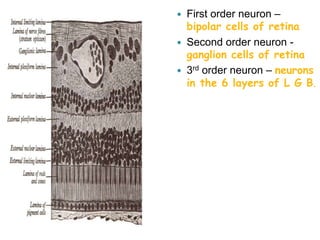
 First order neuron –
bipolar cells of retina
 Second order neuron -
ganglion cells of retina
 3rd order neuron – neurons
in the 6 layers of L G B.
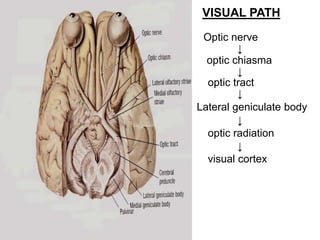
VISUAL PATH
Optic nerve
↓
optic chiasma
↓
optic tract
↓
Lateral geniculate body
↓
optic radiation
↓
visual cortex
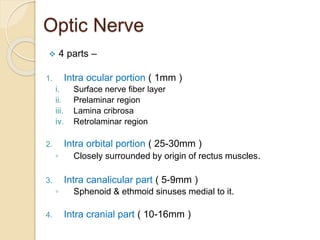
Optic Nerve
 4 parts –
1. Intra ocular portion ( 1mm )
i. Surface nerve fiber layer
ii. Prelaminar region
iii. Lamina cribrosa
iv. Retrolaminar region
2. Intra orbital portion ( 25-30mm )
◦ Closely surrounded by origin of rectus muscles.
3. Intra canalicular part ( 5-9mm )
◦ Sphenoid & ethmoid sinuses medial to it.
4. Intra cranial part ( 10-16mm )
 Consists of approx. 1.2 million axons.
 80 % of fibres originate from macular region.
 No neurilemma – no regeneration.
 Acquire myelin sheaths proximal to lamina
cribrosa.
 Covered by meningeal sheaths.
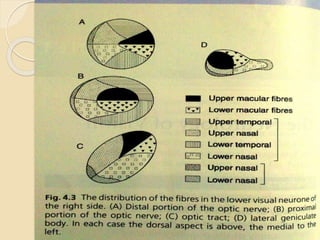
 Fibres from the peripheral parts of retina →
periphery of optic nerve.
 From parts of retina near optic disc → central
area of nerve.
 Fibres from macula ( Papillomacular bundle ) -
◦ Enter nerve on outer aspect , apex towards centre
of nerve.
◦ Become centrally – posterior part.
 Fibers from the 4 quadrants of retina run in
the same relative positions of optic nerve
Optic Chiasma
 Flattened structure , 12mm horizontally & 8mm
anteroposteriorly.
 Lies over tuberculum & diaphragma sella.
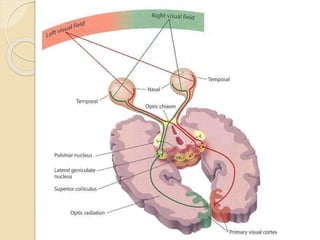
 Nasal fibres decussate.
 Von Willebrand knee – fibres from inferonasal
retina of other side which loop forward slightly
into opposite optic nerve after crossing over.
Optic tracts
 Starts at the posterolateral end of optic chiasma
 Optic tract winds round the upper part of cerebral
peduncle to reach the LGB.
 Pupillary reflex fibres pass onto pretectal nucleus.
 Some fibers terminate in superior colliculus.
 Mode of termination of fibers of optic tract
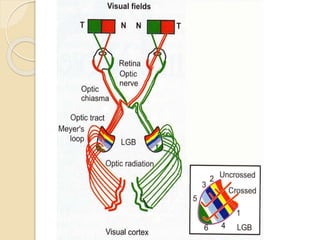
supr quadr of retina – lateral part of L G B
infr quad of retina – medial part of L G B
Macular fibres – central & posterior part of
LGB
Lateral Geniculate Body
 Seen as small ovoid projection at posterolateral part of
thalamus.
 It is the thalamic relay station for visual impulses.
 Grey matter split to form 6 lamina.
 1& 2 lamina larger cells – magnocellular ( motion)
 3 to 6 -smaller neurons –parvocellular ( colour, fine
details,shape )
 Crossed fibers of optic tract make synapse with cells in
1,4,and 6 layers.
 Uncrossed/ fibres of same side with 2,3,and 5.
 Fibers from fovea centralis has precise point to point
Optic radiations
 Extend from LGB to visual cortex ( Geniculo-
calcarine tract ).
 Pass thru the retrolentiform part of internal capsule.
 Ventral fibres ( lower quadrant of retina) run
forwards into temporal lobe – Meyers Loop.
 Dorsal fibres ( upper retinal quadrant ) run directly
thru parietal lobe into visual cortex.
 Pass close to posterior cornu of lateral ventricle.
Visual cortex
 Medial aspect of occipital lobe, in & about the
calcarine fissure.
 Line of Gennari – interpolated in grey matter.
 Visuosensory area - striate area 17,
Visuopsychic area – peristriate area 18 &
parastriate area 19.
 Rt ½ of field of vision is represented in the
visual cortex of Lt hemisphere & vice versa
 Spatial arrangement maintained-
◦ Parts above & below calcarine fissure
represent upper & lower quadrants of
both retinae.
◦ Peripheral retinal fibers end in antr part of
visual area
◦ Macular fibers postrly
Blood supply of visual
pathway
 Mainly supplied by pial network of vessels.
 Orbital part of optic nerve also supplied by an
axial system – central artery of retina.
 Blood supply of optic nerve head –
i. Surface layer – capillaries from retinal arterioles.
ii. Prelaminar region – centripetal branches of
peripapillary choroid + vessels of lamina cribrosa.
iii. Lamina cribrosa – posterior ciliary A & arterial circle
of Zinn.
iv. Retrolaminar part – centrifugal branches from CRA
& centripetal br from pial plexus.
Lesions Of Visual
Pathway
Lesions of optic nerve
 One optic nerve damaged → loss of vision on
affected side, loss of ipsilateral direct &
contralateral consensual pupillary reflexes.
 Lesion in proximal part of optic nerve near chiasma
→ ipsilateral blindness & contralateral
superotemporal field defect – Traquair Junctional
scotoma.
 Due to involvement of crossed fibres of opp side as
they loop forward into the nerve.
 Causes of optic nerve lesions –
◦ Optic atrophy
◦ Traumatic avulsion of optic nerve
◦ Indirect optic neuropathy
◦ Acute optic neuritis
◦ ischemia
Lesions of optic chiasma
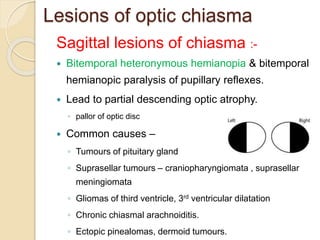
Sagittal lesions of chiasma :-
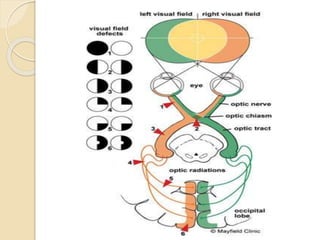
 Bitemporal heteronymous hemianopia & bitemporal
hemianopic paralysis of pupillary reflexes.
 Lead to partial descending optic atrophy.
◦ pallor of optic disc
 Common causes –
◦ Tumours of pituitary gland
◦ Suprasellar tumours – craniopharyngiomata , suprasellar
meningiomata
◦ Gliomas of third ventricle, 3rd ventricular dilatation
◦ Chronic chiasmal arachnoiditis.
◦ Ectopic pinealomas, dermoid tumours.
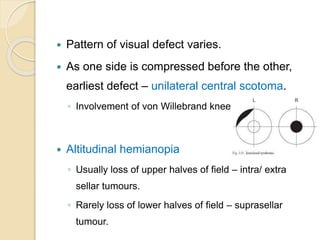
 Pattern of visual defect varies.
 As one side is compressed before the other,
earliest defect – unilateral central scotoma.
◦ Involvement of von Willebrand knee.
 Altitudinal hemianopia
◦ Usually loss of upper halves of field – intra/ extra
sellar tumours.
◦ Rarely loss of lower halves of field – suprasellar
tumour.
Lateral lesions of chiasma :-
 Binasal hemianopia, with binasal paralysis of
pupillary reflexes.
 Partial descending optic atrophy.
 Common causes –
◦ Distension of 3rd ventricle
◦ Atheroma of carotids or posterior communicating
arteries
Lesions of Optic tract
 Incongruous Homonymous hemianopia
◦ As arrangement of nerve fibres in the tract is not regular.
 Contralateral hemianopic pupillary reaction (
Wernicke’s reaction).
 Partial descending optic atrophy.
◦ Atrophy of crossed retinal fibres – bow tie optic atrophy.
 Association with 3rd nerve palsy & hemiplegia.
 Causes –
◦ Syphilitic meningitis or gumma & tuberculous.
◦ Tumours of optic thalamus
◦ Aneurysms of superior cerebellar or posterior
cerebral arteries.
◦ Tentorial meningiomas
Lesions of Optic radiations
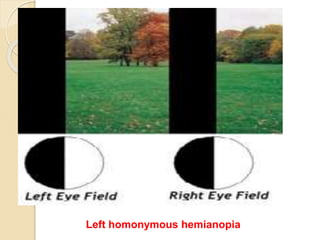
 Involvement of total optic radiation → congruous
homonymous hemianopia.
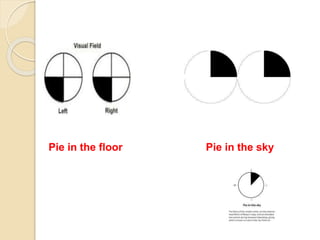
 Lesions of Meyers loop ( inferior fibres) → superior
homonymous quadrantic defects – Pie in the sky on the
opp side.
 Lesions of temporal lobe → complete superior
homonymous quadrantanopia.
 Lesions of parietal lobe (superior fibres) → inferior
quadrantic hemianopia – Pie on the floor.
 No optic atrophy.
Left homonymous hemianopia
Pie in the floor Pie in the sky
Lesions of Visual Cortex
 Congruous Homonymous hemianopia , usually
sparing macular area.
 Pupillary reflexes normal, no optic atrophy.
 Causes –
◦ Injury by fall on the back of head
◦ Gunshot wounds
◦ Cerebral softening
 When angular gyrus involved → word
blindness.
 Riddoch Phenomenon –
◦ Appreciation of a dim kinetic target is retained
within the defective visual field, with loss of
appreciation of a static bright target.
◦ Typical of an occipital lesion.
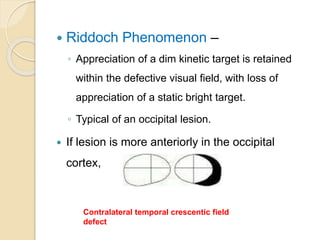
 If lesion is more anteriorly in the occipital
cortex,
Contralateral temporal crescentic field
defect
Visual pathway
Visual pathway

Visual pathway

  • 1.
  • 2.
    Anatomy Of VisualPathway  Visual pathway conveys visual (light) impulses from the retina to the visual cortex in the occipital lobe.  Visual impulses are generated in rods & cones, acts as transducers converting light signals to electrical signals .  Rods and cones of retina acts as photoreceptors
  • 3.
     Rods concernedwith scotopic vision (dim light) numerous at ora serrata (120 million)  Cones concerned with photopic vision (colour vision) numerous at fovea centralis (7 million)  Both rods and cones absent at optic disc
  • 4.
     First orderneuron – bipolar cells of retina  Second order neuron - ganglion cells of retina  3rd order neuron – neurons in the 6 layers of L G B.
  • 5.
    VISUAL PATH Optic nerve ↓ opticchiasma ↓ optic tract ↓ Lateral geniculate body ↓ optic radiation ↓ visual cortex
  • 8.
    Optic Nerve  4parts – 1. Intra ocular portion ( 1mm ) i. Surface nerve fiber layer ii. Prelaminar region iii. Lamina cribrosa iv. Retrolaminar region 2. Intra orbital portion ( 25-30mm ) ◦ Closely surrounded by origin of rectus muscles. 3. Intra canalicular part ( 5-9mm ) ◦ Sphenoid & ethmoid sinuses medial to it. 4. Intra cranial part ( 10-16mm )
  • 9.
     Consists ofapprox. 1.2 million axons.  80 % of fibres originate from macular region.  No neurilemma – no regeneration.  Acquire myelin sheaths proximal to lamina cribrosa.  Covered by meningeal sheaths.
  • 10.
     Fibres fromthe peripheral parts of retina → periphery of optic nerve.  From parts of retina near optic disc → central area of nerve.  Fibres from macula ( Papillomacular bundle ) - ◦ Enter nerve on outer aspect , apex towards centre of nerve. ◦ Become centrally – posterior part.  Fibers from the 4 quadrants of retina run in the same relative positions of optic nerve
  • 12.
    Optic Chiasma  Flattenedstructure , 12mm horizontally & 8mm anteroposteriorly.  Lies over tuberculum & diaphragma sella.  Nasal fibres decussate.  Von Willebrand knee – fibres from inferonasal retina of other side which loop forward slightly into opposite optic nerve after crossing over.
  • 13.
    Optic tracts  Startsat the posterolateral end of optic chiasma  Optic tract winds round the upper part of cerebral peduncle to reach the LGB.  Pupillary reflex fibres pass onto pretectal nucleus.  Some fibers terminate in superior colliculus.  Mode of termination of fibers of optic tract supr quadr of retina – lateral part of L G B infr quad of retina – medial part of L G B Macular fibres – central & posterior part of LGB
  • 14.
    Lateral Geniculate Body Seen as small ovoid projection at posterolateral part of thalamus.  It is the thalamic relay station for visual impulses.  Grey matter split to form 6 lamina.  1& 2 lamina larger cells – magnocellular ( motion)  3 to 6 -smaller neurons –parvocellular ( colour, fine details,shape )  Crossed fibers of optic tract make synapse with cells in 1,4,and 6 layers.  Uncrossed/ fibres of same side with 2,3,and 5.  Fibers from fovea centralis has precise point to point
  • 15.
    Optic radiations  Extendfrom LGB to visual cortex ( Geniculo- calcarine tract ).  Pass thru the retrolentiform part of internal capsule.  Ventral fibres ( lower quadrant of retina) run forwards into temporal lobe – Meyers Loop.  Dorsal fibres ( upper retinal quadrant ) run directly thru parietal lobe into visual cortex.  Pass close to posterior cornu of lateral ventricle.
  • 17.
    Visual cortex  Medialaspect of occipital lobe, in & about the calcarine fissure.  Line of Gennari – interpolated in grey matter.  Visuosensory area - striate area 17, Visuopsychic area – peristriate area 18 & parastriate area 19.  Rt ½ of field of vision is represented in the visual cortex of Lt hemisphere & vice versa
  • 18.
     Spatial arrangementmaintained- ◦ Parts above & below calcarine fissure represent upper & lower quadrants of both retinae. ◦ Peripheral retinal fibers end in antr part of visual area ◦ Macular fibers postrly
  • 19.
    Blood supply ofvisual pathway  Mainly supplied by pial network of vessels.  Orbital part of optic nerve also supplied by an axial system – central artery of retina.  Blood supply of optic nerve head – i. Surface layer – capillaries from retinal arterioles. ii. Prelaminar region – centripetal branches of peripapillary choroid + vessels of lamina cribrosa. iii. Lamina cribrosa – posterior ciliary A & arterial circle of Zinn. iv. Retrolaminar part – centrifugal branches from CRA & centripetal br from pial plexus.
  • 20.
  • 21.
    Lesions of opticnerve  One optic nerve damaged → loss of vision on affected side, loss of ipsilateral direct & contralateral consensual pupillary reflexes.  Lesion in proximal part of optic nerve near chiasma → ipsilateral blindness & contralateral superotemporal field defect – Traquair Junctional scotoma.  Due to involvement of crossed fibres of opp side as they loop forward into the nerve.
  • 22.
     Causes ofoptic nerve lesions – ◦ Optic atrophy ◦ Traumatic avulsion of optic nerve ◦ Indirect optic neuropathy ◦ Acute optic neuritis ◦ ischemia
  • 23.
    Lesions of opticchiasma Sagittal lesions of chiasma :-  Bitemporal heteronymous hemianopia & bitemporal hemianopic paralysis of pupillary reflexes.  Lead to partial descending optic atrophy. ◦ pallor of optic disc  Common causes – ◦ Tumours of pituitary gland ◦ Suprasellar tumours – craniopharyngiomata , suprasellar meningiomata ◦ Gliomas of third ventricle, 3rd ventricular dilatation ◦ Chronic chiasmal arachnoiditis. ◦ Ectopic pinealomas, dermoid tumours.
  • 24.
     Pattern ofvisual defect varies.  As one side is compressed before the other, earliest defect – unilateral central scotoma. ◦ Involvement of von Willebrand knee.  Altitudinal hemianopia ◦ Usually loss of upper halves of field – intra/ extra sellar tumours. ◦ Rarely loss of lower halves of field – suprasellar tumour.
  • 25.
    Lateral lesions ofchiasma :-  Binasal hemianopia, with binasal paralysis of pupillary reflexes.  Partial descending optic atrophy.  Common causes – ◦ Distension of 3rd ventricle ◦ Atheroma of carotids or posterior communicating arteries
  • 26.
    Lesions of Optictract  Incongruous Homonymous hemianopia ◦ As arrangement of nerve fibres in the tract is not regular.  Contralateral hemianopic pupillary reaction ( Wernicke’s reaction).  Partial descending optic atrophy. ◦ Atrophy of crossed retinal fibres – bow tie optic atrophy.  Association with 3rd nerve palsy & hemiplegia.
  • 27.
     Causes – ◦Syphilitic meningitis or gumma & tuberculous. ◦ Tumours of optic thalamus ◦ Aneurysms of superior cerebellar or posterior cerebral arteries. ◦ Tentorial meningiomas
  • 28.
    Lesions of Opticradiations  Involvement of total optic radiation → congruous homonymous hemianopia.  Lesions of Meyers loop ( inferior fibres) → superior homonymous quadrantic defects – Pie in the sky on the opp side.  Lesions of temporal lobe → complete superior homonymous quadrantanopia.  Lesions of parietal lobe (superior fibres) → inferior quadrantic hemianopia – Pie on the floor.  No optic atrophy.
  • 29.
  • 30.
    Pie in thefloor Pie in the sky
  • 31.
    Lesions of VisualCortex  Congruous Homonymous hemianopia , usually sparing macular area.  Pupillary reflexes normal, no optic atrophy.  Causes – ◦ Injury by fall on the back of head ◦ Gunshot wounds ◦ Cerebral softening  When angular gyrus involved → word blindness.
  • 32.
     Riddoch Phenomenon– ◦ Appreciation of a dim kinetic target is retained within the defective visual field, with loss of appreciation of a static bright target. ◦ Typical of an occipital lesion.  If lesion is more anteriorly in the occipital cortex, Contralateral temporal crescentic field defect