Pupillary Reflexes
Othman Al-Abbadi, M.D
Normal pupil
• Functions:
• Limits the amount of light reaching retina
• Controls spherical & chromatic aberrations
• Number
• Location
• Size  3-4 (bright)… 4-8 (dark)
• The same for different genders & iris colours
• Variation with age
• Physiologic anisocoria
• Pupillary unrest: constant symmetrical fluctuation… detected
by magnification
• Hippus: exaggerated.. Detected on visual inspection
• No diagnostic significance
• Colour: depend on the structures behind it
• Greyish black
• Jet black
• leukocoria
• Pupillary constrictor/ spincter-innervated by parasympathetic
• Pupillary dilator – innervated by sympathetic
• Evaluation of pupil- Diagnostic clue to ocular, neurological,
medical, surgical and paediatric diseases
Light reflex
• When light is shown to one eye.. Both pupils constrict
• Direct vs consensual
• Almost identical in time, course & magnitude
• If both pupils illuminated at once summation
• Dependant the state of adaptation of the retina, emotions,
alertness, …
• Maximum frequency of stimuli is 5 Hz
Light reflex
• Initiated by retinal photoreceptors
• Transmitted along optic nerve
• Undergo a hemidecussation at the optic chiasma
(nasal fibres cross over)
• Proceeds along optic tract
• Synapses at pre- tectal nucleus
• Ends in both Edinger westpal nucleui
• Any given pretectal neuron behaves functionally
as though it recieves similar inputs from each eye
& projects equally in each EW nucleus
• Ipsilateral around periaqueduct
• Contralateral via the posterior commissure
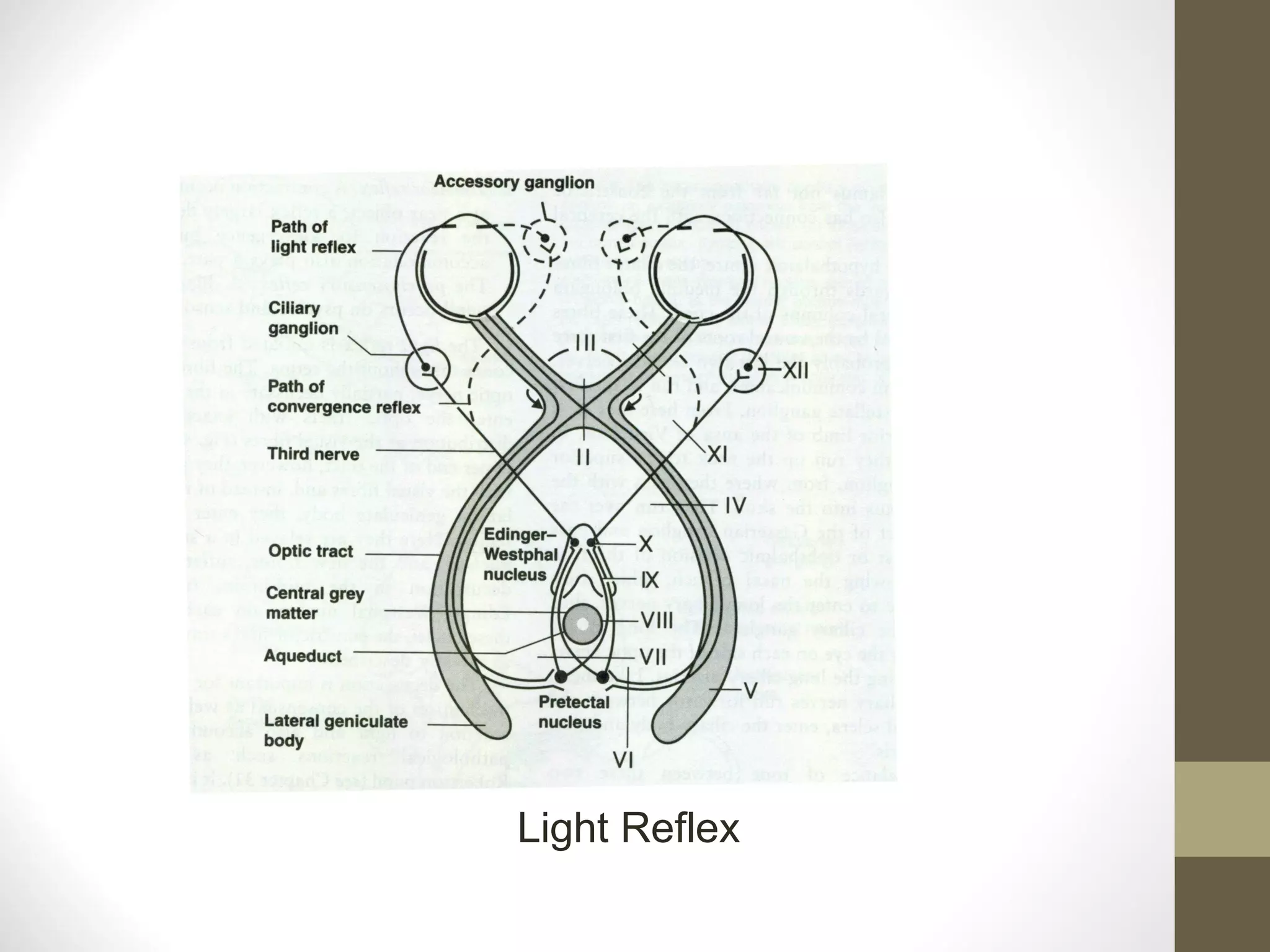
Light Reflex
• Efferent fibers travel on the surface of CN-III
• to inf. Obl.
• &/ due to long course unilateral defecits can be of
localizing significance in unilateral pathology
• Synapse & relay at ciliary ganglion
• Post ganglionic fibres reach ciliary muscle and
iris spincter through short ciliary nerves to reach
the sphincter pupillae
• Cerebral cortex sends inhibitory signals to EW
nucleus absence leads to meiosis during sleep
• Functions:
• Protects against excessive bleaching of the visual pigments
• Light/Dark adaptation to maximize VA
Near reflex
• Triad:
• Inc. accomodation
• Convergence of visual axes
• Constriction of the pupils
Near reflex
• Accomodation reflex:
• Stimulus : Blurring of retinal images when object is near
• Retina- Optic nerve – Optic chiasma- Optic tract- Optic
radiations- Lat geniculate body- visual cortex – cortical
association areas- occipito mesencephalic tract- mid brain-
E.W. nucleus- 3rd nerve- accessory ciliary ganglion along short
ciliary nerves- ciliary muscle and pupil constrictor
Near reflex- convergence
reflex
• Co contraction of both medial recti
• Proprioceptive impulses originate and travel along 5th
nerve
• Reach mesencephalic root of 5th
nerve
• Transmitted to EW nucleus in midbrain via convergence
centre (in the tectal or pretectal area)
• From EW efferent pathway same as accomodation reflex
Accomodation Reflex
Darkness reflex
• From lighted to dim environment
• Physiology
• Abolition of light reflex relaxation of sphincter pupillae
• Contraction dilator pupillae
Psychosensory reflexes
• Dilation in response to psychological stimuli
• Not seen in newborn
• Fully developed at 6 months of age
• Cortical mechanism
Ciliospinal reflex
• Pupil dilation in response to painful stimulus in the neck
• Indicates that some of the psychosensory reflex is mediated at
the spinal cord
Lid-closure reflex
• Nonspecific term
1.Meiosis with blinking
• Constrict transiently with blinking
• Absent in darkness maybe darkness reflex
1.Homolateral meiosis with lid closure
• Constrict with forced prohibited lid closure
• Absent if distant gaze unconscious attempt at near
gaze
1.Oculopupillary reflex (mydriasis on corneal
touch)
Pharmacology
• Miotics
• Mydriatics
Parasympathomimetics
• Cholinergic
• Initiate or potentiate acetylcholine action
1.Direct acting
• Pilocarpine; similar to acetylcholine
1.Indirect (cholinesterase inhibitors)
• Cholinesterase is present in presynaptic axon
• Block action or deplete stores
1. Reversible physostigmine
2. Irreversible ecothiophate iodide, demecarium,
diisopropyl fluorophosphate
2.Dual action
Sympatholytics
• Alpha-adrenergic blockers
• By preventing dilator contraction by occupying alpha-receptor
sites on the iris dilator
• E.g: thymoxamine, phenoxybenzamine, dibenamine,
tolazoline
• Guane-thidine
• commonly used in ophthalmology
• Depletes norepinephrine stores & disrupts release
• Continued topical drops lead to Horner’s syndrome
Other miotics
• Histamine:
• Direct action
• Even in atropinized eyes
• Morphine
• Cutting off cortical inhibition of EW nucleus
• Also direct action
Sympathomimetics
• Ways of action:
• Inc. norepinephrine release
• Prevent reuptake
• Direct action
1.Adrenaline (epinephrine)
• Direct action
• 4 drops of 0.1% q5m
• Rapidly inactivated (not effective)
2. Phenylephrine 5-10%
• Synthetic analog
• Direct action & inc. release
2. Hydroxyamphetamine & ephidrine
• Inc. release
2. Cocaine
• Prevents reuptake
Parasympatholytics
1. Atropine 1%
• Strongest
• Completely paralyses sphincter pupillae & ciliary muscles
• Complete dilation in 30-40 m & cycloplegia in 2h
• Duration 7+ d
1. Homatropine 2%
• Quicker
• Cycloplegia in 45-60 m
• Duration 48 h
3. Cyclopentolate 1%
• Short acting
• Cycloplegia 1 h
• Duration 6-12 h
3. Tropicamide 1%
• noncycloplegic
Abnormalities of
pupillary reflexes
Afferent pathway defects
1. TAPD (amaurotic pupil)
• Complete retinal or nerve lesion
• Total blindness
• -ve ipsilateral direct & contralateral consensual light reflex
• Isocoria in diffuse illumination
• Near reflex is preserved
2. RAPD (marcus gunn pupil)
• Severe retinal or incomplete optic nerve lesion
• Swinging flashlight test
• Paradoxical response of the affected pupil by Swinging flashlight
test
• Earliest sign of optic nerve disease
• VA maybe preserved
• 3. Wernicke’s hemianopic pupil
• Optic tract lesion
• Ipsilateral temporal & contralateral nasal
Efferent pathway defects
• Ipsilateral absence direct & consensual light
reflexes
• Ipsilateral absence of near reflex
• Ipsilateral fixed & dilated pupil
• Causes
• Brainstem lesions
• Fascicular 3rd
nerve lesion
• Ciliary ganglion lesion
• Iris damage
• Drugs
• Pilocarpine to differentiate from neuro
Tonic pupil
• -ve light, accomodation & near reflexes
• Cholinergic hypersensitivity (pilo 0.125%)
• Causes
• Local
• Herpes zoster ganglionitis
• Orbital or choroidal trauma or tumors
• Blunt trauma resulting injury at the iris root
• Neuropathic (DM, alcoholism)
• Adie’s tonic pupil
• Adie’s tonic pupil: Characterised by
• large unilaterally dilated pupil
• Absent / poor light response
• In near response , there is slow / tonic contraction of the iris
• May be associated with loss of deep tendon reflexes as for the
knee (Adie’s syndrome)
• Seen in young women
• Mild regional corneal impaired sensitivity
Light-Near dissociation
1. Bilateral complete afferent pathway defect
2. Lesion in the midbrain at the level of the
pretectal area
3. CN-III palsy with regeneration of MR
innervation into sphincter innervation pathway
(pseudo-Argyll Robertson pupil)
4. Ciliary ganglion or short ciliary nerve with
regeneration of accomodation fibers into
sphincter pupillae
5. Aberrant regeneration in DM, alcoholism,
amyloidosis
• Argyll Robertson pupil(ARP)
• Occurs in neurosyphilis, Tabesdorsalis,G.P.I.
• Site of lesion: (dorsal mid brain) in the region of the tectum near the
sylvian aqueduct interfering with light reflex fibers & supranuclear
inhibitory fibers going down to EW nucleus
• Characteristics:
• Bilateral asymmetrical involvement
• Small irregular pupils
• Preserved vision
• -ve light & +ve near reflexes
• Poor dilation with atropine
• Further constriction with physostigmine
• Horner’s syndrome :
• Involvement of cervical sympathetic
• Miosis, partial ptosis, enophthalmos & anhydrosis
• Iris heterochromia
• Pourfour de Petit Syndrome
• This syndrome is the clinical opposite of Horner syndrome. It
represents oculosympathetic overactivity
• unilateral mydriasis, lid retraction, apparent exophthalmos, and
conjunctival blanching
• Seen after trauma, brachial plexus anesthetic block or other
injury, and parotidectomy

Pupillary reflexes

  • 1.
  • 2.
    Normal pupil • Functions: •Limits the amount of light reaching retina • Controls spherical & chromatic aberrations • Number • Location • Size  3-4 (bright)… 4-8 (dark) • The same for different genders & iris colours • Variation with age • Physiologic anisocoria
  • 3.
    • Pupillary unrest:constant symmetrical fluctuation… detected by magnification • Hippus: exaggerated.. Detected on visual inspection • No diagnostic significance • Colour: depend on the structures behind it • Greyish black • Jet black • leukocoria
  • 4.
    • Pupillary constrictor/spincter-innervated by parasympathetic • Pupillary dilator – innervated by sympathetic • Evaluation of pupil- Diagnostic clue to ocular, neurological, medical, surgical and paediatric diseases
  • 5.
    Light reflex • Whenlight is shown to one eye.. Both pupils constrict • Direct vs consensual • Almost identical in time, course & magnitude • If both pupils illuminated at once summation • Dependant the state of adaptation of the retina, emotions, alertness, … • Maximum frequency of stimuli is 5 Hz
  • 6.
    Light reflex • Initiatedby retinal photoreceptors • Transmitted along optic nerve • Undergo a hemidecussation at the optic chiasma (nasal fibres cross over) • Proceeds along optic tract • Synapses at pre- tectal nucleus • Ends in both Edinger westpal nucleui • Any given pretectal neuron behaves functionally as though it recieves similar inputs from each eye & projects equally in each EW nucleus • Ipsilateral around periaqueduct • Contralateral via the posterior commissure
  • 7.
  • 8.
    • Efferent fiberstravel on the surface of CN-III • to inf. Obl. • &/ due to long course unilateral defecits can be of localizing significance in unilateral pathology • Synapse & relay at ciliary ganglion • Post ganglionic fibres reach ciliary muscle and iris spincter through short ciliary nerves to reach the sphincter pupillae • Cerebral cortex sends inhibitory signals to EW nucleus absence leads to meiosis during sleep
  • 9.
    • Functions: • Protectsagainst excessive bleaching of the visual pigments • Light/Dark adaptation to maximize VA
  • 10.
    Near reflex • Triad: •Inc. accomodation • Convergence of visual axes • Constriction of the pupils
  • 11.
    Near reflex • Accomodationreflex: • Stimulus : Blurring of retinal images when object is near • Retina- Optic nerve – Optic chiasma- Optic tract- Optic radiations- Lat geniculate body- visual cortex – cortical association areas- occipito mesencephalic tract- mid brain- E.W. nucleus- 3rd nerve- accessory ciliary ganglion along short ciliary nerves- ciliary muscle and pupil constrictor
  • 12.
    Near reflex- convergence reflex •Co contraction of both medial recti • Proprioceptive impulses originate and travel along 5th nerve • Reach mesencephalic root of 5th nerve • Transmitted to EW nucleus in midbrain via convergence centre (in the tectal or pretectal area) • From EW efferent pathway same as accomodation reflex
  • 13.
  • 14.
    Darkness reflex • Fromlighted to dim environment • Physiology • Abolition of light reflex relaxation of sphincter pupillae • Contraction dilator pupillae
  • 15.
    Psychosensory reflexes • Dilationin response to psychological stimuli • Not seen in newborn • Fully developed at 6 months of age • Cortical mechanism
  • 16.
    Ciliospinal reflex • Pupildilation in response to painful stimulus in the neck • Indicates that some of the psychosensory reflex is mediated at the spinal cord
  • 17.
    Lid-closure reflex • Nonspecificterm 1.Meiosis with blinking • Constrict transiently with blinking • Absent in darkness maybe darkness reflex 1.Homolateral meiosis with lid closure • Constrict with forced prohibited lid closure • Absent if distant gaze unconscious attempt at near gaze 1.Oculopupillary reflex (mydriasis on corneal touch)
  • 18.
  • 19.
    Parasympathomimetics • Cholinergic • Initiateor potentiate acetylcholine action 1.Direct acting • Pilocarpine; similar to acetylcholine 1.Indirect (cholinesterase inhibitors) • Cholinesterase is present in presynaptic axon • Block action or deplete stores 1. Reversible physostigmine 2. Irreversible ecothiophate iodide, demecarium, diisopropyl fluorophosphate 2.Dual action
  • 20.
    Sympatholytics • Alpha-adrenergic blockers •By preventing dilator contraction by occupying alpha-receptor sites on the iris dilator • E.g: thymoxamine, phenoxybenzamine, dibenamine, tolazoline • Guane-thidine • commonly used in ophthalmology • Depletes norepinephrine stores & disrupts release • Continued topical drops lead to Horner’s syndrome
  • 21.
    Other miotics • Histamine: •Direct action • Even in atropinized eyes • Morphine • Cutting off cortical inhibition of EW nucleus • Also direct action
  • 22.
    Sympathomimetics • Ways ofaction: • Inc. norepinephrine release • Prevent reuptake • Direct action 1.Adrenaline (epinephrine) • Direct action • 4 drops of 0.1% q5m • Rapidly inactivated (not effective)
  • 23.
    2. Phenylephrine 5-10% •Synthetic analog • Direct action & inc. release 2. Hydroxyamphetamine & ephidrine • Inc. release 2. Cocaine • Prevents reuptake
  • 24.
    Parasympatholytics 1. Atropine 1% •Strongest • Completely paralyses sphincter pupillae & ciliary muscles • Complete dilation in 30-40 m & cycloplegia in 2h • Duration 7+ d 1. Homatropine 2% • Quicker • Cycloplegia in 45-60 m • Duration 48 h
  • 25.
    3. Cyclopentolate 1% •Short acting • Cycloplegia 1 h • Duration 6-12 h 3. Tropicamide 1% • noncycloplegic
  • 26.
  • 27.
    Afferent pathway defects 1.TAPD (amaurotic pupil) • Complete retinal or nerve lesion • Total blindness • -ve ipsilateral direct & contralateral consensual light reflex • Isocoria in diffuse illumination • Near reflex is preserved
  • 28.
    2. RAPD (marcusgunn pupil) • Severe retinal or incomplete optic nerve lesion • Swinging flashlight test • Paradoxical response of the affected pupil by Swinging flashlight test • Earliest sign of optic nerve disease • VA maybe preserved
  • 29.
    • 3. Wernicke’shemianopic pupil • Optic tract lesion • Ipsilateral temporal & contralateral nasal
  • 30.
    Efferent pathway defects •Ipsilateral absence direct & consensual light reflexes • Ipsilateral absence of near reflex • Ipsilateral fixed & dilated pupil • Causes • Brainstem lesions • Fascicular 3rd nerve lesion • Ciliary ganglion lesion • Iris damage • Drugs • Pilocarpine to differentiate from neuro
  • 31.
    Tonic pupil • -velight, accomodation & near reflexes • Cholinergic hypersensitivity (pilo 0.125%) • Causes • Local • Herpes zoster ganglionitis • Orbital or choroidal trauma or tumors • Blunt trauma resulting injury at the iris root • Neuropathic (DM, alcoholism) • Adie’s tonic pupil
  • 32.
    • Adie’s tonicpupil: Characterised by • large unilaterally dilated pupil • Absent / poor light response • In near response , there is slow / tonic contraction of the iris • May be associated with loss of deep tendon reflexes as for the knee (Adie’s syndrome) • Seen in young women • Mild regional corneal impaired sensitivity
  • 33.
    Light-Near dissociation 1. Bilateralcomplete afferent pathway defect 2. Lesion in the midbrain at the level of the pretectal area 3. CN-III palsy with regeneration of MR innervation into sphincter innervation pathway (pseudo-Argyll Robertson pupil) 4. Ciliary ganglion or short ciliary nerve with regeneration of accomodation fibers into sphincter pupillae 5. Aberrant regeneration in DM, alcoholism, amyloidosis
  • 34.
    • Argyll Robertsonpupil(ARP) • Occurs in neurosyphilis, Tabesdorsalis,G.P.I. • Site of lesion: (dorsal mid brain) in the region of the tectum near the sylvian aqueduct interfering with light reflex fibers & supranuclear inhibitory fibers going down to EW nucleus • Characteristics: • Bilateral asymmetrical involvement • Small irregular pupils • Preserved vision • -ve light & +ve near reflexes • Poor dilation with atropine • Further constriction with physostigmine
  • 35.
    • Horner’s syndrome: • Involvement of cervical sympathetic • Miosis, partial ptosis, enophthalmos & anhydrosis • Iris heterochromia
  • 36.
    • Pourfour dePetit Syndrome • This syndrome is the clinical opposite of Horner syndrome. It represents oculosympathetic overactivity • unilateral mydriasis, lid retraction, apparent exophthalmos, and conjunctival blanching • Seen after trauma, brachial plexus anesthetic block or other injury, and parotidectomy