RETINITIS PIGMENTOSA
Othman Al-Abbadi, M.D
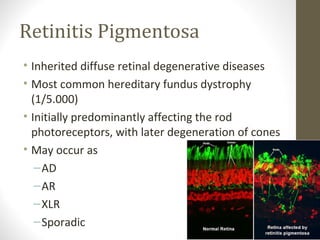
Retinitis Pigmentosa
• Inherited diffuse retinal degenerative diseases
• Most common hereditary fundus dystrophy
(1/5.000)
• Initially predominantly affecting the rod
photoreceptors, with later degeneration of cones
• May occur as
–AD
–AR
–XLR
–Sporadic
Modes of inheritence
• XLR is the least common but most severe form,
and may result in complete blindness by the
third or fourth decades
• AR disease can also be severe
• Sporadic cases may have a more favourable
prognosis, with retention of central vision until
the sixth decade or later
• AD disease generally has the best prognosis
Symptoms
• Nyctalopia and dark adaptation difficulties are
frequently presenting symptoms
• Mid-peripheral then far-peripheral field loss
• reduced central vision (late)
• Cataract
• Photopsia
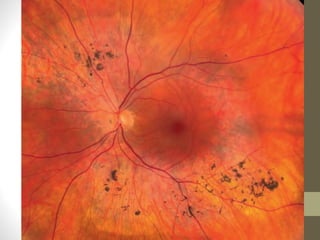
Signs
• Triad of
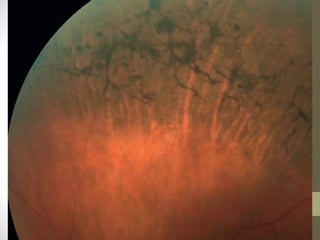
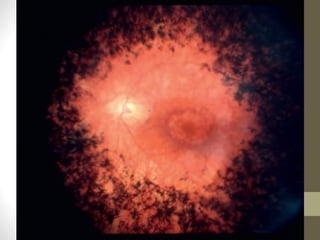
• bone-spicule retinal pigmentation
• arteriolar attenuation
• ‘waxy’ disc pallor
Progression
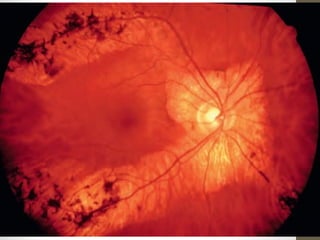
• Bilateral mid-peripheral intraretinal perivascular
‘bone-spicule’ pigmentary changes with
arteriolar narrowing
• Then a gradual increase in density of the
pigment
• Anterior and posterior spread
• Peripheral pigmentation may become severe,
with marked arteriolar narrowing and disc pallor
• The macula may show
• Atrophy
• epiretinal membrane formation
• cystoid macular oedema (CMO)
• Myopia is common.
• Optic disc drusen occur more frequently
Complications
• PSCC
• OAG
• Keratoconus
• PVD
• Intermediate uveitis
• Exudative RD
Investigations
• ERG
• EOG
• Perimetry
• OCT
• Genetic analysis
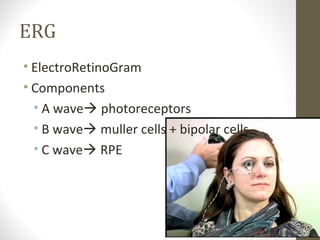
ERG
• ElectroRetinoGram
• Components
• A wave photoreceptors
• B wave muller cells + bipolar cells
• C wave RPE
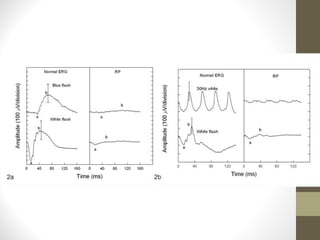
ERG
• Sensitive diagnostic test
• Early  reduced scotopic rod and
combined responses
• With progression  photopic responses
also reduce
EOG
• Measurement of standing potential between the
cornea and the retina
measurement of function of the RPE and
photoreceptors
• Abnormal in RP
• However, ERG is considered a more sensitive
test for detection of photoreceptor function and
consequently EOG is not routinely done
Visual field
• Characteristically shows a ring scotoma in the
mid-periphery of the visual field
• Start as a group of isolated scotomas around 20
degrees from fixation, and gradually coalesce to
form a partial followed by a complete ring
• Useful in monitoring the progression of disease
and document the status of legal blindness
OCT
• to detect
• CMO
• Epiretinal membrane
• vitreomaular traction
Treatment
• Many treatments have been explored without
proven benefit
• These include various vitamins and minerals,
vasodilators, tissue therapy with placental
extract, cortisone, cervical sympathectomy,
injections of a hydrolysate of yeast RNA,
ultrasound, transfer factor, dimethyl sulfoxide,
ozone, muscle transplants, and subretinal
injections of fetal retinal cells
Atypical retinitis pigmentosa
• Syndromic
• Usher syndrome
• Kearns–Sayre syndrome
• Bassen–Kornzweig
syndrome
• Refsum disease
• Bardet–Biedl syndrome
• Non-syndromic
• Retinitis pigmentosa sine
pigmento
• Retinitis punctata
albescens
• Sector retinitis pigmentosa
• Leber congenital
amaurosis
• Pigmented paravenous
chorioretinal atrophy
Usher syndrome
• About 15% to 20% of affected individuals with retinitis
pigmentosa have associated hearing loss
• There are three major types;
• Type I (75%) which features profound congenital
sensorineural deafness and severe RP with an
extinguished ERG in the first decade plus unintelligible
speech & vestibular ataxia
• Type III (2%), with progressive hearing loss, vestibular
dysfunction and relatively late-onset pigmentary
retinopathy
Kearns–Sayre syndrome
• Part of chronic progressive external
ophthalmoplegia
• Mitochondrial inheritance
• Abnormalities include
• Ptosis
• diffuse disturbance of the RPE
• ERGs that are usually reduced in amplitude
• respiratory distress
• heart block which may require a pacemaker
Bassen–Kornzweig syndrome
• Abetalipoproteinaemia
• Malabsorption of fat and fat-soluble vitamin
• Develops FTT in infancy
• The fundus exhibits scattered white dots
followed by RP-like changes developing towards
the end of the first decade; there may also be
ptosis, ophthalmoplegia, strabismus and
nystagmus
Refsum disease
• The patient accumulates exogenous phytanic acid
• Findings include a peripheral neuropathy, ataxia, an increase
in CSF protein with a normal cell count, and retinitis
pigmentosa
• All have elevated serum phytanic acid
• A defect exists in the conversion of phytanic acid to alpha-
hydroxy phytanic acid which results in its accumulation
• Treatment consists of restricting not only animal fats and
milk products (i.e., foods that contain phytanic acid) but also
green leafy vegetables containing phytol
Bardet–Biedl syndrome
• Includes RP, mental retardation,
polydactylism, apple-shaped obesity, and
hypogonadism
• Almost 80% have severe changes by the
age of 20 years
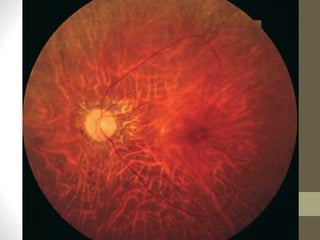
Retinitis pigmentosa sine
pigmento
• Sine pimento = Without pigment
• Absence or paucity of pigment accumulation
• May subsequently appear with time
• Functional manifestations are similar to typical
RP
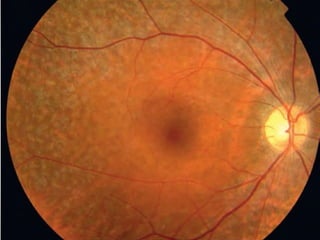
Retinitis punctata albescens
• Albescens = whitish
• Scattered whitish-yellow spots, most
numerous at the equator, usually sparing
the macula, and associated with arteriolar
attenuation
• Nyctalopia and progressive field loss occur
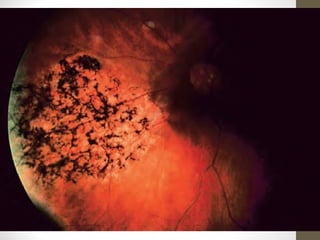
Sector retinitis pigmentosa
• Sectoral RP
• AD
• Characterized by involvement of inferior
quadrants only
• Progression is slow (many cases are
apparently stationary)
• Unilateral RP can also occur
Leber congenital amaurosis
• Severe rod-cone dystrophy
• The commonest genetically defined cause of
visual impairment in children
• ERG is usually non-recordable even in early cases
• Systemic associations include
• mental handicap, deafness, epilepsy, central
nervous system and renal anomalies, skeletal
malformations and endocrine dysfunction
• Presentation
• Blindness at birth or early infancy
• associated with roving eye movements or
nystagmus
• Photoaversion
• Cataract
• Hypermetropia
• Nestagmus
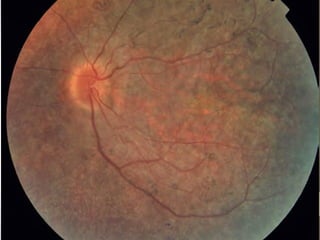
• Signs are variable but may include:
• Absent or diminished pupillary light reflex
• The fundi may be normal in early life apart from mild
arteriolar narrowing
• Initially mild peripheral pigmentary retinopathy, salt
and pepper changes, and less frequently yellow flecks
• Severe macular pigmentation
• Pigmentary retinopathy, optic atrophy and severe
arteriolar narrowing in later childhood
• Oculodigital syndrome: constant rubbing of the eyes
may cause orbital fat atrophy with enophthalmos, and
subsequent keratoconus or keratoglobus
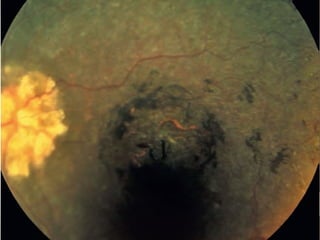
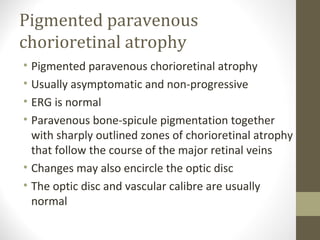
Pigmented paravenous
chorioretinal atrophy
• Pigmented paravenous chorioretinal atrophy
• Usually asymptomatic and non-progressive
• ERG is normal
• Paravenous bone-spicule pigmentation together
with sharply outlined zones of chorioretinal atrophy
that follow the course of the major retinal veins
• Changes may also encircle the optic disc
• The optic disc and vascular calibre are usually
normal
Retinitis pigmentosa

Retinitis pigmentosa

  • 1.
  • 2.
    Retinitis Pigmentosa • Inheriteddiffuse retinal degenerative diseases • Most common hereditary fundus dystrophy (1/5.000) • Initially predominantly affecting the rod photoreceptors, with later degeneration of cones • May occur as –AD –AR –XLR –Sporadic
  • 3.
    Modes of inheritence •XLR is the least common but most severe form, and may result in complete blindness by the third or fourth decades • AR disease can also be severe • Sporadic cases may have a more favourable prognosis, with retention of central vision until the sixth decade or later • AD disease generally has the best prognosis
  • 4.
    Symptoms • Nyctalopia anddark adaptation difficulties are frequently presenting symptoms • Mid-peripheral then far-peripheral field loss • reduced central vision (late) • Cataract • Photopsia
  • 5.
    Signs • Triad of •bone-spicule retinal pigmentation • arteriolar attenuation • ‘waxy’ disc pallor
  • 6.
    Progression • Bilateral mid-peripheralintraretinal perivascular ‘bone-spicule’ pigmentary changes with arteriolar narrowing • Then a gradual increase in density of the pigment • Anterior and posterior spread • Peripheral pigmentation may become severe, with marked arteriolar narrowing and disc pallor
  • 10.
    • The maculamay show • Atrophy • epiretinal membrane formation • cystoid macular oedema (CMO) • Myopia is common. • Optic disc drusen occur more frequently
  • 11.
    Complications • PSCC • OAG •Keratoconus • PVD • Intermediate uveitis • Exudative RD
  • 12.
    Investigations • ERG • EOG •Perimetry • OCT • Genetic analysis
  • 13.
    ERG • ElectroRetinoGram • Components •A wave photoreceptors • B wave muller cells + bipolar cells • C wave RPE
  • 14.
    ERG • Sensitive diagnostictest • Early  reduced scotopic rod and combined responses • With progression  photopic responses also reduce
  • 16.
    EOG • Measurement ofstanding potential between the cornea and the retina measurement of function of the RPE and photoreceptors • Abnormal in RP • However, ERG is considered a more sensitive test for detection of photoreceptor function and consequently EOG is not routinely done
  • 17.
    Visual field • Characteristicallyshows a ring scotoma in the mid-periphery of the visual field • Start as a group of isolated scotomas around 20 degrees from fixation, and gradually coalesce to form a partial followed by a complete ring • Useful in monitoring the progression of disease and document the status of legal blindness
  • 18.
    OCT • to detect •CMO • Epiretinal membrane • vitreomaular traction
  • 19.
    Treatment • Many treatmentshave been explored without proven benefit • These include various vitamins and minerals, vasodilators, tissue therapy with placental extract, cortisone, cervical sympathectomy, injections of a hydrolysate of yeast RNA, ultrasound, transfer factor, dimethyl sulfoxide, ozone, muscle transplants, and subretinal injections of fetal retinal cells
  • 20.
    Atypical retinitis pigmentosa •Syndromic • Usher syndrome • Kearns–Sayre syndrome • Bassen–Kornzweig syndrome • Refsum disease • Bardet–Biedl syndrome • Non-syndromic • Retinitis pigmentosa sine pigmento • Retinitis punctata albescens • Sector retinitis pigmentosa • Leber congenital amaurosis • Pigmented paravenous chorioretinal atrophy
  • 21.
    Usher syndrome • About15% to 20% of affected individuals with retinitis pigmentosa have associated hearing loss • There are three major types; • Type I (75%) which features profound congenital sensorineural deafness and severe RP with an extinguished ERG in the first decade plus unintelligible speech & vestibular ataxia • Type III (2%), with progressive hearing loss, vestibular dysfunction and relatively late-onset pigmentary retinopathy
  • 22.
    Kearns–Sayre syndrome • Partof chronic progressive external ophthalmoplegia • Mitochondrial inheritance • Abnormalities include • Ptosis • diffuse disturbance of the RPE • ERGs that are usually reduced in amplitude • respiratory distress • heart block which may require a pacemaker
  • 23.
    Bassen–Kornzweig syndrome • Abetalipoproteinaemia •Malabsorption of fat and fat-soluble vitamin • Develops FTT in infancy • The fundus exhibits scattered white dots followed by RP-like changes developing towards the end of the first decade; there may also be ptosis, ophthalmoplegia, strabismus and nystagmus
  • 24.
    Refsum disease • Thepatient accumulates exogenous phytanic acid • Findings include a peripheral neuropathy, ataxia, an increase in CSF protein with a normal cell count, and retinitis pigmentosa • All have elevated serum phytanic acid • A defect exists in the conversion of phytanic acid to alpha- hydroxy phytanic acid which results in its accumulation • Treatment consists of restricting not only animal fats and milk products (i.e., foods that contain phytanic acid) but also green leafy vegetables containing phytol
  • 25.
    Bardet–Biedl syndrome • IncludesRP, mental retardation, polydactylism, apple-shaped obesity, and hypogonadism • Almost 80% have severe changes by the age of 20 years
  • 26.
    Retinitis pigmentosa sine pigmento •Sine pimento = Without pigment • Absence or paucity of pigment accumulation • May subsequently appear with time • Functional manifestations are similar to typical RP
  • 28.
    Retinitis punctata albescens •Albescens = whitish • Scattered whitish-yellow spots, most numerous at the equator, usually sparing the macula, and associated with arteriolar attenuation • Nyctalopia and progressive field loss occur
  • 30.
    Sector retinitis pigmentosa •Sectoral RP • AD • Characterized by involvement of inferior quadrants only • Progression is slow (many cases are apparently stationary) • Unilateral RP can also occur
  • 32.
    Leber congenital amaurosis •Severe rod-cone dystrophy • The commonest genetically defined cause of visual impairment in children • ERG is usually non-recordable even in early cases • Systemic associations include • mental handicap, deafness, epilepsy, central nervous system and renal anomalies, skeletal malformations and endocrine dysfunction
  • 33.
    • Presentation • Blindnessat birth or early infancy • associated with roving eye movements or nystagmus • Photoaversion • Cataract • Hypermetropia • Nestagmus
  • 34.
    • Signs arevariable but may include: • Absent or diminished pupillary light reflex • The fundi may be normal in early life apart from mild arteriolar narrowing • Initially mild peripheral pigmentary retinopathy, salt and pepper changes, and less frequently yellow flecks • Severe macular pigmentation • Pigmentary retinopathy, optic atrophy and severe arteriolar narrowing in later childhood • Oculodigital syndrome: constant rubbing of the eyes may cause orbital fat atrophy with enophthalmos, and subsequent keratoconus or keratoglobus
  • 37.
    Pigmented paravenous chorioretinal atrophy •Pigmented paravenous chorioretinal atrophy • Usually asymptomatic and non-progressive • ERG is normal • Paravenous bone-spicule pigmentation together with sharply outlined zones of chorioretinal atrophy that follow the course of the major retinal veins • Changes may also encircle the optic disc • The optic disc and vascular calibre are usually normal