COLOUR VISION AND
PHYSIOLOGICAL PROCESSES
Raju Kaiti, M. Optometry
Consultant Optometrist
Nepal Eye Hospital (NEH)Nepal Eye Hospital (NEH)
ObjECtIVES
 To define color and color vision
 To define color vision types
 To understand the theory behind the color vision
 To learn different types of color vision defects
 To learn different types of color vision testing
procedures
WHAt IS COLOR???
 Color is that what one perceive due to the property of
different wavelengths.
 An aspect of visual perception, characterized by the
attributes of hue ,brightness and saturation and resulting
from stimulation of the retina by visible photopic light
levels.
 There is no one to one relationship between
wavelength and color.
 Depends on number of parameters
 Wavelength or band of wavelengths coming from the
object
 Wavelengths coming from other objects in the field of
view
 Wavelength that the observer was looking at before he
looked at the object
INtRODUCtION
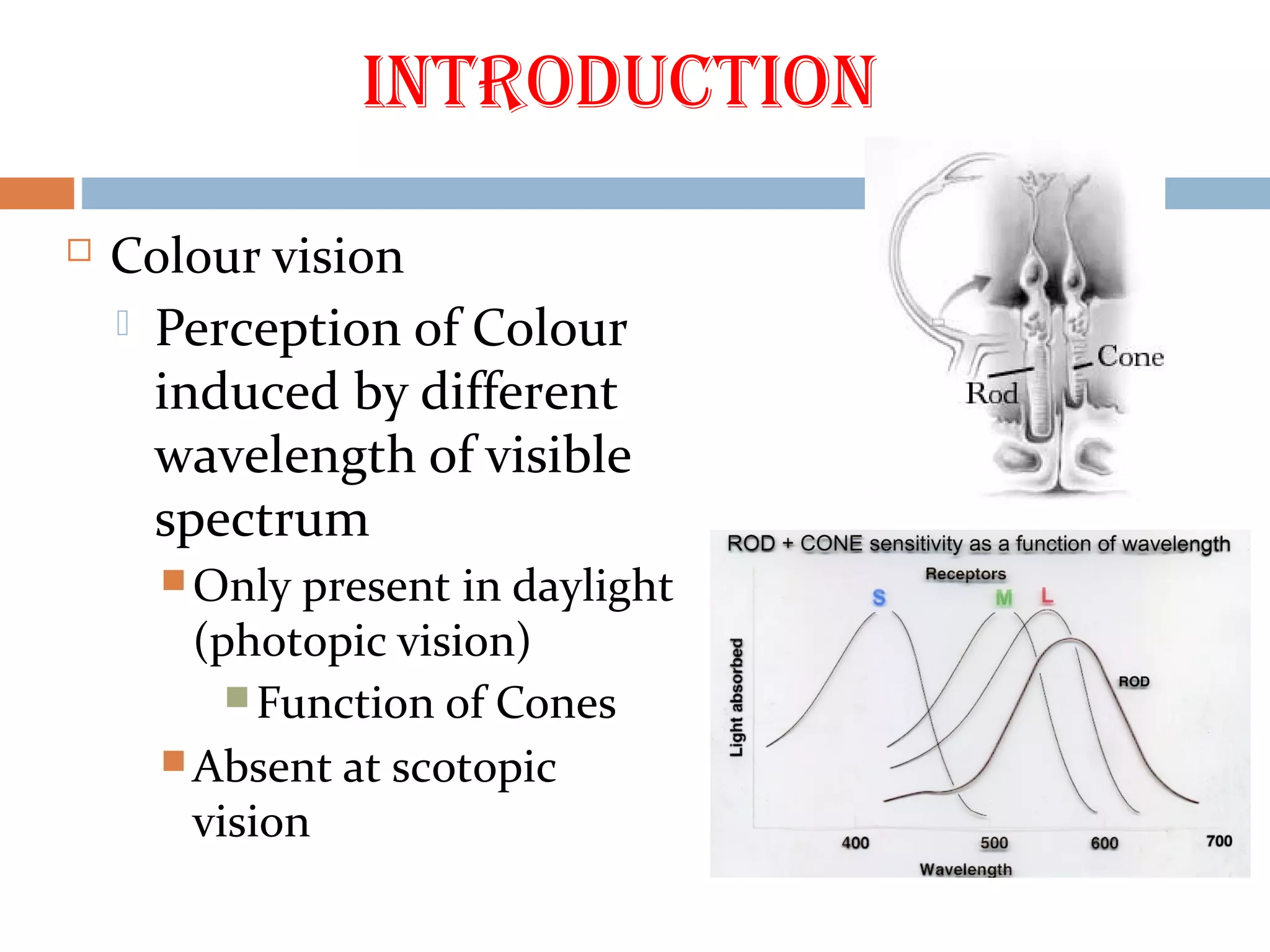
 Colour vision
 Perception of Colour
induced by different
wavelength of visible
spectrum
 Only present in daylight
(photopic vision)
 Function of Cones
 Absent at scotopic
vision
COLOR
PERCEPtION
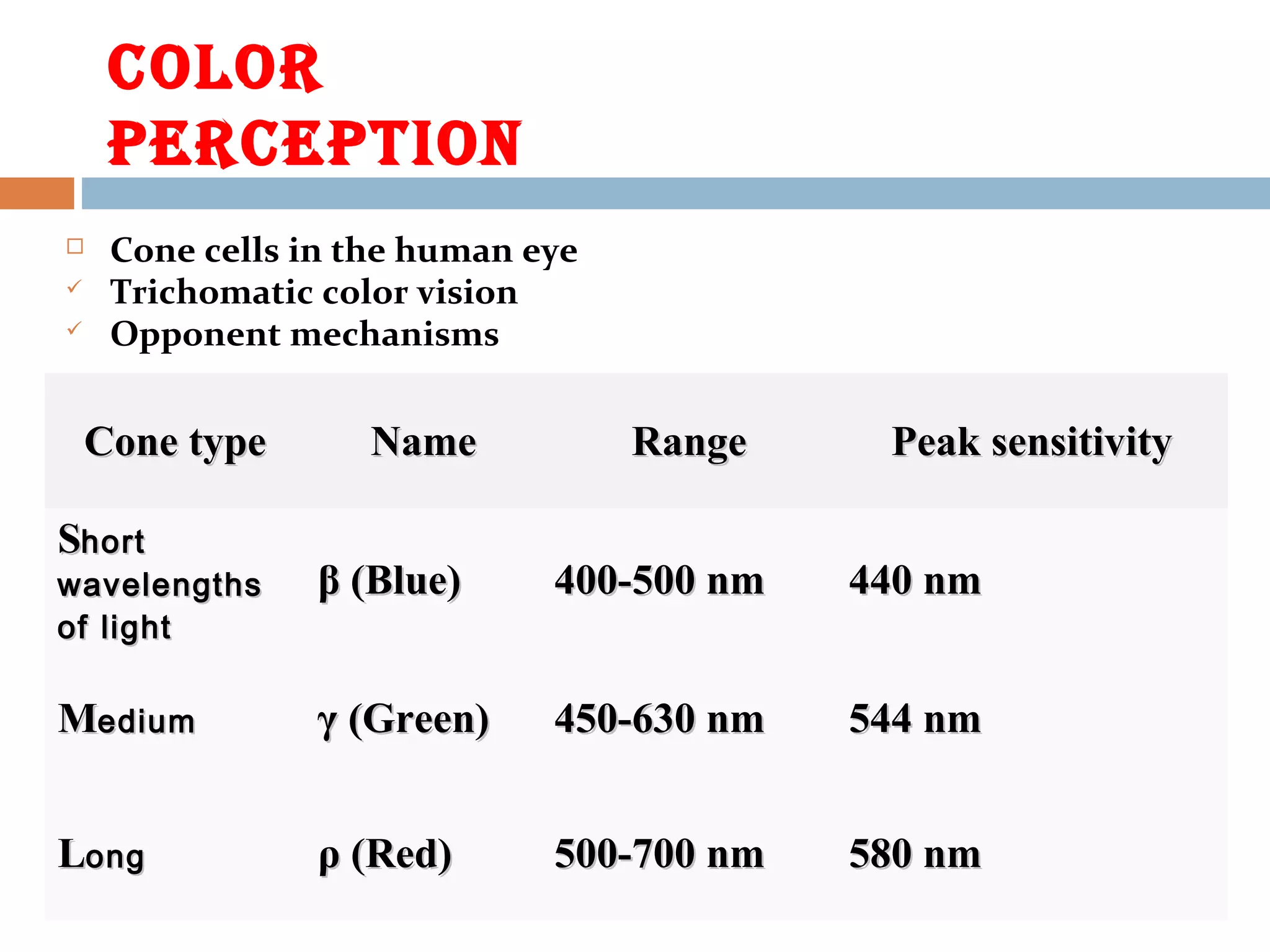
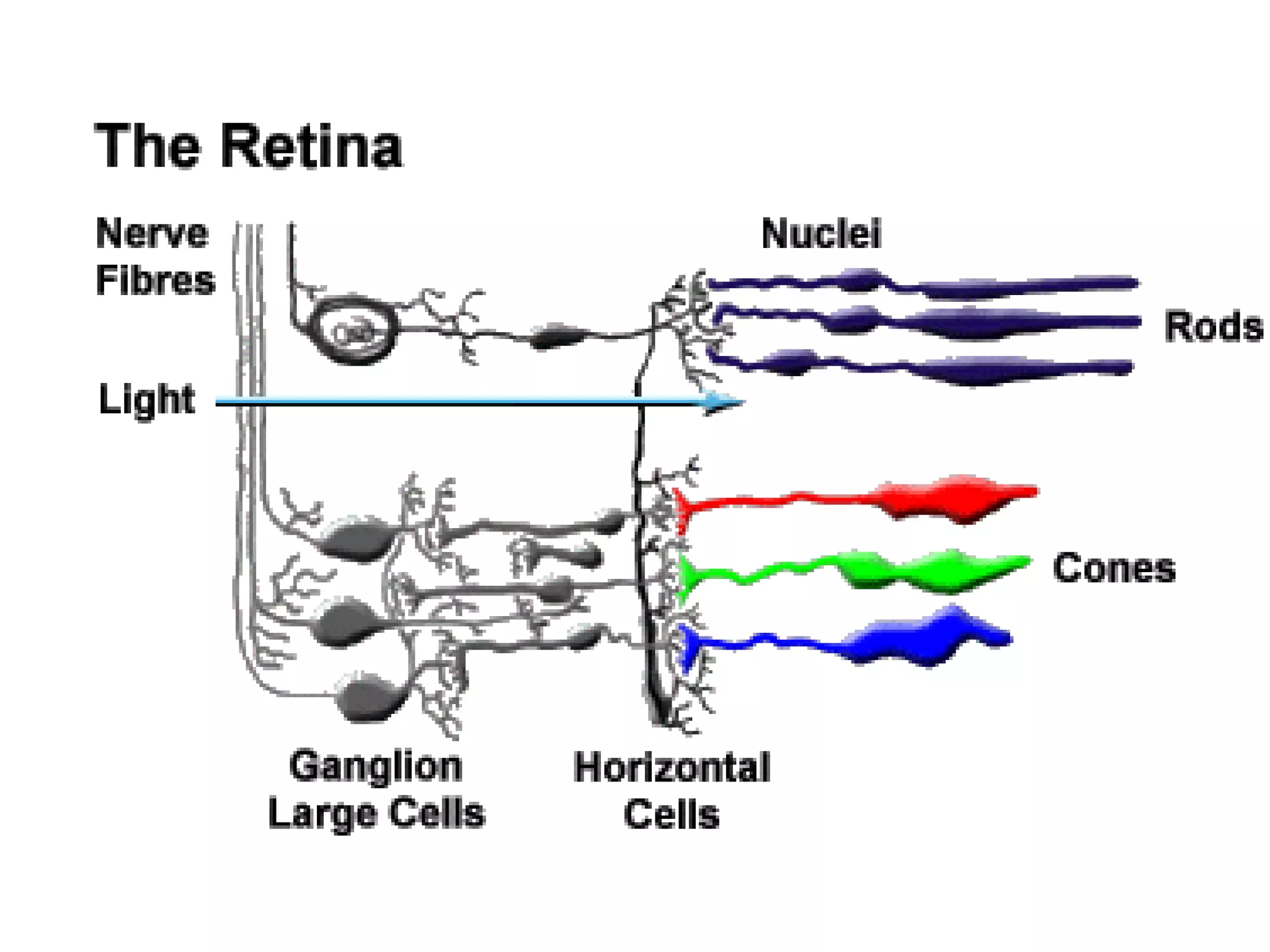
 Cone cells in the human eye
 Trichomatic color vision
 Opponent mechanisms
Cone typeCone type NameName RangeRange Peak sensitivityPeak sensitivity
SShorthort
wavelengthswavelengths
of lightof light
β (Blue)β (Blue) 400-400-500 nm500 nm 440 nm440 nm
MMediumedium γ (Green)γ (Green) 450-630 nm450-630 nm 544 nm544 nm
LLongong ρ (Red)ρ (Red) 500-700 nm500-700 nm 580 nm580 nm
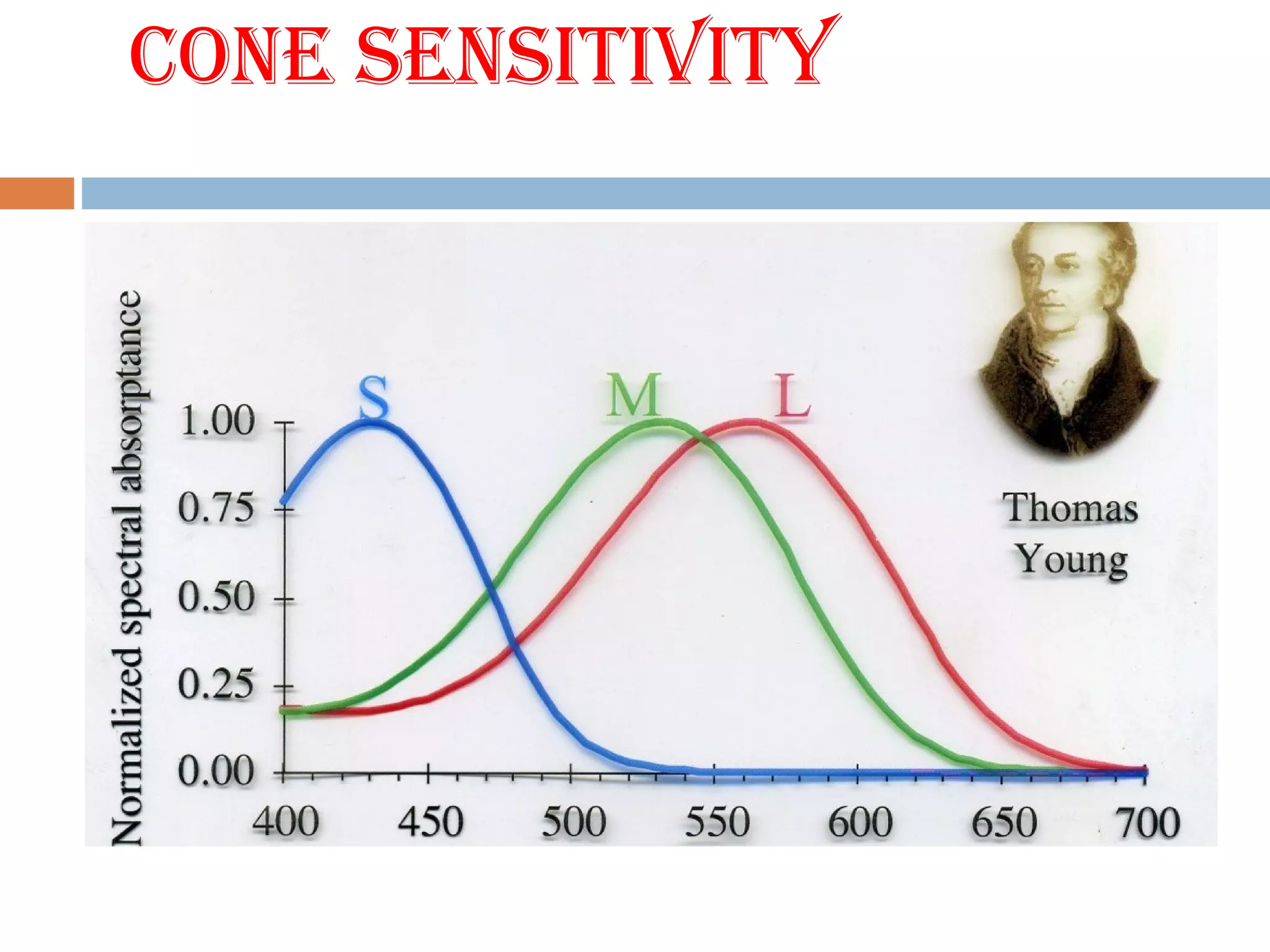
CONE SENSItIVItY
COLOR
PERCEPtION
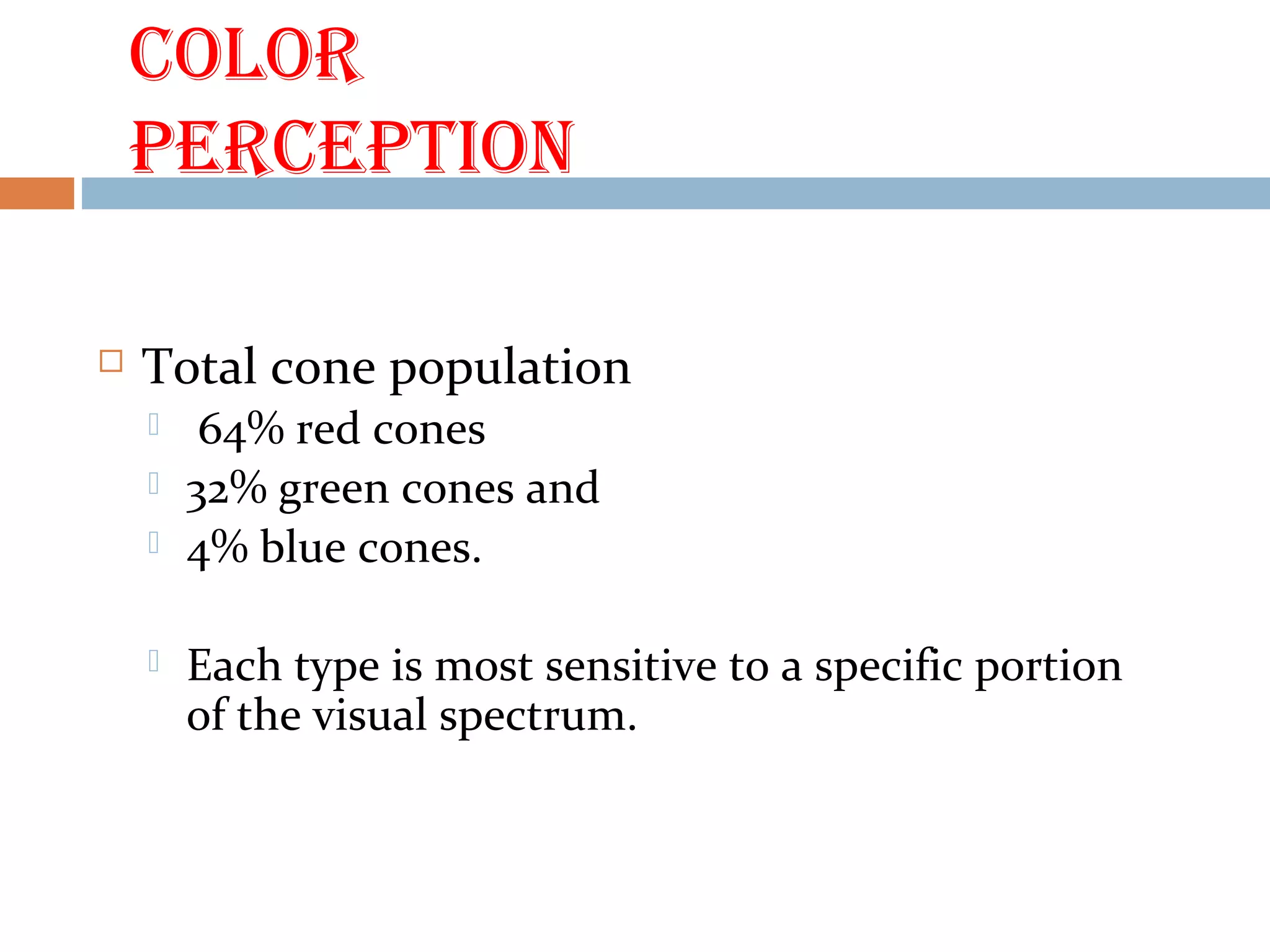
 Total cone population
 64% red cones
 32% green cones and
 4% blue cones.
 Each type is most sensitive to a specific portion
of the visual spectrum.
COLOR VISION
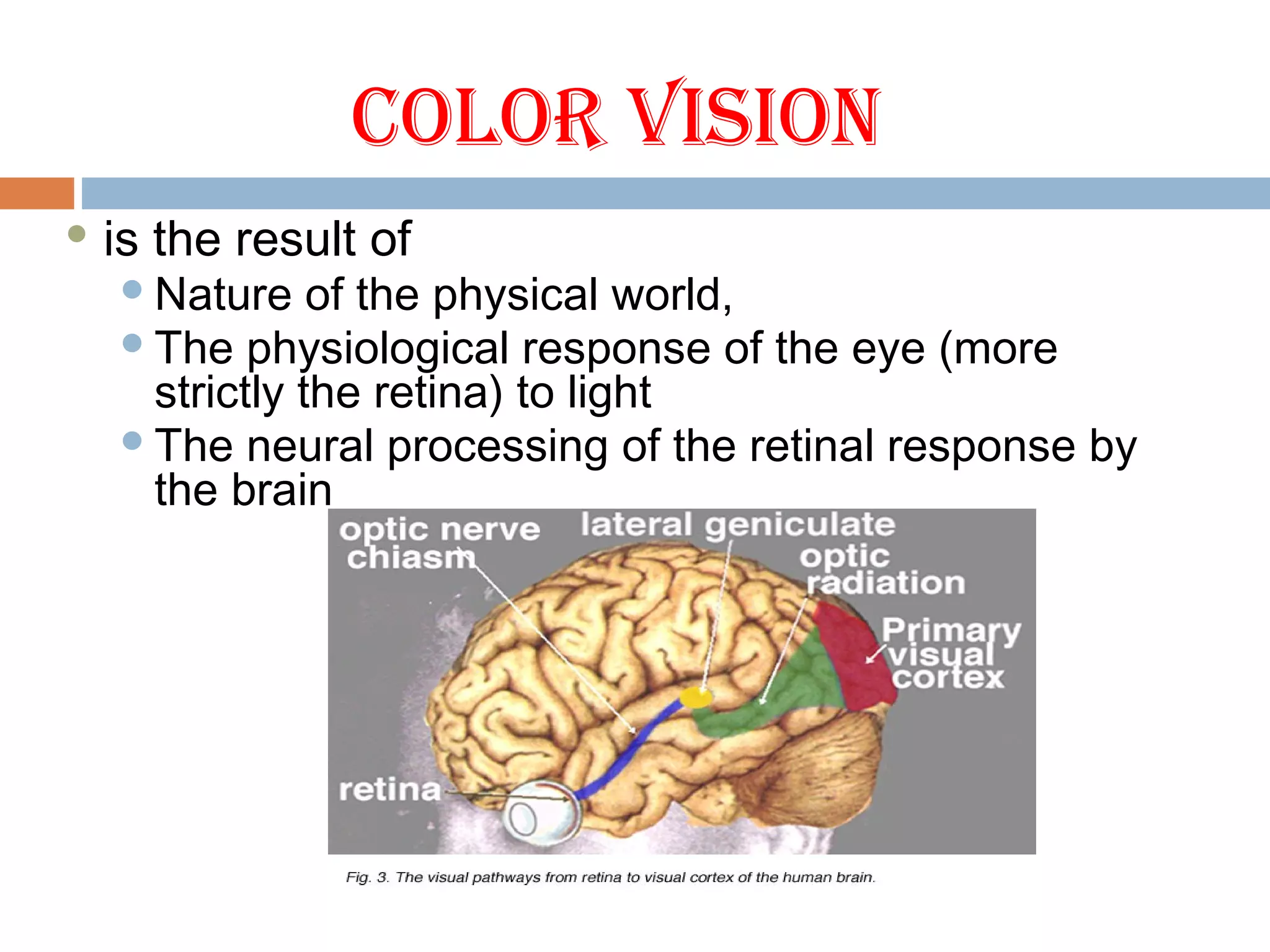
 is the result of
Nature of the physical world,
The physiological response of the eye (more
strictly the retina) to light
The neural processing of the retinal response by
the brain
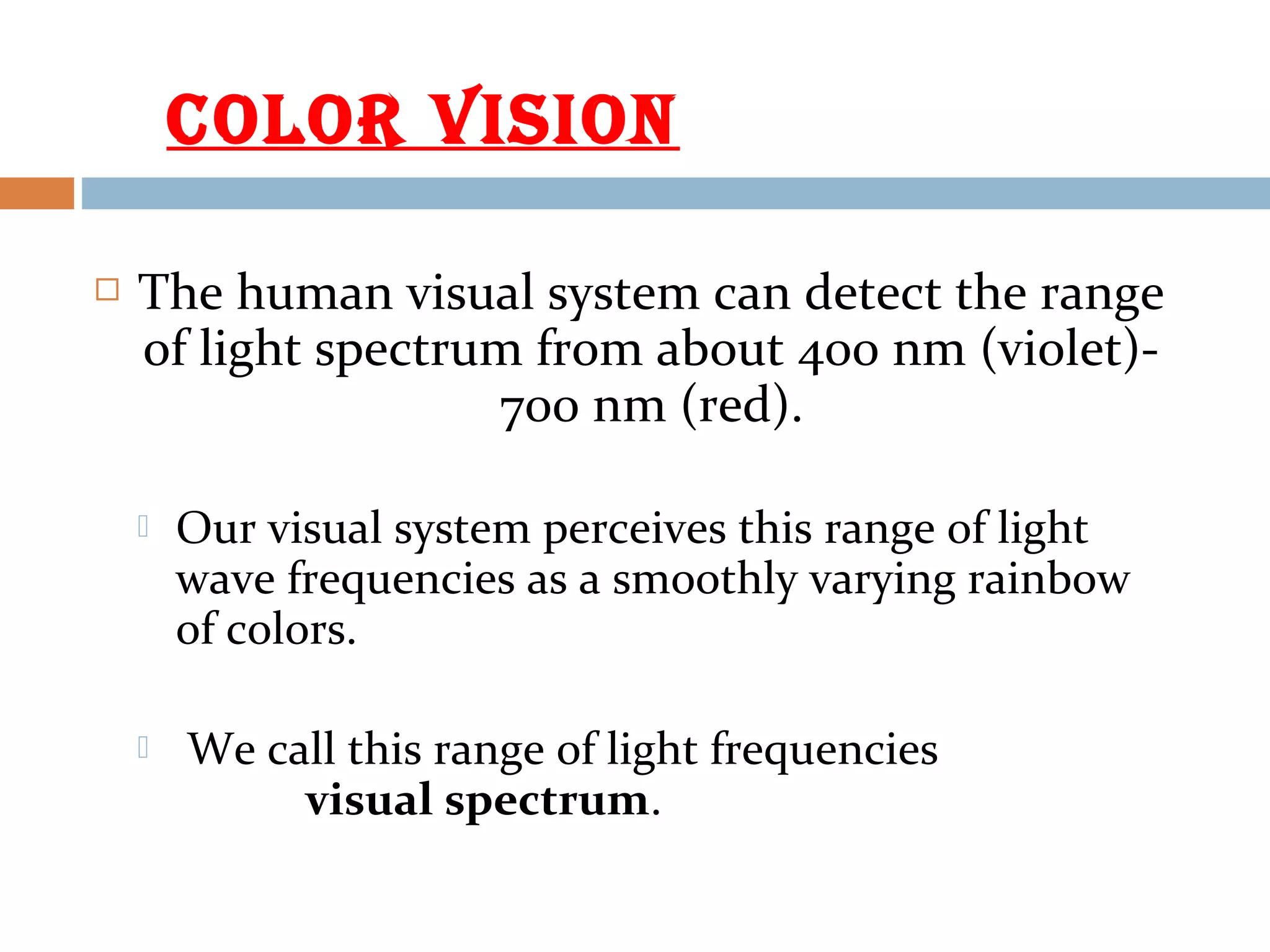
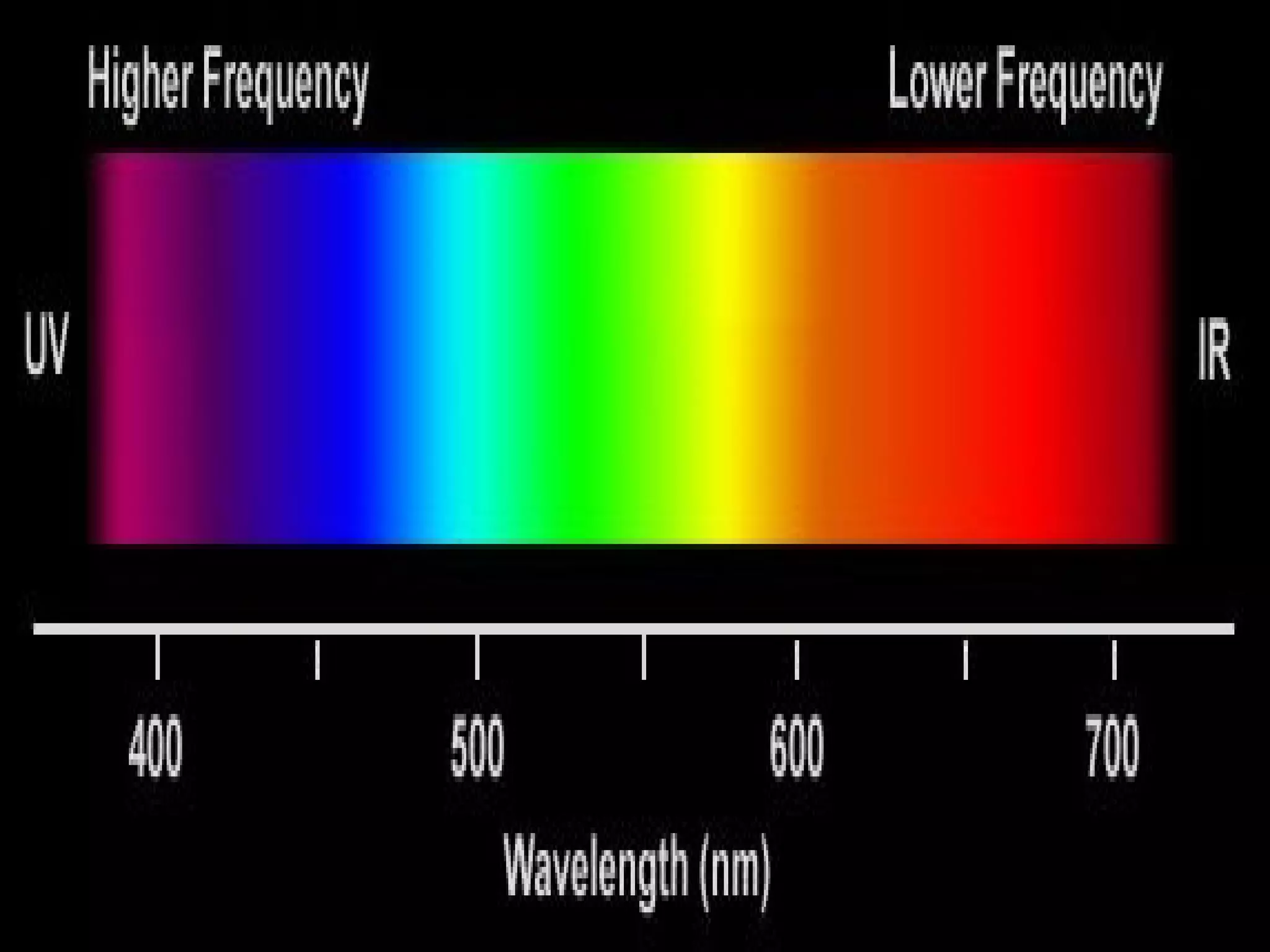
 The human visual system can detect the range
of light spectrum from about 400 nm (violet)-
700 nm (red).
 Our visual system perceives this range of light
wave frequencies as a smoothly varying rainbow
of colors.
 We call this range of light frequencies
visual spectrum.
COLOR VISION
CONCEPtS Of COLOR VISION
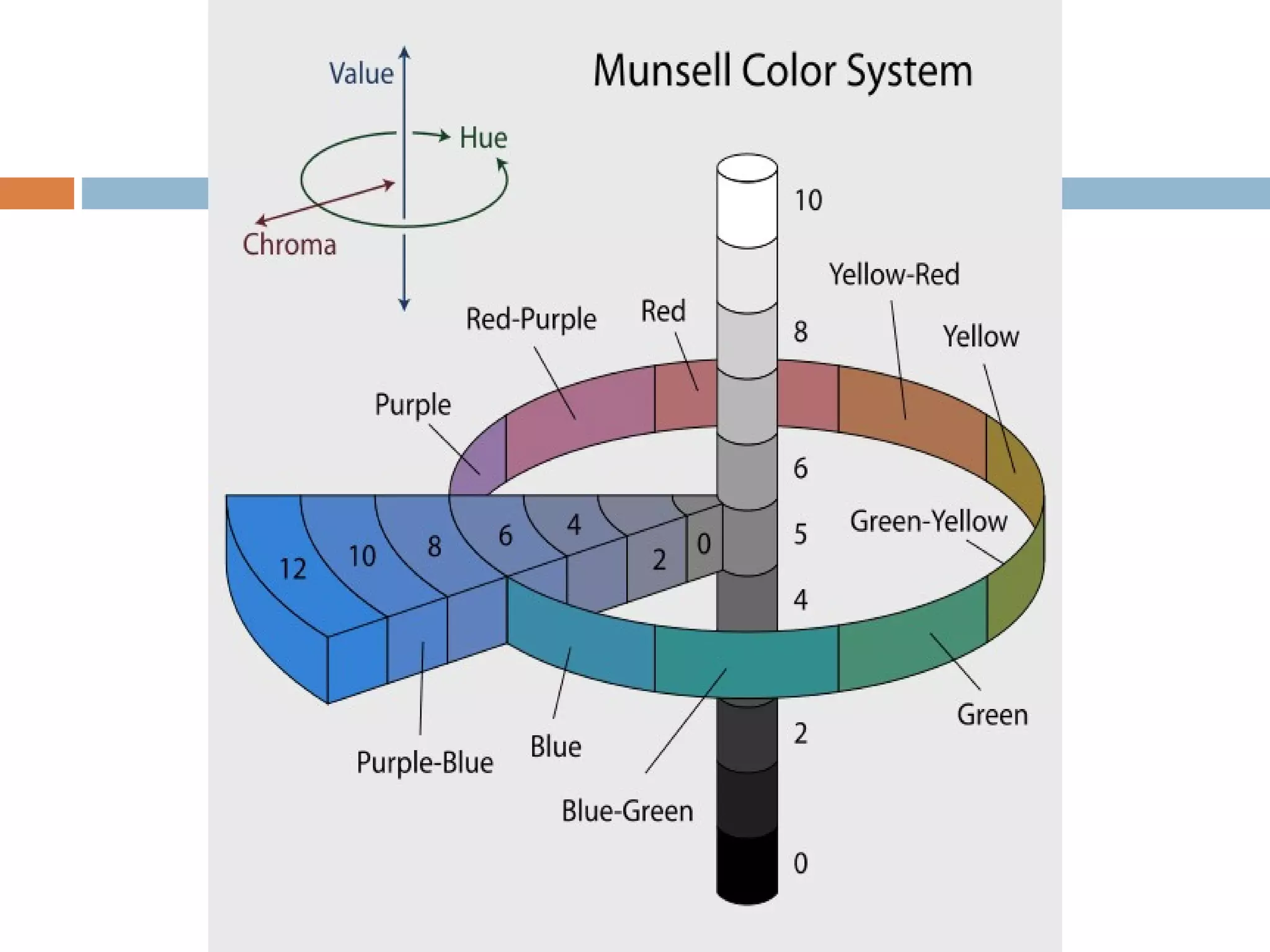
 All color experienced by three psychological impressions
1) Hue
 Strongest effect on color
 Major determination of principle colors (RYGB)
 Function of wavelength
 200 varieties
2. SAtURAtION:
• Reflects how much a hue has been diluted by grayness
(intensity of purity of Hue)
• At short and long wavelength,20 distinguishable steps
of saturation for each hue
• In middle spectral, 6 distinguishable steps of saturation
• The more the white ,the less is the saturation and looks
faded and wasted.
• 100% saturated means there is no addition of gray to the
hue (100% Pure)
 The relative degree of black or white mixed with give
hue
 Sensation shared with achromatic visual systems
 Have 500 distinguishable steps of brightness for every
hue and grade of saturation
3. Brightness
tHEORIES Of COLOR VISION
 Trichromatic theory
 Opponent colors theory
 Zone theory
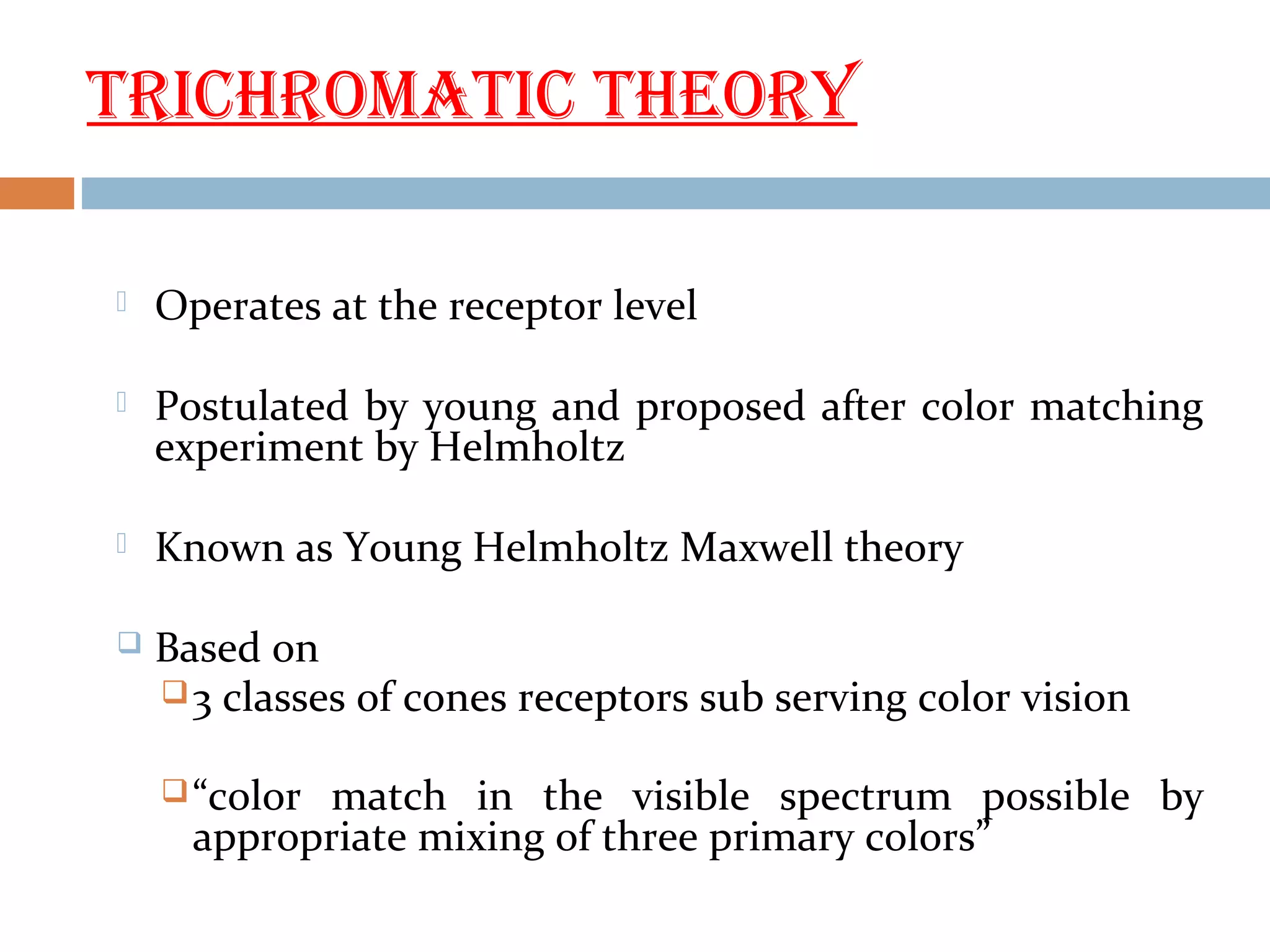
tRICHROmAtIC tHEORY
 Operates at the receptor level
 Postulated by young and proposed after color matching
experiment by Helmholtz
 Known as Young Helmholtz Maxwell theory
 Based on
3 classes of cones receptors sub serving color vision
“color match in the visible spectrum possible by
appropriate mixing of three primary colors”
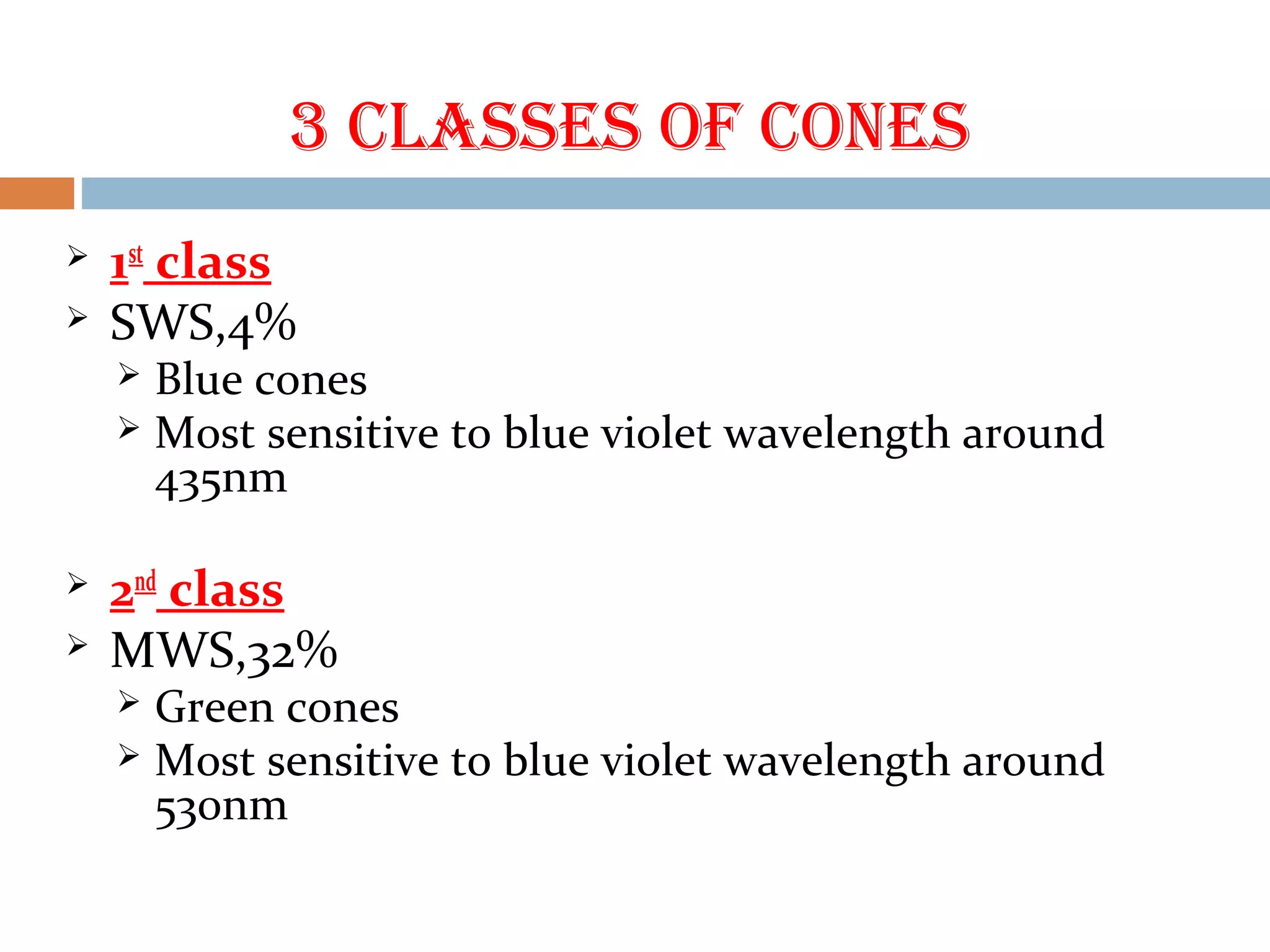
3 CLASSES Of CONES
 1st
class
 SWS,4%
 Blue cones
 Most sensitive to blue violet wavelength around
435nm
 2nd
class
 MWS,32%
 Green cones
 Most sensitive to blue violet wavelength around
530nm
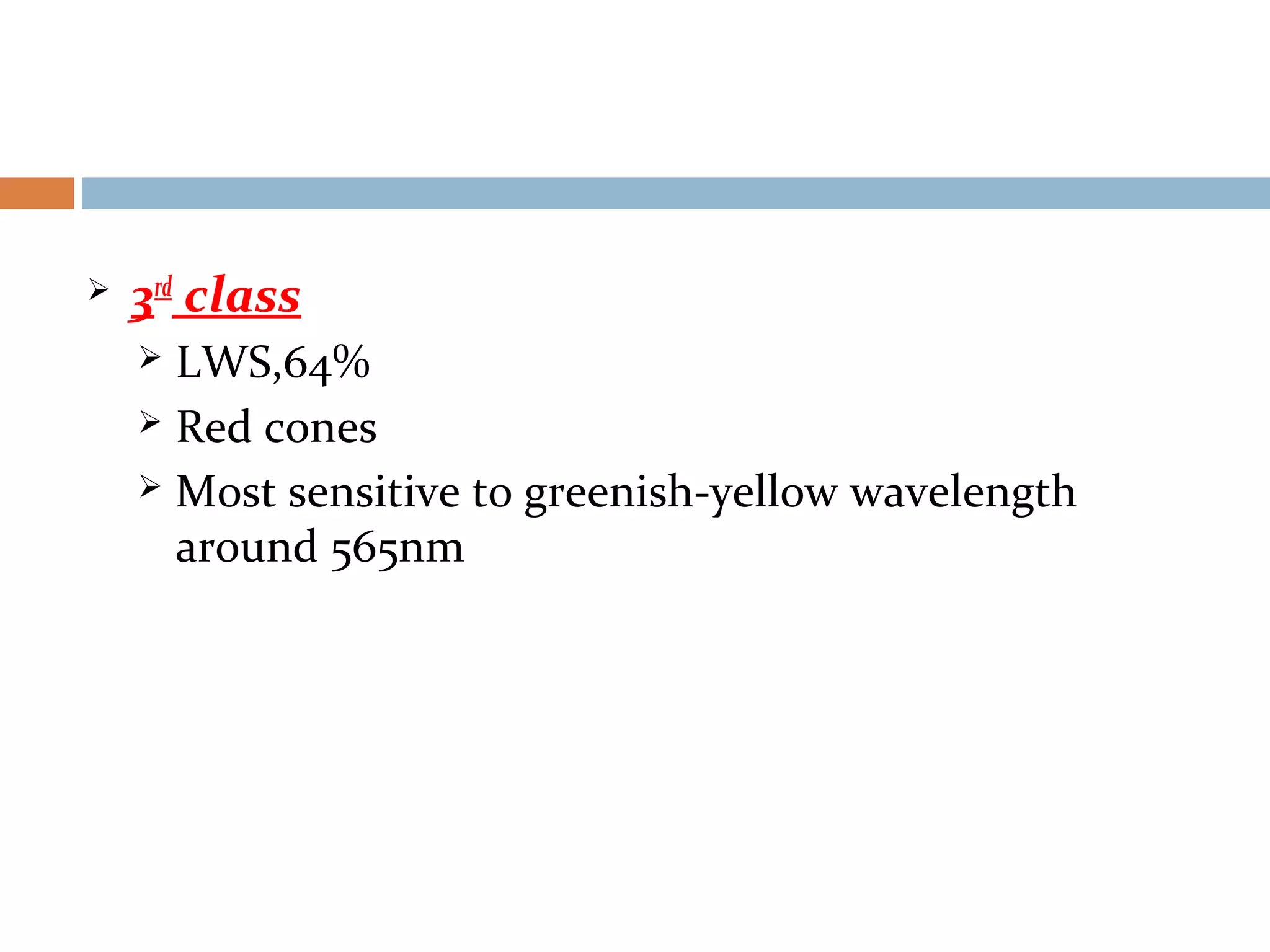
 3rd
class
 LWS,64%
 Red cones
 Most sensitive to greenish-yellow wavelength
around 565nm
 The most direct evidence of presence of three classes of
cones is given by microspectrophotometry.
 “They are overlapped so no individual class of cones can be
stimulated in isolation by any one wavelength”
 Three classes of cones in human retina are with different
but overlapping sensitivities.
 Each molecule of cone photo pigment consists of
chromophore and opsin.
 The chromophore, which is identical for all cone photo
pigments, is retinal(an aldehyde of vitamin A).
 Light quanta are absorbed by the chromophore initiating
the series of events leading to vision.
 It is the opsin, virtually inert chain of amino acids that
determines the absorption characteristics of the photo
pigment molecules.
 Each class of cones has a different opsin. The genes for
the photo pigment of M and L cones are situated on the X-
chromosome.
 So, CV deficiencies in which either the M or L cone is
missing are inherited in sex-linked manner.
 The gene for S cone photo pigment is on chromosome 7
and for rhodopsin is found on chromosome 3.
 MICROSPECTROPHOTOMETRY
 Technically difficult procedure.
 Retinal tissue is back illuminated with monochromatic
light .
 Light is directed towards a single cone.
 Difference between amount of light incident and
transmitted through cone is determined.
 Repeated across the spectrum to obtain a cone
absorption spectrum.
WHY ROD CELLS NOt CONtRIbUtE tO
COLOR VISION???
 CV occur at photopic condition ,rhodopsin
pigments saturate at lower luminosities(rod cells
are more sensitive )
 Temporal phase difference b/w rod and cone
system-75-100ms lag of rod in dark-adapted state
 However, interaction between rod-cone systems is
indicated in dichromats for CV processing
 Cones- fundamental units of visual information,
not the photo pigments
 The idea that our perception of millions of colors
depends on just three distinct color receptors is
called the trichromatic theory of color
vision
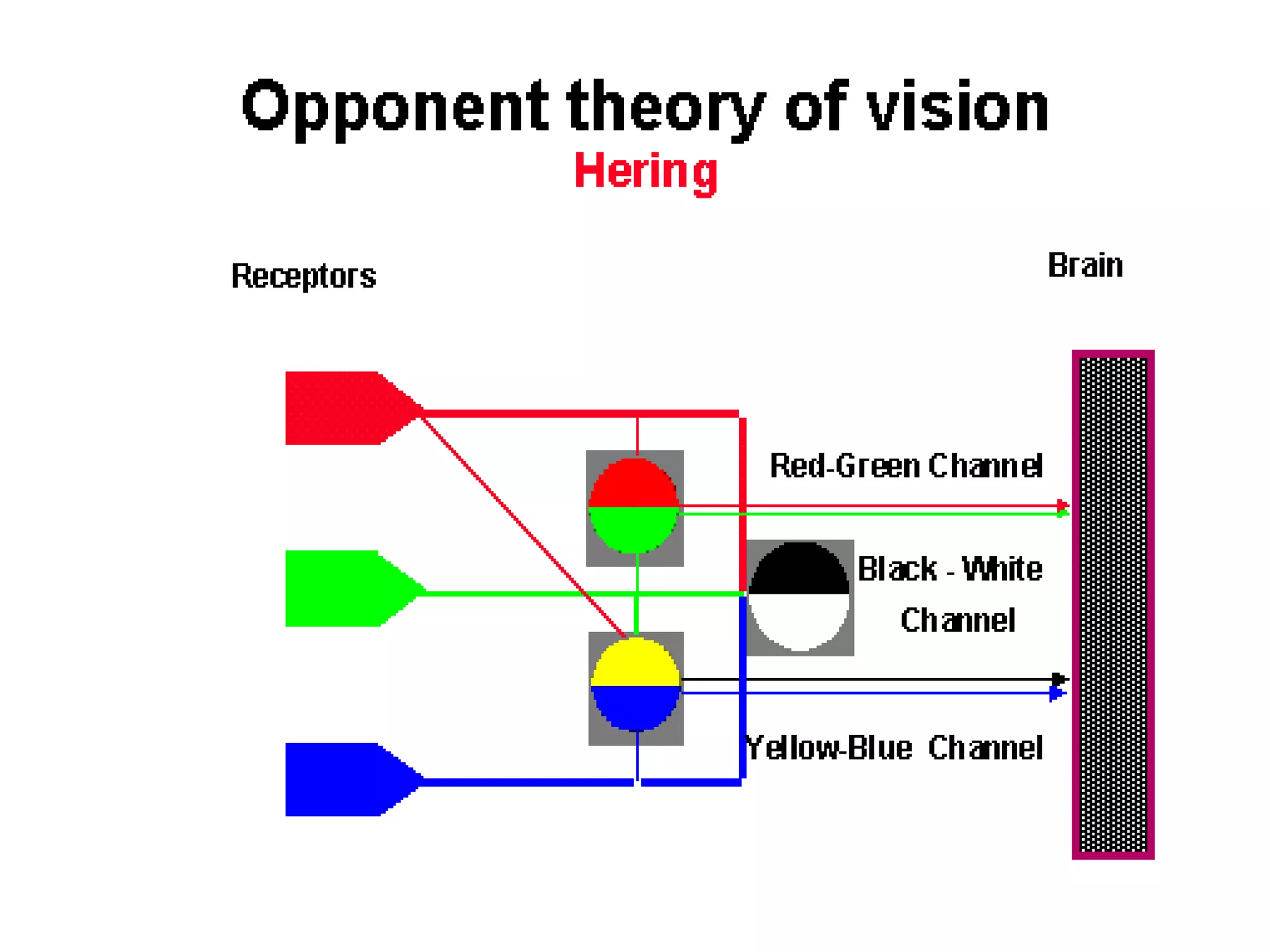
OPPONENt COLORS tHEORY
 Ewald Hering(1878).
 Contradicts the Young –Helmholtz trichromatic theory.
 Explains four physiological color primaries, R, G, Y, B
 Explains the phenomena of after-image (Y-B)
 An additive mixture of red and green light gives
yellow, not a reddish green.
OPPONENt COLORS tHEORY
 This opponent process creates
 the four unique hues red, green, yellow and blue.
 The brightness or lightness of a color is
determined by the luminosity channel i.e. pair
of black-white.
 These six fundamental color sensations can
combine to give any visible colors.
 Proposes that color is processed by bipolar hue channels.
 By bipolar we mean that at any instant, each channel can
signal only one of the two attributes it is capable of
coding .
 After-image: visual sensation persisting after the original
stimulus has been removed.
 Formation of after-image is still obscure, but no doubt in
retinal origin.
ExPLANAtION Of COLOR AftERImAGES bY
tHE OPPONENt PROCESS tHEORY..
 When one member of the color pair is "fatigued"
by extended inspection, inhibition of its
corresponding pair member is reduced.
 This increases the relative activity level of the
unfatigued pair member and results in its color
being perceived.
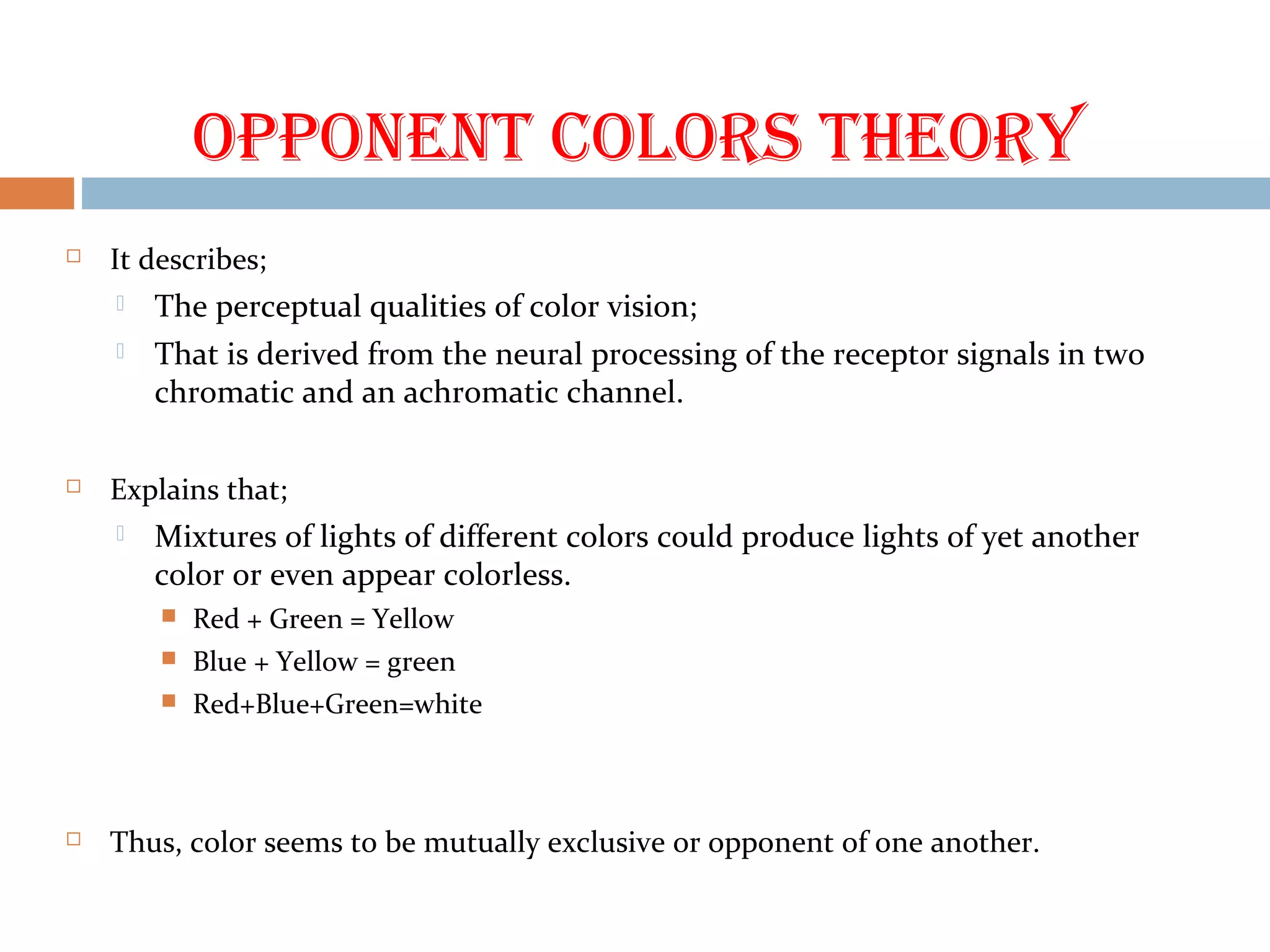
OppOnent cOlOrs theOry
 It describes;
 The perceptual qualities of color vision;
 That is derived from the neural processing of the receptor signals in two
chromatic and an achromatic channel.
 Explains that;
 Mixtures of lights of different colors could produce lights of yet another
color or even appear colorless.
 Red + Green = Yellow
 Blue + Yellow = green
 Red+Blue+Green=white
 Thus, color seems to be mutually exclusive or opponent of one another.
ZOne theOry
 In 1881 Donder proposed-color vision is
processed in a series of zones in the visual
pathway.
 Trichromacy occurs at one level and opponency
on other.
 At receptor level, vision is trichromatic and
mediated by 3 classes of cones.
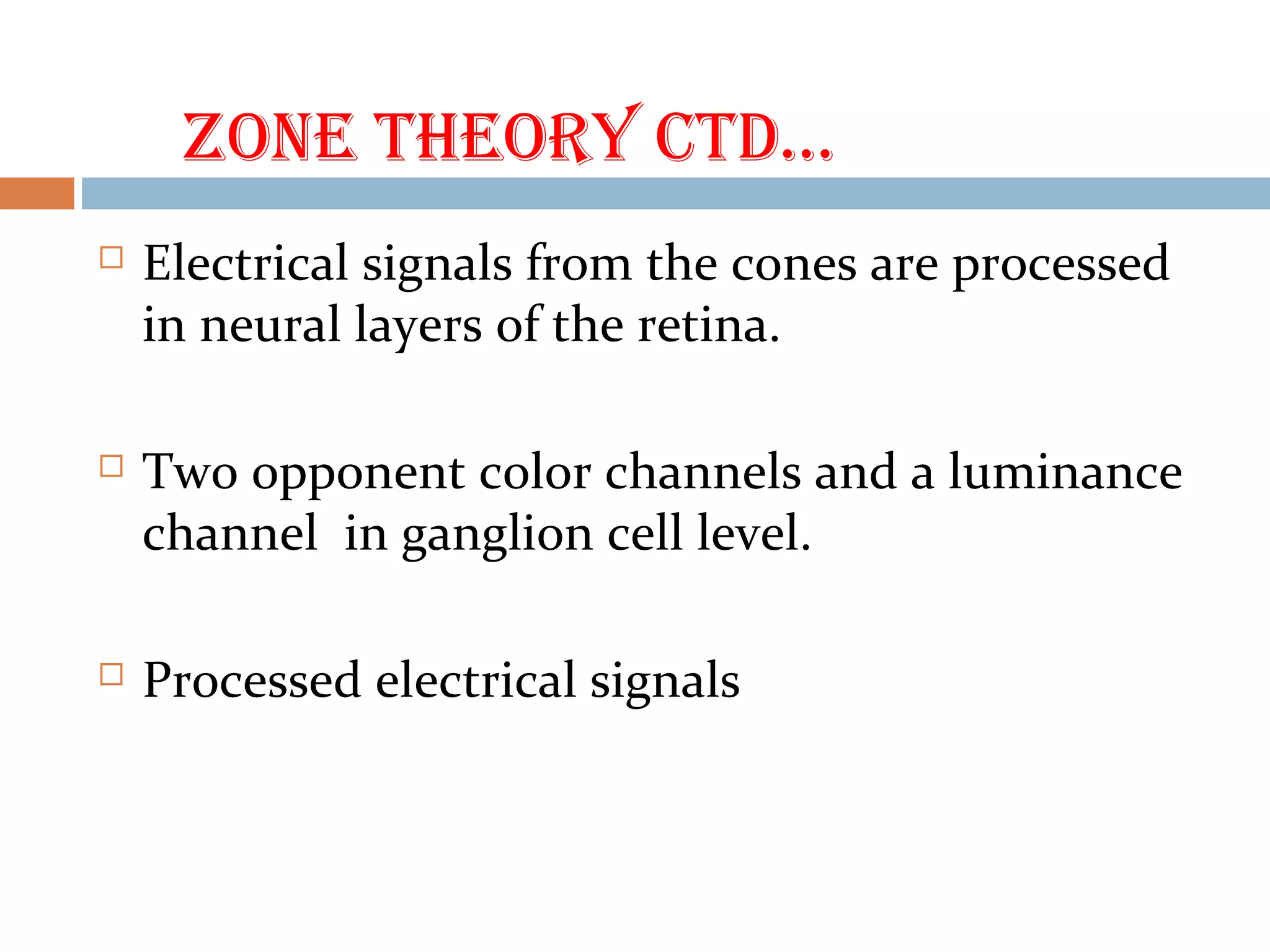
ZOne theOry ctd…
 Electrical signals from the cones are processed
in neural layers of the retina.
 Two opponent color channels and a luminance
channel in ganglion cell level.
 Processed electrical signals
trichrOmacy with cOlOr OppOnent
interactiOns:
 James and Hurvich
 Both theories should be combined to
explain fully the perception of color.
 Thus color vision must occur in;
1st
stage-cones level, CV is trichromatic
2nd
stage-signals are transformed into opponent
color form
cOnclUsiOn
 The cells specifically sensitive to color(hue) exist
only in visual cortex.
 The cells of the retina and LGB initiate the color-
coding process.
 Color vision could be best explained by combining
trichromacy with color opponent interactions.
 “this hybrid is the two stage model of color vision.”
 Trichromacy describes 3 types of cones, color matching and
color vision up to receptor level.
 The findings of color opponent neurons in visual system
tells us that receptoral information is coded in an opponent
fashion at postreceptoral levels.
 Three classes of cones are wired together at postreceptoral
levels such that they are spectrally antagonistic(early at the
level of horizontal cells).
cOlOUr VisiOn defects
Raju Kaiti, M. Optometry
Consultant Optometrist
Nepal Eye Hospital (NEH)Nepal Eye Hospital (NEH)
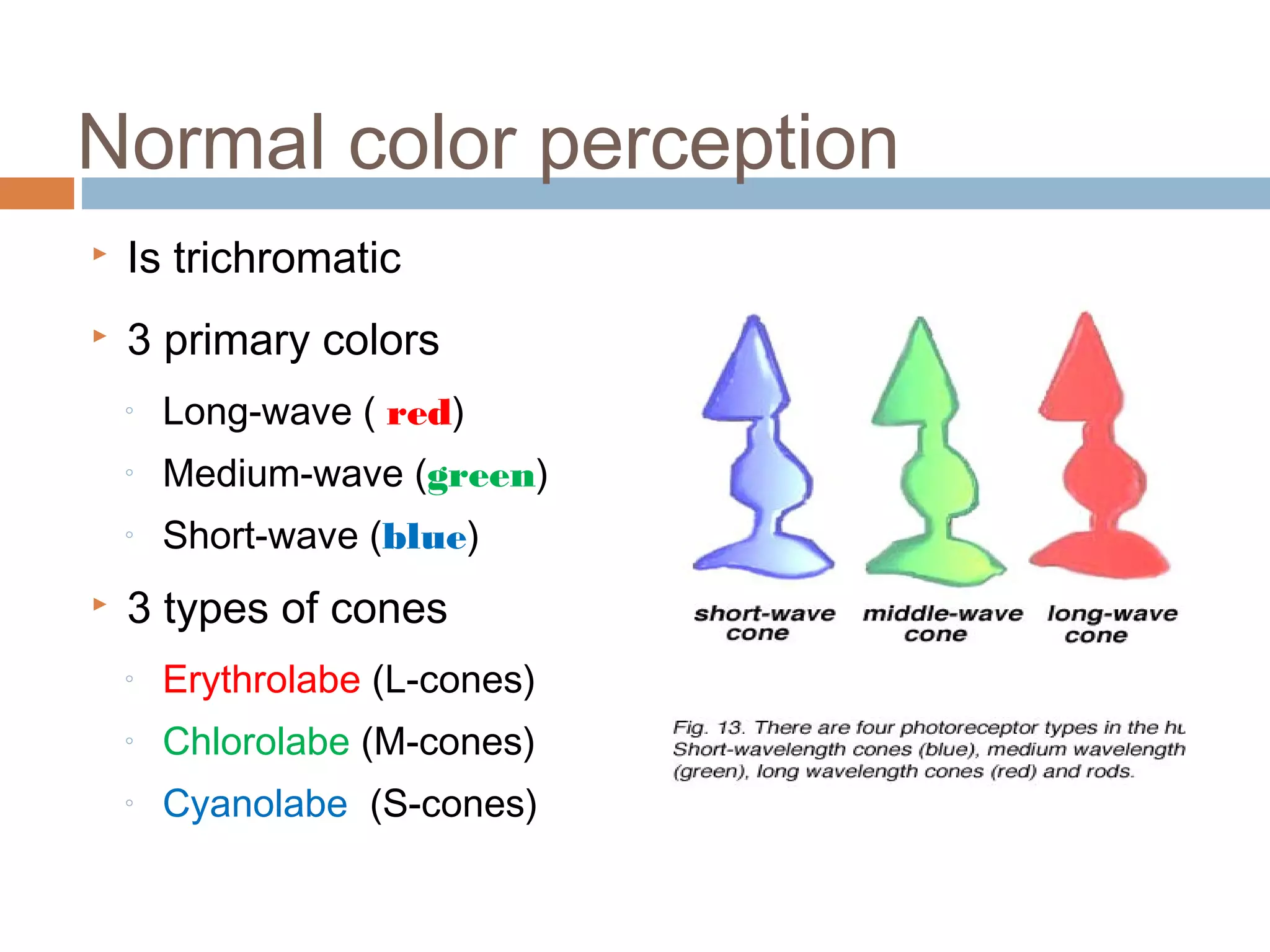
 Is trichromatic
 3 primary colors
◦ Long-wave ( red)
◦ Medium-wave (green)
◦ Short-wave (blue)
 3 types of cones
◦ Erythrolabe (L-cones)
◦ Chlorolabe (M-cones)
◦ Cyanolabe (S-cones)
Normal color perception
 The inability to distinguish certain color
 Ability to appreciate one or more primary colors is
defective(anomalous) or absent(anopia)
 Humans are born color blind
◦ Photoreceptors are not developed till the child is 4
months old
What is color vision defect?
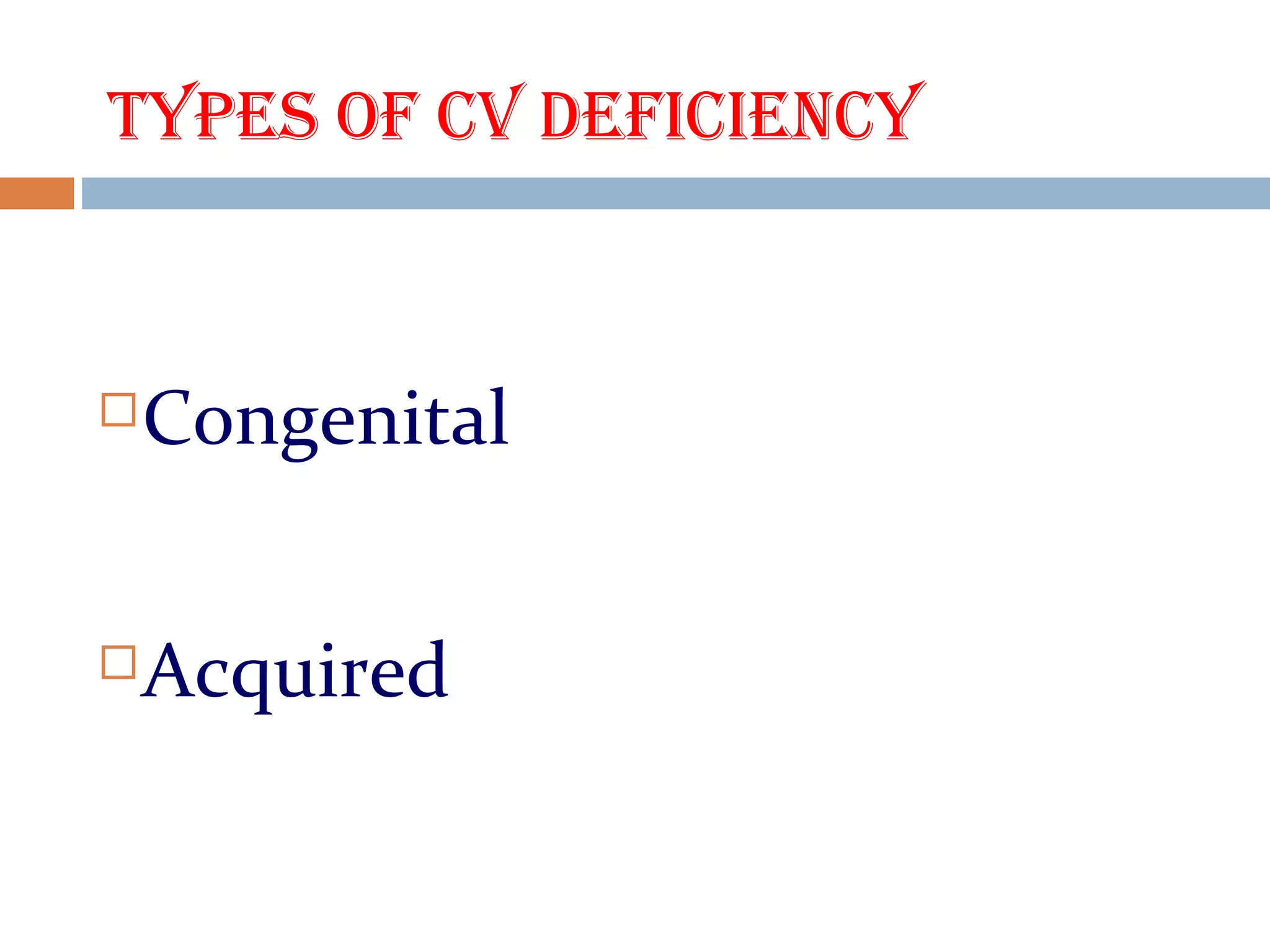
types Of cV deficiency
Congenital
Acquired
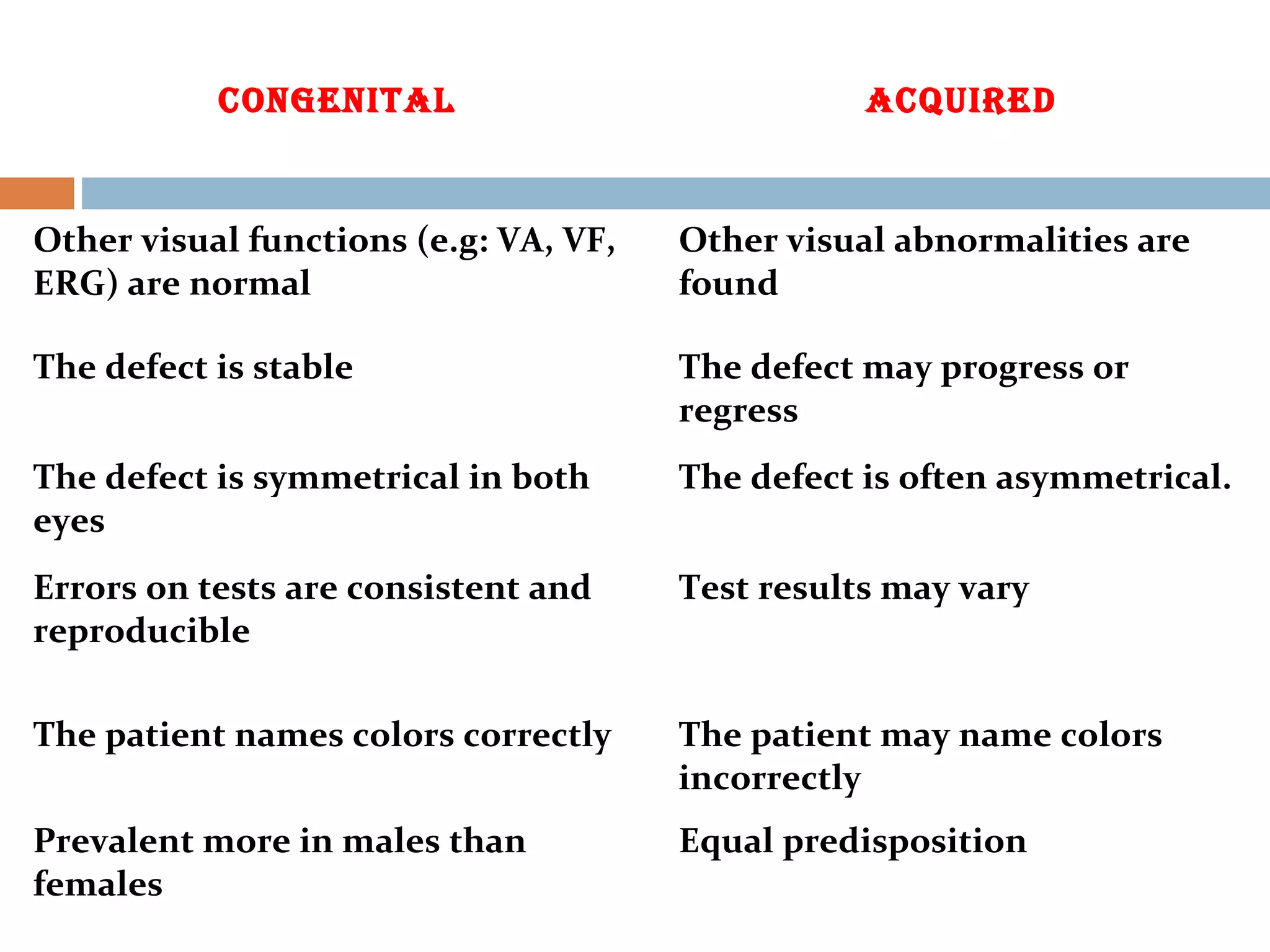
cOngenital acqUired
Other visual functions (e.g: VA, VF,
ERG) are normal
Other visual abnormalities are
found
The defect is stable The defect may progress or
regress
The defect is symmetrical in both
eyes
The defect is often asymmetrical.
Errors on tests are consistent and
reproducible
Test results may vary
The patient names colors correctly The patient may name colors
incorrectly
Prevalent more in males than
females
Equal predisposition
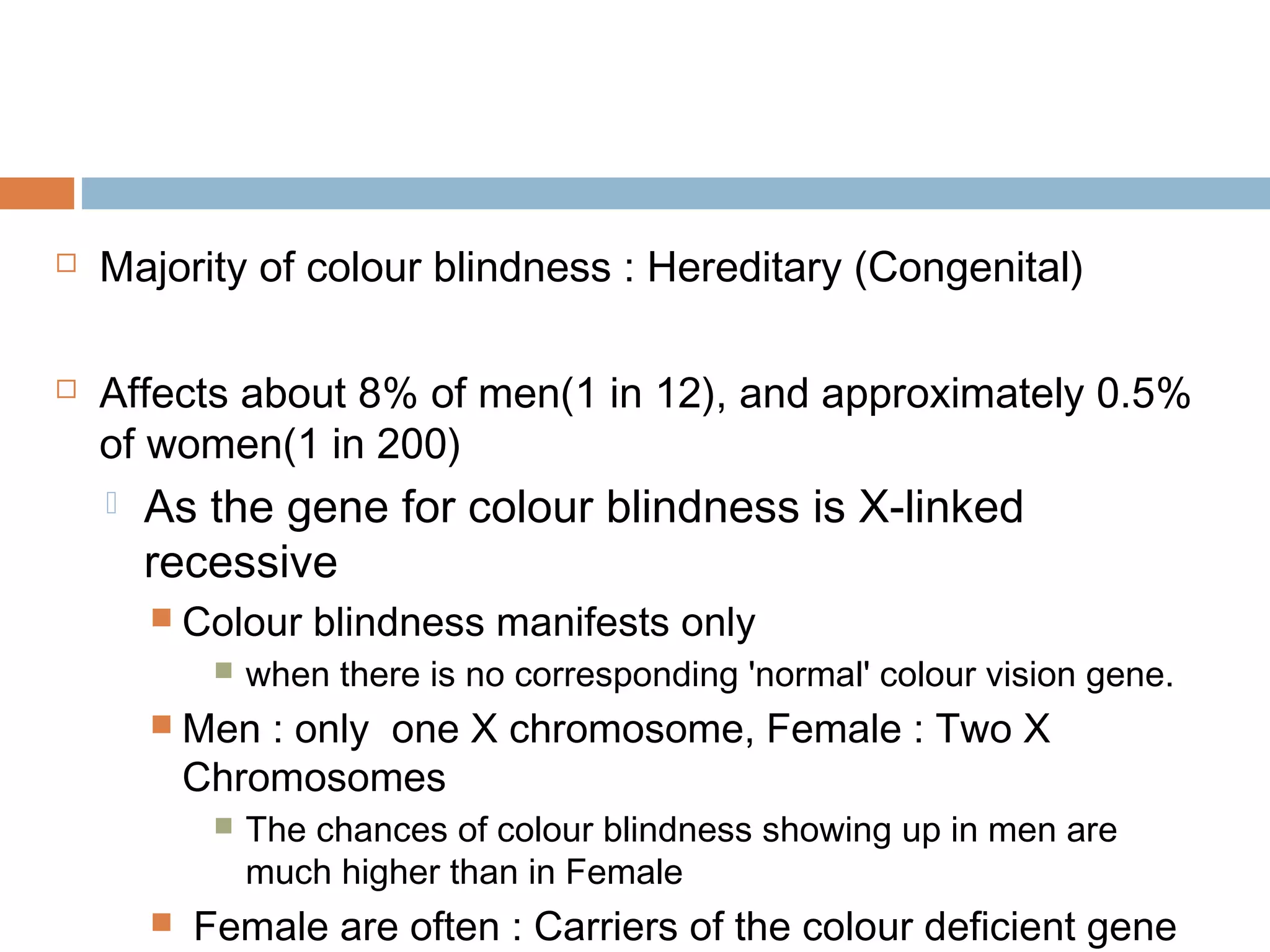
 Majority of colour blindness : Hereditary (Congenital)
 Affects about 8% of men(1 in 12), and approximately 0.5%
of women(1 in 200)
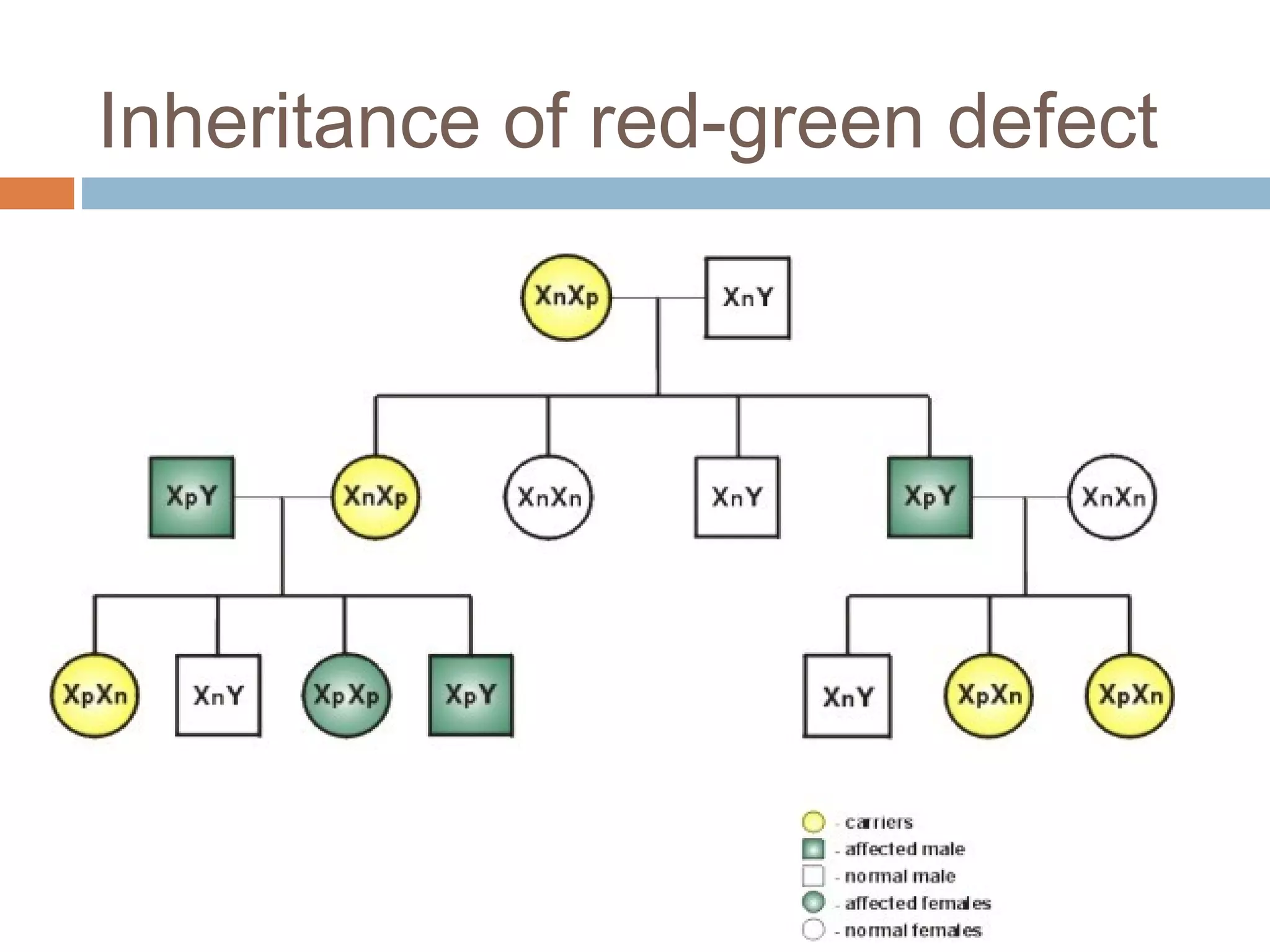
 As the gene for colour blindness is X-linked
recessive
 Colour blindness manifests only
 when there is no corresponding 'normal' colour vision gene.
 Men : only one X chromosome, Female : Two X
Chromosomes
 The chances of colour blindness showing up in men are
much higher than in Female
 Female are often : Carriers of the colour deficient gene
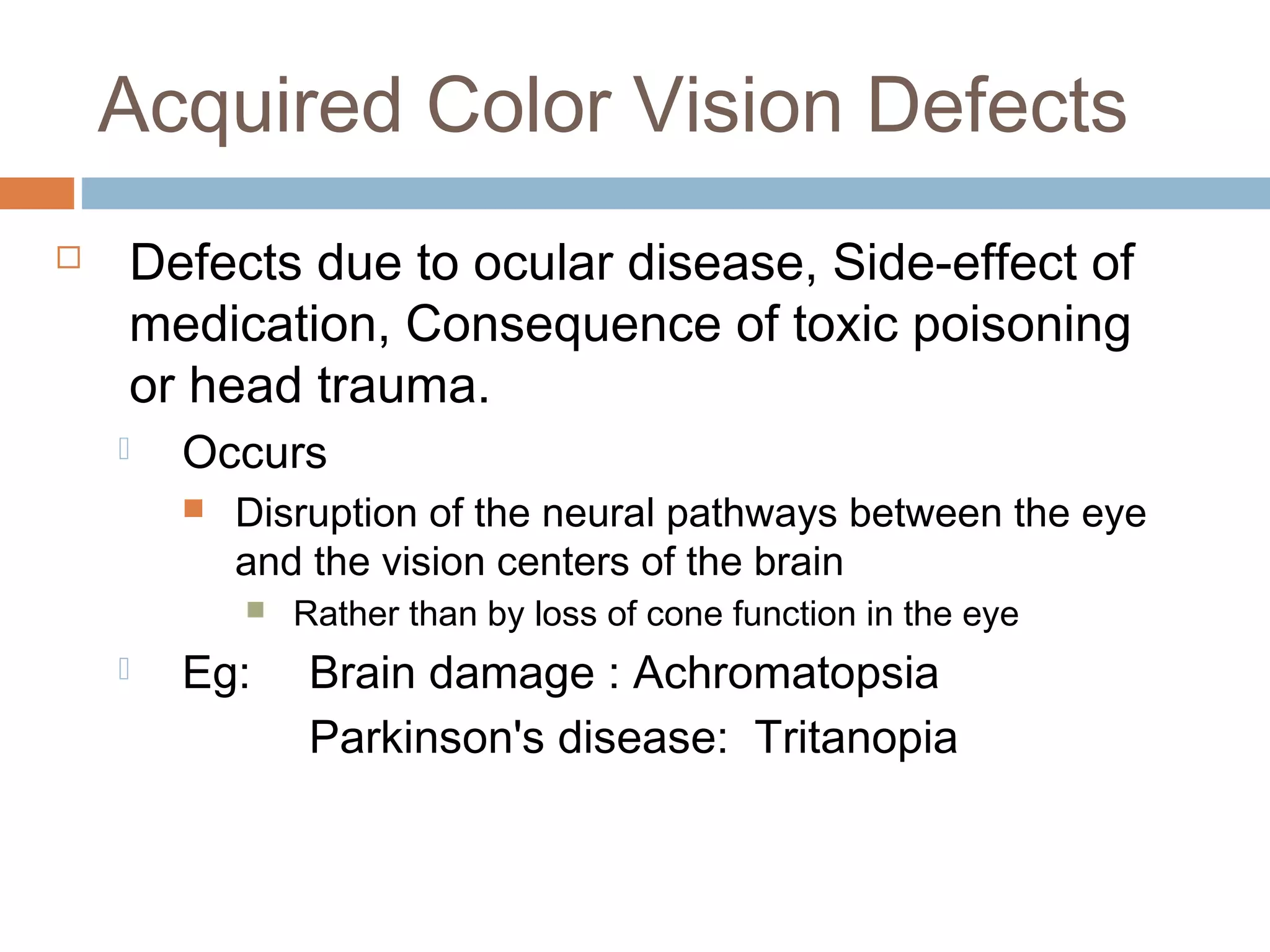
Acquired Color Vision Defects
 Defects due to ocular disease, Side-effect of
medication, Consequence of toxic poisoning
or head trauma.
 Occurs
 Disruption of the neural pathways between the eye
and the vision centers of the brain
 Rather than by loss of cone function in the eye
 Eg: Brain damage : Achromatopsia
Parkinson's disease: Tritanopia
Acquired Color vision Defects
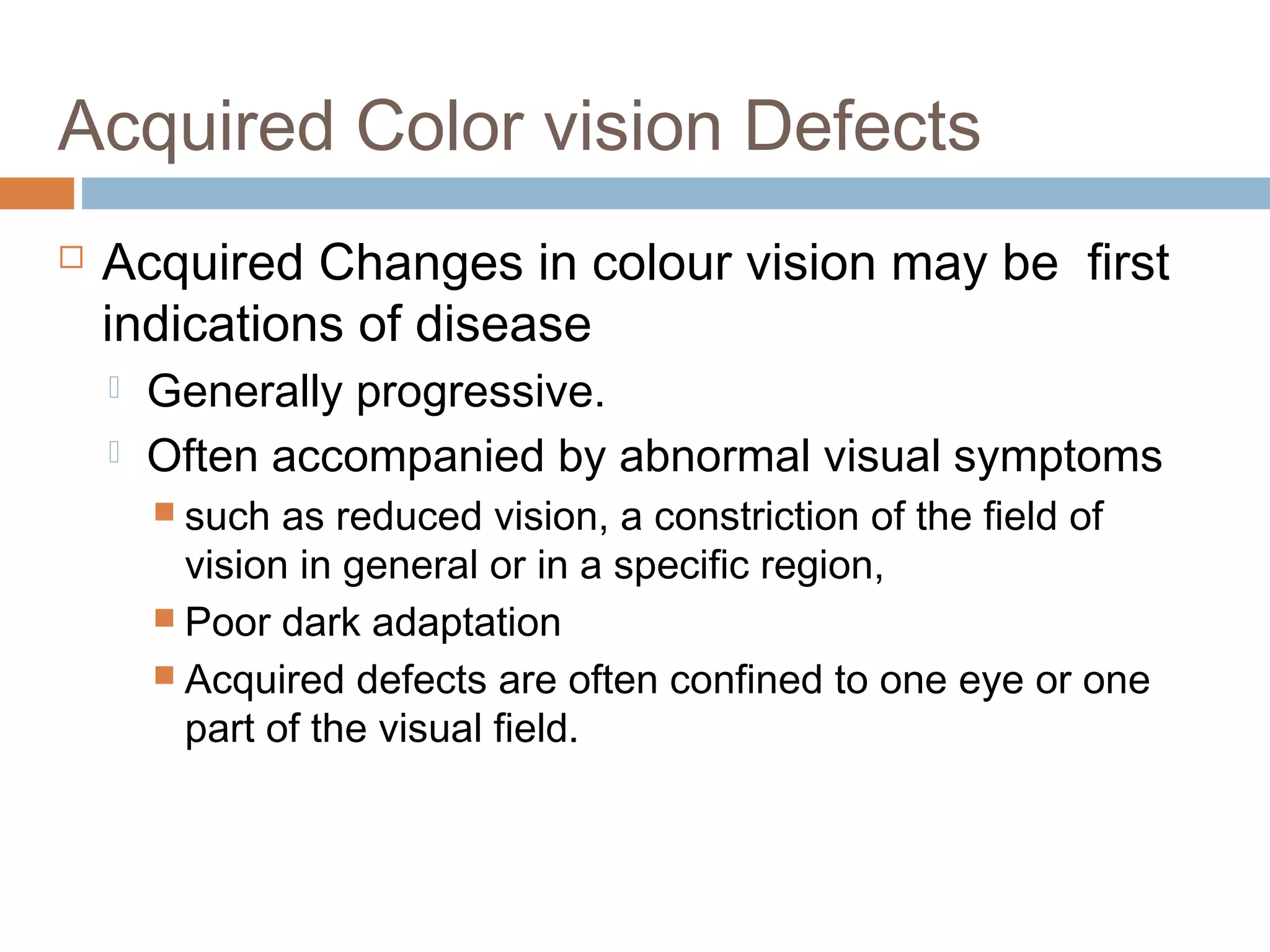
 Acquired Changes in colour vision may be first
indications of disease
 Generally progressive.
 Often accompanied by abnormal visual symptoms
 such as reduced vision, a constriction of the field of
vision in general or in a specific region,
 Poor dark adaptation
 Acquired defects are often confined to one eye or one
part of the visual field.
Types of Congenital Colour Vision DefectsTypes of Congenital Colour Vision Defects
TrichromaticTrichromatic
Possess all three cone pigments and hasPossess all three cone pigments and has
normal colour vision.normal colour vision.
DichromaticDichromatic Has complete deficiency in one coneHas complete deficiency in one cone
pigmentpigment
but preserves the remaining two conebut preserves the remaining two cone
pigments.pigments.
MonochromaticMonochromatic Has only one cone pigment.Has only one cone pigment.
AchromatopicAchromatopic Possesses no functioning cones.Possesses no functioning cones.
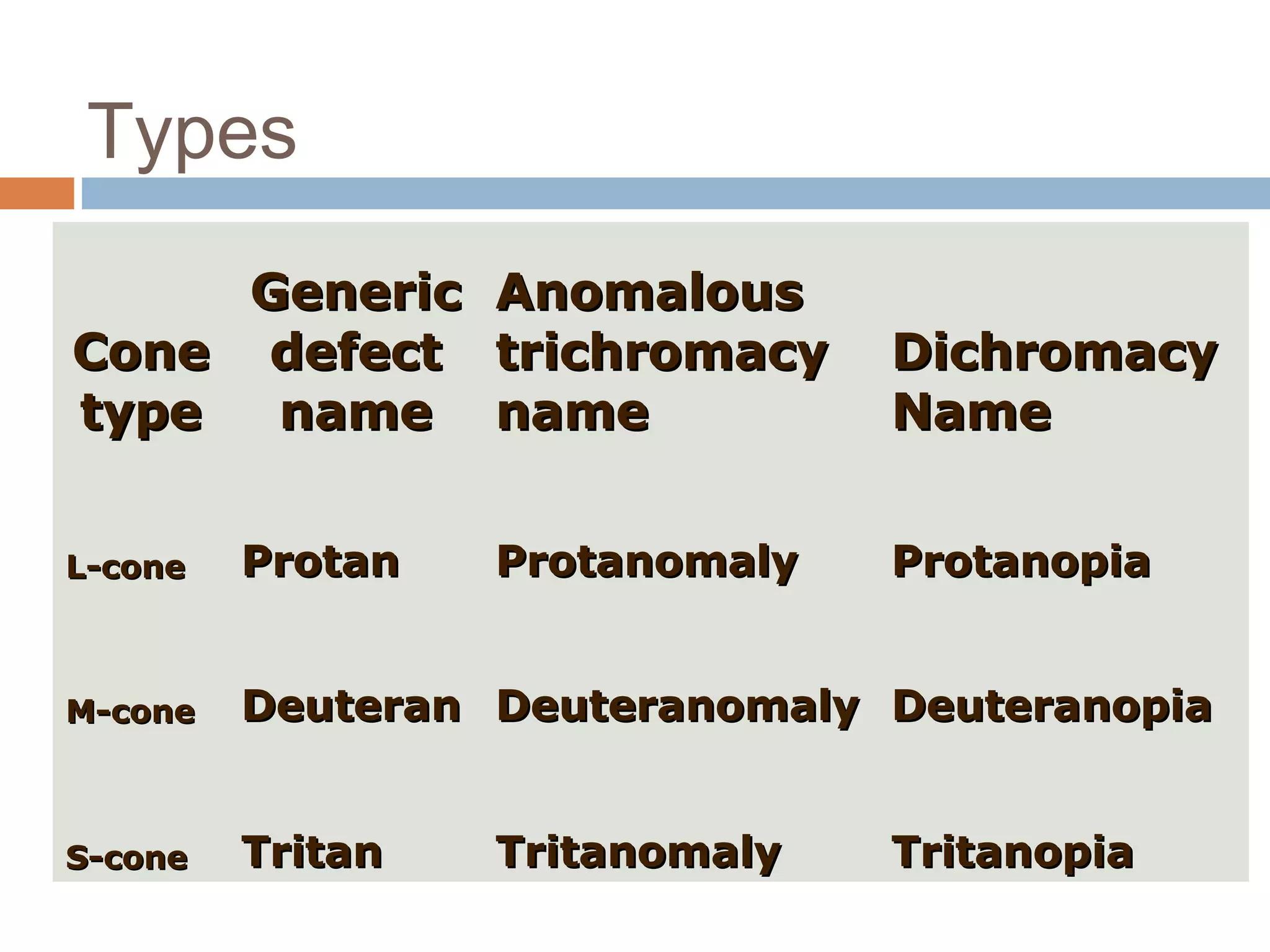
Types
ConeCone
typetype
GenericGeneric
defectdefect
namename
AnomalousAnomalous
trichromacytrichromacy
namename
DichromacyDichromacy
NameName
L-coneL-cone ProtanProtan ProtanomalyProtanomaly ProtanopiaProtanopia
M-coneM-cone DeuteranDeuteran DeuteranomalyDeuteranomaly DeuteranopiaDeuteranopia
S-coneS-cone TritanTritan TritanomalyTritanomaly TritanopiaTritanopia
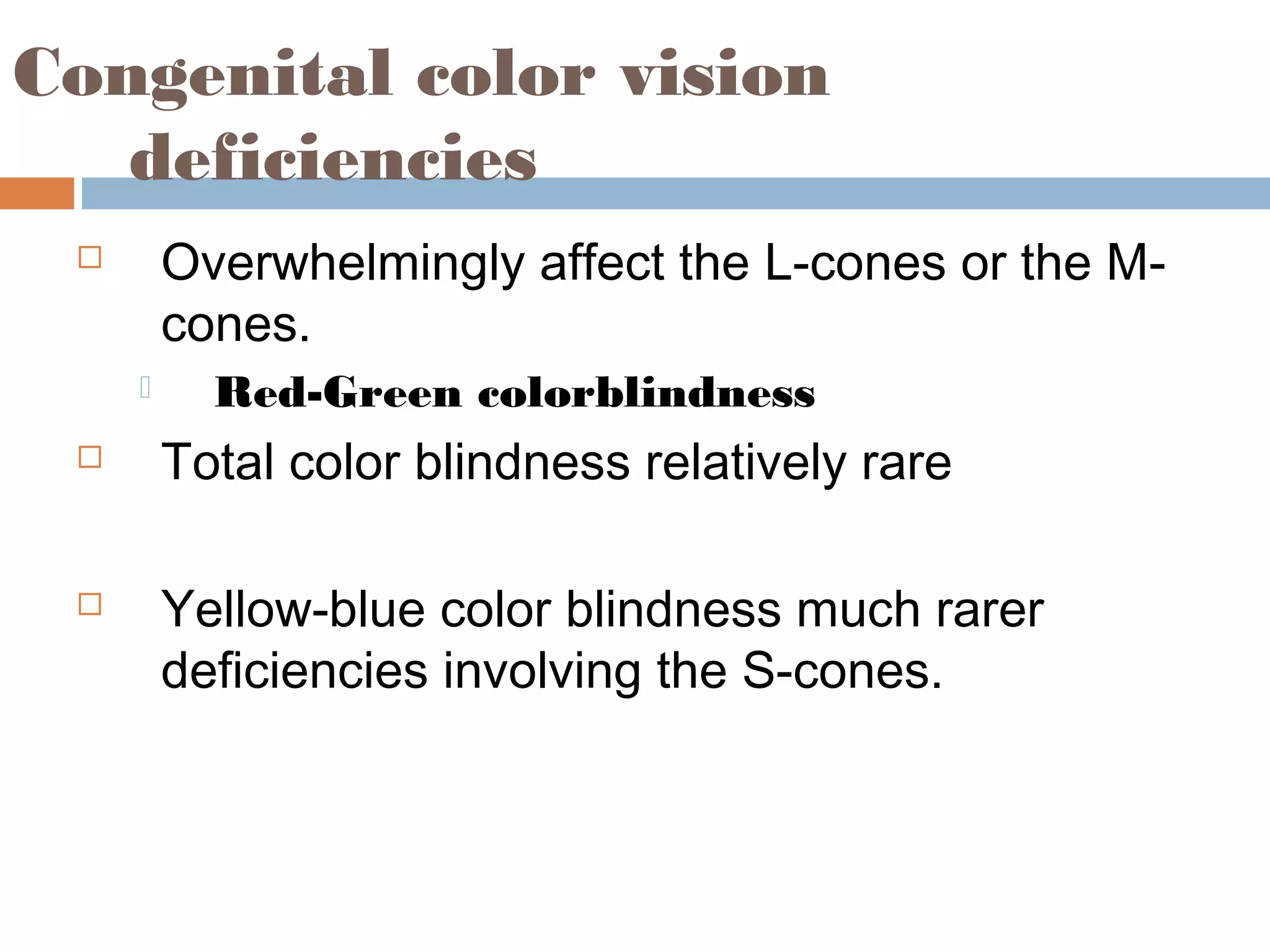
Congenital color vision
deficiencies
 Overwhelmingly affect the L-cones or the M-
cones.
 Red-Green colorblindness
 Total color blindness relatively rare
 Yellow-blue color blindness much rarer
deficiencies involving the S-cones.
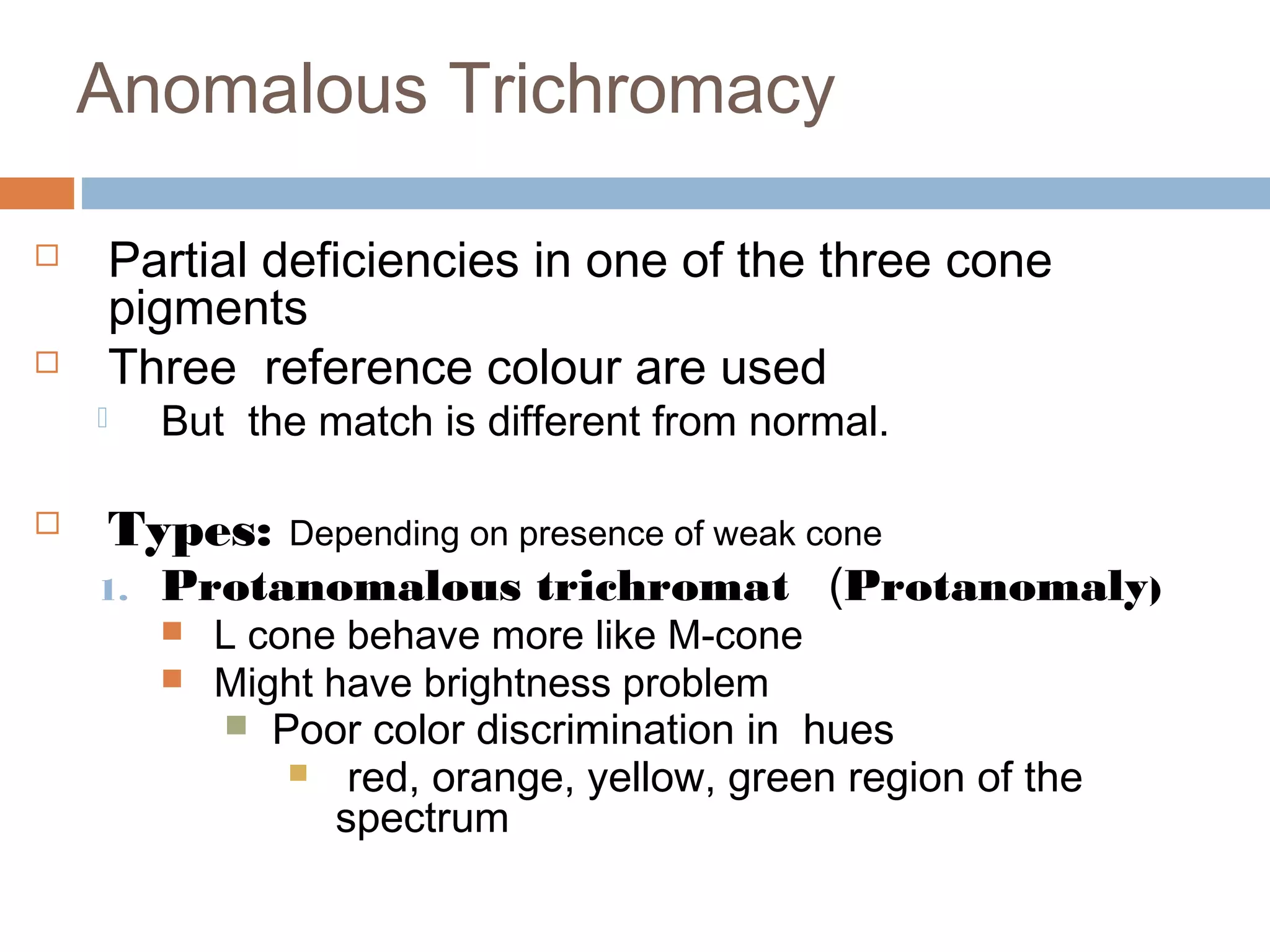
Anomalous Trichromacy
 Partial deficiencies in one of the three cone
pigments
 Three reference colour are used
 But the match is different from normal.
 Types: Depending on presence of weak cone
1. Protanomalous trichromat (Protanomaly)
 L cone behave more like M-cone
 Might have brightness problem
 Poor color discrimination in hues
 red, orange, yellow, green region of the
spectrum
Anomalous Trichromacy
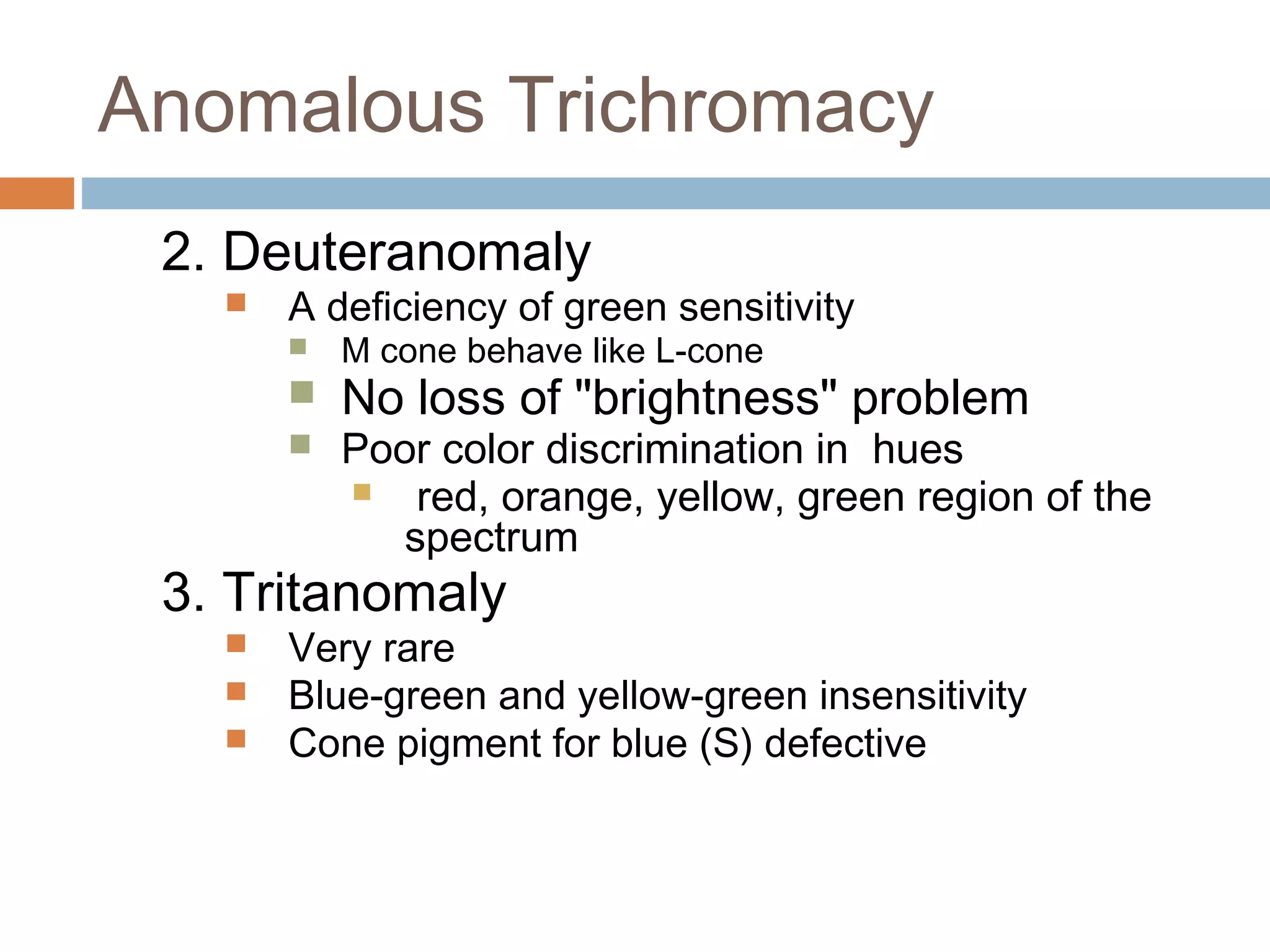
2. Deuteranomaly
 A deficiency of green sensitivity
 M cone behave like L-cone
 No loss of "brightness" problem
 Poor color discrimination in hues
 red, orange, yellow, green region of the
spectrum
3. Tritanomaly
 Very rare
 Blue-green and yellow-green insensitivity
 Cone pigment for blue (S) defective
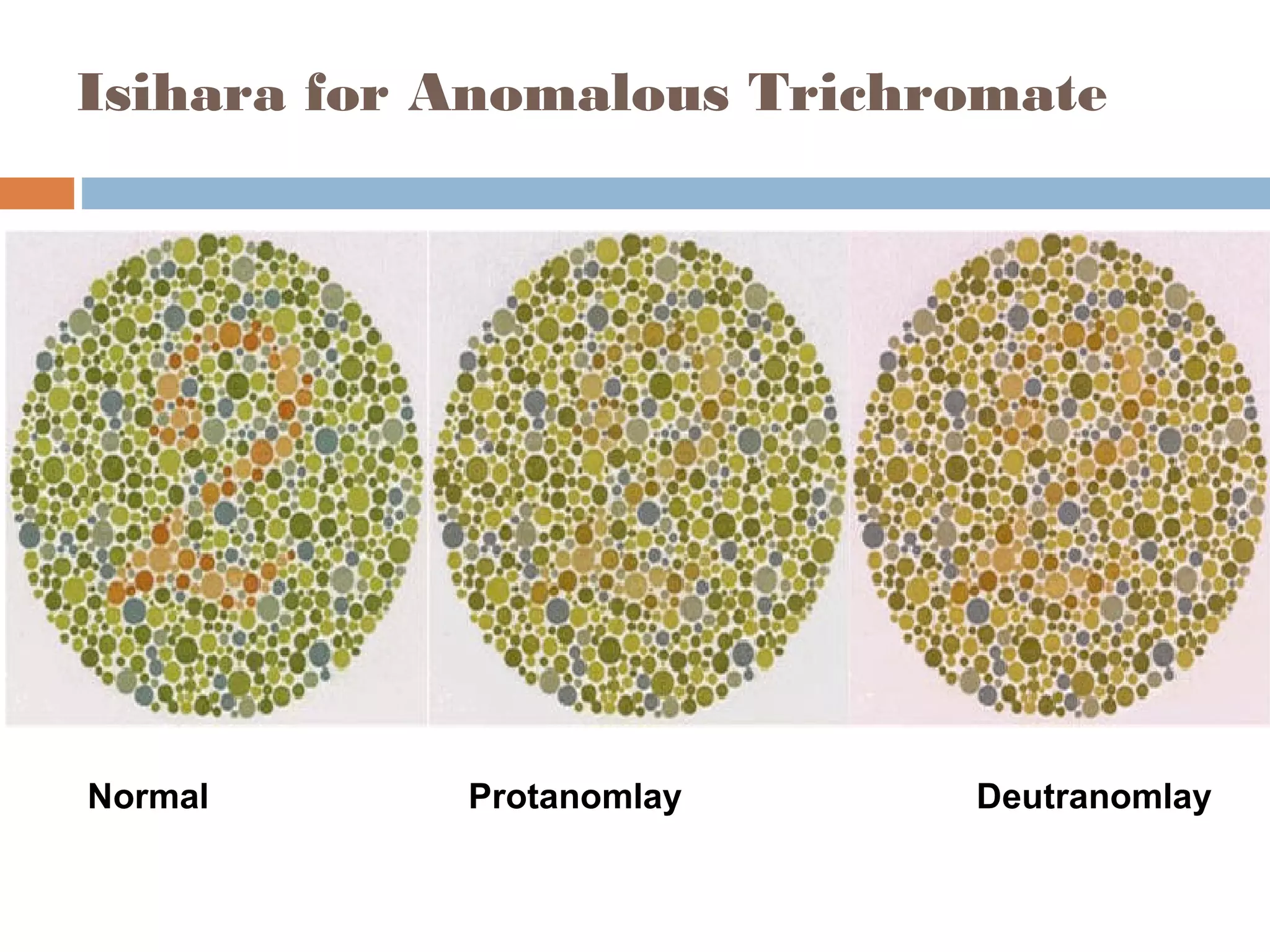
Isihara for Anomalous Trichromate
Normal Protanomlay Deutranomlay
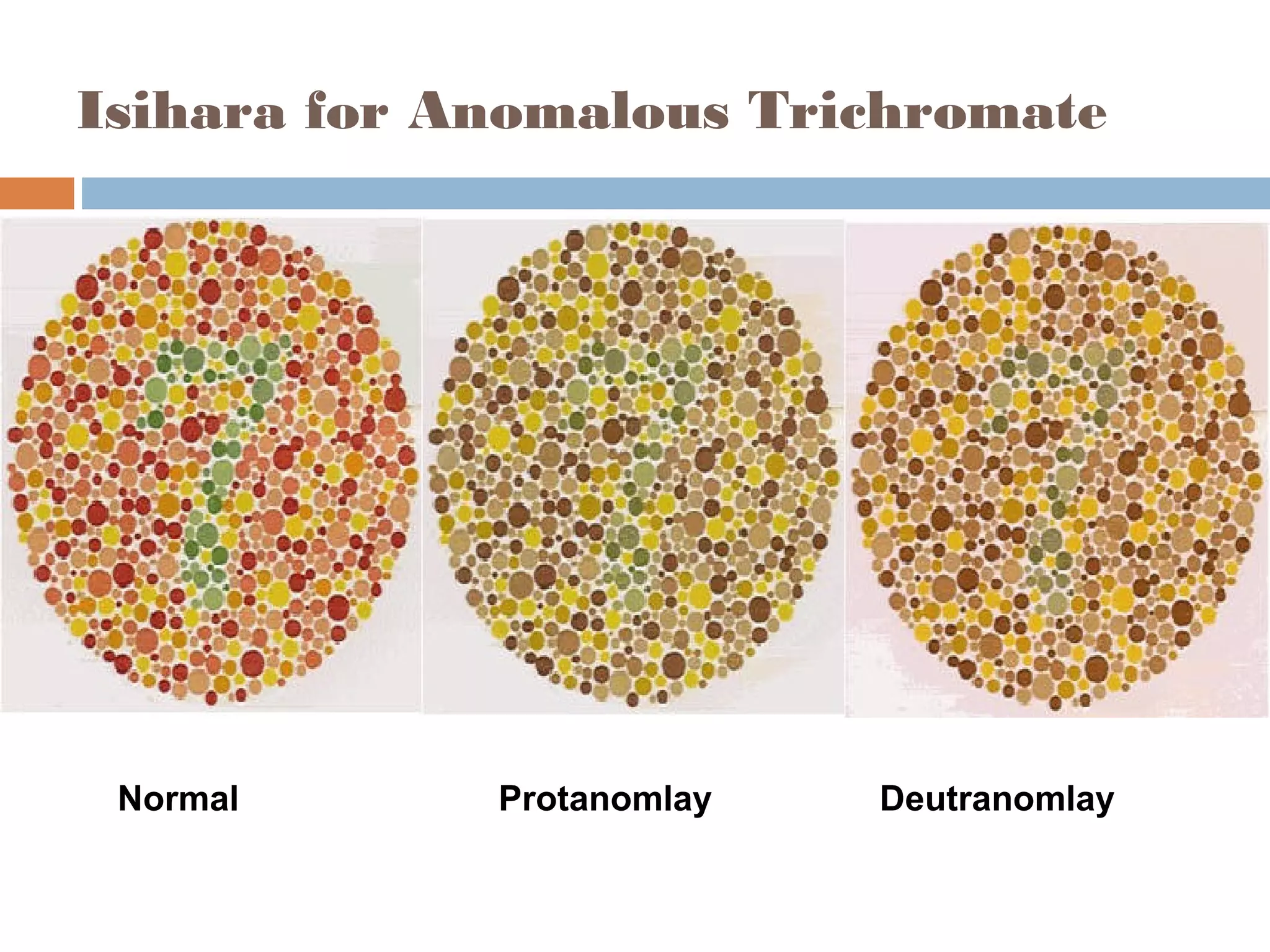
Isihara for Anomalous Trichromate
Normal Protanomlay Deutranomlay
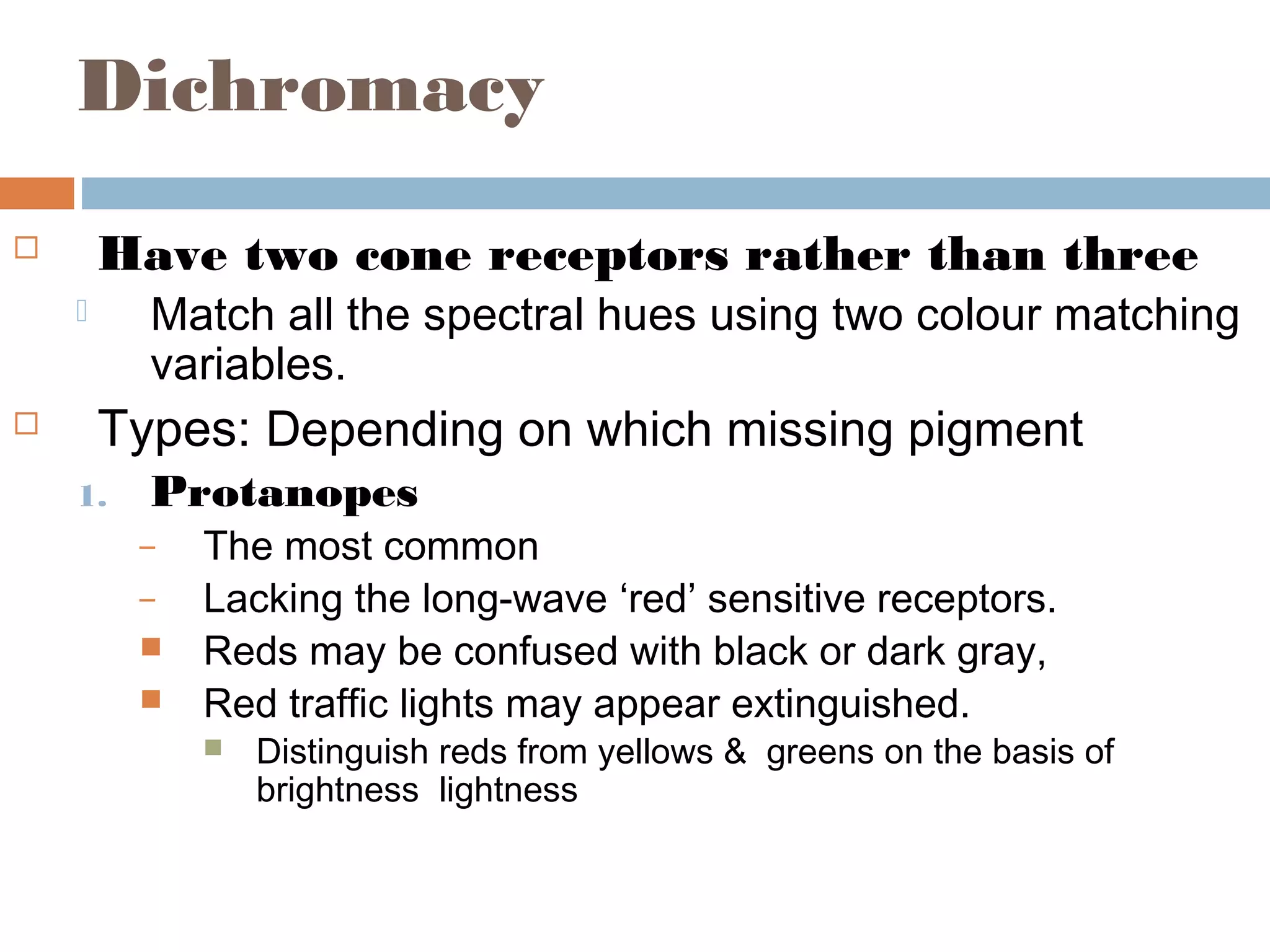
Dichromacy
 Have two cone receptors rather than three
 Match all the spectral hues using two colour matching
variables.
 Types: Depending on which missing pigment
1. Protanopes
– The most common
– Lacking the long-wave ‘red’ sensitive receptors.
 Reds may be confused with black or dark gray,
 Red traffic lights may appear extinguished.
 Distinguish reds from yellows & greens on the basis of
brightness lightness
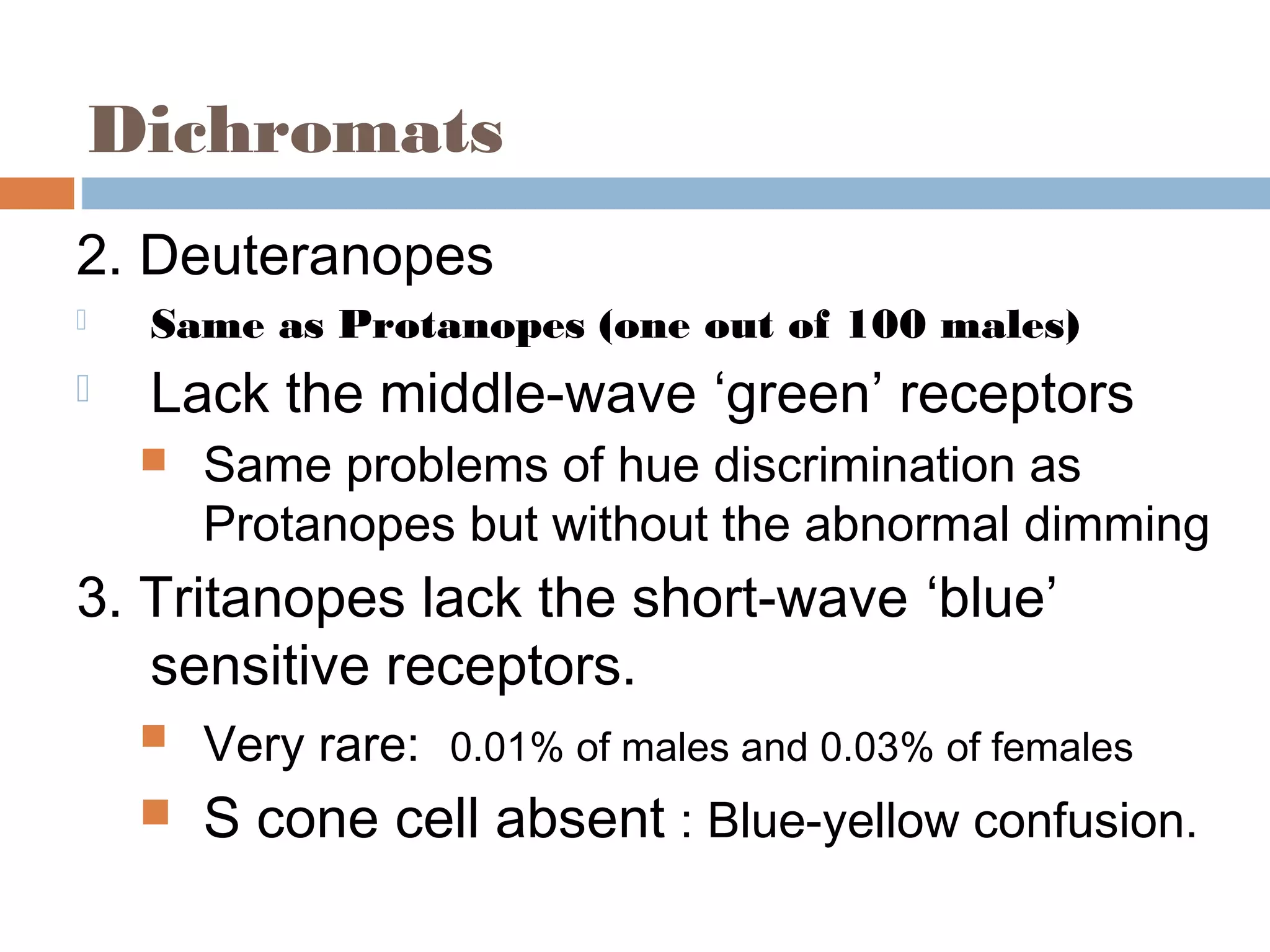
Dichromats
2. Deuteranopes
 Same as Protanopes (one out of 100 males)
 Lack the middle-wave ‘green’ receptors
 Same problems of hue discrimination as
Protanopes but without the abnormal dimming
3. Tritanopes lack the short-wave ‘blue’
sensitive receptors.
 Very rare: 0.01% of males and 0.03% of females
 S cone cell absent : Blue-yellow confusion.
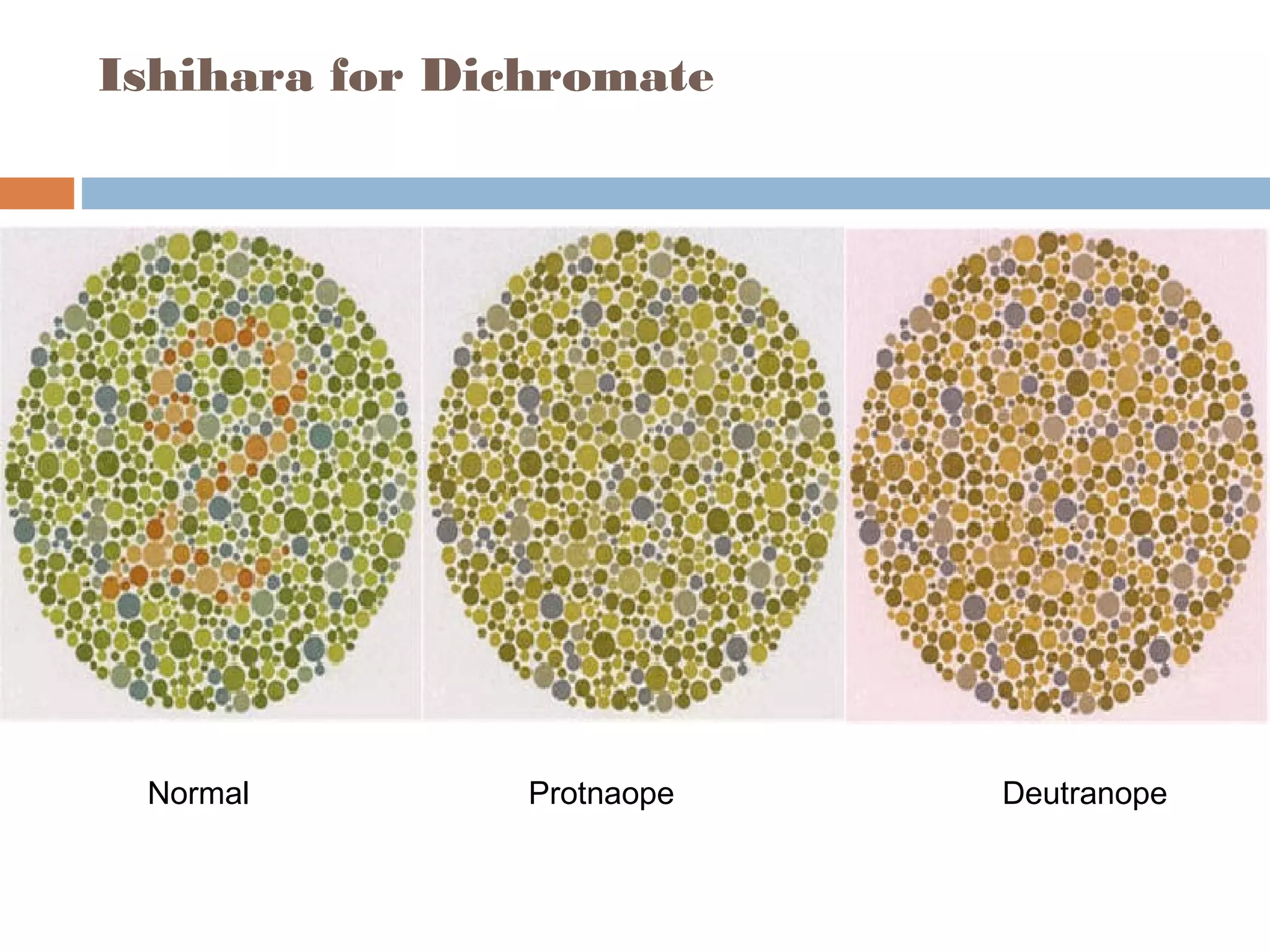
Ishihara for Dichromate
Normal Protnaope Deutranope
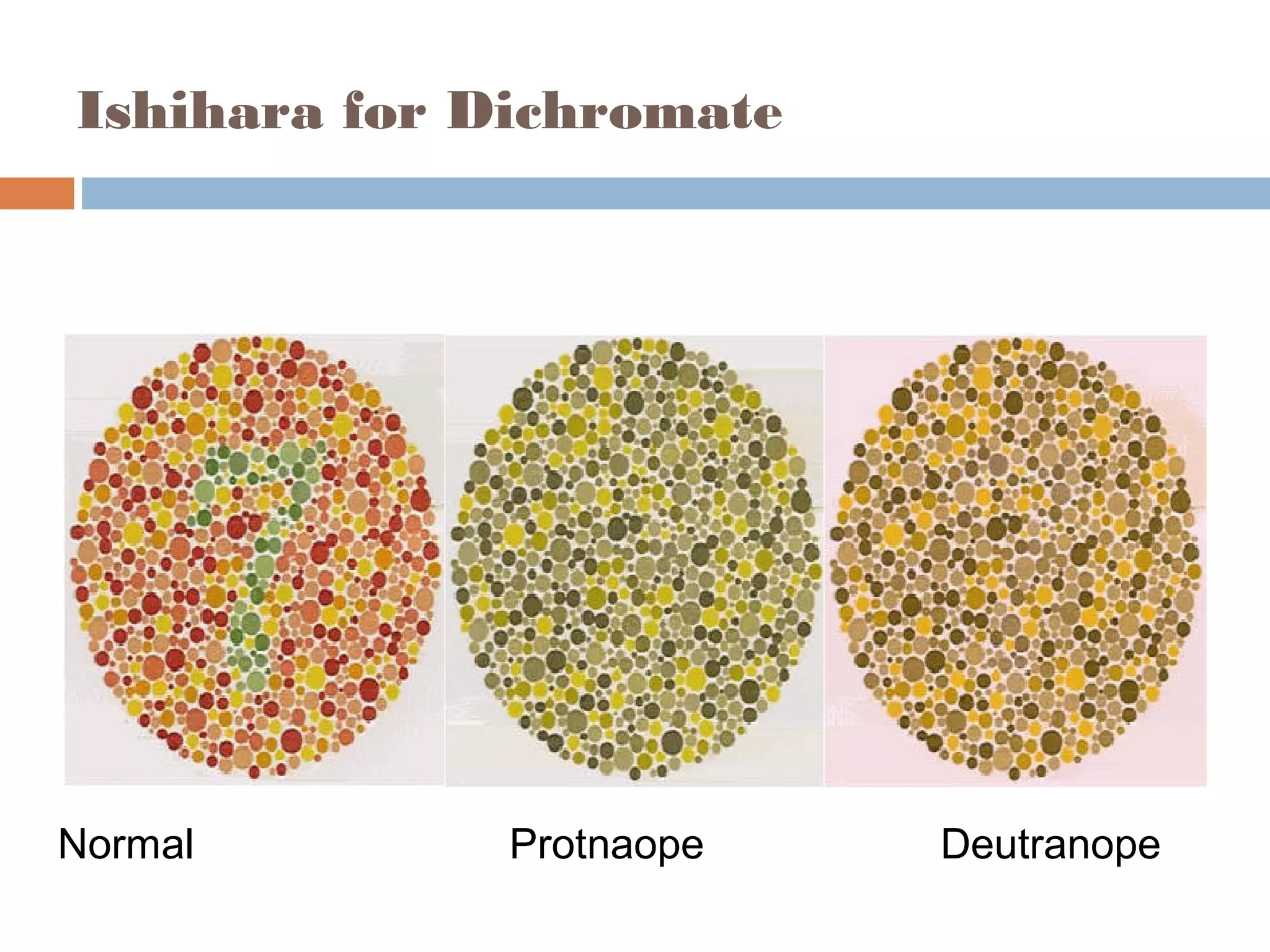
Ishihara for Dichromate
Normal Protnaope Deutranope
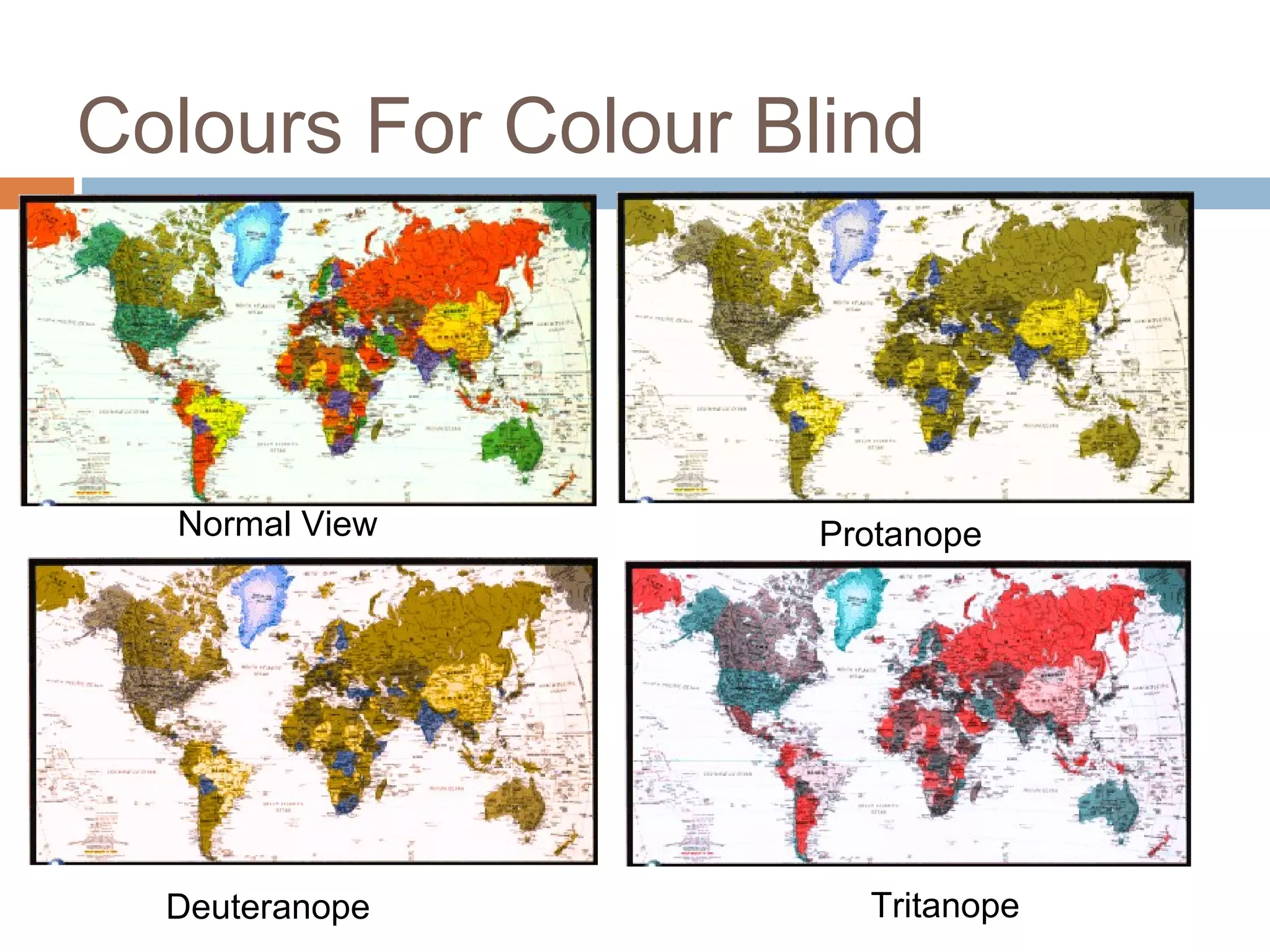
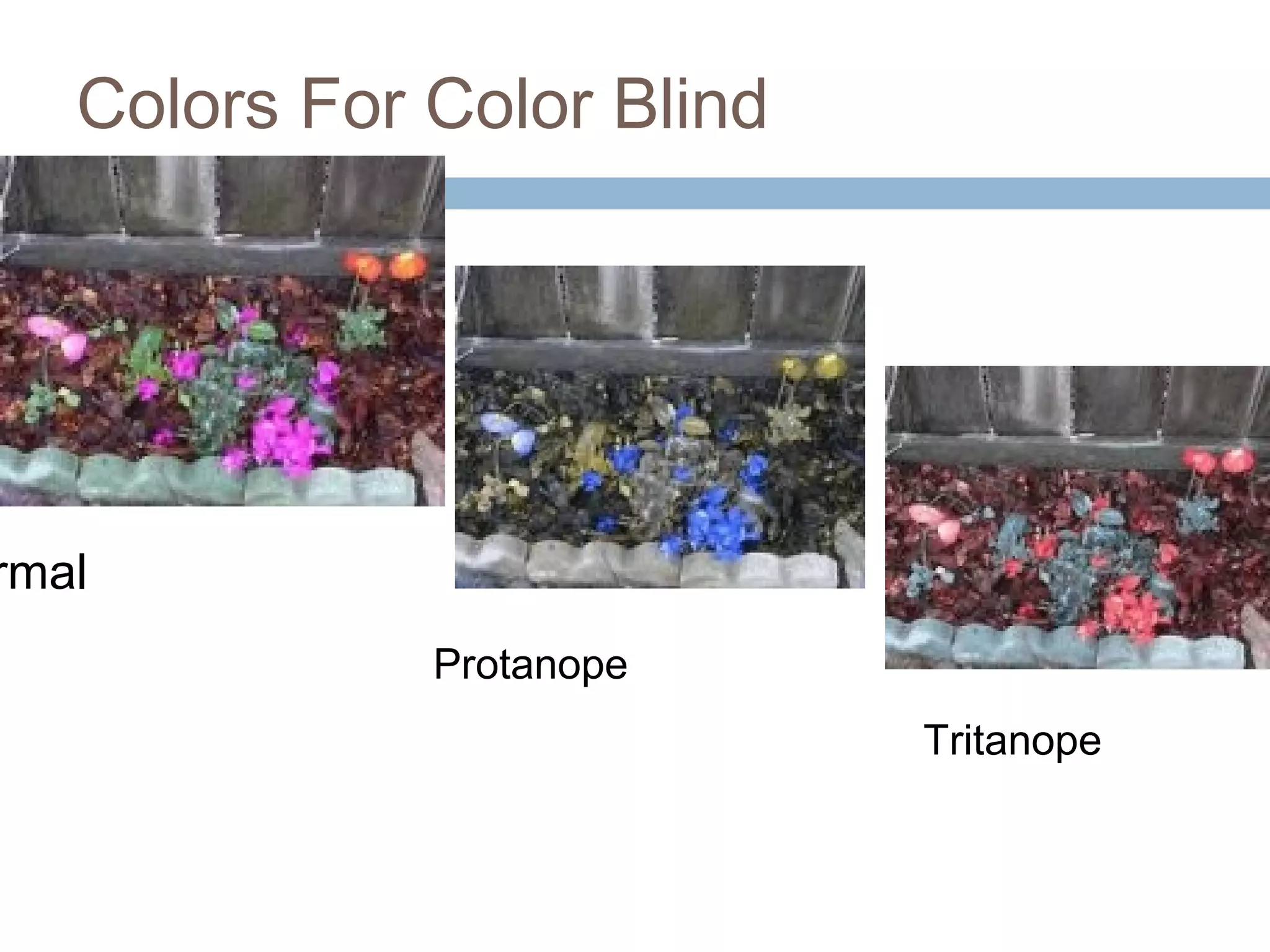
Colours For Colour Blind
Normal View Protanope
Deuteranope Tritanope
Colors For Color Blind
rmal
Protanope
Tritanope
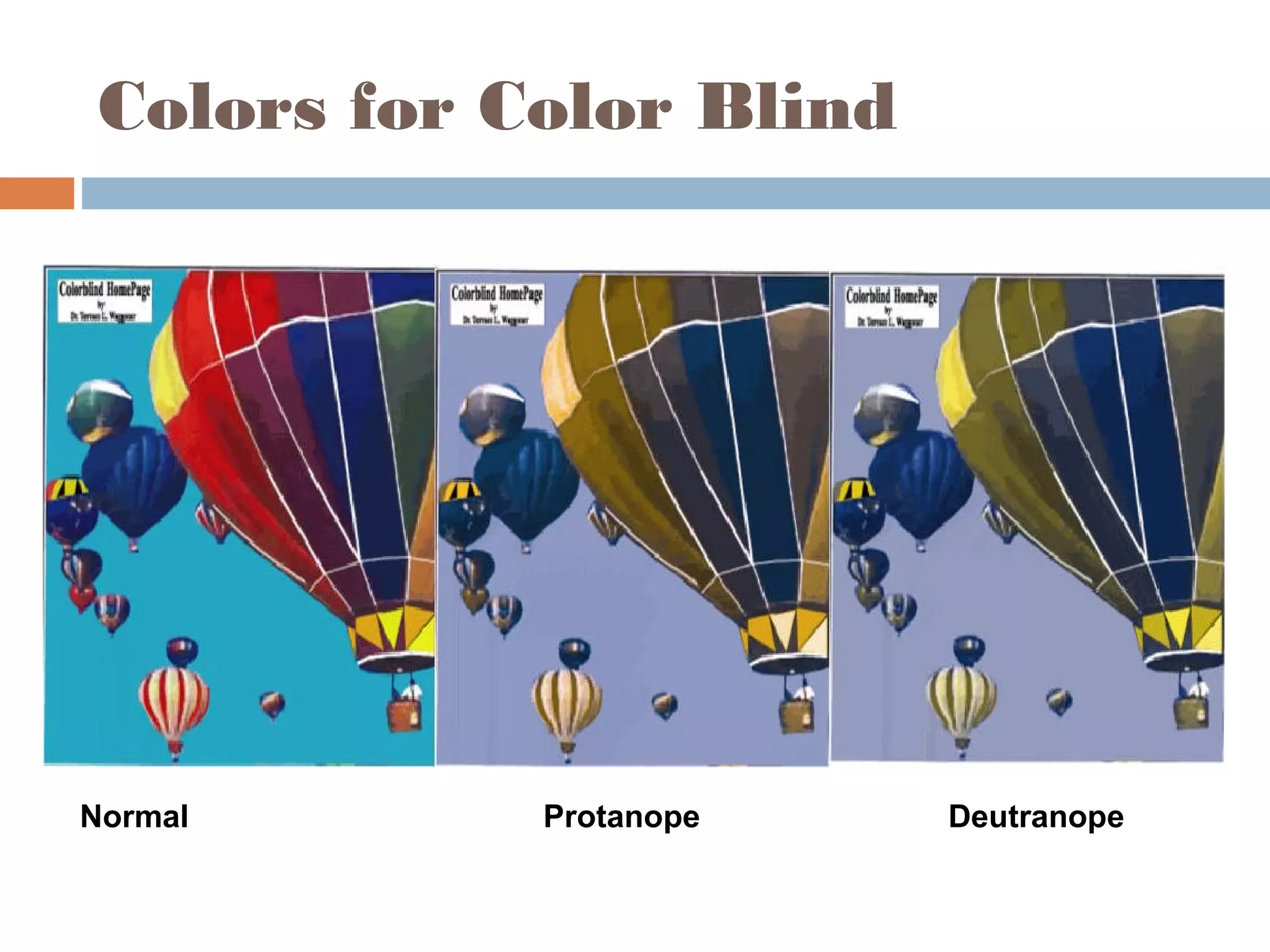
Colors for Color Blind
Normal Protanope Deutranope
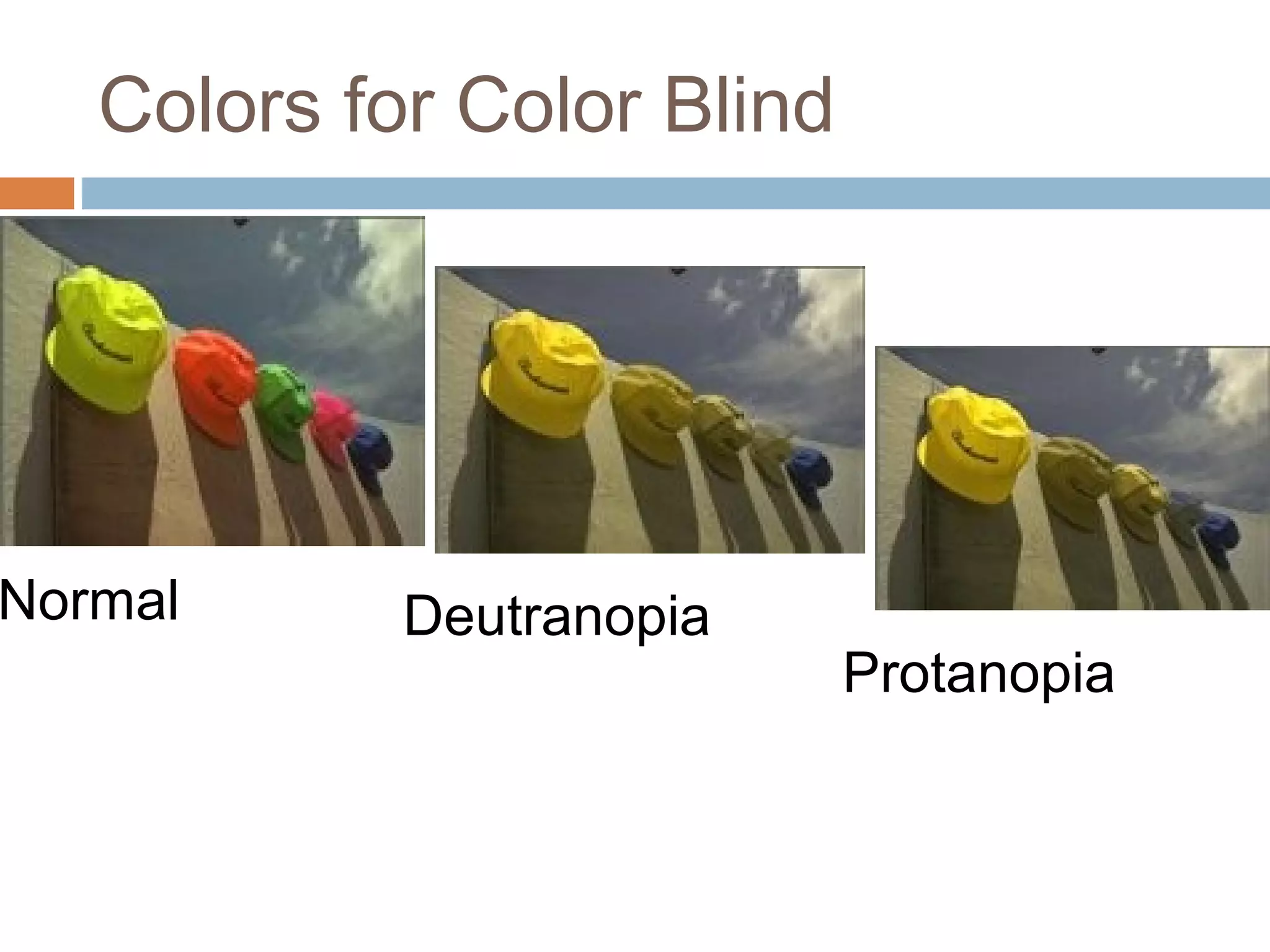
Colors for Color Blind
Normal Deutranopia
Protanopia
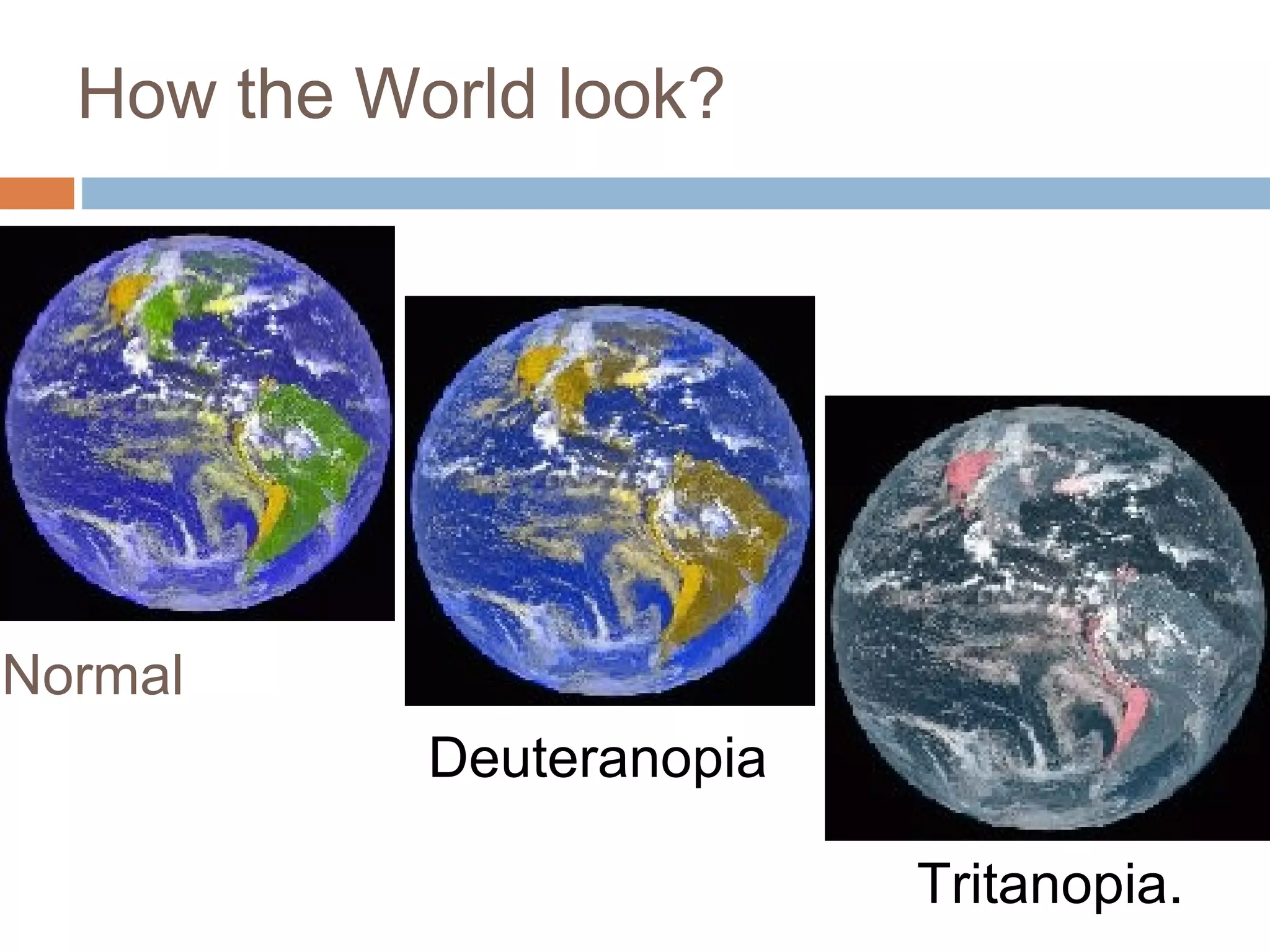
How the World look?
Deuteranopia
Tritanopia.
Normal
Monochromacy
(Atypical Monochromacy)
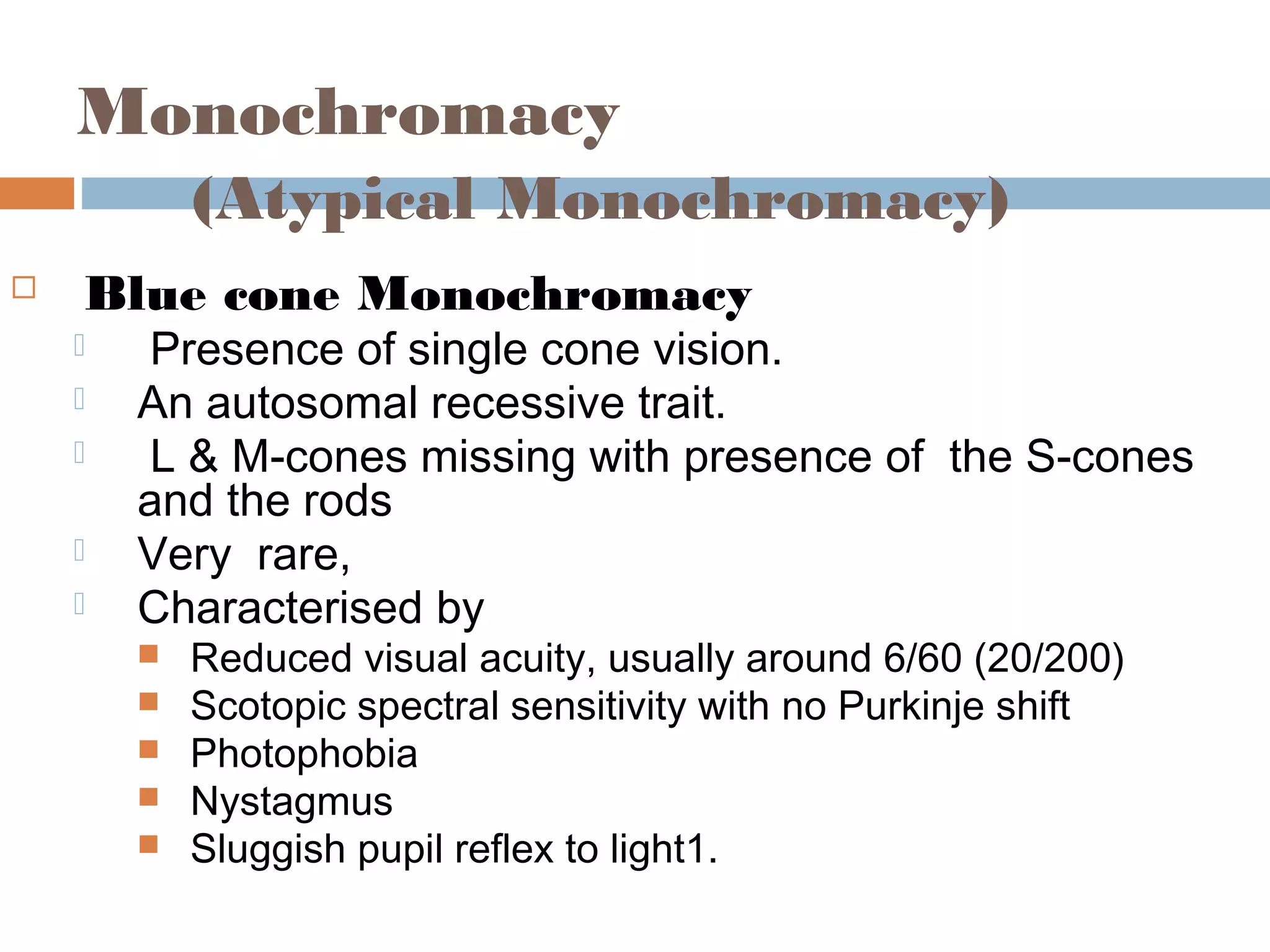
 Blue cone Monochromacy
 Presence of single cone vision.
 An autosomal recessive trait.
 L & M-cones missing with presence of the S-cones
and the rods
 Very rare,
 Characterised by
 Reduced visual acuity, usually around 6/60 (20/200)
 Scotopic spectral sensitivity with no Purkinje shift
 Photophobia
 Nystagmus
 Sluggish pupil reflex to light1.
Achromatopsia
(Typical Monochromacy)
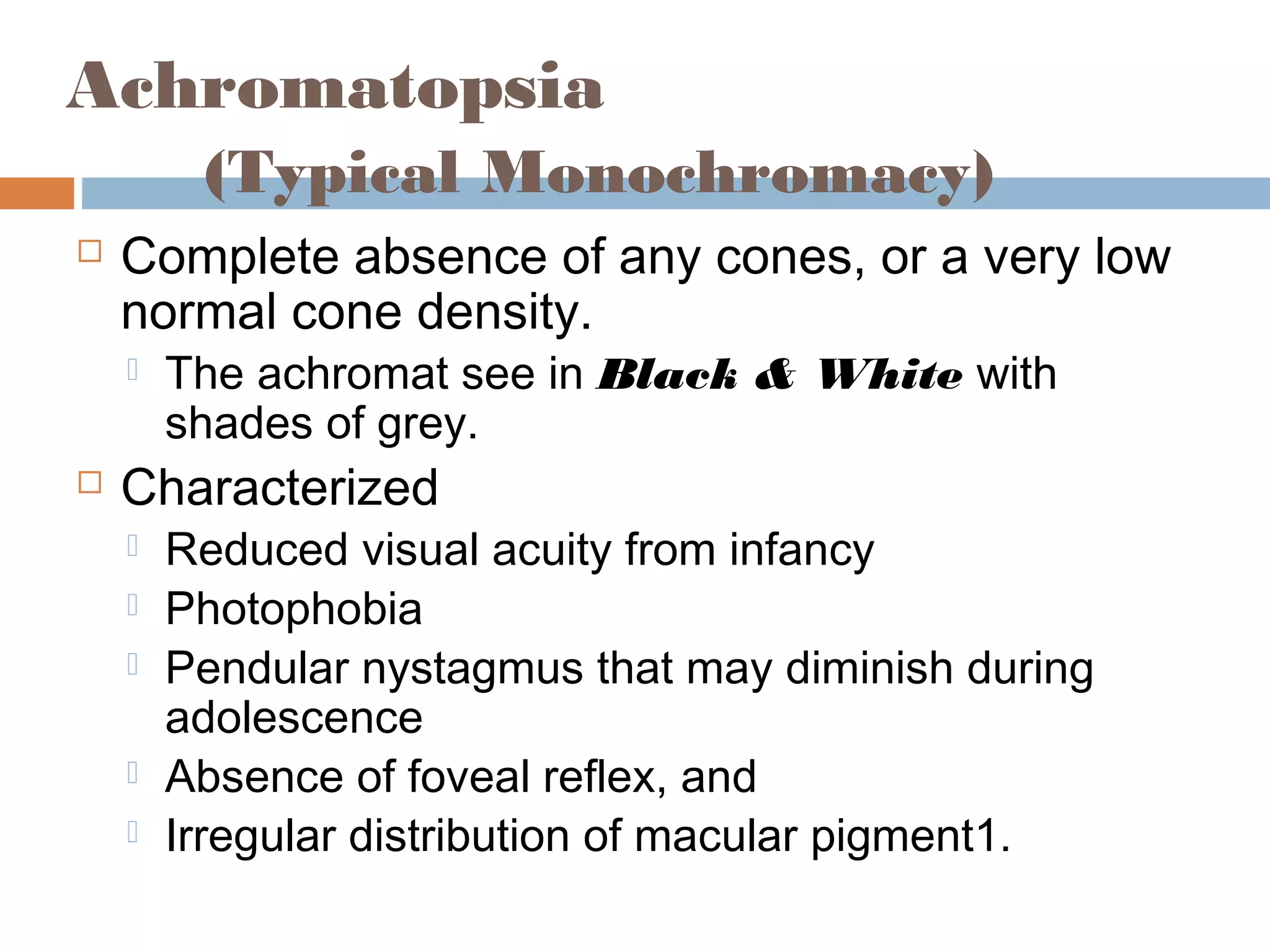
 Complete absence of any cones, or a very low
normal cone density.
 The achromat see in Black & White with
shades of grey.
 Characterized
 Reduced visual acuity from infancy
 Photophobia
 Pendular nystagmus that may diminish during
adolescence
 Absence of foveal reflex, and
 Irregular distribution of macular pigment1.
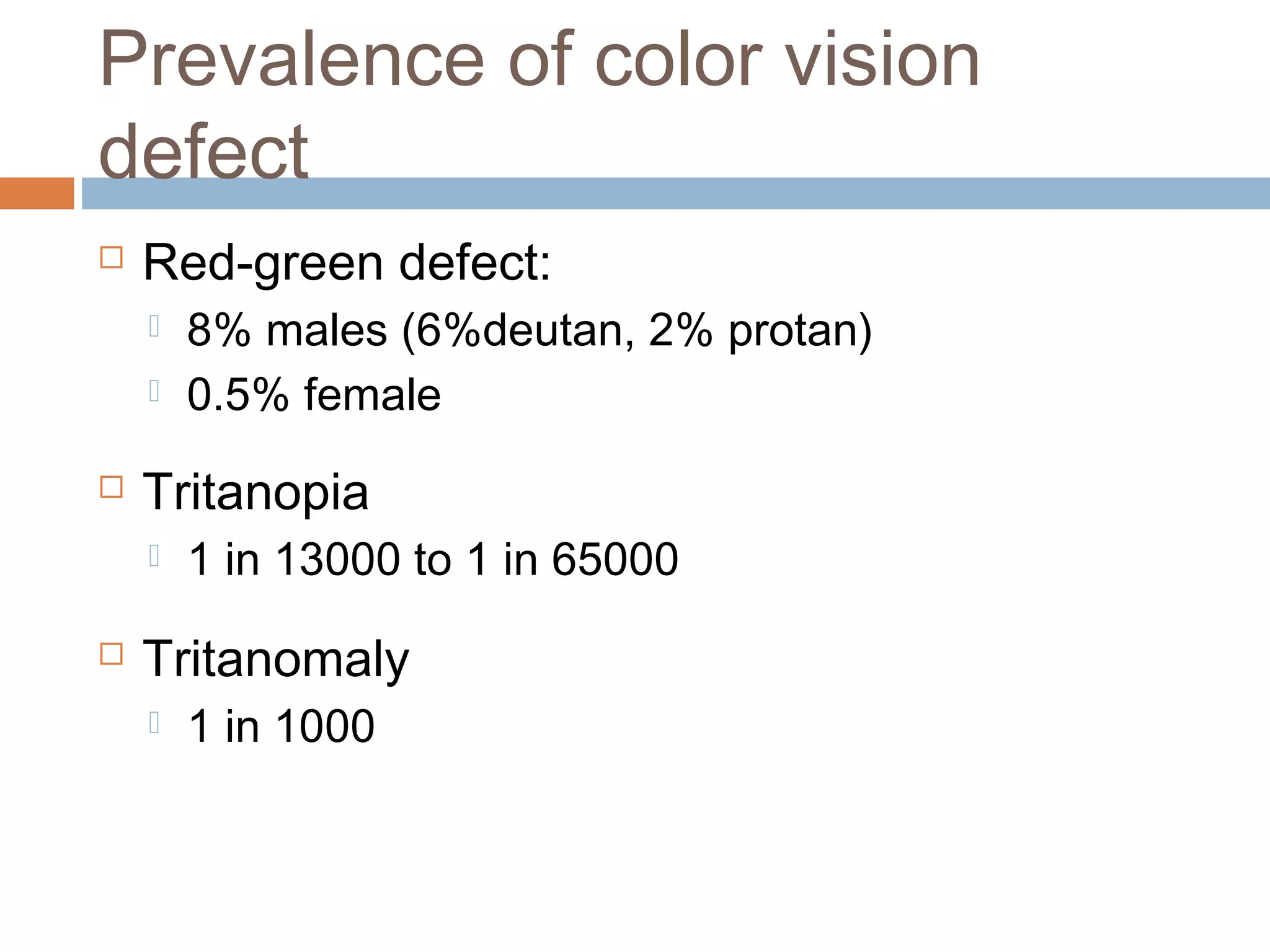
 Red-green defect:
 8% males (6%deutan, 2% protan)
 0.5% female
 Tritanopia
 1 in 13000 to 1 in 65000
 Tritanomaly
 1 in 1000
Prevalence of color vision
defect
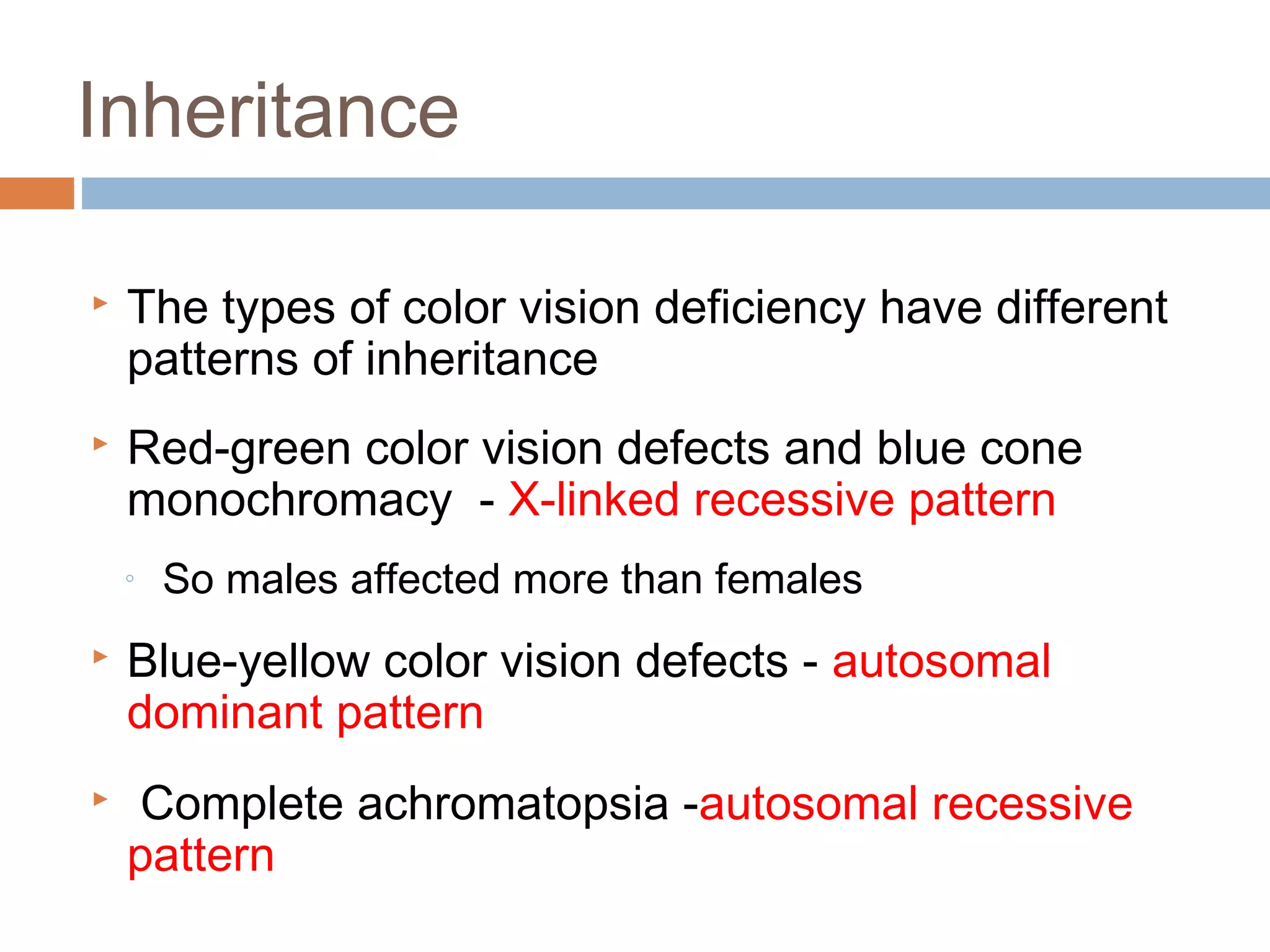
 The types of color vision deficiency have different
patterns of inheritance
 Red-green color vision defects and blue cone
monochromacy - X-linked recessive pattern
◦ So males affected more than females
 Blue-yellow color vision defects - autosomal
dominant pattern
 Complete achromatopsia -autosomal recessive
pattern
Inheritance
Inheritance of red-green defect
Genetics behind Color Vision
 Every human has 2 sex chromosomes
 Female has two X’s and Male has an X and a
Y.  
 The M- and L-cone Photo-pigment genes lie in
a head to tail tandem array
 On the q-arm of the X-chromosome.
This is why men are more likely to be
colorblind
 if there is a defect in a man's genes,
Female has second set of genes
 often keeps her from being colorblind.  
Genetics of Color Blindness
 A female with the colorblindness defect in one X
chromosome
 Carrier of colorblindness.
 Male children of a female carrier
 likely to be colorblind
 Male children of colorblind male and a Carrier
female
 Extremely likely to be colorblind.
 Result from inherited cone photopigment
abnormalities
 Classified as:
a) Dyschromatopsia
a) Achromatopsia
1.Congenital color vision defect
 Acquired after birth
 Due to
 Ocular disease like papilledema, macular
degeneration, glaucoma, papillitis etc.
 Side effect of medication like phenothiazines,
antitubercular drugs, antidiabetics
 Consequence of toxic poisoning
 Head trauma, etc.
2. Acquired color vision defects
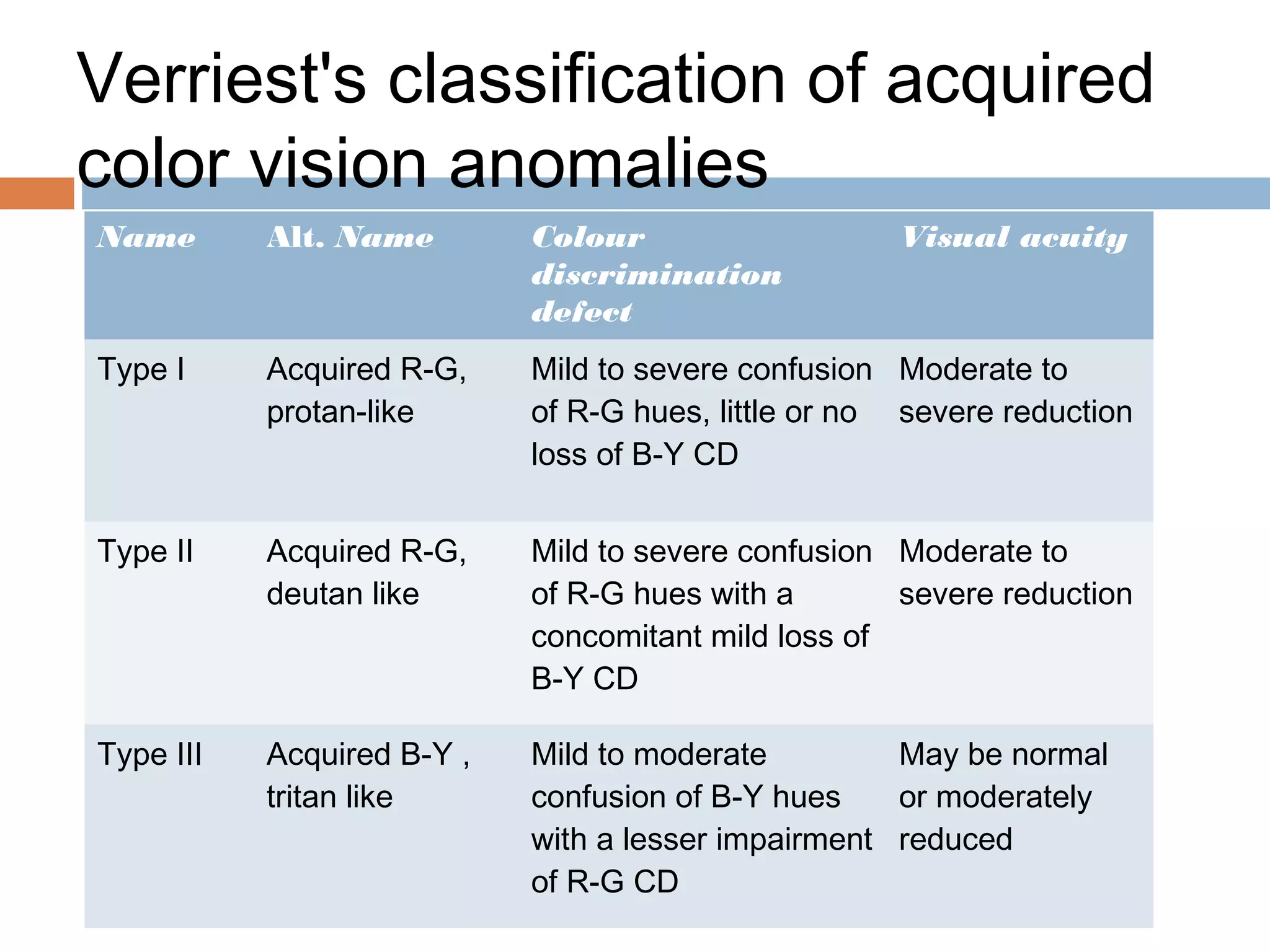
Name Alt. Name Colour
discrimination
defect
Visual acuity
Type I Acquired R-G,
protan-like
Mild to severe confusion
of R-G hues, little or no
loss of B-Y CD
Moderate to
severe reduction
Type II Acquired R-G,
deutan like
Mild to severe confusion
of R-G hues with a
concomitant mild loss of
B-Y CD
Moderate to
severe reduction
Type III Acquired B-Y ,
tritan like
Mild to moderate
confusion of B-Y hues
with a lesser impairment
of R-G CD
May be normal
or moderately
reduced
Verriest's classification of acquired
color vision anomalies
 No treatment is helpful
 Treat the cause in acquired color vision defect
 Proper counseling
 Genetic counseling
Treatment and management
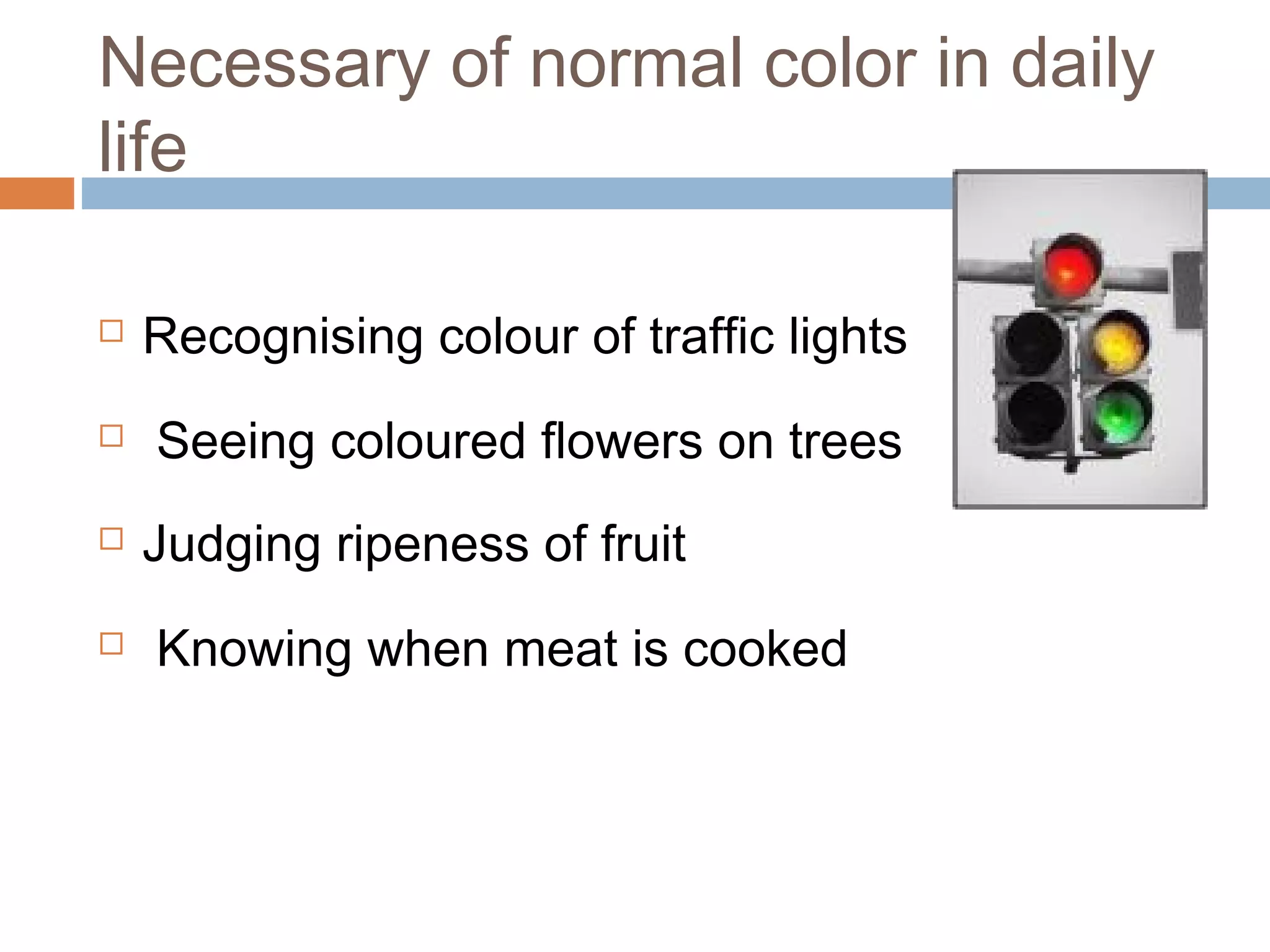
 Recognising colour of traffic lights
 Seeing coloured flowers on trees
 Judging ripeness of fruit
 Knowing when meat is cooked
Necessary of normal color in daily
life
 Air Forces
 Navy
 Army
 Civil aviation
 Electrical work
 Air traffic controller
 Cartographer
 Chemists and chemicals laboratory analysis
 Artist/painter
Careers/Jobs/Occupations/Industri
es requiring perfect colour vision.
 Yes
 In detection of camouflage
Can defective color vision be an
asset?
Types of Color Blindness
 On Verriout’s classification and findings from
Fransworth Munsell 100 Hue test
1. Type I Protan like : Red blindness
2. Type II Deuteran like : Green Blindness
3. Type III Tritan like : Blue/ yellow Blindness
4. Any Combination of above
Kollner's rule
 As a general rule,
 Diseases involving optic nerve , inner retina, visual
pathways and visual cortex produce
 Red / Green deficiencies resembling Protan/
Deuteran
 Where as diseases involving outer retinal diseases
and media changes
 Blue/ Yellow deficiencies resembling Tritan
exCepTion To Kollner’s rule
 Degenerative conditions of retina
 Cone dystrophy and Stargardt's disease
 Predominantly Red-Green defect.
 Optic nerve diseases
 Autosomal dominant optic atrophy and glaucoma
 Predominantly Blue defect
Colour Vision AssessmenTs
Raju Kaiti, M. Optometry
Consultant Optometrist
Nepal Eye Hospital (NEH)Nepal Eye Hospital (NEH)
Color vision test: Purpose
 Clinical Diagnosis
 Identify hereditary and acquired color
deficiencies
 Evaluate macular function
Color vision test: Indications
 First visit to the practice- generally once in a
life time if no abnormality in vision.
 Vocational counseling – Artist, Drivers,
Electrician
 Identification of vision fitness
 Patient with abnormal fundus
 Children before joining school
 Patients on first official visit
 Unexplained reduction of VA
 Low VA
 Painless photophobia and nystagmus
Color vision testing
1. Pseudoisochromatic or polychromatic plates
2. Hue discrimination (Color arrangement tests)
3. Anomaloscopes
4. Color naming & color sorting
 Pseudo isochromatic or polychromatic plates
 Hue + saturation discrimination
 e.g. ishihara, AOHRR, Devorine
 Characteristic features
 Plates consist of figures - color dots arranged among a
background of dots of another color
 Color - arranged - lie close to confusion zones for color defects
 measure extent of the CVDs.
 Testing require hue or saturation difference
 in identification of that figure
 Colors of figure & background - indistinguishable for CVDs
 Proper light source should be used
 as characteristics changes with change in illuminant.
Color Vision Assessing tests
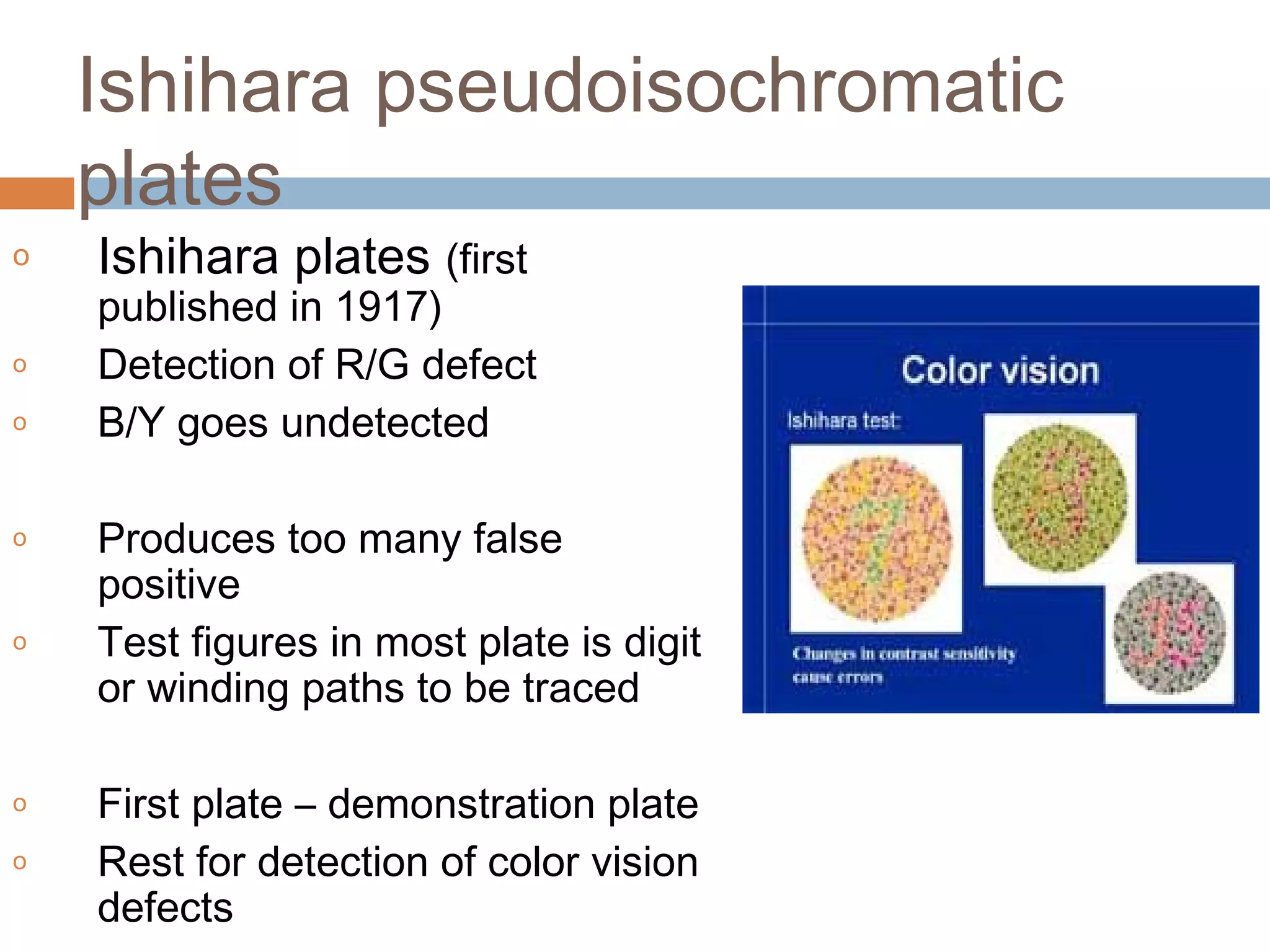
Ishihara pseudoisochromatic
plates
o Ishihara plates (first
published in 1917)
o Detection of R/G defect
o B/Y goes undetected
o Produces too many false
positive
o Test figures in most plate is digit
or winding paths to be traced
o First plate – demonstration plate
o Rest for detection of color vision
defects
Currently available editions are-
38,24 and 16 plate version
Ideal for screening
Ishihara pseudoisochromatic plates
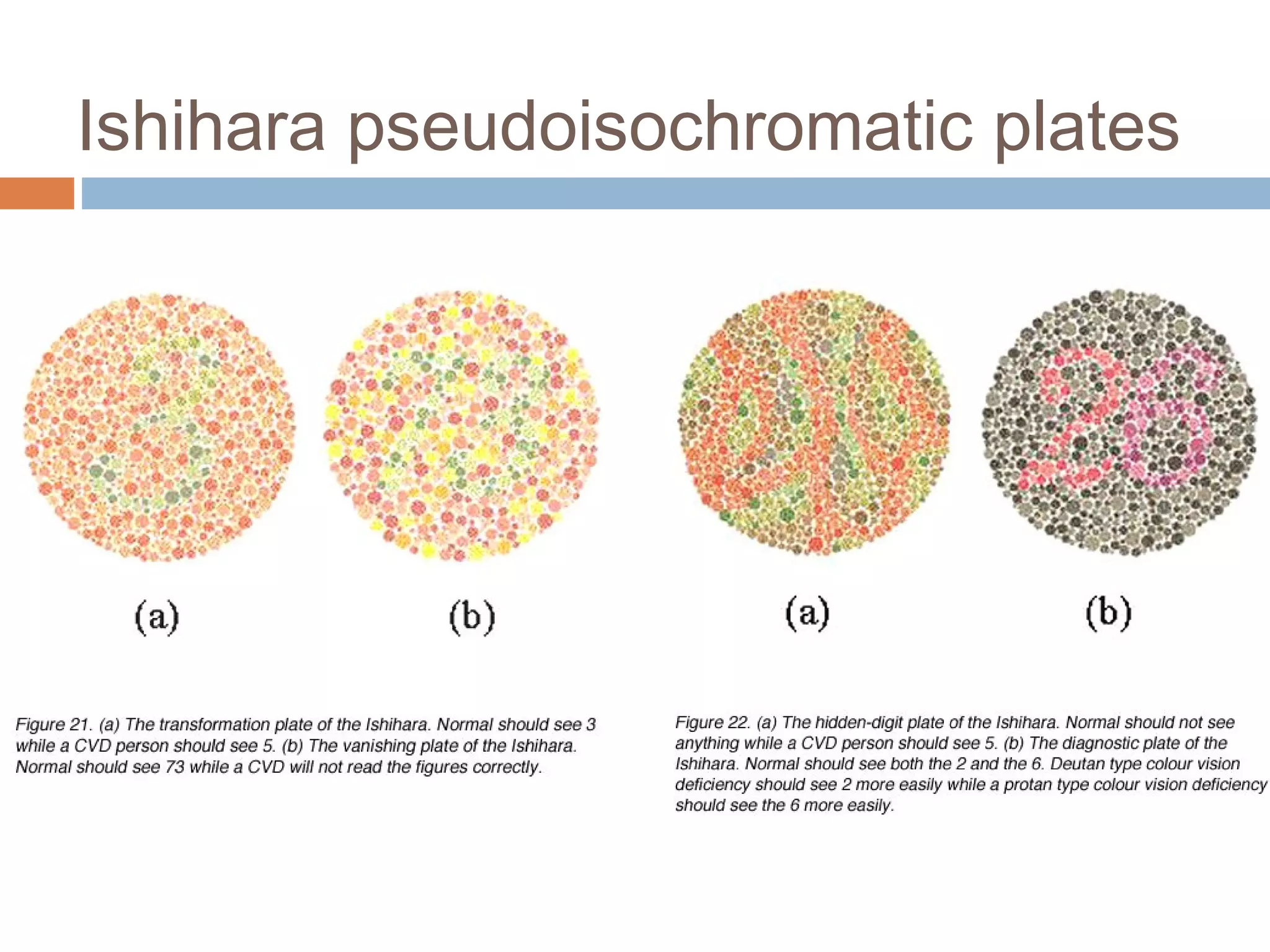
 Pseudoisochromatic plates are designed in four ways:
1. Transformation plates: person with normal CV
sees one figure and a CVD person sees another(figure
21a).
2. Vanishing plates: person with normal CV see the
figure while a CVD person will not (figure 21b).
3. Hidden-digit plates: person with normal CV does
not see a figure while a CVD will see the figure (figure
22a).
4. Diagnostic plates: designed to be seen by normal
Testing guidelines
VA > 6/60
Illumination = 500-600 lux
Testing distance= 75 -100 cm
 Observation time = 3 to5 secs per plate ( 10
secs for winding paths)
 Monocularly to the right eye then to the left eye
Interpretation
Count the no. of plates misread
Exclude the demonstration plate from this
total
More than the indicated no. of errors - presence of
protan/deuteran defect
38 Plate edition= 4 or less – normal
= 8 or more –deficient
24 Plate edition = 2 or less –normal
= 6 or more –deficient
16 Plate edition = 2 or less – normal
= 4 or more deficient
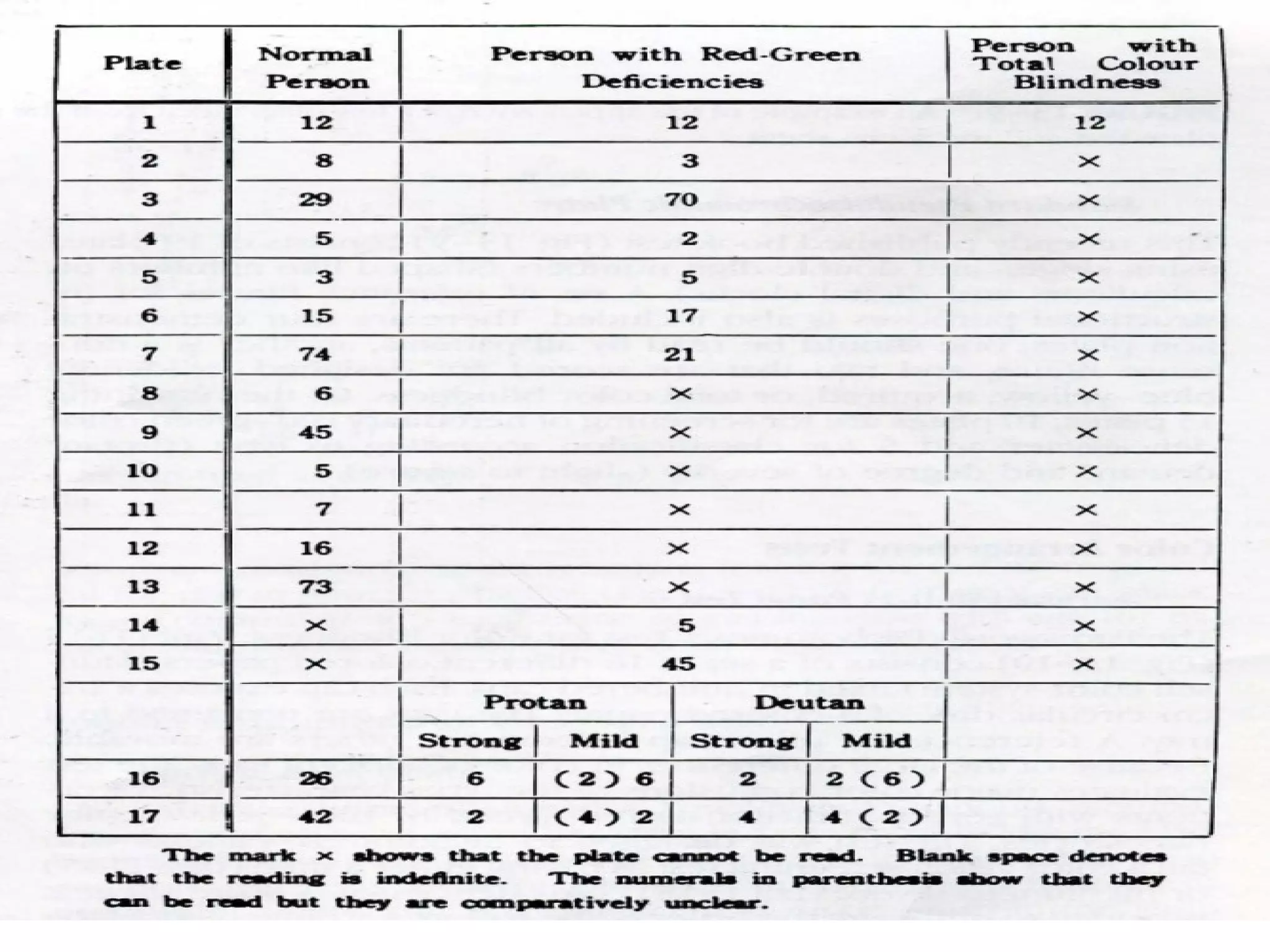
The no. of errors isn’t reliable estimate of the
severity of any color vision defect.
Ishihara pseudoisochromatic plates
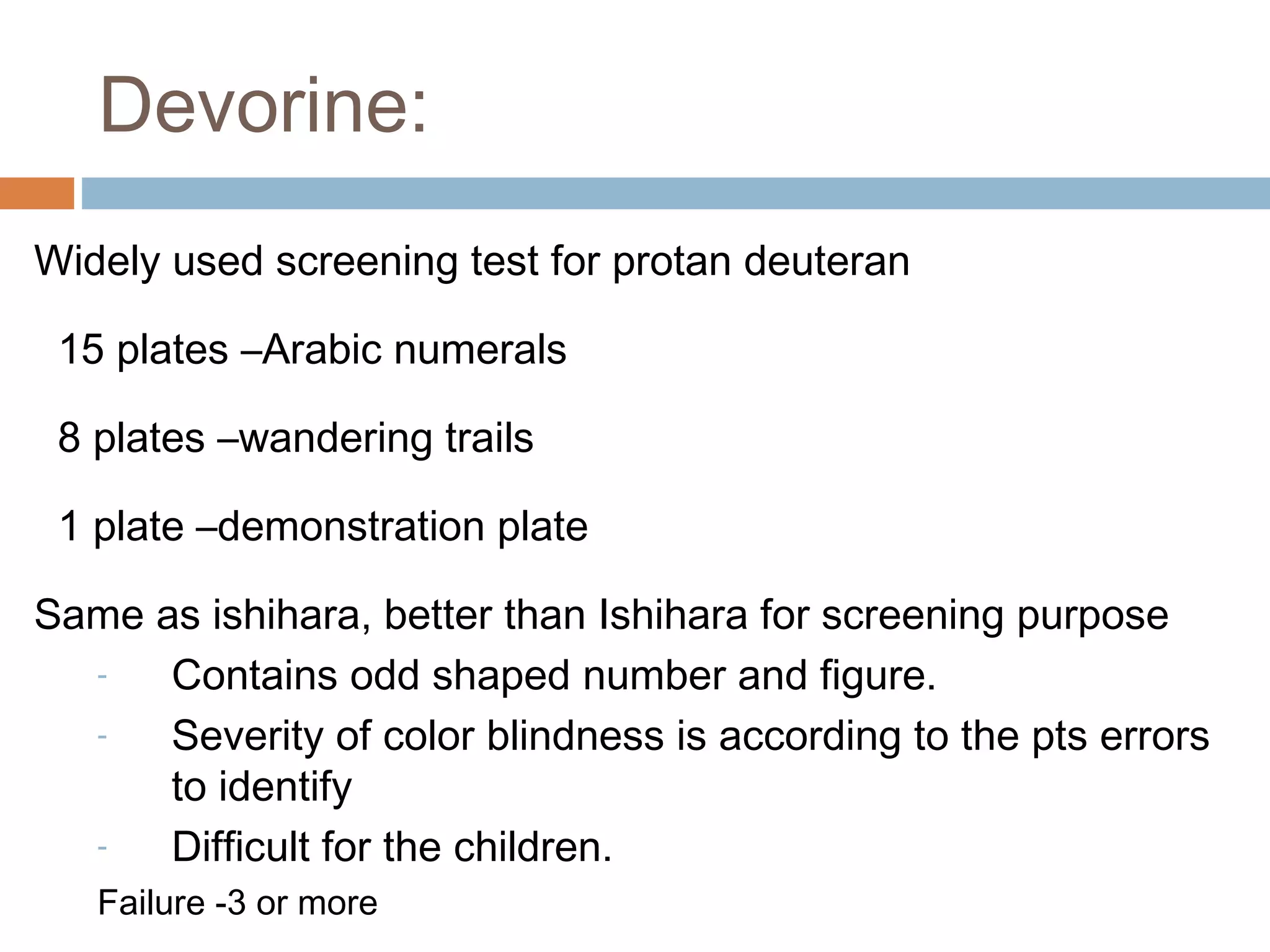
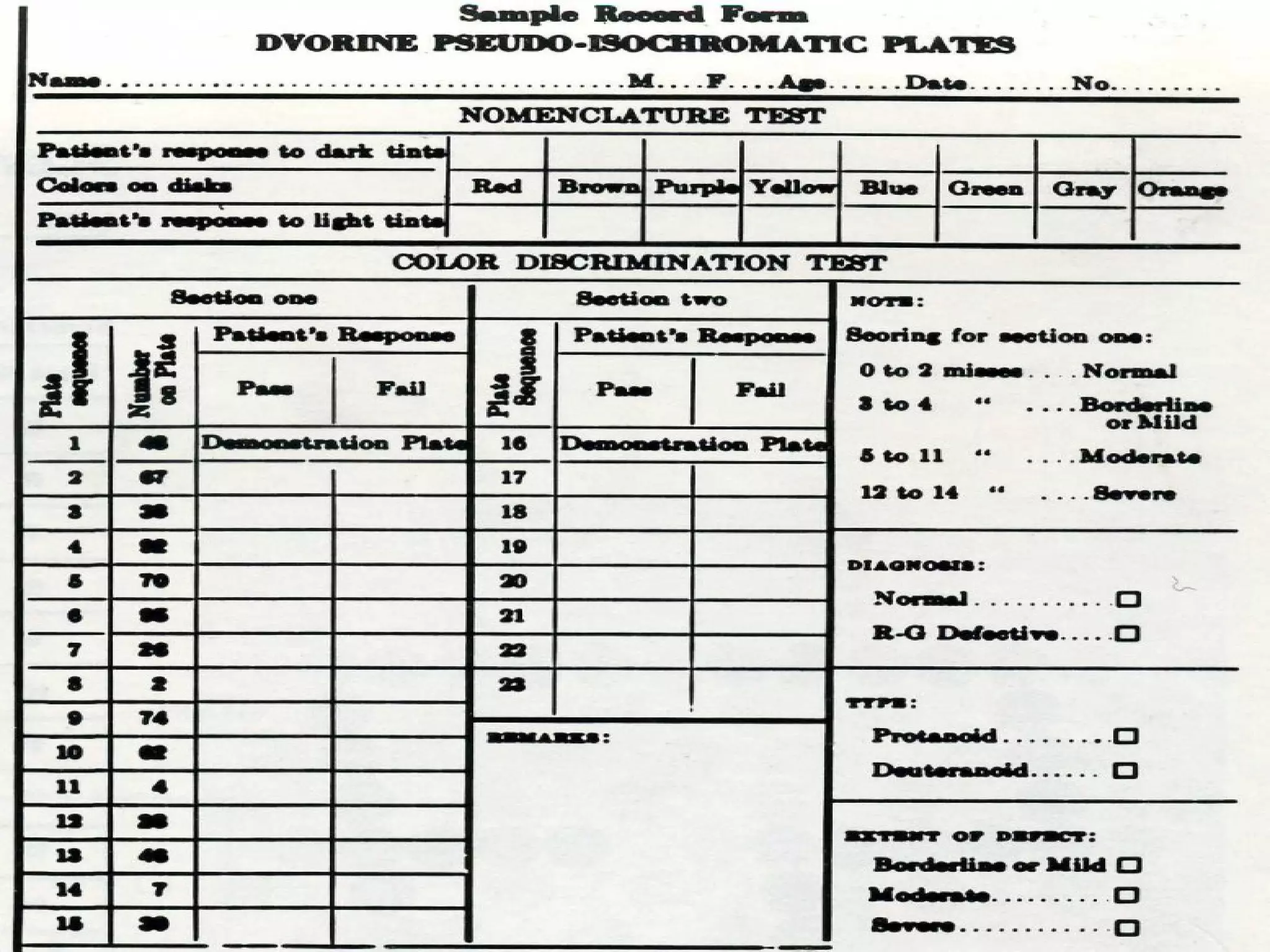
Widely used screening test for protan deuteran
15 plates –Arabic numerals
8 plates –wandering trails
1 plate –demonstration plate
Same as ishihara, better than Ishihara for screening purpose
- Contains odd shaped number and figure.
- Severity of color blindness is according to the pts errors
to identify
- Difficult for the children.
Failure -3 or more
Devorine:
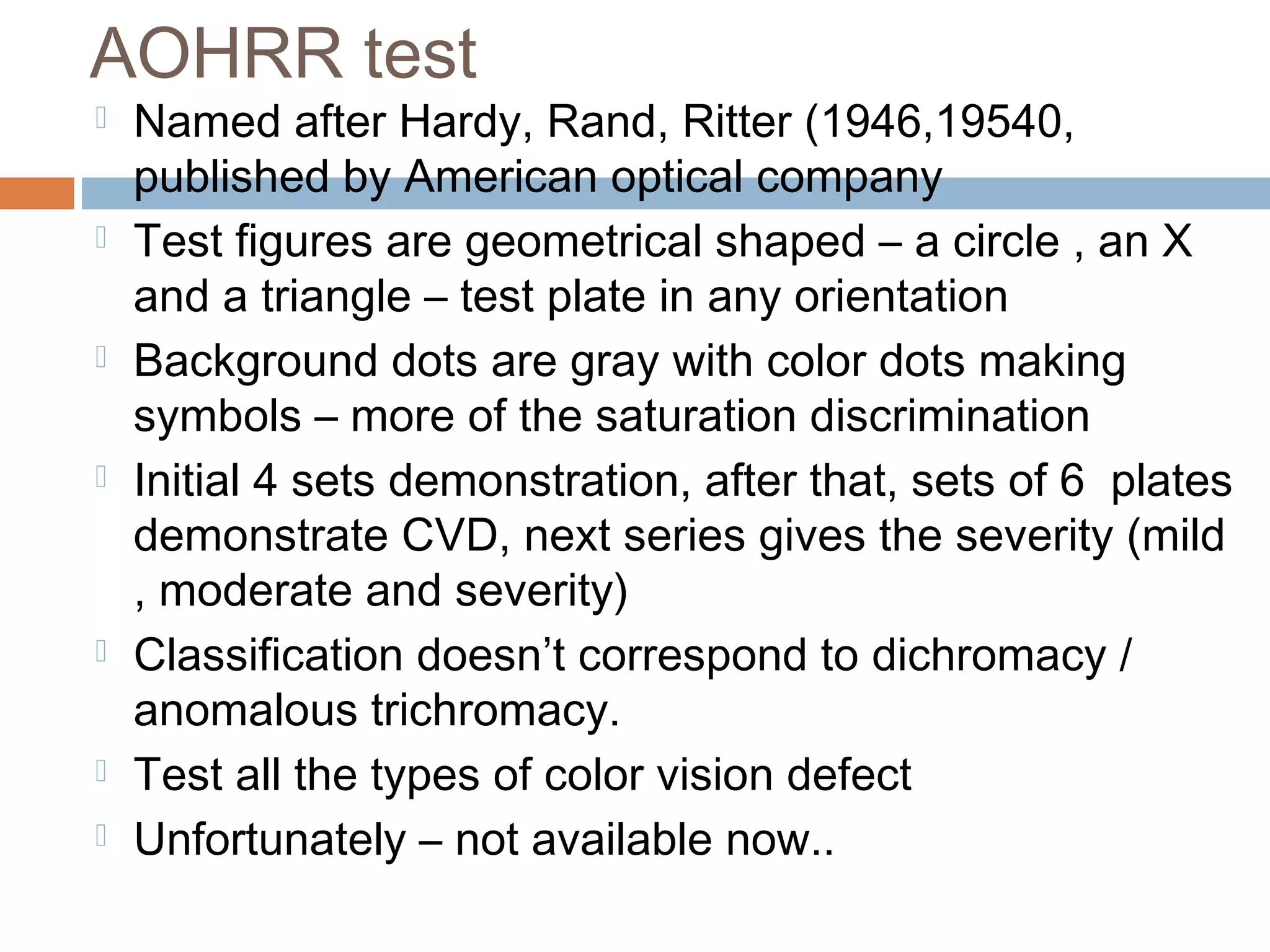
AOHRR test
 Named after Hardy, Rand, Ritter (1946,19540,
published by American optical company
 Test figures are geometrical shaped – a circle , an X
and a triangle – test plate in any orientation
 Background dots are gray with color dots making
symbols – more of the saturation discrimination
 Initial 4 sets demonstration, after that, sets of 6 plates
demonstrate CVD, next series gives the severity (mild
, moderate and severity)
 Classification doesn’t correspond to dichromacy /
anomalous trichromacy.
 Test all the types of color vision defect
 Unfortunately – not available now..
 Hue discrimination tests
 qualitative test of hue discrimination
 permits diagnosis of the type and the degree of color
vision defect
 Not able to distinguish between dichromats and
anomalous trichromats
 consist up of color caps of different hue – to be
arranged in serial order of hue
Color vision assessing tests
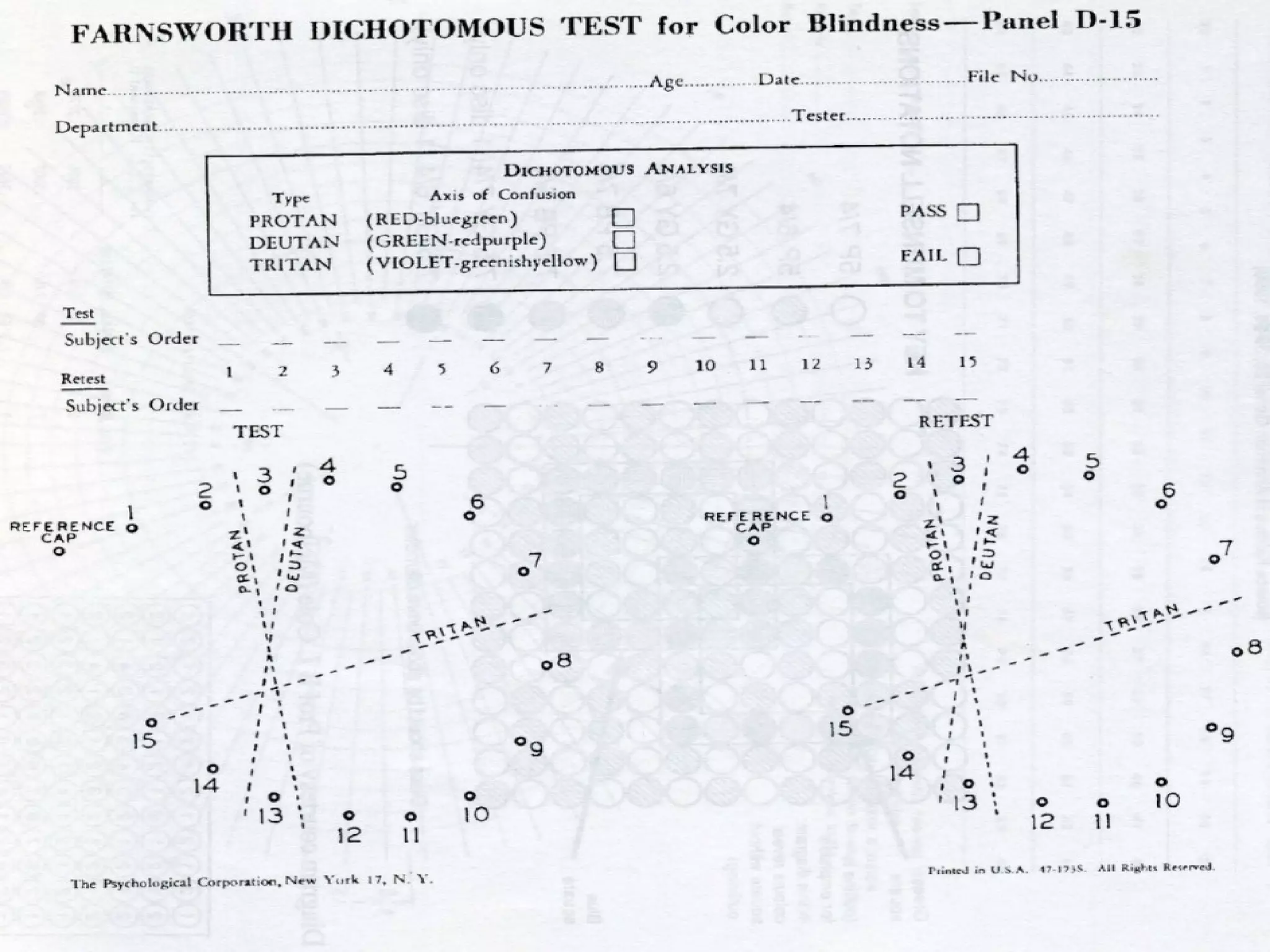
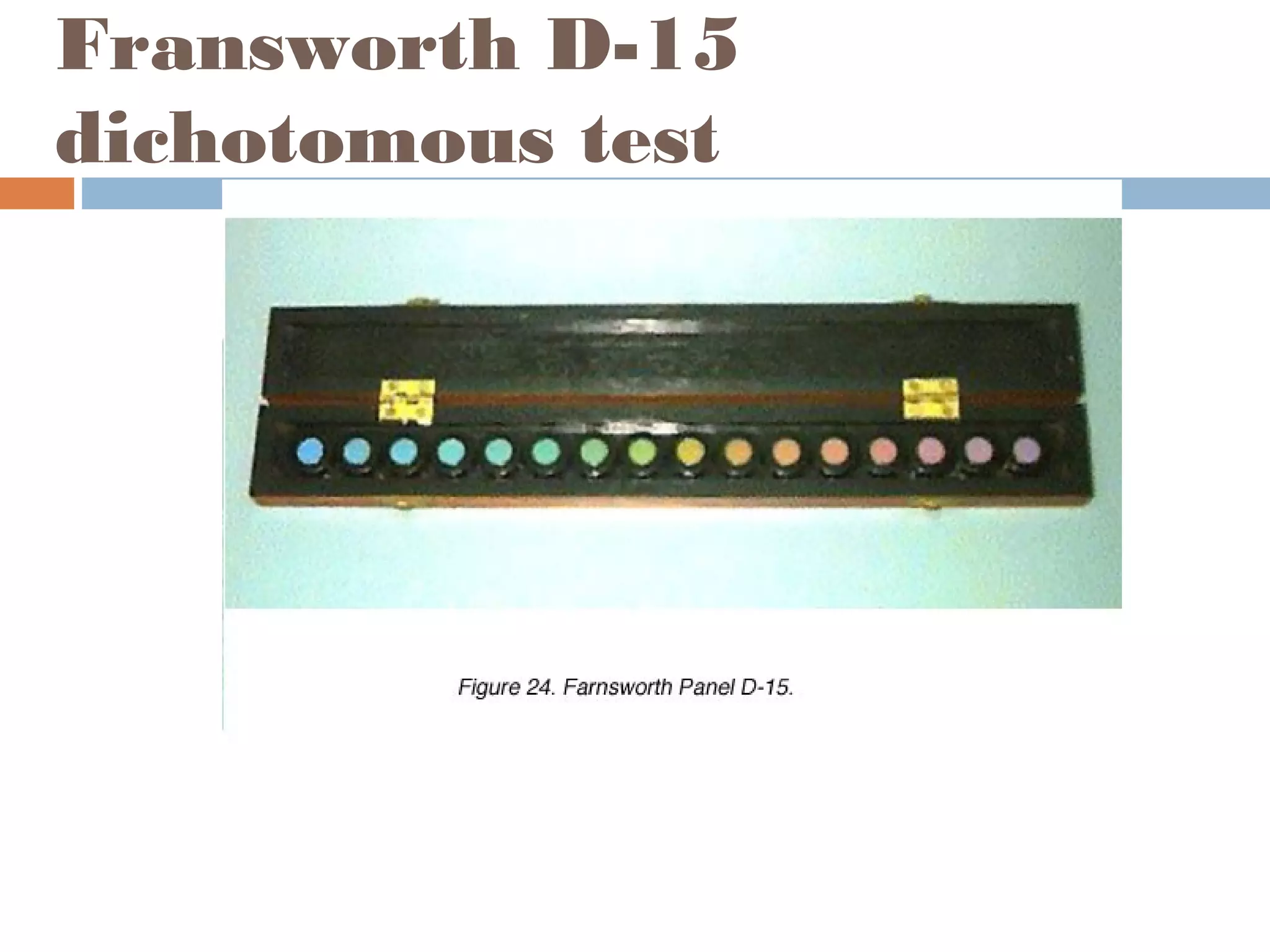
Fransworth D-15
dichotomous test
 This test
 consist up of 15 color caps in order of hue, one
being reference cap
 only diagnose severely color defectives but mild
defect goes undetected
 useful in fast screening for severe defect
 Time – usually takes 2 mins ?? Test dist- 50cm
 Error in making arrangement of caps is plot in
circular polar graph and interpreted
Fransworth D-15
dichotomous test
Fransworth D-15
dichotomous test
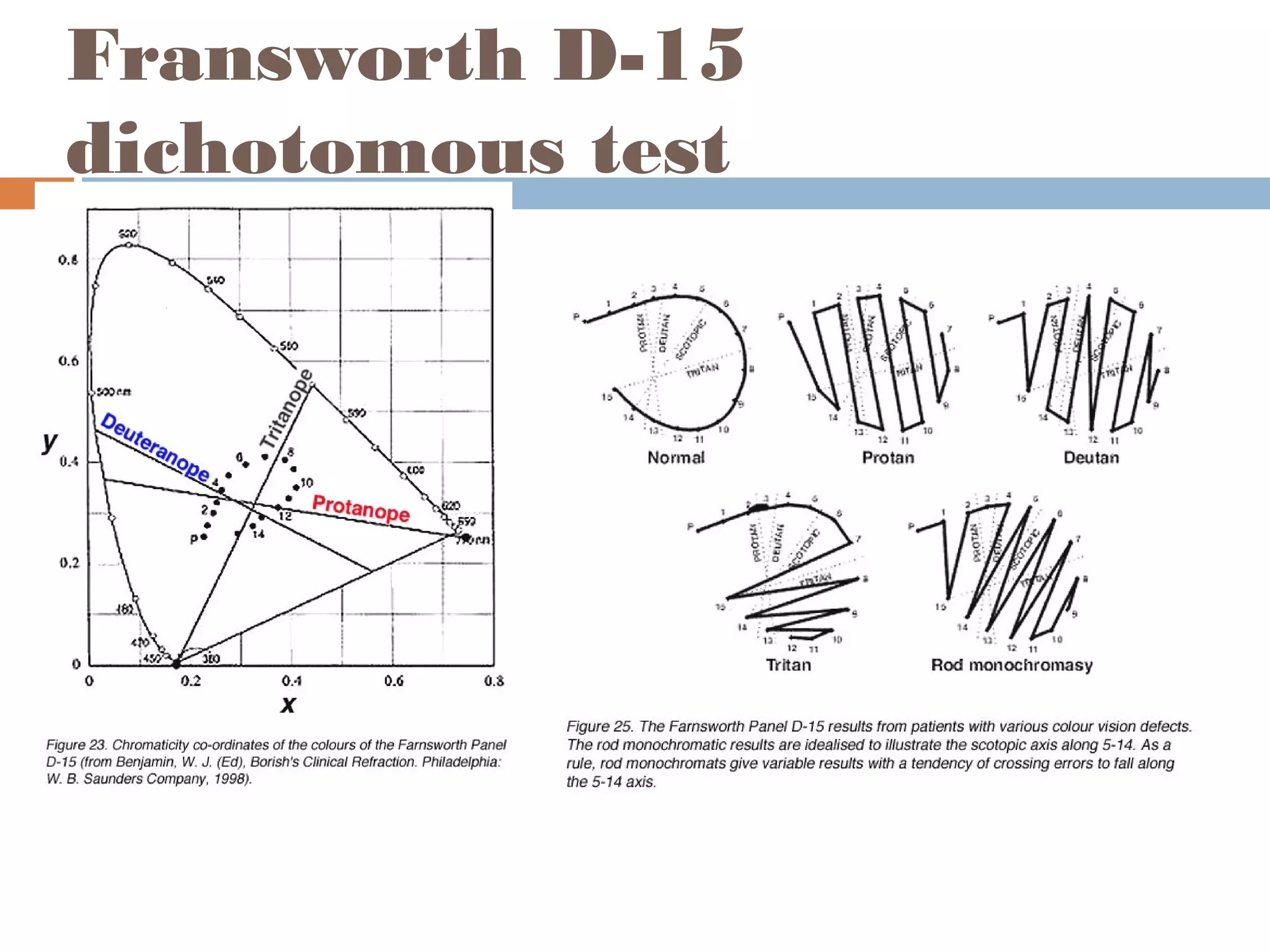
 Interpretation
 Two or few crossings – not severe CVD as
established by Ishihara
 More than two crossings- severe and lies on
certain confusion line
 Monochromats expected to fail
 Confusion line lie b/w deutan & tritan axes
Fransworth D-15
dichotomous test
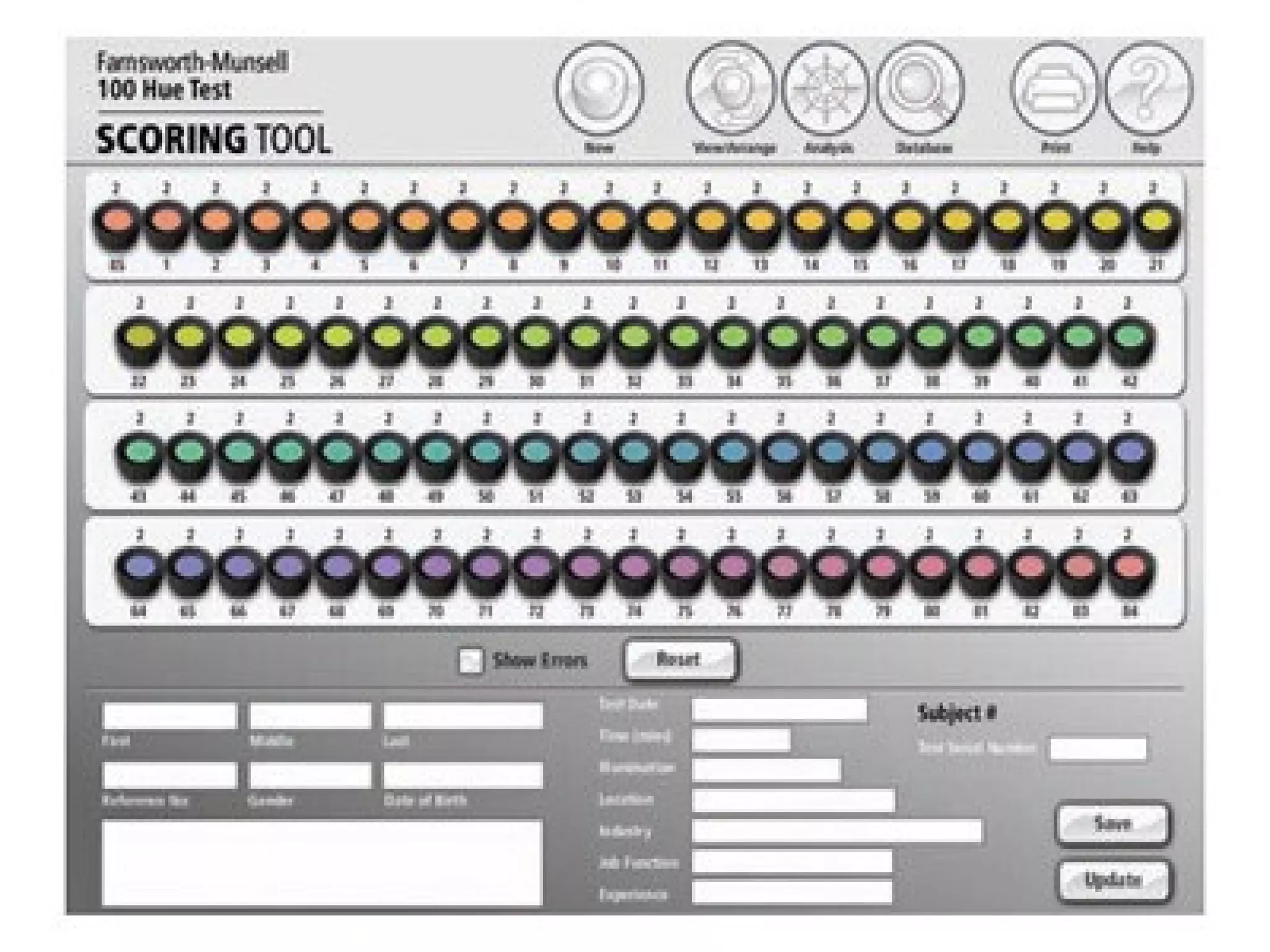
 This test
 An expanded version of Panel D-15 test.
 consist up of 85 caps, divided approximately equally in
four boxes
 Need to arrange the color caps in order of hue
discrimination b/w fixed reference caps
 Required 20-25 minutes to complete – not good for
screening purpose (ideal 2-3 mins for one box)
 Patient has to arrange the samples into serial order.
Fransworth Munsell 100 hue
test
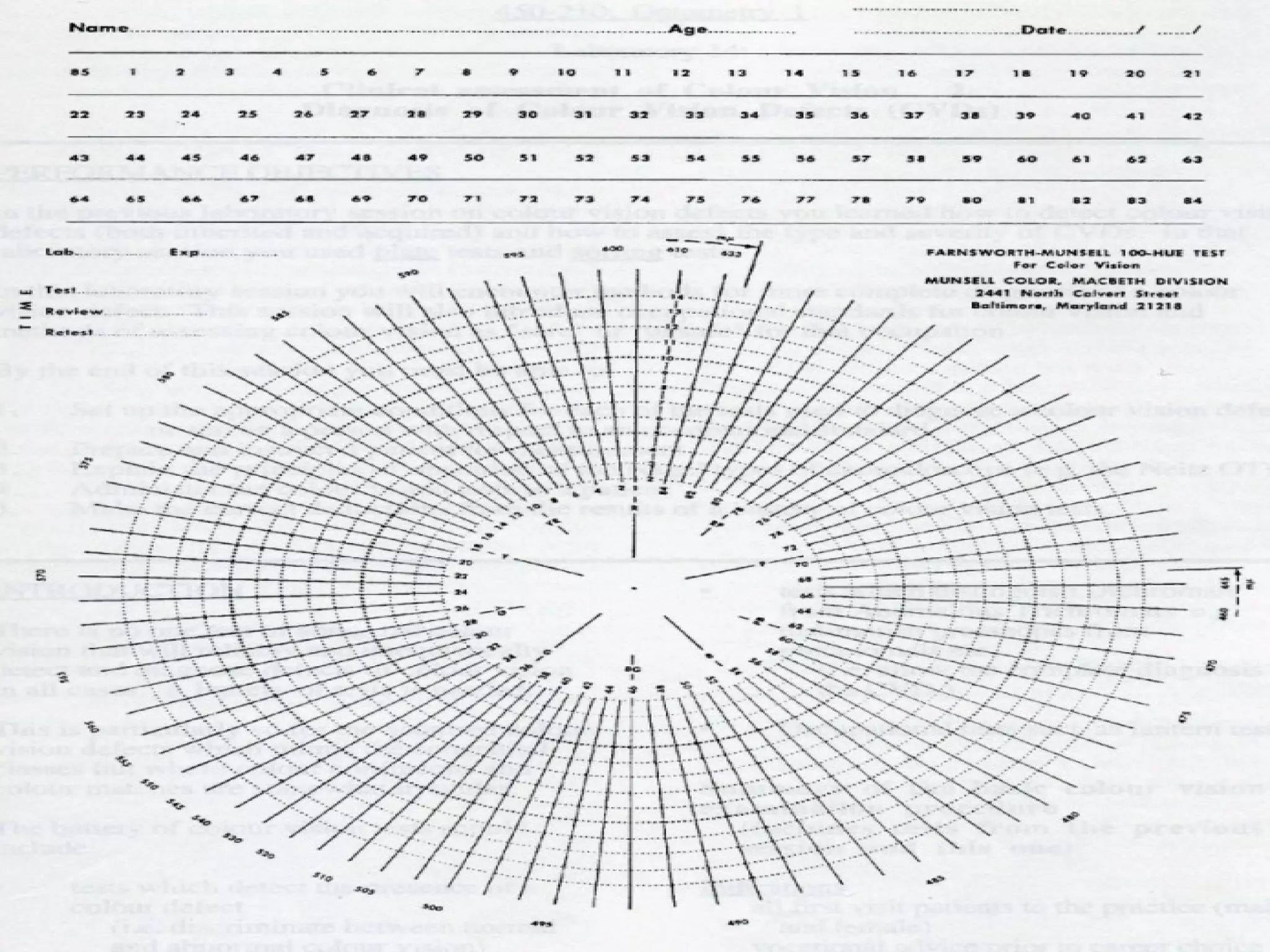
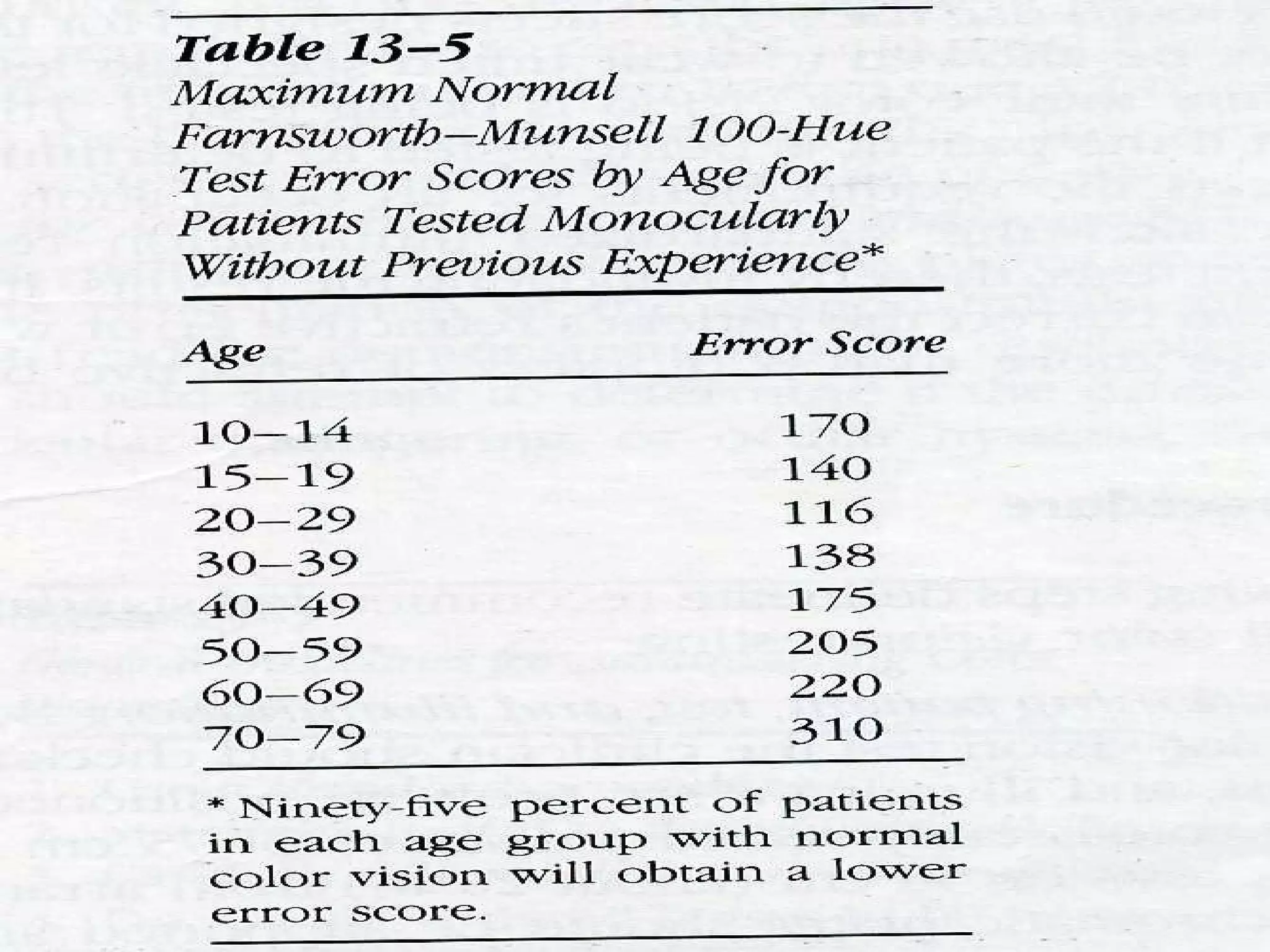
Recording & scorings
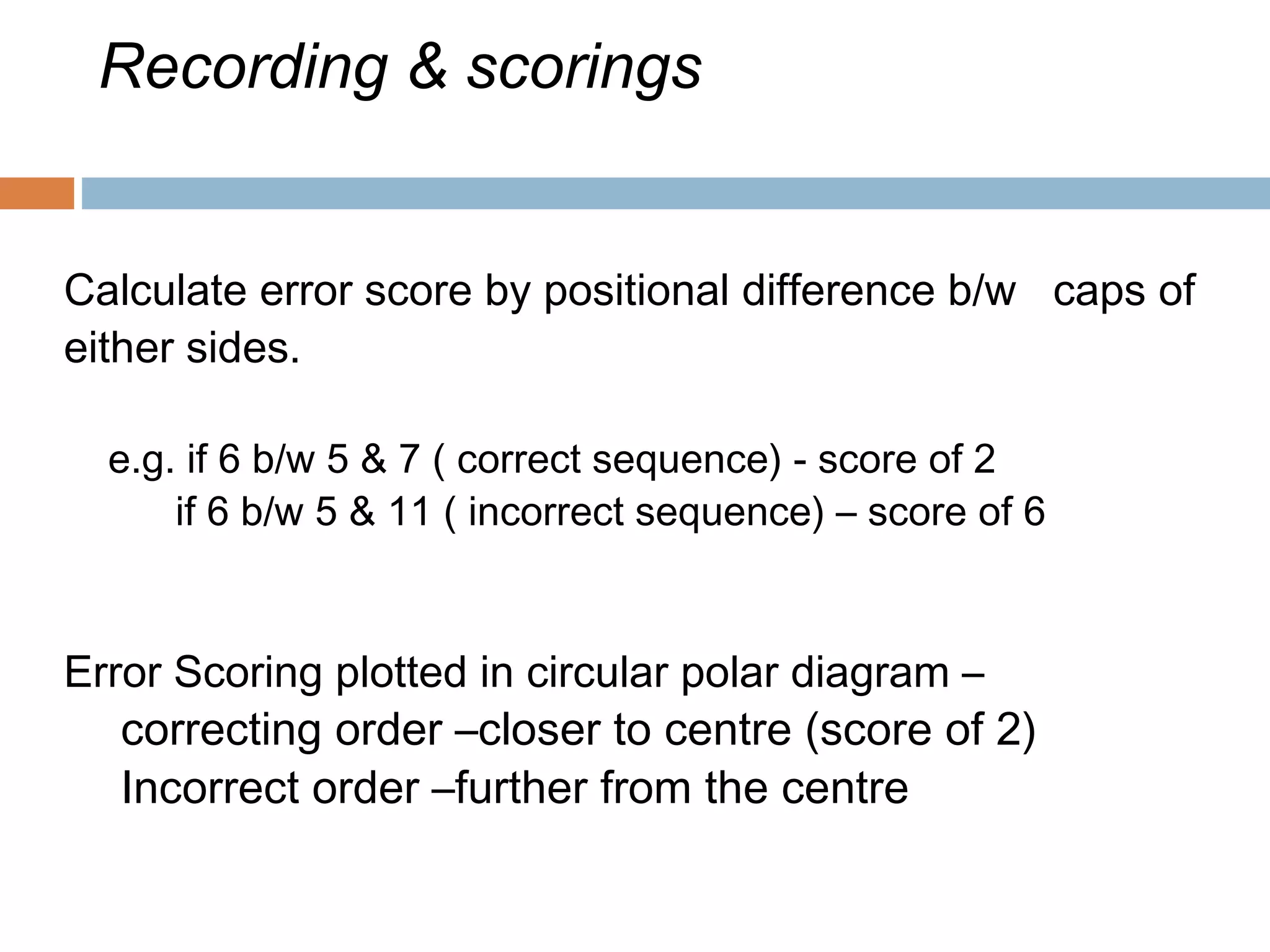
Calculate error score by positional difference b/w caps of
either sides.
e.g. if 6 b/w 5 & 7 ( correct sequence) - score of 2
if 6 b/w 5 & 11 ( incorrect sequence) – score of 6
Error Scoring plotted in circular polar diagram –
correcting order –closer to centre (score of 2)
Incorrect order –further from the centre
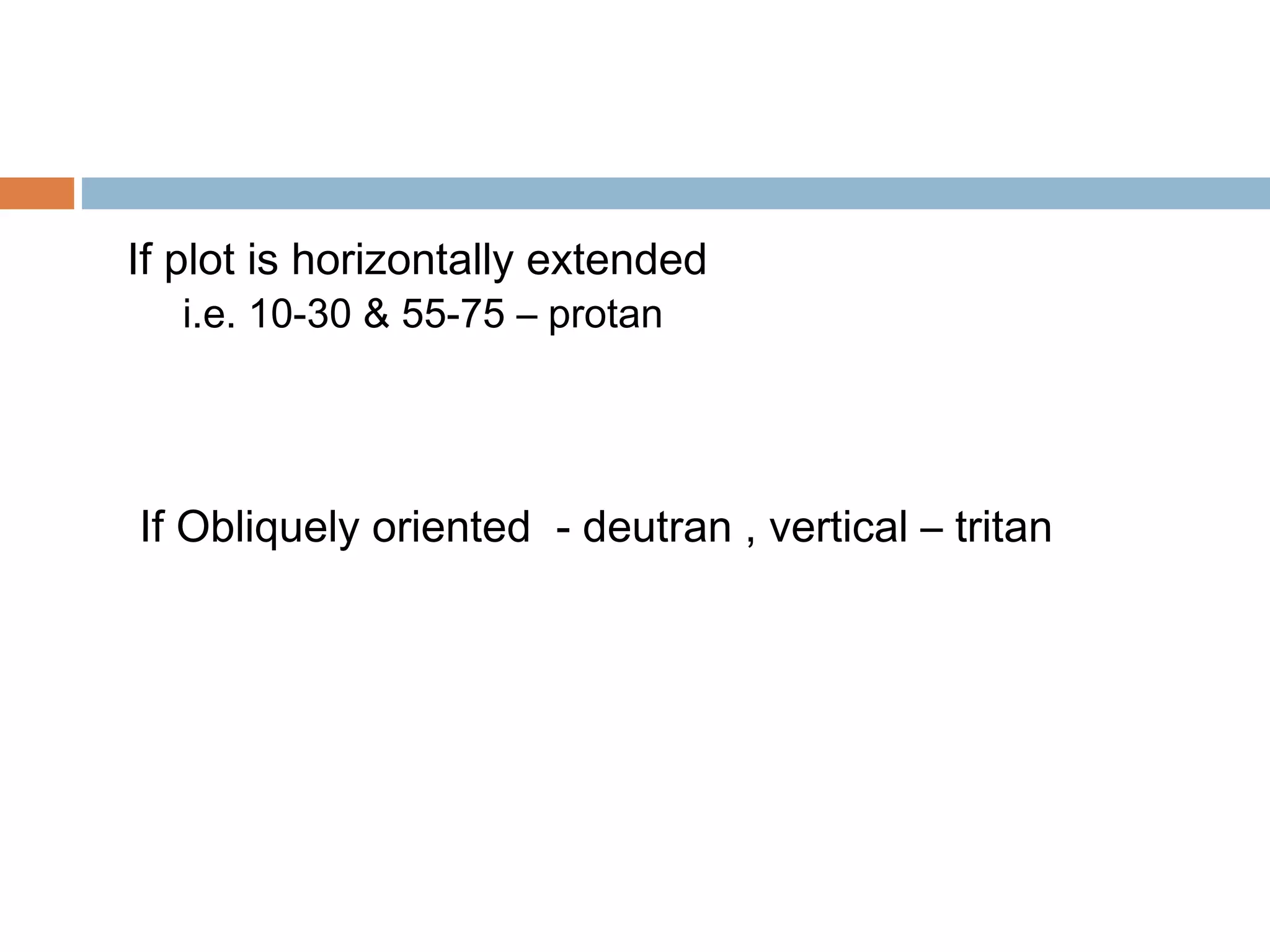
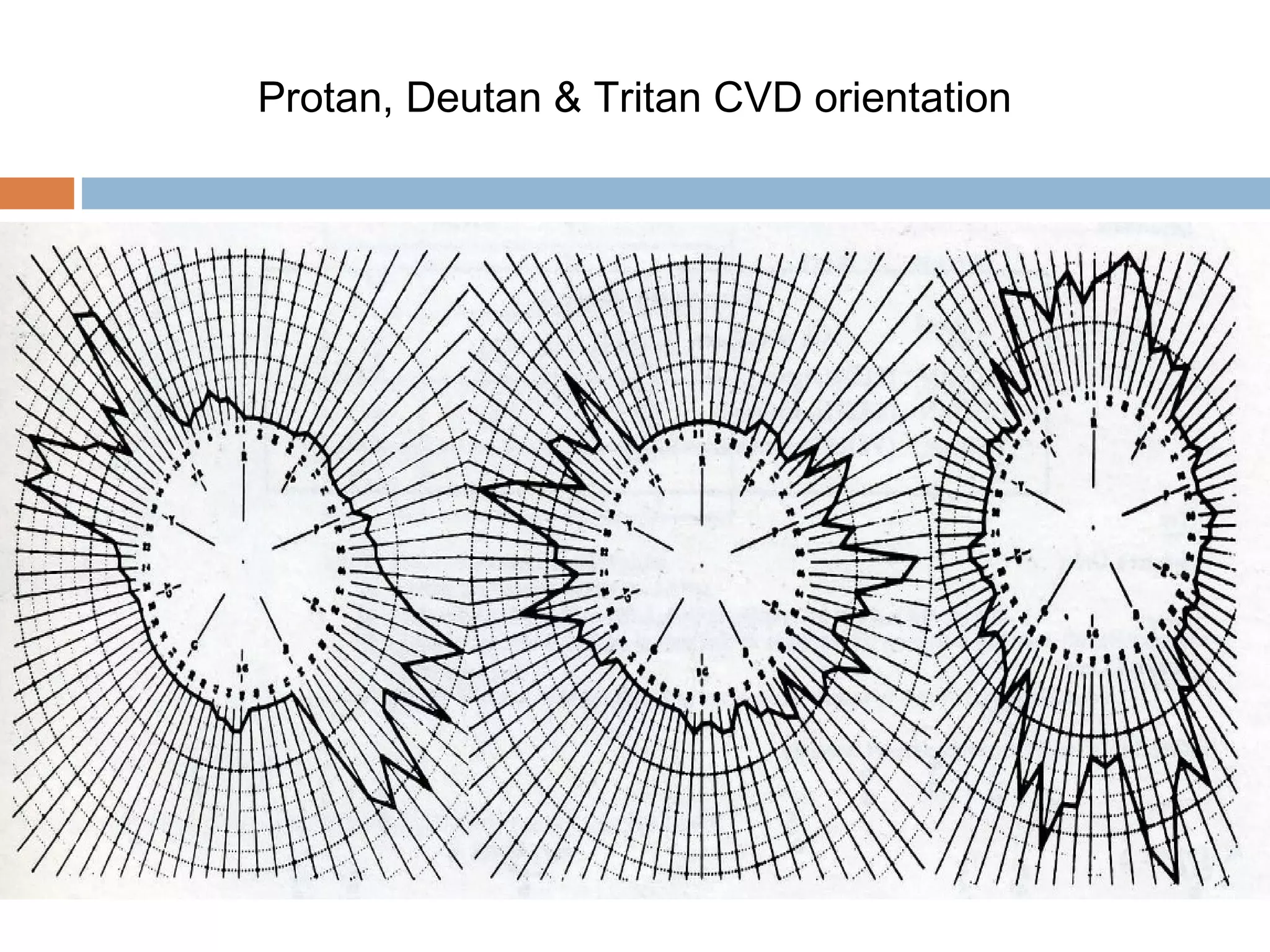
If plot is horizontally extended
i.e. 10-30 & 55-75 – protan
If Obliquely oriented - deutran , vertical – tritan
Protan, Deutan & Tritan CVD orientation
L’Anthony’s Desaturated D-15 test
Similar number of caps as that of D-15
Tested after passing D-15
 to classify type and assess severity ( in mild CVD )
Tested after Ishihara- to detect acquired tritan defects
Also to monitor & assess the progression of
acquired defect.
City University Color Vision Test
Administered after a fail on Ishihara.
Aim to classify severe CVD into either types.
Used as an alternate to D-15
Test based on D-15.
Not suitable for screening.
Need illuminant of 600 lux to 900 lux
Ask to match 4 outside spots of color to the
middle spot.
Interpretation
Response for the types recorded in ratios separately
e.g. 4 normal response & 6 deutan response -> record
as 6/10 Deutan
6/10 medium deutan defect
10/10 Deutan score sever Deutan defect
Score doesn’t distinguish b/w dichromats &
anomalous trichromats.
 Instruments designed to examine color matching
behavior.
 most effective for the classification of R/G defect
 very much expensive
 pt mix the monochromatic R & G color in a proportion
to match given yellow color discs.
 Judgment defect made for relative amount of R&G
color used
 to match given yellow is taken under consideration
to classify the color vision defect.
Anomaloscope
Anomaloscope
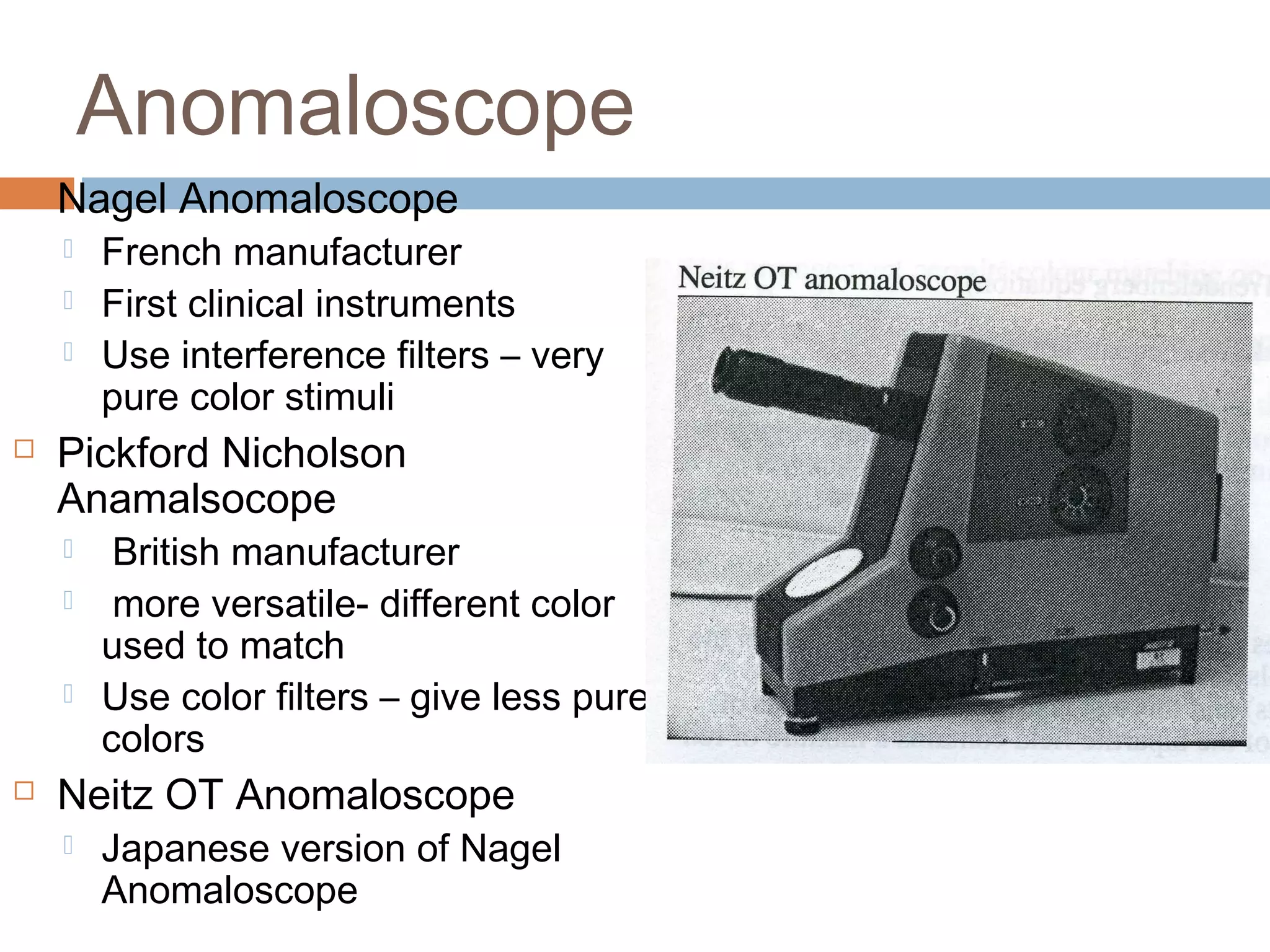
 Nagel Anomaloscope
 French manufacturer
 First clinical instruments
 Use interference filters – very
pure color stimuli
 Pickford Nicholson
Anamalsocope
 British manufacturer
 more versatile- different color
used to match
 Use color filters – give less pure
colors
 Neitz OT Anomaloscope
 Japanese version of Nagel
Anomaloscope
Color naming and color sorting
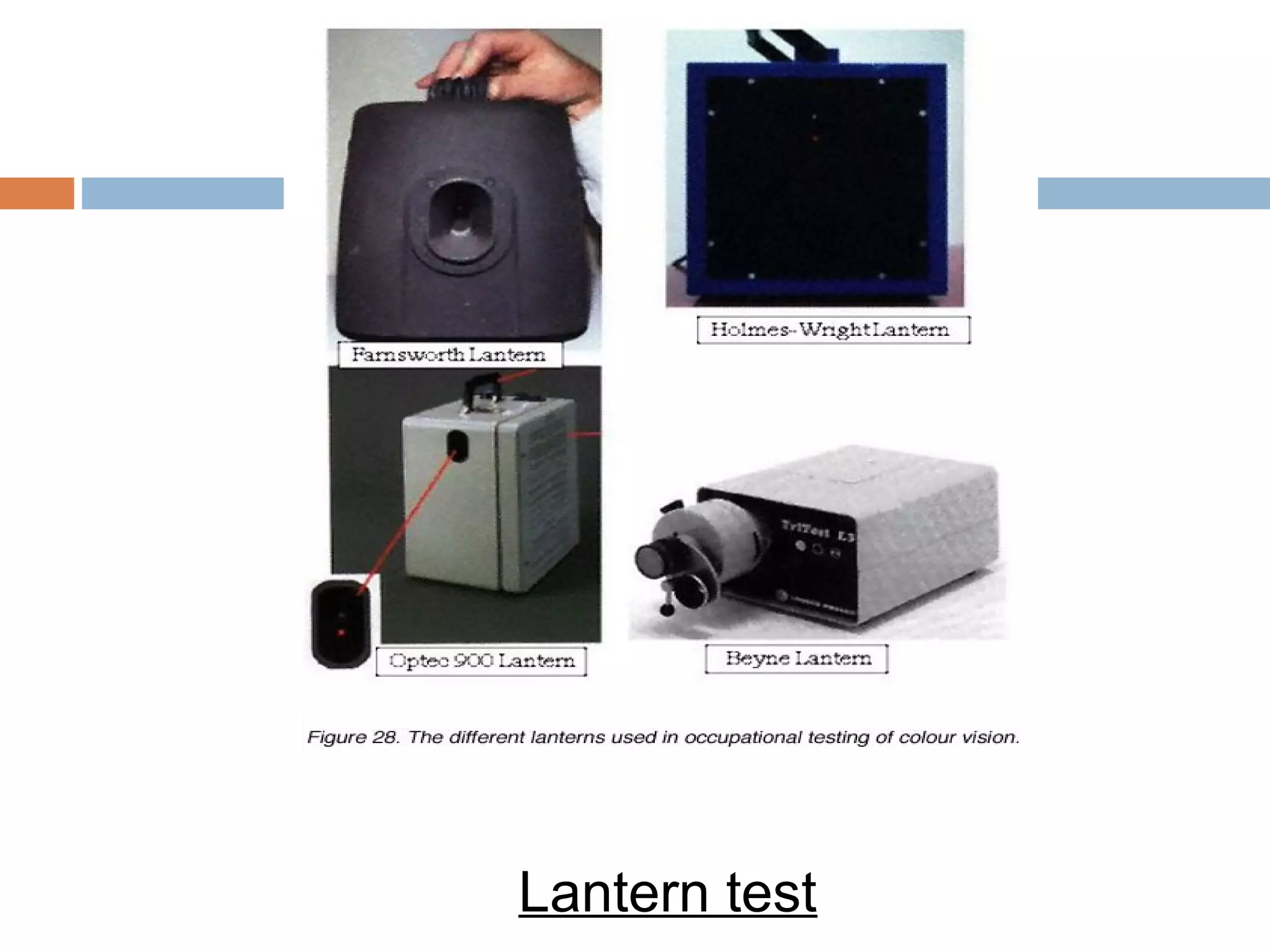
 Lantern test
 Subject is asked to identify the color of a signal light in
lantern.
 Hue ,brightness, saturation & size of the test light can be
altered by filters and apertures.
 Judgment of color vision defect is made by the mistakes
 Not popular test.
 The Eldridge-Green color perception lantern test,
 The Giles- Archer Color Perception Unit,
 Farnsworth Lantern.
 Homes Wright Lantern
 Type A – for aviation standards
 Type B – for marine standards
Lantern test
o Holmgren Wools test- the oldest color sorting
test
o Relay on brightness difference than on the hue.
o Not effective for diagnostic purpose
o Test require the subject to select from the pile
of colored yarns those which resembles a
“standard skin”
o Unreliable as dyes are not standardized
o Yarns fade & become dirty with handling in a
short time.
Yarn test
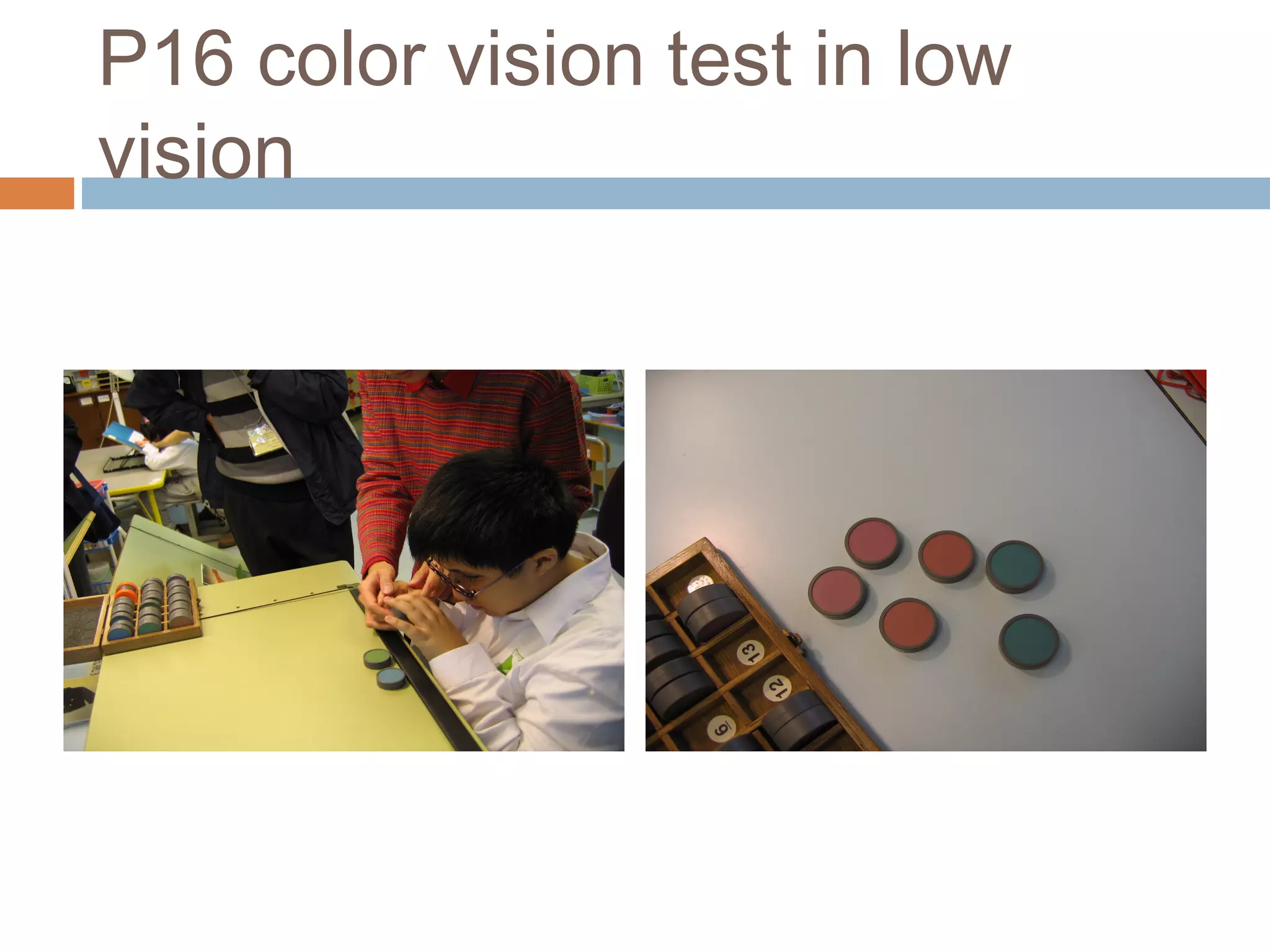
P16 color vision test in low
vision
Recommended sequence of CV tests
1. Ishihara pseudoisochroimatic tests
 To determine presence/absence of protan/deutan CVD
of any severity
 no further tests required, if passed
1. L’ Anthony desaturated D-15
 To determine the presence of a tritan defect
Or Farnsworth F2 plate
 Done after ishihara (No R-G defect) passed to
determine presence of tritan defect
Recommended sequence of CV
tests
3. Medmont C100 0r OSCAR color vision
tests
 To differentiate b/w protan & deutan (no severity
explained)
4. Farnsworth panel D-15
 To determine classification of the more CVDs
 Used in absence of F2 to determine presence of
more sever tritan
 Other tests as required
Recommended sequence of CV
tests
 For complete diagnosis & measurement of
severity
1. Farnsworth Munsell 100 Hue test
 Useful in detection,classification and severity of
CVDs
1. Anomaloscope
 Instrumetnts – Nagel, Neitz OT or Pickford
Nicholson
 Supply a complete diagnosis of R-G defects
THANK YOU!!!!

Color vision physiology, defects and different testing Procedures

  • 1.
    COLOUR VISION AND PHYSIOLOGICALPROCESSES Raju Kaiti, M. Optometry Consultant Optometrist Nepal Eye Hospital (NEH)Nepal Eye Hospital (NEH)
  • 2.
    ObjECtIVES  To definecolor and color vision  To define color vision types  To understand the theory behind the color vision  To learn different types of color vision defects  To learn different types of color vision testing procedures
  • 3.
    WHAt IS COLOR??? Color is that what one perceive due to the property of different wavelengths.  An aspect of visual perception, characterized by the attributes of hue ,brightness and saturation and resulting from stimulation of the retina by visible photopic light levels.
  • 4.
     There isno one to one relationship between wavelength and color.  Depends on number of parameters  Wavelength or band of wavelengths coming from the object  Wavelengths coming from other objects in the field of view  Wavelength that the observer was looking at before he looked at the object
  • 5.
    INtRODUCtION  Colour vision Perception of Colour induced by different wavelength of visible spectrum  Only present in daylight (photopic vision)  Function of Cones  Absent at scotopic vision
  • 6.
    COLOR PERCEPtION  Cone cellsin the human eye  Trichomatic color vision  Opponent mechanisms Cone typeCone type NameName RangeRange Peak sensitivityPeak sensitivity SShorthort wavelengthswavelengths of lightof light β (Blue)β (Blue) 400-400-500 nm500 nm 440 nm440 nm MMediumedium γ (Green)γ (Green) 450-630 nm450-630 nm 544 nm544 nm LLongong ρ (Red)ρ (Red) 500-700 nm500-700 nm 580 nm580 nm
  • 7.
  • 8.
    COLOR PERCEPtION  Total conepopulation  64% red cones  32% green cones and  4% blue cones.  Each type is most sensitive to a specific portion of the visual spectrum.
  • 9.
    COLOR VISION  isthe result of Nature of the physical world, The physiological response of the eye (more strictly the retina) to light The neural processing of the retinal response by the brain
  • 10.
     The humanvisual system can detect the range of light spectrum from about 400 nm (violet)- 700 nm (red).  Our visual system perceives this range of light wave frequencies as a smoothly varying rainbow of colors.  We call this range of light frequencies visual spectrum. COLOR VISION
  • 13.
    CONCEPtS Of COLORVISION  All color experienced by three psychological impressions 1) Hue  Strongest effect on color  Major determination of principle colors (RYGB)  Function of wavelength  200 varieties
  • 14.
    2. SAtURAtION: • Reflectshow much a hue has been diluted by grayness (intensity of purity of Hue) • At short and long wavelength,20 distinguishable steps of saturation for each hue • In middle spectral, 6 distinguishable steps of saturation • The more the white ,the less is the saturation and looks faded and wasted. • 100% saturated means there is no addition of gray to the hue (100% Pure)
  • 15.
     The relativedegree of black or white mixed with give hue  Sensation shared with achromatic visual systems  Have 500 distinguishable steps of brightness for every hue and grade of saturation 3. Brightness
  • 17.
    tHEORIES Of COLORVISION  Trichromatic theory  Opponent colors theory  Zone theory
  • 18.
    tRICHROmAtIC tHEORY  Operatesat the receptor level  Postulated by young and proposed after color matching experiment by Helmholtz  Known as Young Helmholtz Maxwell theory  Based on 3 classes of cones receptors sub serving color vision “color match in the visible spectrum possible by appropriate mixing of three primary colors”
  • 19.
    3 CLASSES OfCONES  1st class  SWS,4%  Blue cones  Most sensitive to blue violet wavelength around 435nm  2nd class  MWS,32%  Green cones  Most sensitive to blue violet wavelength around 530nm
  • 20.
     3rd class  LWS,64% Red cones  Most sensitive to greenish-yellow wavelength around 565nm
  • 21.
     The mostdirect evidence of presence of three classes of cones is given by microspectrophotometry.  “They are overlapped so no individual class of cones can be stimulated in isolation by any one wavelength”  Three classes of cones in human retina are with different but overlapping sensitivities.
  • 22.
     Each moleculeof cone photo pigment consists of chromophore and opsin.  The chromophore, which is identical for all cone photo pigments, is retinal(an aldehyde of vitamin A).  Light quanta are absorbed by the chromophore initiating the series of events leading to vision.  It is the opsin, virtually inert chain of amino acids that determines the absorption characteristics of the photo pigment molecules.
  • 23.
     Each classof cones has a different opsin. The genes for the photo pigment of M and L cones are situated on the X- chromosome.  So, CV deficiencies in which either the M or L cone is missing are inherited in sex-linked manner.  The gene for S cone photo pigment is on chromosome 7 and for rhodopsin is found on chromosome 3.
  • 24.
     MICROSPECTROPHOTOMETRY  Technicallydifficult procedure.  Retinal tissue is back illuminated with monochromatic light .  Light is directed towards a single cone.  Difference between amount of light incident and transmitted through cone is determined.  Repeated across the spectrum to obtain a cone absorption spectrum.
  • 25.
    WHY ROD CELLSNOt CONtRIbUtE tO COLOR VISION???  CV occur at photopic condition ,rhodopsin pigments saturate at lower luminosities(rod cells are more sensitive )  Temporal phase difference b/w rod and cone system-75-100ms lag of rod in dark-adapted state  However, interaction between rod-cone systems is indicated in dichromats for CV processing
  • 26.
     Cones- fundamentalunits of visual information, not the photo pigments  The idea that our perception of millions of colors depends on just three distinct color receptors is called the trichromatic theory of color vision
  • 27.
    OPPONENt COLORS tHEORY Ewald Hering(1878).  Contradicts the Young –Helmholtz trichromatic theory.  Explains four physiological color primaries, R, G, Y, B  Explains the phenomena of after-image (Y-B)  An additive mixture of red and green light gives yellow, not a reddish green.
  • 28.
    OPPONENt COLORS tHEORY This opponent process creates  the four unique hues red, green, yellow and blue.  The brightness or lightness of a color is determined by the luminosity channel i.e. pair of black-white.  These six fundamental color sensations can combine to give any visible colors.
  • 29.
     Proposes thatcolor is processed by bipolar hue channels.  By bipolar we mean that at any instant, each channel can signal only one of the two attributes it is capable of coding .  After-image: visual sensation persisting after the original stimulus has been removed.  Formation of after-image is still obscure, but no doubt in retinal origin.
  • 30.
    ExPLANAtION Of COLORAftERImAGES bY tHE OPPONENt PROCESS tHEORY..  When one member of the color pair is "fatigued" by extended inspection, inhibition of its corresponding pair member is reduced.  This increases the relative activity level of the unfatigued pair member and results in its color being perceived.
  • 32.
    OppOnent cOlOrs theOry It describes;  The perceptual qualities of color vision;  That is derived from the neural processing of the receptor signals in two chromatic and an achromatic channel.  Explains that;  Mixtures of lights of different colors could produce lights of yet another color or even appear colorless.  Red + Green = Yellow  Blue + Yellow = green  Red+Blue+Green=white  Thus, color seems to be mutually exclusive or opponent of one another.
  • 33.
    ZOne theOry  In1881 Donder proposed-color vision is processed in a series of zones in the visual pathway.  Trichromacy occurs at one level and opponency on other.  At receptor level, vision is trichromatic and mediated by 3 classes of cones.
  • 34.
    ZOne theOry ctd… Electrical signals from the cones are processed in neural layers of the retina.  Two opponent color channels and a luminance channel in ganglion cell level.  Processed electrical signals
  • 35.
    trichrOmacy with cOlOrOppOnent interactiOns:  James and Hurvich  Both theories should be combined to explain fully the perception of color.  Thus color vision must occur in; 1st stage-cones level, CV is trichromatic 2nd stage-signals are transformed into opponent color form
  • 36.
    cOnclUsiOn  The cellsspecifically sensitive to color(hue) exist only in visual cortex.  The cells of the retina and LGB initiate the color- coding process.  Color vision could be best explained by combining trichromacy with color opponent interactions.  “this hybrid is the two stage model of color vision.”
  • 37.
     Trichromacy describes3 types of cones, color matching and color vision up to receptor level.  The findings of color opponent neurons in visual system tells us that receptoral information is coded in an opponent fashion at postreceptoral levels.  Three classes of cones are wired together at postreceptoral levels such that they are spectrally antagonistic(early at the level of horizontal cells).
  • 38.
    cOlOUr VisiOn defects RajuKaiti, M. Optometry Consultant Optometrist Nepal Eye Hospital (NEH)Nepal Eye Hospital (NEH)
  • 39.
     Is trichromatic 3 primary colors ◦ Long-wave ( red) ◦ Medium-wave (green) ◦ Short-wave (blue)  3 types of cones ◦ Erythrolabe (L-cones) ◦ Chlorolabe (M-cones) ◦ Cyanolabe (S-cones) Normal color perception
  • 40.
     The inabilityto distinguish certain color  Ability to appreciate one or more primary colors is defective(anomalous) or absent(anopia)  Humans are born color blind ◦ Photoreceptors are not developed till the child is 4 months old What is color vision defect?
  • 41.
    types Of cVdeficiency Congenital Acquired
  • 42.
    cOngenital acqUired Other visualfunctions (e.g: VA, VF, ERG) are normal Other visual abnormalities are found The defect is stable The defect may progress or regress The defect is symmetrical in both eyes The defect is often asymmetrical. Errors on tests are consistent and reproducible Test results may vary The patient names colors correctly The patient may name colors incorrectly Prevalent more in males than females Equal predisposition
  • 43.
     Majority ofcolour blindness : Hereditary (Congenital)  Affects about 8% of men(1 in 12), and approximately 0.5% of women(1 in 200)  As the gene for colour blindness is X-linked recessive  Colour blindness manifests only  when there is no corresponding 'normal' colour vision gene.  Men : only one X chromosome, Female : Two X Chromosomes  The chances of colour blindness showing up in men are much higher than in Female  Female are often : Carriers of the colour deficient gene
  • 44.
    Acquired Color VisionDefects  Defects due to ocular disease, Side-effect of medication, Consequence of toxic poisoning or head trauma.  Occurs  Disruption of the neural pathways between the eye and the vision centers of the brain  Rather than by loss of cone function in the eye  Eg: Brain damage : Achromatopsia Parkinson's disease: Tritanopia
  • 45.
    Acquired Color visionDefects  Acquired Changes in colour vision may be first indications of disease  Generally progressive.  Often accompanied by abnormal visual symptoms  such as reduced vision, a constriction of the field of vision in general or in a specific region,  Poor dark adaptation  Acquired defects are often confined to one eye or one part of the visual field.
  • 46.
    Types of CongenitalColour Vision DefectsTypes of Congenital Colour Vision Defects TrichromaticTrichromatic Possess all three cone pigments and hasPossess all three cone pigments and has normal colour vision.normal colour vision. DichromaticDichromatic Has complete deficiency in one coneHas complete deficiency in one cone pigmentpigment but preserves the remaining two conebut preserves the remaining two cone pigments.pigments. MonochromaticMonochromatic Has only one cone pigment.Has only one cone pigment. AchromatopicAchromatopic Possesses no functioning cones.Possesses no functioning cones.
  • 47.
    Types ConeCone typetype GenericGeneric defectdefect namename AnomalousAnomalous trichromacytrichromacy namename DichromacyDichromacy NameName L-coneL-cone ProtanProtan ProtanomalyProtanomalyProtanopiaProtanopia M-coneM-cone DeuteranDeuteran DeuteranomalyDeuteranomaly DeuteranopiaDeuteranopia S-coneS-cone TritanTritan TritanomalyTritanomaly TritanopiaTritanopia
  • 48.
    Congenital color vision deficiencies Overwhelmingly affect the L-cones or the M- cones.  Red-Green colorblindness  Total color blindness relatively rare  Yellow-blue color blindness much rarer deficiencies involving the S-cones.
  • 49.
    Anomalous Trichromacy  Partialdeficiencies in one of the three cone pigments  Three reference colour are used  But the match is different from normal.  Types: Depending on presence of weak cone 1. Protanomalous trichromat (Protanomaly)  L cone behave more like M-cone  Might have brightness problem  Poor color discrimination in hues  red, orange, yellow, green region of the spectrum
  • 50.
    Anomalous Trichromacy 2. Deuteranomaly A deficiency of green sensitivity  M cone behave like L-cone  No loss of "brightness" problem  Poor color discrimination in hues  red, orange, yellow, green region of the spectrum 3. Tritanomaly  Very rare  Blue-green and yellow-green insensitivity  Cone pigment for blue (S) defective
  • 51.
    Isihara for AnomalousTrichromate Normal Protanomlay Deutranomlay
  • 52.
    Isihara for AnomalousTrichromate Normal Protanomlay Deutranomlay
  • 53.
    Dichromacy  Have twocone receptors rather than three  Match all the spectral hues using two colour matching variables.  Types: Depending on which missing pigment 1. Protanopes – The most common – Lacking the long-wave ‘red’ sensitive receptors.  Reds may be confused with black or dark gray,  Red traffic lights may appear extinguished.  Distinguish reds from yellows & greens on the basis of brightness lightness
  • 54.
    Dichromats 2. Deuteranopes  Sameas Protanopes (one out of 100 males)  Lack the middle-wave ‘green’ receptors  Same problems of hue discrimination as Protanopes but without the abnormal dimming 3. Tritanopes lack the short-wave ‘blue’ sensitive receptors.  Very rare: 0.01% of males and 0.03% of females  S cone cell absent : Blue-yellow confusion.
  • 55.
    Ishihara for Dichromate NormalProtnaope Deutranope
  • 56.
    Ishihara for Dichromate NormalProtnaope Deutranope
  • 57.
    Colours For ColourBlind Normal View Protanope Deuteranope Tritanope
  • 58.
    Colors For ColorBlind rmal Protanope Tritanope
  • 59.
    Colors for ColorBlind Normal Protanope Deutranope
  • 60.
    Colors for ColorBlind Normal Deutranopia Protanopia
  • 61.
    How the Worldlook? Deuteranopia Tritanopia. Normal
  • 62.
    Monochromacy (Atypical Monochromacy)  Bluecone Monochromacy  Presence of single cone vision.  An autosomal recessive trait.  L & M-cones missing with presence of the S-cones and the rods  Very rare,  Characterised by  Reduced visual acuity, usually around 6/60 (20/200)  Scotopic spectral sensitivity with no Purkinje shift  Photophobia  Nystagmus  Sluggish pupil reflex to light1.
  • 63.
    Achromatopsia (Typical Monochromacy)  Completeabsence of any cones, or a very low normal cone density.  The achromat see in Black & White with shades of grey.  Characterized  Reduced visual acuity from infancy  Photophobia  Pendular nystagmus that may diminish during adolescence  Absence of foveal reflex, and  Irregular distribution of macular pigment1.
  • 64.
     Red-green defect: 8% males (6%deutan, 2% protan)  0.5% female  Tritanopia  1 in 13000 to 1 in 65000  Tritanomaly  1 in 1000 Prevalence of color vision defect
  • 65.
     The typesof color vision deficiency have different patterns of inheritance  Red-green color vision defects and blue cone monochromacy - X-linked recessive pattern ◦ So males affected more than females  Blue-yellow color vision defects - autosomal dominant pattern  Complete achromatopsia -autosomal recessive pattern Inheritance
  • 66.
  • 67.
    Genetics behind ColorVision  Every human has 2 sex chromosomes  Female has two X’s and Male has an X and a Y.    The M- and L-cone Photo-pigment genes lie in a head to tail tandem array  On the q-arm of the X-chromosome. This is why men are more likely to be colorblind  if there is a defect in a man's genes, Female has second set of genes  often keeps her from being colorblind.  
  • 68.
    Genetics of ColorBlindness  A female with the colorblindness defect in one X chromosome  Carrier of colorblindness.  Male children of a female carrier  likely to be colorblind  Male children of colorblind male and a Carrier female  Extremely likely to be colorblind.
  • 69.
     Result frominherited cone photopigment abnormalities  Classified as: a) Dyschromatopsia a) Achromatopsia 1.Congenital color vision defect
  • 70.
     Acquired afterbirth  Due to  Ocular disease like papilledema, macular degeneration, glaucoma, papillitis etc.  Side effect of medication like phenothiazines, antitubercular drugs, antidiabetics  Consequence of toxic poisoning  Head trauma, etc. 2. Acquired color vision defects
  • 71.
    Name Alt. NameColour discrimination defect Visual acuity Type I Acquired R-G, protan-like Mild to severe confusion of R-G hues, little or no loss of B-Y CD Moderate to severe reduction Type II Acquired R-G, deutan like Mild to severe confusion of R-G hues with a concomitant mild loss of B-Y CD Moderate to severe reduction Type III Acquired B-Y , tritan like Mild to moderate confusion of B-Y hues with a lesser impairment of R-G CD May be normal or moderately reduced Verriest's classification of acquired color vision anomalies
  • 72.
     No treatmentis helpful  Treat the cause in acquired color vision defect  Proper counseling  Genetic counseling Treatment and management
  • 73.
     Recognising colourof traffic lights  Seeing coloured flowers on trees  Judging ripeness of fruit  Knowing when meat is cooked Necessary of normal color in daily life
  • 74.
     Air Forces Navy  Army  Civil aviation  Electrical work  Air traffic controller  Cartographer  Chemists and chemicals laboratory analysis  Artist/painter Careers/Jobs/Occupations/Industri es requiring perfect colour vision.
  • 75.
     Yes  Indetection of camouflage Can defective color vision be an asset?
  • 76.
    Types of ColorBlindness  On Verriout’s classification and findings from Fransworth Munsell 100 Hue test 1. Type I Protan like : Red blindness 2. Type II Deuteran like : Green Blindness 3. Type III Tritan like : Blue/ yellow Blindness 4. Any Combination of above
  • 77.
    Kollner's rule  Asa general rule,  Diseases involving optic nerve , inner retina, visual pathways and visual cortex produce  Red / Green deficiencies resembling Protan/ Deuteran  Where as diseases involving outer retinal diseases and media changes  Blue/ Yellow deficiencies resembling Tritan
  • 78.
    exCepTion To Kollner’srule  Degenerative conditions of retina  Cone dystrophy and Stargardt's disease  Predominantly Red-Green defect.  Optic nerve diseases  Autosomal dominant optic atrophy and glaucoma  Predominantly Blue defect
  • 79.
    Colour Vision AssessmenTs RajuKaiti, M. Optometry Consultant Optometrist Nepal Eye Hospital (NEH)Nepal Eye Hospital (NEH)
  • 80.
    Color vision test:Purpose  Clinical Diagnosis  Identify hereditary and acquired color deficiencies  Evaluate macular function
  • 81.
    Color vision test:Indications  First visit to the practice- generally once in a life time if no abnormality in vision.  Vocational counseling – Artist, Drivers, Electrician  Identification of vision fitness  Patient with abnormal fundus
  • 82.
     Children beforejoining school  Patients on first official visit  Unexplained reduction of VA  Low VA  Painless photophobia and nystagmus
  • 83.
    Color vision testing 1.Pseudoisochromatic or polychromatic plates 2. Hue discrimination (Color arrangement tests) 3. Anomaloscopes 4. Color naming & color sorting
  • 84.
     Pseudo isochromaticor polychromatic plates  Hue + saturation discrimination  e.g. ishihara, AOHRR, Devorine  Characteristic features  Plates consist of figures - color dots arranged among a background of dots of another color  Color - arranged - lie close to confusion zones for color defects  measure extent of the CVDs.  Testing require hue or saturation difference  in identification of that figure  Colors of figure & background - indistinguishable for CVDs  Proper light source should be used  as characteristics changes with change in illuminant. Color Vision Assessing tests
  • 85.
    Ishihara pseudoisochromatic plates o Ishiharaplates (first published in 1917) o Detection of R/G defect o B/Y goes undetected o Produces too many false positive o Test figures in most plate is digit or winding paths to be traced o First plate – demonstration plate o Rest for detection of color vision defects
  • 86.
    Currently available editionsare- 38,24 and 16 plate version Ideal for screening
  • 87.
    Ishihara pseudoisochromatic plates Pseudoisochromatic plates are designed in four ways: 1. Transformation plates: person with normal CV sees one figure and a CVD person sees another(figure 21a). 2. Vanishing plates: person with normal CV see the figure while a CVD person will not (figure 21b). 3. Hidden-digit plates: person with normal CV does not see a figure while a CVD will see the figure (figure 22a). 4. Diagnostic plates: designed to be seen by normal
  • 88.
    Testing guidelines VA >6/60 Illumination = 500-600 lux Testing distance= 75 -100 cm  Observation time = 3 to5 secs per plate ( 10 secs for winding paths)  Monocularly to the right eye then to the left eye
  • 89.
    Interpretation Count the no.of plates misread Exclude the demonstration plate from this total More than the indicated no. of errors - presence of protan/deuteran defect
  • 90.
    38 Plate edition=4 or less – normal = 8 or more –deficient 24 Plate edition = 2 or less –normal = 6 or more –deficient 16 Plate edition = 2 or less – normal = 4 or more deficient The no. of errors isn’t reliable estimate of the severity of any color vision defect.
  • 92.
  • 93.
    Widely used screeningtest for protan deuteran 15 plates –Arabic numerals 8 plates –wandering trails 1 plate –demonstration plate Same as ishihara, better than Ishihara for screening purpose - Contains odd shaped number and figure. - Severity of color blindness is according to the pts errors to identify - Difficult for the children. Failure -3 or more Devorine:
  • 95.
    AOHRR test  Namedafter Hardy, Rand, Ritter (1946,19540, published by American optical company  Test figures are geometrical shaped – a circle , an X and a triangle – test plate in any orientation  Background dots are gray with color dots making symbols – more of the saturation discrimination  Initial 4 sets demonstration, after that, sets of 6 plates demonstrate CVD, next series gives the severity (mild , moderate and severity)  Classification doesn’t correspond to dichromacy / anomalous trichromacy.  Test all the types of color vision defect  Unfortunately – not available now..
  • 96.
     Hue discriminationtests  qualitative test of hue discrimination  permits diagnosis of the type and the degree of color vision defect  Not able to distinguish between dichromats and anomalous trichromats  consist up of color caps of different hue – to be arranged in serial order of hue Color vision assessing tests
  • 97.
    Fransworth D-15 dichotomous test This test  consist up of 15 color caps in order of hue, one being reference cap  only diagnose severely color defectives but mild defect goes undetected  useful in fast screening for severe defect  Time – usually takes 2 mins ?? Test dist- 50cm  Error in making arrangement of caps is plot in circular polar graph and interpreted
  • 98.
  • 99.
    Fransworth D-15 dichotomous test Interpretation  Two or few crossings – not severe CVD as established by Ishihara  More than two crossings- severe and lies on certain confusion line  Monochromats expected to fail  Confusion line lie b/w deutan & tritan axes
  • 101.
  • 102.
     This test An expanded version of Panel D-15 test.  consist up of 85 caps, divided approximately equally in four boxes  Need to arrange the color caps in order of hue discrimination b/w fixed reference caps  Required 20-25 minutes to complete – not good for screening purpose (ideal 2-3 mins for one box)  Patient has to arrange the samples into serial order. Fransworth Munsell 100 hue test
  • 103.
    Recording & scorings Calculateerror score by positional difference b/w caps of either sides. e.g. if 6 b/w 5 & 7 ( correct sequence) - score of 2 if 6 b/w 5 & 11 ( incorrect sequence) – score of 6 Error Scoring plotted in circular polar diagram – correcting order –closer to centre (score of 2) Incorrect order –further from the centre
  • 104.
    If plot ishorizontally extended i.e. 10-30 & 55-75 – protan If Obliquely oriented - deutran , vertical – tritan
  • 105.
    Protan, Deutan &Tritan CVD orientation
  • 109.
    L’Anthony’s Desaturated D-15test Similar number of caps as that of D-15 Tested after passing D-15  to classify type and assess severity ( in mild CVD ) Tested after Ishihara- to detect acquired tritan defects Also to monitor & assess the progression of acquired defect.
  • 110.
    City University ColorVision Test Administered after a fail on Ishihara. Aim to classify severe CVD into either types. Used as an alternate to D-15 Test based on D-15.
  • 111.
    Not suitable forscreening. Need illuminant of 600 lux to 900 lux Ask to match 4 outside spots of color to the middle spot.
  • 112.
    Interpretation Response for thetypes recorded in ratios separately e.g. 4 normal response & 6 deutan response -> record as 6/10 Deutan 6/10 medium deutan defect 10/10 Deutan score sever Deutan defect Score doesn’t distinguish b/w dichromats & anomalous trichromats.
  • 113.
     Instruments designedto examine color matching behavior.  most effective for the classification of R/G defect  very much expensive  pt mix the monochromatic R & G color in a proportion to match given yellow color discs.  Judgment defect made for relative amount of R&G color used  to match given yellow is taken under consideration to classify the color vision defect. Anomaloscope
  • 114.
    Anomaloscope  Nagel Anomaloscope French manufacturer  First clinical instruments  Use interference filters – very pure color stimuli  Pickford Nicholson Anamalsocope  British manufacturer  more versatile- different color used to match  Use color filters – give less pure colors  Neitz OT Anomaloscope  Japanese version of Nagel Anomaloscope
  • 115.
    Color naming andcolor sorting  Lantern test  Subject is asked to identify the color of a signal light in lantern.  Hue ,brightness, saturation & size of the test light can be altered by filters and apertures.  Judgment of color vision defect is made by the mistakes  Not popular test.  The Eldridge-Green color perception lantern test,  The Giles- Archer Color Perception Unit,  Farnsworth Lantern.  Homes Wright Lantern  Type A – for aviation standards  Type B – for marine standards
  • 116.
  • 117.
    o Holmgren Woolstest- the oldest color sorting test o Relay on brightness difference than on the hue. o Not effective for diagnostic purpose o Test require the subject to select from the pile of colored yarns those which resembles a “standard skin” o Unreliable as dyes are not standardized o Yarns fade & become dirty with handling in a short time. Yarn test
  • 118.
    P16 color visiontest in low vision
  • 119.
    Recommended sequence ofCV tests 1. Ishihara pseudoisochroimatic tests  To determine presence/absence of protan/deutan CVD of any severity  no further tests required, if passed 1. L’ Anthony desaturated D-15  To determine the presence of a tritan defect Or Farnsworth F2 plate  Done after ishihara (No R-G defect) passed to determine presence of tritan defect
  • 120.
    Recommended sequence ofCV tests 3. Medmont C100 0r OSCAR color vision tests  To differentiate b/w protan & deutan (no severity explained) 4. Farnsworth panel D-15  To determine classification of the more CVDs  Used in absence of F2 to determine presence of more sever tritan  Other tests as required
  • 121.
    Recommended sequence ofCV tests  For complete diagnosis & measurement of severity 1. Farnsworth Munsell 100 Hue test  Useful in detection,classification and severity of CVDs 1. Anomaloscope  Instrumetnts – Nagel, Neitz OT or Pickford Nicholson  Supply a complete diagnosis of R-G defects
  • 122.