Light & Dark Adaptation
Trisruta Deb
M.Optom (P.G Scholar)
BV(DU) MC School of Optometry, Pune
Light Adaptation
• Light adaptation is the ability of the eye to adjust in bright
light.
• Within about one minute the cones are sufficiently excited by the
bright light to take over.
• Visual accuracy and colour vision continue to improve over the next
ten minutes. During light adaptation rod sensitivity is lost.
Trisruta Deb, M.Optom 2
Dark Adaptation
• Ability of the eye to adapt itself in low illumination after
immediate light exposure.
Or,
• Dark Adaptation is the ability of the eye to recover its
sensitivity in the dark after being exposed to bright light,
making vision possible in relative darkness.
Trisruta Deb, M.Optom 3
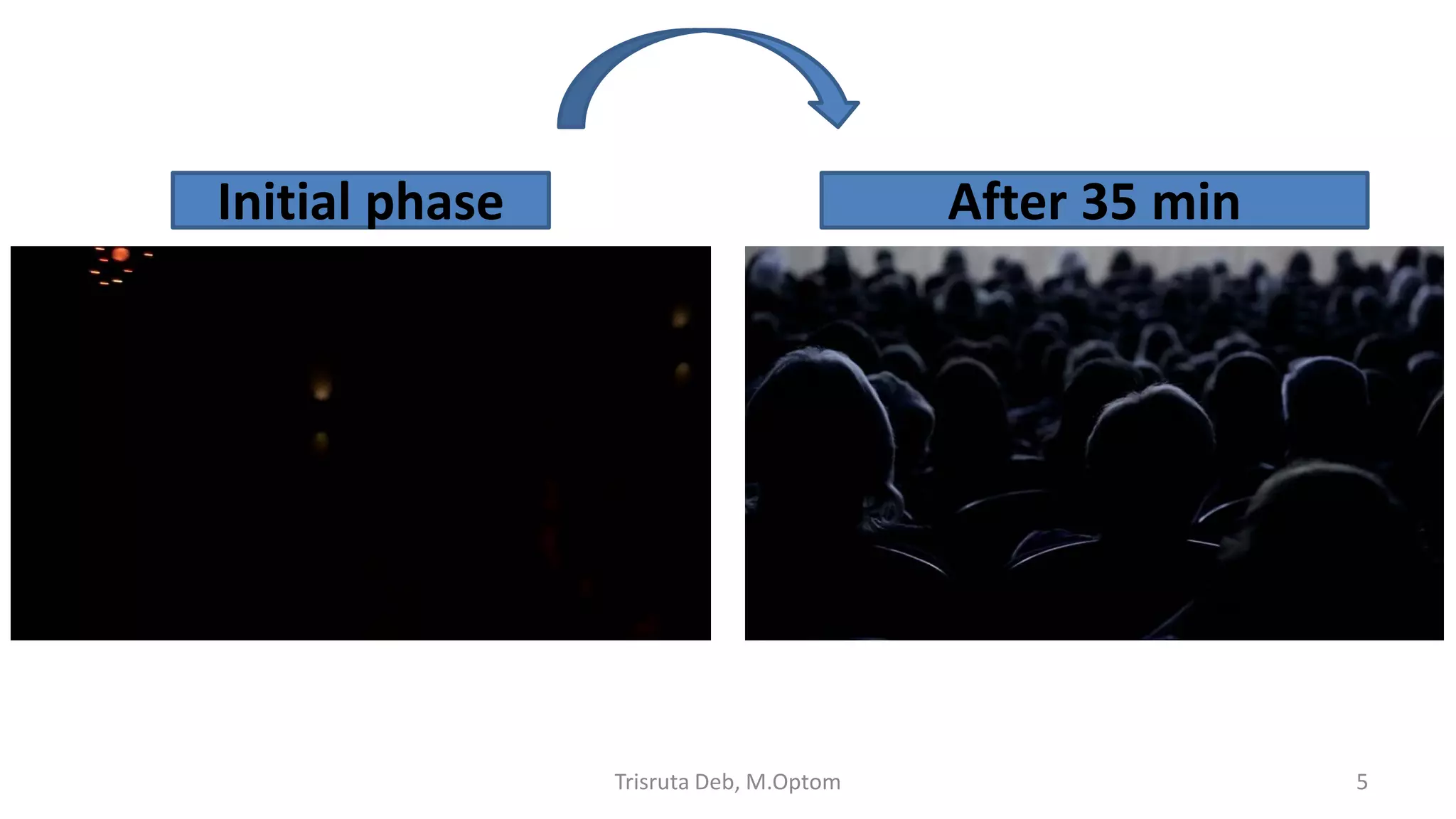
Let’s take an example
• Most of us have had the experience of entering a dark movie
theater on a sunny afternoon. Immediately on entering the
theater, we are virtually blind. Yet, after several minutes,
vision recovers to the point where we can walk down and find
an empty seat. This gradual improvement in vision, after
exposure to a bright adapting light (in this case the sun), is
referred to as dark adaptation.
Trisruta Deb, M.Optom 4
Trisruta Deb, M.Optom 5
After 35 minInitial phase
Responsible retinal cells for vision
• Rods & Cones
• Bipolar cells
• Ganglionic cells
Retinal rods are responsible for dark adaptation & cones are
responsible for light adaptation.
Trisruta Deb, M.Optom 6
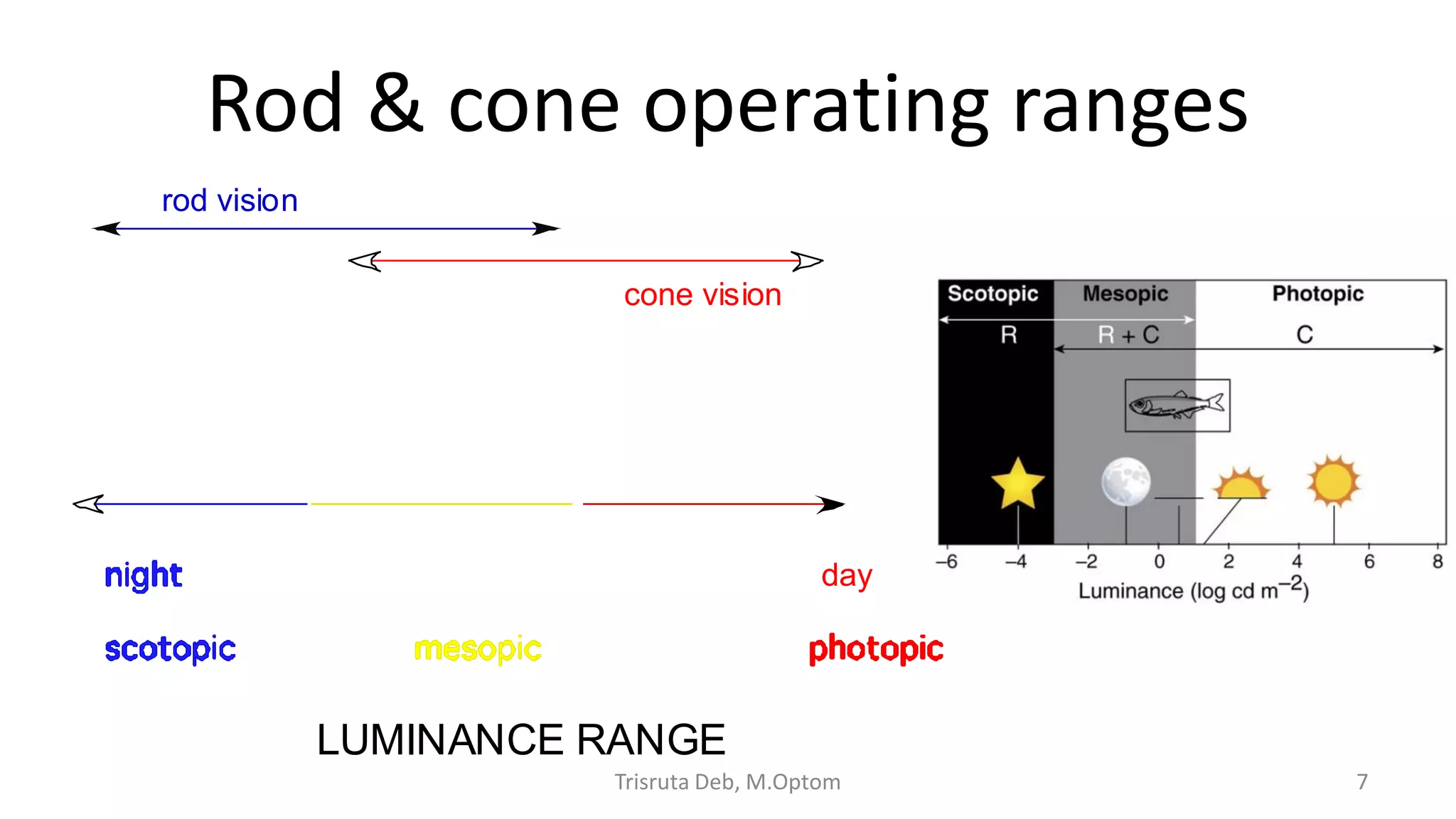
Rod & cone operating ranges
Trisruta Deb, M.Optom 7
cone vision
day
LUMINANCE RANGE
rod vision
Key points about Rods
• The human retina contains approximately 120 million rods.
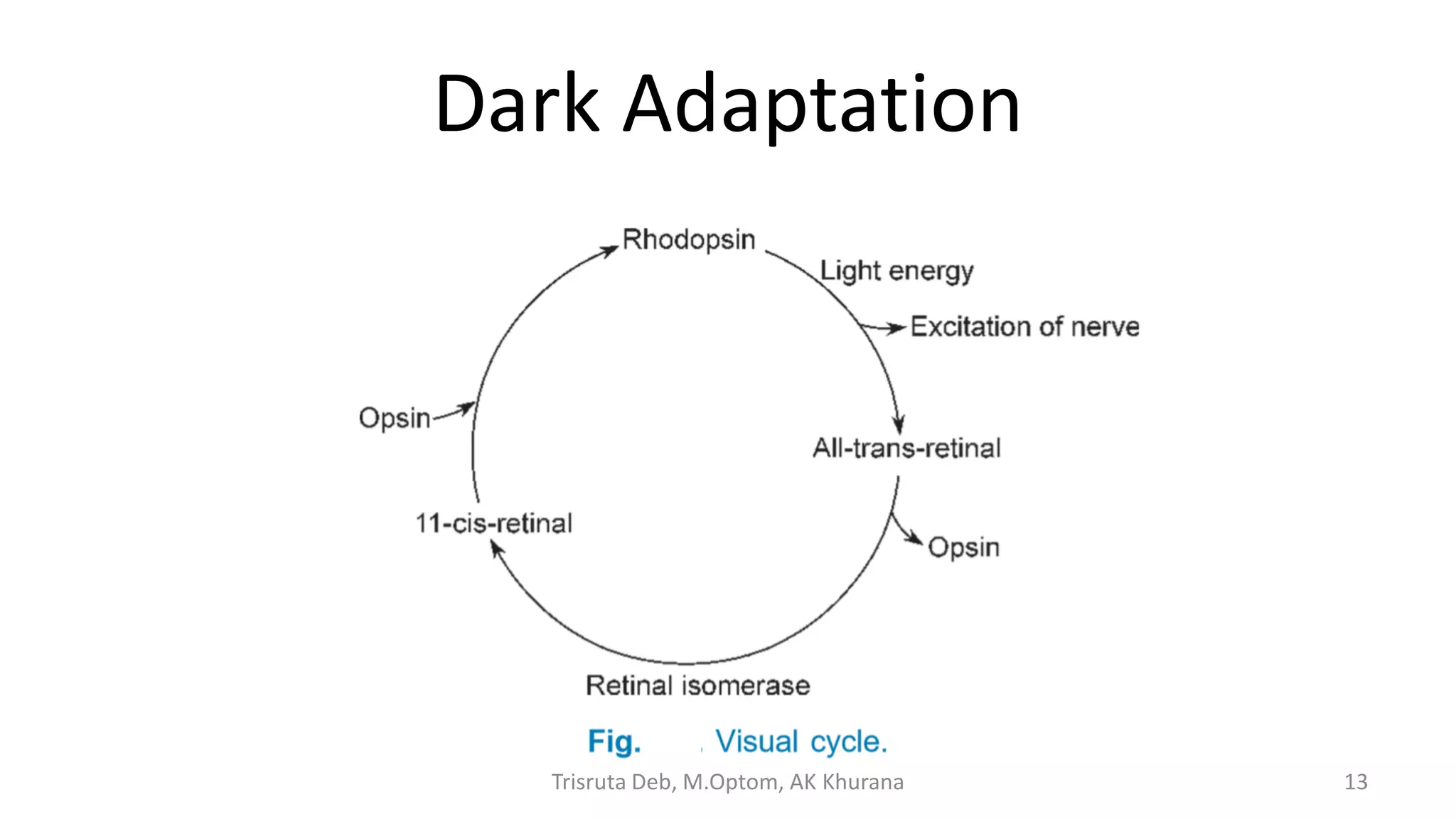
• Rhodopsin (opsin+ retinal) are the photo pigments present in
the rod cells.
• There are no rods in the fovea.
• Rods are responsible for vision at low illumination (scotopic
vision).
Trisruta Deb, M.Optom 8
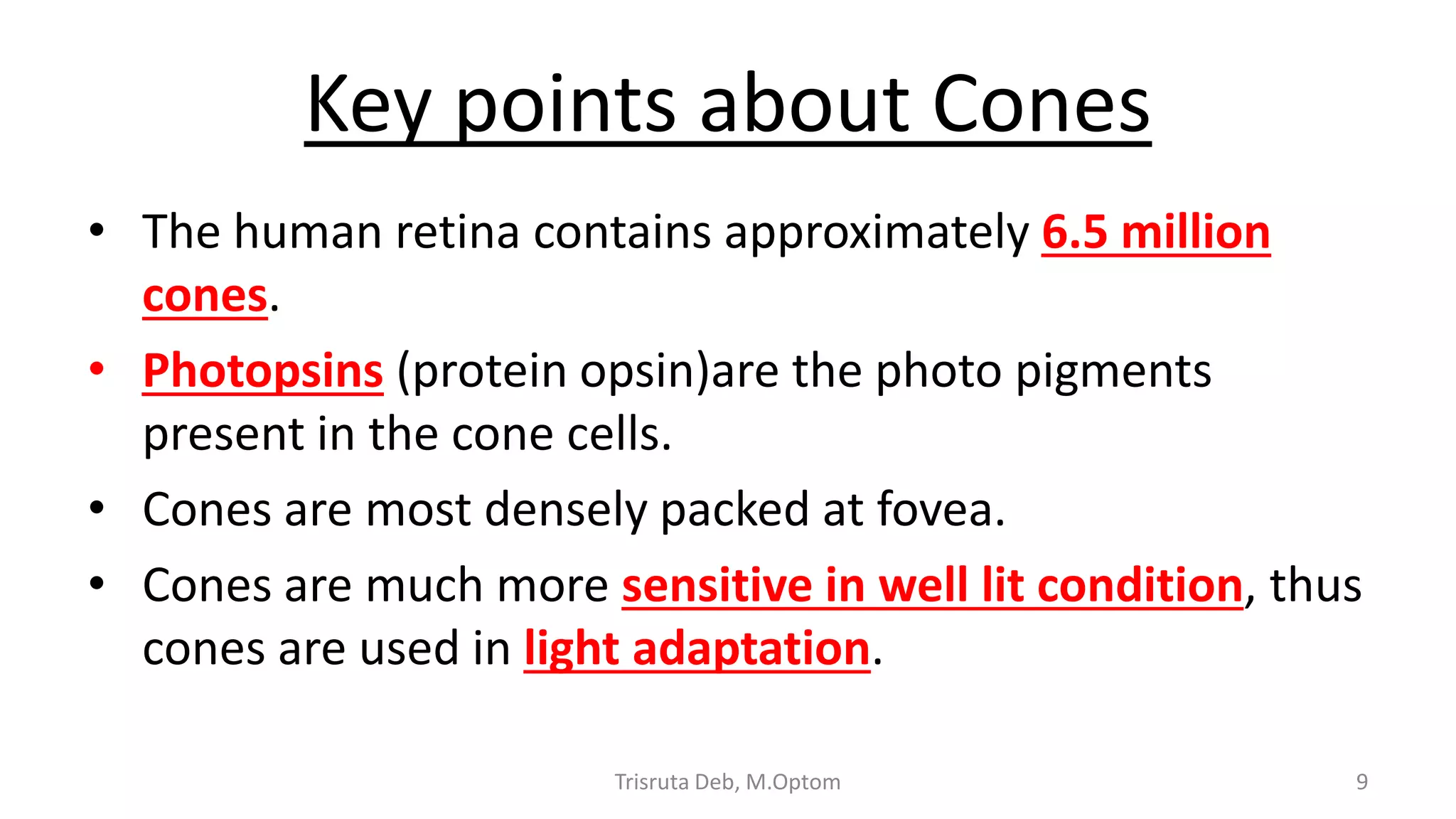
Key points about Cones
• The human retina contains approximately 6.5 million
cones.
• Photopsins (protein opsin)are the photo pigments
present in the cone cells.
• Cones are most densely packed at fovea.
• Cones are much more sensitive in well lit condition, thus
cones are used in light adaptation.
Trisruta Deb, M.Optom 9
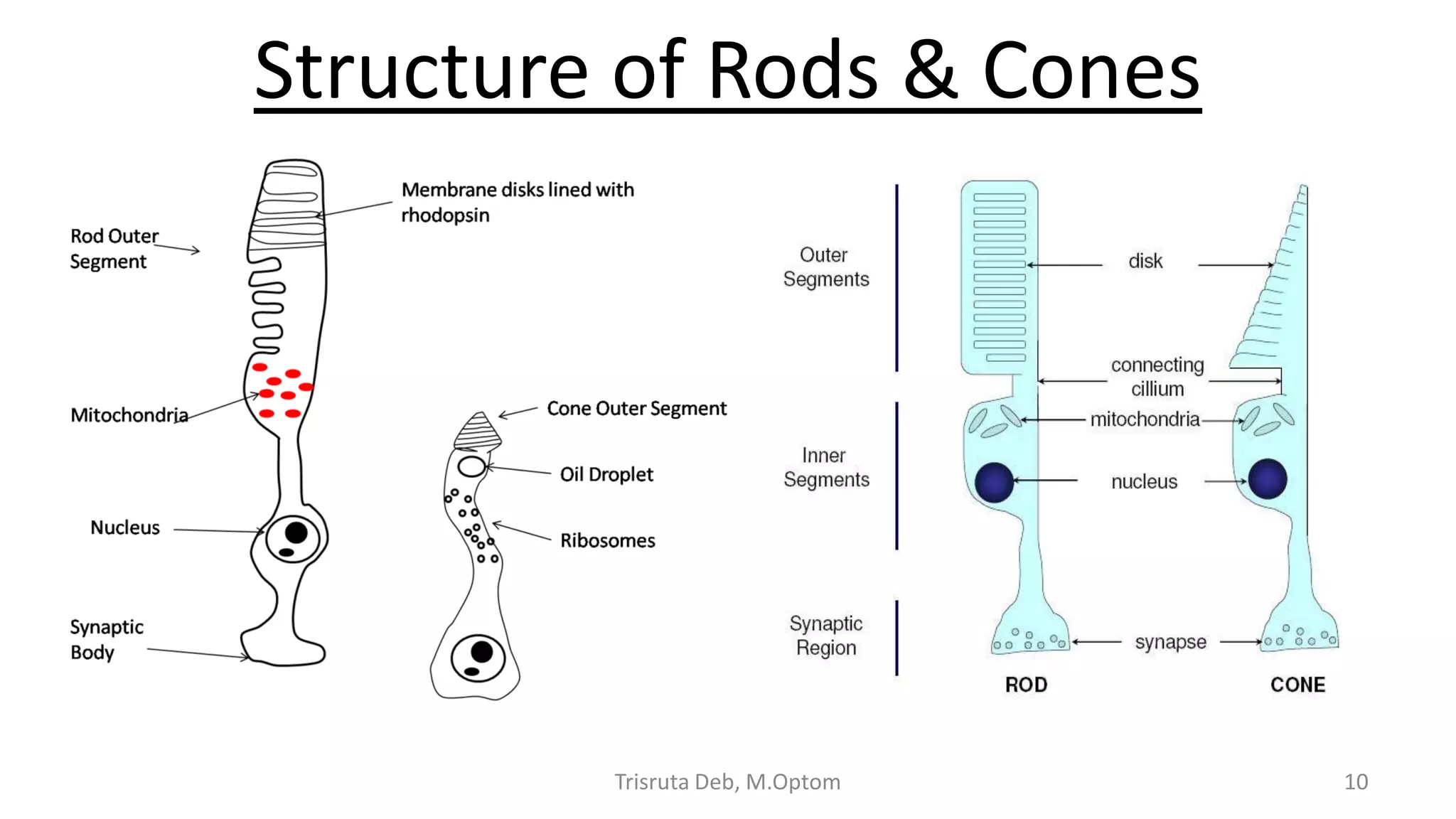
Structure of Rods & Cones
Trisruta Deb, M.Optom 10
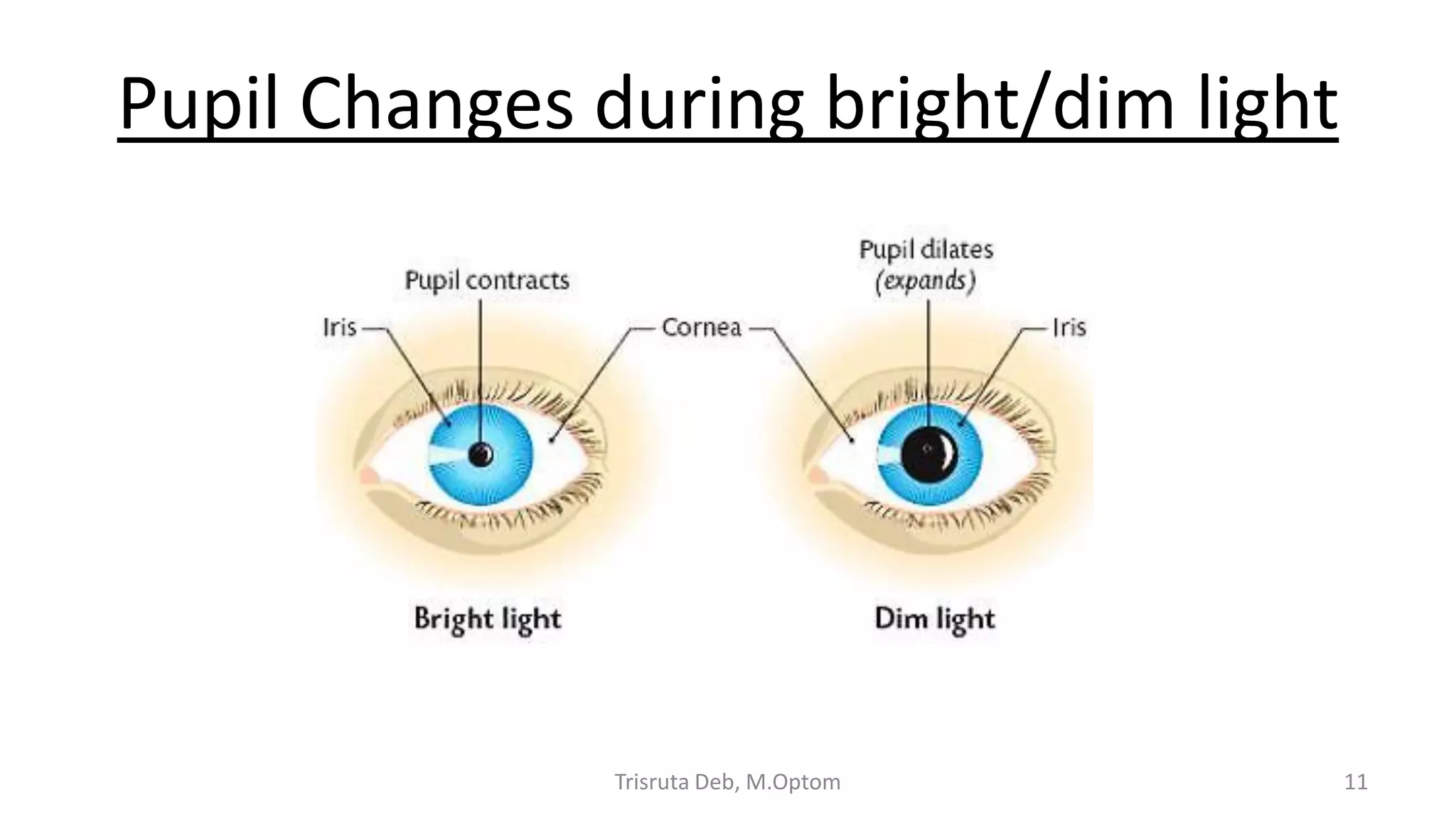
Pupil Changes during bright/dim light
Trisruta Deb, M.Optom 11
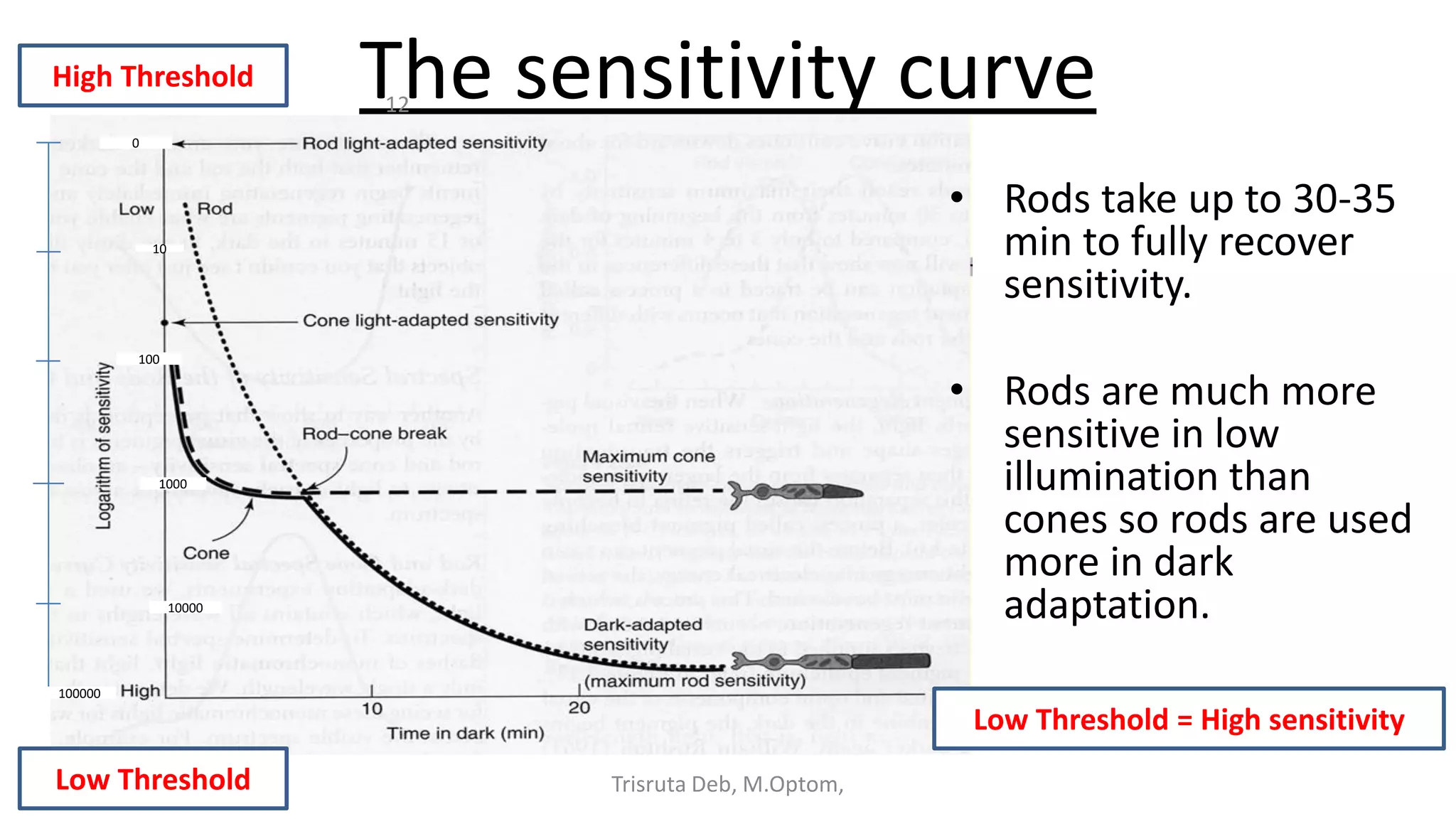
The sensitivity curve
Trisruta Deb, M.Optom,
12
• Rods take up to 30-35
min to fully recover
sensitivity.
• Rods are much more
sensitive in low
illumination than
cones so rods are used
more in dark
adaptation.
Low Threshold = High sensitivity
Low Threshold
High Threshold
100000
10000
1000
100
10
0
Dark Adaptation
Trisruta Deb, M.Optom, AK Khurana 13
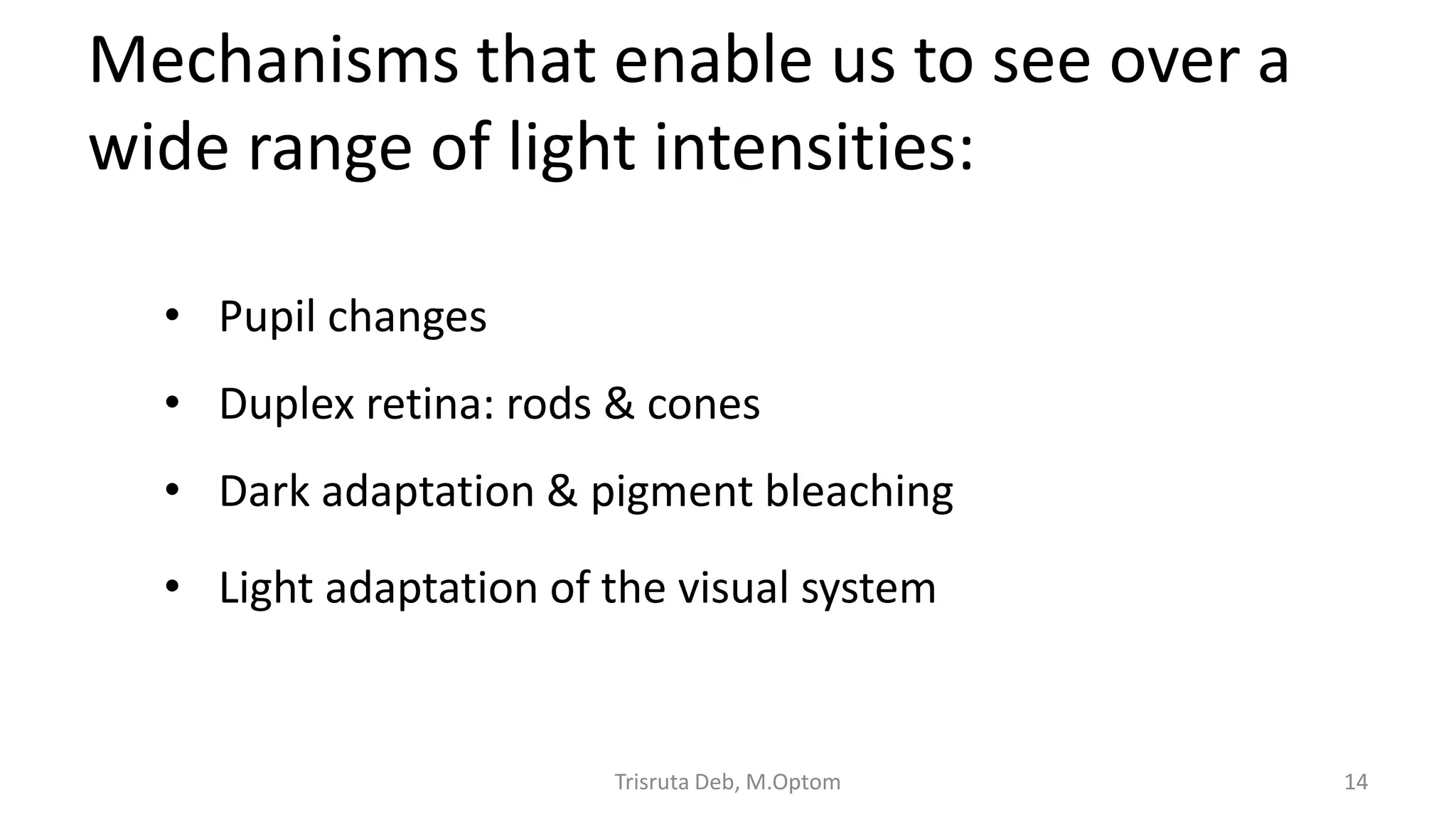
Mechanisms that enable us to see over a
wide range of light intensities:
• Pupil changes
• Duplex retina: rods & cones
• Dark adaptation & pigment bleaching
• Light adaptation of the visual system
Trisruta Deb, M.Optom 14
Duplex function of retina
1. Scotopic vision, occurs under dim (night-time) lighting conditions.
2. Photopic vision, which occurs under bright (daytime) lighting
conditions, cone cells shows poor sensitivity to dim lights; however,
it is characterized by both excellent visual acuity (20/20) and colour
discrimination. Cones mediate Photopic vision.
The existence of two classes of photoreceptors, each operating under
different lighting conditions, leads to what has been referred to as a
duplex retina.
Trisruta Deb, M.Optom 15
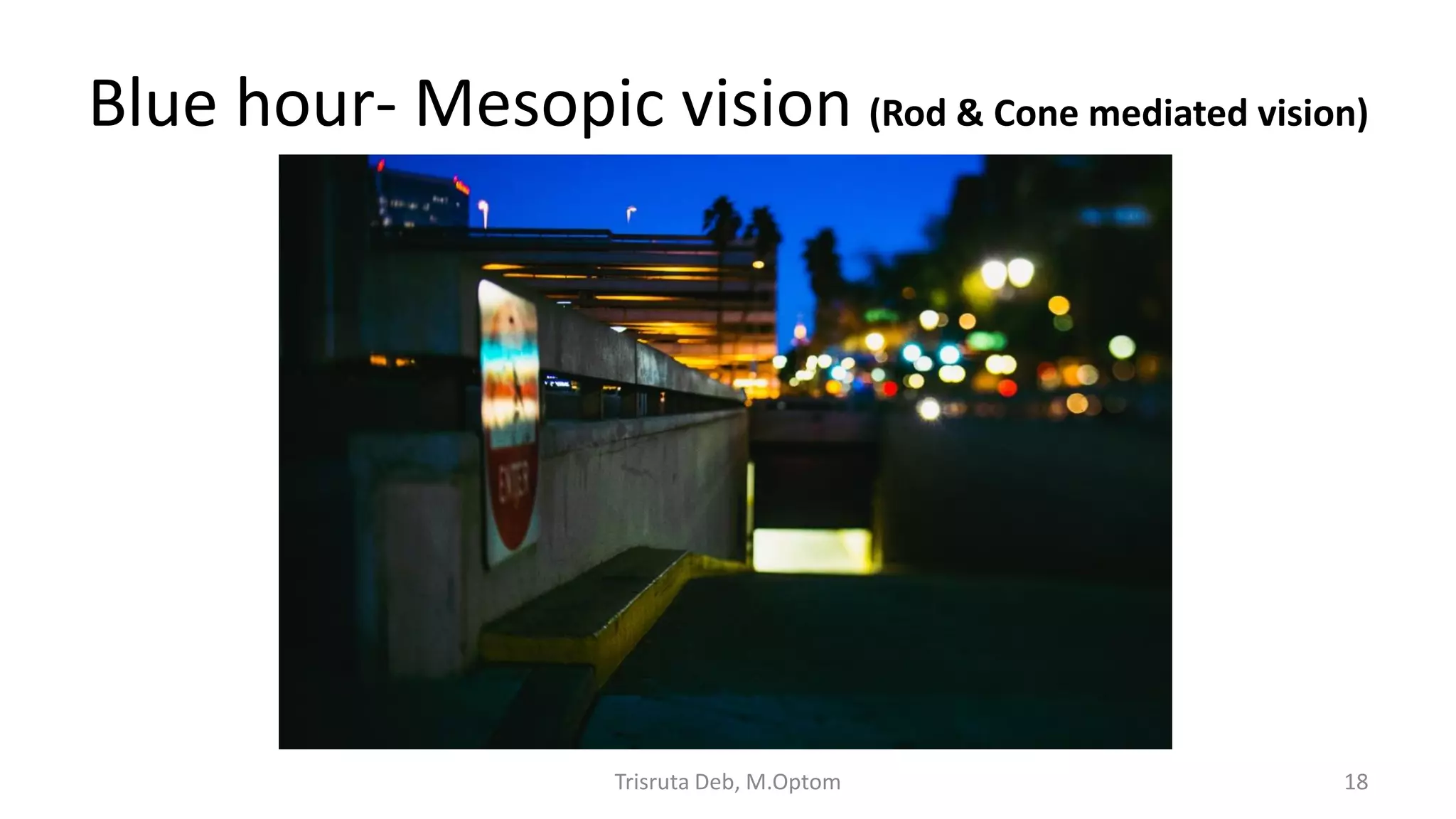
Purkinje Shift
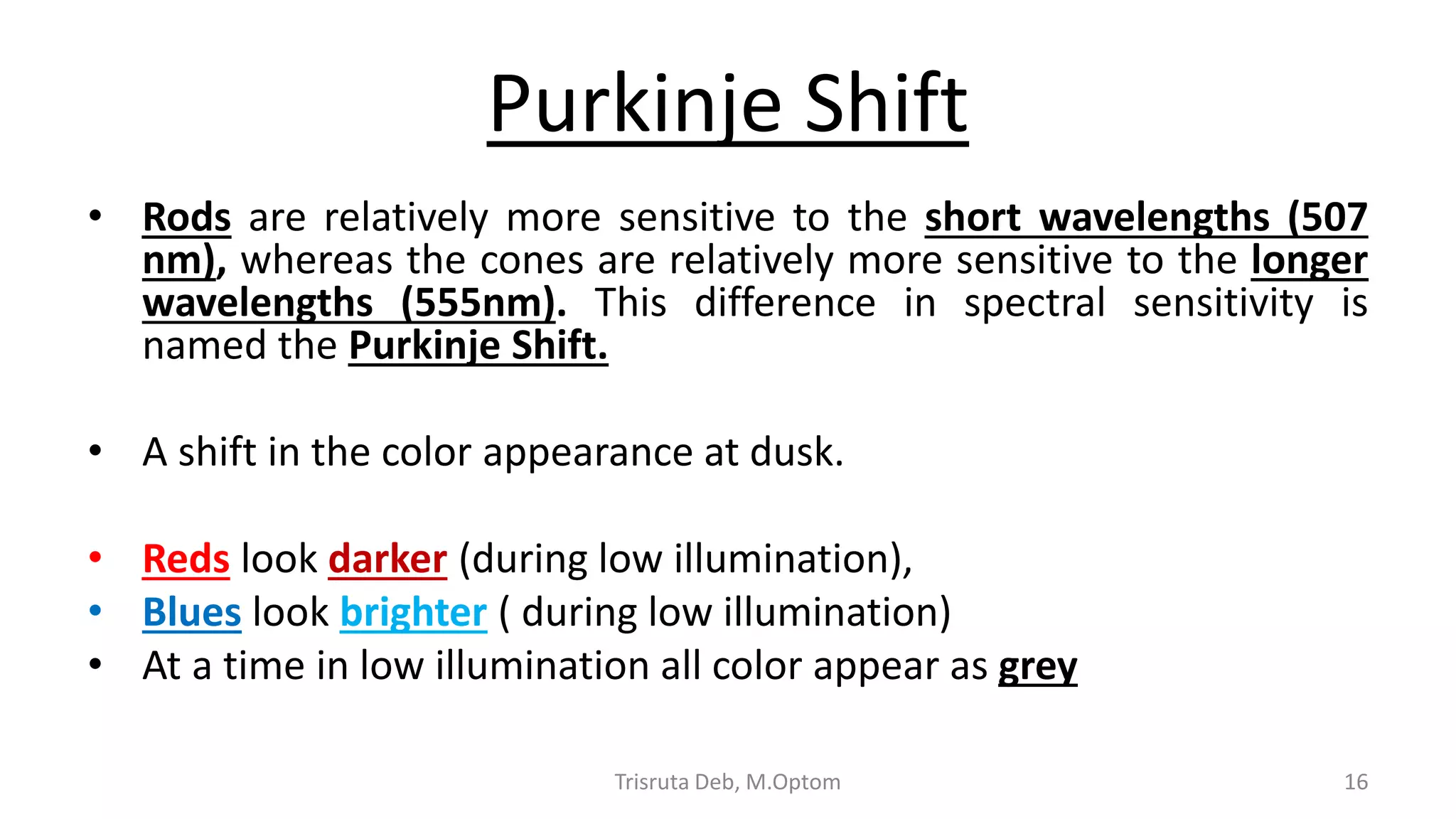
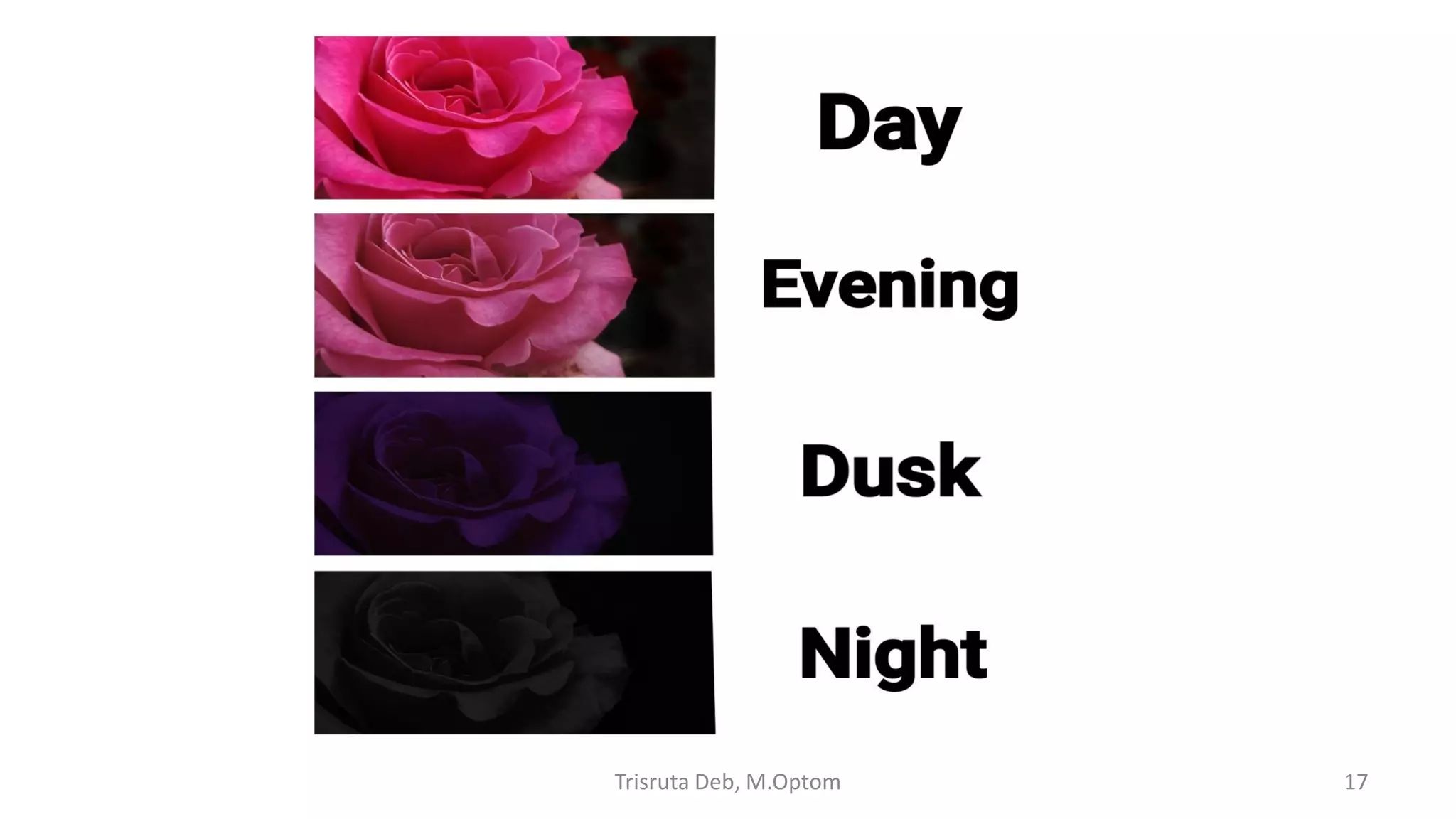
• Rods are relatively more sensitive to the short wavelengths (507
nm), whereas the cones are relatively more sensitive to the longer
wavelengths (555nm). This difference in spectral sensitivity is
named the Purkinje Shift.
• A shift in the color appearance at dusk.
• Reds look darker (during low illumination),
• Blues look brighter ( during low illumination)
• At a time in low illumination all color appear as grey
Trisruta Deb, M.Optom 16
Trisruta Deb, M.Optom 17
Blue hour- Mesopic vision (Rod & Cone mediated vision)
Trisruta Deb, M.Optom 18
Clinical significance
Dark adaptation has proven useful in the clinical diagnosis of various retinal
disorders.
Disease affecting dark adaptation curve:
1.Oguchi’s disease (congenital stationary blindness)
2. Choroideremia (an X-linked chorioretinal dystrophy)
3. Diabetic retinopathy
4. Retinitis pigmentosa
5. Glaucoma
Refractive error dark adaptation:
1. Myopia
Trisruta Deb, M.Optom 19
Factors affecting dark adaptation related to individual
• Vitamin A deficiency
• Effects of anoxia
• Effects of tobacco inhalation
• Effects of opacities in ocular media
• Effect of anaesthesia (halothane anaesthesia)
Trisruta Deb, M.Optom 20
Dark Adaptometry
• A type of retinal testing done to diagnose and manage retinal
degeneration by measuring the length of time it takes for the
retina to regain maximal sensitivity to low amounts of light
after it has been exposed to bright light then returned to
darkness.
Trisruta Deb, M.Optom 21
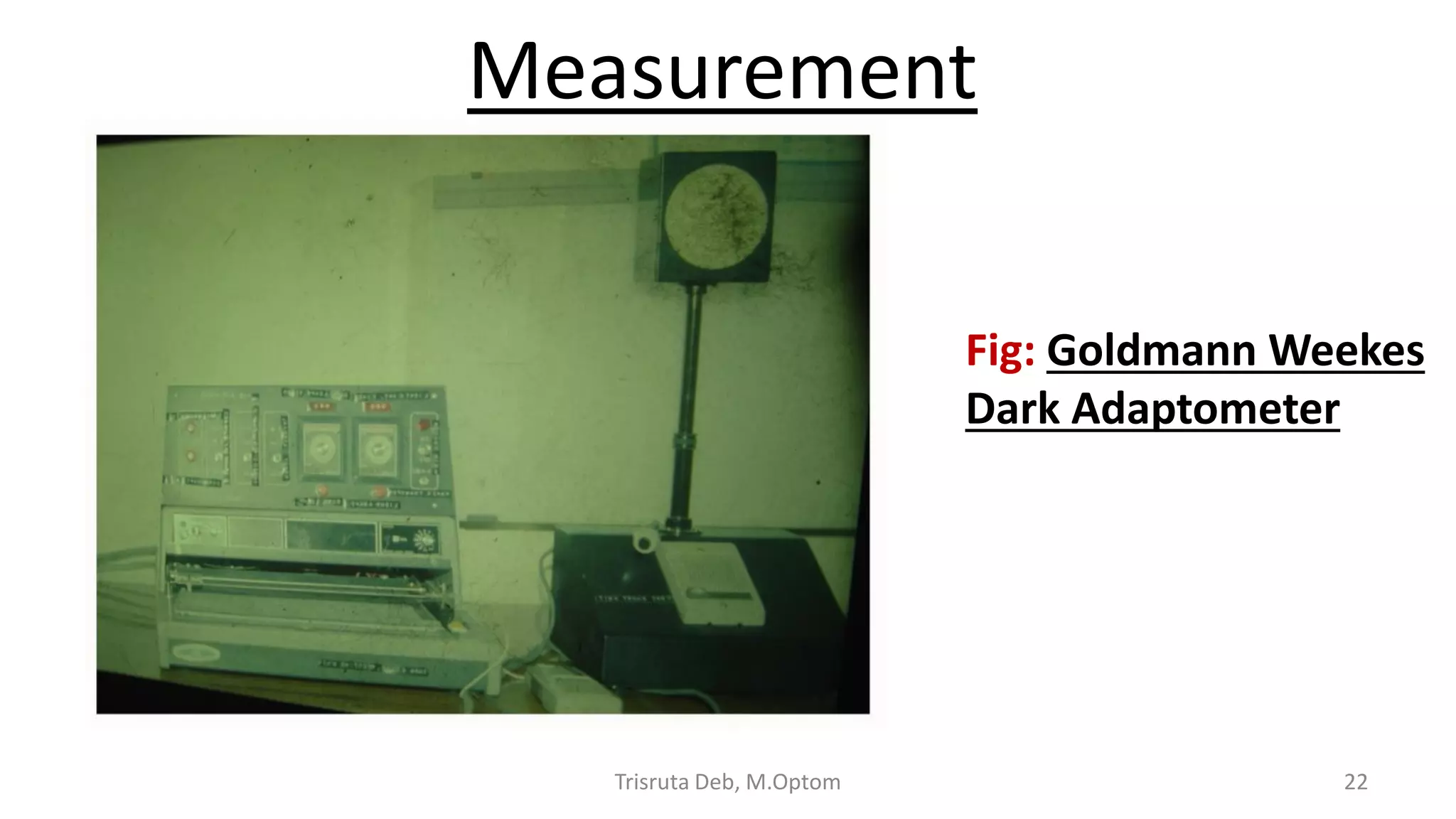
Measurement
Fig: Goldmann Weekes
Dark Adaptometer
Trisruta Deb, M.Optom 22
Trisruta Deb, M.Optom 23
High
Low
Low Threshold = High sensitivity
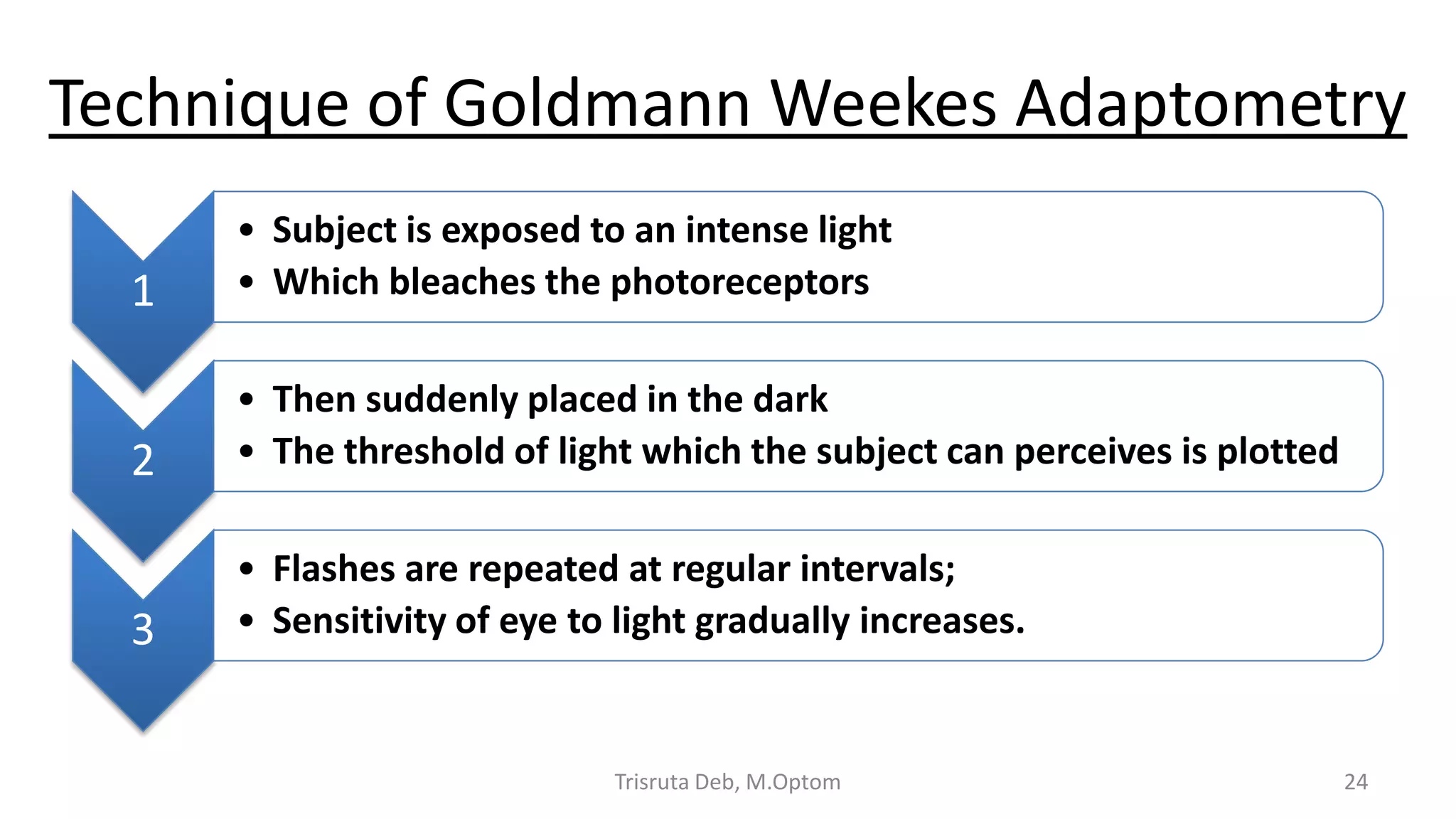
Technique of Goldmann Weekes Adaptometry
1
• Subject is exposed to an intense light
• Which bleaches the photoreceptors
2
• Then suddenly placed in the dark
• The threshold of light which the subject can perceives is plotted
3
• Flashes are repeated at regular intervals;
• Sensitivity of eye to light gradually increases.
Trisruta Deb, M.Optom 24
Trisruta Deb, M.Optom 25
High
Low
Low Threshold = High sensitivity
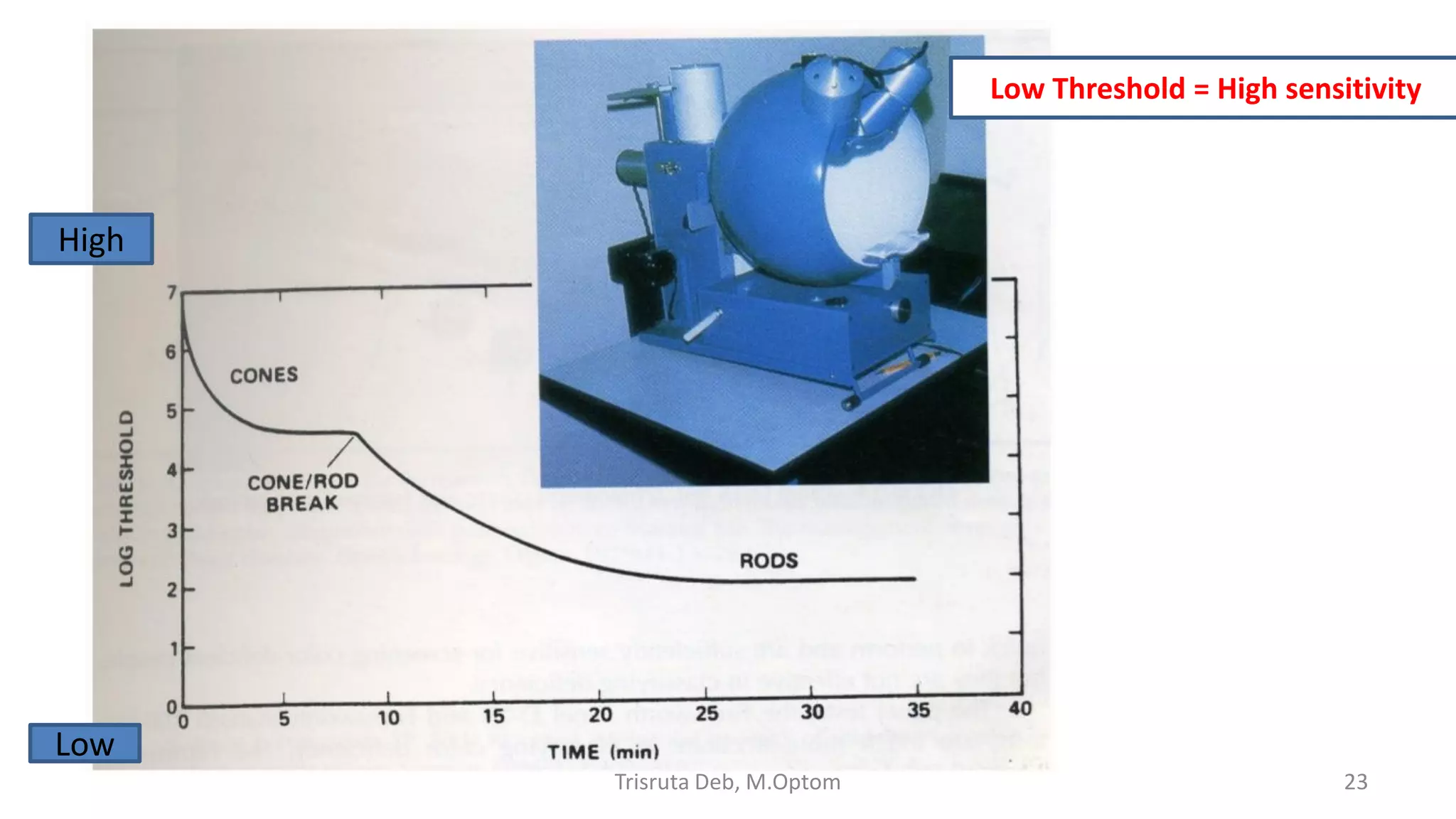
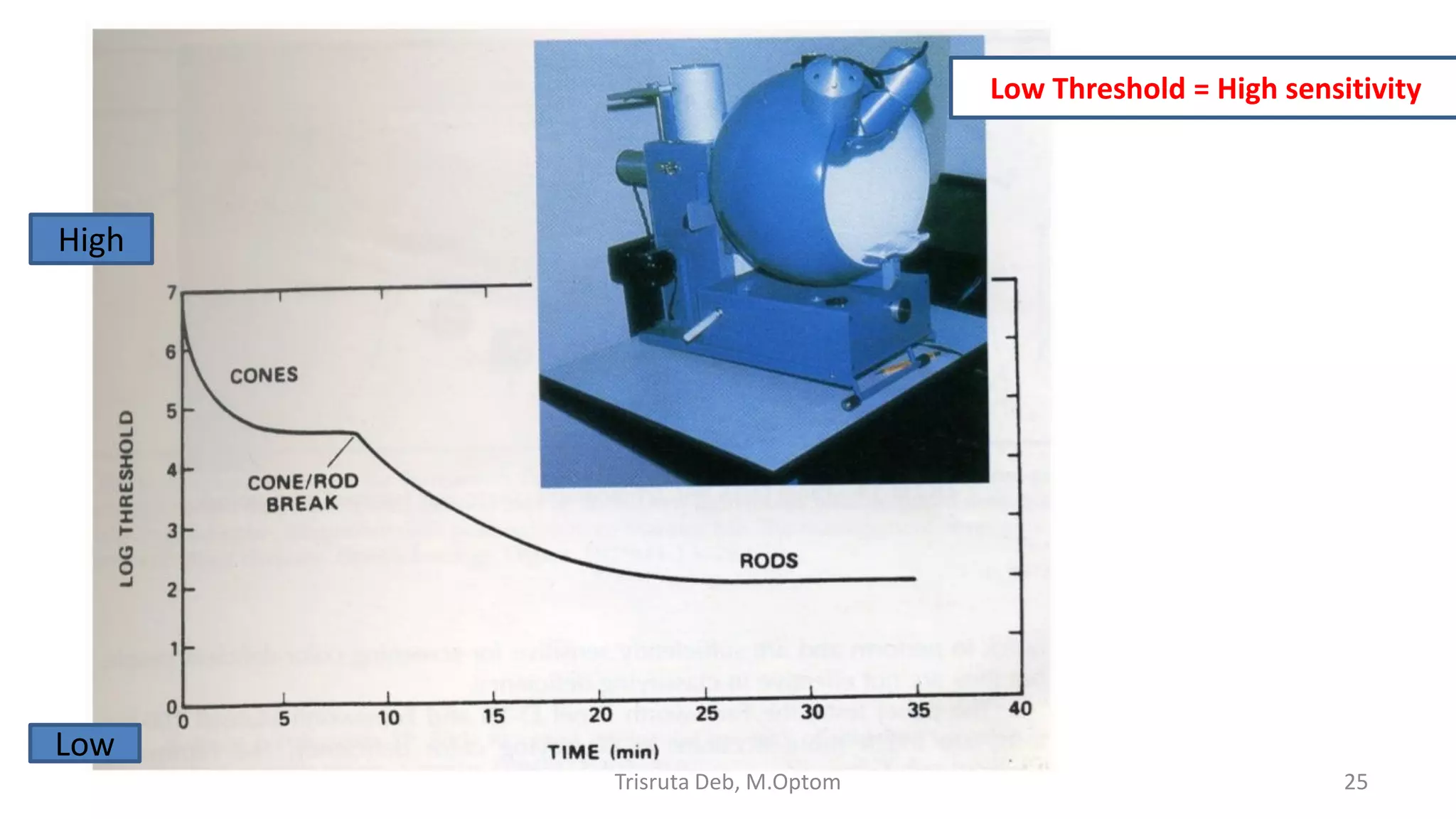
The sensitivity curve
• First section(CONE):
-rapid threshold reduction(5 min)
-this represents the cone thresholds
• Cone rod break:
- break in curves that occur after 7-10 min of
adaptation, when cones achieve their maximum
sensitivity & rods become noticeably sensitive
• Second section:
-reduction in threshold that extends to 35 min
-this represents the rod thresholds
26
References
Trisruta Deb, M.Optom 27
Trisruta Deb, M.Optom
28

Light and Dark Adaptation

  • 1.
    Light & DarkAdaptation Trisruta Deb M.Optom (P.G Scholar) BV(DU) MC School of Optometry, Pune
  • 2.
    Light Adaptation • Lightadaptation is the ability of the eye to adjust in bright light. • Within about one minute the cones are sufficiently excited by the bright light to take over. • Visual accuracy and colour vision continue to improve over the next ten minutes. During light adaptation rod sensitivity is lost. Trisruta Deb, M.Optom 2
  • 3.
    Dark Adaptation • Abilityof the eye to adapt itself in low illumination after immediate light exposure. Or, • Dark Adaptation is the ability of the eye to recover its sensitivity in the dark after being exposed to bright light, making vision possible in relative darkness. Trisruta Deb, M.Optom 3
  • 4.
    Let’s take anexample • Most of us have had the experience of entering a dark movie theater on a sunny afternoon. Immediately on entering the theater, we are virtually blind. Yet, after several minutes, vision recovers to the point where we can walk down and find an empty seat. This gradual improvement in vision, after exposure to a bright adapting light (in this case the sun), is referred to as dark adaptation. Trisruta Deb, M.Optom 4
  • 5.
    Trisruta Deb, M.Optom5 After 35 minInitial phase
  • 6.
    Responsible retinal cellsfor vision • Rods & Cones • Bipolar cells • Ganglionic cells Retinal rods are responsible for dark adaptation & cones are responsible for light adaptation. Trisruta Deb, M.Optom 6
  • 7.
    Rod & coneoperating ranges Trisruta Deb, M.Optom 7 cone vision day LUMINANCE RANGE rod vision
  • 8.
    Key points aboutRods • The human retina contains approximately 120 million rods. • Rhodopsin (opsin+ retinal) are the photo pigments present in the rod cells. • There are no rods in the fovea. • Rods are responsible for vision at low illumination (scotopic vision). Trisruta Deb, M.Optom 8
  • 9.
    Key points aboutCones • The human retina contains approximately 6.5 million cones. • Photopsins (protein opsin)are the photo pigments present in the cone cells. • Cones are most densely packed at fovea. • Cones are much more sensitive in well lit condition, thus cones are used in light adaptation. Trisruta Deb, M.Optom 9
  • 10.
    Structure of Rods& Cones Trisruta Deb, M.Optom 10
  • 11.
    Pupil Changes duringbright/dim light Trisruta Deb, M.Optom 11
  • 12.
    The sensitivity curve TrisrutaDeb, M.Optom, 12 • Rods take up to 30-35 min to fully recover sensitivity. • Rods are much more sensitive in low illumination than cones so rods are used more in dark adaptation. Low Threshold = High sensitivity Low Threshold High Threshold 100000 10000 1000 100 10 0
  • 13.
    Dark Adaptation Trisruta Deb,M.Optom, AK Khurana 13
  • 14.
    Mechanisms that enableus to see over a wide range of light intensities: • Pupil changes • Duplex retina: rods & cones • Dark adaptation & pigment bleaching • Light adaptation of the visual system Trisruta Deb, M.Optom 14
  • 15.
    Duplex function ofretina 1. Scotopic vision, occurs under dim (night-time) lighting conditions. 2. Photopic vision, which occurs under bright (daytime) lighting conditions, cone cells shows poor sensitivity to dim lights; however, it is characterized by both excellent visual acuity (20/20) and colour discrimination. Cones mediate Photopic vision. The existence of two classes of photoreceptors, each operating under different lighting conditions, leads to what has been referred to as a duplex retina. Trisruta Deb, M.Optom 15
  • 16.
    Purkinje Shift • Rodsare relatively more sensitive to the short wavelengths (507 nm), whereas the cones are relatively more sensitive to the longer wavelengths (555nm). This difference in spectral sensitivity is named the Purkinje Shift. • A shift in the color appearance at dusk. • Reds look darker (during low illumination), • Blues look brighter ( during low illumination) • At a time in low illumination all color appear as grey Trisruta Deb, M.Optom 16
  • 17.
  • 18.
    Blue hour- Mesopicvision (Rod & Cone mediated vision) Trisruta Deb, M.Optom 18
  • 19.
    Clinical significance Dark adaptationhas proven useful in the clinical diagnosis of various retinal disorders. Disease affecting dark adaptation curve: 1.Oguchi’s disease (congenital stationary blindness) 2. Choroideremia (an X-linked chorioretinal dystrophy) 3. Diabetic retinopathy 4. Retinitis pigmentosa 5. Glaucoma Refractive error dark adaptation: 1. Myopia Trisruta Deb, M.Optom 19
  • 20.
    Factors affecting darkadaptation related to individual • Vitamin A deficiency • Effects of anoxia • Effects of tobacco inhalation • Effects of opacities in ocular media • Effect of anaesthesia (halothane anaesthesia) Trisruta Deb, M.Optom 20
  • 21.
    Dark Adaptometry • Atype of retinal testing done to diagnose and manage retinal degeneration by measuring the length of time it takes for the retina to regain maximal sensitivity to low amounts of light after it has been exposed to bright light then returned to darkness. Trisruta Deb, M.Optom 21
  • 22.
    Measurement Fig: Goldmann Weekes DarkAdaptometer Trisruta Deb, M.Optom 22
  • 23.
    Trisruta Deb, M.Optom23 High Low Low Threshold = High sensitivity
  • 24.
    Technique of GoldmannWeekes Adaptometry 1 • Subject is exposed to an intense light • Which bleaches the photoreceptors 2 • Then suddenly placed in the dark • The threshold of light which the subject can perceives is plotted 3 • Flashes are repeated at regular intervals; • Sensitivity of eye to light gradually increases. Trisruta Deb, M.Optom 24
  • 25.
    Trisruta Deb, M.Optom25 High Low Low Threshold = High sensitivity
  • 26.
    The sensitivity curve •First section(CONE): -rapid threshold reduction(5 min) -this represents the cone thresholds • Cone rod break: - break in curves that occur after 7-10 min of adaptation, when cones achieve their maximum sensitivity & rods become noticeably sensitive • Second section: -reduction in threshold that extends to 35 min -this represents the rod thresholds 26
  • 27.
  • 28.