Ananta poudel
B.Optom 1st batch NAMS
Presentation layout.
 Introduction on color vision
 Introduction on color blindness.
 Types of colour vision defect and its classification, causes.
 Prevalence.
 Congenital vs acquired colour vision defect.
Introduction on color vision
 Color vision is that attribute of the sense of sight
which provides an appreciation of differences in the
physical composition of wavelength of light that excite
the retina.
 John dalton first reported color vision in 1798 (reports
of his own color blindness as compared to his
colleagues with normal color vision.
 Colour vision is a function of the cones and thus,
better appreciated in photopic vision.
 In dim light (scotopic vision), all colors are seen grey
and this phenomenon is called Purkinje shift.
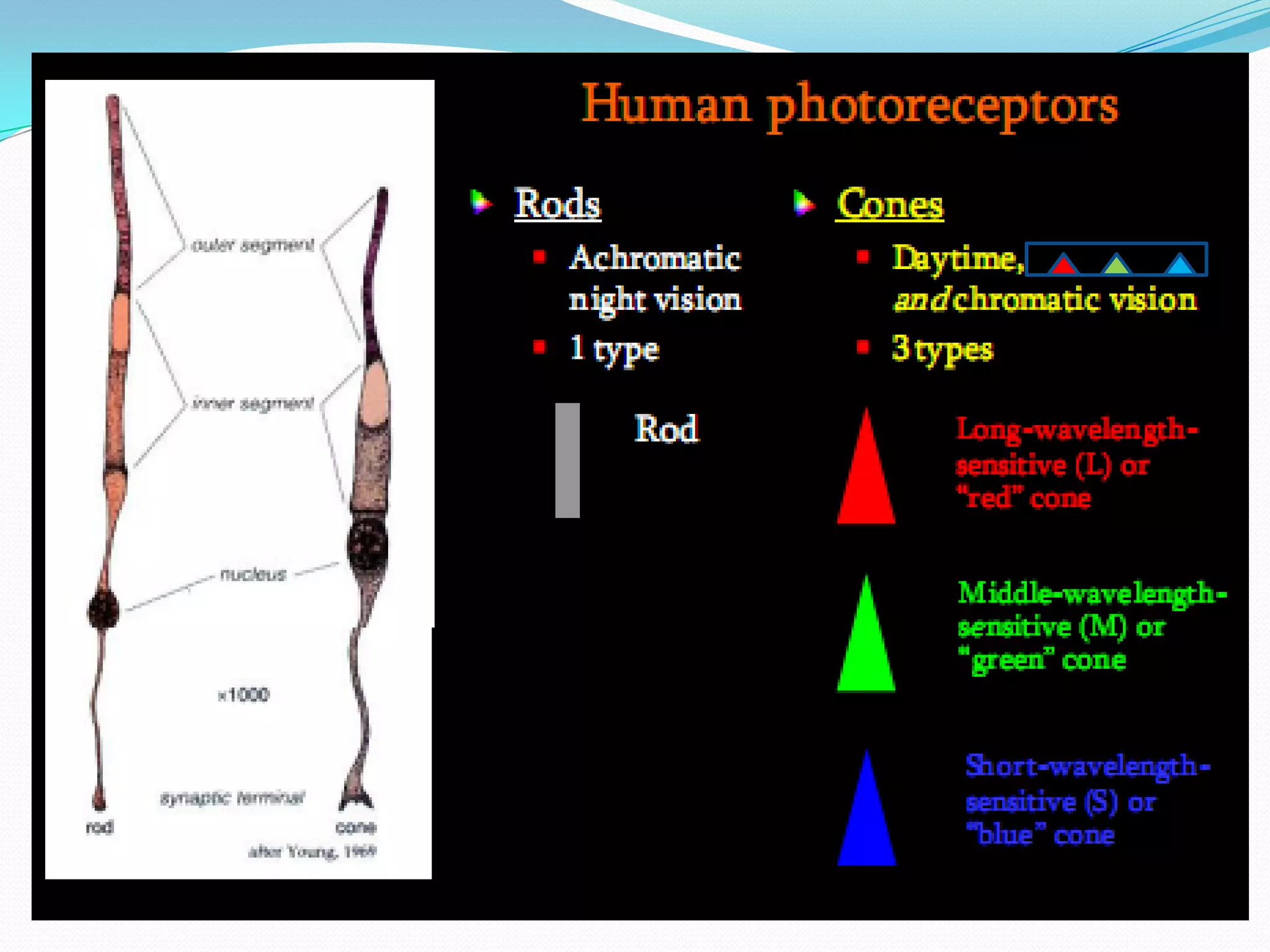
 There are three different types of cones viz.
 red sensitive, 56%(erythrolabe)
 green sensitive, 37% (chlorolabe)
 blue sensitive, 7% (cynolabe)
 which combinedly perform the function of colour
vision
Facts.
 Color perceptions best in the fovea and declines in the
periphery.
 The "green" and "red" cones are mostly packed into
the fovea centralis.
 Sensitivity to red–green color variations declines more
steeply toward the periphery than sensitivity to luminance
or blue–yellow colors. Due to the increasing size of
receptive fields of parvocellular retinal ganglion cells
ref.ARVO journal
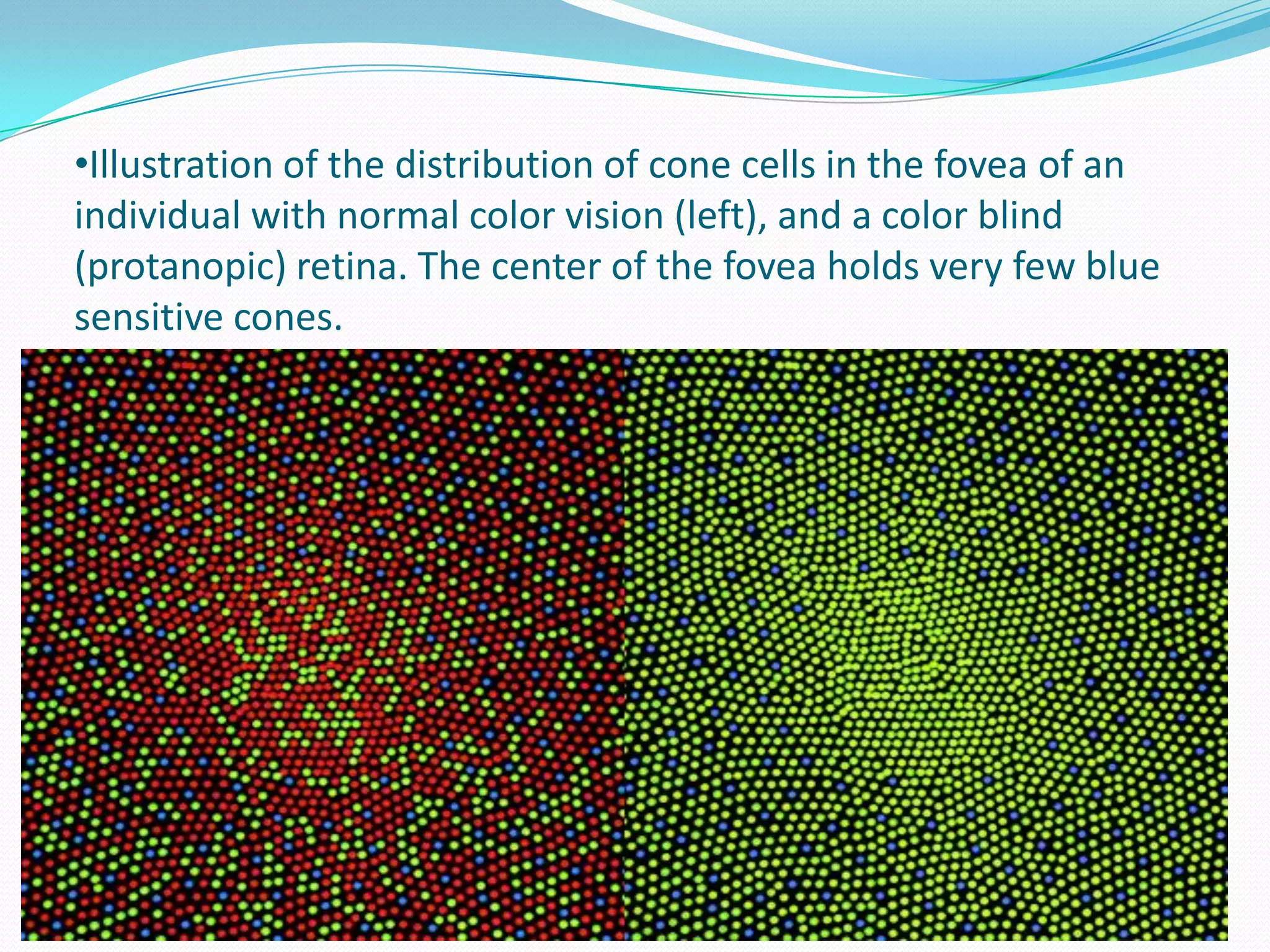
•Illustration of the distribution of cone cells in the fovea of an
individual with normal color vision (left), and a color blind
(protanopic) retina. The center of the fovea holds very few blue
sensitive cones.
Colours have three attributes :
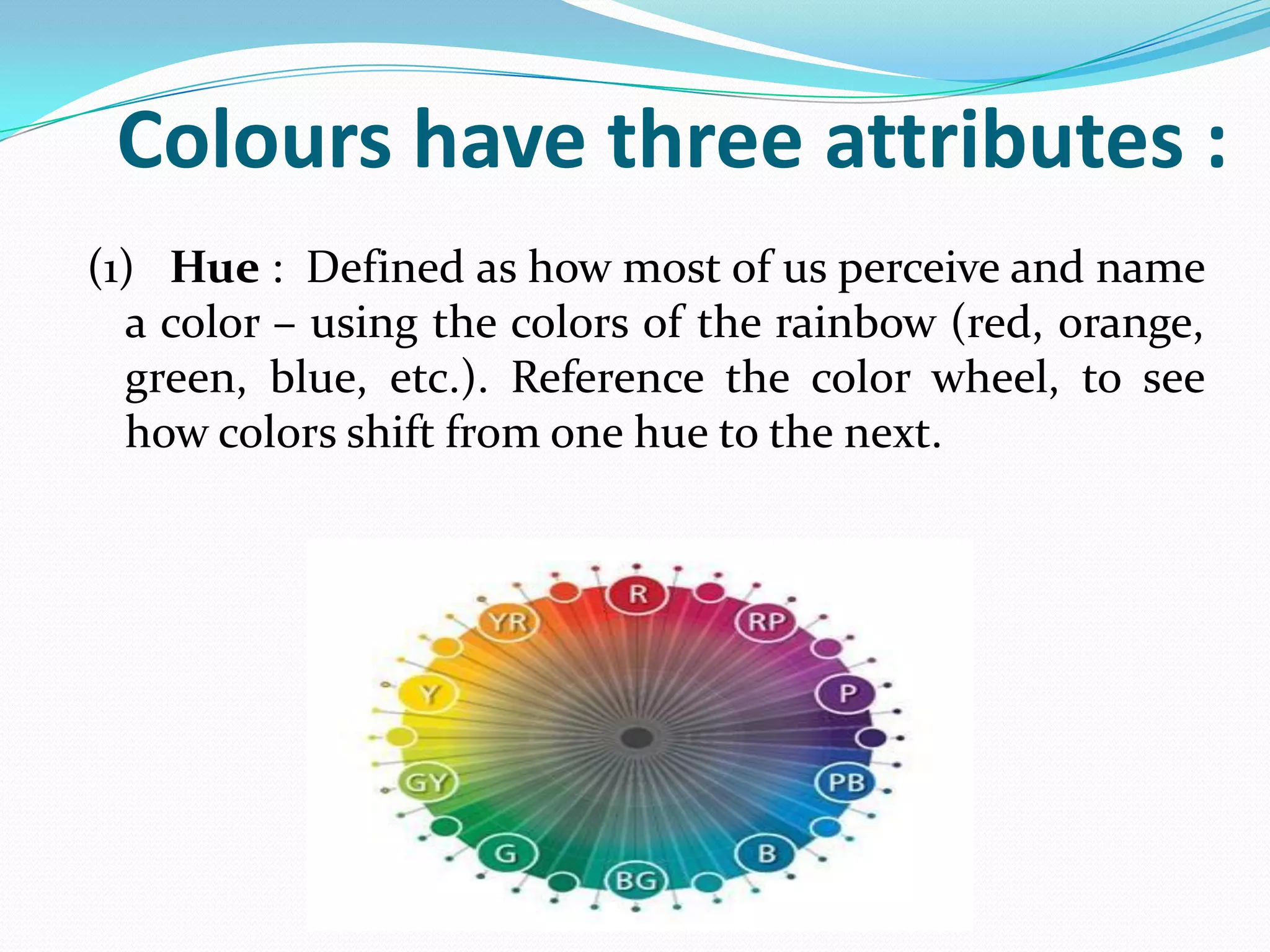
(1) Hue : Defined as how most of us perceive and name
a color – using the colors of the rainbow (red, orange,
green, blue, etc.). Reference the color wheel, to see
how colors shift from one hue to the next.
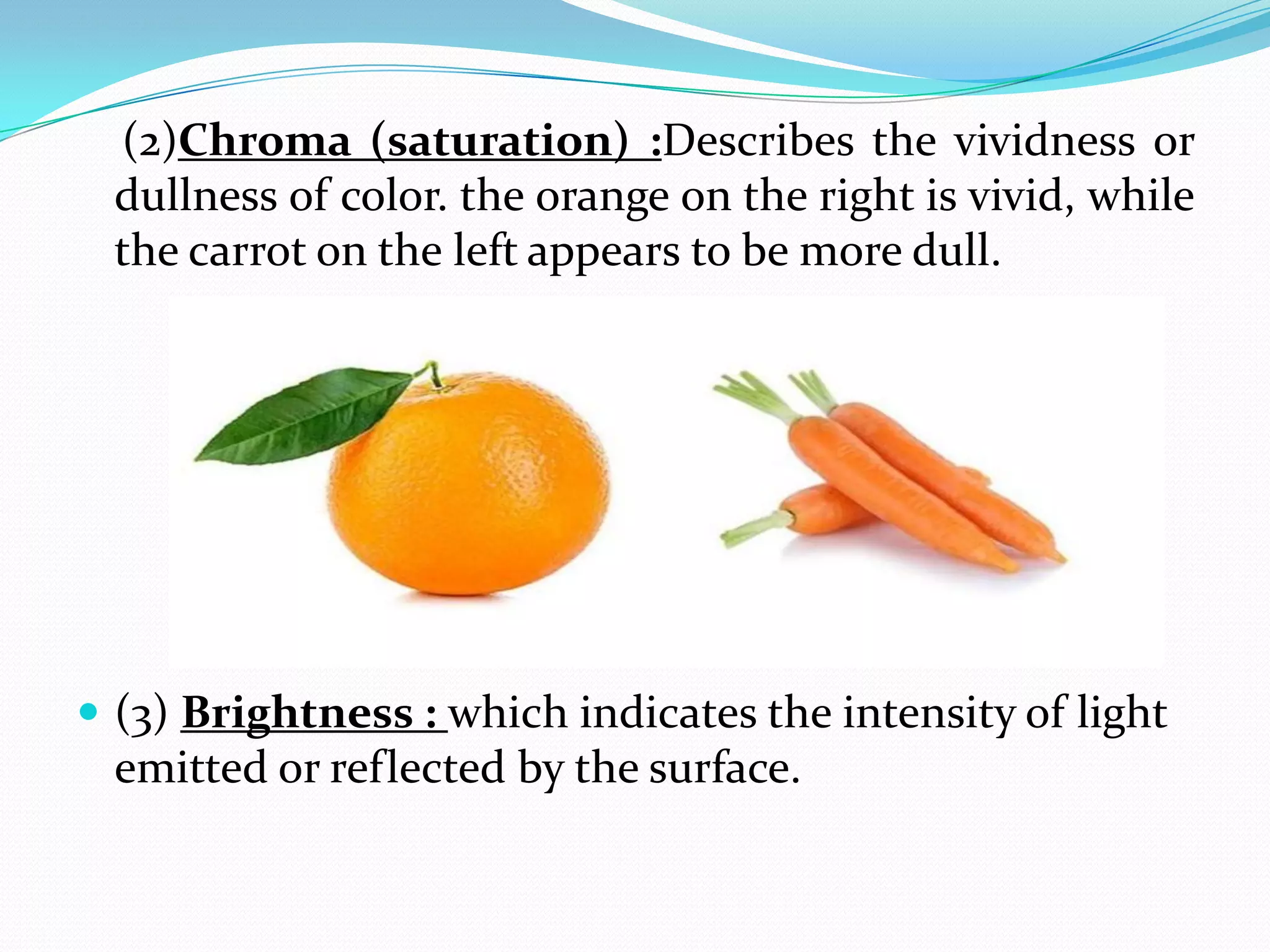
(2)Chroma (saturation) :Describes the vividness or
dullness of color. the orange on the right is vivid, while
the carrot on the left appears to be more dull.
 (3) Brightness : which indicates the intensity of light
emitted or reflected by the surface.
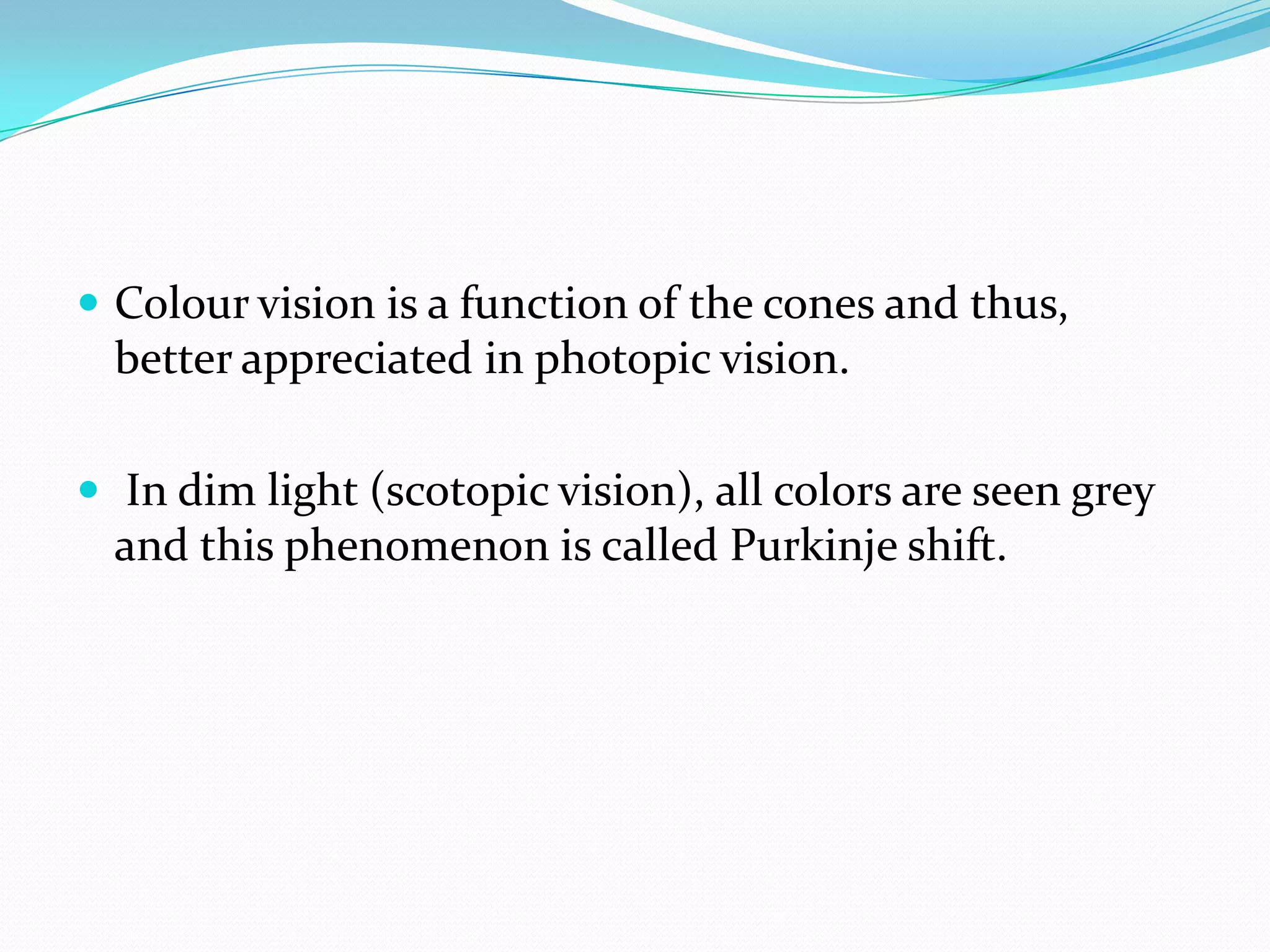
 Our eyes perceive colour with wavelength of light
ranging from 400 to 700nm.
Three classes of cones:
1st class : SWS receptors.
 7% in retina i.e Blue cone.
 More sensitive to blue violet wavelength around 453
nm.
2nd class :MWS receptor
 37% in retina i.e Green cones
 Most sensitive to green wavelength around 530 nm.
 3rd class : LWS receptors .
 56% in retina i.e. Red cones.
 More sensitive to Red wavelength about 565 nm.
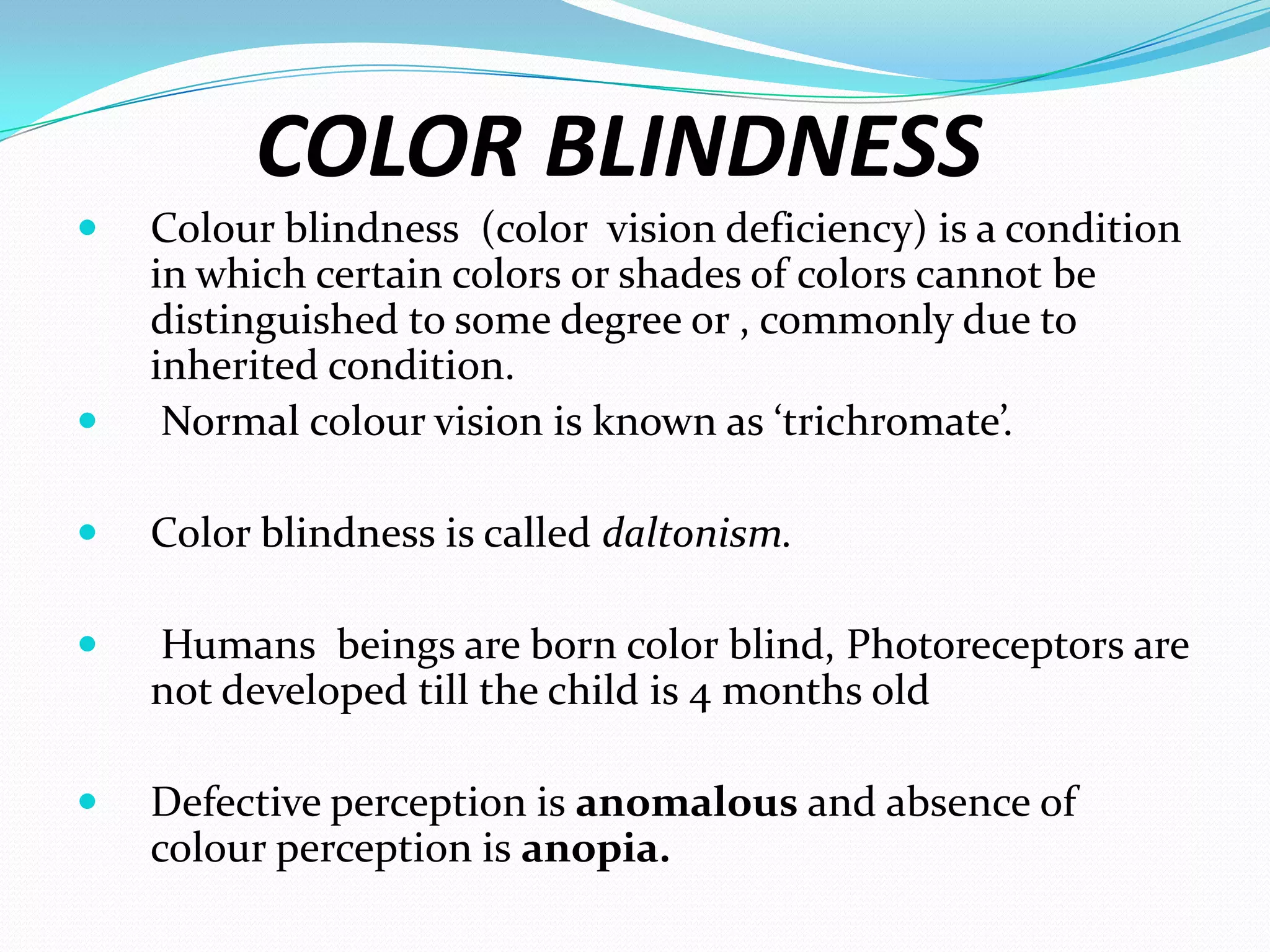
COLOR BLINDNESS
 Colour blindness (color vision deficiency) is a condition
in which certain colors or shades of colors cannot be
distinguished to some degree or , commonly due to
inherited condition.
 Normal colour vision is known as ‘trichromate’.
 Color blindness is called daltonism.
 Humans beings are born color blind, Photoreceptors are
not developed till the child is 4 months old
 Defective perception is anomalous and absence of
colour perception is anopia.
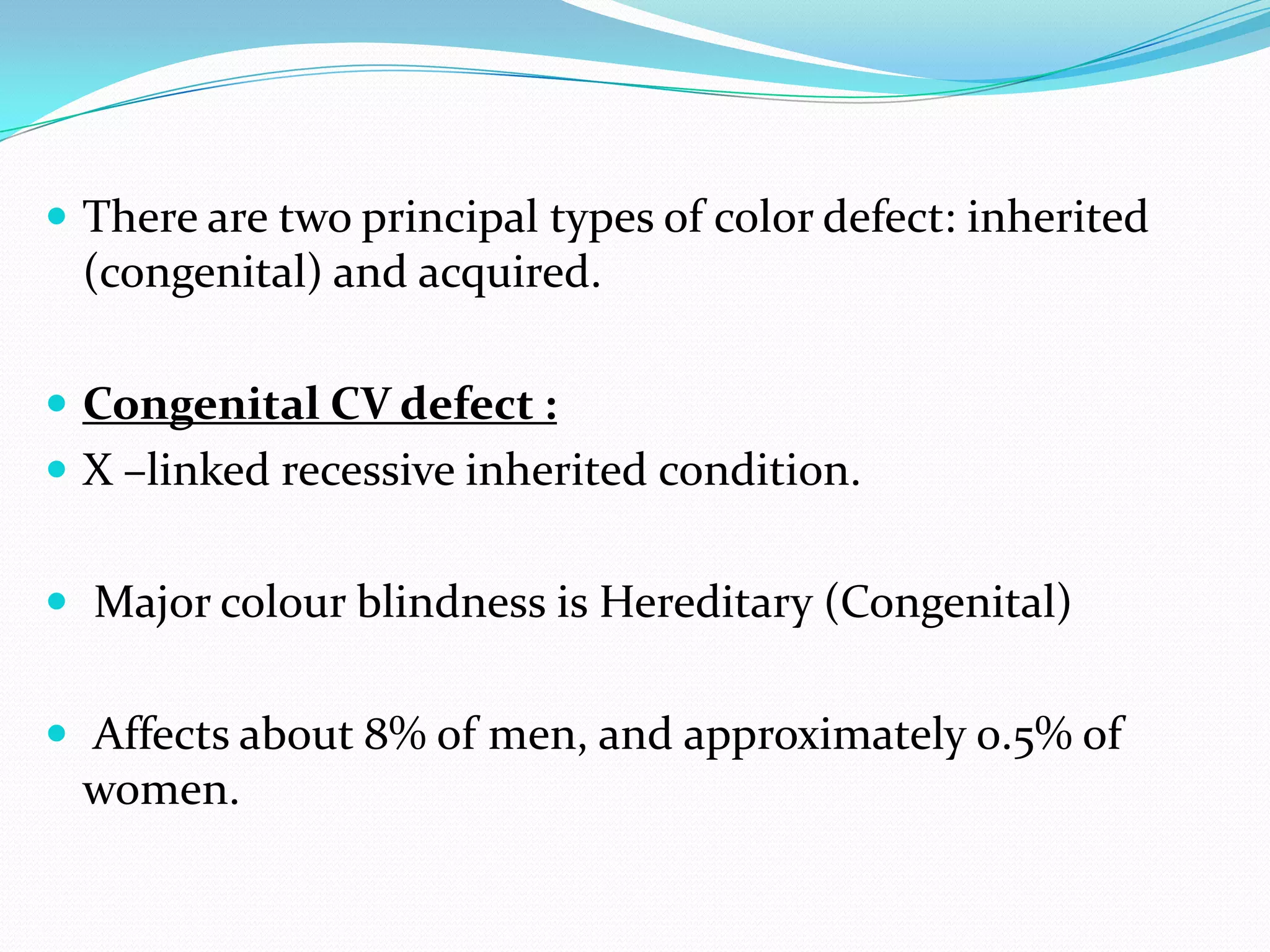
 There are two principal types of color defect: inherited
(congenital) and acquired.
 Congenital CV defect :
 X –linked recessive inherited condition.
 Major colour blindness is Hereditary (Congenital)
 Affects about 8% of men, and approximately 0.5% of
women.
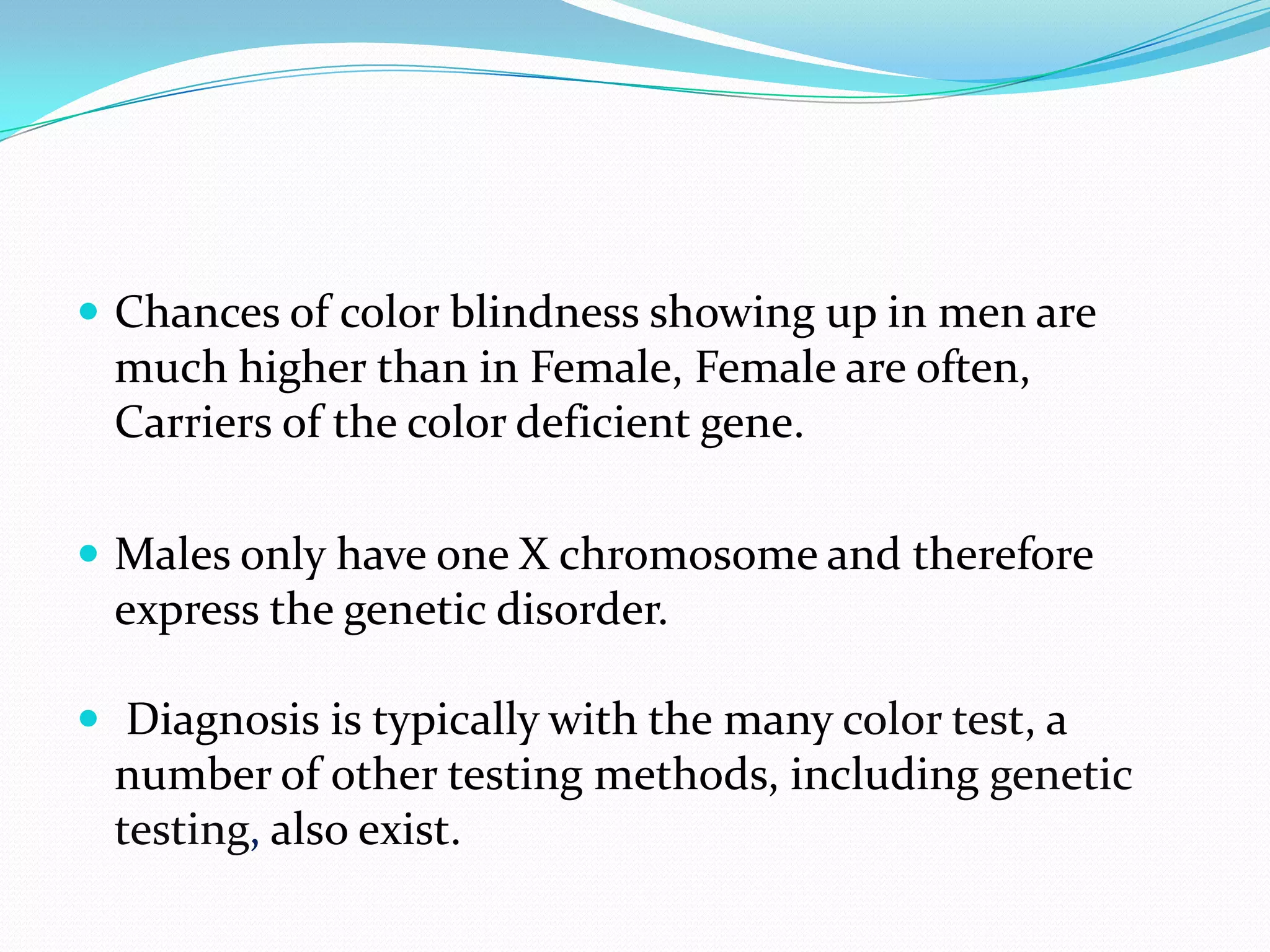
 Chances of color blindness showing up in men are
much higher than in Female, Female are often,
Carriers of the color deficient gene.
 Males only have one X chromosome and therefore
express the genetic disorder.
 Diagnosis is typically with the many color test, a
number of other testing methods, including genetic
testing, also exist.
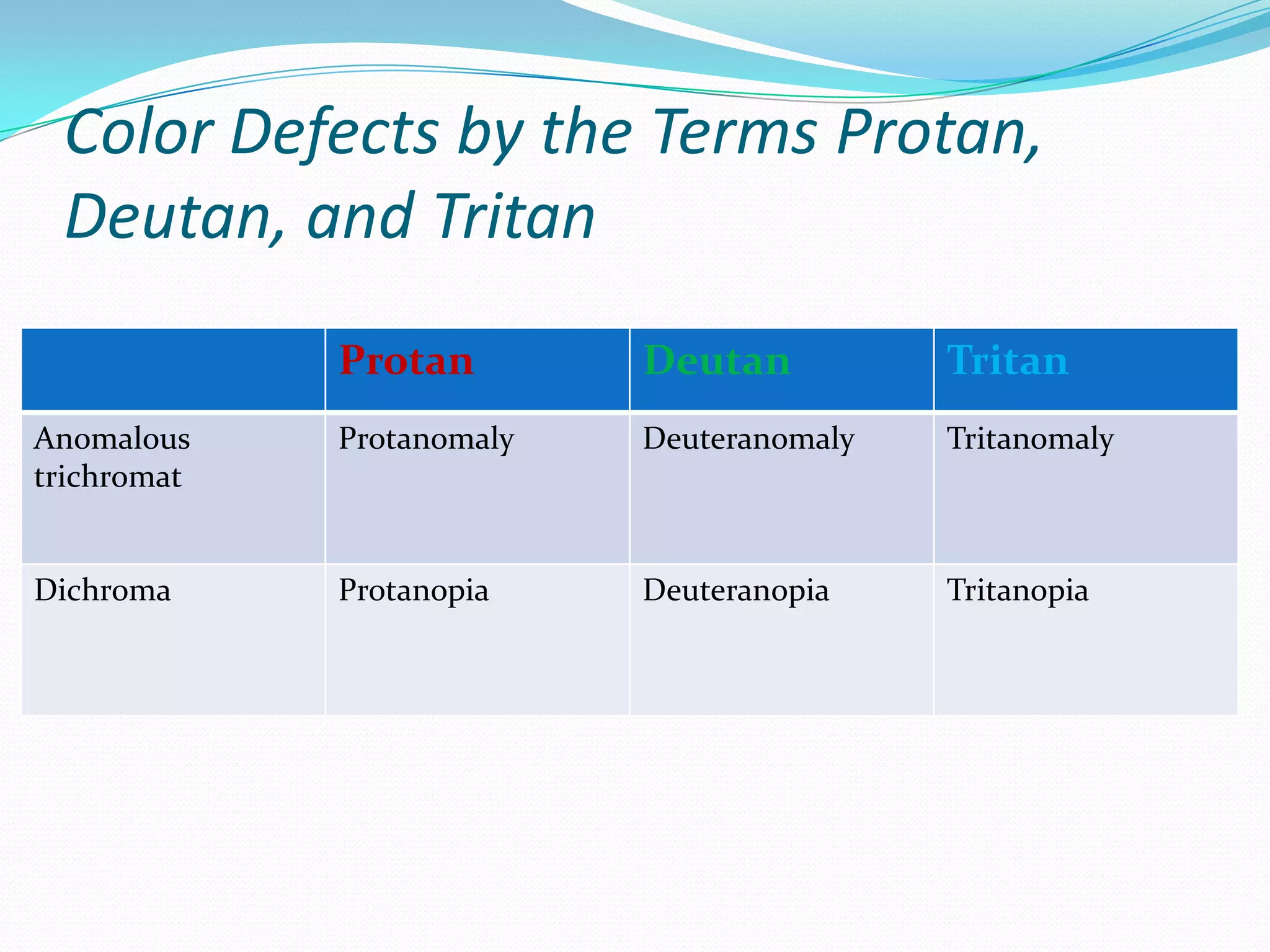
Color Defects by the Terms Protan,
Deutan, and Tritan
Protan Deutan Tritan
Anomalous
trichromat
Protanomaly Deuteranomaly Tritanomaly
Dichroma Protanopia Deuteranopia Tritanopia
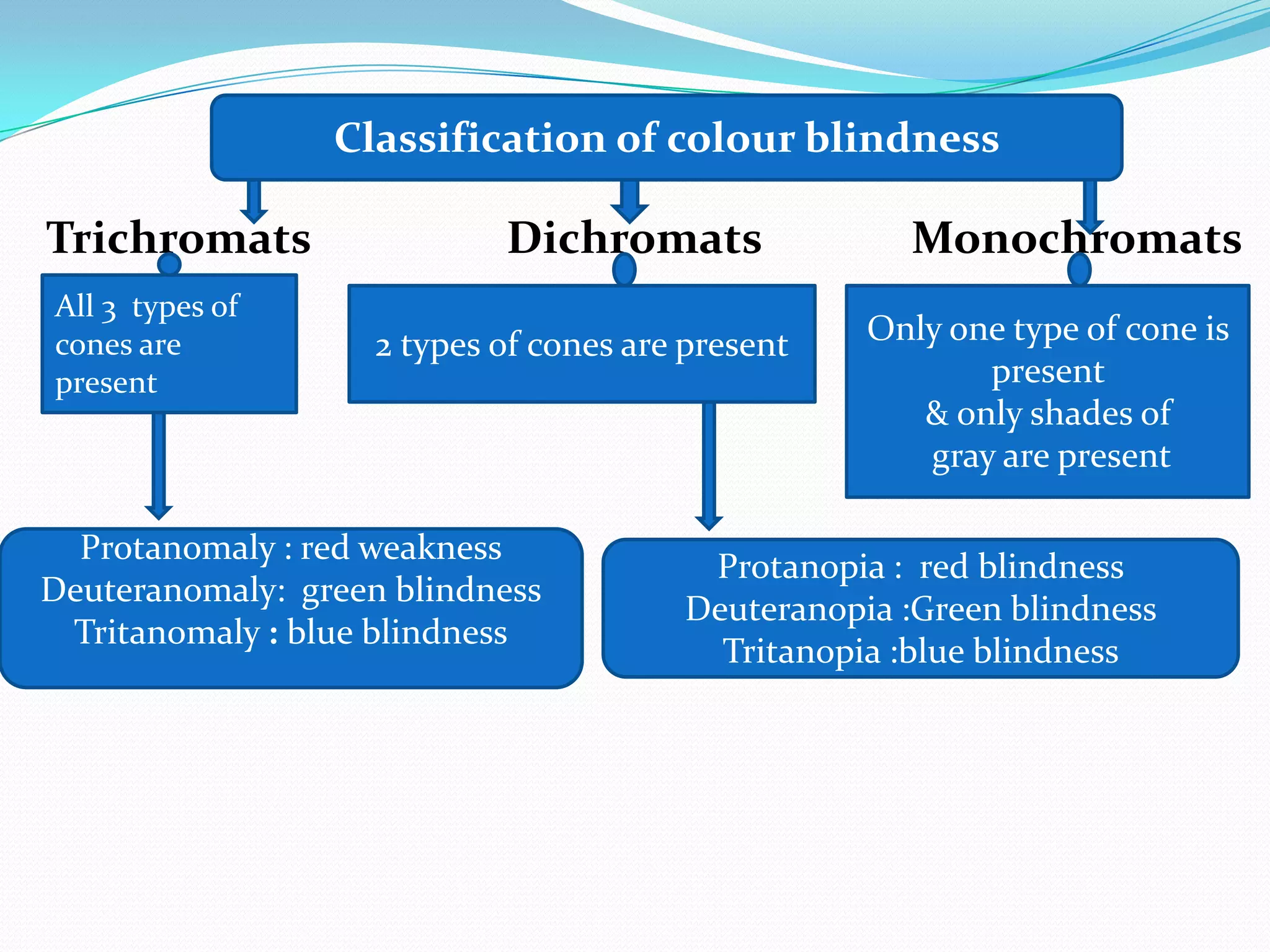
Trichromats Dichromats Monochromats
Classification of colour blindness
All 3 types of
cones are
present
2 types of cones are present Only one type of cone is
present
& only shades of
gray are present
Protanomaly : red weakness
Deuteranomaly: green blindness
Tritanomaly : blue blindness
Protanopia : red blindness
Deuteranopia :Green blindness
Tritanopia :blue blindness
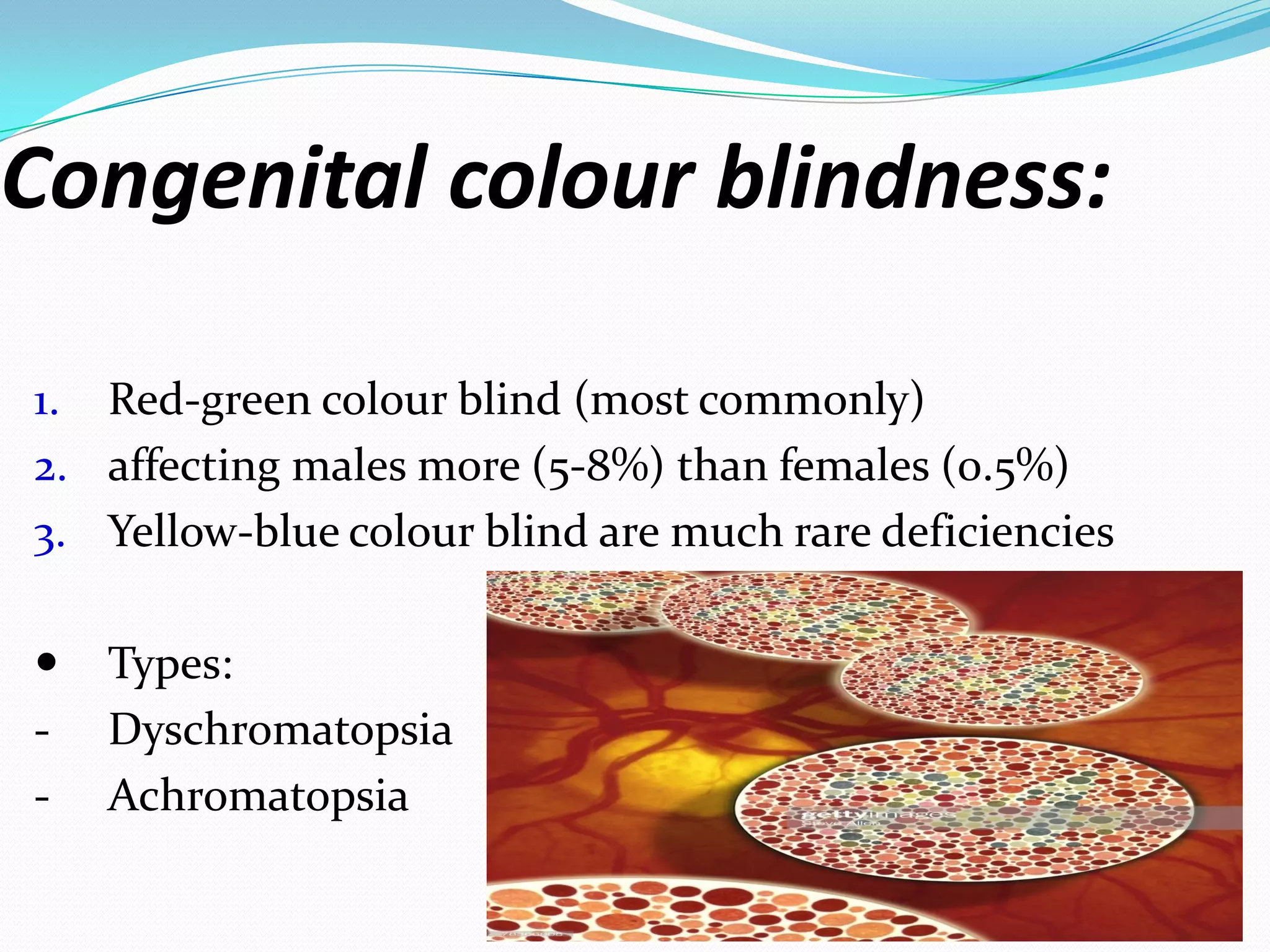
Congenital colour blindness:
1. Red-green colour blind (most commonly)
2. affecting males more (5-8%) than females (0.5%)
3. Yellow-blue colour blind are much rare deficiencies
 Types:
- Dyschromatopsia
- Achromatopsia
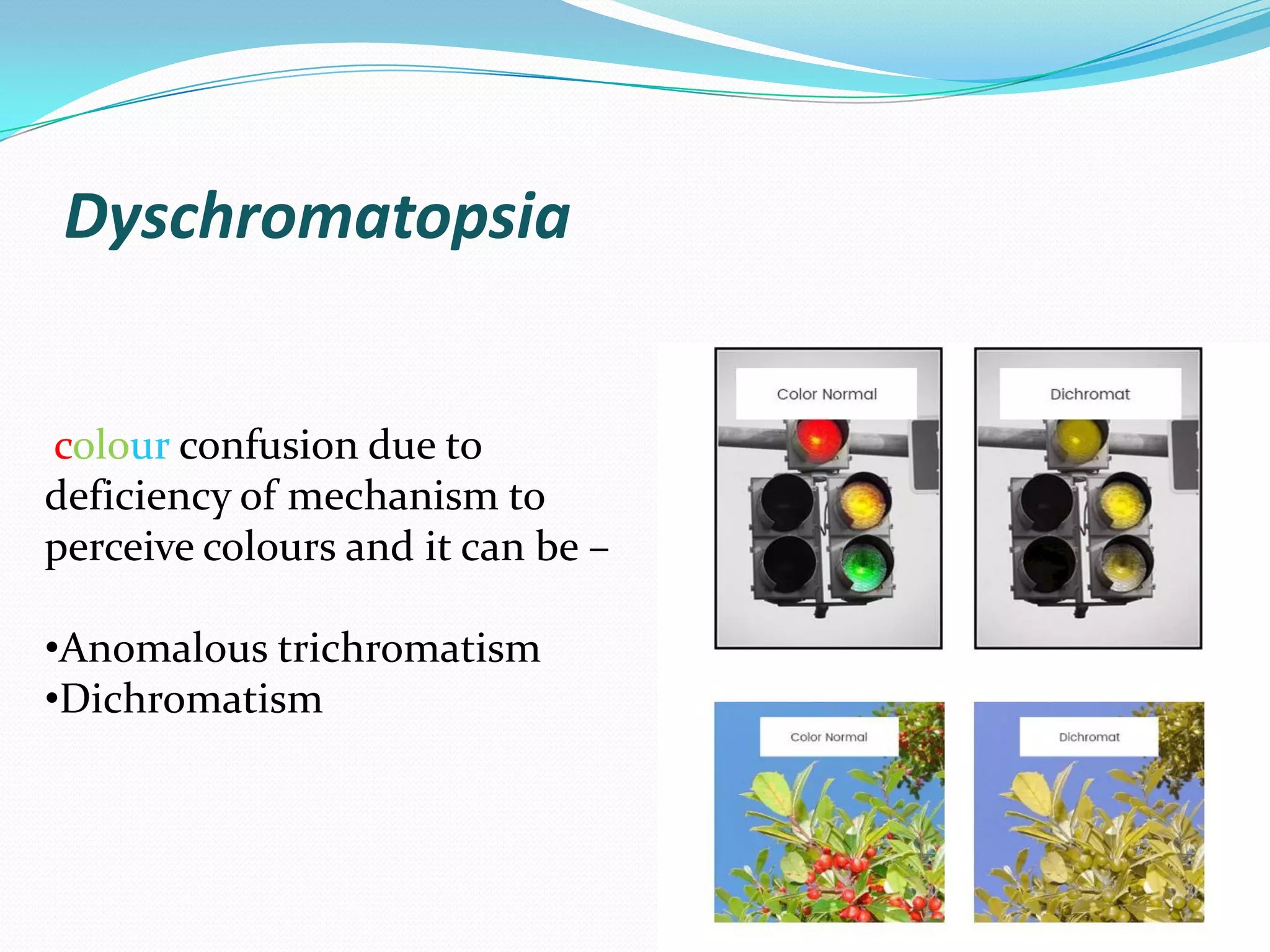
Dyschromatopsia
colour confusion due to
deficiency of mechanism to
perceive colours and it can be –
•Anomalous trichromatism
•Dichromatism
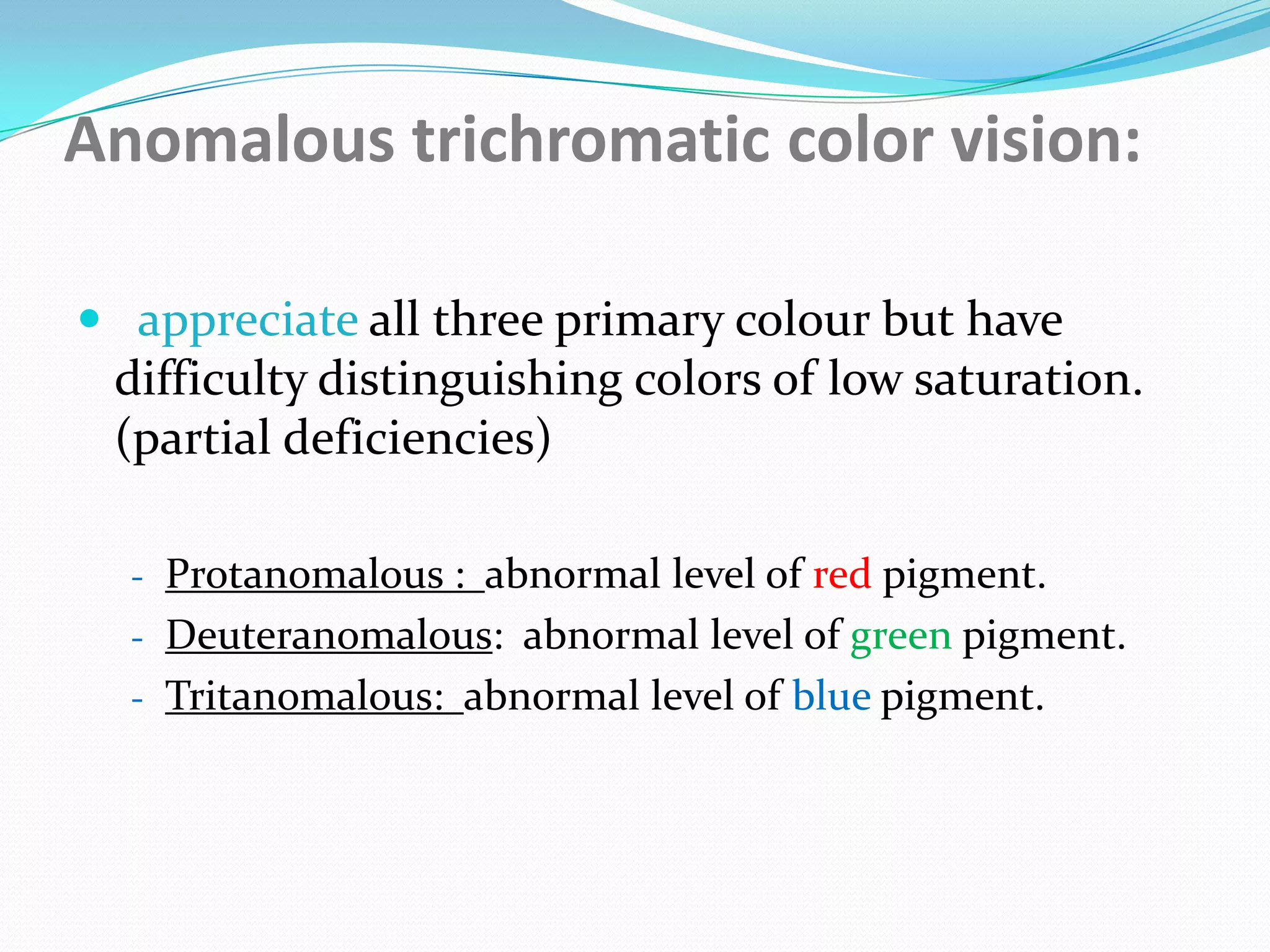
Anomalous trichromatic color vision:
 appreciate all three primary colour but have
difficulty distinguishing colors of low saturation.
(partial deficiencies)
- Protanomalous : abnormal level of red pigment.
- Deuteranomalous: abnormal level of green pigment.
- Tritanomalous: abnormal level of blue pigment.
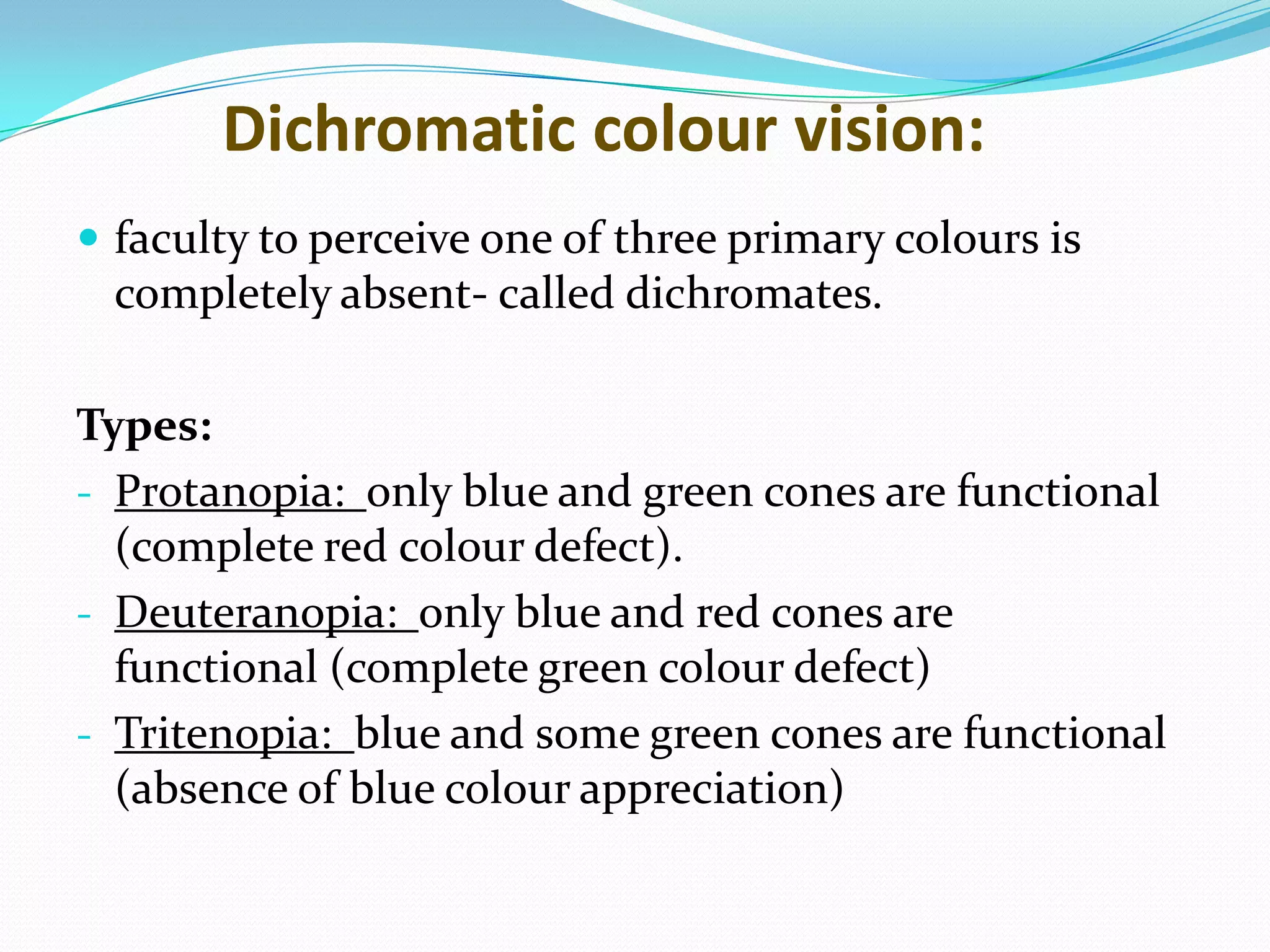
Dichromatic colour vision:
 faculty to perceive one of three primary colours is
completely absent- called dichromates.
Types:
- Protanopia: only blue and green cones are functional
(complete red colour defect).
- Deuteranopia: only blue and red cones are
functional (complete green colour defect)
- Tritenopia: blue and some green cones are functional
(absence of blue colour appreciation)
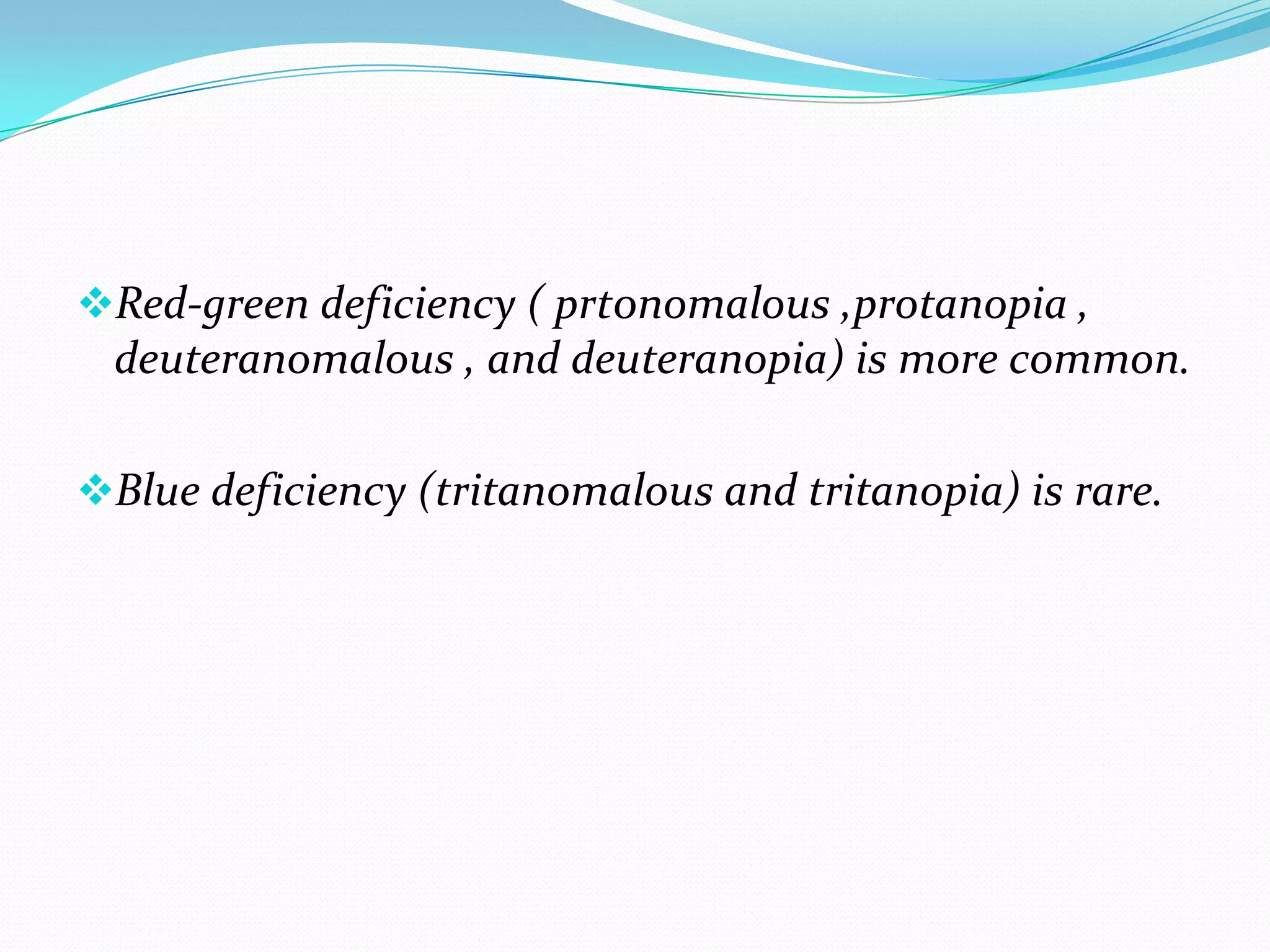
Red-green deficiency ( prt0nomalous ,protanopia ,
deuteranomalous , and deuteranopia) is more common.
Blue deficiency (tritanomalous and tritanopia) is rare.
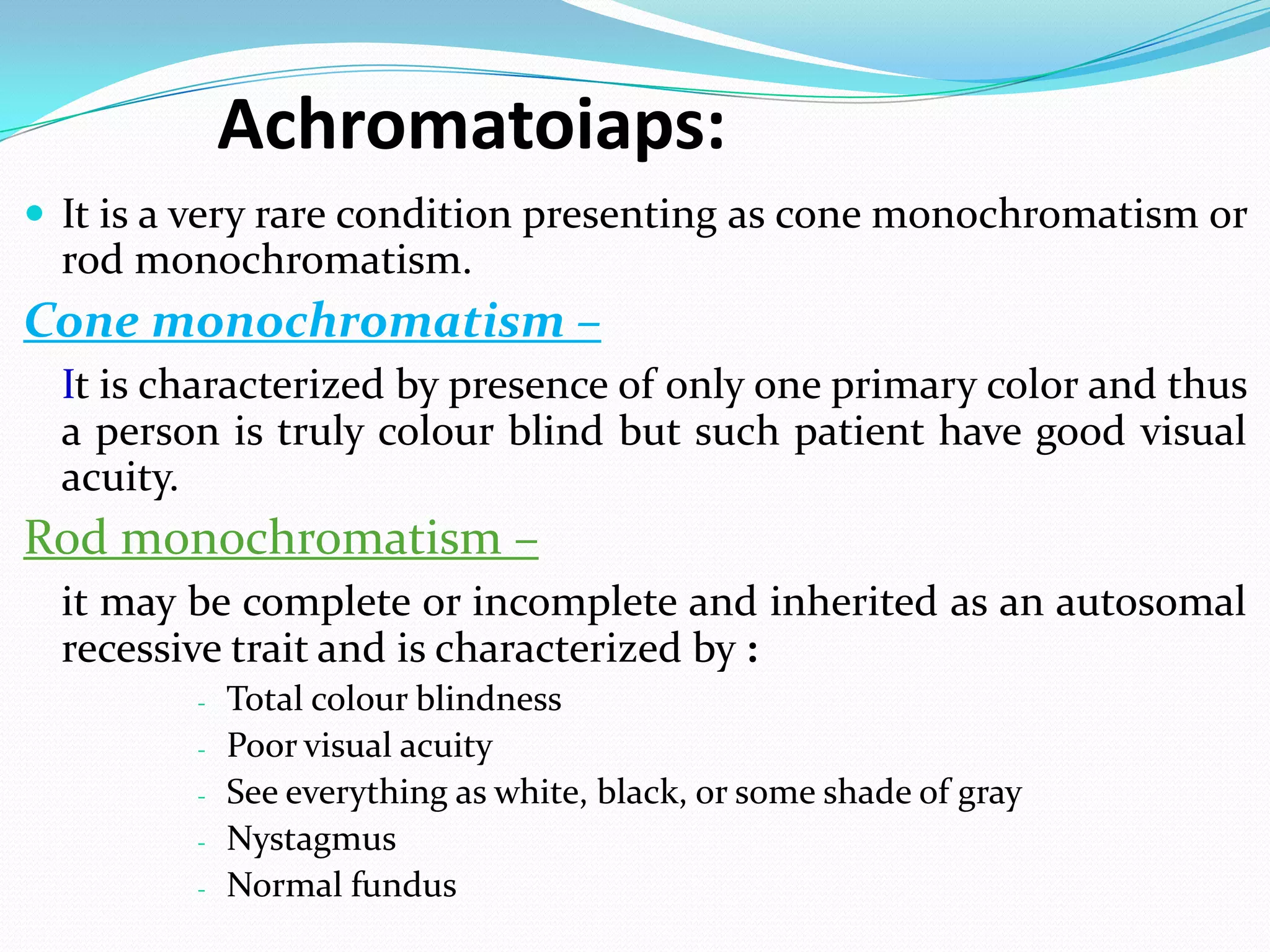
Achromatoiaps:
 It is a very rare condition presenting as cone monochromatism or
rod monochromatism.
Cone monochromatism –
It is characterized by presence of only one primary color and thus
a person is truly colour blind but such patient have good visual
acuity.
Rod monochromatism –
it may be complete or incomplete and inherited as an autosomal
recessive trait and is characterized by :
- Total colour blindness
- Poor visual acuity
- See everything as white, black, or some shade of gray
- Nystagmus
- Normal fundus
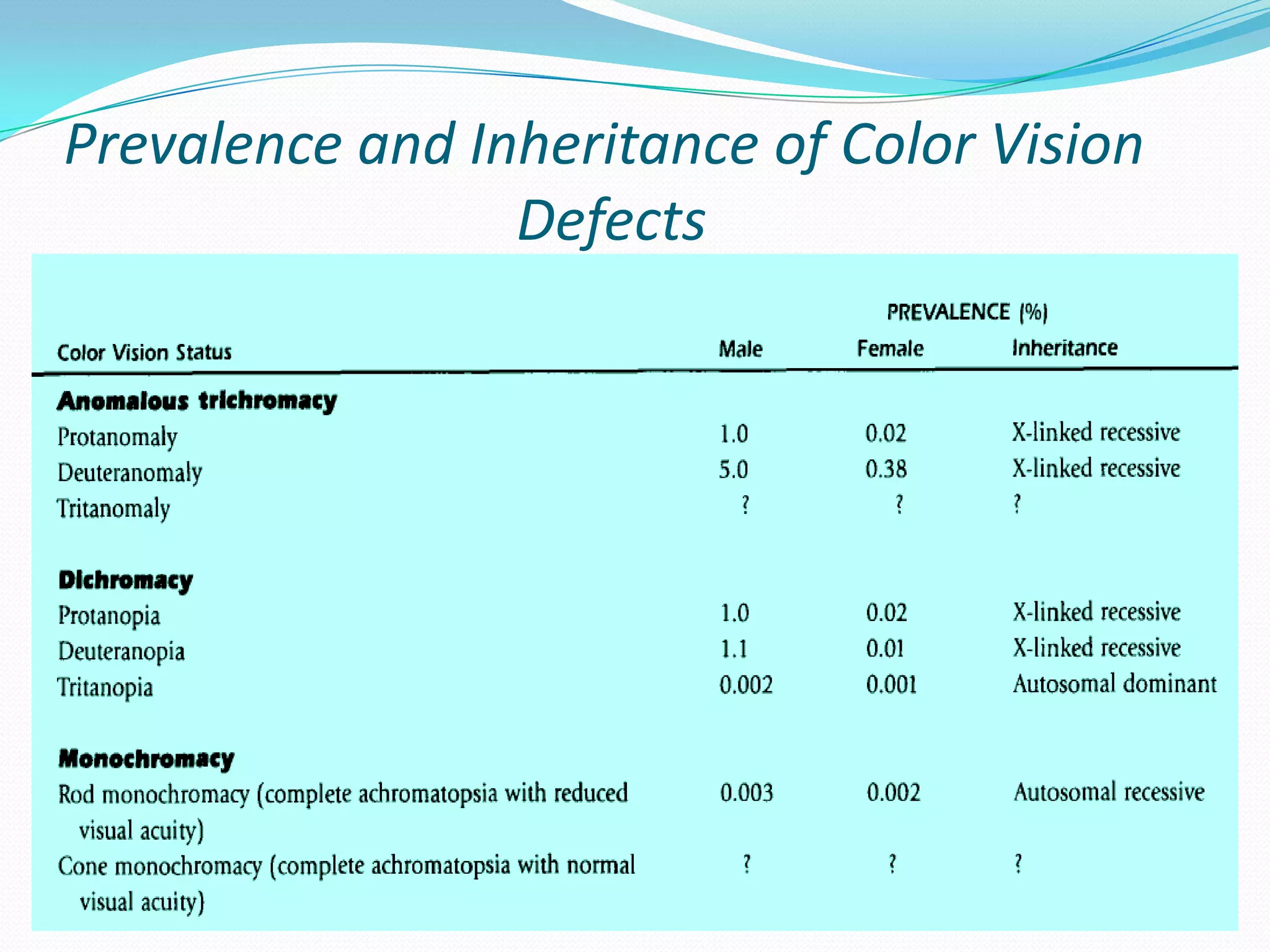
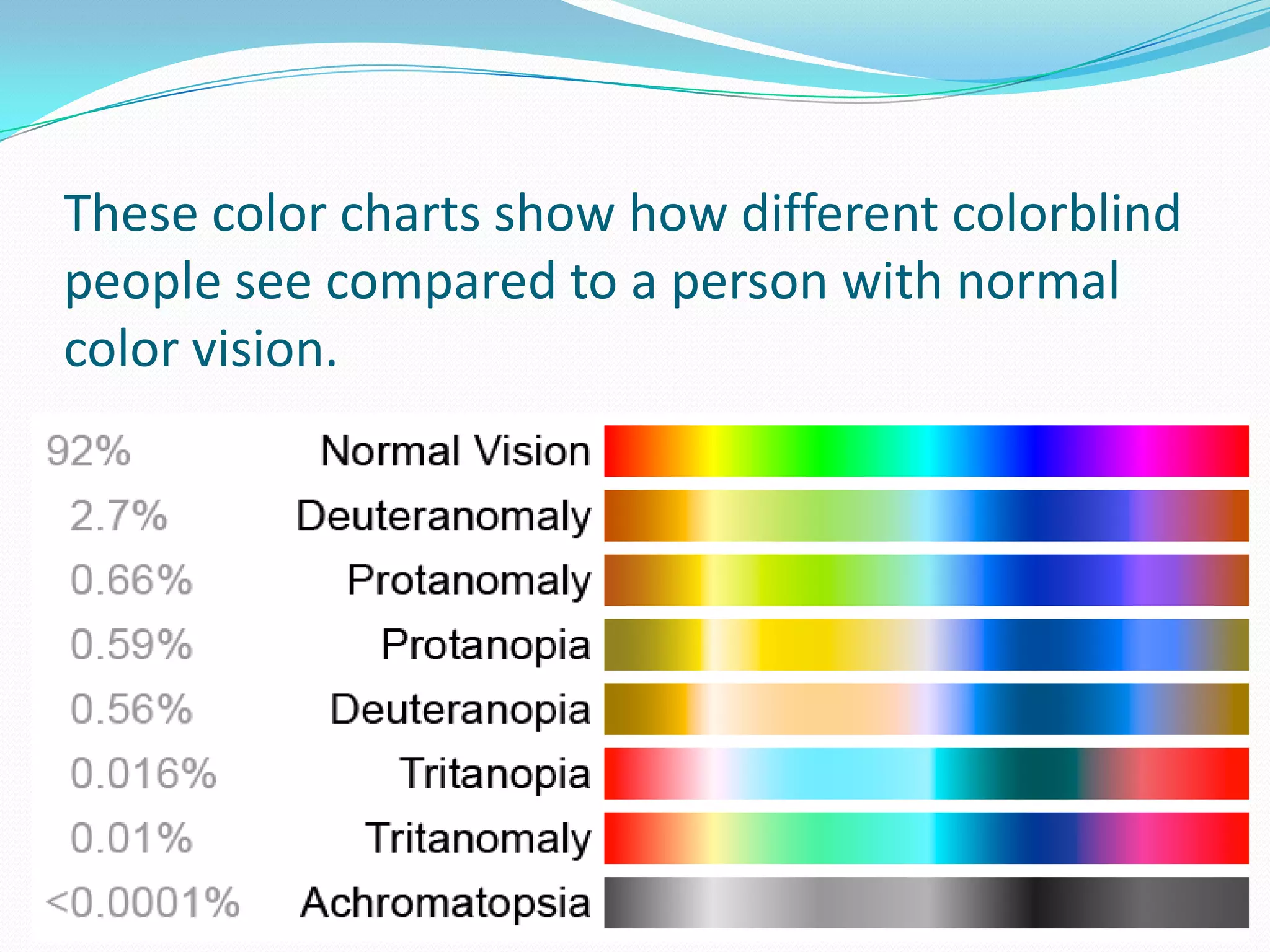
Prevalence and Inheritance of Color Vision
Defects
These color charts show how different colorblind
people see compared to a person with normal
color vision.
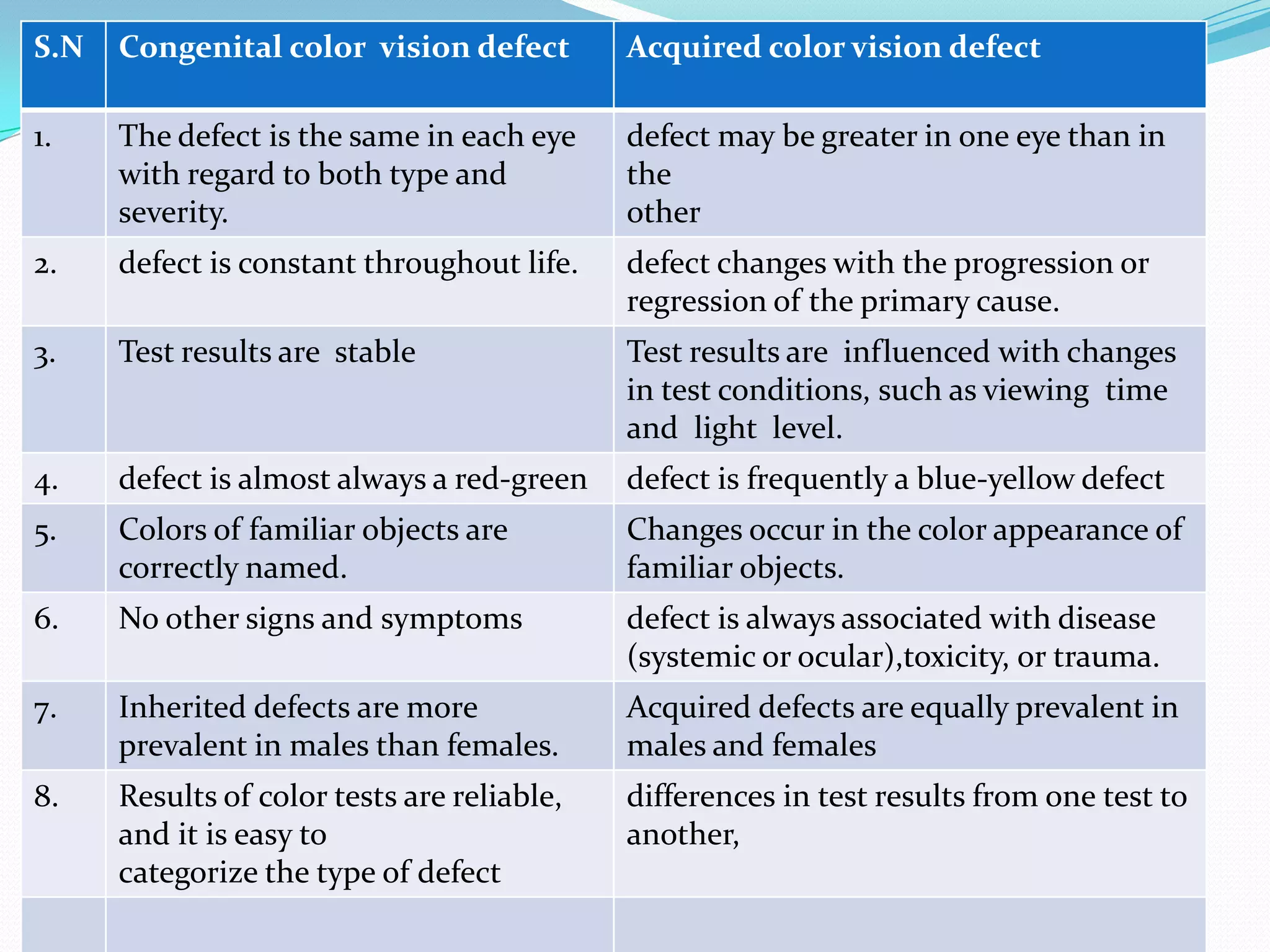
S.N Congenital color vision defect Acquired color vision defect
1. The defect is the same in each eye
with regard to both type and
severity.
defect may be greater in one eye than in
the
other
2. defect is constant throughout life. defect changes with the progression or
regression of the primary cause.
3. Test results are stable Test results are influenced with changes
in test conditions, such as viewing time
and light level.
4. defect is almost always a red-green defect is frequently a blue-yellow defect
5. Colors of familiar objects are
correctly named.
Changes occur in the color appearance of
familiar objects.
6. No other signs and symptoms defect is always associated with disease
(systemic or ocular),toxicity, or trauma.
7. Inherited defects are more
prevalent in males than females.
Acquired defects are equally prevalent in
males and females
8. Results of color tests are reliable,
and it is easy to
categorize the type of defect
differences in test results from one test to
another,
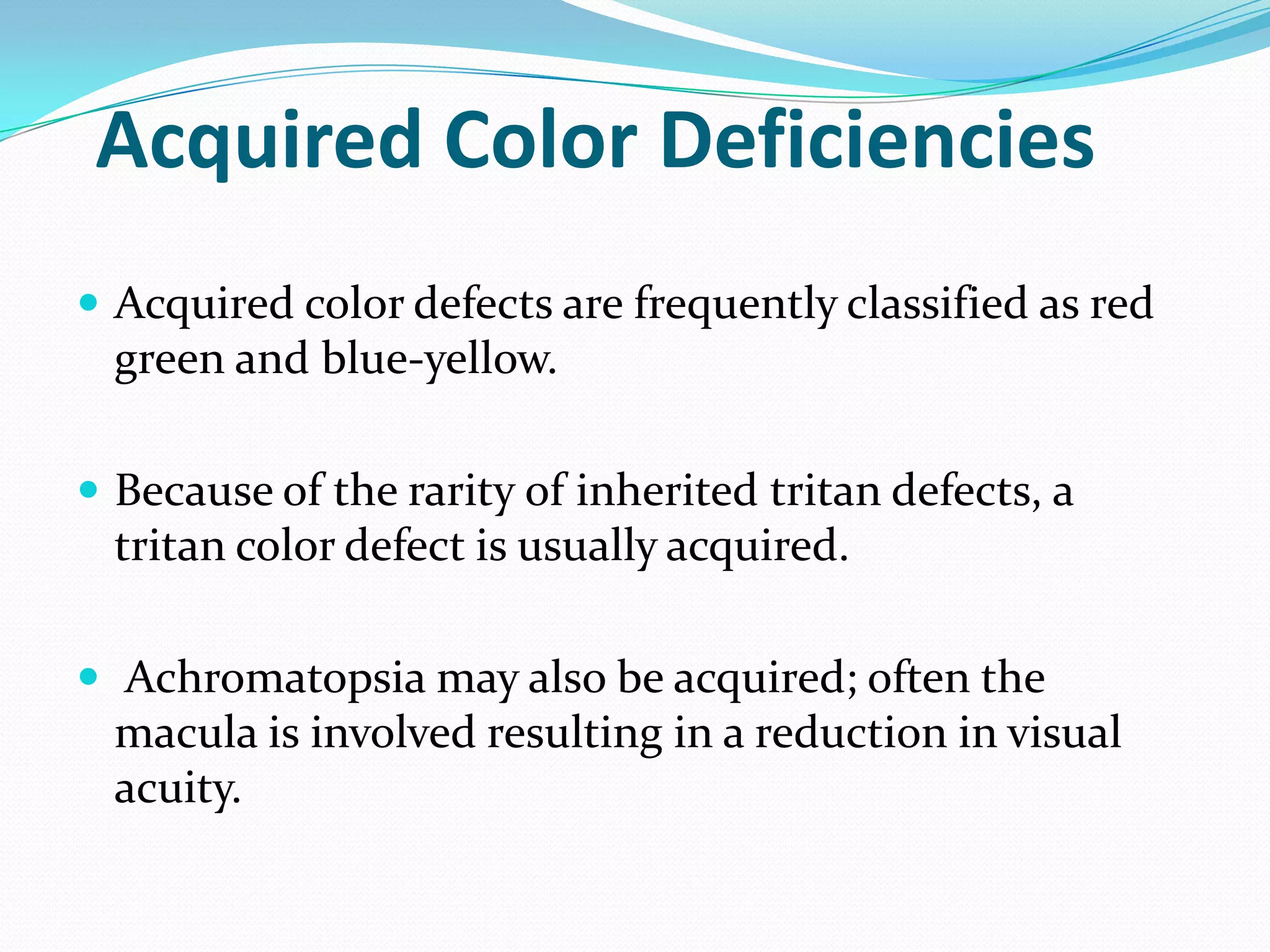
Acquired Color Deficiencies
 Acquired color defects are frequently classified as red
green and blue-yellow.
 Because of the rarity of inherited tritan defects, a
tritan color defect is usually acquired.
 Achromatopsia may also be acquired; often the
macula is involved resulting in a reduction in visual
acuity.
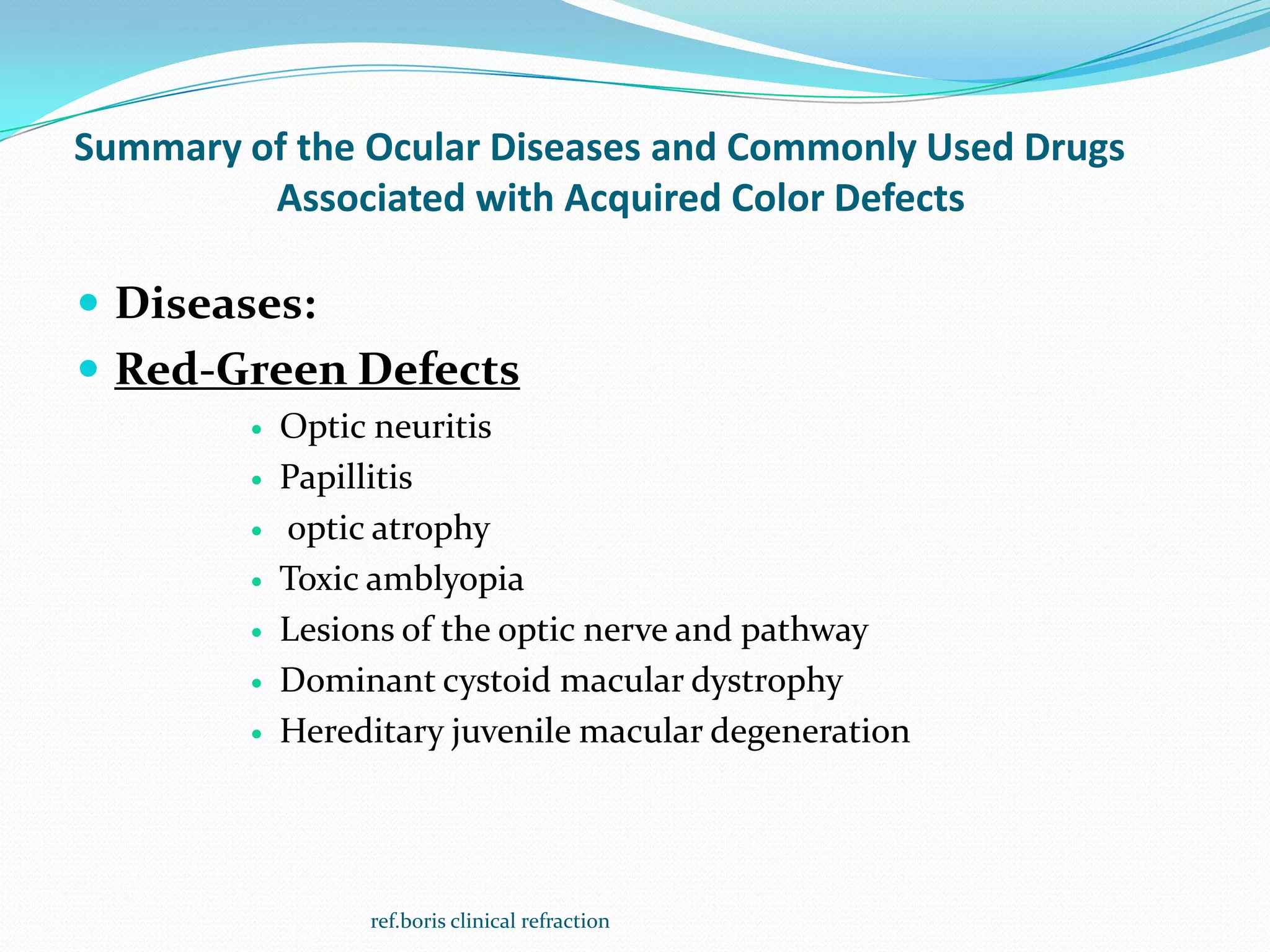
Summary of the Ocular Diseases and Commonly Used Drugs
Associated with Acquired Color Defects
 Diseases:
 Red-Green Defects
 Optic neuritis
 Papillitis
 optic atrophy
 Toxic amblyopia
 Lesions of the optic nerve and pathway
 Dominant cystoid macular dystrophy
 Hereditary juvenile macular degeneration
ref.boris clinical refraction
 Blue-Yellow Defects
 Glaucoma*
 Diabetes
 Retinal detachment
 Age-related maculopathy
 Chorioretinitis
 Central serous retinopathy
 Papilledema
 Hereditary autosomal dominant optic atrophy
Drugs induced cvD
 Red-Green Defects
 Antidiabetics (oral)
 Tuberculostatics
 Blue-Yellow Defects
 Erythromycin : antibiotic used to treat bacterial infections.
 Indomethacin: to treat osteoarthritis, rheumatoid
arthritis, gouty arthritis, or ankylosing spondylitis.
 Trimethadione : anti-epileptic medication.
 Chloroquine derivatives : Antimalarial medications.
 Phenothiazine derivatives : antipsychotics medication.
 Red-Green and/or Blue-Yellow Defects
 Ethanol : in management of toxicity due to ingestion of
methanol, or ethylene glycol.
 Cardiac glycosides : for improving the cardiac function.
 Oral contraceptives.
 The diagnosis of the specific type of acquired
color defect can lead to clues about the site in the
visual system at which the anomaly lies, and this may
facilitate the differential diagnosis of the underlying
disease or cause.
 Diagnosis may allow a person's to change their method
of teaching to accommodate the decreased ability to
recognize colors.
Reference.
 BORISH'S CLINICAL Refraction, SECOND EDITION
 CLINICAL PROCEDURES IN OPTOMETRY.
 Diagnostic Procedures in OPHTHALMOLOGY ,SECOND EDITION
 Journals.
Thank
you..
..for your valuable time..

Color vision : introduction, classification, causes

  • 1.
  • 2.
    Presentation layout.  Introductionon color vision  Introduction on color blindness.  Types of colour vision defect and its classification, causes.  Prevalence.  Congenital vs acquired colour vision defect.
  • 3.
    Introduction on colorvision  Color vision is that attribute of the sense of sight which provides an appreciation of differences in the physical composition of wavelength of light that excite the retina.  John dalton first reported color vision in 1798 (reports of his own color blindness as compared to his colleagues with normal color vision.
  • 4.
     Colour visionis a function of the cones and thus, better appreciated in photopic vision.  In dim light (scotopic vision), all colors are seen grey and this phenomenon is called Purkinje shift.
  • 5.
     There arethree different types of cones viz.  red sensitive, 56%(erythrolabe)  green sensitive, 37% (chlorolabe)  blue sensitive, 7% (cynolabe)  which combinedly perform the function of colour vision
  • 7.
    Facts.  Color perceptionsbest in the fovea and declines in the periphery.  The "green" and "red" cones are mostly packed into the fovea centralis.  Sensitivity to red–green color variations declines more steeply toward the periphery than sensitivity to luminance or blue–yellow colors. Due to the increasing size of receptive fields of parvocellular retinal ganglion cells ref.ARVO journal
  • 8.
    •Illustration of thedistribution of cone cells in the fovea of an individual with normal color vision (left), and a color blind (protanopic) retina. The center of the fovea holds very few blue sensitive cones.
  • 9.
    Colours have threeattributes : (1) Hue : Defined as how most of us perceive and name a color – using the colors of the rainbow (red, orange, green, blue, etc.). Reference the color wheel, to see how colors shift from one hue to the next.
  • 10.
    (2)Chroma (saturation) :Describesthe vividness or dullness of color. the orange on the right is vivid, while the carrot on the left appears to be more dull.  (3) Brightness : which indicates the intensity of light emitted or reflected by the surface.
  • 11.
     Our eyesperceive colour with wavelength of light ranging from 400 to 700nm. Three classes of cones: 1st class : SWS receptors.  7% in retina i.e Blue cone.  More sensitive to blue violet wavelength around 453 nm. 2nd class :MWS receptor  37% in retina i.e Green cones  Most sensitive to green wavelength around 530 nm.
  • 12.
     3rd class: LWS receptors .  56% in retina i.e. Red cones.  More sensitive to Red wavelength about 565 nm.
  • 13.
    COLOR BLINDNESS  Colourblindness (color vision deficiency) is a condition in which certain colors or shades of colors cannot be distinguished to some degree or , commonly due to inherited condition.  Normal colour vision is known as ‘trichromate’.  Color blindness is called daltonism.  Humans beings are born color blind, Photoreceptors are not developed till the child is 4 months old  Defective perception is anomalous and absence of colour perception is anopia.
  • 14.
     There aretwo principal types of color defect: inherited (congenital) and acquired.  Congenital CV defect :  X –linked recessive inherited condition.  Major colour blindness is Hereditary (Congenital)  Affects about 8% of men, and approximately 0.5% of women.
  • 15.
     Chances ofcolor blindness showing up in men are much higher than in Female, Female are often, Carriers of the color deficient gene.  Males only have one X chromosome and therefore express the genetic disorder.  Diagnosis is typically with the many color test, a number of other testing methods, including genetic testing, also exist.
  • 16.
    Color Defects bythe Terms Protan, Deutan, and Tritan Protan Deutan Tritan Anomalous trichromat Protanomaly Deuteranomaly Tritanomaly Dichroma Protanopia Deuteranopia Tritanopia
  • 17.
    Trichromats Dichromats Monochromats Classificationof colour blindness All 3 types of cones are present 2 types of cones are present Only one type of cone is present & only shades of gray are present Protanomaly : red weakness Deuteranomaly: green blindness Tritanomaly : blue blindness Protanopia : red blindness Deuteranopia :Green blindness Tritanopia :blue blindness
  • 18.
    Congenital colour blindness: 1.Red-green colour blind (most commonly) 2. affecting males more (5-8%) than females (0.5%) 3. Yellow-blue colour blind are much rare deficiencies  Types: - Dyschromatopsia - Achromatopsia
  • 19.
    Dyschromatopsia colour confusion dueto deficiency of mechanism to perceive colours and it can be – •Anomalous trichromatism •Dichromatism
  • 20.
    Anomalous trichromatic colorvision:  appreciate all three primary colour but have difficulty distinguishing colors of low saturation. (partial deficiencies) - Protanomalous : abnormal level of red pigment. - Deuteranomalous: abnormal level of green pigment. - Tritanomalous: abnormal level of blue pigment.
  • 21.
    Dichromatic colour vision: faculty to perceive one of three primary colours is completely absent- called dichromates. Types: - Protanopia: only blue and green cones are functional (complete red colour defect). - Deuteranopia: only blue and red cones are functional (complete green colour defect) - Tritenopia: blue and some green cones are functional (absence of blue colour appreciation)
  • 22.
    Red-green deficiency (prt0nomalous ,protanopia , deuteranomalous , and deuteranopia) is more common. Blue deficiency (tritanomalous and tritanopia) is rare.
  • 23.
    Achromatoiaps:  It isa very rare condition presenting as cone monochromatism or rod monochromatism. Cone monochromatism – It is characterized by presence of only one primary color and thus a person is truly colour blind but such patient have good visual acuity. Rod monochromatism – it may be complete or incomplete and inherited as an autosomal recessive trait and is characterized by : - Total colour blindness - Poor visual acuity - See everything as white, black, or some shade of gray - Nystagmus - Normal fundus
  • 24.
    Prevalence and Inheritanceof Color Vision Defects
  • 25.
    These color chartsshow how different colorblind people see compared to a person with normal color vision.
  • 26.
    S.N Congenital colorvision defect Acquired color vision defect 1. The defect is the same in each eye with regard to both type and severity. defect may be greater in one eye than in the other 2. defect is constant throughout life. defect changes with the progression or regression of the primary cause. 3. Test results are stable Test results are influenced with changes in test conditions, such as viewing time and light level. 4. defect is almost always a red-green defect is frequently a blue-yellow defect 5. Colors of familiar objects are correctly named. Changes occur in the color appearance of familiar objects. 6. No other signs and symptoms defect is always associated with disease (systemic or ocular),toxicity, or trauma. 7. Inherited defects are more prevalent in males than females. Acquired defects are equally prevalent in males and females 8. Results of color tests are reliable, and it is easy to categorize the type of defect differences in test results from one test to another,
  • 27.
    Acquired Color Deficiencies Acquired color defects are frequently classified as red green and blue-yellow.  Because of the rarity of inherited tritan defects, a tritan color defect is usually acquired.  Achromatopsia may also be acquired; often the macula is involved resulting in a reduction in visual acuity.
  • 28.
    Summary of theOcular Diseases and Commonly Used Drugs Associated with Acquired Color Defects  Diseases:  Red-Green Defects  Optic neuritis  Papillitis  optic atrophy  Toxic amblyopia  Lesions of the optic nerve and pathway  Dominant cystoid macular dystrophy  Hereditary juvenile macular degeneration ref.boris clinical refraction
  • 29.
     Blue-Yellow Defects Glaucoma*  Diabetes  Retinal detachment  Age-related maculopathy  Chorioretinitis  Central serous retinopathy  Papilledema  Hereditary autosomal dominant optic atrophy
  • 30.
    Drugs induced cvD Red-Green Defects  Antidiabetics (oral)  Tuberculostatics  Blue-Yellow Defects  Erythromycin : antibiotic used to treat bacterial infections.  Indomethacin: to treat osteoarthritis, rheumatoid arthritis, gouty arthritis, or ankylosing spondylitis.  Trimethadione : anti-epileptic medication.  Chloroquine derivatives : Antimalarial medications.  Phenothiazine derivatives : antipsychotics medication.
  • 31.
     Red-Green and/orBlue-Yellow Defects  Ethanol : in management of toxicity due to ingestion of methanol, or ethylene glycol.  Cardiac glycosides : for improving the cardiac function.  Oral contraceptives.
  • 32.
     The diagnosisof the specific type of acquired color defect can lead to clues about the site in the visual system at which the anomaly lies, and this may facilitate the differential diagnosis of the underlying disease or cause.  Diagnosis may allow a person's to change their method of teaching to accommodate the decreased ability to recognize colors.
  • 33.
    Reference.  BORISH'S CLINICALRefraction, SECOND EDITION  CLINICAL PROCEDURES IN OPTOMETRY.  Diagnostic Procedures in OPHTHALMOLOGY ,SECOND EDITION  Journals.
  • 34.