Color vision Manal Al-Romeih
Definition  Is the  initiation of visual response by absorption of light by three different spectral classes of cones. The capacity of the eye to distinguish objects based on the wavelengths or the frequencies of the light they reflect or emit.
Three classes of cones   Short-wavelength sensitive: (S-cones), 440 nm. Middle-wavelength sensitive: (M-cones), 545 nm. Long-wavelength sensitive: (L-cones), 565 nm. All have different but overlapping spectral sensitivities.
Physical Color Concepts     light is not colored.  physical optics dimensions (e.g., wavelength, frequency, quantum energy) are closely connected with the effect of the light on the human visual system. the color is in the visual system, not in the light.
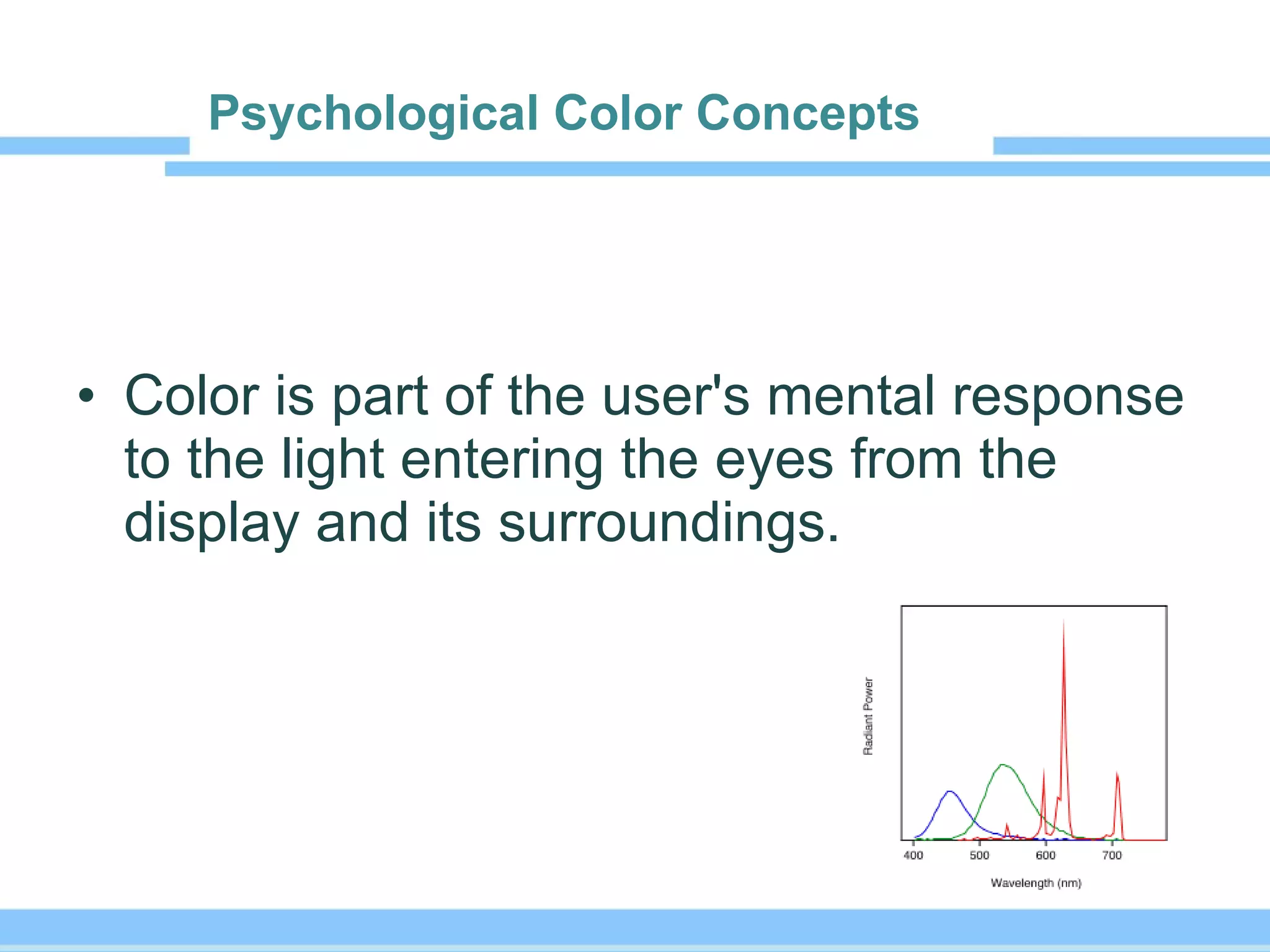
Psychological Color Concepts   Color is part of the user's mental response to the light entering the eyes from the display and its surroundings.
  Three dimensions to describe color experience Hue .  the dimension of color experience that most people mean by the nontechnical term "color". It is described by the labels "red", "blue", "green", "magenta", etc.
Saturation . is the dimension of color experience which ranges from "colorless" through "pale" to "vivid".  The perceived color can be described in terms of whether it appears closer to the "colorless" end or the purely chromatic end.  Saturation increases from left to right in this figure.
Brightness is the apparent amount of light, varying from "dim" to "bright". Brightness increases from bottom to top in this figure.
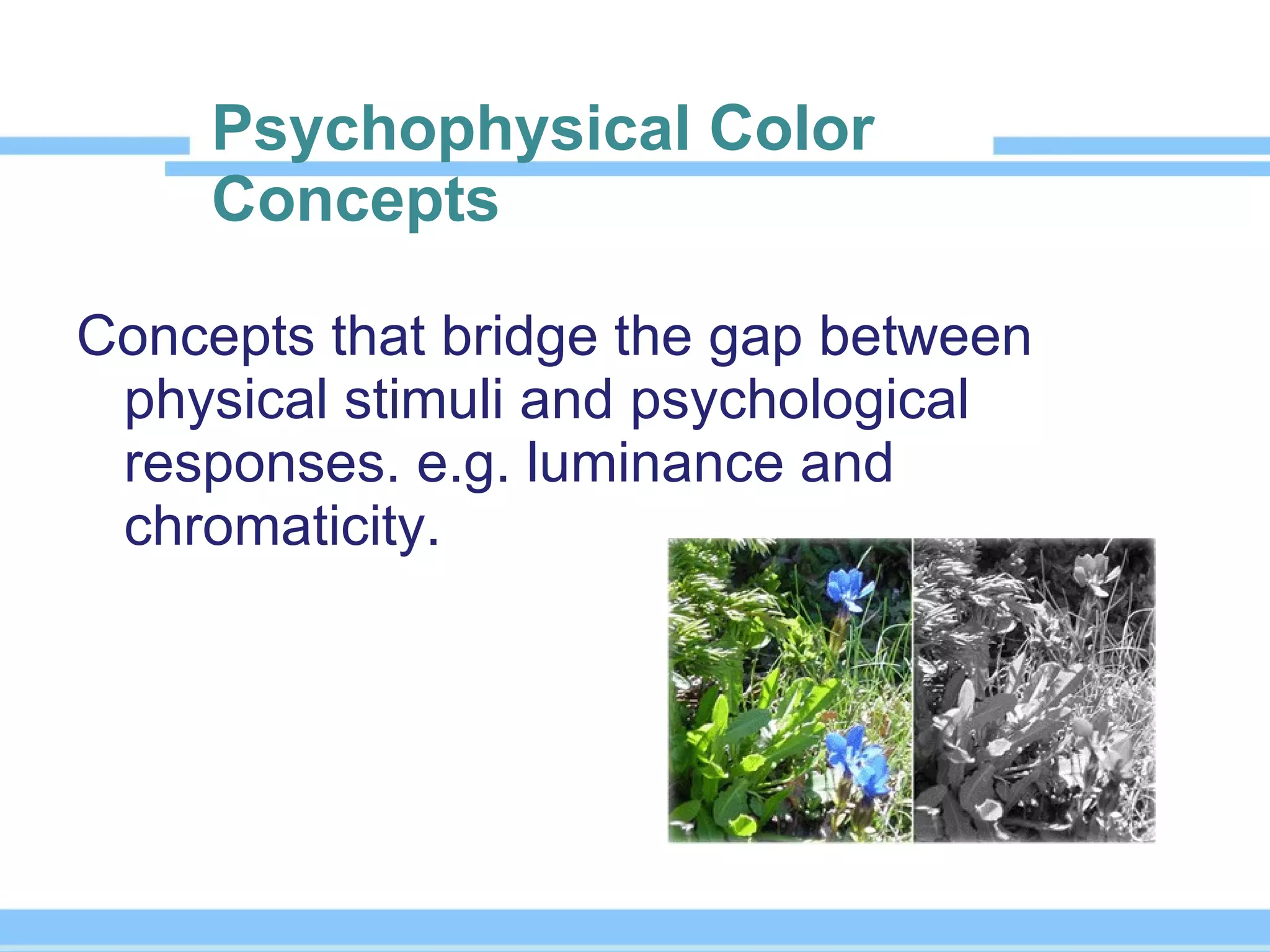
Psychophysical Color Concepts Concepts that bridge the gap between physical stimuli and psychological responses. e.g. luminance and chromaticity.
COLOR DISCRIMINATION AND IDENTIFICATION Small color differences can be distinguished when the areas to be discriminated are large, immediately adjacent to each other (share an edge near the viewed point) and are displayed at the same time.
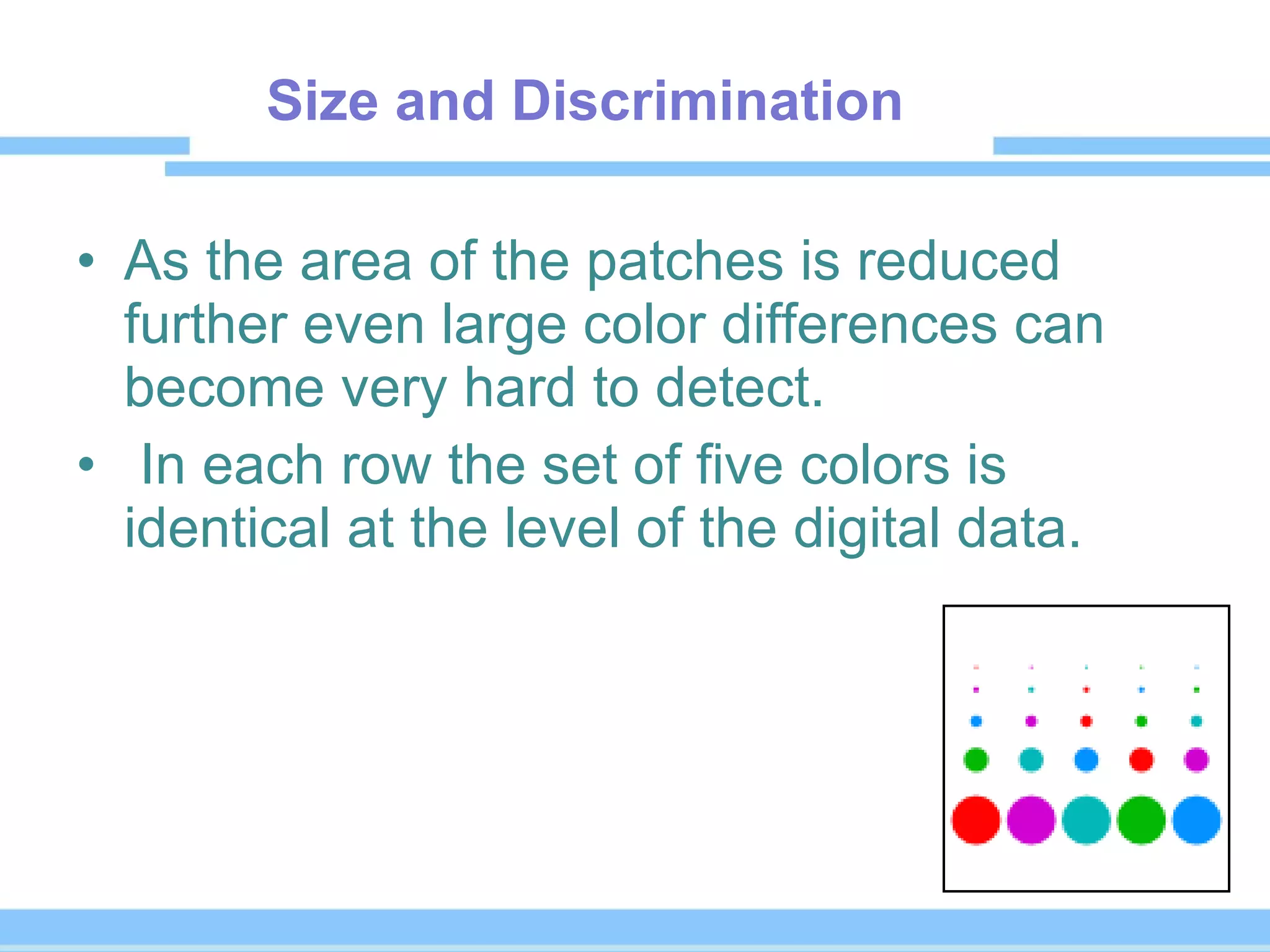
Size and Discrimination Here are the same colors in the previous figure, but the areas are smaller and the patches are separated from each other by the contrasting white background. Adjacent pairs are difficult or impossible to discriminate.
Size and Discrimination As the area of the patches is reduced further even large color differences can become very hard to detect.   In each row the set of five colors is identical at the level of the digital data. 
Edge vs. Smooth Gradient Color discrimination is best when a sharp edge separates the colors to be discriminated. When a smooth gradient separates two color patches the smallest detectable difference in color is larger than it would be if the patches were adjacent and separated by a sharp edge, and the difference of color appearance is reduced.
COLOR VISION DEFECTS   the inability to distinguish certain shades of color or in more severe cases, see colors at all. Causes: Inherited:   X-linked recessive gene Acquired:  diabetes, glaucoma, medication, aging, and Chemical Exposure.
Diagnosis  Pseudoisochromatic testing plates: The patient is asked to look for numbers among the various colored dots, which help distinguish between red, green and blue color deficiencies. Individuals with normal color vision will see a number, while those with a deficiency do not see it. On some plates, a person with normal color vision may see one number, while a person with a  deficiency sees a different number.
Additional diagnostic tests  (discriminating) Frans worth-munsell 100-hue test. The D-15 or Dichotomous test.
Treatment  There’s no cure for inherited color deficiency. But if the cause is an illness or eye injury, treating these conditions may improve color vision.
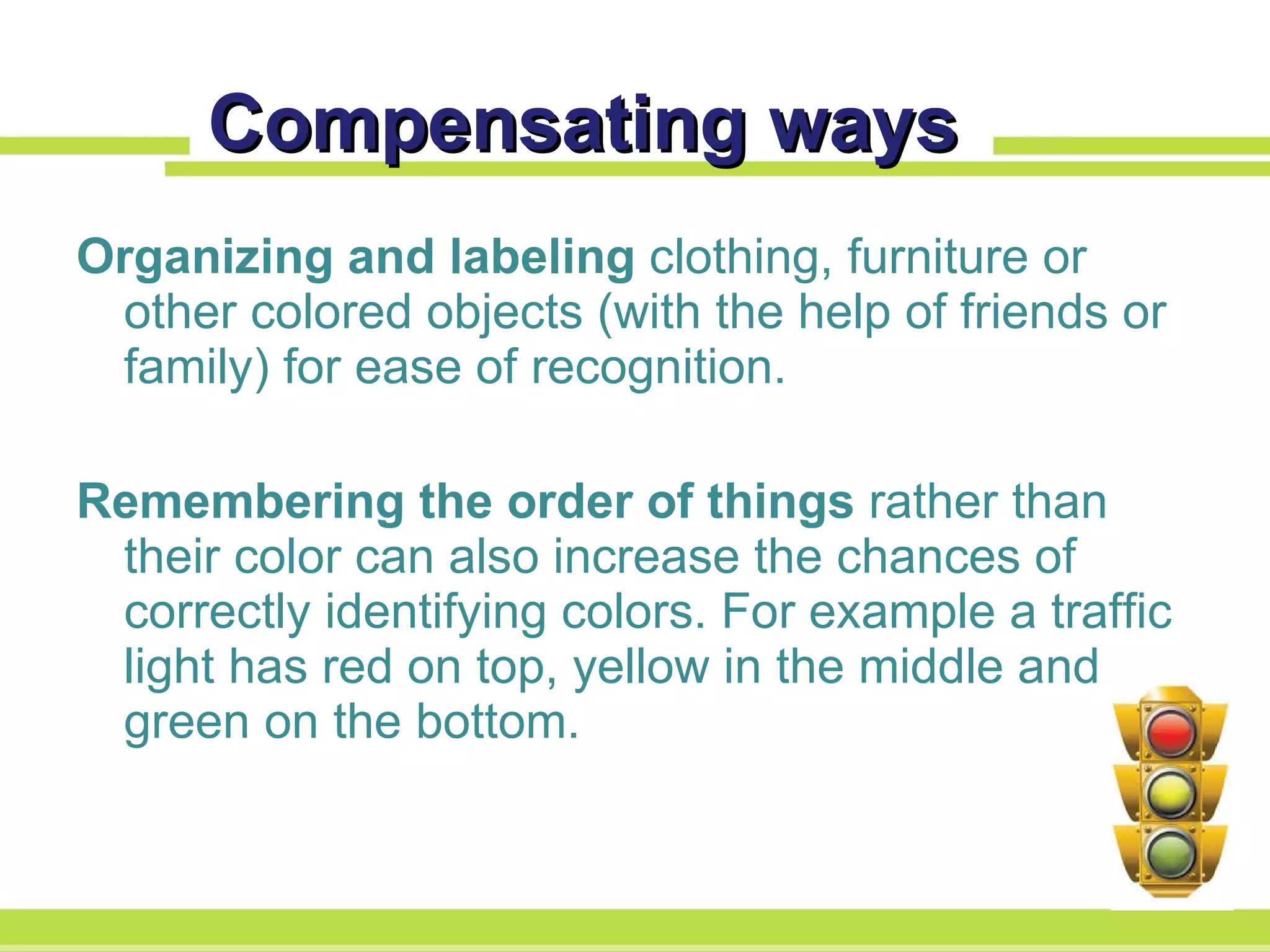
Compensating ways Organizing and labeling  clothing, furniture or other colored objects (with the help of friends or family) for ease of recognition. Remembering the order of things  rather than their color can also increase the chances of correctly identifying colors. For example a traffic light has red on top, yellow in the middle and green on the bottom.
© P sychophysics of Vision Thanks for listening!

Color vision

  • 1.
  • 2.
    Definition Isthe  initiation of visual response by absorption of light by three different spectral classes of cones. The capacity of the eye to distinguish objects based on the wavelengths or the frequencies of the light they reflect or emit.
  • 3.
    Three classes ofcones   Short-wavelength sensitive: (S-cones), 440 nm. Middle-wavelength sensitive: (M-cones), 545 nm. Long-wavelength sensitive: (L-cones), 565 nm. All have different but overlapping spectral sensitivities.
  • 4.
    Physical Color Concepts    light is not colored. physical optics dimensions (e.g., wavelength, frequency, quantum energy) are closely connected with the effect of the light on the human visual system. the color is in the visual system, not in the light.
  • 5.
    Psychological Color Concepts  Color is part of the user's mental response to the light entering the eyes from the display and its surroundings.
  • 6.
      Three dimensionsto describe color experience Hue . the dimension of color experience that most people mean by the nontechnical term "color". It is described by the labels "red", "blue", "green", "magenta", etc.
  • 7.
    Saturation . isthe dimension of color experience which ranges from "colorless" through "pale" to "vivid". The perceived color can be described in terms of whether it appears closer to the "colorless" end or the purely chromatic end. Saturation increases from left to right in this figure.
  • 8.
    Brightness is theapparent amount of light, varying from "dim" to "bright". Brightness increases from bottom to top in this figure.
  • 9.
    Psychophysical Color ConceptsConcepts that bridge the gap between physical stimuli and psychological responses. e.g. luminance and chromaticity.
  • 10.
    COLOR DISCRIMINATION ANDIDENTIFICATION Small color differences can be distinguished when the areas to be discriminated are large, immediately adjacent to each other (share an edge near the viewed point) and are displayed at the same time.
  • 11.
    Size and DiscriminationHere are the same colors in the previous figure, but the areas are smaller and the patches are separated from each other by the contrasting white background. Adjacent pairs are difficult or impossible to discriminate.
  • 12.
    Size and DiscriminationAs the area of the patches is reduced further even large color differences can become very hard to detect.   In each row the set of five colors is identical at the level of the digital data. 
  • 13.
    Edge vs. SmoothGradient Color discrimination is best when a sharp edge separates the colors to be discriminated. When a smooth gradient separates two color patches the smallest detectable difference in color is larger than it would be if the patches were adjacent and separated by a sharp edge, and the difference of color appearance is reduced.
  • 14.
    COLOR VISION DEFECTS  the inability to distinguish certain shades of color or in more severe cases, see colors at all. Causes: Inherited:  X-linked recessive gene Acquired: diabetes, glaucoma, medication, aging, and Chemical Exposure.
  • 15.
    Diagnosis Pseudoisochromatictesting plates: The patient is asked to look for numbers among the various colored dots, which help distinguish between red, green and blue color deficiencies. Individuals with normal color vision will see a number, while those with a deficiency do not see it. On some plates, a person with normal color vision may see one number, while a person with a  deficiency sees a different number.
  • 16.
    Additional diagnostic tests (discriminating) Frans worth-munsell 100-hue test. The D-15 or Dichotomous test.
  • 17.
    Treatment There’sno cure for inherited color deficiency. But if the cause is an illness or eye injury, treating these conditions may improve color vision.
  • 18.
    Compensating ways Organizingand labeling  clothing, furniture or other colored objects (with the help of friends or family) for ease of recognition. Remembering the order of things  rather than their color can also increase the chances of correctly identifying colors. For example a traffic light has red on top, yellow in the middle and green on the bottom.
  • 19.
    © P sychophysicsof Vision Thanks for listening!