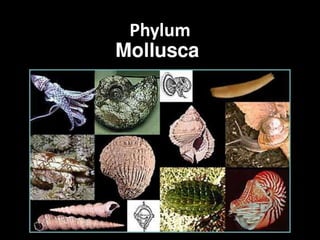
Phylum
GENERAL CHARACTERISTICS
 BODY CHARACTERS :
Soft
Unsegmented
Triploblastic
No jointed appendages
 SYMMETRY : Bilaterally symmetrical
 SHELL : Externally mantle secretes a
hard , brittle , calcareous shell .
It protects the soft body .
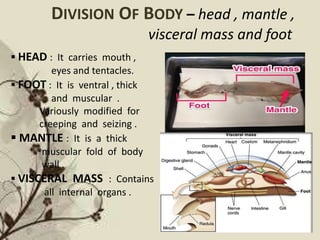
DIVISION OF BODY – head , mantle ,
visceral mass and foot
 HEAD : It carries mouth ,
eyes and tentacles.
 FOOT : It is ventral , thick
and muscular .
Variously modified for
creeping and seizing .
 MANTLE : It is a thick
muscular fold of body
wall .
 VISCERAL MASS : Contains
all internal organs .
GENERAL CHARACTERISTICS [visceral mass ]
 DIGESTIVE ORGANS :
Alimentary canal is
well developed and coiled .
 RESPIRATION :
Respiration by gills
enclosed in mantle cavity .
 CIRCULATORY SYSTEM :
It is of lacunar type
with dorsal heart & few
blood vessels .
 EXCRETORY ORGANS :
One or two pairs of kidney .
 NERVOUS SYSTEM :
Comprises of paired cerebral ,
plural , pedal and visceral ganglia .
 REPRODUCTION :
Sexes are usually separate
but may be united .
Gonads are usually unpaired .
Fertilisation can be either
external or internal .
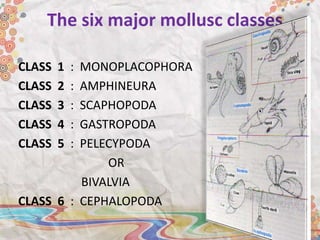
The six major mollusc classes
CLASS 1 : MONOPLACOPHORA
CLASS 2 : AMPHINEURA
CLASS 3 : SCAPHOPODA
CLASS 4 : GASTROPODA
CLASS 5 : PELECYPODA
OR
BIVALVIA
CLASS 6 : CEPHALOPODA
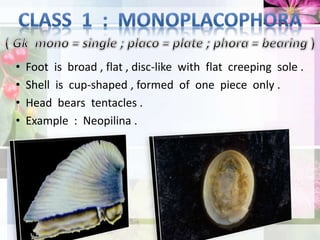
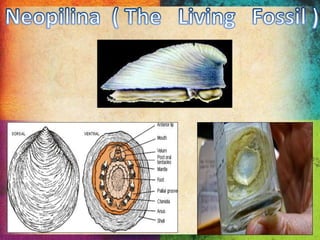
• Foot is broad , flat , disc-like with flat creeping sole .
• Shell is cup-shaped , formed of one piece only .
• Head bears tentacles .
• Example : Neopilina .
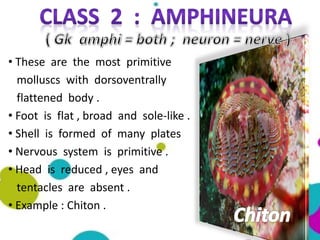
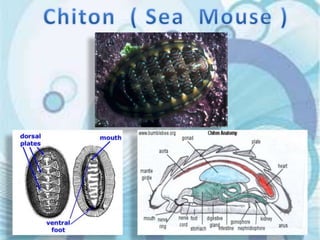
• These are the most primitive
molluscs with dorsoventrally
flattened body .
• Foot is flat , broad and sole-like .
• Shell is formed of many plates
• Nervous system is primitive .
• Head is reduced , eyes and
tentacles are absent .
• Example : Chiton .
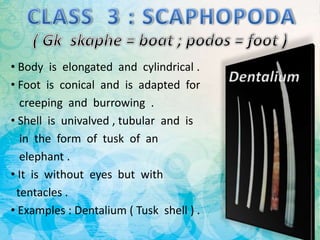
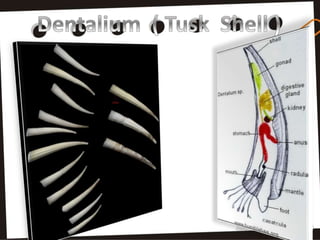
• Body is elongated and cylindrical .
• Foot is conical and is adapted for
creeping and burrowing .
• Shell is univalved , tubular and is
in the form of tusk of an
elephant .
• It is without eyes but with
tentacles .
• Examples : Dentalium ( Tusk shell ) .
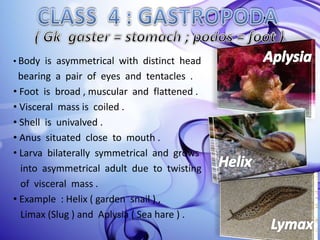
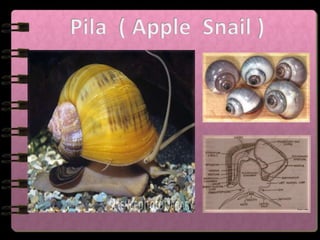
• Body is asymmetrical with distinct head
bearing a pair of eyes and tentacles .
• Foot is broad , muscular and flattened .
• Visceral mass is coiled .
• Shell is univalved .
• Anus situated close to mouth .
• Larva bilaterally symmetrical and grows
into asymmetrical adult due to twisting
of visceral mass .
• Example : Helix ( garden snail ) ,
Limax (Slug ) and Aplysia ( Sea hare ) .
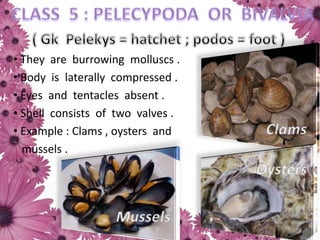
• They are burrowing molluscs .
• Body is laterally compressed .
• Eyes and tentacles absent .
• Shell consists of two valves .
• Example : Clams , oysters and
mussels .
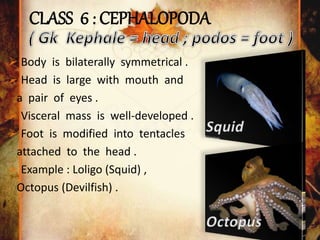
CLASS 6 : CEPHALOPODA
 Body is bilaterally symmetrical .
 Head is large with mouth and
a pair of eyes .
 Visceral mass is well-developed .
 Foot is modified into tentacles
attached to the head .
 Example : Loligo (Squid) ,
Octopus (Devilfish) .
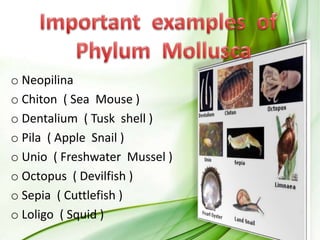
o Neopilina
o Chiton ( Sea Mouse )
o Dentalium ( Tusk shell )
o Pila ( Apple Snail )
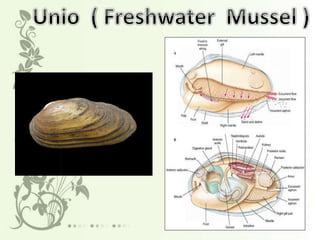
o Unio ( Freshwater Mussel )
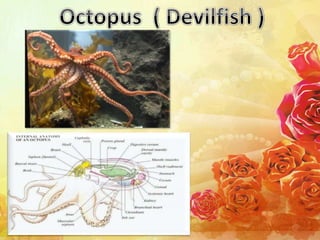
o Octopus ( Devilfish )
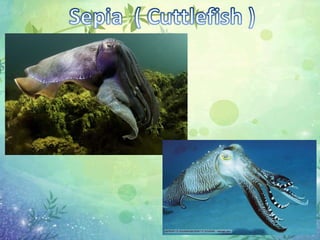
o Sepia ( Cuttlefish )
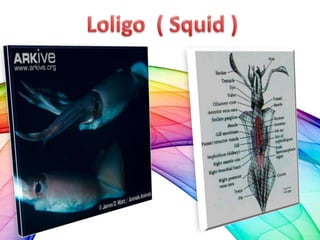
o Loligo ( Squid )
Phylum Mollusca
Phylum Mollusca
Phylum Mollusca
Phylum Mollusca
Phylum Mollusca
Phylum Mollusca
Phylum Mollusca
Phylum Mollusca

Phylum Mollusca

  • 1.
  • 3.
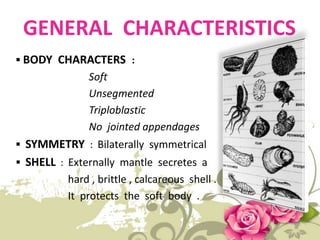
    GENERAL CHARACTERISTICS  BODYCHARACTERS : Soft Unsegmented Triploblastic No jointed appendages  SYMMETRY : Bilaterally symmetrical  SHELL : Externally mantle secretes a hard , brittle , calcareous shell . It protects the soft body .
  • 4.
    DIVISION OF BODY– head , mantle , visceral mass and foot  HEAD : It carries mouth , eyes and tentacles.  FOOT : It is ventral , thick and muscular . Variously modified for creeping and seizing .  MANTLE : It is a thick muscular fold of body wall .  VISCERAL MASS : Contains all internal organs .
  • 5.
    GENERAL CHARACTERISTICS [visceralmass ]  DIGESTIVE ORGANS : Alimentary canal is well developed and coiled .  RESPIRATION : Respiration by gills enclosed in mantle cavity .  CIRCULATORY SYSTEM : It is of lacunar type with dorsal heart & few blood vessels .  EXCRETORY ORGANS : One or two pairs of kidney .  NERVOUS SYSTEM : Comprises of paired cerebral , plural , pedal and visceral ganglia .  REPRODUCTION : Sexes are usually separate but may be united . Gonads are usually unpaired . Fertilisation can be either external or internal .
  • 6.
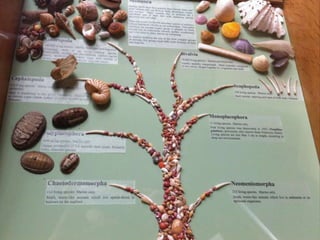
    The six majormollusc classes CLASS 1 : MONOPLACOPHORA CLASS 2 : AMPHINEURA CLASS 3 : SCAPHOPODA CLASS 4 : GASTROPODA CLASS 5 : PELECYPODA OR BIVALVIA CLASS 6 : CEPHALOPODA
  • 7.
    • Foot isbroad , flat , disc-like with flat creeping sole . • Shell is cup-shaped , formed of one piece only . • Head bears tentacles . • Example : Neopilina .
  • 8.
    • These arethe most primitive molluscs with dorsoventrally flattened body . • Foot is flat , broad and sole-like . • Shell is formed of many plates • Nervous system is primitive . • Head is reduced , eyes and tentacles are absent . • Example : Chiton .
  • 9.
    • Body iselongated and cylindrical . • Foot is conical and is adapted for creeping and burrowing . • Shell is univalved , tubular and is in the form of tusk of an elephant . • It is without eyes but with tentacles . • Examples : Dentalium ( Tusk shell ) .
  • 10.
    • Body isasymmetrical with distinct head bearing a pair of eyes and tentacles . • Foot is broad , muscular and flattened . • Visceral mass is coiled . • Shell is univalved . • Anus situated close to mouth . • Larva bilaterally symmetrical and grows into asymmetrical adult due to twisting of visceral mass . • Example : Helix ( garden snail ) , Limax (Slug ) and Aplysia ( Sea hare ) .
  • 11.
    • They areburrowing molluscs . • Body is laterally compressed . • Eyes and tentacles absent . • Shell consists of two valves . • Example : Clams , oysters and mussels .
  • 12.
    CLASS 6 :CEPHALOPODA  Body is bilaterally symmetrical .  Head is large with mouth and a pair of eyes .  Visceral mass is well-developed .  Foot is modified into tentacles attached to the head .  Example : Loligo (Squid) , Octopus (Devilfish) .
  • 13.
    o Neopilina o Chiton( Sea Mouse ) o Dentalium ( Tusk shell ) o Pila ( Apple Snail ) o Unio ( Freshwater Mussel ) o Octopus ( Devilfish ) o Sepia ( Cuttlefish ) o Loligo ( Squid )

Editor's Notes