Protochordata: General characters and
classification up to orders
By,
Dr. Manoj K. Bangadkar
Protochordata
• The organisms belonging to the Protochordata are generally
known as the lower chordates.
• They don’t form a “proper” taxonomic group and are only
classified as such for convenience purposes.
• However, they do form a major division of Chordata.
• They are also known as Acraniata because they lack a true
skull.
• On the basis of the notochord present, they are divided into
three sub-phyla- Hemichordata, Urochordata and
Cephalochordata.
Characteristics of Protochordata
• They are generally found in marine water.
• Their body is bilaterally symmetrical, triploblastic, and
coelomated.
• At a certain stage of their lives, their body develops a long,
rod-like structure for support called notochord.
• They exhibit organ system level of organization.
• Eg., Herdmania, Amphioxus.
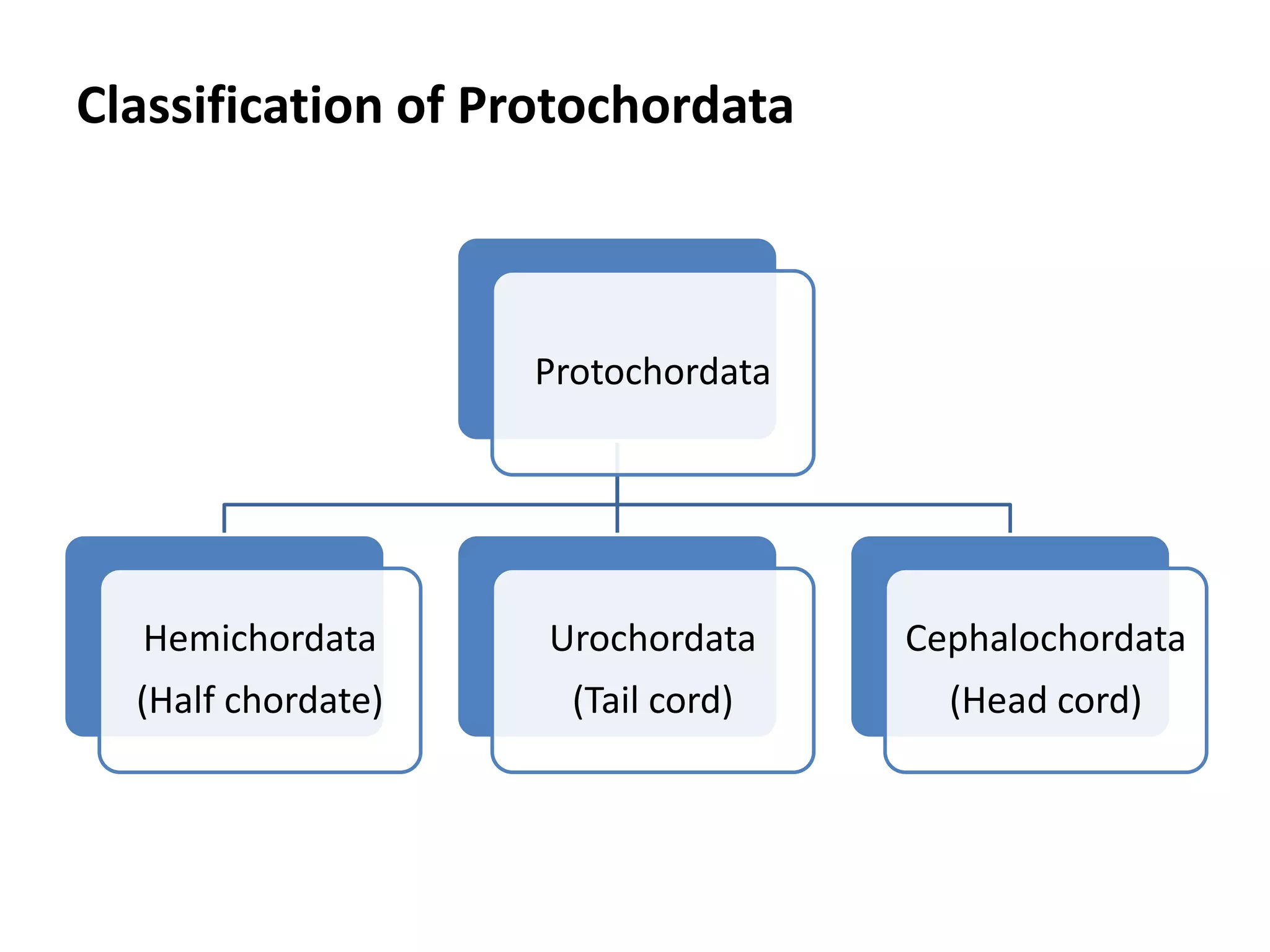
Classification of Protochordata
Protochordata
Hemichordata
(Half chordate)
Urochordata
(Tail cord)
Cephalochordata
(Head cord)
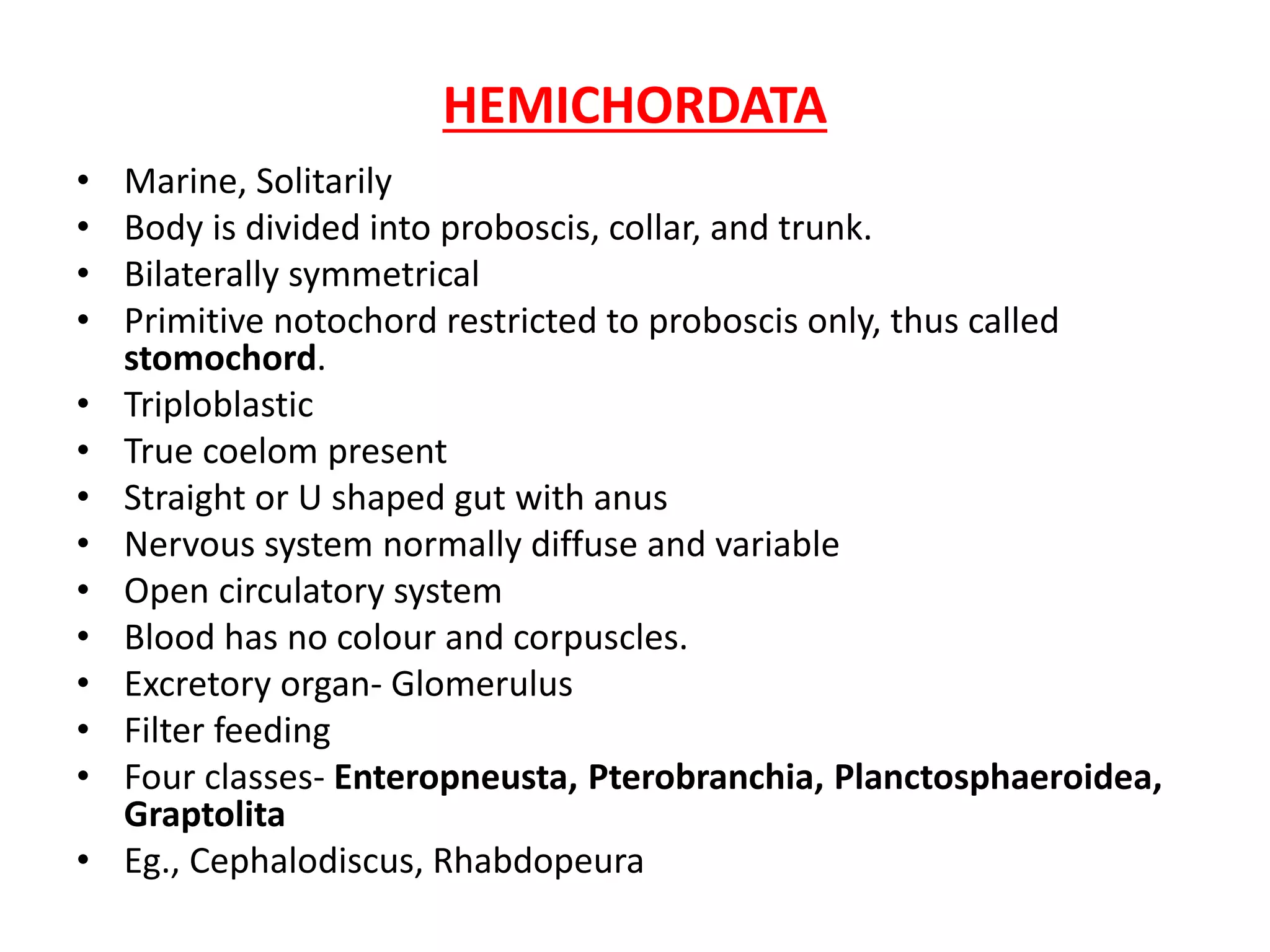
HEMICHORDATA
• Marine, Solitarily
• Body is divided into proboscis, collar, and trunk.
• Bilaterally symmetrical
• Primitive notochord restricted to proboscis only, thus called
stomochord.
• Triploblastic
• True coelom present
• Straight or U shaped gut with anus
• Nervous system normally diffuse and variable
• Open circulatory system
• Blood has no colour and corpuscles.
• Excretory organ- Glomerulus
• Filter feeding
• Four classes- Enteropneusta, Pterobranchia, Planctosphaeroidea,
Graptolita
• Eg., Cephalodiscus, Rhabdopeura
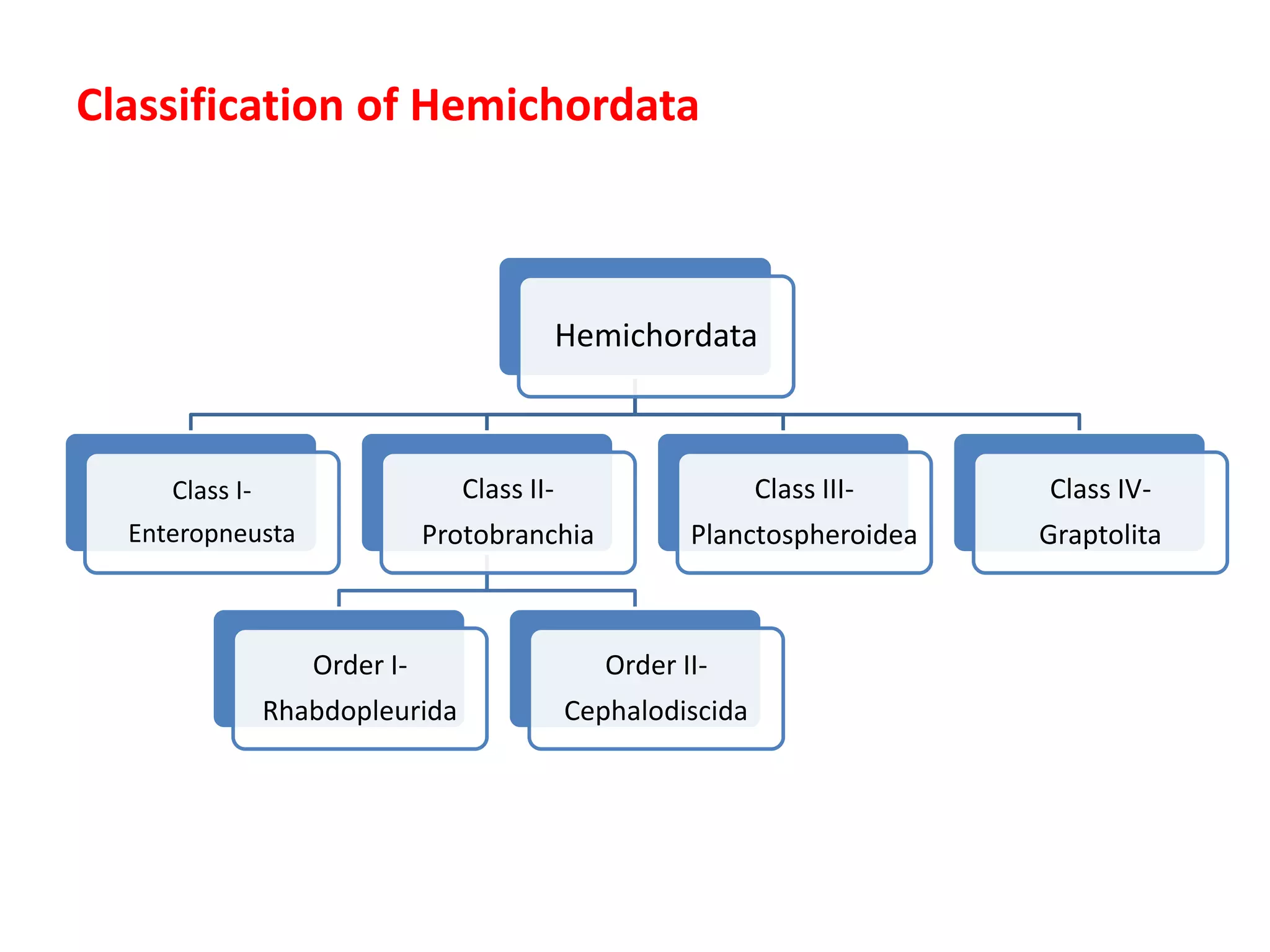
Classification of Hemichordata
Hemichordata
Class I-
Enteropneusta
Class II-
Protobranchia
Order I-
Rhabdopleurida
Order II-
Cephalodiscida
Class III-
Planctospheroidea
Class IV-
Graptolita
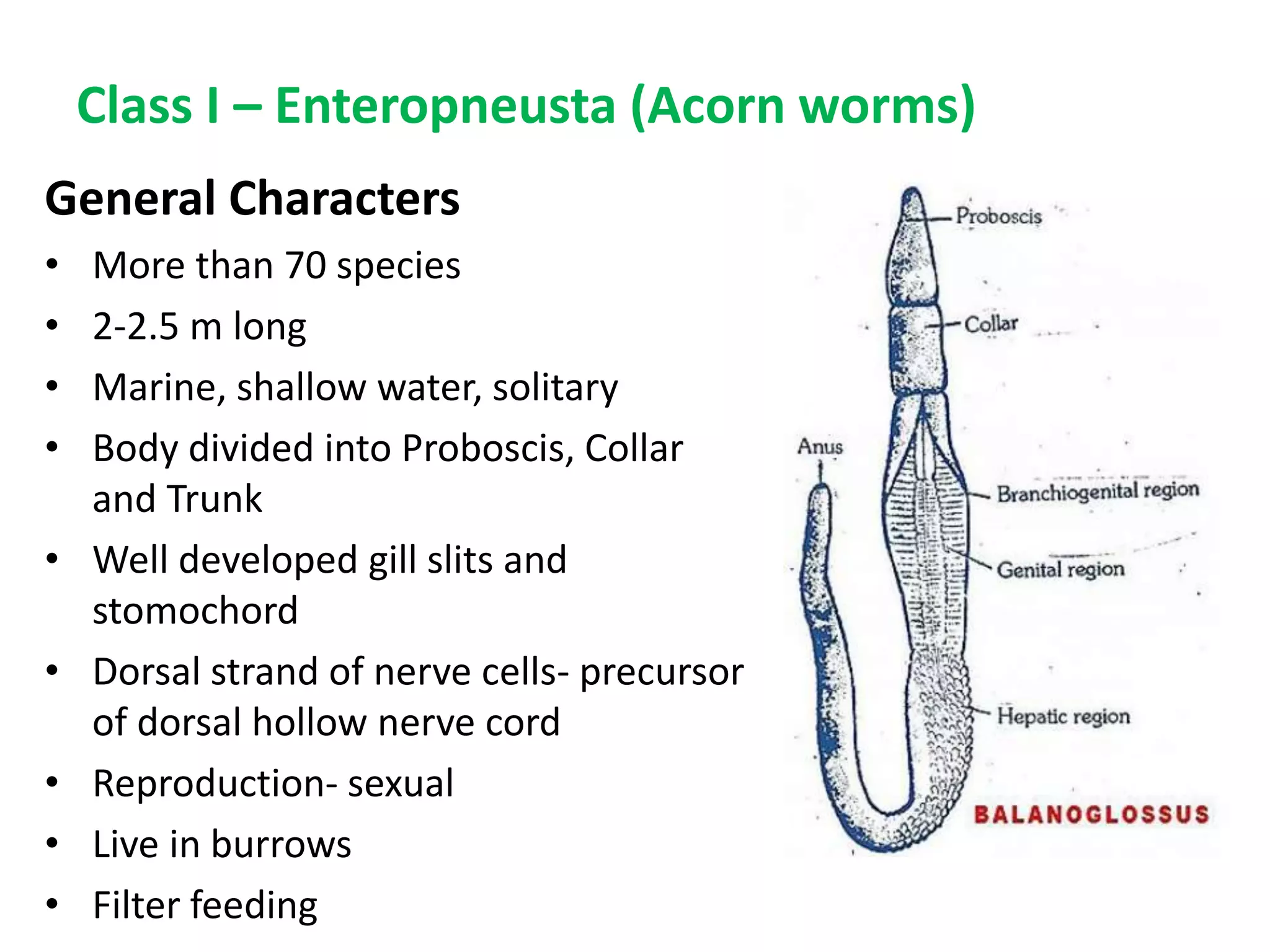
Class I – Enteropneusta (Acorn worms)
General Characters
• More than 70 species
• 2-2.5 m long
• Marine, shallow water, solitary
• Body divided into Proboscis, Collar
and Trunk
• Well developed gill slits and
stomochord
• Dorsal strand of nerve cells- precursor
of dorsal hollow nerve cord
• Reproduction- sexual
• Live in burrows
• Filter feeding
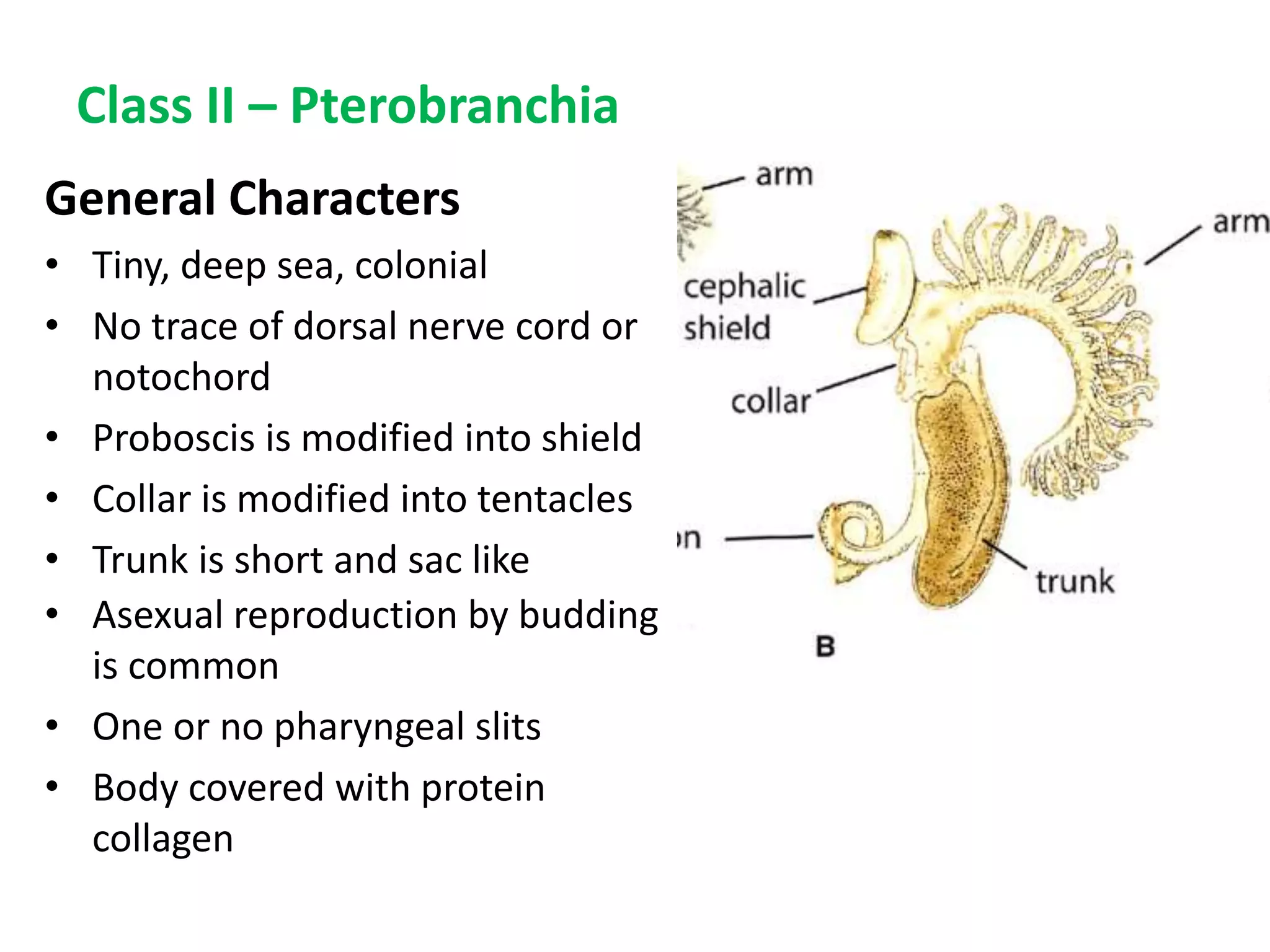
Class II – Pterobranchia
General Characters
• Tiny, deep sea, colonial
• No trace of dorsal nerve cord or
notochord
• Proboscis is modified into shield
• Collar is modified into tentacles
• Trunk is short and sac like
• Asexual reproduction by budding
is common
• One or no pharyngeal slits
• Body covered with protein
collagen
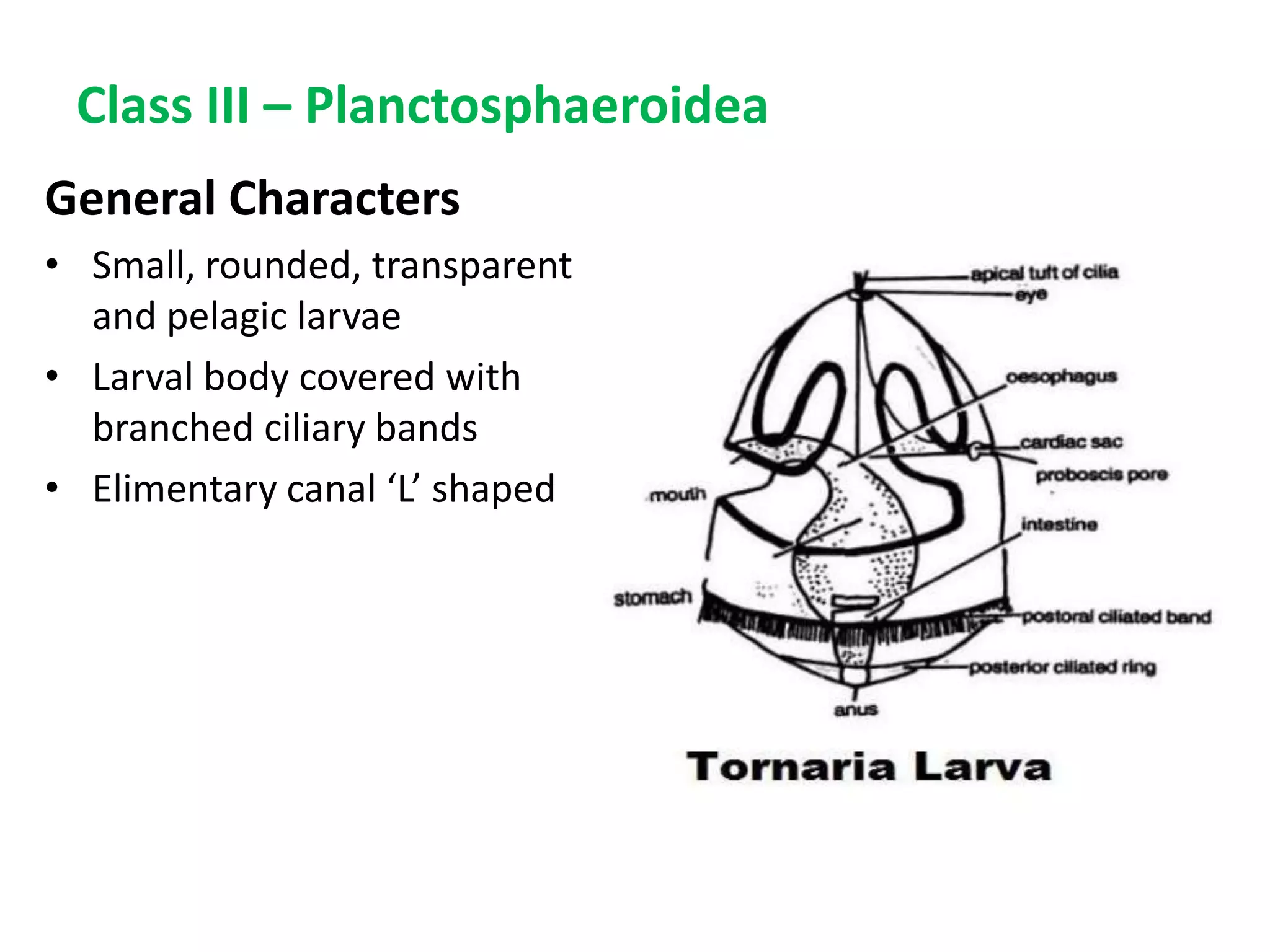
Class III – Planctosphaeroidea
General Characters
• Small, rounded, transparent
and pelagic larvae
• Larval body covered with
branched ciliary bands
• Elimentary canal ‘L’ shaped
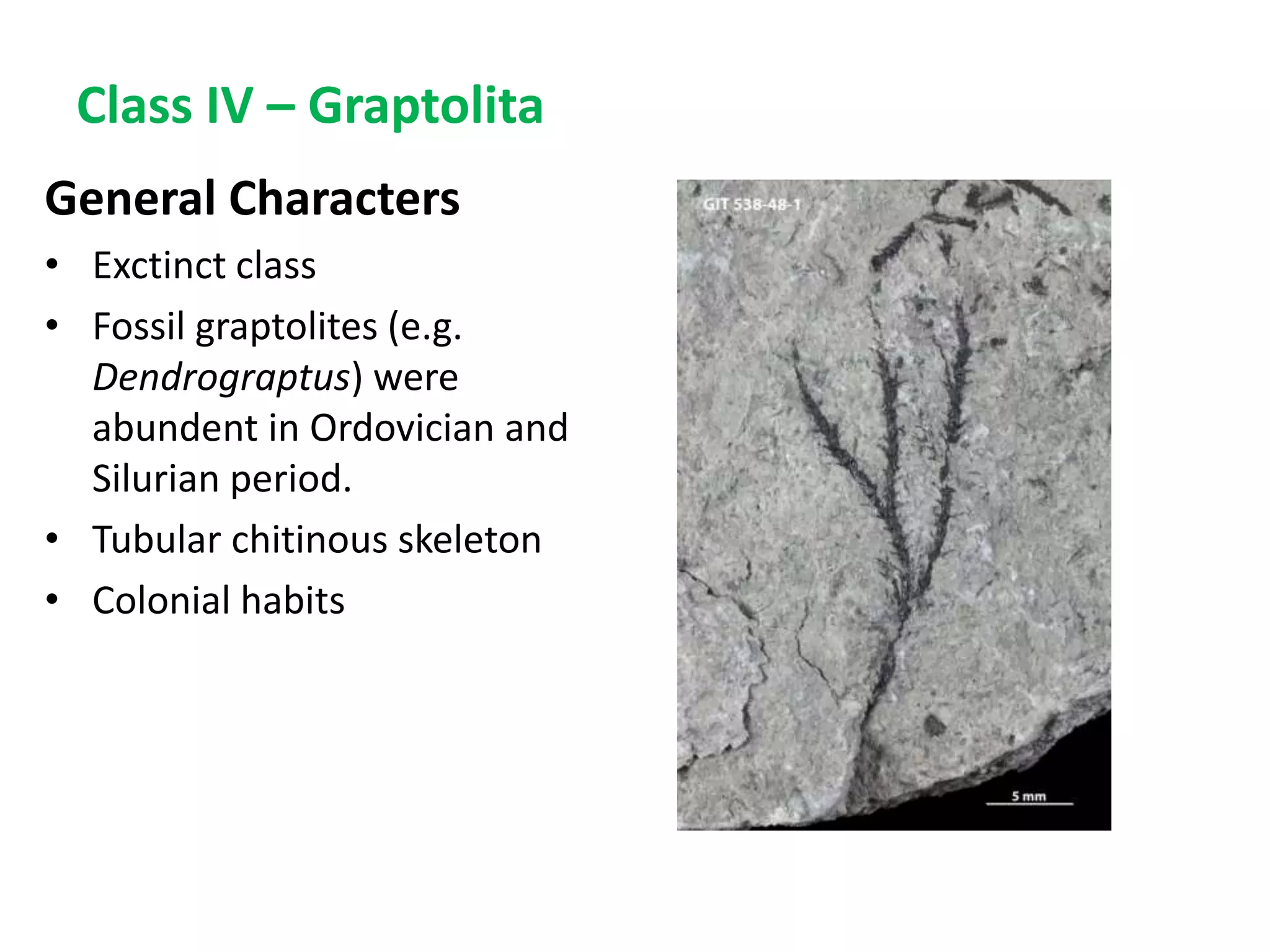
Class IV – Graptolita
General Characters
• Exctinct class
• Fossil graptolites (e.g.
Dendrograptus) were
abundent in Ordovician and
Silurian period.
• Tubular chitinous skeleton
• Colonial habits
UROCHORDATA (TUNICATA)
• Tail chordate
• Most primitive of the chordates
• They are found in the marine environment.
• They are sessile and filter-feeders.
• They are also known as tunicates because their body is surrounded
by a leathery sheath composed of tunicin (cellulose).
• Retrogressive metamorphosis : The notochord appears in the larval
stage in the tail of the larva and disappears in the adult.
• Triploblastic
• U shaped gut, Coelom absent
• Hermophroditic
• Respiration occurs through gills.
• They have an Incomplete closed circulatory system.
• Haemocyanin as blood pigment
• The excretory organs are absent.
• They reproduce asexually by budding.
• Eg., Herdmania, Selpa
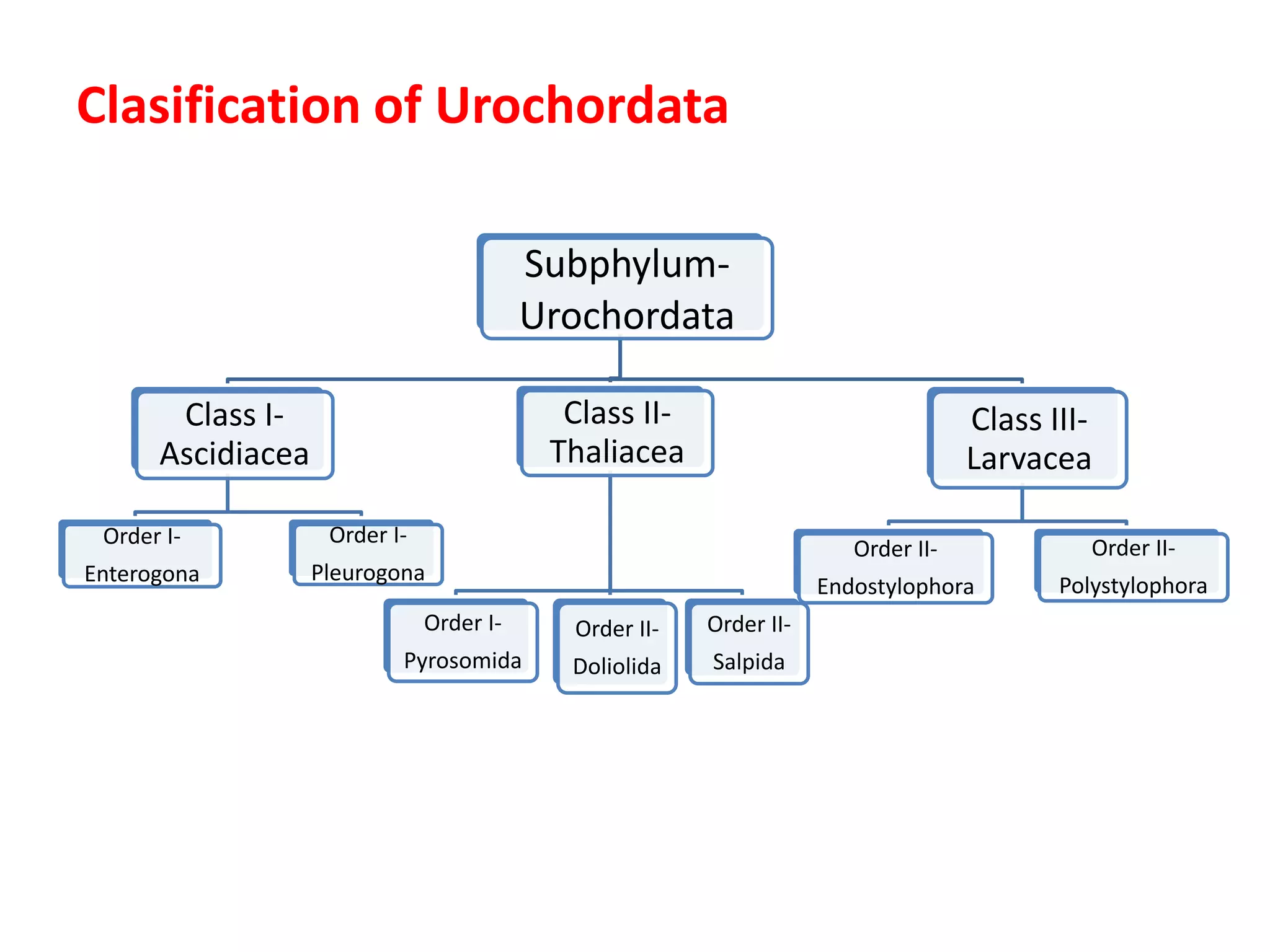
Clasification of Urochordata
Subphylum-
Urochordata
Class I-
Ascidiacea
Order I-
Enterogona
Order I-
Pleurogona
Class II-
Thaliacea
Order I-
Pyrosomida
Order II-
Doliolida
Order II-
Salpida
Class III-
Larvacea
Order II-
Endostylophora
Order II-
Polystylophora
Class I - Ascidiacea
• Sea squirts
• Notochord and post anal tail found in the larval stage only
• Marine, solitary or colonial, Sessile adults
• Tunic composed of an acellular matrix of tunicin
• Two opening- an inhelant and exhalent siphon
• Hermaphroditic
• Filter feeders
• Two orders- I) Enterogona and II) Pleurogona
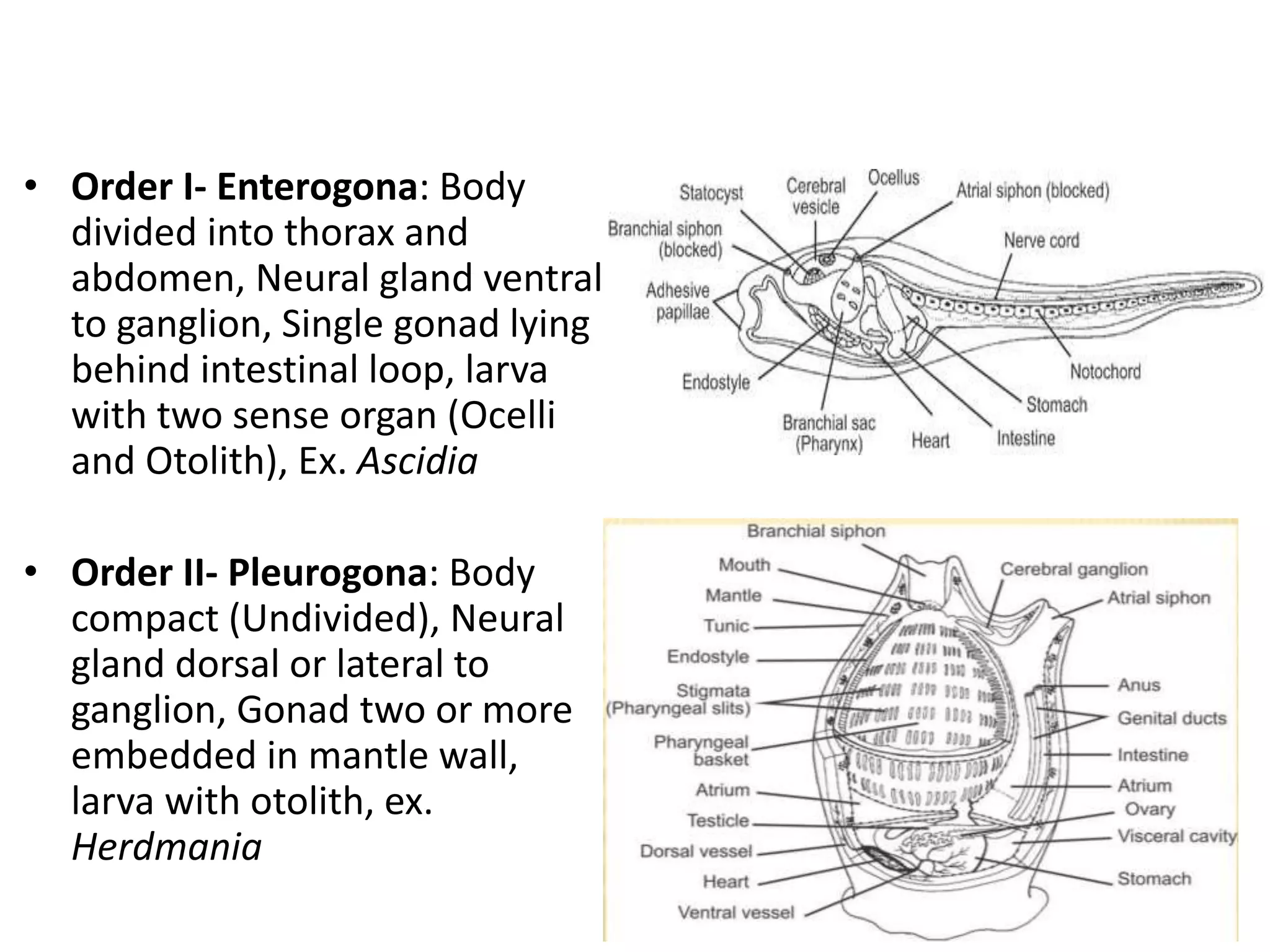
• Order I- Enterogona: Body
divided into thorax and
abdomen, Neural gland ventral
to ganglion, Single gonad lying
behind intestinal loop, larva
with two sense organ (Ocelli
and Otolith), Ex. Ascidia
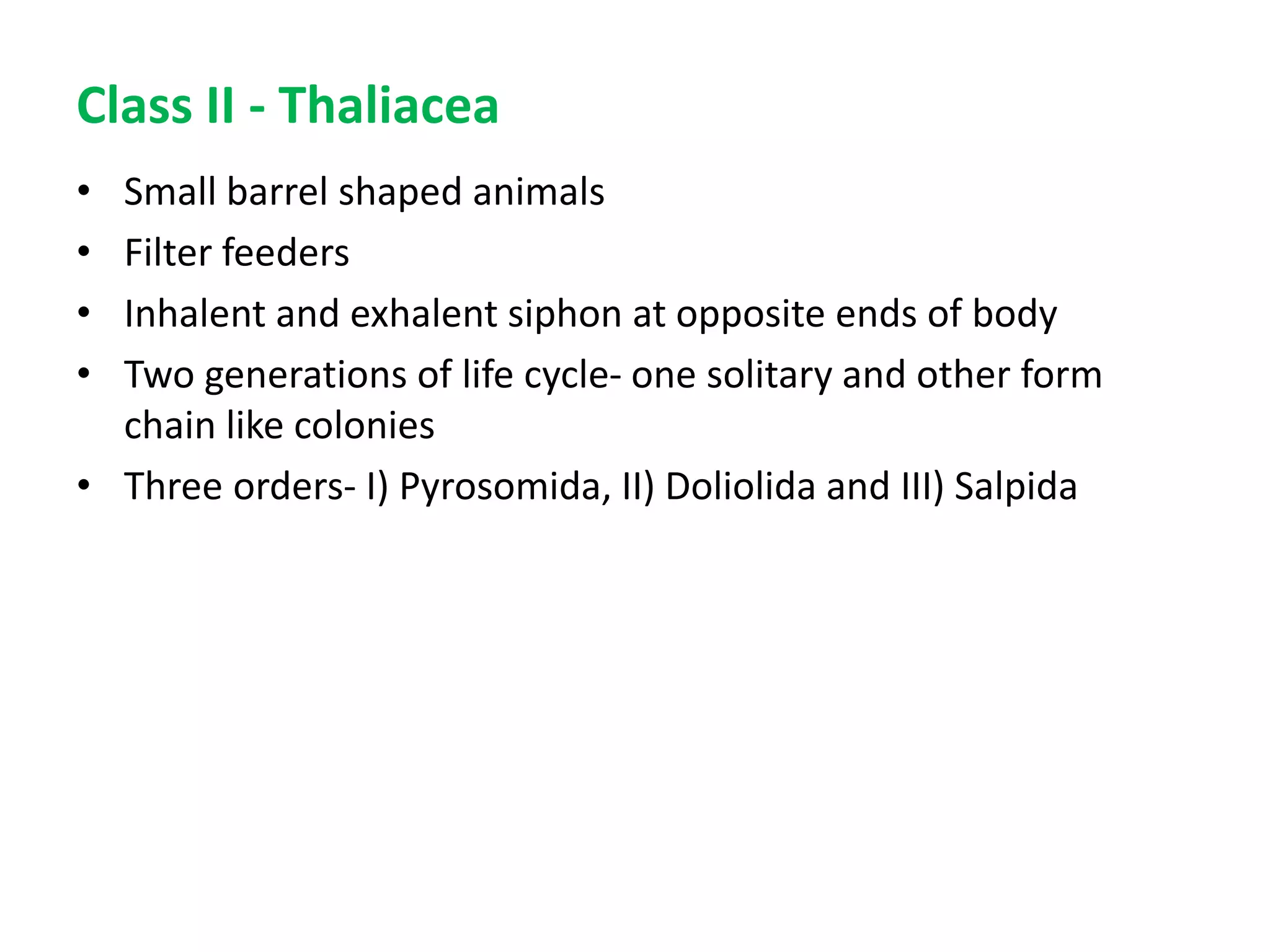
• Order II- Pleurogona: Body
compact (Undivided), Neural
gland dorsal or lateral to
ganglion, Gonad two or more
embedded in mantle wall,
larva with otolith, ex.
Herdmania
Class II - Thaliacea
• Small barrel shaped animals
• Filter feeders
• Inhalent and exhalent siphon at opposite ends of body
• Two generations of life cycle- one solitary and other form
chain like colonies
• Three orders- I) Pyrosomida, II) Doliolida and III) Salpida
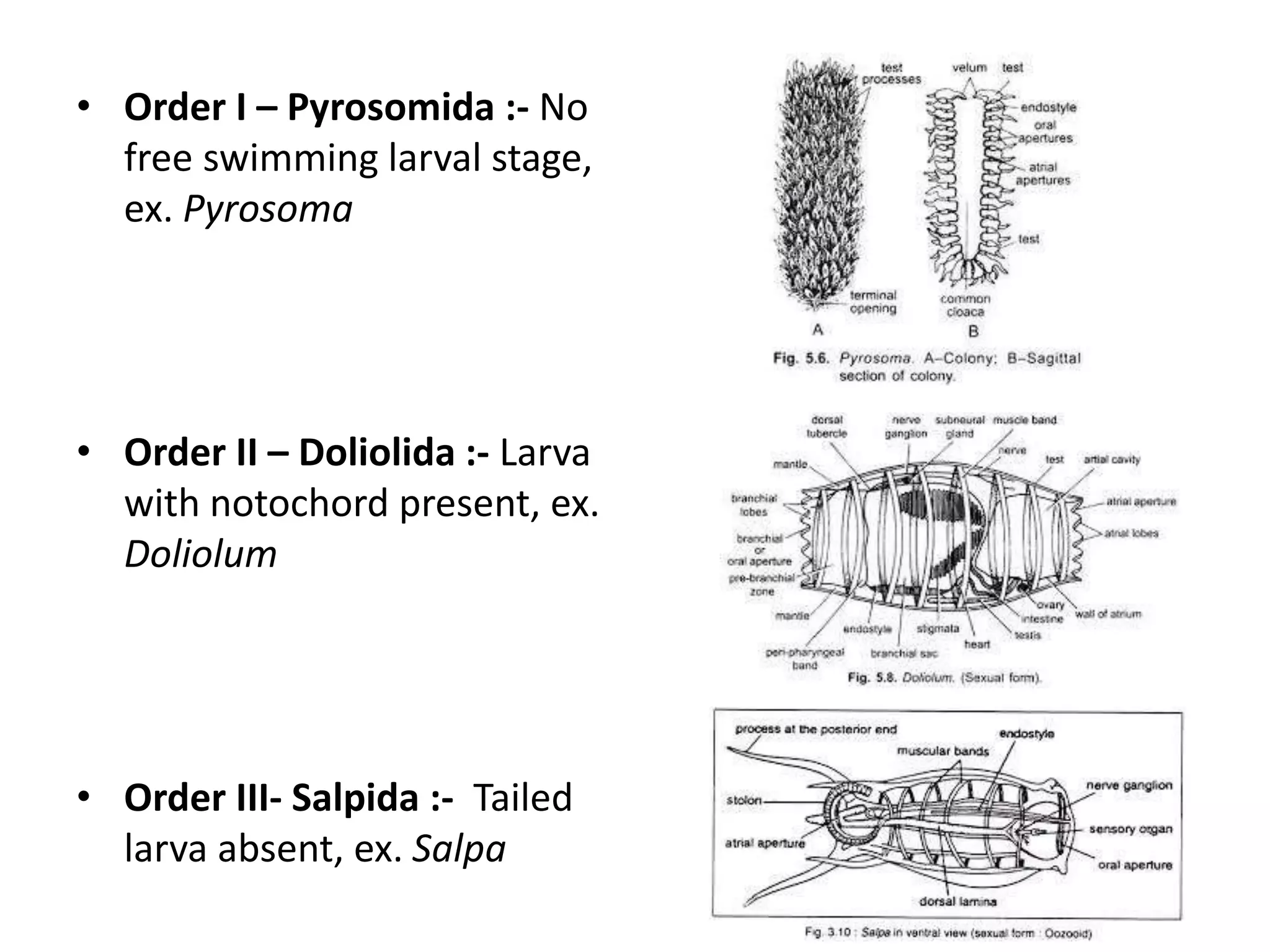
• Order I – Pyrosomida :- No
free swimming larval stage,
ex. Pyrosoma
• Order II – Doliolida :- Larva
with notochord present, ex.
Doliolum
• Order III- Salpida :- Tailed
larva absent, ex. Salpa
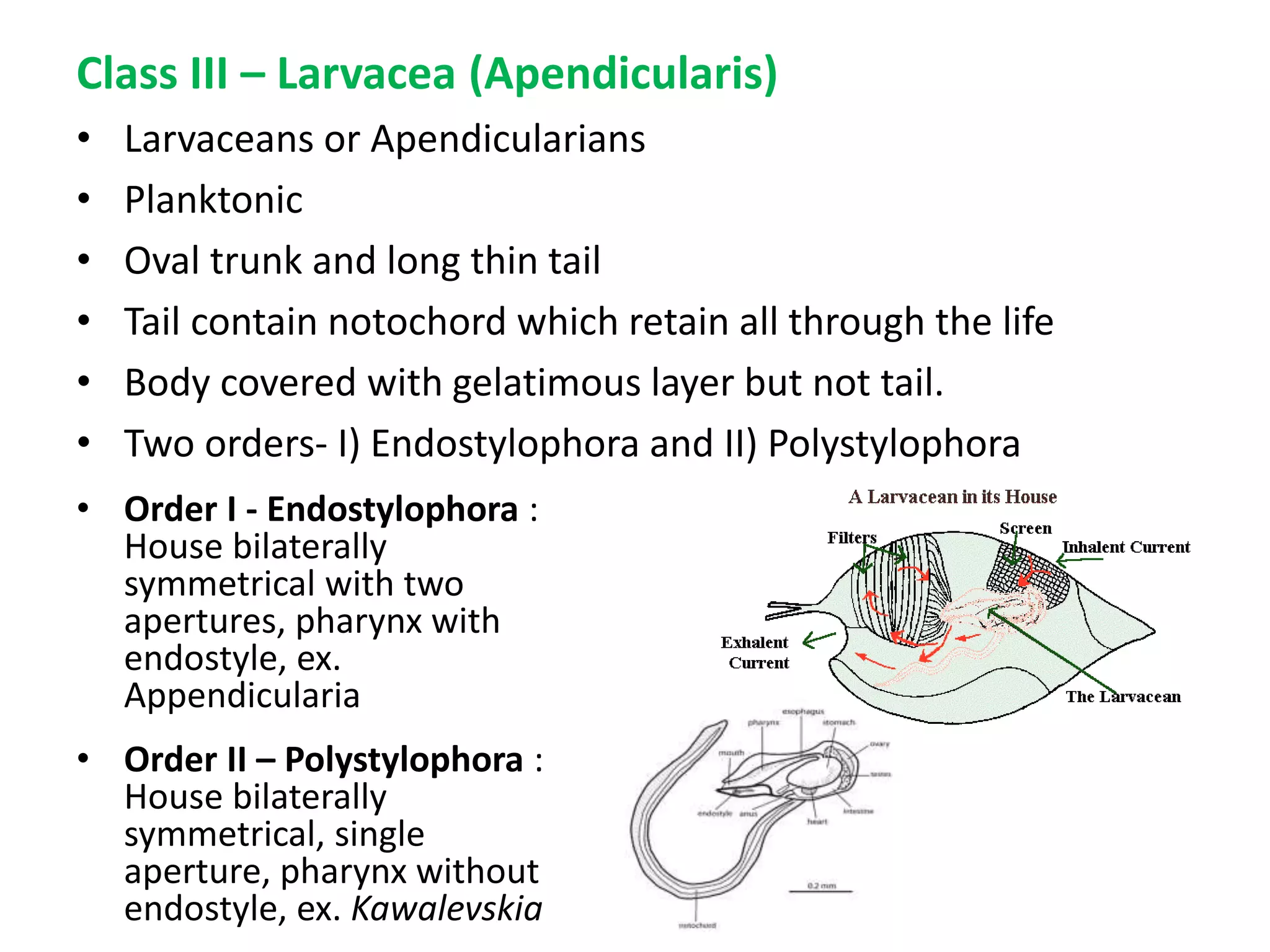
Class III – Larvacea (Apendicularis)
• Larvaceans or Apendicularians
• Planktonic
• Oval trunk and long thin tail
• Tail contain notochord which retain all through the life
• Body covered with gelatimous layer but not tail.
• Two orders- I) Endostylophora and II) Polystylophora
• Order I - Endostylophora :
House bilaterally
symmetrical with two
apertures, pharynx with
endostyle, ex.
Appendicularia
• Order II – Polystylophora :
House bilaterally
symmetrical, single
aperture, pharynx without
endostyle, ex. Kawalevskia
CEPHALOCHORDATA
• Most advanced protochordates
• Notocord: Well developed, persist throughout the life and
runs from tail to head (Head cord)
• Gill slits: Numerous (Upto 100)
• Dorsal nerve cord
• Post anal tail
• Marine
• Fish like appearance
• External fertilization
• Metamerism found
• Closed blood circulatory system
• Haemocyanin pigment
• Single class- Leptocardii / Leptocardia
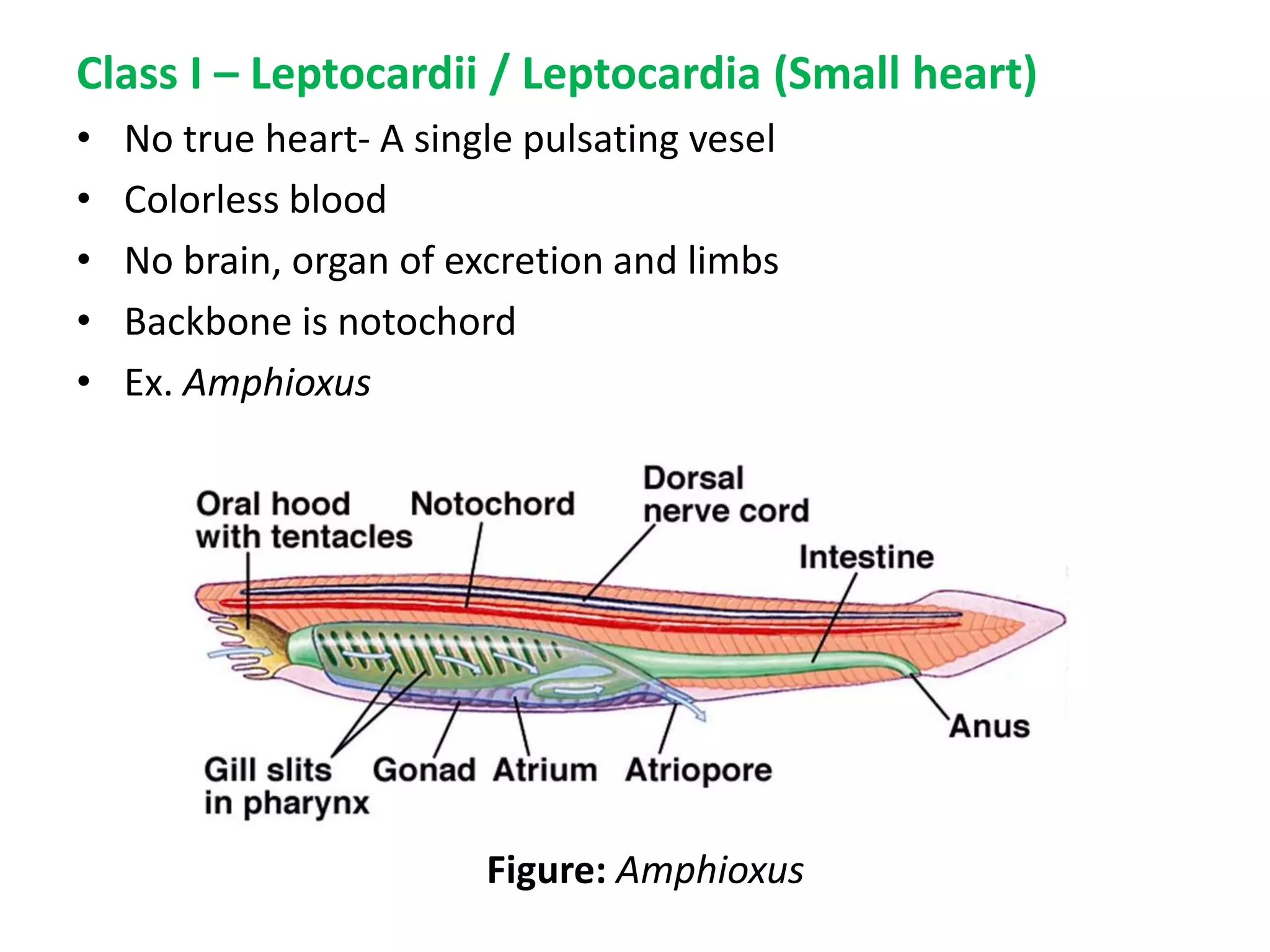
Class I – Leptocardii / Leptocardia (Small heart)
• No true heart- A single pulsating vesel
• Colorless blood
• No brain, organ of excretion and limbs
• Backbone is notochord
• Ex. Amphioxus
Figure: Amphioxus

Outline of classification of protochordates

  • 1.
    Protochordata: General charactersand classification up to orders By, Dr. Manoj K. Bangadkar
  • 2.
    Protochordata • The organismsbelonging to the Protochordata are generally known as the lower chordates. • They don’t form a “proper” taxonomic group and are only classified as such for convenience purposes. • However, they do form a major division of Chordata. • They are also known as Acraniata because they lack a true skull. • On the basis of the notochord present, they are divided into three sub-phyla- Hemichordata, Urochordata and Cephalochordata.
  • 3.
    Characteristics of Protochordata •They are generally found in marine water. • Their body is bilaterally symmetrical, triploblastic, and coelomated. • At a certain stage of their lives, their body develops a long, rod-like structure for support called notochord. • They exhibit organ system level of organization. • Eg., Herdmania, Amphioxus.
  • 4.
    Classification of Protochordata Protochordata Hemichordata (Halfchordate) Urochordata (Tail cord) Cephalochordata (Head cord)
  • 5.
    HEMICHORDATA • Marine, Solitarily •Body is divided into proboscis, collar, and trunk. • Bilaterally symmetrical • Primitive notochord restricted to proboscis only, thus called stomochord. • Triploblastic • True coelom present • Straight or U shaped gut with anus • Nervous system normally diffuse and variable • Open circulatory system • Blood has no colour and corpuscles. • Excretory organ- Glomerulus • Filter feeding • Four classes- Enteropneusta, Pterobranchia, Planctosphaeroidea, Graptolita • Eg., Cephalodiscus, Rhabdopeura
  • 6.
    Classification of Hemichordata Hemichordata ClassI- Enteropneusta Class II- Protobranchia Order I- Rhabdopleurida Order II- Cephalodiscida Class III- Planctospheroidea Class IV- Graptolita
  • 7.
    Class I –Enteropneusta (Acorn worms) General Characters • More than 70 species • 2-2.5 m long • Marine, shallow water, solitary • Body divided into Proboscis, Collar and Trunk • Well developed gill slits and stomochord • Dorsal strand of nerve cells- precursor of dorsal hollow nerve cord • Reproduction- sexual • Live in burrows • Filter feeding
  • 8.
    Class II –Pterobranchia General Characters • Tiny, deep sea, colonial • No trace of dorsal nerve cord or notochord • Proboscis is modified into shield • Collar is modified into tentacles • Trunk is short and sac like • Asexual reproduction by budding is common • One or no pharyngeal slits • Body covered with protein collagen
  • 9.
    Class III –Planctosphaeroidea General Characters • Small, rounded, transparent and pelagic larvae • Larval body covered with branched ciliary bands • Elimentary canal ‘L’ shaped
  • 10.
    Class IV –Graptolita General Characters • Exctinct class • Fossil graptolites (e.g. Dendrograptus) were abundent in Ordovician and Silurian period. • Tubular chitinous skeleton • Colonial habits
  • 11.
    UROCHORDATA (TUNICATA) • Tailchordate • Most primitive of the chordates • They are found in the marine environment. • They are sessile and filter-feeders. • They are also known as tunicates because their body is surrounded by a leathery sheath composed of tunicin (cellulose). • Retrogressive metamorphosis : The notochord appears in the larval stage in the tail of the larva and disappears in the adult. • Triploblastic • U shaped gut, Coelom absent • Hermophroditic • Respiration occurs through gills. • They have an Incomplete closed circulatory system. • Haemocyanin as blood pigment • The excretory organs are absent. • They reproduce asexually by budding. • Eg., Herdmania, Selpa
  • 12.
    Clasification of Urochordata Subphylum- Urochordata ClassI- Ascidiacea Order I- Enterogona Order I- Pleurogona Class II- Thaliacea Order I- Pyrosomida Order II- Doliolida Order II- Salpida Class III- Larvacea Order II- Endostylophora Order II- Polystylophora
  • 13.
    Class I -Ascidiacea • Sea squirts • Notochord and post anal tail found in the larval stage only • Marine, solitary or colonial, Sessile adults • Tunic composed of an acellular matrix of tunicin • Two opening- an inhelant and exhalent siphon • Hermaphroditic • Filter feeders • Two orders- I) Enterogona and II) Pleurogona
  • 14.
    • Order I-Enterogona: Body divided into thorax and abdomen, Neural gland ventral to ganglion, Single gonad lying behind intestinal loop, larva with two sense organ (Ocelli and Otolith), Ex. Ascidia • Order II- Pleurogona: Body compact (Undivided), Neural gland dorsal or lateral to ganglion, Gonad two or more embedded in mantle wall, larva with otolith, ex. Herdmania
  • 15.
    Class II -Thaliacea • Small barrel shaped animals • Filter feeders • Inhalent and exhalent siphon at opposite ends of body • Two generations of life cycle- one solitary and other form chain like colonies • Three orders- I) Pyrosomida, II) Doliolida and III) Salpida
  • 16.
    • Order I– Pyrosomida :- No free swimming larval stage, ex. Pyrosoma • Order II – Doliolida :- Larva with notochord present, ex. Doliolum • Order III- Salpida :- Tailed larva absent, ex. Salpa
  • 17.
    Class III –Larvacea (Apendicularis) • Larvaceans or Apendicularians • Planktonic • Oval trunk and long thin tail • Tail contain notochord which retain all through the life • Body covered with gelatimous layer but not tail. • Two orders- I) Endostylophora and II) Polystylophora • Order I - Endostylophora : House bilaterally symmetrical with two apertures, pharynx with endostyle, ex. Appendicularia • Order II – Polystylophora : House bilaterally symmetrical, single aperture, pharynx without endostyle, ex. Kawalevskia
  • 18.
    CEPHALOCHORDATA • Most advancedprotochordates • Notocord: Well developed, persist throughout the life and runs from tail to head (Head cord) • Gill slits: Numerous (Upto 100) • Dorsal nerve cord • Post anal tail • Marine • Fish like appearance • External fertilization • Metamerism found • Closed blood circulatory system • Haemocyanin pigment • Single class- Leptocardii / Leptocardia
  • 19.
    Class I –Leptocardii / Leptocardia (Small heart) • No true heart- A single pulsating vesel • Colorless blood • No brain, organ of excretion and limbs • Backbone is notochord • Ex. Amphioxus Figure: Amphioxus