Arthropoda
Core Concept  Exoskeleton= chitin Jointed appendage Segmented body brain- dorsal part of the head Ventral nerve cord Open circuatory system, single heart
Body plan- adaptation for low water loss Found in all types of habitat
Four major subphyla Trilobita (fossilized trilobites) Chelicerata (spiders, ticks, mites, scorpions, horseshoe crabs) Crustacea (crabs, craysfish, shrimps, barnacles, pill bugs, water fleas) Uniramia (centipedes, millipedes,, all insects) Class Chilopoda (centipede) Class Diplopoda (millipedes) Insecta
Keywords Arthropoda Trilobita Chelicerata Crustacea Uniramia Chilopoda Diplopoda Insecta Molting Metamorphosis:complete/incomplete Hemolymph hemocoel ventral nerve cord Head thorax abdomen cephalotorax Carapace chelicerae malpighian tubules Green gland book gills book lungs Spiracles tracheal tubes
Characteristics 2 out of 3 organisms are arthropods Segments: head, thorax, abdomen Fused segments: cephalotorax Extensive cephalization Open circulatory system: use of hemolymph and hemocoels Exoskeleton: prevents water loss, attachment of muscle
Exoskeleton- limits growth Molting- allows growth (energy expensive) Bases for subdivision of phylum- number of antenna, presence or absence of jawlike mandibles, type of appendages *Crustaceans and insects may be more closely related
Digestive system Complete gut Every mode of feeding
Respiratory system Gills- aquatic Book gills- horseshoe crab Book lungs Tracheal tubes w/ spiracles
Circulatory System Well-developed heart Open circulatory system Hemolymph –blood + interstitial fluid Sinus- space that surrounds organs  Hemocoel collective term
Excretory system Malpighian tubule- remove nitrogenous waste from blood Gills Green glands- found beneath the antenna, remove nitrogenous waste
Nervous system Brain- made up of pair of ganglia Ventral nerve cord- presence of ganglia per segment Simple and complex sense organs Statocysts- balance Compound eye- ommatidium of fly
Reproductive system Internal fertilization Some have queens
Subphylum Trilobita Oldest subphylum Extinct Three lengthwise lobes from head to tail One pair of unspecialized appendages per body segment Appendage divided into two branches Gill Walking leg
Subphylum Chelicerata Cheilos- lips; cheir- arm Chelicerae- clawlike feeding appendage Arachnids- chelicerae are called pedipalps 4 pairs of walking legs 2 fused segments- cephalothorax, abdomen Lack antenna
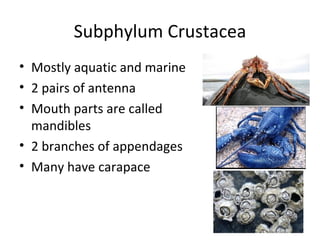
Subphylum Crustacea Mostly aquatic and marine 2 pairs of antenna Mouth parts are called mandibles 2 branches of appendages Many have carapace
Subphylum Uniramia Almost all are terrestrial 1 pair of antenna Have mandibles Unbranched appendages
Class Chilopoda Centipedes Long, worm-like body Many segments One pair/ segment Poison claw for feeding carnivorous
Class Diplopoda Wormlike bodies with many segments 2 pairs of legs per segment Mostly herbivorous
Class Insecta Insects Body parts- head, thorax, abdomen Three pairs of legs Usually two pairs of wings attach to thorax Metamorphosis: complete/incomplete

Arthropoda

  • 1.
  • 2.
    Core Concept Exoskeleton= chitin Jointed appendage Segmented body brain- dorsal part of the head Ventral nerve cord Open circuatory system, single heart
  • 3.
    Body plan- adaptationfor low water loss Found in all types of habitat
  • 4.
    Four major subphylaTrilobita (fossilized trilobites) Chelicerata (spiders, ticks, mites, scorpions, horseshoe crabs) Crustacea (crabs, craysfish, shrimps, barnacles, pill bugs, water fleas) Uniramia (centipedes, millipedes,, all insects) Class Chilopoda (centipede) Class Diplopoda (millipedes) Insecta
  • 5.
    Keywords Arthropoda TrilobitaChelicerata Crustacea Uniramia Chilopoda Diplopoda Insecta Molting Metamorphosis:complete/incomplete Hemolymph hemocoel ventral nerve cord Head thorax abdomen cephalotorax Carapace chelicerae malpighian tubules Green gland book gills book lungs Spiracles tracheal tubes
  • 6.
    Characteristics 2 outof 3 organisms are arthropods Segments: head, thorax, abdomen Fused segments: cephalotorax Extensive cephalization Open circulatory system: use of hemolymph and hemocoels Exoskeleton: prevents water loss, attachment of muscle
  • 7.
    Exoskeleton- limits growthMolting- allows growth (energy expensive) Bases for subdivision of phylum- number of antenna, presence or absence of jawlike mandibles, type of appendages *Crustaceans and insects may be more closely related
  • 8.
    Digestive system Completegut Every mode of feeding
  • 9.
    Respiratory system Gills-aquatic Book gills- horseshoe crab Book lungs Tracheal tubes w/ spiracles
  • 10.
    Circulatory System Well-developedheart Open circulatory system Hemolymph –blood + interstitial fluid Sinus- space that surrounds organs Hemocoel collective term
  • 11.
    Excretory system Malpighiantubule- remove nitrogenous waste from blood Gills Green glands- found beneath the antenna, remove nitrogenous waste
  • 12.
    Nervous system Brain-made up of pair of ganglia Ventral nerve cord- presence of ganglia per segment Simple and complex sense organs Statocysts- balance Compound eye- ommatidium of fly
  • 13.
    Reproductive system Internalfertilization Some have queens
  • 14.
    Subphylum Trilobita Oldestsubphylum Extinct Three lengthwise lobes from head to tail One pair of unspecialized appendages per body segment Appendage divided into two branches Gill Walking leg
  • 15.
    Subphylum Chelicerata Cheilos-lips; cheir- arm Chelicerae- clawlike feeding appendage Arachnids- chelicerae are called pedipalps 4 pairs of walking legs 2 fused segments- cephalothorax, abdomen Lack antenna
  • 16.
    Subphylum Crustacea Mostlyaquatic and marine 2 pairs of antenna Mouth parts are called mandibles 2 branches of appendages Many have carapace
  • 17.
    Subphylum Uniramia Almostall are terrestrial 1 pair of antenna Have mandibles Unbranched appendages
  • 18.
    Class Chilopoda CentipedesLong, worm-like body Many segments One pair/ segment Poison claw for feeding carnivorous
  • 19.
    Class Diplopoda Wormlikebodies with many segments 2 pairs of legs per segment Mostly herbivorous
  • 20.
    Class Insecta InsectsBody parts- head, thorax, abdomen Three pairs of legs Usually two pairs of wings attach to thorax Metamorphosis: complete/incomplete