CLASSIFICATION

Kingdom: Animalia

    UROCHORDATA
     Phylum: Chordata
          Subphylum: Urochordata (Tunicates)
                  Class: Ascidiacea (Sea Squirts)
       Anatomy of the Sea Squirt
                         Larvacea (Larvaceans)
                         Thaliacea (Thaliaceans)
GENERAL CHARACTERISTICS

- Protochordates
  • Morphological features: notochord, dorsal
    hollow central nervous system, pharynx with
    paired pouches; muscular, post-anal tail
  - Group of marine chordates in which the
    notochord is confined to the locomotor tail of
    the larval stage
GENERAL CHARACTERISTICS

- Also known as Tunicates
- Enclosed in a delicate, nonliving, and
  sometimes beautifully colored transparent tunic
- Filter-feeders.
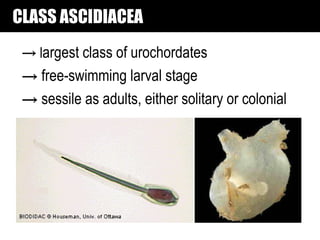
CLASS ASCIDIACEA
 → largest class of urochordates
 → free-swimming larval stage
 → sessile as adults, either solitary or colonial
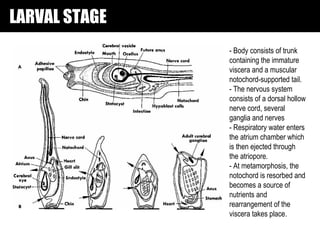
LARVAL STAGE
               - Body consists of trunk
               containing the immature
               viscera and a muscular
               notochord-supported tail.
               - The nervous system
               consists of a dorsal hollow
               nerve cord, several
               ganglia and nerves
               - Respiratory water enters
               the atrium chamber which
               is then ejected through
               the atriopore.
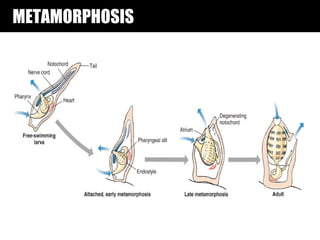
               - At metamorphosis, the
               notochord is resorbed and
               becomes a source of
               nutrients and
               rearrangement of the
               viscera takes place.
METAMORPHOSIS
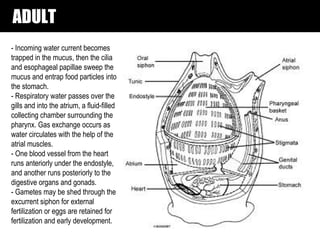
ADULT
- Incoming water current becomes
trapped in the mucus, then the cilia
and esophageal papillae sweep the
mucus and entrap food particles into
the stomach.
- Respiratory water passes over the
gills and into the atrium, a fluid-filled
collecting chamber surrounding the
pharynx. Gas exchange occurs as
water circulates with the help of the
atrial muscles.
- One blood vessel from the heart
runs anteriorly under the endostyle,
and another runs posteriorly to the
digestive organs and gonads.
- Gametes may be shed through the
excurrent siphon for external
fertilization or eggs are retained for
fertilization and early development.
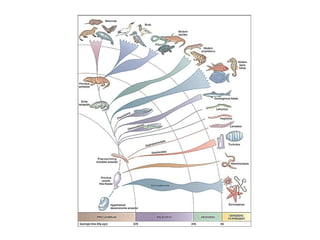
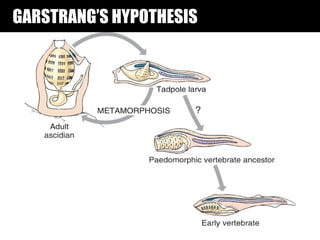
GARSTRANG’S HYPOTHESIS
UROCHORDATA
 Anatomy of the Sea Squirt

Urochordata

  • 1.
    CLASSIFICATION Kingdom: Animalia UROCHORDATA Phylum: Chordata Subphylum: Urochordata (Tunicates) Class: Ascidiacea (Sea Squirts) Anatomy of the Sea Squirt Larvacea (Larvaceans) Thaliacea (Thaliaceans)
  • 3.
    GENERAL CHARACTERISTICS - Protochordates • Morphological features: notochord, dorsal hollow central nervous system, pharynx with paired pouches; muscular, post-anal tail - Group of marine chordates in which the notochord is confined to the locomotor tail of the larval stage
  • 4.
    GENERAL CHARACTERISTICS - Alsoknown as Tunicates - Enclosed in a delicate, nonliving, and sometimes beautifully colored transparent tunic - Filter-feeders.
  • 5.
    CLASS ASCIDIACEA →largest class of urochordates → free-swimming larval stage → sessile as adults, either solitary or colonial
  • 6.
    LARVAL STAGE - Body consists of trunk containing the immature viscera and a muscular notochord-supported tail. - The nervous system consists of a dorsal hollow nerve cord, several ganglia and nerves - Respiratory water enters the atrium chamber which is then ejected through the atriopore. - At metamorphosis, the notochord is resorbed and becomes a source of nutrients and rearrangement of the viscera takes place.
  • 7.
  • 8.
    ADULT - Incoming watercurrent becomes trapped in the mucus, then the cilia and esophageal papillae sweep the mucus and entrap food particles into the stomach. - Respiratory water passes over the gills and into the atrium, a fluid-filled collecting chamber surrounding the pharynx. Gas exchange occurs as water circulates with the help of the atrial muscles. - One blood vessel from the heart runs anteriorly under the endostyle, and another runs posteriorly to the digestive organs and gonads. - Gametes may be shed through the excurrent siphon for external fertilization or eggs are retained for fertilization and early development.
  • 9.
  • 10.
    UROCHORDATA Anatomy ofthe Sea Squirt

Editor's Notes

  • #5 3. incomplete gut - blind (has a mouth and no anus) and sac-like, often with incomplete branchings, mouth for both ingestion and egestion
  • #8 Dugesia (Planarian): common freshwater turbellarian