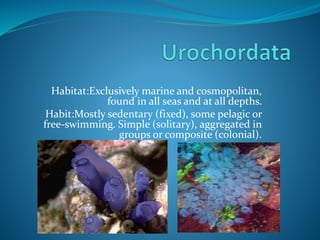
Habitat:Exclusively marine and cosmopolitan,
found in all seas and at all depths.
Habit:Mostly sedentary (fixed), some pelagic or
free-swimming. Simple (solitary), aggregated in
groups or composite (colonial).
 Size (0.25 to 250 mm), shape and colour variable.
 Adult body:Adult body degenerate, sac-like,
unsegmentcd, without paired appendages and usually
without tail
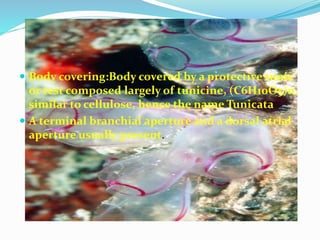
 Body covering:Body covered by a protective tunic
or test composed largely of tunicine, (C6H10O5)n,
similar to cellulose, hence the name Tunicata
 A terminal branchial aperture and a dorsal atrial
aperture usually present.
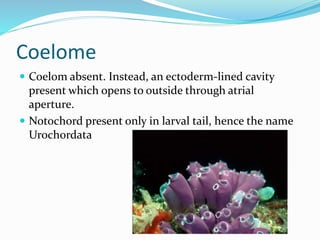
Coelome
 Coelom absent. Instead, an ectoderm-lined cavity
present which opens to outside through atrial
aperture.
 Notochord present only in larval tail, hence the name
Urochordata
 Alimentary canal complete. Pharynx (branchial sac)
large, with endostyle and two to several pairs of gill-
slits. Ciliary feeders.
 Respiration through test and gill-slits
 Blood-vascular system open. Heart simple, tubular and
ventral. Flow of blood periodically reversed. Special
vanadocytes in blood extract vanadium from sea water.
 Excretion by neural gland, pyloric gland and
nephrocytes
 Dorsal tubular nerve cord only in larval stage, reduced
to a single dorsal nerve ganglion in adult.
 Reproduction:
 Mostly hermaphrodite. Fertilization cross and
external.
 Development indirect including a free swimming
tailed larva with basic chordate characters.
Metamorphosis retrogressive
 Asexual reproduction by budding common.
Classification
 Subphylum Urochordata or Tunicata includes about
2,000 fixed and nearly 100 pelagic species exhibiting
high degree of diversity. The classification given below
has been adopted from Storer and Usinger as given
in their book General Zoology of 1965 edition.
 Urochordata is divided into 3 classes.
 Class 1. Ascidiacea:
• Solitary, colonial or compound. Bottom living.
Body form and size variable.
 Test permanent, well developed and thick.
 Atrium opens dorsally by atriopore.
 Pharynx large with many persistent gill-slits.
 Sexes united. Larva free-swimming and highly
developed.
 Adults usually sessile after retrogressive
metamorphosis when larval notochord, nerve cord
and tail are lost and brain reduced to a solid dorsal
ganglion.
 Stolon simple or none.
 Order 1. Enterogona :
 Body sometimes divided into thorax and abdomen
 Neural gland usually ventral to ganglion.
 Gonad 1, lying in or behind intestinal loop.
 Larva with 2 sense organs (ocelli and otolith)
 Ascidia, Ciona, Phallusia
 Order 2, Pleurogona:
 1. Body compact, undivided.
 2. Neural gland dorsal or lateral to ganglion.
 3. Gonads 2 or more embedded in mantle wall.
 4. Larva with otolith. Separate eye absent. Examples :
Herdmania, Botryllus, Molgula, Styela.
Class Thaliacae
 1. Adults free living, pelagic, in warm and temperate
seas. Solitary or colonial. 2. Body shape and size
variable. 3. Tunic permanent, thin and transparent,
with circular muscle bands. 4. Atriopore located
posteriorly. 5. Pharynx with 2 large or many small gill-
slits. 6. Sexes united. Larva formed or absent. 7. Adult
without notochord, nerve cord and tail. 8. Asexual
budding from a complex stolon. 9. Life history with an
alternation of generations.
 Order 1. Pyrosomida 1. Colony compact, tubular,
closed at one end and phosphorescent throughout the
life, due to the invasion of its egg by a symbiotic
luminescent bacteria. 2. Zooids embedded tn a
common test. 3. Muscle bands confined to body ends.
4. Gill-slits tall, numerous, upto 50. 5. No free-
swimming larval stage. 6. Reproduces by budding.
Examples : Single genus, Pyrosoma.
 Order 2. Doliolida (= Cyclomyaria)
 1. Body characteristically barrel-shaped. 2. Muscle
bands form 8 complete rings. 3. Gill-slits small, few to
manv. 4. A tailed larva with notochord present.
Examples . Doliolum, Doliopsis.
 Order 3. Saipida (= Desmomyaria)
 1. Body cylindrical or prism-shaped. 2. Muscle bands
incomplete ventrally.
 3, Pharynx communicates freely with atrium through a
large gill-slit. 4. Tailed larva absent. Examples : Salpa,
Scyclosalpa
Larvacea (= Appendicularia)
 1. Small (5 mm long), solitary, free-swimming, pelagic,
neotenic, larva-like forms with persistent nil,
notochord, nerve cord and brain. 2. Test forming a
temporary house, renewed periodically. 3. Atrium and
atrial aperture absent. 4. Gill-slits 2, opening directly
to outside. 5. Sexes united. No metamorphosis.
 Order 1. Endostylophora
 1. House bilaterally symmetrical, with separate
inhalent and exhalent apertures. 2. Pharynx with
endostyle. Examples : Oikopleura, Appendicularia.
 Order 2. Polystylophora
 1. House biradially symmetrical, with single aperture.
2. Pharynx without endostyle. Example : Kowalevskia,

Urochordata.pptx

  • 1.
    Habitat:Exclusively marine andcosmopolitan, found in all seas and at all depths. Habit:Mostly sedentary (fixed), some pelagic or free-swimming. Simple (solitary), aggregated in groups or composite (colonial).
  • 2.
     Size (0.25to 250 mm), shape and colour variable.  Adult body:Adult body degenerate, sac-like, unsegmentcd, without paired appendages and usually without tail
  • 3.
     Body covering:Bodycovered by a protective tunic or test composed largely of tunicine, (C6H10O5)n, similar to cellulose, hence the name Tunicata  A terminal branchial aperture and a dorsal atrial aperture usually present.
  • 4.
    Coelome  Coelom absent.Instead, an ectoderm-lined cavity present which opens to outside through atrial aperture.  Notochord present only in larval tail, hence the name Urochordata
  • 5.
     Alimentary canalcomplete. Pharynx (branchial sac) large, with endostyle and two to several pairs of gill- slits. Ciliary feeders.
  • 6.
     Respiration throughtest and gill-slits  Blood-vascular system open. Heart simple, tubular and ventral. Flow of blood periodically reversed. Special vanadocytes in blood extract vanadium from sea water.  Excretion by neural gland, pyloric gland and nephrocytes
  • 7.
     Dorsal tubularnerve cord only in larval stage, reduced to a single dorsal nerve ganglion in adult.
  • 8.
     Reproduction:  Mostlyhermaphrodite. Fertilization cross and external.  Development indirect including a free swimming tailed larva with basic chordate characters. Metamorphosis retrogressive  Asexual reproduction by budding common.
  • 9.
    Classification  Subphylum Urochordataor Tunicata includes about 2,000 fixed and nearly 100 pelagic species exhibiting high degree of diversity. The classification given below has been adopted from Storer and Usinger as given in their book General Zoology of 1965 edition.  Urochordata is divided into 3 classes.
  • 10.
     Class 1.Ascidiacea: • Solitary, colonial or compound. Bottom living. Body form and size variable.  Test permanent, well developed and thick.  Atrium opens dorsally by atriopore.  Pharynx large with many persistent gill-slits.  Sexes united. Larva free-swimming and highly developed.  Adults usually sessile after retrogressive metamorphosis when larval notochord, nerve cord and tail are lost and brain reduced to a solid dorsal ganglion.  Stolon simple or none.
  • 11.
     Order 1.Enterogona :  Body sometimes divided into thorax and abdomen  Neural gland usually ventral to ganglion.  Gonad 1, lying in or behind intestinal loop.  Larva with 2 sense organs (ocelli and otolith)  Ascidia, Ciona, Phallusia
  • 12.
     Order 2,Pleurogona:  1. Body compact, undivided.  2. Neural gland dorsal or lateral to ganglion.  3. Gonads 2 or more embedded in mantle wall.  4. Larva with otolith. Separate eye absent. Examples : Herdmania, Botryllus, Molgula, Styela.
  • 13.
    Class Thaliacae  1.Adults free living, pelagic, in warm and temperate seas. Solitary or colonial. 2. Body shape and size variable. 3. Tunic permanent, thin and transparent, with circular muscle bands. 4. Atriopore located posteriorly. 5. Pharynx with 2 large or many small gill- slits. 6. Sexes united. Larva formed or absent. 7. Adult without notochord, nerve cord and tail. 8. Asexual budding from a complex stolon. 9. Life history with an alternation of generations.
  • 14.
     Order 1.Pyrosomida 1. Colony compact, tubular, closed at one end and phosphorescent throughout the life, due to the invasion of its egg by a symbiotic luminescent bacteria. 2. Zooids embedded tn a common test. 3. Muscle bands confined to body ends. 4. Gill-slits tall, numerous, upto 50. 5. No free- swimming larval stage. 6. Reproduces by budding. Examples : Single genus, Pyrosoma.
  • 15.
     Order 2.Doliolida (= Cyclomyaria)  1. Body characteristically barrel-shaped. 2. Muscle bands form 8 complete rings. 3. Gill-slits small, few to manv. 4. A tailed larva with notochord present. Examples . Doliolum, Doliopsis.
  • 16.
     Order 3.Saipida (= Desmomyaria)  1. Body cylindrical or prism-shaped. 2. Muscle bands incomplete ventrally.  3, Pharynx communicates freely with atrium through a large gill-slit. 4. Tailed larva absent. Examples : Salpa, Scyclosalpa
  • 17.
    Larvacea (= Appendicularia) 1. Small (5 mm long), solitary, free-swimming, pelagic, neotenic, larva-like forms with persistent nil, notochord, nerve cord and brain. 2. Test forming a temporary house, renewed periodically. 3. Atrium and atrial aperture absent. 4. Gill-slits 2, opening directly to outside. 5. Sexes united. No metamorphosis.
  • 18.
     Order 1.Endostylophora  1. House bilaterally symmetrical, with separate inhalent and exhalent apertures. 2. Pharynx with endostyle. Examples : Oikopleura, Appendicularia.
  • 19.
     Order 2.Polystylophora  1. House biradially symmetrical, with single aperture. 2. Pharynx without endostyle. Example : Kowalevskia,