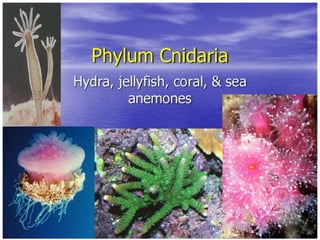
Phylum Cnidaria
Includes
• Jelly fish
• Anemones
• Corals
• Hydroids
• 10,000 species
• Diploblastic tissues level organization.
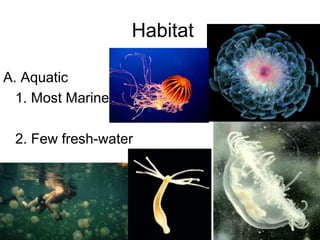
Habitat
A. Aquatic
1. Most Marine
2. Few fresh-water
• Internal sac for digestion called gastrovascular
cavity
• One opening which serve as mouth/anus.
• Cells of epidermis and gastrodermis
differentiated into different cell types for:
• Movement
• Protection
• Food gathering
• Digestion
Characteristic feature of cnidarians is Cnidocytes
Contain Cnidea (commonly known as
Nematocyst)
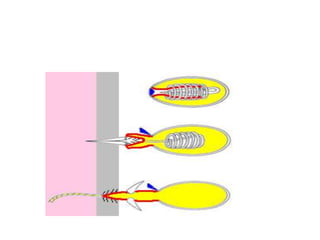
Nematocyst is a capsule enclosing coiled thread
with barbs and spines.
Operculum caps the capsule.
Modified cilium called Cnidocil
• Cnidocil receive stimulus from prey/enemy.
• Nematocyst discharge initiated by opening of
operculum.
• Thread comes out in twisting motion with
enormous speed and penetrate the prey body.
• Spines/barbs help to anchor into the prey.
Cnidarian have two body form in
their life cycle
Polyp:
1. Polyp:
• Sessile stage
• Attach at aboral end
• Asexual stage
• Cylindrical body
• Mouth pointed upward
Medusa:
2. Medusa:
• Free-swimming stage
• Mouth pointed downward
• Sexual stage
• Body is like inverted
bowl
• Usually dioecious
Reproduction
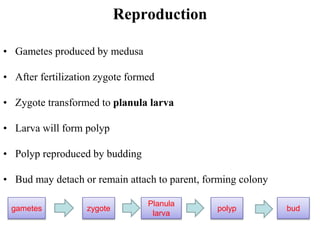
• Gametes produced by medusa
• After fertilization zygote formed
• Zygote transformed to planula larva
• Larva will form polyp
• Polyp reproduced by budding
• Bud may detach or remain attach to parent, forming colony
gametes zygote
Planula
larva
polyp bud
Maintenance of Function
• Gastrovascular cavity carry out theses
functions:
Digestion
Exchange of gases
Removal of waste material
Discharge of gametes
• Feeds on crustaceans
• On contact to prey, nematocyst discharged and
paralyze the prey
• Tentacles draw the food into mouth and then to
gastrovascular cavity
• Gastrodermal enzymes help in digestion
• Indigested material ejected through the
opening
• Gas exchange and excretion takes place by
diffusion process
• Cnidarians have hydrostatic skeleton
• Hydrostatic skeleton is water or fluid filled
cavity, against which the contractile elements
of the body wall acts
• It give support to cnidarians body
• Gastrovascular cavity act as a hydrostatic
skeleton
• Epitheliomuscular cells are contractile cells,
help in movement of polyp and medusa
• Cnidarians have nerve cells.
• Sensory structure distributed throughout the body.
• It has receptors for touch.
• Epidermis and gastrodermis both possess nerve cells.
• These nerve cells interconnected to form network
called as Nerve Net.
• Some species have Nerve Ring.
Classification
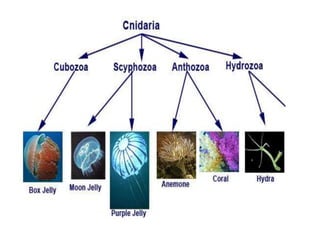
Phylum Cnidaria is divided into four major
classes.
1. Class Hydrozoa.
2. Class Scyphozoa.
3. Class Cubozoa.
4. Class Anthozoa.
Class Hydrozoa
• Mostly marine, some fresh-water.
• Some hydroid lost medusa stage.
• Gametes released outside the body.
• Mesoglea is acellular.
• Colonial formation.
• Entire colony has continuous gastrovascular
cavity.
• Feeding polyp called Gastrozoids.
• Reproductive polyps called Gonozoids.
Hydra
• Typical cnidarian body.
• Cnidocytes present in epidermis.
• One opening surrounded by tentacles.
• Attached aborally by pedal disc.
• Lacks medusa stage.
• Reproduced by budding of polyps.
• Sexual reproduction occurs also in polyps.
• Epidermal cells will form ovaries and testes that
release eggs and sperms.
• After fertilization, zygote develop into adult hydra.
Class Scyphozoa
• Exclusively marine true-jelly fish.
• Medusa is dominant stage.
• Mesoglea contain mesenchyme cells.
• Cnidocytes present in epidermis and
gastrodermis.
• Gametes released in gastovascular cavity.
• Dioecious.
• Common example is Aurelia.
Class Cubozoa
• Marine box-jelly fish.
• Similar to scyphozoan.
• Square-shaped or cuboidal-shaped.
• Four tentacles hang from each corner.
• Active swimmer.
• Polyps and medusa both present in life cycle.
Class Anthozoa
• Marine, colonial or solitary.
• Lack medusa stage.
• Mouth lead to pharynx.
• Gastrovascular cavity divided into mesentaries
containing cnidocytes and gonads.
• Mouth surrounded by tentacles.
• Tentacles function to protect and catch food.
• Common anthozoans sea anemones.
• Monoecious/dioecious.
• Fertilization may be external/gastrovascular
cavity.
• Zygote develop into planula larva
• Larva develop into adult animal.
• Another common anthozoans are coral.
• Similar to anemones.
• Secrete cup-shaped exoskeleton.
• Made of calcium carbonate.
• Sexual reproduction similar to anemones.
• Asexually by budding, live in colony.
• Common examples sea fans, red corals.
Brain Corals
Phylum Ctenophora
• Commonly known as comb-jellies/sea walnuts.
• ~ 90 species.
• Diploblastic.
• Gelatinous layer between epidermis and
gastrodermis.
• Gastrovascular cavity present.
• Nerve net present.
• 8 rows of comb-like paddles
• Paddles contain thousands of cilia for
swimming.
• Adhesive cells colloblast for protection and
feeding.
• Ctenophores have two openings.
• Regenerate their lost parts.
• Monoecious.
• Fertilization external.
• Larva develops into adult.
Classification
1. Class Tentaculata:
• Have two tentacles.
• Large mouth parts.
2. Class Nuda:
• Lacks tentacles.
• Swim with plankton.

Phylum Cnidaria presentation

  • 1.
  • 2.
    Includes • Jelly fish •Anemones • Corals • Hydroids • 10,000 species • Diploblastic tissues level organization.
  • 3.
    Habitat A. Aquatic 1. MostMarine 2. Few fresh-water
  • 4.
    • Internal sacfor digestion called gastrovascular cavity • One opening which serve as mouth/anus. • Cells of epidermis and gastrodermis differentiated into different cell types for: • Movement • Protection • Food gathering • Digestion
  • 6.
    Characteristic feature ofcnidarians is Cnidocytes Contain Cnidea (commonly known as Nematocyst) Nematocyst is a capsule enclosing coiled thread with barbs and spines. Operculum caps the capsule. Modified cilium called Cnidocil
  • 7.
    • Cnidocil receivestimulus from prey/enemy. • Nematocyst discharge initiated by opening of operculum. • Thread comes out in twisting motion with enormous speed and penetrate the prey body. • Spines/barbs help to anchor into the prey.
  • 10.
    Cnidarian have twobody form in their life cycle Polyp: 1. Polyp: • Sessile stage • Attach at aboral end • Asexual stage • Cylindrical body • Mouth pointed upward Medusa: 2. Medusa: • Free-swimming stage • Mouth pointed downward • Sexual stage • Body is like inverted bowl • Usually dioecious
  • 14.
    Reproduction • Gametes producedby medusa • After fertilization zygote formed • Zygote transformed to planula larva • Larva will form polyp • Polyp reproduced by budding • Bud may detach or remain attach to parent, forming colony gametes zygote Planula larva polyp bud
  • 18.
    Maintenance of Function •Gastrovascular cavity carry out theses functions: Digestion Exchange of gases Removal of waste material Discharge of gametes
  • 19.
    • Feeds oncrustaceans • On contact to prey, nematocyst discharged and paralyze the prey • Tentacles draw the food into mouth and then to gastrovascular cavity • Gastrodermal enzymes help in digestion • Indigested material ejected through the opening • Gas exchange and excretion takes place by diffusion process
  • 20.
    • Cnidarians havehydrostatic skeleton • Hydrostatic skeleton is water or fluid filled cavity, against which the contractile elements of the body wall acts • It give support to cnidarians body • Gastrovascular cavity act as a hydrostatic skeleton • Epitheliomuscular cells are contractile cells, help in movement of polyp and medusa
  • 21.
    • Cnidarians havenerve cells. • Sensory structure distributed throughout the body. • It has receptors for touch. • Epidermis and gastrodermis both possess nerve cells. • These nerve cells interconnected to form network called as Nerve Net. • Some species have Nerve Ring.
  • 22.
    Classification Phylum Cnidaria isdivided into four major classes. 1. Class Hydrozoa. 2. Class Scyphozoa. 3. Class Cubozoa. 4. Class Anthozoa.
  • 25.
    Class Hydrozoa • Mostlymarine, some fresh-water. • Some hydroid lost medusa stage. • Gametes released outside the body. • Mesoglea is acellular. • Colonial formation. • Entire colony has continuous gastrovascular cavity. • Feeding polyp called Gastrozoids. • Reproductive polyps called Gonozoids.
  • 26.
    Hydra • Typical cnidarianbody. • Cnidocytes present in epidermis. • One opening surrounded by tentacles. • Attached aborally by pedal disc. • Lacks medusa stage. • Reproduced by budding of polyps. • Sexual reproduction occurs also in polyps. • Epidermal cells will form ovaries and testes that release eggs and sperms. • After fertilization, zygote develop into adult hydra.
  • 28.
    Class Scyphozoa • Exclusivelymarine true-jelly fish. • Medusa is dominant stage. • Mesoglea contain mesenchyme cells. • Cnidocytes present in epidermis and gastrodermis. • Gametes released in gastovascular cavity. • Dioecious. • Common example is Aurelia.
  • 30.
    Class Cubozoa • Marinebox-jelly fish. • Similar to scyphozoan. • Square-shaped or cuboidal-shaped. • Four tentacles hang from each corner. • Active swimmer. • Polyps and medusa both present in life cycle.
  • 32.
    Class Anthozoa • Marine,colonial or solitary. • Lack medusa stage. • Mouth lead to pharynx. • Gastrovascular cavity divided into mesentaries containing cnidocytes and gonads. • Mouth surrounded by tentacles. • Tentacles function to protect and catch food.
  • 33.
    • Common anthozoanssea anemones. • Monoecious/dioecious. • Fertilization may be external/gastrovascular cavity. • Zygote develop into planula larva • Larva develop into adult animal.
  • 35.
    • Another commonanthozoans are coral. • Similar to anemones. • Secrete cup-shaped exoskeleton. • Made of calcium carbonate. • Sexual reproduction similar to anemones. • Asexually by budding, live in colony. • Common examples sea fans, red corals.
  • 37.
  • 38.
    Phylum Ctenophora • Commonlyknown as comb-jellies/sea walnuts. • ~ 90 species. • Diploblastic. • Gelatinous layer between epidermis and gastrodermis. • Gastrovascular cavity present. • Nerve net present.
  • 39.
    • 8 rowsof comb-like paddles • Paddles contain thousands of cilia for swimming. • Adhesive cells colloblast for protection and feeding. • Ctenophores have two openings. • Regenerate their lost parts. • Monoecious. • Fertilization external. • Larva develops into adult.
  • 41.
    Classification 1. Class Tentaculata: •Have two tentacles. • Large mouth parts. 2. Class Nuda: • Lacks tentacles. • Swim with plankton.