1 
“To a good 
approximation, 
all species are 
insects.” 
-Robert May
3
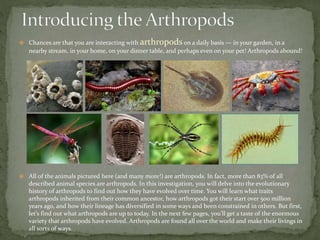
 Chances are that you are interacting with arthropods on a daily basis — in your garden, in a 
nearby stream, in your home, on your dinner table, and perhaps even on your pet! Arthropods abound! 
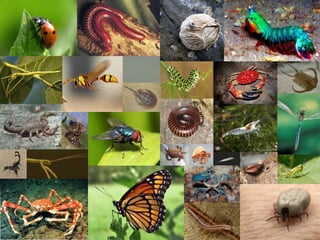
 All of the animals pictured here (and many more!) are arthropods. In fact, more than 83% of all 
described animal species are arthropods. In this investigation, you will delve into the evolutionary 
history of arthropods to find out how they have evolved over time. You will learn what traits 
arthropods inherited from their common ancestor, how arthropods got their start over 500 million 
years ago, and how their lineage has diversified in some ways and been constrained in others. But first, 
let’s find out what arthropods are up to today. In the next few pages, you’ll get a taste of the enormous 
variety that arthropods have evolved. Arthropods are found all over the world and make their livings in 
all sorts of ways.
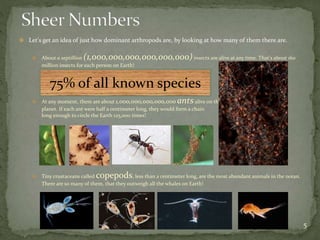
 Let's get an idea of just how dominant arthropods are, by looking at how many of them there are. 
 About a septillion (1,000,000,000,000,000,000) insects are alive at any time. That's about 160 
million insects for each person on Earth! 
 At any moment, there are about 1,000,000,000,000,000 ants alive on the 
planet. If each ant were half a centimeter long, they would form a chain 
long enough to circle the Earth 125,000 times! 
 Tiny crustaceans called copepods, less than a centimeter long, are the most abundant animals in the ocean. 
There are so many of them, that they outweigh all the whales on Earth! 
5 
75% of all known species
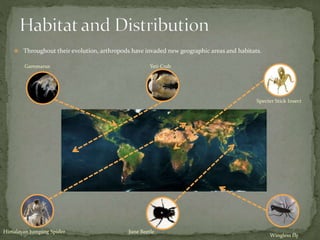
 Throughout their evolution, arthropods have invaded new geographic areas and habitats. 
Wingless fly 
Gammarus 
Himalayan Jumping Spider 
Yeti Crab 
June Beetle 
Specter Stick Insect
7 
 Almost any way you look at them, arthropods are successful: 
 They have been around for more than 500 million years and are still evolving. 
 They live on Earth in overwhelming numbers. 
About 1,000,000,000,000,000,000 
 They have come in all shapes and sizes. 
 They have evolved to fill a variety of ecological niches — from tiny internal parasite to giant bird-eating 
predator.
8 
 We're going to take a closer look at this amazing group of animals called arthropods. You are 
familiar with a wide variety of arthropods from seeing them in your daily life. Have you thought about 
what they all have in common? 
 Arthropods are a lot more than just 
delicious feasts and disgusting pests. 
Before we go too far, we need to 
figure out exactly what an arthropod 
is. 
 In this section, we will explore these 
key questions: 
 What is an arthropod? 
 Why do all arthropods share 
certain key characteristics? 
 OK. Let’s dive right in!
9 
 Bilateral (left/right) symmetry 
 Segmented body 
 Hard Exoskeleton 
 Jointed legs 
 Many pair of limbs
1. Bilateral symmetry 
• One character inherited by all 
arthropods is bilateral 
symmetry. 
• Many animals have a body form 
that is symmetrical, meaning 
that it could be divided into 
matching halves by drawing a 
line down the center. In this 
respect, arthropods are built like 
humans are; the right half of an 
arthropod is a mirror image of 
its left half — this is called 
bilateral symmetry (bi = two, 
latus = side). 
10
11 
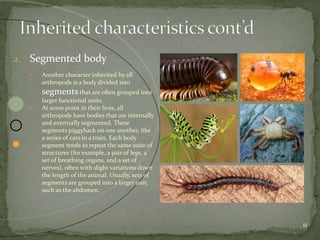
2. Segmented body 
• Another character inherited by all 
arthropods is a body divided into 
segments that are often grouped into 
larger functional units. 
• At some point in their lives, all 
arthropods have bodies that are internally 
and externally segmented. These 
segments piggyback on one another, like 
a series of cars in a train. Each body 
segment tends to repeat the same suite of 
structures (for example, a pair of legs, a 
set of breathing organs, and a set of 
nerves), often with slight variations down 
the length of the animal. Usually, sets of 
segments are grouped into a larger unit, 
such as the abdomen.
12 
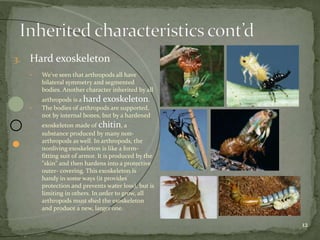
3. Hard exoskeleton 
• We've seen that arthropods all have 
bilateral symmetry and segmented 
bodies. Another character inherited by all 
arthropods is a hard exoskeleton. 
• The bodies of arthropods are supported, 
not by internal bones, but by a hardened 
exoskeleton made of chitin, a 
substance produced by many non-arthropods 
as well. In arthropods, the 
nonliving exoskeleton is like a form-fitting 
suit of armor. It is produced by the 
"skin" and then hardens into a protective 
outer- covering. This exoskeleton is 
handy in some ways (it provides 
protection and prevents water loss), but is 
limiting in others. In order to grow, all 
arthropods must shed the exoskeleton 
and produce a new, larger one.
13 
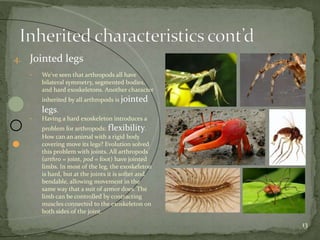
4. Jointed legs 
• We've seen that arthropods all have 
bilateral symmetry, segmented bodies, 
and hard exoskeletons. Another character 
inherited by all arthropods is jointed 
legs. 
• Having a hard exoskeleton introduces a 
problem for arthropods: flexibility. 
How can an animal with a rigid body 
covering move its legs? Evolution solved 
this problem with joints. All arthropods 
(arthro = joint, pod = foot) have jointed 
limbs. In most of the leg, the exoskeleton 
is hard, but at the joints it is softer and 
bendable, allowing movement in the 
same way that a suit of armor does. The 
limb can be controlled by contracting 
muscles connected to the exoskeleton on 
both sides of the joint.
14 
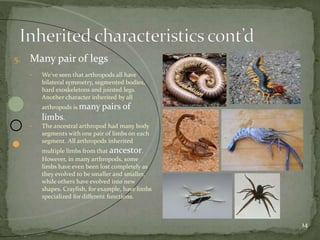
5. Many pair of legs 
• We've seen that arthropods all have 
bilateral symmetry, segmented bodies, 
hard exoskeletons and jointed legs. 
Another character inherited by all 
arthropods is many pairs of 
limbs. 
• The ancestral arthropod had many body 
segments with one pair of limbs on each 
segment. All arthropods inherited 
multiple limbs from that ancestor. 
However, in many arthropods, some 
limbs have even been lost completely as 
they evolved to be smaller and smaller, 
while others have evolved into new 
shapes. Crayfish, for example, have limbs 
specialized for different functions.
Kingdom Animalia 
Phylum Athropoda 
Trilobites Arachnids Myriapods Crustaceans Insects 
15 
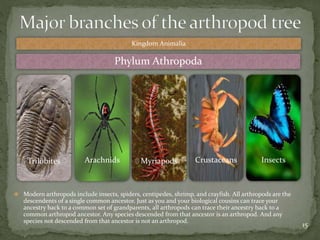
 Modern arthropods include insects, spiders, centipedes, shrimp, and crayfish. All arthropods are the 
descendents of a single common ancestor. Just as you and your biological cousins can trace your 
ancestry back to a common set of grandparents, all arthropods can trace their ancestry back to a 
common arthropod ancestor. Any species descended from that ancestor is an arthropod. And any 
species not descended from that ancestor is not an arthropod.
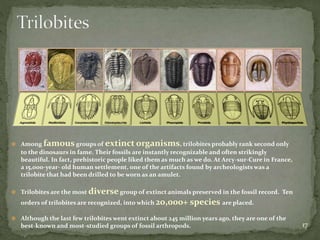
tri- “three” + lobos- “lobe” + morphi- “shape” 
“three-lobe shaped” 
16
17 
 Among famousgroups of extinct organisms, trilobites probably rank second only 
to the dinosaurs in fame. Their fossils are instantly recognizable and often strikingly 
beautiful. In fact, prehistoric people liked them as much as we do. At Arcy-sur-Cure in France, 
a 15,000-year- old human settlement, one of the artifacts found by archeologists was a 
trilobite that had been drilled to be worn as an amulet. 
 Trilobites are the most diverse group of extinct animals preserved in the fossil record. Ten 
orders of trilobites are recognized, into which 20,000+ species are placed. 
 Although the last few trilobites went extinct about 245 million years ago, they are one of the 
best-known and most-studied groups of fossil arthropods.
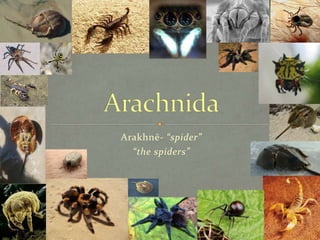
Arakhnē- “spider” 
“the spiders” 
18
19 
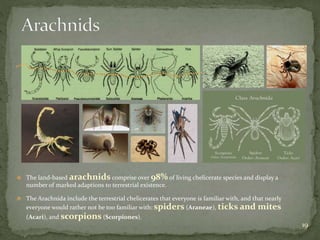
 The land-based arachnids comprise over 98%of living chelicerate species and display a 
number of marked adaptions to terrestrial existence. 
 The Arachnida include the terrestrial chelicerates that everyone is familiar with, and that nearly 
everyone would rather not be too familiar with: spiders (Araneae), ticks and mites 
(Acari), and scorpions (Scorpiones).
20 
crūstaceus- “crust” 
“crusty-shelled”
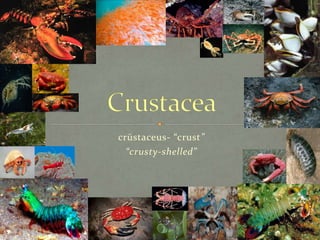
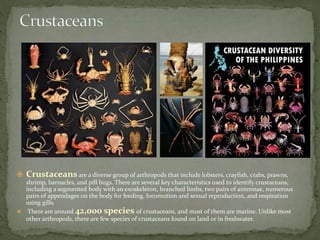
 Crustaceans are a diverse group of arthropods that include lobsters, crayfish, crabs, prawns, 
shrimp, barnacles, and pill bugs. There are several key characteristics used to identify crustaceans, 
including a segmented body with an exoskeleton, branched limbs, two pairs of antennae, numerous 
pairs of appendages on the body for feeding, locomotion and sexual reproduction, and respiration 
using gills. 
 There are around 42,000 species of crustaceans, and most of them are marine. Unlike most 
other arthropods, there are few species of crustaceans found on land or in freshwater.
Mūrias- “ten-thousand” + poda- “foot” 
“ten-thousand footed”
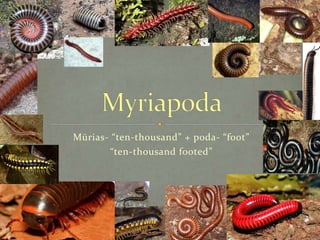
 The myriapods are centipedes and millipedes , and some small relatives. Centipedes and 
millipedes look similar to each other; they both look a little like worms with lots of legs. 
Actually they are arthropods, they have a tough exoskeleton and jointed legs, and they are related to 
insects and crustaceans. Like insects, myriapods have one pair of antennae, but they have many more 
legs than insects do. All myriapods have more than 20 legs, and all the other arthropods 
have fewer legs than that (most have only 6 or 8 legs).
hexa- “six” + poda “foot” 
“six-legged”
6 6 legs 
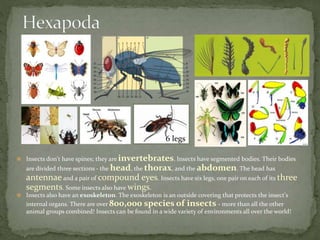
 Insects don't have spines; they are invertebrates. Insects have segmented bodies. Their bodies 
are divided three sections - the head, the thorax, and the abdomen. The head has 
antennae and a pair of compound eyes. Insects have six legs, one pair on each of its three 
segments. Some insects also have wings. 
 Insects also have an exoskeleton. The exoskeleton is an outside covering that protects the insect's 
internal organs. There are over 800,000 species of insects - more than all the other 
animal groups combined! Insects can be found in a wide variety of environments all over the world!
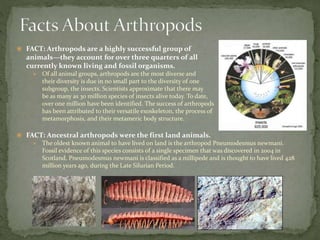
 FACT: Arthropods are a highly successful group of 
animals—they account for over three quarters of all 
currently known living and fossil organisms. 
 Of all animal groups, arthropods are the most diverse and 
their diversity is due in no small part to the diversity of one 
subgroup, the insects. Scientists approximate that there may 
be as many as 30 million species of insects alive today. To date, 
over one million have been identified. The success of arthropods 
has been attributed to their versatile exoskeleton, the process of 
metamorphosis, and their metameric body structure. 
 FACT: Ancestral arthropods were the first land animals. 
 The oldest known animal to have lived on land is the arthropod Pneumodesmus newmani. 
Fossil evidence of this species consists of a single specimen that was discovered in 2004 in 
Scotland. Pneumodesmus newmani is classified as a millipede and is thought to have lived 428 
million years ago, during the Late Silurian Period.
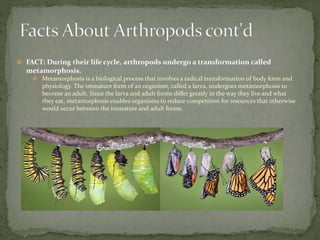
 FACT: During their life cycle, arthropods undergo a transformation called 
metamorphosis. 
 Metamorphosis is a biological process that involves a radical transformation of body form and 
physiology. The immature form of an organism, called a larva, undergoes metamorphosis to 
become an adult. Since the larva and adult forms differ greatly in the way they live and what 
they eat, metamorphosis enables organisms to reduce competition for resources that otherwise 
would occur between the immature and adult forms.
Phylum Arthropoda

Phylum Arthropoda

  • 1.
    1 “To agood approximation, all species are insects.” -Robert May
  • 3.
  • 4.
     Chances arethat you are interacting with arthropods on a daily basis — in your garden, in a nearby stream, in your home, on your dinner table, and perhaps even on your pet! Arthropods abound!  All of the animals pictured here (and many more!) are arthropods. In fact, more than 83% of all described animal species are arthropods. In this investigation, you will delve into the evolutionary history of arthropods to find out how they have evolved over time. You will learn what traits arthropods inherited from their common ancestor, how arthropods got their start over 500 million years ago, and how their lineage has diversified in some ways and been constrained in others. But first, let’s find out what arthropods are up to today. In the next few pages, you’ll get a taste of the enormous variety that arthropods have evolved. Arthropods are found all over the world and make their livings in all sorts of ways.
  • 5.
     Let's getan idea of just how dominant arthropods are, by looking at how many of them there are.  About a septillion (1,000,000,000,000,000,000) insects are alive at any time. That's about 160 million insects for each person on Earth!  At any moment, there are about 1,000,000,000,000,000 ants alive on the planet. If each ant were half a centimeter long, they would form a chain long enough to circle the Earth 125,000 times!  Tiny crustaceans called copepods, less than a centimeter long, are the most abundant animals in the ocean. There are so many of them, that they outweigh all the whales on Earth! 5 75% of all known species
  • 6.
     Throughout theirevolution, arthropods have invaded new geographic areas and habitats. Wingless fly Gammarus Himalayan Jumping Spider Yeti Crab June Beetle Specter Stick Insect
  • 7.
    7  Almostany way you look at them, arthropods are successful:  They have been around for more than 500 million years and are still evolving.  They live on Earth in overwhelming numbers. About 1,000,000,000,000,000,000  They have come in all shapes and sizes.  They have evolved to fill a variety of ecological niches — from tiny internal parasite to giant bird-eating predator.
  • 8.
    8  We'regoing to take a closer look at this amazing group of animals called arthropods. You are familiar with a wide variety of arthropods from seeing them in your daily life. Have you thought about what they all have in common?  Arthropods are a lot more than just delicious feasts and disgusting pests. Before we go too far, we need to figure out exactly what an arthropod is.  In this section, we will explore these key questions:  What is an arthropod?  Why do all arthropods share certain key characteristics?  OK. Let’s dive right in!
  • 9.
    9  Bilateral(left/right) symmetry  Segmented body  Hard Exoskeleton  Jointed legs  Many pair of limbs
  • 10.
    1. Bilateral symmetry • One character inherited by all arthropods is bilateral symmetry. • Many animals have a body form that is symmetrical, meaning that it could be divided into matching halves by drawing a line down the center. In this respect, arthropods are built like humans are; the right half of an arthropod is a mirror image of its left half — this is called bilateral symmetry (bi = two, latus = side). 10
  • 11.
    11 2. Segmentedbody • Another character inherited by all arthropods is a body divided into segments that are often grouped into larger functional units. • At some point in their lives, all arthropods have bodies that are internally and externally segmented. These segments piggyback on one another, like a series of cars in a train. Each body segment tends to repeat the same suite of structures (for example, a pair of legs, a set of breathing organs, and a set of nerves), often with slight variations down the length of the animal. Usually, sets of segments are grouped into a larger unit, such as the abdomen.
  • 12.
    12 3. Hardexoskeleton • We've seen that arthropods all have bilateral symmetry and segmented bodies. Another character inherited by all arthropods is a hard exoskeleton. • The bodies of arthropods are supported, not by internal bones, but by a hardened exoskeleton made of chitin, a substance produced by many non-arthropods as well. In arthropods, the nonliving exoskeleton is like a form-fitting suit of armor. It is produced by the "skin" and then hardens into a protective outer- covering. This exoskeleton is handy in some ways (it provides protection and prevents water loss), but is limiting in others. In order to grow, all arthropods must shed the exoskeleton and produce a new, larger one.
  • 13.
    13 4. Jointedlegs • We've seen that arthropods all have bilateral symmetry, segmented bodies, and hard exoskeletons. Another character inherited by all arthropods is jointed legs. • Having a hard exoskeleton introduces a problem for arthropods: flexibility. How can an animal with a rigid body covering move its legs? Evolution solved this problem with joints. All arthropods (arthro = joint, pod = foot) have jointed limbs. In most of the leg, the exoskeleton is hard, but at the joints it is softer and bendable, allowing movement in the same way that a suit of armor does. The limb can be controlled by contracting muscles connected to the exoskeleton on both sides of the joint.
  • 14.
    14 5. Manypair of legs • We've seen that arthropods all have bilateral symmetry, segmented bodies, hard exoskeletons and jointed legs. Another character inherited by all arthropods is many pairs of limbs. • The ancestral arthropod had many body segments with one pair of limbs on each segment. All arthropods inherited multiple limbs from that ancestor. However, in many arthropods, some limbs have even been lost completely as they evolved to be smaller and smaller, while others have evolved into new shapes. Crayfish, for example, have limbs specialized for different functions.
  • 15.
    Kingdom Animalia PhylumAthropoda Trilobites Arachnids Myriapods Crustaceans Insects 15  Modern arthropods include insects, spiders, centipedes, shrimp, and crayfish. All arthropods are the descendents of a single common ancestor. Just as you and your biological cousins can trace your ancestry back to a common set of grandparents, all arthropods can trace their ancestry back to a common arthropod ancestor. Any species descended from that ancestor is an arthropod. And any species not descended from that ancestor is not an arthropod.
  • 16.
    tri- “three” +lobos- “lobe” + morphi- “shape” “three-lobe shaped” 16
  • 17.
    17  Amongfamousgroups of extinct organisms, trilobites probably rank second only to the dinosaurs in fame. Their fossils are instantly recognizable and often strikingly beautiful. In fact, prehistoric people liked them as much as we do. At Arcy-sur-Cure in France, a 15,000-year- old human settlement, one of the artifacts found by archeologists was a trilobite that had been drilled to be worn as an amulet.  Trilobites are the most diverse group of extinct animals preserved in the fossil record. Ten orders of trilobites are recognized, into which 20,000+ species are placed.  Although the last few trilobites went extinct about 245 million years ago, they are one of the best-known and most-studied groups of fossil arthropods.
  • 18.
  • 19.
    19  Theland-based arachnids comprise over 98%of living chelicerate species and display a number of marked adaptions to terrestrial existence.  The Arachnida include the terrestrial chelicerates that everyone is familiar with, and that nearly everyone would rather not be too familiar with: spiders (Araneae), ticks and mites (Acari), and scorpions (Scorpiones).
  • 20.
    20 crūstaceus- “crust” “crusty-shelled”
  • 21.
     Crustaceans area diverse group of arthropods that include lobsters, crayfish, crabs, prawns, shrimp, barnacles, and pill bugs. There are several key characteristics used to identify crustaceans, including a segmented body with an exoskeleton, branched limbs, two pairs of antennae, numerous pairs of appendages on the body for feeding, locomotion and sexual reproduction, and respiration using gills.  There are around 42,000 species of crustaceans, and most of them are marine. Unlike most other arthropods, there are few species of crustaceans found on land or in freshwater.
  • 22.
    Mūrias- “ten-thousand” +poda- “foot” “ten-thousand footed”
  • 23.
     The myriapodsare centipedes and millipedes , and some small relatives. Centipedes and millipedes look similar to each other; they both look a little like worms with lots of legs. Actually they are arthropods, they have a tough exoskeleton and jointed legs, and they are related to insects and crustaceans. Like insects, myriapods have one pair of antennae, but they have many more legs than insects do. All myriapods have more than 20 legs, and all the other arthropods have fewer legs than that (most have only 6 or 8 legs).
  • 24.
    hexa- “six” +poda “foot” “six-legged”
  • 25.
    6 6 legs  Insects don't have spines; they are invertebrates. Insects have segmented bodies. Their bodies are divided three sections - the head, the thorax, and the abdomen. The head has antennae and a pair of compound eyes. Insects have six legs, one pair on each of its three segments. Some insects also have wings.  Insects also have an exoskeleton. The exoskeleton is an outside covering that protects the insect's internal organs. There are over 800,000 species of insects - more than all the other animal groups combined! Insects can be found in a wide variety of environments all over the world!
  • 26.
     FACT: Arthropodsare a highly successful group of animals—they account for over three quarters of all currently known living and fossil organisms.  Of all animal groups, arthropods are the most diverse and their diversity is due in no small part to the diversity of one subgroup, the insects. Scientists approximate that there may be as many as 30 million species of insects alive today. To date, over one million have been identified. The success of arthropods has been attributed to their versatile exoskeleton, the process of metamorphosis, and their metameric body structure.  FACT: Ancestral arthropods were the first land animals.  The oldest known animal to have lived on land is the arthropod Pneumodesmus newmani. Fossil evidence of this species consists of a single specimen that was discovered in 2004 in Scotland. Pneumodesmus newmani is classified as a millipede and is thought to have lived 428 million years ago, during the Late Silurian Period.
  • 27.
     FACT: Duringtheir life cycle, arthropods undergo a transformation called metamorphosis.  Metamorphosis is a biological process that involves a radical transformation of body form and physiology. The immature form of an organism, called a larva, undergoes metamorphosis to become an adult. Since the larva and adult forms differ greatly in the way they live and what they eat, metamorphosis enables organisms to reduce competition for resources that otherwise would occur between the immature and adult forms.